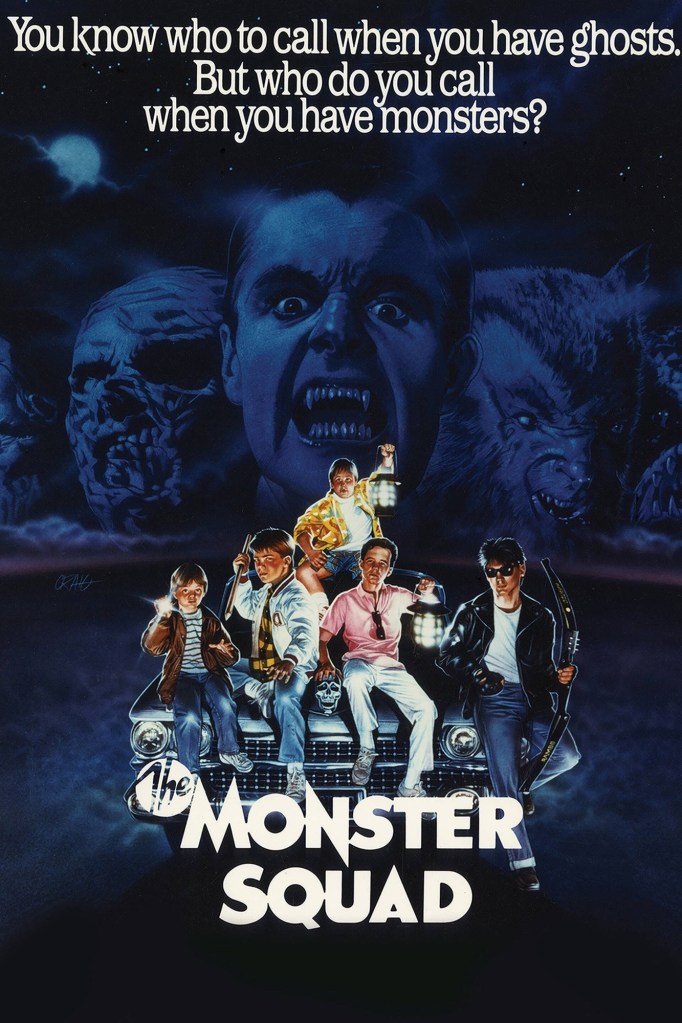
Review: The Monster Squad (dir. by Fred Dekker)


“Creature stole my Twinkie.” – Eugene

Released in 1987, The Monster Squad has lived one of those strange afterlives that cult films sometimes enjoy—ignored or even ridiculed upon release, only to become a beloved artifact for the generation that found it later on VHS. Directed by Fred Dekker and co-written with Shane Black, the movie occupies an awkward but endearing space between horror, comedy, and kids’ adventure. It never fully settles into one tone, and that’s part of both its charm and its problem. Watching it today, the film feels like The Goonies took a detour through a drive-in double feature of Dracula and The Wolf Man. It’s clunky, funny, occasionally mean-spirited, and loaded with enthusiasm—qualities that make it a thoroughly guilty pleasure for fans of ’80s genre mashups.

The story wastes no time getting into its madcap premise. A group of suburban preteens calling themselves “The Monster Squad” find that the classic Universal-style monsters are real, and worse, they’ve come to town. Count Dracula has a plan to plunge the world into darkness using an ancient amulet, and to succeed he enlists a roster of familiar faces: Frankenstein’s Monster, the Mummy, the Gill-Man, and the Wolf Man. This roster is fan-service before fan-service was a marketing term—a kid’s monster toybox brought to life. The squad, of course, must stop them, armed with comic-book knowledge, wooden stakes, and a blend of reckless courage and youthful sarcasm.

Dekker’s direction and tone play like a movie made for kids but smuggled in some heavy teenage energy. There’s violence, crude jokes, and occasional language that Hollywood would never let slip into a PG-friendly franchise today. Yet that rough edge is part of why The Monster Squad aged into cult status. It’s unapologetically of its time, operating on the belief that kids can handle scares as long as they’re fun and that suburban fantasy can, for a while at least, coexist with real danger. The movie’s depiction of childhood feels filtered through a stack of comic books and Creepshow issues—hyper absurd but still emotionally grounded in a way only ’80s adventure films seemed to pull off.

The kids themselves are a mixed bunch of believable archetypes. There’s Sean (André Gower), the de facto leader with a bedroom plastered in monster movie posters; Patrick (Robby Kiger), his wisecracking sidekick; Rudy (Ryan Lambert), the too-cool-for-school older kid who smokes, rides a bike, and somehow becomes the squad’s weapons specialist; and Eugene (Michael Faustino), the youngest, who still sleeps with his dog and writes letters to the Army for backup. They’re joined by Horace, nicknamed “Fat Kid,” played with surprising vulnerability by Brent Chalem. Each character is drawn broadly but memorably, and even when the dialogue veers into dated humor, there’s an underlying sincerity. You can tell Dekker and Black really liked these kids. They might use slingshots and one-liners, but what unites them is their intense sense of loyalty to one another—the kind of friendship that survives both bullies and broomstick-wielding vampires.

If there’s an emotional anchor, oddly enough, it’s the relationship between the squad and Frankenstein’s Monster, played by Tom Noonan in an unexpectedly gentle performance. When the creature befriends the kids, particularly little Phoebe (Ashley Bank), the film shifts momentarily from wisecracks to something close to tenderness. Noonan gives the character a shy uncertainty, a weary loneliness that offsets the visual absurdity of the rubbery monsters around him. There’s even a tinge of tragedy in his final act, which echoes Frankenstein’s literary roots—a moment of real feeling buried inside an otherwise loud and gleefully messy creature romp.

The monsters themselves, created by legendary effects artist Stan Winston, are among the film’s biggest draws. Each design feels like a loving upgrade to the old Universal look—recognizable but more feral, angular, and rooted in late-’80s aesthetics. The Wolf Man, for example, looks simultaneously comic and menacing, while the Gill-Man costume still impresses for its texture and movement decades later. The decision not to rely on stop motion or heavy opticals gives the monsters a tactile presence that CGI could never capture. There’s something about watching full-bodied suits and prosthetics move in real space that makes the threats feel tangible even when the stakes are goofy. These creatures are fun to look at, even when the script doesn’t give them much to do beyond roar and stalk across smoke-filled sets.

Shane Black’s fingerprints are all over the dialogue—the sardonic banter, the genre in-jokes, the affection for both pulp tropes and subverting them. But perhaps because the film was marketed partly as family adventure and partly as horror spoof, it often can’t decide whether to play sincere or ironic. Some scenes lean heavily on nostalgic affection for monster movies, while others feel almost mean in their mockery of small-town innocence. The tone whiplash means The Monster Squad doesn’t build much consistent momentum; one minute it’s heartfelt, the next it’s a barrage of sarcastic one-liners. Still, its rough tonal juggling has a ragtag energy that keeps it lively, and the sheer commitment to blending genres is endearing.

When it comes to pacing, the movie flies by in under 80 minutes, which turns out to be both blessing and curse. On one hand, there’s no filler—every scene moves briskly to the next piece of monster mayhem. On the other, the movie’s emotional beats and mythology barely have time to breathe. We get glimmers of backstory (like Dracula’s cryptic hunt for the amulet and Van Helsing’s prologue battle) that hint at a larger world that the film never really explores. You sense that Dekker and Black were operating under the fantasy logic of childlike storytelling: don’t explain too much, just move fast enough that no one questions it. It works, more or less, because of the film’s sheer enthusiasm, but it leaves you imagining a richer version of this story that never quite made it onscreen.

Looking back from today’s lens, some parts of The Monster Squad show their age more harshly. Certain lines and stereotypes that went unnoticed in the ’80s now feel jarring, even uncomfortable, and the film’s cavalier tone sometimes undercuts moments that should feel more innocent. Yet despite that, most viewers who revisit it with awareness of its era find themselves disarmed by its sense of fun. There’s no cynicism driving it—it’s pure genre love, messy and sincere, like a handmade Halloween costume that’s somehow cooler precisely because it’s imperfect. The film represents a time when kids’ movies were allowed to have teeth, blood, and a few scary moments, trusting that a young audience could handle being spooked without needing everything smoothed over.

For many fans, The Monster Squad works less as a polished film and more as an experience—a flashback to VHS sleepovers, bad pizza, and rewinding favorite scenes. The movie’s newfound appreciation, fueled by screenings and documentaries like Wolfman’s Got Nards, speaks to that nostalgic bond. It’s less about objective greatness and more about the feeling it preserves. Sure, some of the jokes fall flat, and the plot functions mostly as connective tissue between monster gags, but few movies embody the gleeful chaos of late-’80s pop horror as affectionately as this one does.

The Monster Squad earns its title. It’s not a flawless film, nor even a particularly coherent one, but it’s deeply fun, carried by the conviction that monsters—real or imaginary—are made to be fought with courage, humor, and friends who have your back. Watching it now is like flipping through an old comic book you used to love: you can see every crease and faded color, but that doesn’t make it any less special. And in a cinematic era saturated with irony and nostalgia pastiche, The Monster Squad still feels refreshingly earnest about its own weirdness. Maybe that’s its secret power.

Retro Television Review: Miami Vice 2.13 “Definitely Miami”


Welcome to Retro Television Reviews, a feature where we review some of our favorite and least favorite shows of the past!  On Mondays, I will be reviewing Miami Vice, which ran on NBC from 1984 to 1989.  The entire show can be purchased on Prime!

Things get weird this week.

Episode 2.13 “Definitely Miami”

(Dir by Rob Cohen, originally aired on January 10th, 1986)

This week’s episode of Miami Vice is all about heat.

Seriously, it literally starts with a shot of a solar flares erupting off the surface of the sun.  The camera then pulls away, letting us see what the sun looks like a cloudless blue sky.  Finally, we find ourselves in Miami, where the sky is clear and a heat wave is raging.  The camera focuses on the beads of sweat forming on skin.  Every pastel shirt is stained with sweat and everyone is wearing sunglasses.  When a drug dealer drives out to a quarry to meet connection, the heat seems to radiate out of the screen.  When he’s shot and killed by Charlie Basset (Ted Nugent — yes, the musician and gun enthusiast), the dust that rises up looks like smoke rising from a burning planet.

Sonny and Rico are working undercover as Burnett and Cooper, hanging out at a hotel pool and complaining about the heat.  Their target is Sergio Clemente (Roger Pretto) but Sonny is actually more interested in Callie (Arielle Dombasle), a beautiful blonde who he spots laying by the pool.  Callie sees Sonny watching her and brings him a drink.  Sonny introduces himself as Sonny Burnett.

Clemente is willing to turn himself in but only if he can see his sister, Maria (Kamala Lopez), and know that she’s still alive.  Maria testified against her brother at a trial and is currently in the witness protecting program.  Joe Dalva (Albert Hall), an arrogant Department of Justice official, is willing to bring Maria to Clemente, despite the fact that Maria indicates that Clemente used to sexually abuse her.  Castillo thinks that it’s a terrible idea and tries to use a decoy.  In the end, the government orders Castillo to do what Dalva wants.  Castillo stands in a corner and stares down at the ground, which viewers of the show know is something Castillo does whenever he knows just how badly things are going to turn out.  When the meeting finally happens, Tubbs, Castillo, and Davla can only watch as Maria pulls a knife and stabs her brother to death.

Sonny is not there to see Clemente die.  Callie has told him that her husband is physically abusive and she wants Sonny — as Burnett — to meet him in a quarry, make a drug deal with him, and then kill him.  Sonny suspects that he’s being set up and he’s right.  Callie’s husband is Charlie and he only hits her when she tells him to.  Callie seduces drug dealers and then Charlie kills them.  Sonny, however, is smart enough to bring Zito with him to the quarry.  During a shoot out, Charlie ends up dead.  While the police dig up the quarry and find body after body, Sonny goes to the beach so that he can arrest Callie.  When Sonny approaches Callie, she’s making a sand castle that looks exactly like the quarry.  At first, Callie thinks that Sonny is Charlie but then she forces herself to smile when she sees that Charlie is dead.  She assumes Sonny will be her new partner.  Instead, Sonny calls in a police helicopter and Callie is taken into custody by two cops.  Callie flirts with one of the cops while she’s being led to the helicopter.

And the sun continues to burn in the sky….

This was an odd episode, one that put far more emphasis on vivid and sometimes surreal imagery than it did on telling a coherent story.  That’s not a complaint, of course.  This episode had a dream-like intensity to it that I really appreciated.  It was weird but entertaining, with the grinning Ted Nugent popping up like a gleefully evil goblin.  Sonny is targeted because Callie thinks that he’s a drug dealer when he’s actually a cop.  The idea of Sonny being able to maintain his undercover identity despite having personally arrested or killed a countless number of Miami drug dealers has always been one of the stranger elements of Miami Vice.  This episode, though, it makes a strange sense that Sonny could be mistaken for a drug dealer despite always acting like a cop.  That’s definitely Miami.

Retro Television Review: Miami Vice 1.18 “Made For Each Other”


Welcome to Retro Television Reviews, a feature where we review some of our favorite and least favorite shows of the past!  On Mondays, I will be reviewing Miami Vice, which ran on NBC from 1984 to 1989.  The entire show is currently streaming on Tubi!

This week, two supporting players get an episode all their own.

Episode 1.18 “Made For Each Other”

(Dir by Rob Cohen, originally aired on March 8th, 1985)

After spending most of the first season as background comedic relief, Detectives Switek (Michael Talbott) and Zito (John Diehl) are at the center of this week’s episode of Miami Vice.

With the Vice Squad trying to make a case against criminal fence John Costeleda (Johnny “Vatos” Hernandez), Switek and Zito recruit two informants — Noogie (Charlie Barnett) and Izzy (Martin Ferrero) — and send them in undercover to get close to Costeleda’s lieutenant, an electronic store owner named “Bonzo” Barry Gold (Mark Linn-Baker).  For once, it’s Zito and Switek who are pushing ethical boundaries to take down the bad guy though, notably, they never get quite as angsty about it as either Crockett or Tubbs.  If Crockett and Tubbs are secretly aware that they’re fighting a losing war against crime, Switek and Zito are a bit more earnest in their outlook.

This episode also takes a look at Switek and Zito’s life outside of Vice.  Zito likes to take care of fish and is something of an eccentric.  Switek is dating Darlene (Ellen Greene), who used to date Zito.  Switek is also a big fan of Elvis, though Darlene has tossed almost all of his Elvis stuff out of the apartment and instead replaced it with pictures of Princess Diana and baby Harry.  (Prince Harry’s father is not seen in any of the pictures.  Neither is the future King Charles III.)  When Zito’s house explodes due to a gas leak, he moves in with Switek and Darlene.  Darlene is not particularly happy about that and, by the end of the episode, Switek has decided that his partner is more important to him than his girlfriend.  As the title says, Switek and Zito are made for each other.

I like the fact that Miami Vice would occasionally allow people other than Crockett and Tubbs to headline an episode.  After all, the show is called Miami Vice and there’s more to the Vice Squad than just Crockett’s houseboat and Tubbs’s fake Jamaican accent.  Michael Talbott and especially John Diehl are both likable in their roles, with Diehl in particular making Zito into the type of strange guy who you can’t help but love.  That said, this episode was a bit too silly for its own good.  It would have been interesting to see Zito and Switek go after the type of criminals that Crockett and Tubbs regularly went after but instead, Costeleda was too much of a buffoon to really be a serious threat.  The emphasis here was on comedy but Miami Vice works better as a serious show with funny moments than as a funny show with serious moments.

It was nice to see that Zito and Switek were made for each other but, otherwise, this episode never worked as well as one might hope.

50 Shades of Obsession: The Boy Next Door and Bound


Happy Valentine’s Day!

Okay, I know.  It’s not Valentine’s Day yet.  But it will be soon.  50 Shades of Grey is opening tomorrow and I have a feeling that, come November, there will be hundreds of newborn babies being named Christian and Anastasia.  (And, in a few years, they’ll all have teenage babysitters named Bella…)

However, in case you can’t get into 50 Shades of Grey, here’s two other films that you could possibly watch on Valentine’s Day.  Much like 50 Shades, they both involve a woman having sex with a manipulative sociopath.  The Boy Next Door is still in theaters while Bound has just been released on video.

And they’re both reviewed below!
The-Boy-Next-Door-2015

The Boy Next Door, which was released towards the end of January, was the first film of 2015 that I was really excited about seeing.  That’s not because I thought that the film was going to be any good.  Instead, it was because I literally couldn’t watch any movie on Lifetime without seeing about a dozen commercials for The Boy Next Door.  The commercials promised a lot of cheap thrills and sordid melodrama.

Anyway, my BFF Evelyn and I saw The Boy Next Door on the weekend that it was first released and we had a great time watching it.  Though the film may start slow, it eventually becomes a minor triumph of so-bad-its-good filmmaking.  This is the type of film that you would normally expect to see going straight to cable but, somehow, it managed to get a theatrical release.  Making it all the more fun is the fact that it stars Jennifer Lopez, playing the type of role that you would normally expect to see Jennifer Love Hewitt or Elizabeth Berkley playing in a Lifetime movie.

Jennifer Lopez plays an AP English teacher who has recently separated from her adulterous husband (John Corbett).  When a teenage boy (Ryan Guzman) moves in next door and starts standing naked in front of his bedroom window, can you really be surprised that he and Lopez end up spending one night making torrid love?  Well, unfortunately, Guzman turns out to be a bit obsessive and, when the new school year begins, he suddenly shows up as one of Lopez’s students.  And you can probably guess what happens from there…

As directed by Rob Cohen, there’s really nothing surprising or interesting to be found in The Boy Next Door but we still had a lot of fun watching it, if just because it gave us an excuse to be snarky.  Ryan Guzman was undeniably hot and, wisely, Jennifer Lopez didn’t seem to be taking the film that seriously.  The great Kristin Chenoweth showed up as Lopez’s best friend and the film’s climax was appropriately over the top.

And, three weeks after seeing the film, Evelyn and I are still laughing about the scene where Guzman gives Lopez a gift, a copy of The Illiad.   Looking down at the book, J. Lo says, “Oh!  A first edition!”  Evelyn and I were just like, “Really?  So, that book’s from 760 B.C!?”  Seriously, did the character have a time machine?

Now, that would have made for an interesting movie!

Bound

If, for some reason, you can’t find a theater showing 50 Shades of Grey this weekend, I would suggest instead watching the Asylum’s mockbuster version, Bound.  

(Personally, I would have titled the film 50 Shades of Charisma but anyway…)

In Bound, Charisma Carpenter plays Michelle, a real estate broker who has an unsatisfying sex life and who finds herself regularly being bullied by her boss (Daniel Baldwin).  However, Michelle then meets Ryan (Bryce Draper), who is young, handsome, rich, and very much into domination  He even has a red room in his mansion where…

Oh wait, does this sound familiar?

Okay, so Bound pretty much tells the same story as 50 Shades of Grey but there are a few significant differences.  A big one is that, as played by Carpenter, Michelle is a much stronger character than Anastasia Steele.  For one thing, she’s not an innocent and naive girl being introduced to sex for the first time by a charming sociopath.  Instead, she’s significantly older than Ryan, which also brings an interesting dynamic to the film.  Michelle’s not a virgin, she doesn’t say things like “jeez” or “oh my,” and she’s capable of getting aroused without obsessing about what her inner goddess is doing as a result.  And, while her relationship with Ryan does head in a similar direction as Anastasia’s relationship with Christian Grey, Michelle never seems weak as a result.  Instead, she’s experimenting and there’s no way you can’t root for her as you watch the movie.

(Ryan, meanwhile, is ultimately portrayed as being the type of manipulative sociopath that Christian Grey would be in real life.)

Perhaps my favorite part of the film was Michelle’s relationship with her teenage daughter, Dara (Morgan Oberender).  The two actresses play off each other well and, from the minute they first interacted, I believed that they could be mother and daughter.  They’re relationship felt real and, as a result, you cared about both of them and found yourself hoping that things would work out for the best.  And, as a result, it made one of the film’s final plot twists feel very immediate and real.

Bound is the type of film that will be (and has been) dismissed by a lot of mainstream critics but it deserves more consideration than it’s been given.

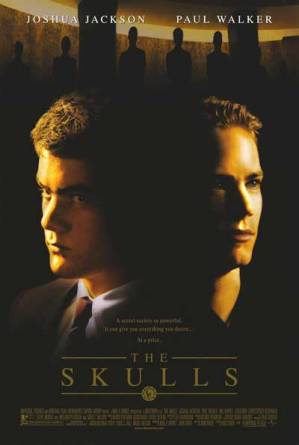
Shattered Politics #68: The Skulls (dir by Rob Cohen)


Theskullsposter

What do George W. Bush, John Kerry, and Paul Giamatti all have in common?

They were all members of the Skull and Bones, which may be an organization that secretly controls the world.  Then again, it might also just be an organization for male students at Yale, a place for the sons of the rich and famous to get together, drink, and do whatever else rich kids do when they go to an Ivy League college.

One thing’s for sure — when you’re a member of the Skulls and Bones, you’re a Bonesman for life.  If you have any doubt about that, go ahead and watch the 2000 film The Skulls.  In The Skulls, Martin Lombard (Christopher McDonald) is such a loyal member of the Skulls that, even though he’s currently a provost at Yale, he’s still willing to break a student’s neck in order to keep him from revealing the society’s secrets.

Seriously, do all Ivy League administrators know how to break necks or just ones that were former members of the Skulls?  It just makes me glad that I went to UNT, a good school with absolutely no ivy on the walls.  A degree from UNT might not translate into membership into America’s elite but at least you don’t have to worry about being targeted by any dangerous secret societies.

(Unless, of course, you’re a TAM.  But that’s another story…)

Anyway, the dead student’s best friend is Luke McNamara (Joshua Jackson).  We know Luke’s the hero because he doesn’t come from a rich family and he’s attending Yale on a rowing scholarship.  Shortly before Will’s death, Luke is invited to join the Skulls and does so because he thinks it will help him court rich art major Chloe (Leslie Bibb).  However, after Will death, Luke decides that he has to join so that he can find out the identity of the murderer.

Luke wrongly suspects that the murderer was his new friend and fellow Skull, Caleb Mandrake (Paul Walker).  What Luke doesn’t know is that the murder was actually ordered by Caleb’s father, Supreme Court candidate Litten Mandrake (Craig T. Nelson).  (As a sidenote, has anyone named Litten Mandrake ever not turned out to be evil?)  However, as Luke gets closer to the truth, the Skulls arrange for him to be arrested and put into a mental asylum.

Oh, and Martin Lombard starts chasing after him with a gun.

Remember, this is the same Martin Lombard who is a provost at Yale.  Now, I’m not saying that it’s out of the question that a Yale provost could chase after a student with a gun.  But, at the very least, it seems like a conspiracy as wealthy and powerful as the Skulls could afford to hire less recognizable henchmen.

In fact, watching The Skulls, you can’t help but suspect that this secret conspiracy is not exactly the smartest conspiracy in the word.  Not only do they do a terrible job of hiding their existence but they are continually outsmarted by a bunch of undergrads.

Anyway, eventually, it all leads to Luke challenging Caleb to a duel.  A mysterious Senator (William Petersen) shows up and says, “Well done, son, well done.”

It’s all kind of stupid.