Late Night Retro Television Review: Highway to Heaven 3.13 “Basinger’s New York”


Welcome to Late Night Retro Television Reviews, a feature where we review some of our favorite and least favorite shows of the past!  On Thursdays, I will be reviewing Highway to Heaven, which aired on NBC from 1984 to 1989.  The entire show is currently streaming on Tubi and several other services!
New York, New York, it’s a heckuva town….

Episode 3.13 “Basinger’s New York”

(Dir by Michael Landon, originally aired on December 17th, 1986)

It’s Christmas in New York and veteran news columnist Jed Basinger (Richard Mulligan) has no idea what to write about.  Basinger has been recording the lives of the people of New York City for decades and he’s finally reached the point where he fears that there may not be anything good left to write about.  In short, Jed Basinger is a cynic and we know what this show thinks of cynicism!

While Basinger walks down a cold city sidewalk, he suddenly discovers Jonathan and Mark walking beside him.  Basinger worries that they’re fans, looking to harass him or tell him a long story that they think he should write about.  Instead, Jonathan introduces himself as an angel and explains that he’s here to show Basinger all the good things happening in the city.

I have to admit that I always groan a little whenever an episode of this show starts with Jonathan admitting that he’s angel.  The episodes where Jonathan makes no effort to hide his identity are usually the weakest, if just because they tend to be a bit more preachy than the typical episode of Highway to Heaven.  (Despite its reputation, Highway to Heaven was usually more earnest than preachy.)  Once Jonathan says those three words — “I’m an angel,” — the viewer is immediately aware that this episode has a message and it’s not going to be a subtle one either.

Jonathan, Mark, and Basinger make their way through New York.  They meet a cab driver who just wants to be reunited with his son.  They meet the saintly homeless people who live on the streets and take care of each other in their own quirky way.  They meet a nice cop.  They meet not one but two women who are in labor and who end up at the same hospital.  One woman is poor and turned away because she doesn’t have insurance (which, technically, I think is illegal under federal law but whatever).  The other woman is the wife of a U.S. Senator who announces that she refuses to give birth in a hospital that turns away the poor.  Luckily, Basinger is there and threatens to write about it.  The scene in the hospital is typical of this episode.  It’s well-meaning but so heavy-handed that it’s nowhere near as effective as it should have been.  If I was in labor, would I take the time to demand that the hospital treat all of its patients fairly?  I’d like to think so but, realistically, my mind would probably be on other things.  Luckily, Basinger gets to write his column, despite showing up late at the newspaper.  It turns out that the presses went down while Basinger learned a lesson about New York and kindness.

I can’t really be too critical of this episode because its heart was in the right place.  That was this show’s biggest strength.  Michael Landon really did seem to believe he could make the world a better place, one episode at a time.  That said, this episode was a bit too heavy-handed for my tastes.  But again, how can I be too critical of a show about Christmas miracles?


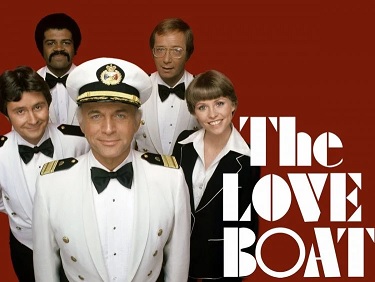
Retro Television Reviews: The Love Boat 2.5 “Julie’s Aunt/Where Is It Written?/The Big Deal”


Welcome to Retro Television Reviews, a feature where we review some of our favorite and least favorite shows of the past!  On Wednesdays, I will be reviewing the original Love Boat, which aired on ABC from 1977 to 1986!  The series can be streamed on Paramount Plus!

Things get a bit icky this week.  Ugh!

Episode 2.5 “Julie’s Aunt/Where Is It Written?/The Big Deal”

(Dir by Allen Baron, originally aired on October 14th, 1978)

How icky can one cruise get?

Well, consider this.  On this week’s episode of The Love Boat, Captain Stubing’s uncle (Red Buttons) is a passenger on the boat.  Uncle Cyrus decides that he likes Julie.  How does he express how much he likes Julie?  He invites her to his cabin and then lunges at her and starts kissing her.  Julie runs out of the cabin and Uncle Cyrus chases her through the corridors of the boat.  Once Julie does get away from him, she tells Doc and Gopher about what happened.  Doc and Gopher both think that it’s funny.

(Uhmm, guys, this isn’t some old guy with a crush.  This is someone who invited the cruise director to his cabin …. AND ATTACKED HER!)

Everyone agrees that Julie should just try to avoid Cyrus and that she should not tell the Captain about what happened.  Unfortunately, because Uncle Cyrus told the Captain about how much he enjoys Julie’s company, Stubing insists that Julie spend as much time as possible with Uncle Cyrus.  Every time that Julie goes down to his cabin, Cyrus grabs her and starts kissing her.  Scene after scene, Julie has to push Cyrus off of her so that she can escape, screaming, into the hallway.

Finally, realizing that she can’t go on like this, Julie realizes that she has to do something, even if both Doc Bricker and Gopher refuse to take the situation seriously.  Out of the three choice below, which do you think she goes with?

  1. Call the police
  2. Tell Captain Stubing and demand that he call the police
  3. Have Gopher dress up like a woman and pretend to be a member of the police

If you picked number three, you could have been a writer for The Love Boat!

Ugh!  I hated everything about this storyline!

I wasn’t a fan of the other two storylines as well.  The first featured Hope Lange as Sandra Newberry, the wife of publisher Alfred Newberry (Gene Barry).  She is upset to discover that Alfred has invited a Norman Maileresque writer named Mark Littlejohn (Richard Mulligan) to accompany them on the cruise.  Alfred wants Mark to hurry up and finish the final chapter of his autobiography.  Make wants to steal Sandra away.  In the end, Alfred and Mark get into a fight.  They’re too clumsy to actually hit each other but they do manage to knock out Captain Stubing.  Again, you would think that this would be the sort of thing that would eventually involve the police but instead Stubing just accepts a payment that will come from the royalties of Mark’s book.  Whatever.  Go deal with your uncle, Captain.

Finally, Martin Scott (Allen Ludden) is a businessman who is selling his business to Brad Collins (Sam Groom).  Martin’s daughter, Allison (Mackenzie Phillips), feels like she has to date Brad even though she’s actually in love with a musician named Jim Warren (Erik Estrada).  It was hard not to feel that, intentionally or not, Martin was basically pimping out his daughter.  Again, it was just icky.

This was not a fun cruise.  Hopefully, next week will be better.

Horror on TV: Ghost Story 1.8 “House of Evil” (dir by Daryl Duke)


Tonight’s episode of Ghost Story is full of stars!

Evil grandpa comes to visit his family and, with the help of voodoo cookies (you read that right), he tries to manipulate his deaf and mute granddaughter into helping him kill everyone!  Grandpa is played by Melvyn Douglas.  His granddaughter is played by Jodie Foster!  And the script was written by none other than Robert Bloch and Richard Matheson!

This episode originally aired on November 10th, 1972.

Retro Television Reviews: The Love Boat 1.3 “Ex Plus Y / Golden Agers / Graham and Kelly”


Welcome to Retro Television Reviews, a feature where we review some of our favorite and least favorite shows of the past!  On Wednesdays, I will be reviewing the original Love Boat, which aired on ABC from 1977 to 1986!  The series can be streamed on Paramount Plus!

Love!  Was it exciting and new this week?

Episode 1.3 “Ex Plus Y / Golden Agers / Graham and Kelly”

(Directed by  Adam Rafkin and Stuart Margolin, originally aired on October 8th, 1977)

The third episode of The Love Boat is all about age differences, growing together, and growing apart.

For instance, it’s love at first sight when Julie spots Jim Wright (Charles Frank).  I mean, hey, his name is even “Mr. Wright!”  And it turns out that, even though he looks like he’s 40, Mr. Wright is actually only 30!  And he likes Julie too!  The problem, however, is that Jim has been hired to serve as a tour guide for a group of elderly tourists.  And those tourists (led by Edward Andrews) simply will not leave Mr. Wright alone!  Every time Mr. Wright tries to spend some time alone with Julie, the old people show up.  Obviously, the show means for us to sympathize with Julie and Jim but I think I’m actually on the side of the old people as far as this is concerned.  I mean, they didn’t pay money so that Jim could have a vacation.  They paid Jim to be their tour guide and, unless he’s going to refund their money, that’s what he needs to concentrate on.  He and Julie can fall in love once Jim is off the clock.

While Julie pursues Jim, 12 year-olds Kelly (Kristy McNichol) and Graham (a very young Scott Baio) pursue their own romance.  Or actually, it’s Kelly who pursues the romance.  Graham likes Kelly but he’s also immature and not sure how to talk to girls so he always ends up doing or saying something silly or stupid whenever he and Kelly are on the verge of having a “real” moment.  On the one hand, this was actually a fairly realistic storyline, at least by Love Boat standards.  On the other hand, Baio and McNichol looked so much alike that any scene featuring the two of them was like that picture of the two Spider-Men pointing at each other.  Graham also ended up with a very convoluted backstory to explain why he was traveling with a British grandmother (played by Hermoine Baddeley) despite being a kid from Brooklyn.  It was one of those overly complicated and distracting things that could have been solved by simply not casting a British stage actress as Baio’s grandmother or not casting a very American actor as Baddeley’s grandson.

Finally, Robert Reed and Loretta Swit played a divorced couple who found themselves on the same cruise.  At first, they dreaded seeing each other but then, eventually, they agreed that they still had feelings for each other.  Surprisingly enough, the story did not end with Reed and Swit getting back together.  Instead, they just grew as people and were now ready to let go of the bitterness that was holding them back in their new relationships.  That was actually a pretty good story and I appreciated the realistic resolution.  However, before making peace with his ex-wife, Robert Reed came across as being so angry and so bitter that it was actually kind of scary to watch.  It turns out that the Love Boat has skeet shooting.  If you don’t think the sight of Robert “Mr. Brady” Reed with a rifle wouldn’t be terrifying, this episode is here to prove you wrong!

I have to give this episode a mixed review.  Two of the stories worked better than I was expecting but this episode suffered from the miscasting of some of the passengers.  Still, the ship and the ocean looked as lovely as ever and really, that’s the important thing.

Film Review: One Potato, Two Potato (dir by Larry Peerce)


The 1964 film, One Potato, Two Potato, is the story of two people who fall in love.

Julie Cullen (Barbara Barrie) was previously married to Joe (Richard Mulligan).  She’s divorced now and raising her daughter, Ellen (Marti Mericka), on her own.  Ellen was barely a year old when Joe abandoned his family and she’s never known her father.  Perhaps that’s for the best because, as we later see firsthand, Joe was an immature and abusive man.

Frank Hamilton (Bernie Hamilton) is quiet, responsible, and mild-mannered.  For the majority of the movie, the only time that we see Frank show any emotion is when he’s playing football with coworkers.  However, he’s obviously a sensitive and intelligent man.  He and Julie begin a relationship, tentatively at first.  But soon, they’re very much in love and planning to get married.

And really, there’s nothing unusual about either one of them.  They’re two genuinely nice people who met and fell in love.  The only thing that sets their romance apart from so many other romances is that Julie’s white and Frank’s black.  For that reason, Frank and Julie get harassed by the police when they try to enjoy a romantic stroll at night.  For that reason, Frank’s parents (played by Robert Earl Jones and Vinette Carroll) object to their relationship, saying that all the love in the world can’t overcome prejudice.  For that reason, when Frank and Julie do get married, hardly anyone comes to the wedding and the one bridesmaid glares at them throughout the ceremony.  Frank and Julie end up living on a farm with Frank’s parents, in love but practically isolated from the world.  (Tellingly, the “friend” who first introduced them doesn’t want to visit them after they marry.)  When Joe suddenly shows up and discovers that Julie has not only remarried but that her new husband is black, he goes to court and demands custody of his daughter.

It’s interesting think that, in 2019, it’s very easy to take interracial relationships (not to mention interracial marriages) for granted.  And yet, it wasn’t until 1967 (three years after the release of One Potato, Two Potato), that the U.S. Supreme Court officially ruled that laws against interracial marriage were unconstitutional.  One Potato, Two Potato was an early independent film, precisely because none of the major studios were willing to deal with an issue as controversial as interracial marriage.  (When the studios finally did deal with it, the end result was Guess Who’s Coming To Dinner, a film that was as safe and mild as One Potato, Two Potato was brave and angry.)  Barbara Barrie did win the best actress award at Cannes and the film itself received an Oscar nomination for Best Original Screenplay but otherwise, it’s a sadly neglected piece of film history.  If I hadn’t recorded it off of TCM, I probably never would have seen or even heard of this film.

And that would have been a shame because, along with being a valuable historical document, One Potato, Two Potato is a compelling and heartbreaking drama.  The film approaches its subject matter with a maturity and an honesty that probably stunned audiences back in 1964.  This film refuses to give into any of the well-intentioned clichés that often dominated films about racism in the 60s and 70s.  There are no sympathetic whites (à la Gregory Peck in To Kill A Mockingbird) willing to argue for Frank and Julie’s right to raise Ellen.  (In fact, the lawyer that they hire gets angry when Frank first approaches him and advises them to leave the state.)  It does Frank no good to be dignified and patient.  The racism in One Potato, Two Potato does not come from a handful of ignorant souls.  Instead, it’s built into the very system to which Frank and Julie are now having to appeal.

One Potato, Two Potato is also a rarity in that it’s a film that allows a black man to get angry about the way he’s being treated, even if it means making whites in the audience uncomfortable.  One need only compare the hopeful ending of Guess Who’s Coming To Dinner with the heart-breaking conclusion of One Potato, Two Potato.  Whereas Guess Who’s Coming To Dinner highlighted Sidney Poitier saying, in his dignified manner, that he has no interest in fighting the battles of the past, One Potato, Two Potato finds a distraught Bernie Hamilton watching a western and finally breaking down as he yells, “Kill that white bastard!”

One Potato, Two Potato ends with a title card that informs us that the story that we’ve seen is fictional but that the laws and the issues discussed in the film are real.  55 years after it was released, One Potato, Two Potato remains a compelling drama and an important historical document.


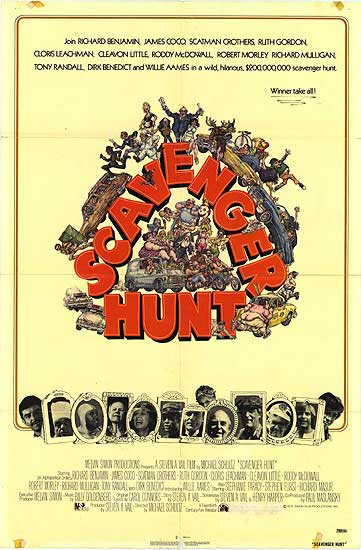
A Movie A Day #114: Scavenger Hunt (1979, directed by Michael Schultz)


When game designer Milton Parker (Vincent Price) dies, all of his greedy relatives and his servants gather for the reading of his will.  Parker’s lawyer, Benstein (Robert Morley), explains that Parker is leaving behind a $200 million dollar estate to whoever can win an elaborate scavenger hunt.  Dividing into five teams, the beneficiaries head out to track down as many items as they can by five o’clock that evening.  Among the items that they have to find: a toilet, a cash register, an ostrich, a microscope, and an obese person.  Hardy har har.

The five teams are made up of a who’s who of sitcom and television actors who had time to kill in 1979.  The Odd Couple‘s Tony Randall is Henry Motely, who is Parker’s son-in-law and who works with his four children.  Soap‘s Richard Mulligan plays a blue-collar taxi driver named Marvin Dummitz (because funny names are funny) who teams up with his friend, Merle (Stephen Furst).  The Mary Tyler Moore Show‘s Cloris Leachman (an Oscar winner, no less) gets stuck with the role of Milton’s greedy sister, Mildred.  She works with her conniving lawyer (Richard Benjamin) and her stupid son (Richard Masur).  Maureen Teefy plays Milton’s niece while his nephews are played by Willie Aames and Dirk Benedict.  Cleavon Little, James Coco, Roddy McDowall, and Stephanie Faracy play the servants.

It doesn’t stop there, though.  Avery Schreiber plays a zookeeper.  Meat Loaf plays a biker who beats up Richard Benjamin.  Ruth Gordon, Stuart Pankin, Pat McCormick, and Scatman Crothers all have cameos.  Even Arnold Schwarzenegger makes an appearance as a gym instructor who knocks Tony Randall out of a second story window.

There are a lot of famous people in Scavenger Hunt.  It’s just too bad that the movie itself is barely watchable and not at all funny.  It tries to go for the zaniness of It’s A Mad, Mad, Mad, Mad World but, unless watching Willie Aames steal a clown head from Jack in the Box is your idea of hilarity, the film never comes close to succeeding.  Michael Schultz directed some classic films (like Car Wash) during the 1970s but, unfortunately, he also directed Sgt. Pepper’s Lonely Hearts Club Band and this.

Scavenger Hunt used to show up on a late night television, where it was always advertised as starring Arnold Schwarzenegger.  (He barely has five minutes of screentime.)  It was released on DVD/Blu-ray earlier this year but watching for the cameos is the only reason to take part in this Scavenger Hunt.