Review: Patriot Games (dir. by Phillip Noyce)


“You don’t know what it’s like to have your life destroyed by one stupid mistake!” — Sean Miller

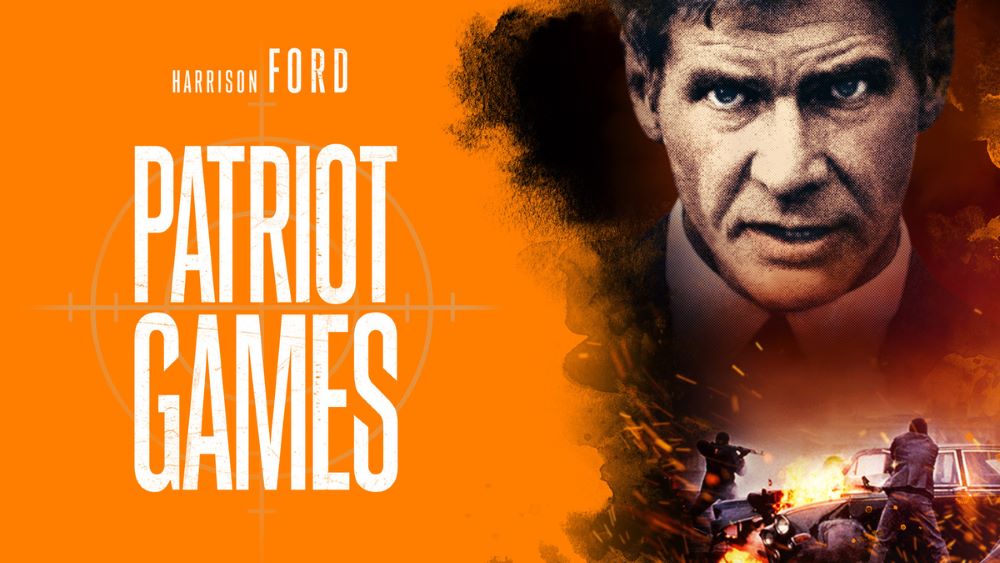
Patriot Games hits the ground running by thrusting Jack Ryan and his family into the heart of a terrorist ambush on a London street, targeting a key British official tied to the royal family. Harrison Ford plays Ryan as a sharp-minded history professor and former CIA analyst on a simple vacation with his wife Cathy and daughter Sally, but his old Marine training surges up—he charges in, kills two attackers including one terrorist’s brother, and gets winged by a bullet himself. Right away, this setup grabs attention by showing how a random act of guts can boomerang into endless trouble, forcing a guy who craves quiet lectures to dodge bullets and betrayal across oceans, and it plants seeds about whether playing hero is worth the fallout on everyone you love.

Back in Maryland at the Naval Academy, Ryan tries piecing together normalcy, grading papers and dodging CIA calls, but Sean Miller—the captured terrorist whose sibling Ryan killed—gets sprung in a brutal prison convoy hit that leaves cops dead in the dirt. Miller, now laser-focused on payback, reroutes his rogue Ulster splinter group’s rage straight at Ryan’s home front, culminating in a savage freeway pileup where goons ram Cathy’s car off the road, injuring her and Sally badly. Ford nails the shift from composed academic to seething protector, his clenched jaw and urgent phone calls conveying a dad pushed to the brink, while these family-targeted strikes crank the paranoia, transforming everyday drives and school runs into potential kill zones that linger long after the crashes fade.

Sean Bean invests Miller with a coiled, wordless intensity—scarred features and piercing glares that scream obsession without needing speeches, flipping Ryan’s principled stand into the villain’s fuel for a mirror-image crusade. This fictional IRA offshoot rolls with pro-level gear for hits from UK alleys to U.S. suburbs, dodging authorities with insider tips, but their flat-out villainy skips any cracks in loyalty or ideology, turning them into efficient machines rather than messy humans with grudges worth unpacking. Anne Archer holds Cathy together through hospital beds and hushed fears, emerging tougher, as James Earl Jones’ Admiral Greer supplies the gruff guidance that tugs Ryan toward Langley, balancing the intimate home front with globe-spanning spycraft that feels like a real squeeze on one man’s bandwidth.

The camera shifts smoothly from rain-slicked London corners to bright Maryland bays, capturing open spaces that make characters look small and exposed against the sprawl. Gunshots snap clean and engines growl low during pursuits, pulling you deeper into the fray without drowning out the quieter beats. Horner’s soundtrack builds with brooding pipes and driving rhythms that hit hard in the final bay showdown, boats tearing through darkness with bursts of flame from hands-on stunts that pack a punch even now. Action ramps up step by step from early scraps to that watery chaos, mixing smarts with muscle, even if plot points line up a bit too neatly at times.

CIA war rooms buzz with satellite feeds sharpening grainy Libyan camp footage into proof of terror training, a tech showcase that echoes Clancy’s gearhead love and ramps brainpower against brute force without flashy overkill. Ryan hashes out returns to duty with British contacts, including a Sinn Féin type disavowing the extremists, sketching post-Cold War shifts where lone wolves replace nation-states in the threat lineup. Book-to-screen changes crank Ryan’s field time over desk strategy, letting Ford flex rugged moves that thrill audiences but sand off novel layers of naval tactics and alliance chess for punchier pacing.

Ford and Archer capture the raw friction in Ryan’s marriage through tense, whispered spats about diving back into danger, their easy chemistry making the pushback feel lived-in and real rather than scripted melodrama. Miller’s storyline hurtles toward a frantic leap onto Ryan’s rocking boat, boiling his grudge down to savage, no-holds-barred combat amid crashing waves. On-screen locations—from echoing Naval Academy corridors to churning bay waters—breathe life into the settings, casting national pride as a bruising, up-close shield instead of hollow cheers. Subtle audio touches, like distant creaks in the dim Ryan house, crank up the exposed feeling, linking slick production values to gut-punch emotions without piling on the noise.

Those procedural deep dives—poring over red-haired accomplice sketches or grilling shaky informants—add authentic wonkery, like Ryan spotting tells in grainy photos that crack the case wide, but they drag amid family rehab montages where Sally’s recovery mirrors the slow-burn hunt. The baddies’ cartoonish zeal glosses Northern Ireland’s brutal splits, opting for clear-cut evil over thorny politics that could’ve mirrored real headlines from the era, a choice that streamlines tension yet dates the take harshly next to modern nuance. Endgame flips the house siege into a decoy boat trap, Ryan baiting Miller solo on fiery Chesapeake swells, evolving his street-brawl start into tactical payback, though the tidy win lacks the submarine slyness of earlier Ryan yarns.

This swap prioritizes visceral family shields over shadowy sub hunts, hooking casual viewers while purists miss the book’s flowchart plotting, yet it spotlights Ford’s prime reluctant-warrior groove amid practical blasts that crush today’s green-screen slop. Pacing ebbs in alliance huddles, but peaks like the SAS desert wipeout—watched live via infrared ghosts—deliver clinical thrills tying brains to bangs seamlessly.

Taken together, the taut opener, vengeful pursuits, tech-savvy thrills, emotional anchors, dated politics, and solid craftsmanship add up to a clear verdict: Patriot Games is a good film, a reliable ’90s thriller that delivers crowd-pleasing tension and strong leads without reinventing the wheel. It holds up for its practical stunts and intimate stakes, earning replays as Ford’s standout Ryan turn, even if flaws like simplification and lulls keep it from greatness. Worth the watch for anyone craving balanced action with heart.

Lisa Reviews An Oscar Winner: Unforgiven (dir by Clint Eastwood)


The 1992 Best Picture winner, Unforgiven, begins as a story of frontier justice.

In Kansas, a young and cocky cowboy who calls himself the Schofield Kid (Jaimz Woolvett) rides up to an isolated hog farm.  He’s looking for Will Munny (Clint Eastwood), a notorious outlaw with a reputation for being a ruthless killer.  Instead, he just finds a broken down, elderly widower who is trying to raise two young children and who can barely even manage to climb on a horse.  Will Munny, the murderer, has become Will Munny the farmer.  He gave up his former life when he got married.

The Schofield Kid claims to be an experienced gunfighter who has killed a countless number of men.  He explains that a group of sex workers in Wyoming have put a $1,000 bounty on two men, Quick Mike (David Mucci) and his friend, Davey Bunting (Rob Campbell).  Quick Mike cut up one of the women when she laughed at how unimpressively endowed he was.  While Davey didn’t take part in the crime, he was present when it happened and he didn’t do anything to stop it.  The local sheriff, a man named Little Bill Daggett (Gene Hackman), had Davey give the woman’s employer several horses as compensation.  The Kid wants Munny to help him collect the bounty.

At first, Munny refuses to help the Kid.  But, when he realizes that he’s on the verge of losing his farm, Munny changes his mind.  He and his former partner, Ned Logan (Morgan Freeman), join with the Kid and the three of them head to Wyoming.  Along the way, they discover that the Kid is severely nearsighted and can hardly handle a pistol.

Meanwhile, in the town of Big Whiskey, Wyoming, Little Bill ruthlessly enforces the peace.  He’s a charismatic man who is building a house and bringing what many would consider to be civilization to the Old West. When we first meet Little Bill, he seems like a likable guy.  The town trusts him.  His deputies worship him.  He has a quick smile but he’s willing to stand his ground.  But it soon becomes apparent that, underneath that smile and friendly manner, Bill is a tyrant and a petty authoritarian who treats the town as his own personal kingdom.    Little Bill has a strict rule.  No one outside of law enforcement is allowed to carry a gun in his town.  When another bounty hunter, English Bob (Richard Harris), comes to town to kill the two cowboys, Little Bill humiliates him and sends him on his way but not before recruiting Bob’s traveling companion, writer W.W. Beauchamp (Saul Rubinek), to write Bill’s life story.  Bill’s not that much different from the outlaws that he claims to disdain.  Like them, Bill understands that value of publicity.

Unforgiven starts as a traditional western but it soon becomes something else all together.  As the Schofield Kid discovers, there’s a big difference between talking about killing a man and actually doing it.  Piece-by-piece, Unforgiven deconstructs the legends of the old west.  Gunfights are messy.  Gunfighters are not noble.  Davey Bunting is the only man in town to feel guilty about what happened but, because he’s included in the bounty, he still dies an agonizing death.  Quick Mike is killed not in the town square during a duel but while sitting in an outhouse.  Ned and Munny struggle with the prospect of going back to their old ways, with Munny having to return to drinking before he can once again become the fearsome killer that he was in the past.  And Little Bill, the man who says that he’s all about taming the west and bringing civilization to a lawless land, turns out to be just as ruthless a killer as the rest.  A lot of people are dead by the end of Unforgiven.  Some of them were truly bad.  Some of them were good.  Most of them were in the wrong place at the wrong time.  Everyone’s got it coming, to paraphrase Will Munny.

With its violent storyline, deliberate pacing, and its shots of the desolate yet beautiful western landscape, Clint Eastwood’s film feels like a natural continuation of the Spaghetti westerns that he made with Sergio Leone.  (Unforgiven is dedicated to both Leone and Don Seigel.)  Unforgiven was the first of Eastwood’s directorial efforts to be nominated for Best Picture and also the first to win.  It’s brutal meditation on violence and the truth behind the legends of the American frontier.  Eastwood gives one of his best and ultimately most frightening performances as Will Munny.  Gene Hackman won his second Oscar for playing Little Bill Daggett.

Unforgiven holds up well today.  Hackman’s Little Bill Dagget feels like the 19th century version of many of today’s politicians and unelected bureaucrats, authoritarians who claims that their only concern is the greater good but whose main interest is really just increasing their own power.  Unforgiven remains one Clint Eastwood’s best films and one of the best westerns ever made.  Leone would have been proud.

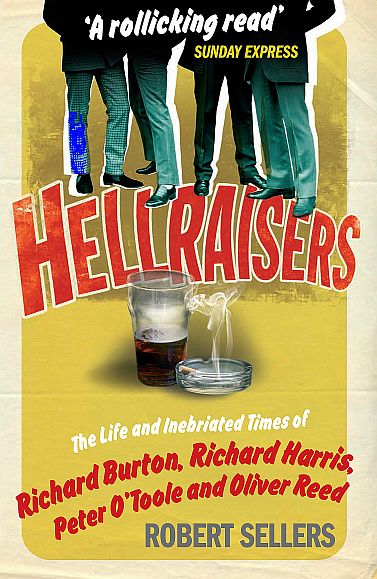
Book Review: Hellraisers: The Life and Inebriated Times of Richard Burton, Richard Harris, Peter O’Toole, and Oliver Reed by Robert Sellers


First published in 2009, Hellraisers is a fast-paced look at the life and times of four men, Richard Burton, Richard Harris, Peter O’Toole, and Oliver Reed, and an examination of what they all had in common.

First off, they were all talented actors who were at the height of their careers in the 60s and the 70s.

They all first came to prominence in the UK.  Peter O’Toole and Oliver Reed were English.  Richard Burton was Welsh.  Richard Harris was born in Ireland.

With the exception of Oliver Reed, all of them were multiple Oscar nominees but none of them actually won the award.

All four of them could boast filmographies that included some of the best and some of the worst films of all time.

And, of course, all four of them were infamous for their drinking.  They were all, if I may borrow the book’s title, famous for raising Hell.

Hellraisers is a frequently entertaining look at their careers and their legendary off-screen exploits.  All four of them come across as being very different drinkers.  Richard Burton was a depressing drunk, one who drank because he was aware that he was wasting his talents in mediocre films.  O’Toole was a drunk who alternated between being charming and being dangerous, someone who was capable of coming across as being a bon vivant even at his lowest moments.  Richard Harris was the angry drunk but he was also the one who seemed to have the both the best understanding of why he drank and why, at a certain age, it was necessary for him to cut back.  And, finally, Oliver Reed was the showman, the one who viewed drinking a beer the way that others viewed having a cup of tea and who would rather damage his career than allow anyone else to tell him how to live.  He knew that he had a reputation and he was determined to live up to it, even at the risk of his own health.

Perhaps not surprisingly, it’s Oliver Reed who dominates the book.  There was very little that Reed wouldn’t do while drunk and he was drunk quite a lot of the time.  He was also perhaps the most unpredictable of all of the actors profiled in the book, a raw mountain of energy who kept audiences off-balance.  Personally, I would not have wanted to have been along in a room with a drunk Oliver Reed.  The book has too many stories of Reed dropping his trousers and asking everyone to look at what he called his “mighty mallet,” for the reader to feel totally safe with Reed.  At the same time, anyone who has seen a good Oliver Reed performance knows that he deserved better roles than he was often given.  (Then again, the book is also honest about the fact that a lot of filmmakers would not work with Reed because they had justifiable reasons to be terrified of him and his erratic nature.)  Over the course of the book, Reed comes across as hyperactive, easily bored, and also far more intelligent than most gave him credit for.  In many ways, he was a prisoner of his own reputation.  He was outrageous because he knew that was what was expected of him.  As shocking as some of his behavior seems today, he felt that he was giving the people what they wanted and Hellraisers suggests that he may have been right.

Personally, I don’t drink and I find most heavy drinkers to be tedious company at best.  That said, Hellraisers is an interesting book.  Burton, Harris, O’Toole, and Reed are all fascinating talents and the book takes a look at how their hellraising reputations both hurt and, in some cases, helped their careers.  However, the book is more than just a biography of four actors who drank a lot.  It’s also an examination of a different era, of a time when performers were expected to raise Hell and when one could get away with being a contrarian just for the fun of it.  One can only imagine what the moral scolds of social media would have to say if Oliver Reed were around today!  As a result, this is a book that can be enjoyed by both film lovers and history nerds, like you and me.

Lisa Reviews An Oscar Nominee: The Guns of Navarone (dir by J. Lee Thompson)


The Oscar nominations are finally due to be announced on March 15th and the Oscars themselves are scheduled to be awarded at the end of April.  In anticipation of the big event (and the end of this current lengthy awards season), I am going to spend the next two months watching and reviewing Oscar nominees of the past.  Some day, I hope to be able to say that I have watched and reviewed every single film nominated for Best Picture.  It’s a mission that, with each passing year, I come a little bit closer to acomplishing.

Tonight, I decided to start things off by watching the 1961 best picture nominee, The Guns of Navarone.

The Guns of Navarone takes place in 1943, during World War II.  2,000 British troops are stranded on the Greek island of Kheros and the Nazis are planning on invading the island in a show of force that they hope will convince Turkey to join the Axis powers.  The Allies need to evacuate those troops before the Nazis invade.  The problem is that, on the nearby island of Navarone, there are two massive guns that can shoot down any plane that flies over and sink any ship that sails nearby.  If the British soldiers are to be saved, the guns are going to have to be taken out.

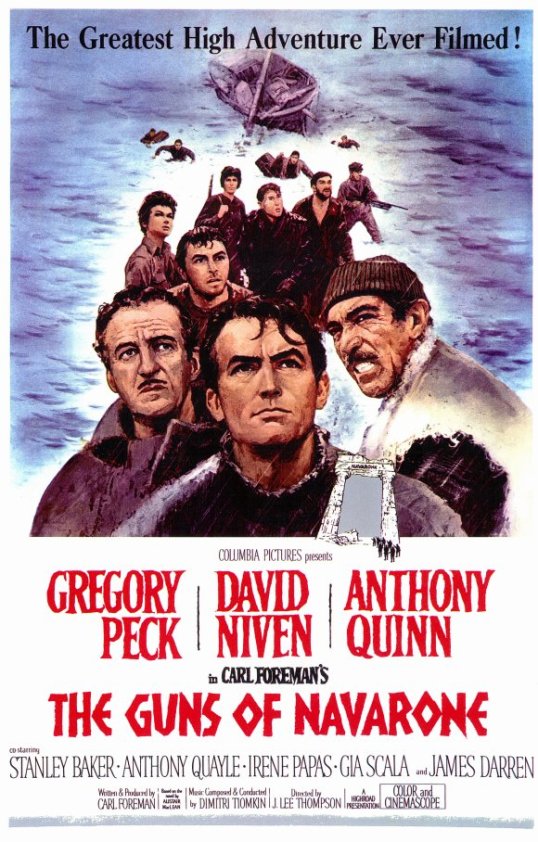
Everyone agrees that it’s a suicide mission.  Even if a commando team manages to avoid the patrol boats and the German soldiers on the island, reaching the guns requires scaling a cliff that is considered to be nearly unclimbable.  Still, the effort has to be made.  Six men are recruited to do the impossible.  Leading the group is Major Roy Franklin (Anthony Quayle), a natural-born leader who is described as having almost supernatural luck.  Franklin’s second-in-command is Keith Mallory (Gregory Peck), an American spy who speaks several languages and who is an expert mountain climber.  Spyros Pappadimos (James Darren) and Butcher Brown (Stanley Baker) are both assigned to the team because they have fearsome reputations as killers, though it quickly becomes clear that only one of them kills for enjoyment.  Colonel Stavrou (Anthony Quinn) is a member of the defeated Greek army and he has a complicated past with Mallory.  Finally, Corporal Miller (David Niven) is a chemistry teacher-turned-explosive expert.  Waiting for the men on the island are two members of the Resistance, Spyros’s sister Maria (Irene Papas) and her friend, Anna (Gia Scala).  The mission, not surprisingly, the mission doesn’t go as planned.  There’s violence and betrayal and not everyone makes it to the end.  But everyone knows that, as tired as they are of fighting, the mission cannot be abandoned.

The Guns of Navarone was a huge box office success when it was originally released, which probably has a lot to do with it showing up as a best picture nominee.  It’s an entertaining film and, watching it, it’s easy to see how it served as a prototype for many of the “teams on a mission” action films that followed.  Though none of the characters are exactly deeply drawn, that almost doesn’t matter when you’ve got a cast that includes actors like Gregory Peck, Anthony Quinn, and David Niven.  At it best, the film works as a triumph of old-fashioned movie star charisma.  Peck is upright and determined to do whatever needs to be done to get the job done.  Quinn is tempermental and passionate.  David Niven is cynical, witty, and very, very British.  Quayle, Darren, and especially Stanley Baker provide strong support.  Before Sean Connery got the role, Stanley Baker was a strong contender for James Bond and, watching this film, you can see why.

Seen today, there’s not a lot that’s surprising about The Guns of Navarone.  It’s simply a good adventure film, one that occasionally debates the morality of war without forgetting that the audience is mostly watching to see the bad guys get blown up.  Some of the action scenes hold up surprisingly well.  The scene where the team is forced to deal with a German patrol boat is a particular stand-out.

The Guns of Navarone was nominated for 7 Academy Awards, including Best Picture.  Though it lost the top prize to West Side Story, The Guns of Navarone still won the Oscar for Best Visual Effects.

Scenes I Love: Gladiator


GladiatorBattle

“ROMA VICTOR!”

While Lisa Marie watches Ben-Hur on TCM I decided to revisit one of my favorite films to start of the new millenium. This was a film that helped resurrect sword and sandals epic that had burnt out during the late 60’s. From the late 50’s and throughout most of the 1960’s we had such classic epics as Spartacus, Quo Vadis and Ben-Hur. Then we have the Italian-produced peplum films which ranged from memorable to awful.

In 2000, Ridley Scott released the film that would finally win Russell Crowe an Oscar for Best Actor (one he should’ve won for The Insider in the previous year). Gladiator was a return to the old-school epic-scale filmmaking that we hadn’t seen in decades and audiences ate it all up as it won in the box-office and charmed critics.

I wasn’t sure about Gladiator leading up to it’s release, but I was always up for some hacking and slashing in my entertainment. What changed my mind from just being interested to buying fully into the film was when I first saw it and the opening scene which I dub the Battle of Germania. This opening sequence appealed to my sense of adventure as a viewer and also as a student of history (especially military history). While the scene itself wasn’t as accurate as I would’ve liked it got enough of how the Roman Legions fought as an army correct that I was able to forgive Sir Ridley for some dramatic flourishes that wasn’t historically accurate.

In this scene we see the Legions form up in square ranks with their recognizable scutum (Roman shield) into their typical shield wall formation. There are also the auxiliries acting as long-range support such as archers, catapults and ballista (though the last two were rarely, if ever used outside of sieges). Then there were the Roman cavalry led by Maximus himself (a unit seen less as an elite formation as we see later in the Medieval era). Scott was able to combine all these elements and create a scene that probably was as close as we’d get to seeing how war was waged between the Roman Empire and the so-called barbarian hordes of Germania.

I think this scene would’ve been perfect if the Roman Legion formations remained cohesive and just meat-grinded their enemy in front instead of breaking apart and turning the fight into a free-for-all. Other than that misstep this scene was what I loved about Gladiator.

Lisa Marie Reviews The Oscar-Nominated Films: Mutiny on the Bounty (dir. by Lewis Milestone)


Mutiny_On_The_Bounty_1962_1

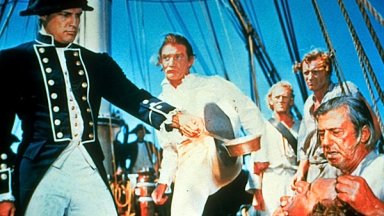
Previously, I reviewed the 1935 Best Picture winner Mutiny on the Bounty, a film that still stands as one of the best adventure films ever made.  However, this was not the only film made about the Bounty to be honored with several Oscar nominations.  In 1962, another version of Mutiny on The Bounty was released and, like its predecessor, received a nomination for Best Picture of the year.  However, while the 1935 Mutiny on the Bounty remains one of the most entertaining films ever made, the 1962 Mutiny on the Bounty is a mess.

As in the 1935 version of the story, we once again follow the HMS Bounty as it sails from England to Tahiti.  Again, the ship’s captain is the tyrannical Capt. Bligh (Trevor Howard) and again, the eventual mutiny is led by Fletcher Christian (Marlon Brando).  While the 1935 version presented Christian as the unquestioned leader of the mutiny, this version features an indecisive Christian who is goaded into leading the mutiny by a seaman named John Mills (Richard Harris).  Whereas the 1935 Fletcher Christian never regretted his decision, the 1962 version seems to regret the mutiny from the moment it occurs and literally spends the rest of the film trying to get the mutineers to agree to return to England with him.

Perhaps the biggest difference between the two versions of Mutiny on the Bounty is that the 1935 version was a 2-hour film that felt shorter while the 1962 remake lasts 3 hours and 15 minutes (including intermission) and feels even longer.  The 1962 version was made at a time when Hollywood was attempting to counteract the influences of European art films and American television by making films that were a thousand times bigger then they needed to be.  Whereas the 1935 Mutiny on The Bounty was all about telling the story as efficiently as possible, the 1962 Mutiny on the Bounty was about telling audiences, at every possible moment, that they couldn’t see anything like this on television or in some French art film.  Audiences in 1962 may very well have been amazed by the endless shots of Tahitians dancing and the Bounty rocking on the ocean but, for modern audiences, the entire film just feels incredibly slow and padded.

Another major difference between the two versions of Mutiny on the Bounty is that Marlon Brando, to be charitable, was no Clark Gable.  Much as Clark Gable could never have been a credible Stanley Kowalski or Vito Corleone, Brando could never have been a convincing Fletcher Christian.  Whereas Gable played Christian as the epitome of masculinity, Brando’s internalized, method approach serves to turn the character into something of a wimp.  It doesn’t help that Brando’s twangy attempt at an English accent sounds like every bad Monty Python impersonation that’s ever been heard in a college dorm room.

The 1962 Mutiny on the Bounty was a notoriously troubled production.  Marlon Brando was reportedly bored with the role of Fletcher Christian (which might explain why he gave such an eccentric performance) and he reportedly used his star status to demand and make constant changes in the script.  The film’s original director, Carol Reed, reportedly quit over frustration with Brando and was replaced by Lewis Milestone.  Milestone, a veteran director who had started his career during the silent era, proved just as ineffectual when it came to controlling Brando.  By the end of the film, Richard Harris was literally refusing to film any scenes opposite Brando.  The end result was that the film went wildly over schedule and over budget.

Despite being reviled by even contemporary critics, Mutiny on the Bounty received seven Oscar nominations, including Best Picture.  The nomination was a triumph for the studio system as MGM reportedly directed all of its employees to vote for the film. That may have been enough to win Mutiny a nomination for best picture but the actual Oscar went to Lawrence of Arabia.

Film Review: Camelot (dir by Joshua Logan)


Back when I was 18 years old, I auditioned for a community theater production of Camelot.  For as long as I can remember, I’ve always been intrigued with the spectacle and romance of the Arthurian legends and I just knew that I would make the perfect Guinevere.  And so, for two nights, I auditioned.  I performed “Baby One More Time” as my audition song, I showed off my dance moves, and I did countless cold readings with countless potential Arthurs and Lancelots.  At the end of the two days, the director told me that he would be in touch and I left with stars in my mismatched eyes, convinced that I had won the role of Guinevere.

Two days later, I got a call not from the director but from the assistant director.  She informed me that while my dancing was impressive, I wasn’t right for the role of Guinevere because:

1) I was too young.

2) I couldn’t sing.

3) My voice carried too much of a rural twang for me to be a believable Queen of England.

However, she did tell me that I had been selected to be a part of the “chorus.”  Well, I may have only been 18 but I still had my pride so I told her that, if I couldn’t I play Guinevere, I had no interest in being in their little production of Camelot.  I was later told that this caused a lot of people to assume that I was a diva but no matter, I stand by my decision.

When I later saw the theater’s production of Camelot, I felt thoroughly vindicated.  It wasn’t just the fact that the actress they cast as Guinevere had no stage presence, no boobs, and a horsey face.  It’s the fact that Camelot itself isn’t a very good show.  As good as the songs are, Camelot is something of a talky mess and Pellinore is one of the most annoying characters ever.

It was only after I saw that mediocre production that I discovered that there was a film version of Camelot. Released in 1967, the Warner Bros. production was one of the many big budget musicals released in the late 60s.  It has a terrible reputation (and was a box office bomb) but I recently decided to watch it for two reasons.

First off, Camelot was nominated for five Academy Awards (though not best picture) and won three (Best Art-Set Decoration, Best Costume Design, and Best Music — Scoring of Music, Adaptation or Treatment).  That means that Camelot won two more Oscars than The Graduate and one more than Bonnie and Clyde.

Secondly, this film version of Camelot features Franco Nero (who, in 1967, was literally the most handsome man in the world) in the role of Lancelot.

And so, I recently set aside 3 hours and I watched the film version of Camelot.

Camelot tells a familiar story.  Arthur (played here by Richard Harris) becomes king of England and he marries Guinevere (Vanessa Redgrave).  At the magnificent castle of Camelot, the most noble knights of England gather at a round table and Arthur preaches equality and chivalry.  Eventually, the righteous French knight Lancelot (Franco Nero) travels to Camelot and becomes Arthur’s  greatest knight.  However, Lancelot and Guinevere fall in love and, as a result of the schemes of Arthur’s illegitimate son Mordred (David Hemmings), Lancelot and Arthur are soon at war with each other.

Despite my dislike of the stage production, I actually started watching the film version with high hopes.  I have a soft place in my heart for the overproduced musical spectacles of the late 60s and I figured that what was slow on stage might be more tolerable when seen on film.  Unfortunately, I was incorrect.  Camelot is a painfully old-fashioned film and, clocking in at 179 minutes, it’s also one of the most boring movies ever made.  Richard Harris was reportedly miserable while making the film and it shows in his performance.  You get the feeling that King Arthur would rather be anywhere other than Camelot.

The only time that the film comes alive is when Franco Nero is allowed to command the screen.  While the very Italian Nero is somewhat miscast as the very French Lancelot, that doesn’t change the fact that Nero plays the role with a passion that’s missing from the rest of the film.  Franco Nero’s blue eyes did more to make me believe in Camelot than any of the songs sung by Richard Harris.  One need only watch the scenes that Franco shares with Vanessa Redgrave to understand why they’ve been a couple for over 40 years.

Ultimately, Camelot is interesting mostly as an example of how the old Hollywood studio establishment attempted to deal with competition from television and European films.  Instead of attempting to adapt to the new culture of the 60s, the old studio bosses just continued to make the same movies they had always made, with the exception being that they now spent even more money than before to do so.  While it’s easy to mock them, you have to wonder if the Camelot of 1967 is all that different from the John Carter of today.

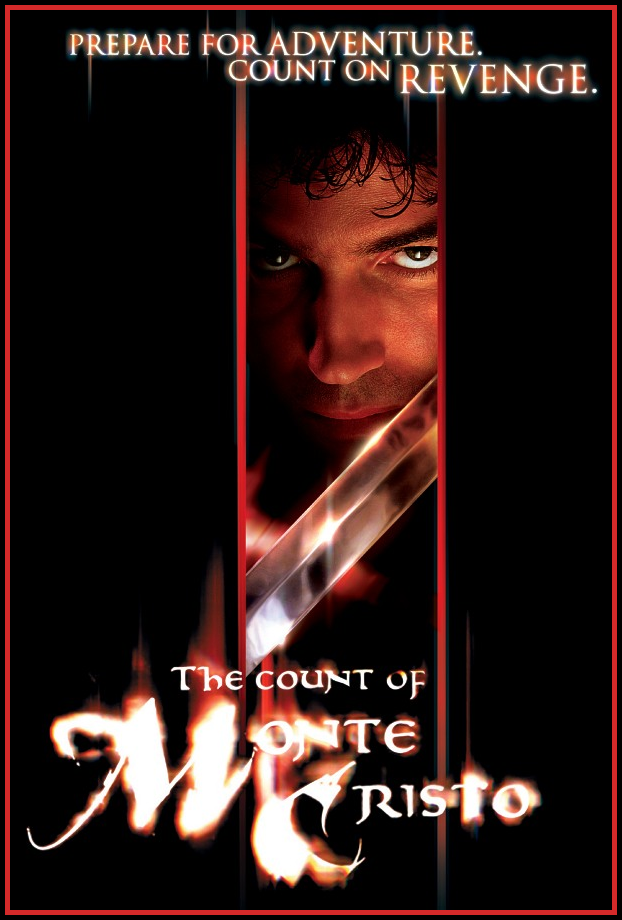
Review: The Count of Monte Cristo (dir. by Kevin Reynolds)


In what has become an unofficial ritual for myself whenever my birthday rolls around I always end up watching a film from 2002 that flew under the radar of most people. While it made modest box-office returns it wasn’t the head-turning blockbuster that some of its producers hoped it would turn out to be. It’s a romantic adventure piece by Kevin Reynolds and for readers of classic literature they’d recognize the title of the film, The Count of Monte Cristo. A film loosely based on the classic novel of adventure, revenge and redemption by French author Alexandre Dumas. The film ends up being a fun, thrilling throwback to films of an era which had marquee stars such as Errol Flynn and Basil Rathbone.

The story is one known well enough. It’s a tale of a man, Edmond Dantès wrongly accussed of a capital crime and imprisoned in the Alcatraz-like prison Chateau d’If through the machinations of three individuals: his best friend Fernand Mondego, first mate Danglars and the ambitious deputy prosecutor Villefort. Dantès spends the next several years in Chateau d’If under the cruel and sadistic eyes of it’s warden, Armand Dorleac (played by Michael Wincott with his usual flair for sadism). It’s while Dantès  has started to contemplate suicide after rejecting God for the pain and suffering he has had to endure that he has a fortuitious meeting with another guest of Chateau d’If. It’s this relationship between Dantès and Abbé Faria (Richard Harris in the mentor role he had begun to play in his later years) which take up the bulk of the first third of the film.

Dantès tells him of the circumstances which led to his imprison in Chateau d’If and the thoughts of vengeance on those responsible for his predicament. Faria tries to turn him from his dark path, but seeing how determined his young friend seems on journeying down its twisted path he agrees to teach him how to become adept at being a noble, finances and in swordcraft in exchange for help in digging themselves out of their prison. Taking several more years to complete the education Dantès needs to exact his revenge it ends at the death of Faria and his mentor’s final gift to his student. The location of a treasure so vast that Dantès could retire to a life of peace and contemplation or fund his plans of vengeance.

The middle section of the film shows Dantès finding the treasure and remaking himself through his newfound wealth as the Count of Monte Cristo to better insinuate himself amongst the wealthy and noble-born his targets mingle in. With the help of a bandit whose life spares after a duel in Jacopo (Luis Guzman) the plans Dantès has worked on for years begin to bear fruit as he manipulates and fools Fernand, Villefort and Danglars into his confidence to better see to their downfall. It’s during this time he meets his former fiancee Mercedes (played by the ridiculously beautiful Dagmara Dominczyk), now Countess Mondego after being told of Edmond’s execution earlier in the film, and Fernand’s son Albert. The circumstances of how his former love having had a child and married to one of the men who had conspired against him brings a new complication to Dantès plans.

The last third of the film shows the culmination of Dantès and his elaborate plans to bring about the downfall of all those who had wronged him. While the plans, at times, strain the bonds of disbelief at actually having fooled and worked against his enemies the way the film makes the audience root for Dantès to succeed helps. This is a Dantès who comes off as noble despite being of commoner origins who we stand behind and support in his plans of vengeance. With the amount of wealth at his disposal it’s not too difficult to put oneself in the same shoes and not think of vengeance as well to strike a balance.

It’s a testament to the direction of filmmaker Kevin Reynolds that the film and it’s story never bogs down despite a story with many elaborate plots and secondary characters introduced midway. The fact that the film only borrows some of its complexity from an even more labyrinthine novel shows how the filmmakers actually had to simplify the story as to not make it so complex that it loses the bulk of its audience.

The Count of Monte Cristo also benefit from a strong cast led by Jim Caviezel in the titular role with Guy Pearce playing his former friend and betrayer Fernand Mondego and James Frain as the prosecutor Villefort. Caviezel plays his role as Dantès and as the Count of Monte Cristo as two different people with distinct personalities. There’s Dantès the earnest sailor who just wanted to get back to his love, Mercedes and then there’s the sophisticated and ruthless Count whose machinations would lead to the destruction of lives and reputations. It’s a mystery why Caviezel hasn’t become the star he surely was in the making and this film showed that he had the talent to become one of the industry’s new leading men. I blame Mel Gibson in casting him as Jesus in The Passion of the Christ for having put a curse on Caviezel.

Guy Pierce in the role of Fernand plays the conniving and remoreless villain role to the hilt. With an overbearing and effete noble bearing to his performance it was a character written to inspire hatred not just in its main protagonist but in the audience as well. Pearce knows what his roles represent and has fun playing up the role as main heavy.

Richard Harris as the priest Faria did his usual great work as the elder mentor to a younger man. It was a role he began to be known for starting with Ridley Scott’s Gladiator right up to his final mentor role as the wizard Dumbledore in the Harry Potter film franchise. It’s hard to explain to people that Harris was not always this wise and mentoring father figure, but one who played roles where he’d play womanizers, charming cads and roguish rebel.

The Count of Monte Cristo ended up being more fun than it should be with enough complexities in its storytelling that the film doesn’t dumb down too much the story it was adapted from. To be honest the only way one could truly adapt Dumas’ novel of revenge and redemption is through a long-form tv series. It is just that complex with so many characters that a film adaptation would just be too long or just unnecessarily crowded with characters the audience would care to know. It’s a good thing that the film by Kevin Reynolds was still able to keep to the spirit of the original source while whiling away the story down to its basic core.

It’s a film that plays like a throwback to the swashbuckling films from Hollywood of the 30’s and 40’s and it wouldn’t be too difficult to see Caviezel in the roles Errol Flynn once inhabited. There’s very little special effects in the film which adds more to this sense with swordfight scenes as expertly choreographed as any of the past. The Count of Monte Cristo, for some reason still unknown to me, continues to be the one thing that keeps airing on my birthday and the fact that it’s such a fun and thrilling film that I continue to watch it everytime my day of days roll around. Can’t wait for next year.

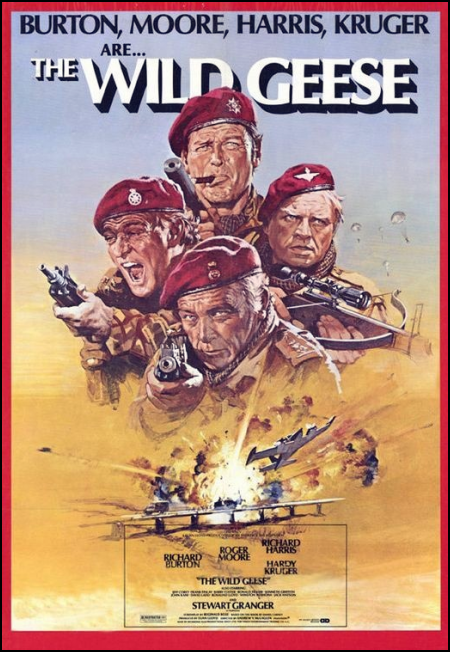
Review: The Wild Geese (dir. by Andrew V. McLaglen)


1978’s action war film The Wild Geese is an adaptation of Daniel Carney’s unpublished novel about a group of mercenaries on a mission during the turbulent revolutionary times that beset Central Africa during the 1960s and early 70s. The film features an all-star cast of British actors, a true who’s who of the era. Under the direction of Andrew V. McLaglen, The Wild Geese manages to be an action-packed and well-told film with memorable performances.

The character Colonel Allen Faulkner, played by Sir Richard Burton, is loosely based on the real-life mercenary legend Michael “Mad Mike” Hoare. Hoare not only inspired this central character but also served as the film’s military and technical advisor. Adding to the film’s authenticity, one of the actors portraying a mercenary, Ian Yule, had served with Hoare in his mercenary company. This infusion of real-life experience gives the film a vivid sense of art imitating life and lends credibility to its portrayal of mercenary warfare.

The story begins with a meeting between Faulkner and British banker Sir Edward Matheson about a rescue mission in the fictional Central African nation of Zembala. The first third follows Faulkner’s recruitment of a 50-man mercenary team, including his reluctant old friend Rafer Janders (Sir Richard Harris). The film portrays the mercenary company training and preparing for the mission before being inserted behind enemy lines. The second half details the rescue of their target: a deposed African leader about to be executed by the man who overthrew him.

During the second third of the film, the action intensifies. Though tame by today’s standards, the sequences were energetic and well-shot for their time. The mercenaries are shown not as idealized heroes but as pragmatic soldiers who use ruthless tactics—such as cyanide gas and poisoned crossbow bolts—that may shock modern audiences. This realism reflects Hoare’s influence and presents mercenaries as professionals doing a dangerous job for pay, blurring the moral lines of warfare. Betrayal during the mission tests their survival in enemy territory.

Burton and Harris deliver excellent performances as hardened war veterans, while a younger Sir Roger Moore adds roguish charm as the Irish pilot Shaun Fynn. Strong supporting roles include Hardy Kruger as Pieter Coetzee, an initially racist Afrikaner who gains new perspective on the continent’s upheaval, and Stewart Granger as the principled banker Matheson.

Though relatively small budgeted compared to other war epics of the era, The Wild Geese carries an epic feel and should have appealed more to American audiences. Unfortunately, financial difficulties with the production company affected its U.S. release. Over time, video and DVD releases built it a cult following among war and mercenary film fans, a subgenre often dominated by lesser films. McLaglen’s straightforward direction keeps the film’s pacing steady, and the story balances action with political and philosophical themes in its final act.

The Wild Geese stands as a rare gem in war cinema that delves into a little-known subgenre. With strong performances by knighted British actors, a former Hitler Youth, and real-life mercenaries as extras, the film distinguishes itself from the many flawed war movies flooding late-70s and early-80s cinema. Its roots in actual mercenary experiences, highlighted by Hoare’s real-life involvement and character inspiration, make it a compelling and underappreciated classic for aficionados of the genre.