UPSAHL is already responsible for my favorite song of the year, Drugs. And now, she’s responsible for my second favorite.
Poor UPSAHL. All of her friends are drinking champagne and hanging out on their huge lawn and smoking expensive cigars and enjoying themselves the way that only people with money can. Meanwhile, UPSAHL can’t even pay her rent or, to judge from this video, afford a decent lawn mower.
Now, of course, it’s also totally possible that her friends are just better at handling their money than UPSAHL. The thing is …. when you don’t have much money, everyone around you seems like they’re rich and they don’t have a problem in the world. I remember the first time I ever had to pay rent and I was shocked to discover that apparently the apartment manger was serious when he said that we had to pay by the end of the first week of the month. Seriously, I just kinda figured that was just a general suggestion. I remember very clearly thinking, “How does everyone else handle this so easily?” Only later would I discover that no one was handling anything easily.
(Fortunately, I was able to pay my half of the rent. I sold some of my friend’s college textbooks back to the student store and then I borrowed the rest from my mom. So, I may not have been rich but I still survived.)
UPSAHL’s songs are so relatable and her DGAF attitude should be an inspiration to us all.
The year is 1919 and a brutish young man named Al (played by Rod Steiger) has just arrived in Chicago. He’s got a new job, working for the city’s top mobster, Johnny Torrio (Nehemiah Persoff). Torrio is the second-in-command to Big Jim Colosimo (Joe De Santis) and is impressed enough by the young Al to take him under his wing.
It’s an exciting time to be a gangster in Chicago because prohibition is about to become the law of the land. Alcohol is about to become illegal, which means that there will soon be an unregulated underground of people smuggling booze into the United States and selling it in speakeasies across the land. Those speakeasies are going to be need men to watch the door and to toss out troublemakers and it turns out that’s a perfect job for someone who isn’t afraid of violence.
Someone like Al, for instance.
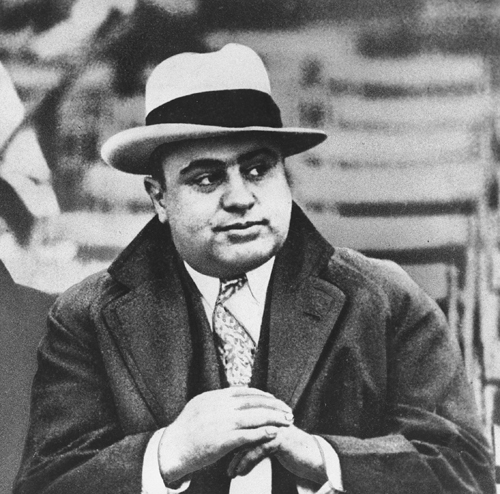
It’s while Al is working as bouncer that he receives a long and deep gash across his face. When the wound heals, it leaves him with the scar that will come to define him for the rest of his life. As much as he hates the nickname “Scarface,” it’s what Al Capone will be known as.
The 1959 film, Al Capone, follows Capone as he works his way up the ladder of the Chicago underworld until he eventually finds himself sitting atop an empire of corruption and crime. Along the way Capone kills the majority of his rivals and finds the time to fall in love with Maureen Flannery (Fay Spain), the widow of one of his victims.
Well, perhaps love is the wrong word. As played by Rod Steiger, Al Capone isn’t really capable of loving anyone but himself. This film does not provide us with the superslick or diabolically clever Capone that has appeared in other gangster movies. Instead, Steiger plays Capone as almost being a caged animal. Capone comes to power through violence and betrayal and he uses the same techniques to hold onto power. The film suggests that the secret of his success was his complete lack of conscience but that the same arrogant stupidity that makes him so fearsome also leaves him doomed to failure. There’s really nothing subtle about Steiger’s performance but then again, there was probably nothing subtle about Al Capone, either. Steiger’s tendency to overact every moment works well in the role of a man who constantly seems to be striking out at anyone who makes the mistake of getting too close to him.
Though many films had featured characters based on Capone, Al Capone was the first biographical film to actually be made about the infamous leader of the Chicago Outfit. (Up until the mid-50s, the Hollywood Production Code expressly forbade anyone from portraying a “real” gangster in a movie.) With the exception of the character of Maureen Flannery (who was a heavily fictionalized stand-in for Capone’s then-living widow), Al Capone is fairly faithful to the know facts of Capone’s life. The film not only includes most of Capone’s violent acts (i.e., the St. Valentine’s Day Massacre) but it also explores both how Capone was protected by Chicago’s corrupt political establishment and how prohibition actually enabled the activities that it was meant to prevent. Director Richard Wilson directs in a semi-documentary style and the film’s harsh black-and-white images capture the idea of a shadowy world hidden away from “respectable” society. It’s a fast-paced film and fans of classic character acting will be happy to see James Gregory as an honest cop and Martin Balsam as a not-at-all honest reporter.
If you’re looking to put together a quick cinematic history lesson about the origins of the Mafia before you watch Martin Scorsese’s The Irishman later this year, Al Capone is a worthwhile addition to your curriculum.
Today’s music video of the day is for the first single to be released off of Tegan and Sara’s upcoming album, Hey I’m Just Like You.
Seeing as how the album is made up of re-recorded versions of songs that the Quin sisters originally wrote in high school, it’s perhaps appropriate that this video has a retro, 90s feel to it. At this point, just seeing a landline phone hanging on a wall almost makes the video seem as if it’s taking place in some strange fantasy world. According to Tegan and Sara, this video is about the angst of waiting for someone to acknowledge your efforts to reach out to them. It’s also about people’s obsession with checking their phones.
Today’s music video of the day is this haunting and rather sad video for Summer ’09, the second single to be released from Vancouver Sleep Clinic’s upcoming second album, Onwards to Zion.
The song itself was inspired by the passing of a friend of Tom Bettison’s. (Bettison is the artist behind Vancouver Sleep Clinic.) Bettison’s friend passed away (“out of the blue,” as Bettison puts it) in 2017 and this song was Bettison’s way of dealing with the pain of his loss. It’s not surprising, then, that both the song and the video are both nostalgic and sad, a song of regret that also celebrates the time that these two friends were able to share with one another.
Onwards to Zion is set to be released on October 18th.
This is without a doubt one of the best music videos that I’ve seen in a while.
Through a series of images that seem still but aren’t, this video tells a story that …. well, I’m not going to ruin the story. When it begins, you might think it’s just going to be another dramatic lover’s quarrel in a parking lot but it instead turns into something far different. What do the video’s final images mean? I’m not sure that there is a definitive answer. Perhaps it’s all in the eye of the beholder.
I like the mix of glitz and ennui that’s present in this video. When I first saw this video, I have to admit that I mistakenly thought the video had been filmed in several cities in the United States, one of which was I was sure was Las Vegas. I’m really glad that I actually bothered to google “Where was Spector’s Half-Life video filmed” before I wrote up this post because it turns out that I was 100% incorrect.
(See? Everyone complains about Google but, sometimes, it can be your best friend.)
It turns out that this video was shot in East London. Fred Macpherson is sitting in the back of an Uber and having a minor existential crisis as he watches the world pass him by. According to the linked article, this video was very much a bit of a do it yourself project with Fred just riding around with a camera crew who recorded whatever it was that they saw during the drive. That takes a certain amount of courage because, seriously, what would you do if you saw absolutely nothing while you were driving around?
(Myself, I’d probably wonder how I suddenly found myself in Vermont …. I’m joking! I swear, it’s just a joke….)
Anyway, as I said, I like the mix of glamour and insecurity that’s present in this video. Anyone who has ever felt isolated while surrounded by hundreds of people will be able to relate to this video’s theme. This video is for everyone who has felt like they were lost even though they knew exactly where they were. And yet, I don’t necessarily feel that this is a pessimistic video. As long as the journey’s continuing, there’s always something new on the horizon.
From the minute I saw those red curtains, I started thinking about Twin Peaks and the Black Lodge. I don’t know if that was the video’s intention or not. Still, I’m always happy to find David Lynch references anywhere that I look. And, just because you’re in the Black Lodge, that doesn’t mean you can’t be entertained.
I mean, everyone loves music, right?
Myself, I always wished I could play bass. Of course, another part of me wishes that I could play drums. I think I’d be a kickass red-haired drummer.
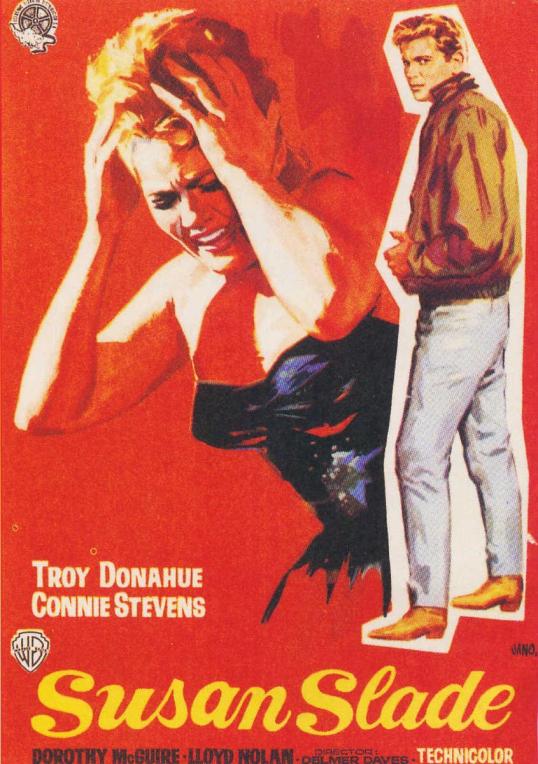
Shortly after this 1961 film begins, 17 year-old Susan Slade (Connie Stevens) announces, “We’ve been sinful!”
She’s talking to her first lover, Conn White (Grant Williams). You would think that anyone — even someone as unbelievably naive and innocent as Susan Slade — would know better than to ever trust someone named Conn White but no. From the minute that Conn and Susan met on an ocean liner heading from South America to California, it was love at first sight. In fact, Susan was so sure of her love that she spent the night in Conn’s cabin, fully knowing that it would mean surrendering her status as an Eisenhower era good girl.
Conn laughs off her concerns about sin. He also tells her that it makes perfect sense for her not to tell her parents (played by Dorothy McGuire and Lloyd Nolan). “When we’re married,” he asks, “are you going to tell your mother every time that we make love?”
Wow, Conn still wants to get married even though he’s already had sex with her!? And he’s also extremely wealthy and stands to inherit control of a multinational corporation! He sounds like the perfect guy! Way to go, Susan!
Unfortunately, it turns out that Conn does have one flaw. He really, really likes to go mountain climbing. In fact, he’s planning on scaling fearsome old Mt. McKinley. While Susan and her family settle into life in Monterey, California, Conn heads up to Alaska. He promises Susan that he’ll keep in touch but, when she doesn’t hear from him, she fears the worse. Has he abandoned her? Was he lying when he said he wanted to get married? Then one day, she gets a call from Conn’s father, informing her that Conn fell off the mountain and died. Susan’s almost father-in-law tells her that Conn’s body cannot be retrieved from the mountain. Though it’s neither confirmed nor denied by the film, I decided that this was because Conn faked his own death to get out of having to spend any more time listening to Susan talk about sin.
Anyway, Susan’s single again but, fortunately, she does not lack for suitors. For instance, there’s the spoiled Wells Corbett (Bert Convy), who is kind of shallow and arrogant but who has a lot of money. And then there’s Hoyt Brecker (played, in reliably vacuous style, by Troy Donahue), who is poor but honest and who is also an aspiring writer. “Someday,” Susan declares,”they’ll say that Robert Louis Stevenson, Jack London, and Hoyt Brecker wrote here!” Who will Susan chose? The sensitive artist who loves her unconditionally or the arrogant rich boy who smirks his way through the whole film?
Complicating matters is the fact that Susan is …. pregnant! That’s right, this is another one of those movies from the early 60s where having sex outside of marriage always leads to an unplanned pregnancy. And, because this movie is from 1961, the only solution is for the Slades to move down to Guatemala for two years, just so they can fool the people on Monterey into believing that the baby is actually McGuire’s and that Susan Slade is not an unwed mother but is instead an overprotective older sister. Will either of Susan’s two suitors be waiting for her when she and her family return to California?
Now, please don’t get me wrong. I do understand that there’s a big difference between 1961 and 2019 and that there used to be a lot more scandal attached to sex outside of marriage and unwed pregnancy. In fact, I guess that difference is really the only thing that makes Susan Slade interesting to a modern viewer. As soon as we see that this film was directed by Delmer Daves (the poor man’s Douglas Sirk) and that it stars Troy Donahue, we know who poor Susan is going to end up with so it’s not like there’s any real surprises lurking in the film’s plot. And none of the actors, though Connie Stevens sometimes to be trying, seems to be that invested in the film’s story. Instead, Susan Slade is mostly useful of a time capsule of the time in which it was made, a time when sex outside of marriage was unironically “sinful” and the only possible punishment was either pregnancy, death, or both. Indeed, Susan Slade is less concerned about the hypocrisy of a society that would force Susan to lie about her new “brother” and more about whether bland lunkhead Troy Donaue will still be willing to marry Susan even if she’s no longer eligible to wear white at their wedding. The film seems to be asking, “After being sinful, can Susan Slade become a good girl again?” As a movie, it’s fairly turgid but as a cultural artifact of a time in which everyone was obsessed with sex but no one was willing to talk about it, Susan Slade is occasionally fascinating.
Poor Susan Slade! If only she had gotten pregnant in a 1971 film instead of one made in 1961, her story could have been so different. But no, she was sinful in the early 60s and that means she’ll be have to settle for Troy Donahue.
Continuing yesterday’s Dirty Dancing theme, today’s music video of the day is for Michael Spaulding’s cover of She’s Like The Wind. She’s Like The Wind was written and originally performed by Patrick Swayze and, while there’s official video for the original on YouTube, I think Spaulding’s cover serves as an acceptable substitute.
 Through the Shattered Lens