Horror Film Review: Halloween Party (dir by Jay Dahl)


“What is your greatest fear?”

That’s a question that I found myself discussing on Saturday night as I joined a group of friends to watch the 2019 film, Halloween Party.

“What is your greatest fear?”

It seems like a simple question but it can be so difficult to answer. I know that a lot of people, at this very moment, would probably say COVID-19. Others would probably say climate change or creeping authoritarianism or Greta Thunberg’s disapproving stare. On Saturday night, a few people identified clowns as being their greatest fear. Leonard said that he didn’t like spiders.

Myself, I struggled to come up with one. It’s not that I’m not scared of things. I hate heights. I have a fear of drowning. I’m not a fan of dogs. But when it comes to my greatest fear, that’s a difficult one to answer. The more I thought about it, the more I realized that most of my fears were more abstract as opposed to being physical. I fear being at the mercy of pitiless and chaotic universe, the type that Werner Herzog always talks about. I fear having to listen to a boring conversation. I fear discovering that I picked the wrong confirmation name. In fact, I spent a lot of time on Saturday bragging about how my fears were so much more interesting than everyone else’s fear.

Then, on Sunday, I watched the original Poltergeist and I remembered that my greatest fear is actually accidentally eating spoiled food. Which could totally happen! I mean, what if they put the wrong expiration date on the package? What if you’re refrigerator stopped working while you were away and then started working at the exact moment that you returned home? You would never know that the food had been sitting there, unrefrigerated, for hours.

Seriously, I think it’s a pretty justifiable fear.

Halloween Party is all about being forced to face your greatest fears. It’s about a cursed internet meme. When it shows up in your email, you’ve got only a few seconds to type in your greatest fear and then hit return. Tell the truth and hit return in time and you’ll get a cute little dancing ghost. Lie or don’t hit return in time and an evil witch appears and announces that you will soon meet your greatest fear. Everyone laughs the meme off but then their fears actually do start to show up, killing not only the person who received the meme but also anyone unlucky enough to get in the way.

College students Grace (Amy Groening) and Spencer (T. Thomason) attempt to investigate the meme and try to figure out how to stop it. It all has something to do with the fact that horribly disfigured children were once housed in their dorm. Apparently, the children got walled up and have been after revenge ever since. To be honest, I couldn’t really follow all of the stuff about the kids and the fact that the kids were made up to appear to be kind of grotesque made it a bit difficult for me to really watch any of the scenes involving them. I kind of wish the film had just concentrated on the meme and the fears. That’s fun part of a film like this.

(For the record, Spencer is afraid of bears. Personally, I think he just needs to watch Grizzly Man a few times and he’ll get over it. Grace is scared of “vagina spiders” and that’s actually a perfectly reasonable fear to have because spiders are almost as frightening as spoiled food and they do tend to get everywhere. I did some research and discovered that, thankfully, spiders cannot lay eggs under your skin but still, whether they’re laying eggs or not, there are certain places that a spider just has no place being.)

Halloween Party is a fairly derivative horror film, as anyone who has seen any of The Ring films will quickly notice. That said, it has a sense of humor about itself and Grace and Spencer are appealingly quirky protagonists. There are more than enough creepy scenes to make up for the familiarity of the story. Halloween Party is a film made for horror fans by horror fans. Watch it at your next party but be prepared to confess what you’re greatest fear is. Don’t say spoiled food, though. That’s already taken.

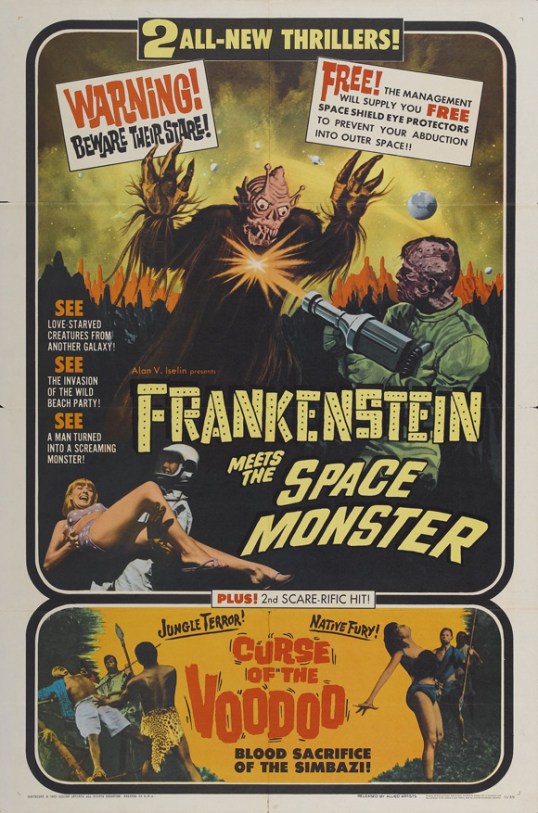
Horror On The Lens: Frankenstein Meets The Space Monster (dir by Robert Gaffney)


Last night, I watched Poltergeist on TCM and I found myself thinking about how much I’ve always liked James Karen’s performance in that film.  Karen plays Craig T. Nelson’s boss, the guy who moved the headstones but left the bodies.  Karen also appeared in Return of the Living Dead and, up until his death a few years ago, he was a busy character actor.  He almost always seemed to play slightly sinister executive types.  If you saw him in a film, you knew he would probably be a crooked businessman, a corrupt lawyer, or a politician on the take.  And yet, even though he often played less than savory characters, he always played them not as being evil but instead, at worst, merely misguided.  Anyway, as I watched him get yelled at by Craig T. Nelson in Poltergeist, I decided that our next horror on the lens would be a James Karen film.

Today’s horror on the lens is the 1965 film, Frankenstein Meets The Space Monster.  This film features not only the debut of James Karen but it also gave him a rare lead role.  For once, james Karen gets to the hero!  Though he’s much younger than he was when he appeared in films like Poltergeist and Return of the Living Dead, you’ll know James Karen as soon as you see him.

Despite the movie’s title, it’s not about Frankenstein.  Instead, it’s about an astronaut named Frank who is actually an android.  When his latest mission into space goes wrong, Frank ends up crashing in Puerto Rico.  Now malfunctioning, Frank causes some major chaos.  Can his creator, Dr. Adam Steele (James Karen), track Frank down and put an end to his reign of terror?

And what about the Martians?  Android Frank isn’t the only threat in Puerto Rico.  A group of Martians have landed and are determined to kidnap any girl wearing a bikini so that they can use them to repopulate their race.  We’re told that every woman on Mars — with the apparent exception of Princess Marcuzan, played with evil haughtiness by Marilyn Hanold — has been killed as the result of an atomic war.  Assisting Princess Marcuzan is Dr. Nadir (Lou Cutell), a short, bald Martian with pointy ears.

One of the oddest things about Frankenstein Meets The Space Monster is that, despite being a standard — if wonderfully nonsensical — low-budget B-movie, it features a great soundtrack!  Just try to get “That’s The Way It’s Got To Be” out of your head.

Enjoy!

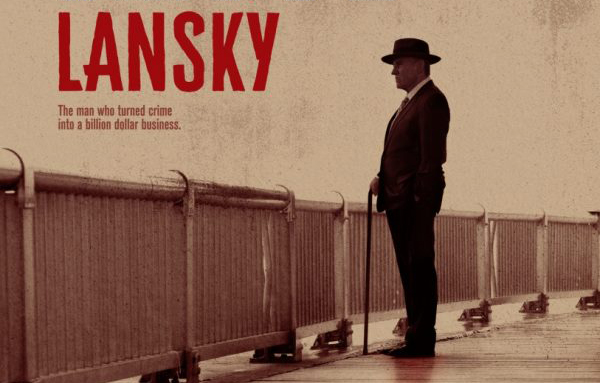
Film Review: Lansky (dir by Eytan Rockaway)


Over the course of his long and distinguished career, Harvey Keitel has only been nominated once for an Academy Award.

And, amazingly enough, he wasn’t nominated for any of the films for which he is best remembered. He wasn’t nominated for Mean Streets or Taxi Driver or any of his other collaborations with Martin Scorsese. He wasn’t nominated for playing the Wolf in Pulp Fiction or Mr. White in Reservoir Dogs. He was not nominated for The Piano. He certainly wasn’t nominated for baring his soul in Bad Lieutenant. Instead, Harvey Keitel’s only nomination was for playing real-life gangster Mickey Cohen in the 1991 Best Picture nominee Bugsy.

Bugsy was one of the many films to be made about the life of Bugy Siegel, the reputedly psychotic gangster who left New York for Hollywood and who later helped to create the wonderland of Las Vegas. In both the movie and real-life, Siegel was gunned down by his former associates, who felt that he was recklessly wasting their money out in the middle of the desert. It’s generally agreed that the order to murder Siegel was given by Lucky Luciano and Meyer Lansky, two of Siegel’s long-time friends and business partners. In Bugsy, Lansky was played by Ben Kingsley. Kingsley was also nominated for Best Supporting Actor. Unfortunately, whenever two actors from the same film are nominated for an Oscar, they usually end up canceling each other out. That’s what happened in the case of Bugsy, with both Kingsley and Keitel losing the Oscar to City Slickers‘s Jack Palance.

30 years after Busgy, Harvey Keitel once again acted out of the story of the death of Bugsy Siegel. Except, things time, Keitel played Meyer Lansky, Mickey Cohen was nowhere to be seen, and the film was called Lansky.

Of course, there’s more to Lansky than just the falling out with Bugsy Siegel. As you can tell from the film’s title, it attempts to deal with Lansky’s entire life. The film starts in 1979, with a friendly but terminally ill Meyer Lansky meeting with a writer named David Stone (Sam Worthington). David desperately needs the money that would come from writing the only authorized biography of Meyer Lansky. Lansky, knowing that he’s dying, wants to tell his story. Of course, Lansky has a few conditions. David can only publish the book after Lansky has died and David is not to talk to anyone about anything that Lansky tells him. David agrees.

From there, the film jumps back and forth in time. We watch the young Lansky (played by John Magaro) as he teams up with Lucky Luciano (Shane McRae) and Bugsy Siegel (David Cade) to change the face of organized crime. Along the way, he gets involved in the casino business, the CIA, and the Cuban revolution, and he fights Nazis at home and abroad. Lansky turns organized crime into a business and, as a result, becomes known as “the Mob’s accountant.” The FBI hounds him for almost his entire life, determined to discover where he’s hidden the millions of dollars that he’s rumored to have earned through his crimes.

While Lansky tells his story to David, the two of them form a slightly uneasy friendship Lansky is friendly and curteous but, as becomes clear as the film progresses, he’s still as capable of ordering a murder as ever. David, meanwhile, is being pressured by the FBI. They want him to become an informant and to press Lansky for information on where he’s hiding his money.

Lansky is a film that requires some patience. The first hour or so is a bit messy, with the film awkwardly trying to strike a balance between the flashbacks and the scenes of David talking to Lansky. At times, the film becomes a bit of an odd buddy picture, with Lansky offering David some unexpected life advice. However, once the FBI starts pressuring David, things pick up. The arrival of the FBI adds some much needed tension to the film’s storyline. As you watch the main agent (played by David James Elliott) pressure David into becoming an informant and essentially put his life at risk, it’s hard not to contrast Lansky with the men who are determined to put him away. Lansky may be a criminal but he has a code of ethics and, most importantly, he doesn’t harass innocents. The FBI, though, has no problem with bullying and manipulating informants and witnesses, all in the name of trying to figure out where a dying man is hiding his money. When the attention shifts from Lansky telling his story to Lansky outwitting the FBI, the film takes on an entirely new feel. When a smug FBI agent flies all the way to Israel in search of Lansky’s money, it’s impossible not to cheer a little when he gets outsmarted.

Due to the film’s flashback structure, Harvey Keitel is not in as much of Lasnky as you might expect. And yet he dominates the entire film. He perfectly captures both Lansky’s determination and his grim humor. Even facing death, Lansky is determined to keep control over every situation. In the film’s most powerful moments, he discusses what it’s like to be an outsider in America. Lansky knows that, as a Jew, he’ll never be fully accepted by the establishment. So, instead of begging for hand-outs, Lansky created his own establishment, one that operated in the shadows but which ultimately proved to be as successful as any corporation. When Lansky discovers that the American government is pressuring Israel to refuse to grant Lansky citizenship, Keitel perfectly captures both Lansy’s pain and his defiance. It all leads to a haunting final scene of Lansky on the beach. Appropriately enough, Meyer Lansky is alone.

Lansky is a both a portrait of a fascinating life and a tribute to the talent of Harvey Keitel. It may require some patience but that patience will be rewarded.

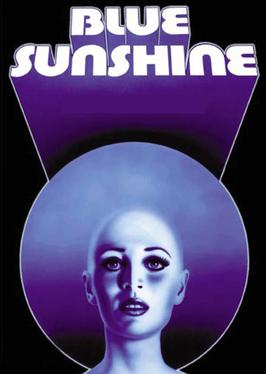
Scenes That I Love: The Blue Sunshine Kicks In


Today’s scene that I love comes from Jeff Lieberman’s 1978 film, Blue Sunshine.

If you haven’t seen the film, Blue Sunshine is the nickname for the acid that a group of characters dropped while in college during the 60s. Unfortunately, ten years later, all of them are losing their hair, suffering from extreme migraines, and turning into psycho killers. It’s the worst acid flashback of all time!

This is a pretty good film, one that uses the horror genre as a way to explore the contrast between the idealism of college and the realities of the real world. It’s also, as you can see in the scene below, quite suspenseful and more than a little frightening.

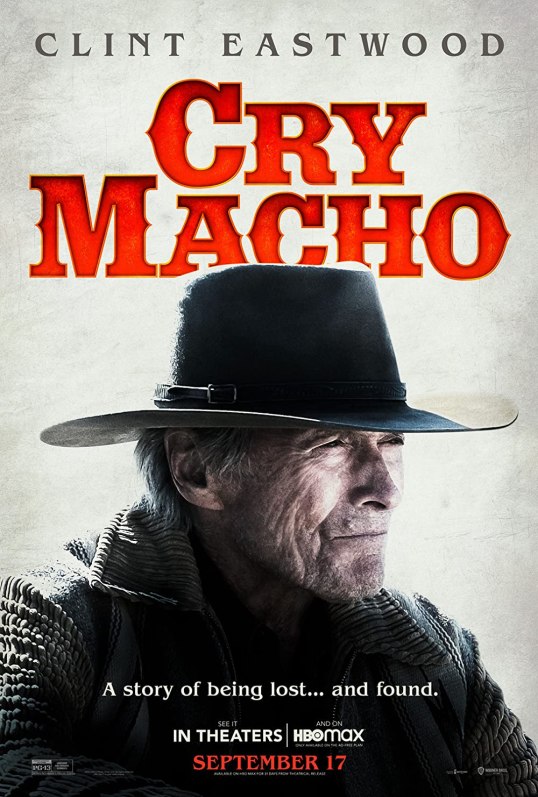
Film Review: Cry Macho (dir by Clint Eastwood)


I like Clint Eastwood.

That can be a dangerous thing to admit nowadays. Clint is not a popular man on social media. The older critics have yet to forgive him for endorsing Mitt Romney over Barack Obama in 2012, despite the fact that Eastwood’s empty chair speech was quite a bit tamer than some of the other criticisms and insults that were being lobbed at both Obama and Romney at the time. The younger critics are still angry that he made Richard Jewell, a film that was seen as criticizing the press at a time when Trump was doing the same thing, this despite the fact that Eastwood never endorsed Trump in 2016 or 2020. (Beyond having a strong individualistic streak, Eastwood’s films are usually apolitical.)

He’s one of those cultural figures that drives Twitter crazy. No one can deny that he’s a film icon and that he’s directed several good and a handful of great films. But, because he doesn’t seem to care what the online crowd thinks and probably isn’t even totally sure what Twitter is, there’s this need to try to tear him down. As such, I wasn’t surprised when his latest film, Cry Macho, received mixed reviews. At this point in the game, any film that Eastwood makes is going to be criticized.

Don’t get me wrong, of course. Sometimes, the criticism is correct, even if it is more motivated by personal animus than anything else. Some of his recent films have been a bit weaker than his earlier ones. I wasn’t a fan of Jersey Boys but I figured that Eastwood was in his 80s and he probably had always wanted to do a musical and, if anyone has earned the right to cross a few things off of his bucket list, it’s Clint Eastwood. Having the three men at the center of The 15:17 to Paris play themselves is something that worked better as an idea than in the actual execution. J. Edgar was a mess and so was Hereafter.

And yet, for every weak Eastwood film, there’s also a recent film that reminds us that he’s still a good director and that he’s still far more willing to explore new territory than some of his contemporaries. The Mule is a film that, like Cry Macho, received mixed reviews but which looks better with each subsequent viewing. Sully was a moving tribute to professionalism and grace under pressure and featured one of Tom Hanks’s best performances. American Sniper was far more nuanced that most critics were willing to admit. All of these films received mixed reviews, even the Oscar-nominated American Sniper. All of them have benefitted from reevaluation.

Will Cry Macho be another Eastwood film that will be embraced in later years? It’s too early to say but I think it will be. Now, again, don’t get me wrong. Some of the criticism that the film has received is justified. In Cry Macho, Clint plays a rodeo rider who, a year after being forced to retire due to a back injury, is hired to go down to Mexico and track down Rafo (Eduardo Minett), the teenage son of a wealthy businessman (Dwight Yoakam). Clint Eastwood is 91 years old and, let’s just be honest, he looks like he’s 91 years old as well. Thirty or even twenty years ago, Clint would have been perfect for the role of Mike Milo. Today, Clint is a bit too old for the role and it’s hard not to notice that, whenever Mike does throw a punch in the film, the scene is edited so that we see the fist and we see the results of the hit but we don’t actually see the punch itself. Clint is old in this film and, even more importantly, he comes across as being old.

But you know what? It almost doesn’t matter. He may be old but he’s still Clint Eastwood. He’s a pop cultural icon. He’s a legend. He epitomizes an era that Cry Macho acknowledges is coming to an end. It’s a bit of a meandering film. Though Rafo’s mother refuses to allow him to leave with Mike, Rafo still sneaks into Mike’s truck and travels with him to the border. Along the way, some men working for Rafo’s mother try to stop them from leaving Mexico. There are a few small action scenes but they’re not what the movie is about and it’s significant that this is a rare Eastwood film in which no one, not even the main bad guy, dies. Instead, the movie is about Mike and Rafo bonding on the road and discussing what it truly means to be macho. Mike is someone who has spent his entire life being “macho” but now he’s old and he’s broken down and he’s realizing that there’s more to life than just trying to live up to some sort of idealized version of manhood. Rafo is young and Mike is very old but, over the course of the movie, they both learn the same lesson. It’s okay to just be yourself. That may be a simple lesson but it’s one worth hearing.

As a director, Eastwood leaves room for the story to wander a bit but he still keeps the action moving at a steady pace. He gets good performances out of his cast. Despite being miscast, he still manages to gets a good performance from himself, though you may cringe a little at his insistence of still trying to present himself as being a romantic lead. (This was played for laughs in The Mule.) The film’s cinematography, courtesy of Ben Davis, is breathtaking. Even while helping Rafo leave the country, Mike falls in love with Mexico and, looking at the beautiful landscapes in this film, you can’t blame him. All in all, it’s a good film. If it had been made a few decades earlier, it would have been a great film but still, this is Eastwood at his most gentle and self-reflective. Future reviewers, free from the need to appease the online mob, will appreciate this film more than the modern ones.

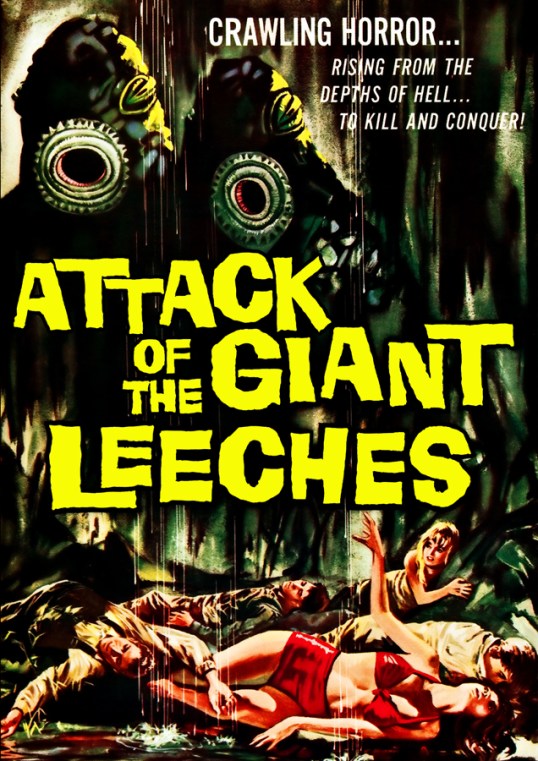
Horror On The Lens: Attack of the Giant Leeches (dir. by Bernard Kowalski)


For today’s public domain horror film, I present to you 1959’s Attack of the Giant Leeches. This 60-minute film is a classic Drive-in film. While it has its slow spots, it also features an iconic performance from Yvette Vickers, who is like one of my favorites of the strong, confident, unapologetically sexy women who dominated the old B-movies. (Plus, she was only 5’3 and it’s not easy being brave when you’re having to look up at everyone. Trust me, I know.) This short little film is steamier than Louisiana in August and is full of bayou atmosphere.

I have to admit that I’m kinda freaked out by the scenes of people floating underwater in this film. And leeches … agck! Don’t even get me started on leeches. Especially giant leeches…

Lisa Marie’s Week In Television — 10/10/21 — 10/16/21


I didn’t watch much TV this week.  I’ve kind of made the decision to hold off on a lot of shows until after October so no Dancing With The Stars or The Voice for now.

Here’s what little I did watch:

Allo Allo (Sunday Night, PBS)

With the Gestapo looking to arrest Rene, Rene was forced to disguise himself by wearing a putty nose.  Yes, the nose did get smashed.  Yes, Rene did try to smoke a cigar.  Yes, the nose did catch on fire.  Rene, being the bravest man in France, ripped those nose off and threw it out the cafe, where it promptly exploded.  It was an interesting episode.

Bar Rescue (Weekday Mornings, Paramount Network)

I watched two episodes on Monday morning.  Judging from all the yelling and the scowling, apparently there is no more important job in America than being a good bar owner.

Friday the 13th: The Series (Yahoo)

I’m still having fun watching and sharing this series on the Shattered Lens!

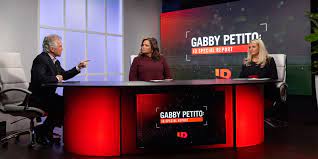
Gabby Petito: ID Special Report (Wednesday Night, ID)

This didn’t really reveal anything about the case that I didn’t already know.  John Walsh showed up to say that he thinks Brian Laundrie is still alive.  I agree but, at the same time, I’m not sure if sending Dog the Bounty Hunter after him is the best way to eventually capture him.  So many people are using the Petito case to build up or reboot their own brand that I fear that Gabby herself is getting forgotten in the rush.  My heart breaks for her and her family.

The Office (Thursday Night, Comedy Central)

It watched an episode on Thursday.  It was from the final season.  Andy got out his guitar and started singing.  It was cringe city.

Open All Hours (Sunday Night, PBS)

Help I’m Being Held Prisoner, Granville painted on the store window.  No one came to his aid.  This is the darkest British sitcom that I’ve ever seen.

Parking Wars (Weekday Mornings, A&E)

A&E’s tribute to fascism continues to be must-viewing for anyone who wants to understand how authoritarianism took root in the United States.  I watched a few episodes on Monday morning while I was straightening up around the house.  There was one terrifying parking cop in general, who kept complaining about people making excuses but who, at the same time, seemed to feel that she was a victim just because people didn’t appreciate getting ticketed.  Giving out tickets to the guilty is one thing.  Whining because people aren’t kissing your ass in response is another.

Survivor (Wednesday Night, CBS)

I wrote about this week’s episode here.

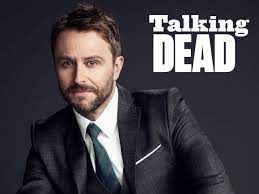
Talking Dead (Sunday Night, AMC)

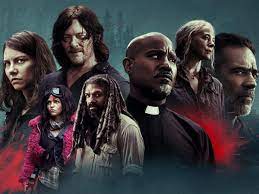
In the past, I was often bored with The Walking Dead but charmed with Talking Dead.  This season, I’ve pretty much had the opposite reaction.  Every good episode of The Walking Dead is followed by a boring Talking Dead.  It doesn’t help that Talking Dead also has to hype up stuff like World Beyond.  It’s been a long time since that night that Chris Hardwicke shed a tear while discussing the death of Herschel.  (We miss you, Scott Wilson!)

The Walking Dead (Sunday Night, AMC)

I wrote about this week’s episode here!

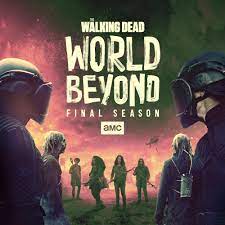
Walking Dead: World Beyond (Sunday Night, AMC)

Eh, who cares?  I set the DVR for it.  I watched it.  It didn’t interest me.  It feels too much like Walking Dead fanfic, to be honest.  I guess I’ll give it another chance next Sunday but, so far, this show just is not holding my interest at all.  It’s like the CSI: Cyber of The Walking Dead franchise.

The TSL’s Grindhouse: Dead in Tombstone (dir by Roel Reine)


In the 2013 film, Dead in Tombstone, Danny Trejo plays Guerrero De La Cruz, an old west outlaw who is loyal to his family, who has no problem robbing banks, but who also is not a fan of unnecessary bloodshed. Even though the film opens with Guerrero and his gang gunning down a posse of men, that’s just because they were saving the life of Red (Anthony Michael Hall), who just happens to be Guerrero’s half-brother. No sooner than you can say, “In what world could Danny Trejo and Anthony Michael Hall possibly be related?,” Red is asking Guerrero to help him pull off a daring robbery.

Guerrero helps Red because Guerrero is all about family. Unfortunately, Red is all about money and, not wanting to share the loot after the robbery, he promptly guns Guerrero down. Not only does Red shoot Guerrero but he insists that each member of the gang shoot him as well, implicating all of them in the crime.

Guerrero dies and promptly goes to Hell, where he’s met by Lucifer (Mickey Rourke). Guerrero doesn’t want to go to to Hell. He wants to get revenge. He offers to send a lot more souls down to Hell if Lucifer gives him a chance to return to the world of the living so that he can kill Red and the former members of his gang. Amused, Lucifer agrees but with a condition: Guerrero only has 24 hours to kill all six of his killers and Guerrero has to do all of the killing himself. He can’t hire someone else to do it or ask anyone for help. Guerrero agrees.

Unfortunately, as Guerrero soon discovers, he’s not the only one who wants Red dead. He’s going to have to move quickly if he’s going to kill all the members of the gang before Calathea (Dina Meyer), the wife of a sheriff killed by Red, gets a chance to do it herself!

Dead In Tombstone is one of those films that sounds a lot more interesting than it is. The concept behind the film is actually a pretty neat one and I like the idea of Guerrero actually having competition. This isn’t one of those westerns where everyone patiently waits their turn to go after the bad guys. The entire world wants these guys dead! Plus, who wouldn’t be excited about the idea of watching Danny Trejo and Mickey Rouke act opposite each other? With his weathered features and stoic demeanor, Danny Trejo is the perfect choice to play an outlaw and, for that matter, Rourke’s gravelly whisper and permanent smirk are put to good use in the role of the Devil. And while Anthony Michael Hall might seem like an odd choice to play Danny Trejo’s half-brother, he’s still properly villainous and loathsome in the role of Red.

And yet, the overall film itself is a bit uneven. The film looks good (especially for a straight-to-video project) but it never really seems to develop any sort of narrative momentum and there’s more than a few slow spots. At times, the film seems to be unsure of just how seiously it wants to take itself and, as a result, the story exists in a kind of limbo between being a straight western with supernatural elements and send-up of the whole genre. The end result is pretty uneven but the dream combination of Rourke and Trejo still makes it worth watching.

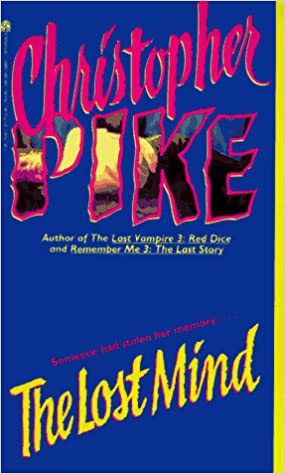
Horror Novel Review: The Lost Mind by Christopher Pike


First published in 1995, this is an odd one.

The book opens with our main character waking up in middle of the wilderness. She has no idea who she is or where she is. She doesn’t know why she’s covered in blood. What she does know is that there’s another girl lying a few feet away from her and she’s been stabbed to death! Did the living girl kill the other girl? She knows that she didn’t but, at the same time, she also knows that everyone will assume that she did.

It’s only after our main character stumbles across her car that she discovers that her name is Jenny. It’s only when she drives to a nearby town that she discovers that she lives with her overworked mom and her little brother. Apparently she goes to school and she has a job but Jenny can’t remember the specifics of any of it. Also, Jenny has a best friend named Crystal and they’re so extremely close that people are shocked whenever they see that Jenny is by herself. In fact, no one has seen Crystal for a while. Where could she be …. uh-oh.

Now, if this was an R.L. Stine novel, this is where you would expect some sort of cutesy twist to kick in. This is where you would look up from the book and says, “Ah-ha! I bet Jenny actually is Crystal and Jenny is just some imaginary character that she created to help her deal with a past trauma!” However, this is not an R.L. Stine novel. This is a Christopher Pike novel and Christopher Pike was always a hundred times darker than R.L. Stine ever was. If Stine always ended his books with a return to normalcy and maybe a joke or two, Pike’s novels took his characters to Hell and usually abandoned them there.

Even as she tries to figure out what type of life she’s led up until losing her memory, Jenny finds herself having dreams and visions where she’s in another person’s body, watching as they smoke hash, commit murders, and perform occult ceremonies. Soon, Jenny is investigating just what exactly it means to have a soul and whether or not a soul can move from one body to another. And, as she discovers more about the circumstances of Crystal’s death, she’s forced to consider just how far she’ll go to get revenge….

AGCK! Seriously, this is pretty dark stuff for a YA novel. I would have had nightmares if I had read this when I was a child. But that’s the thing with Christopher Pike. When he told a horrific story, he didn’t hold back. Instead, he created a world where happy endings often did not exist. The Lost Mind is dark and morbid and, even reading it now as an snarky and sarcastic adult, the book’s mystery was still intriguing. The book started out with a murder and it ended with a bang. Someone needs to turn this one into a Lifetime film.

Book Review: Murder By Design: The Unsane Cinema of Dario Argento by Troy Howarth


Ah, Dario Argento.

That Argento is responsible for some of the greatest horror and suspense films of all time, everyone agrees. At the same time, there’s a tendency amongst critics to be unfairly dismissive of his post-Opera films. The claims that Argento either lost his touch or that he ceased to care about his films or that Asia Argento is somehow to blame for the uneveness of his later films have themselves become clichés, repeated by people who really should know better. Obviously, any director is going to struggle to follow-up the string of masterpieces that Argento directed early on in his career. And yet, the claim that Argento’s later films aren’t worth watching simply does not hold up under scrutiny. Unfortunately, these claims became even more widespread with the release of the unnecessary remake of Suspiria. When it become obvious that Luca Guadagnino’s film was a pretentious disaster, his online supporters responded by trying to destory the legacy of Argento’s masterpiece.

That’s why I’m grateful for Troy Howarth’s Murder By Design. Published in 2020, Murder By Design examines the life and the work of Dario Argento. It’s a combination of a biography and a critical analysis and it’s probably about as fair of an examination of Argento’s controversial legacy as I’ve ever read. Howarth, of course, writes about the films that everyone agrees are brilliant but, even more importantly, Howarth also gives the same amount of consideration to the films that are usually dismissed, like Phantom of the Opera and The Stendhal Syndrome. Though Howarth is hardly a blind Argento cheerleader — he’s critical of many of Argento’s later films — he also doesn’t give in to the temptation to lazily dismiss everything that Argento directed after 1985. He approaches Argento as both a fan and a scholar, critical but open-minded. As a result, he not only provides an interesting look at Argento but also a look at the development of post-World War II film industry and at the growth of horror as a genre.

Even better, Howarth explores all of Argento’s work. That includes the screenplays that he wrote before directing his first film. That includes the films that he produced and the television shows that he hosted. He makes the case for Argenton as an artist whose influence and vision goes far beyond just the films that he’s directed. Troy Howarth is one of the best writers about Italian cinema out there and Murder By Design is a must-read for anyone serious about Argento.