I like dancing. I like the country. What better music video to pick for Oscar Nomination Tuesday?
Enjoy!
I like dancing. I like the country. What better music video to pick for Oscar Nomination Tuesday?
Enjoy!
Welcome to Retro Television Reviews, a feature where we review some of our favorite and least favorite shows of the past! On Mondays, I will be reviewing Hang Time, which ran on NBC from 1995 to 2000. The entire show is currently streaming on YouTube!

Having lost the tournament in California, the Tornadoes are back in Indiana!
Episode 3.13 “The Perfect Girl”
(Directed by Patrick Maloney, originally aired on October 25th, 1997)
Coach Fuller finds himself subbing as the teacher of the school’s cooking class. Thinking that the class will be an easy A, Michael, Teddy, Danny, and Julie all enroll in the class …. which, doesn’t really make any sense as they’re high school students and there are few high schools that will let you randomly enroll in a class halfway through a semester. Add to that, they’re specifically enrolling in the class because Fuller is teaching it but what are they going to do when the regular teacher comes back?
It turns out that Fuller expects them to take his cooking class seriously and, when they screw around and even try to pass off a Stadium-bought pie as their own work, Fuller threatens to give them all Fs. Seeing as how they randomly entered the class, couldn’t they just as randomly drop out before getting their final grade? I’m really not sure how this high school works. Eventually, the four of them get serious and make a real pie. Of course, Teddy trips and accidentally smashes it into Fuller’s face. Strangely enough, Danny did the exact same thing to a rival coach in the previous episode.
Meanwhile, Mary Beth enters a modeling contest and makes it to the finals. When she doesn’t win, she considers getting plastic surgery. As someone who was once told that the only thing keeping me from potentially becoming a star was a nose job, I could relate. And, much like Mary Beth, I did consider getting that nose job. Ultimately, I didn’t because I actually like my imperfect nose. It’s a physical feature that I shared with my mom and just about everyone else in my family. Mary Beth, thankfully, also declines to get plastic surgery, largely due to overhearing Vince talking about how beautiful she is. Awwwwww!
Episode 3.14 “Blood Drive”
(Directed by Patrick Maloney, originally aired on October 25th, 1997)
Kristy is tying to organize the school blood drive.
Mary Beth is trying to organize the school dance.
Danny helps Kristy because he likes her. That’s not a surprise since Kristy bears a strong resemblance to Sam, the former team manager who broke Danny’s heart at the start of the second season. Unfortunately, Danny gets jealous when he meets the handsome doctor who will be helping to draw the blood. Danny almost ruins everything with his jealousy but then, he somehow convinces an actual NBA star to show up and give some blood. The audience goes crazy. Kristy, however, informs Danny that she’s not ready to date anyone. (Seriously, Kristy, you’re only in high school for a limited amount of time. You might as well try to have some fun.)
Meanwhile, Vince nearly ruins Mary Beth’s dance because of his inability to find a good band. Finally, he finds a really cool old guy who plays an accordion. Woo hoo! The dance is saved.
Finally, I guess Julie broke up with that Jason guy because now she wants Michael to ask her to the dance. However, Michael is insecure because he can’t dance. Teddy tries to teach Michael how to dance and, even though it’s a really silly scene, Anthony Anderson gets so much into it that you can’t help but be charmed. Anyway. Julie fakes an ankle sprain so that Michael, seeing that she won’t be able to dance, will ask her to be his date and it works. Yay! I just hope this relationship works out better than every other relationship Julie has had. Chris cheated on her. Josh and Jason both mysteriously vanished. Michael seems to be a good guy, though.
This was a sweet episode. Hang Time was at its best when it just let the teens be teens.
I assume this music video is about vampires. Regardless, it’s certainly atmospheric.
Enjoy!
Welcome to Retro Television Reviews, a feature where we review some of our favorite and least favorite shows of the past! On Sundays, I will be reviewing the made-for-television movies that used to be a primetime mainstay. Today’s film is 1974’s The Elevator! It can be viewed on YouTube!
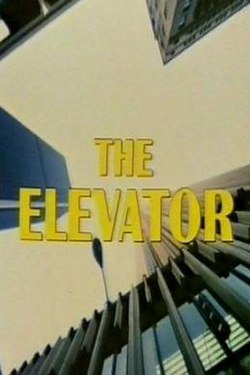
Marvin Ellis (Roddy McDowall) hates his job. He’s been assigned to be the manager of a new high-rise office building. Parts of the building are still under construction but that hasn’t stopped the company that owns it from selling out office space. When Mrs. Kenyon (Myrna Loy) comes by and asks to look at the top floor penthouse, Ellis agrees. In public, Ellis is always friendly and always courteous. It’s only under the most stressful of circumstances that Ellis reveals that he feels as if the building has been built of out lies and cheap material.
Ellis and Kenyon soon find themselves in a stressful situation when they are trapped in an elevator. Of course, they’re not alone in the elevator. There’s also Dr. Reynolds (Craig Stevens), his wife (Teresa Wright), and his mistress (Arlene Golonka). And then there’s Robert Peters (Barry Livingston), a teenager who has inherited a fortune. And finally, there’s Eddie Holcomb (James Farentino). Eddie has a suitcase full of money that he’s stolen from an office in the building. He’s also got a loaded gun. And, perhaps worst of all, he has an intense fear of tight places. The longer that he’s trapped in the elevator, the worse his claustrophobia becomes.
Because the building isn’t really finished yet, the elevator’s alarm button doesn’t really work. Other than the passengers trapped inside, the only people who know about the stalled elevator are Eddie’s partners-in-crime. Irene (Carol Lynley) is Eddie’s girlfriend and she just wants to get the situation resolved with as little violence as possible. Pete (Don Stroud) is Eddie’s sociopathic friend. Pete is not only determined to rescue Eddie and retrieve the suitcase. He’s also determined to take care of any potential witnesses by killing everyone on the elevator.
The Elevator is a disaster film, along the lines of Airport and The Towering Inferno. Due to the hubris of a faceless corporation, a group of people find themselves trapped in a potentially catastrophic situation. Some of them react with bravery. Some of them react with cowardice. All of them get a chance to reveal a bit of who they are on the inside. Some might say that being trapped in an elevator is not quite as bad being trapped in a fiery skyscraper or being a passenger on a airplane that’s being held hostage by a mad bomber. Technically, they’re right but I am also going to admit right now that I absolutely hate elevators and I try to avoid them whenever I can. I always say that this is because running up and down several flights of stairs is a good way to keep my legs looking good and certainly that’s part of it. But an even bigger reason is that I dread the thought of being stuck in a confined space with a bunch of strangers. If I was on an elevator that was stuck between floors, I would probably lose my mind. I have a hard enough time just standing in line for longer than 3 minutes. As directed by Jerry Jameson, The Elevator does as good job of capturing the feeling of being trapped in a small space. It’s not a film to watch if you have claustrophobia.
As for the cast, Myrna Loy is a delight as the eccentric Mrs. Kenyon. And seriously, how can you dislike any film that gives Roddy McDowall a monologue about how much he hates skyscrapers? It’s an entertaining, if undemanding, film. After watching The Elevator, I’ll keep taking the stairs.
Again, this was another week that was, for the most part, dedicated to watching movies. Here’s a few thoughts on the television that I did watch.
Abbott Elementary (Wednesday Night, ABC)
This week was not only an Ava episode but it also featured a cat so you know I enjoyed it!
The Brady Bunch Hour (YouTube)
I watched and reviewed the first episode of The Brady Bunch Hour! I’ve got 8 more episodes to review and, to be honest, I’m kind of feeling like I’m going to regret this decision. The pilot was amusing because it was so corny and …. well, bad. Unfortunately, corny and bad can only be entertaining for so long. I know I’m probably going to get bored with this show after the 4th episode but, at the same time, I also know that it’s something that I need to watch and get out of my system. I guess it’s better to suffer than to always wonder.
Football Game: Bengals vs Ravens (Sunday Night, NBC)
Jeff and I watched a football game on Sunday night. Jeff’s from Baltimore so we were rooting for the Ravens but they lost to the other team and they also lost their chance to go to the Super Bowl. That seems kind of unfair, to be honest, but I guess you only get one chance to win a game in football. What I find strange about football is that each quarter is only 15 minutes long but each game seems to last a little over four hours. If I was in charge of the NFL, I would get the clocks in the stadiums checked out because I think they’re running slow.
One thing I really hate about football is when the losing players start crying at the end of the game. That always breaks my heart. It’s just a game, I want to tell them. You all still have so much living to look forward to!
The Cowboys are playing tomorrow and I hope they win because, if they don’t, everyone down here is going to be whining about it for the next nine months.
Hell’s Kitchen (Thursday Night, FOX)
The black jackets have been handed out. It seems kind of obvious that Alex is going to win this season so there’s really not much suspense. That said, it’s always nice to see Chef Ramsay actually being nice and encouraging for once.
The Mary Tyler Moore Show (Hulu)
I watched a few episodes on Tuesday. I actually lost track of how many I watched but the one that I remember was about a clown getting stepped on by an elephant. It made me laugh! I might have to binge this show later. I wonder why I didn’t review this show instead of the Brady Bunch Hour. Oh well! Hindsight is 20/20.
Night Court (Tuesday Night, NBC)
I watched the first two episodes of this new reboot series on Tuesday. They didn’t really do much for me, though I do like Melissa Rauch so I hope the show can settle on a consistent tone over the next few episodes. I was glad that Dan at least trimmed his beard but he really needs to just shave the whole thing off. I don’t know what it is with older actors and their need to grow big, Santa Claus-style beards.
Project Greenlight (YouTube)
I watched the last two episodes of season three on Thursday. John Gulager finished filming Feast and, unlike other Greenlight winners, his film actually looked like a real movie. It’s a bit weird to watch a show like Project Greenlight now and listen to everyone talk about how much they respect the opinions of Harvey and Bob Weinstein. I can also see why Chris Moore declined to return for the fourth season reboot because I doubt it was fun to be continually portrayed as being the angriest boss in Hollywood.
Welcome to Retro Television Reviews, a feature where we review some of our favorite and least favorite shows of the past! On Saturdays, I will be reviewing California Dreams, which ran on NBC from 1992 to 1996. The entire show is currently streaming on YouTube!

This week, California Dreams is all about family.
Episode 3.10 “Daddy’s Girl”
(Dir by Patrick Maloney, originally aired on November 19th, 1994)
Tiffani is worried that her father (Rod Arrantis) is lonely being a single man who spends all of his time studying humpback whales. So, she decides to set him up with Ariel (Kristine Sutherland), who is also a humpback enthusiast. (Wait, that sounds weird….) Somewhat distractingly, Ariel is played by the same actress who played Zack Morris’s mother on Saved By The Bell so it’s easy to spend this entire episode wondering if maybe she divorced Derek Morris after Zack graduated from high school and Tiffani and Zack are about to become stepsiblings.
Anyway, things are great at first but then Tiffani gets jealous and tries to break up her father’s relationship by revealing the Ariel has a police record. Unfortunately, Tiffani doesn’t actually bother to take a look at the record before barging in on her father’s date and it turns out that Ariel only has two unpaid parking tickets. Today, of course, Ariel would be thrown in prison for the tickets and locked up while the FBI, CIA, and NSA searched her twitter account for any negative remarks about the government’s COVID policies. However, 1994 was a more libertarian time and everyone on the show understood that parking tickets were no big deal.
After her father ends his relationship to keep Tiffani happy, Tiffani realizes that she was in the wrong. That means that it’s time to save the relationship by singing a song!
The thing that bothers me about this episode is that Tiffani is a hundred times brattier than Lorena was when they all visited Lorena’s father’s ski resort and yet nobody accuses Tiffani of being spoiled. That’s a bit of double standard. That said, there was one funny scene in which a horrified Tony realized that there was nothing that Mr. Smith enjoyed talking about more than humpback whales. “I’ve got to get back to work,” Tony said. “I’ll just tell you about them while you work,” Mr. Smith replies (or words to that effect). It made me laugh.
Episode 3.11 “Family Tree”
(Dir by Patrick Maloney, originally aired on November 26th, 1994)
For history class, the Dreams are investigating their family trees. Jake reveals that his grandparents were refugees from Eastern Europe. Sam reveals that her ancestors built the Great Wall of China. Lorena turns out to be related to both Benito Juarez and Mario Lopez. Tiffani is forced to research both the Smiths and the Joneses. Amazingly, it appears the genealogical research is so easy that all you have to do is check out a few books from the library.
Tony is upset to discover that his earliest known ancestor was a slave so he makes up a story about being descended from an emperor. Everyone is really impressed. “That’s wonderful, Tony,” the very white teacher announces, “especially since most African-American can’t find anything before the Civil War.” She said it in such a cheerful and condescending manner that it immediately made me think of the incredibly awkward episode of The Love Boat in which Captain Stubing took it upon himself to explain black history to Isaac.
Eventually, Tony is visited by the ghost of one of his ancestors and he finally decides to be honest about his background. This episode was well-intentioned and nowhere near as bad as the infamous Running Zack episode of Saved By The Bell. A bit of the humor was a bit awkward. For a show that was ground-breaking in the diversity of its cast (at least as far as TNBC shows were concerned), a lot of the humor is still based on stereotypes and the same studio audience that cheered Tony for embracing his identity also laughed whenever Lorena spoke Spanish. For the most part, though, this episode worked and it gave William James Jones a chance to do something more than just be the goofy comedic relief.
(Incidentally, I love family tree projects. I’m Irish on my father’s side and Italian/Spanish on my mother’s side.)
Next week, it’s a double dose of Jake as he takes up smoking and considers losing his cool!
Cheer up, people!
That, of course, is mostly a message to myself. I’m not depressed. Instead, I’m just exhausted. I’ve been up since Thursday, trying to catch up on all the movies that I still need to see before posting my personal picks for the best of the year and I imagine that I won’t be getting any sleep until Tuesday evening. You want to talk about exhaustion? Try watching Avatar: The Way of the Water and Black Panther: Wakanda Forever, one after another. For two thoroughly ludicrous films featuring an underwater civilization, they’re good enough. But they’re also very long. Fortunately, Puss In Boots: The Last Wish woke me right up.
Anyway, this video and this song woke me up too. Positive energy, people! Keep it positive!
Enjoy!
Welcome to Retro Television Reviews, a new feature where we review some of our favorite and least favorite shows of the past! On Fridays, I will be reviewing The Brady Bunch Hour, which ran on ABC from 1976 to 1977. All nine episodes can be found on YouTube!
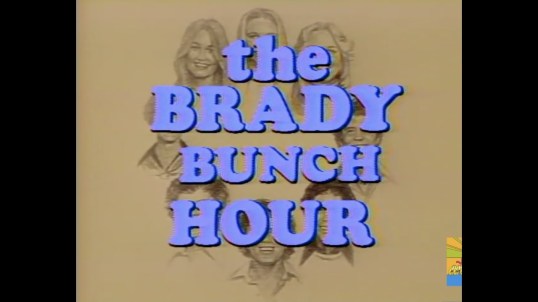
The year was 1976 and cocaine was very popular.
Well, seriously, how else do you explain the existence of The Brady Bunch Hour? Produced by Sid and Marty Kroft, The Brady Bunch Hour imagined a world in which the Bradys got their own variety show. Now, this could have made sense if the show had been hosted by “the stars of the Brady Bunch” but instead, in this show, Mike Brady specifically abandoned his job as an architect so he and the family could move to Hollywood and star on a variety show.
Almost all of the Bradys returned to do the show. Eve Plumb balked at signing a five-year contract and, as a result, Geri Reischl was cast as Jan Brady. Barry Williams, who was starring on Broadway in Pippin, returned to play Greg “Music is My Life” Brady. Maureen “Marcia” McCormick was also excited to get a chance to dance and sing. Susan “Cindy” Olsen was excited over the prospect of appearing in skits. (She was told that the skits would be SNL-style skits.) Both Christopher “Peter” Knight and Mike “Bobby” Lookinland were aware of their own musical limitations. Knight eventually agreed to return when he was told that he wouldn’t have to do much dancing or singing. Lookinland tried to get out of appearing in the show by demanding a lot of money. To his surprise, the producers not only paid him what he asked for but his demands led to everyone else getting a bigger paycheck as well. Ann B. Davis had left acting to work for a church but she appeared on the show as a “guest star.” Florence Henderson, who had the most singing and dancing experience of anyone in the original cast, was not enthusiastic about The Brady Bunch Hour but she agreed to give it a shot for the fans and the kids.
Actually, the most enthusiastic member of the cast was Robert Reed. Reed, who rarely had a good word to say about his time on The Brady Bunch (though he did get along with the rest of the cast), was surprisingly enthusiastic about getting to dance and sing despite not being very good at either one of those things. Alone amongst the cast, he reportedly never lost his enthusiasm for the Brady Bunch Hour.
But enough background! Let’s take a look at this bizarre, only in the 70s type show!
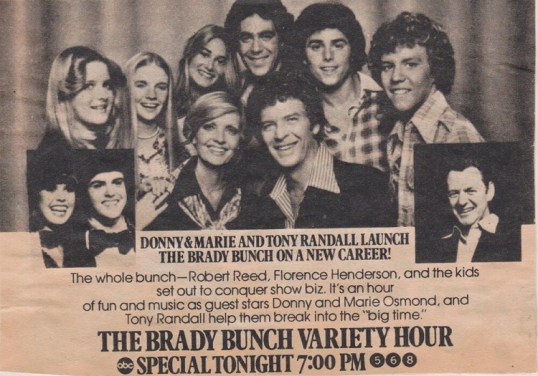
Episode 1.1 “The Brady Bunch Variety Hour”
(Dir by Art Fisher, originally aired on November 28th, 1976)
We open with a line of dancers doing kicks in a front of a swimming pool. On the screen behind the dancers, the faces of the Brady Bunch are projected. We immediately notice that Jan is now played by Geri Reischl and she’s the only one of the kids who appears to be sincerely happy to be there. While the other members of the Bunch are obviously struggling to smile, Fake Jan can’t wait to get out on stage and perform. And she quickly gets that opportunity when the family comes out to perform Baby Face. While the Bunch sings an off-key rendition of the song, the dancers dive into the pool. The audience goes crazy as the announcer says, “Ladies and gentleman, the Brady Bunch!”
This performance only lasts for two minutes but it’s hard not to notice that all of the members of the Bunch appear to be totally exhausted by the time it’s over. Robert Reed especially looks like he’s on the verge of fainting.
With the performance over, the Bradys argue over who will be the first to speak. Carol reveals that the Bradys are each assigned a number, like at the DMV, and the Bradys are now serving “Number 27!” “Who has number 27!?” Mike demands. “Mike, check your number,” Carol says. Yes, you guessed it! Mike is 27 and he explains that he’s an architect but his family is forcing him to star on a variety show. “I didn’t want to do this,” Mike tells us. “We’re all very excited!” Carol shouts.
(Again. in real life, Robert Reed was the only member of the Bunch who wanted to do the show, despite the fact that he could neither dance or sing.)
Carol introduces the members of the Bunch. Greg says music is his life. The audience goes crazy for Marcia. Peter flirts with dancer. Jan complains, though the naturally cheerful Geri Reischl is a bit less convincing when it comes to playing bitter as Eve Plumb was. Bobby announces that he grew 2 and a half inches this year. Cindy announces she grew 3 inches. Carol explains that Mike is the first architect to have his own variety show. Maybe there’s a reason why architects are not typically given this opportunity.
Suddenly, everyone starts singing Baby Face again. Mike falls in the pool. The audience loves it.
After a commercial break, we find the Bradys (sans Mike) at the family’s new Hollywood home. The kids agree that Mike has to be dumped from the show because, as Greg puts it, “he’s not very good.” Carol tells them that Mike is their father and that he will always be a part of the act. Carol points out that Mike doesn’t enjoy wearing tights and that he’s only doing the show for his ungrateful children. Carol has a point. These kids suck.
The doorbell rings and Tony Randall, looking like he’s already realizes this is a mistake, steps into the living room. He says that he needs a script. Bobby calls him “Tony.” Randall replies, “You can call me Mr. Randall.” Bobby suggests that Tony Randall could be the family’s new father. Mike comes down the stairs, just in time to hear his family begging Tony Randall to become their new father. AWKWARD! Anyway, Tony refuses to steal Mike’s role. To me, it seems like the kid owe Mike an apology but he doesn’t get one. However, everyone does eventually agree that they love him. Then Bobby suggests Burt Reynolds could be their father.
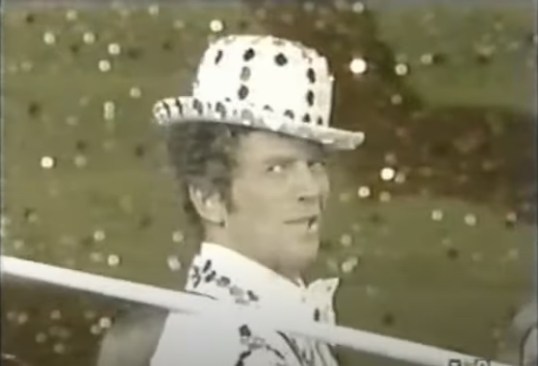
We then cut to the Brady Bunch performing One from A Chorus Line. Mike takes center stage for this performance, wearing a glittery white suit and a hat. The viewer gets the feeling that this was all done to show that Robert Reed really could perform and dance but it has the opposite effect for both him and the entire family.
At the Brady Bunch home, Greg plays his guitar. Marcia comes in and wonders if Mike and Carol were ever young. This leads to a flashback to the 1950s, with young Mike and his gang (played by the Brady boys) hanging out at the roller rink and hitting on four girls, played by Carol and the Brady Daughters.
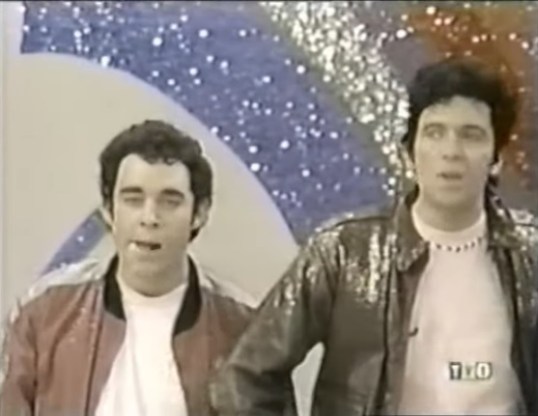
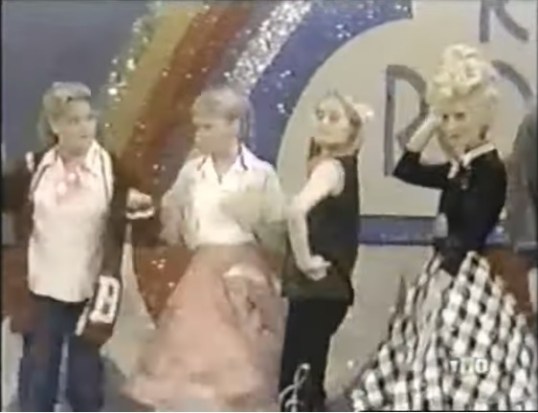
Now, you may think that things couldn’t possibly get worse than the Brady Bunch paying tribute to Grease. (Actually, Grease wouldn’t come out for another two years so I’m not really sure what the point of this skit was.) Well, it does get worse because Donnie and Marie Osmond roll up on a motorcycle and everyone sings Splish Splash. It’s not so much that the Bradys (with the exception of Fake Jan and Florence Henderson) can’t dance or sing. It’s that the audience applauds every little thing that they do, in much the same way that parents give out pity applause at a talent show at an elementary school.
Once the flashbacks ends, Greg welcomes the audience to the second half of the show. Peter pushes Greg into the pool. Greg grabs Peter and throws him in the pool. The audience loves it but, judging from the way their bodies hit the water, it’s obvious that neither Greg nor Peter were trained stuntmen and they were both risking injury for a joke that wasn’t really that funny. Oh well, no matter! It’s time for the show’s dancer to put on clown makeup and do an aquatic dance number.
Cut to the Brady Bunch’s Hollywood home, where Mike is playing Risk with the kids and bitching about how he “always lands on Yugoslavia.” You know, I felt bad for Mike when the kids were trying to replace him with Tony Randall but now I see that the kids had a point and that Mike is always whining about something.
Meanwhile, Marcia is talking on the landline about how much she loved The Boy In The Plastic Bubble. “Barbarino in a bubble!” Excuse me, Marcia …. his name is Travolta!
Continuing to play the game, Mike announces, “I just landed on East Germany and your mother already owns it!” “With three hotels,” Carol says. Uhmmm …. okay, are we playing Risk or Monopoly? WHAT THE HELL IS GOING ON!?
Peter, meanwhile, call his girlfriend and breaks their date because “My Dad is being held prisoner in East Germany.” It turns out that Peter is interested in another girl, which leads to Mike and Carol reprimanding him and teaching him an important lesson about honesty. This skit goes on forever. It’s almost bad enough to make me wish for another musical number….
Be careful what you wish for because this skit is followed by Cindy and Bobby introducing “our big brother,” and saying that they think he’s very talented. As if to specifically humiliate them, Greg comes out on stage and oversings Corner of the Sky. (Corner of the Sky comes from Pippin, a show that Greg left so that he could co-star on the Brady Bunch Hour.) Perhaps the most interesting thing about this sequence is that Bobby and Cindy both appear to have joined a cult.
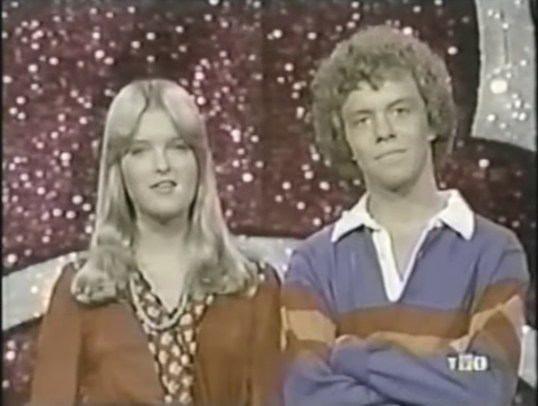
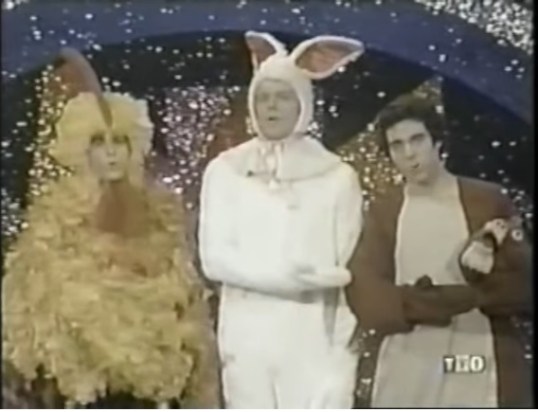
This is followed by a skit in which a disgruntled Mike and Bobby show up on stage dressed as a rabbit and a chicken. They are soon joined by Greg, who is dressed as a bear, and Tony Randall, who is dressed as himself. Tony announces that he’s going to sing a song about animals but he doesn’t want any of the Bradys to be involved. (Considering that he was the show’s “special guest star,” it’s interesting that Tony Randall only appears twice on the show and, both times, he makes it clear that he holds the Brady Bunch in complete and utter disdain.)
After Tony does his song, Alice the Maid (Anne B. Davis) appears and says that she watched the Bradys grow up. This leads to a montage of old Brady Bunch clips and Florence Henderson singing The Way We Were and, believe it or not, it actually works. For once thing, Florence Henderson could actually sing and The Way We Were is exactly the right song for her performance style. I mean, make no mistake. It’s silly and schmaltzy but it’s also kind of touching.
Finally, it’s time for the big finale! The Bradys are on stage, dressed in white, but they can’t decide what medley they want to perform. Greg wants to do music from “that Rocky Horror show!” “This is a family show!” Mike yells. Carol suggests something from The Sound of Music. The kids don’t want to do old stuff. “We’re young and we want to do young music,” Marcia says. Alice runs on to the stage and tells them to just sing something.
Greg takes her words to heart and performs Attitude Dancing, while wearing an outfit that makes it look like he’s about to jump a motorcycle over a line of school buses. 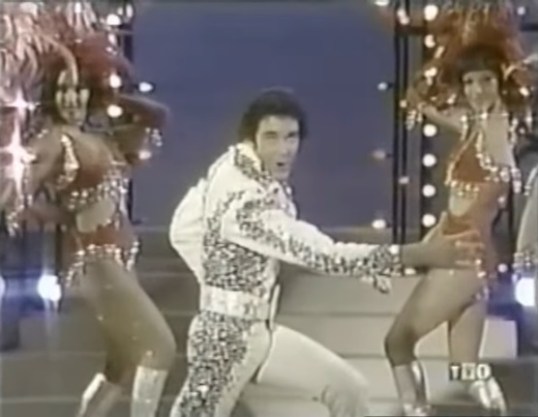
Mike and Carol sing Cheek to Cheek and then the kids sing Dance With Me. Carol responds by singing I Could Have Danced All Night, which is another good song for her. Unfortunately, the kids start to sing Do The Hustle and eventually segue into Shake Your Booty. All the Bradys dance, including an embarrassed-looking Alice. Fake Jan gets a solo and proves that, unlike the other Brady kids, she actually has a pretty good voice.
In the final comments, Carol thanks the audience. “Without you, there would be Brady Bunch,” she says. “I think I had something to do with it,” Mike says, which …. I mean, I know it’s awkward to point this out but Mike can really only take credit for half of the kids. So, really, Mike didn’t have much to do with it beyond the fact that he quickly moved on from his first wife’s death. (Or is Mike the one who got divorced? I can never keep track of who was divorced and who was widowed.)
Anyway, on that cheery note, the show ends.
Wow, that was exhausting. My main impression of the pilot of The Brady Bunch Hour is that it wasn’t good but it was impossible to look away. It was fun to watch but I can already tell that the show’s corny humor and badly-choreographed musical numbers are going to get tiresome pretty quickly. Fortunately, this thing only ran for 9 episodes so this is only going to cost me nine weeks of my life. Yay!
As always with UPSAHL, I feel like she’s singing exactly what I’m feeling.
Enjoy!
Lyrics:
I don’t recognize the girl that I see on the screen looking mean uh
I don’t wanna call my friends so I’m home staying lonely instead uh
What if I can’t be loved
What if I’m not enough
Kicking myself
When I get down
What if I can’t get up
What if I’m always stuck
And who can I ever trust
Spiral again out of my head
I…
I wanna get into my body
And let my skin do the talking
I wanna feel like I’m myself again
I wanna get into my body
I don’t need anyone on me
Just serotonin rushing to my head (I wanna get)
I don’t
Wanna open up to anyone, cause if I do, they might run
And I won’t
Waste another night, and tell a lie, and say “thanks that was fun”
I I I
I wanna get into my body
And let my skin do the talking
I wanna feel like I’m myself again
I wanna get into my body
I don’t need anyone on me
Just serotonin rushing to my head (x2)
I wanna get…
Into my body body body
Into my body body body
I wanna get…
CHORUS
Get into my body and out of my head
Can’t stop a train wreck, I’ll get off instead
I wanna get into my body
And let my skin do the talking
I wanna feel like I’m myself again
Welcome to Retro Television Reviews, a feature where we review some of our favorite and least favorite shows of the past! On Thursdays, I will be reviewing City Guys, which ran on NBC from 1997 to 2001. The entire show is currently streaming on Tubi!
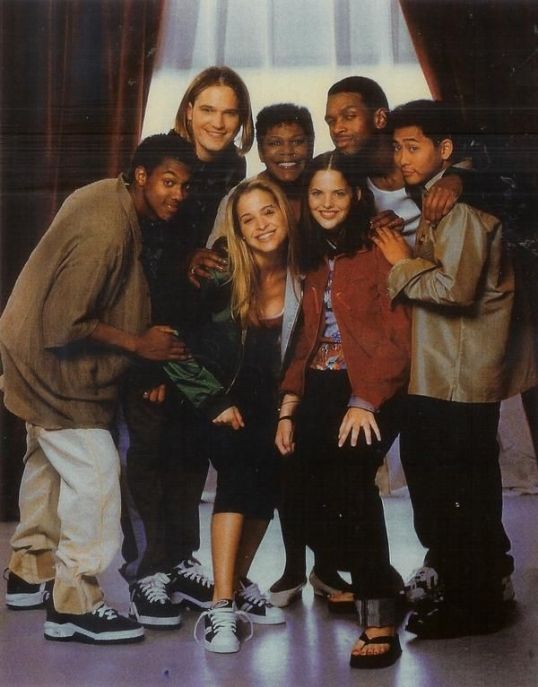
Hello Manny High! When last we checked in with the City Guys, they were starring on a reality show. Let’s see what happens this week….
Episode 3.15 “Funny Business”
(Dir by Frank Bonner, originally aired on November 6th, 1999)
Oh hey, I guess the whole reality show thing is over. In this episode, there’s no mention of Reality House or the Loft. There’s no cameramen chasing Jamal and Chris. In fact, no one mentions anything about ever having appeared on reality television. I guess this is one of those things, like the video yearbook, where they’ll explain what actually happened two seasons from now.
In this episode, Rebecca (Lisa Pepper), a Manny High graduate, returns to her former school so that she can offer three internships at her architectural firm. Of course, Dawn volunteers. And then Ms. Nobel randomly draws two names out of a bag for the other two spots and, of course, she draws Chris and Jamal! I have a feeling that every piece of paper in that bag had either Chris or Jamal’s name written on it.
Chris really enjoys the internship until Rebecca orders him to be her love slave. After Chris says that’s not appropriate workplace behavior, Rebecca threatens to flunk him unless he become her boy toy. Chris, Jamal, and Dawn secretly record Rebecca threatening Chris and Rebecca gets fired.
Every show produced by Peter Engel did at least one episode dealing with sexual harassment but I think City Guys was the only one to feature a guy being harassed by a woman. The episode is a bit heavy-handed and, over the past two and a half seasons, Chris has basically tried to get in the pants of every woman that he’s met so it seems like a little out-of-character that he would turn down the first woman who has actually shown any interest in him. I mean, if we’re going to be honest, Chris is a serial harasser who apparently can’t handle having the tables turned on him. This episode says more about Chris than it does Rebecca.
Episode 3.16 “Get Your Vote On”
(Dir by Frank Bonner, originally aired on November 13th, 1999)
Chris has two tickets to the Taxi, Taxi, “the hottest Broadway show.” Both Cassidy and Dawn volunteer to be his date.
“Two girls, one ticket,” Al says, “you in trouble!”
Well, Al, let’s think about it. First off, Chris has been trying to date Cassidy since this season began and now, she’s begging to go on a date with him. Plus, Al — YOU’RE DATING DAWN! Remember that!? I’m going to guess this episode was actually filmed before the episode in which Al and Dawn got together and NBC, as they often did, showed the episodes out of order. As I’ve said before and will probably say again …. NBC just didn’t care.
The Broadway thing is only the B-plot. The A-plot features L-Train running for reelection as Student Council president. Jamal decides to run against him because he feels that L-Train hasn’t done enough for the radio station.
While Jamal campaigns for the presidency, Dawn and Cassidy beg Chris to pick one of them to take to the Broadway show. “You in a player’s paradise!” Al tells Chris before reminding him that Chris has all the power over Dawn and Cassidy. Al …. DAWN IS YOUR GIRLFRIEND, YOU WEIRDO!
As for the election, Jamal makes a lot of promises that he can’t keep and is elected over L-Train. After Ms. Nobel informs him that the student council has no money and he’ll have to hold a fund raiser to keep all of his promises, Jamal decides to have a carnival on the roof of the school. I have to admit that I’m kind of amazed at how strong that roof is. I mean, they do everything on that roof!
For some reason, Jamal decides to bring a pig to the carnival. L-Train, looking for revenge, plots to set the pig on the loose but, after Jamal offers to make him vice president, L-Train abandons his evil plan. Unfortunately, the pig is already on the loose. (There’s something I never thought I’d write.) The carnival is a disaster.
“Jamal must go!” the students chant, until L-Train explains that he’s responsible for the pig getting loose.
While this is going on, Cassidy and Dawn get revenge on Al and Chris by having Cassidy’s uncle pretend to be a cop in the anti-scalping division. After Chris tries to sell the tickets, the fake cop arrests Chris and Al and orders them to hand the tickets over to Cassidy and Dawn. Ha! Take that, Chris and Al!
Jamal and L-Train make up and then Jamal resigns so L-Train can become president again. So, everything’s back to normal. Yay!
This episode wasn’t that bad, if you can overlook the plot. Steven Daniel had some good moments as L-Train. And the pig getting loose on the roof was a genuinely well-done moment. Plus, Dawn and Cassidy got to see Taxi Taxi!
Next week …. well, who knows? I’m sure it’ll be crazy whatever it is.

