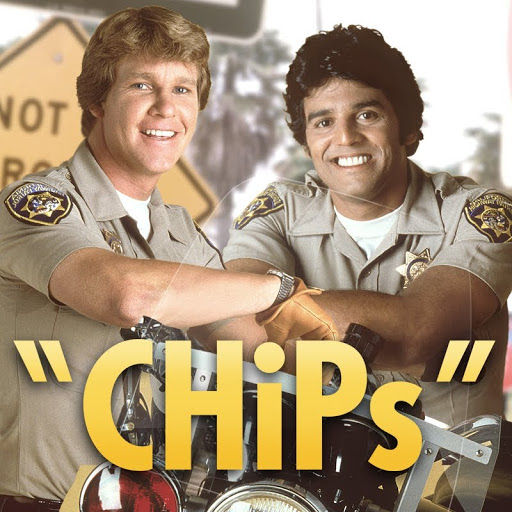
Welcome to Late Night Retro Television Reviews, a feature where we review some of our favorite and least favorite shows of the past! On Mondays, I will be reviewing CHiPs, which ran on NBC from 1977 to 1983. The entire show is currently streaming on Prime!
This week, the fourth season comes to an end.
Episode 4.21 “A Special Operation”
(Dir by Leslie H. Martinson., originally aired on May 17th, 1981)
Season 4 comes to an odd end with A Special Operation.
Getraer is injured when he crashes his motorcycle. He takes a piece of metal to the face and he nearly loses his eyesight. Luckily, the abrasive but brilliant Dr. Patterson (James Sloyan) is able to save both Getraer’s eye and his ability to see with it. However, the idealistic young Dr. Rhodes (A Martinez) worries that Patterson may have missed something. Can Patterson set aside his ego long enough to listen to his younger colleague?
Hey, wait a minute, isn’t this CHiPs?
I don’t have any way to prove this but there’s a part of me that strongly suspects the season finale of CHiPs was also a backdoor pilot for a medical show. So much time is spent with Patterson, Rhodes, and the nurses at the local hospital that it just feels like there was some hope that viewers would call in and demand to see more of Dr. Rhodes. A Martinez even gives a very Erik Estrada-style performance in the role of Rhodes.
Speaking of Estrada, he’s barely in this episode. (Ponch, we’re told, is preparing for to testify in a big court case.) It largely falls to Jon Baker to stop the assassin (Eugene Butler) who has been hired to try to take Getraer out of commission. This, of course, leads to the assassin stealing an ambulance and Baker chasing him. The ambulance flips over in slow motion but somehow, the assassin survives to that Baker can arrest him.
It was a strange end for a season that’s largely been dominated by Erik Estrada and his performance as Ponch. (Larry Wilcox, I will say, looked happy to have the finale to himself.) For the most part, Season 4 was an uneven season. The writing so favored Estrada over Wilcox that the show sometimes felt like it was turning into a parody of itself. The show that started out about two partners on motorcycles became a show about how Ponch could literally walk on water and do no wrong.
Welcome to Retro Television Reviews, a feature where we review some of our favorite and least favorite shows of the past! On Mondays, I will be reviewing Miami Vice, which ran on NBC from 1984 to 1989. The entire show can be purchased on Prime!
This week, Crockett and Tubbs are assigned to protect a witness.
Episode 5.6 “Line Of Fire”
(Dir by Richard Compton, originally aired on December 16th, 1988)
Carlos Cantero (Aharon Ipalé) is on trial for murdering Ian Sims, one of Crockett’s confidential informants. Crockett is the number one witness against him, which is a problem because Crockett just spent the last few months under the impression that he was Sonny Burnett, one of Miami’s biggest drug dealers. Cantero’s defense attorney dismantles Crockett’s testimony by pointing out that Crockett had a “psychotic breakdown.”
(And you know what? The attorney is actually very correct about that. Crockett acts shocked when his mental health history is brought up but why wouldn’t it be?)
Luckily, there is an eyewitness to the murder of Ian Sims. The FBI asks Crockett and Tubbs to keep an eye on Keith (Justin Lazard), a heavy metal fan who is willing to testify against Cantero.
I have to admit that I nearly gave up on this episode because my first impression of Keith was that he was the most annoying character to ever appear on a television show. However, I’m glad that I didn’t because this episode actually introduced a very clever twist. Keith is not actually Keith. Instead, he’s DEA agent Joey Hardin, who has been assigned to pretend to be Keith to keep Cantero from going after the real Keith. It turns out that FBI Agent Bates (Kevyn Major Howard, the “Do you believe in Jesus?” guy from Death Wish II) is crooked and he’s giving information to Cantero.
Unfortunately, Crockett doesn’t find out the truth until Joey has already been shot multiple times by Bates. (Tubbs and Crockett proceed to gun down Bates.) Joey nearly dies while the prosecutor chortles about how all of this is actually going to help him get a conviction. It turns out that the prosecutor doesn’t know what he’s talking about. The real Keith is now too terrified to testify against Cantero, leading to Cantero going free. Joey does recover from being shot but, at the end of this episode, it’s hard not to feel that it was all for nothing.
This is one cynical episode! But that’s okay. Miami Vice was always at its best when it was being cynical and this episode is a throwback to old school Vice, back when the emphasis was on how no one could trust anyone and the government was often its own worst enemy. MiamiVice was definitely a left-wing show but occasionally, it did reveal a libertarian streak. That was certainly the case with this episode, in which the war on drugs is portrayed as being unwinnable because the government is naturally incompetent. Young idealists like Joey Hardin are sent off to battle and are ultimately abandoned once they’re no longer needed.
This was a good episode. I’m still having a hard time buying that Crockett could just go back to being a cop after being Miami’s top drug lord but whatever. It’s the final season. I’ll suspend my disbelief a little.
Today, we continue to celebrate the birthday of Martin Scorsese with a song that has appeared in countless Scorsese films! When Scorsese made his Rolling Stone documentary, nonetheless than Mick Jagger commented on how odd it was that this was the first Scorsese film to not feature Gimme Shelter.
From the Rolling Stones and Merry Clayton, here is today’s song of the day.
Sometimes, on twitter (or whatever it’s called nowadays), people will just become fixated with something. Yesterday, it was this music video for a song called When The Going Gets Tough, The Tough Gets Going. I lost track of how many times I saw this video shared on Saturday.
So, I figured, why not share it here as well?
This music video was made to promote the 1985 film, The Jewel of the Nile. Along with Billy Ocean, the stars of the film — Kathleen Turner, Danny DeVito, and Michael Douglas — also appear in this video. Was Danny really playing the saxophone? No, he was not. Apparently, in the UK, this video was briefly banned because Danny was not a member of the Musicians’ Union and his miming of the sax solo went against the rules.
The UK banning something because an American broke a rule? Wow, that’s so unlike them!
Sally Kirkland stars as Monica Martel, a sexy but aging Hollywood actress who’s in lust for, and obsessed with, her boy toy, Eric Cline (Andrew Stevens). When Monica is given a chance for a big comeback, she uses her pull to get Eric the leading man role. Still, the producer Crocker Scott (Anthony Franciosa) insists that the film contain a lot of sexy scenes and Monica isn’t exactly in her prime anymore. Needing this big break, director Stephen Ross (Chick Vennera) hires a model of visual perfection, the lovely Lisa Shane (Sherrie Rose), to serve as a body double for Monica on the production. Soon Eric and Lisa are having a hot affair while Monica is being left out in the cold. Not one to accept being the odd woman out, Monica hires a private investigator to track the oversexed young lovers. When Lisa’s car blows up, luckily for us viewers she isn’t in it at the time, you can’t help but wonder if Monica has decided nobody will make a fool of her again. Not so fast though when Detective Robert Fenich (Richard Lynch) shows up on the scene carrying a serious grudge against Eric… something to do with a murderous event that occurred in San Francisco a few years earlier. It’s not easy to determine who’s hateful and who’s just horny in this sizzler from Director David A. Prior.
This was my first viewing of the 1992 erotic thriller, DOUBLE THREAT, but I’ve seen plenty of movies like it before. I was a teenager when the erotic thriller became a staple at the video store. Actor Andrew Stevens, who had starred with my hero Charles Bronson in the films DEATH HUNT (1981) and TEN TO MIDNIGHT (1983) became a star of the genre with his roles in the NIGHT EYES and SCORNED series. I remember talking my mom into letting me rent NIGHT EYES (1990) because “the guy from 10 TO MIDNIGHT is in it.” Needless to say, she wasn’t happy when the “erotic” part of the erotic thriller started, and we never finished the film. To be completely honest, outside of the budget differences and the overall talent on display, a film like DOUBLE THREAT isn’t that much different than a movie like BASIC INSTINCT (1992), which I’m sure served as an inspiration when you consider that both films came out in 1992. There is a scene where Andrew Stevens walks into a club and sees Sherrie Rose dancing provocatively that reminded me of the corresponding scene in BASIC INSTINCT with Michael Douglas and Sharon Stone. And when it’s all said and done, the plots of these types of films are all pretty ridiculous. This one’s a real doozy, and looking back there are ample clues, but I somehow didn’t figure out the big twist at the end.
I must say that Sally Kirkland and Sherrie Rose, separated in age by 25 years, are both extremely appealing in DOUBLE THREAT as the actress on the comeback trail and her beautiful young body double. This is the first time I’ve watched one of these straight-to-video erotic thrillers in a long, long, time, so I may just need to revisit a few more just for old times’ sake! Besides the sexy ladies, this specific film intrigues me due to the presence of Andrew Stevens as the ladies’ man whose motives aren’t completely clear until later in the film. A consistent presence in Charles Bronson films of the early 80’s, Stevens has had quite the career as an actor, director, and producer, almost exclusively in low budget fare like this. He’s a good-looking guy and a pretty good actor, and I’m always glad to see him involved in a production. He’s recently written and directed a documentary about his mother called STELLA STEVENS: THE LAST STARLET (2025) that I have on my watch-list. Honestly, the full cast of DOUBLE THREAT is pretty stacked, with actors like Rychard Lynch (INVASION USA), Gary Swanson (VICE SQUAD), and Anthony Franciosa (TENEBRAE) all bringing some additional class to the proceedings in their various roles.
At the end of the day, you fall in one of three categories when it comes to a movie like DOUBLE THREAT: you’re the kind of person who wants to watch a low budget erotic thriller; you’re the kind of person who says that you don’t want to watch a low budget erotic thriller, but then you watch one anyway; or you’re the kind of person who truly doesn’t want to watch a low budget erotic thriller. In my case, there’s a certain nostalgia that I associate with these types of video store genre films that were a dime a dozen in my youth. As silly as it all is, I must admit that I enjoyed DOUBLE THREAT and proudly fall in the first category!
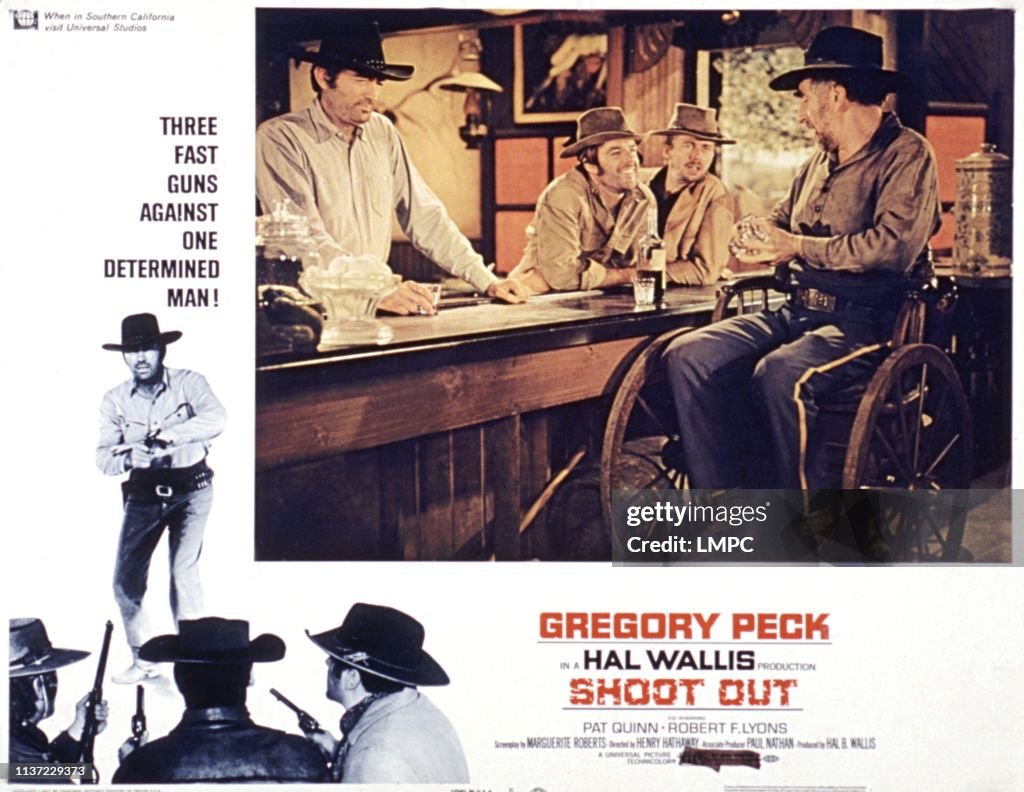
After serving a stretch at the Canon City penitentiary, Clay Lomax (Gregory Peck) gets out with only one thing on his mind… revenge on his former partner Sam Foley (James Gregory), who shot him in the back during a bank robbery, leaving him to take the rap. Foley isn’t a fool, though, so he’s hired a trio of young punks, Bobby Jay (Robert F. Lyons), Skeeter (John Davis Chandler), and Pepe (Pepe Serna) to surveil Lomax and let him know if he’s heading to his home in Gun Hill with payback on his mind. These guys are about as crazy as it gets, and they make two major mistakes. First, they kill Lomax’s friend Trooper (Jeff Corey) who lets him know where Foley is with his dying breath. Second, they kidnap the prostitute Alma (Susan Tyrell) just because they want to treat her like crap and have fun with her, which turns out to be a dumb move. Interrupting Lomax’s quest for revenge, he finds himself being forced to care for a young child named Decky (Dawn Lyn), who just may be his daughter with a lady back in Kansas City who used to be his “friend.” Looking after Decky, and then meeting and falling for the widow Juliana Farrell (Patricia Quinn), Lomax is soon facing off against his most dangerous foe, the crazed Bobby Joe, as he attempts to protect all these new people that he loves so he can move on with his life. But is it all too late?!!
I love westerns, but I must admit that I’m not the biggest fan of director Henry Hathaway’s SHOOT OUT. Hathaway has directed some of my favorite actors and movies, like Charles Bronson’s debut film with Gary Cooper, YOU’RE IN THE NAVY NOW (1951), along with the Jimmy Stewart film CALL NORTHSIDE 777 (1948) and John Wayne’s Oscar winning TRUE GRIT (1969). Unfortunately, it seems his best years are behind him, and he would only direct one more film after this, the less than excellent black action film HANGUP (1974). This isn’t exactly Gregory Peck’s best work either. Coming nine years after his Oscar winning performance in TO KILL A MOCKINGBIRD (1962), this is definitely not even close to that kind of level. Don’t get me wrong, I do enjoy his turn as Lomax when he’s the wronged outlaw looking for revenge, but I don’t really care at all for his part as the reluctant father figure trying to deal with the six-year-old Decky. I found Dawn Lyn to be more annoying than cute in the role, and this storyline distracted me from the revenge plot that I actually enjoyed. As a co-host of the “This Week in Charles Bronson Podcast,” we had the opportunity to interview Robert F. Lyons, who plays the bad guy, Bobby Jay Jones. I specifically asked him about this film and what it was like working with Gregory Peck. While he enjoyed working with Peck, his response about the film itself was telling…. “The work in there is not my work.” If you’ve watched much of the excellent actor’s work before, you can immediately understand what he means. Lyons goes so over-the-top as the spying outlaw Bobby Jay Jones, that his performance is inconsistent with the bulk of his career. Lyons told us that his performance was orchestrated by Hathaway in a way that he disagreed with, and he essentially disowns his work in the film. You can see a similar vibe with his “gang” that includes the actors John Davis Chandler and Pepe Serna.
While I’m not a huge fan of the overall direction of the storyline or the focus of some of the main performances in SHOOT OUT, I am appreciative of the genre and the classic western stars that Hathaway cast in supporting roles. I especially enjoy seeing Jeff Corey in the small but pivotal role as the wheelchair bound Trooper, Paul Fix as the train brakeman who delivers Decky and a stack of cash to Lomax, and Arthur Hunnicutt as the ranch owner who barters with Lomax over the price of a pony. Hunnicutt is a particular favorite of mine although his role here is very small. Nominated for an Oscar for his performance in Howard Hawks’ THE BIG SKY (1952), Hunnicutt is from the small town of Gravelly, Arkansas, which is not far from where my own family is from. He even attended the same college that I graduated from, the University of Central Arkansas, which was known as the Arkansas State Teachers College when he (and my dad) went there. And then there is the setup of the revenge scenario at the beginning and the final showdown at the end, classic staples of the western genre. These are enjoyable and satisfying moments as Lomax settles his scores and the bad guys get their comeuppance.
Overall, SHOOT OUT is best enjoyed by fans of old school westerns and star Gregory Peck. It veers aways from the best storylines of the genre and wastes a lot of time with uninteresting melodrama, but it does offer us another chance to see some of our great character actors doing what they do. That means something to me.
I’ve included our podcast episode with Robert F. Lyons below. He discusses SHOOT OUT at around the 1:00:30 mark.
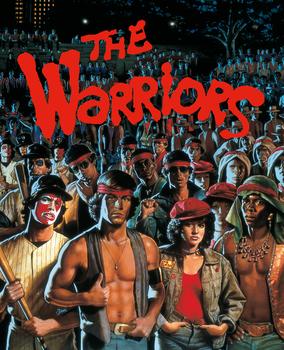
From 1979’s The Warriors, here’s a scene that I love. Playing the role of Cyrus, the man who could bring all of the gangs of New York together, is Roger Hill. Playing the role of his assassin is the great David Patrick Kelly.
Cyrus knew what he was talking about but the world wasn’t ready for him.
Death by Lightning, a four-episode miniseries that recently dropped on Netflix, tells the story of two “forgotten men,” as the show itself puts it.
Michael Shannon plays James A. Garfield, the Ohio farmer and former Congressman who, despite attending the 1880 Republican convention solely to give the nominating speech for Secretary of Treasury John Sherman (Alistair Petrie), found himself nominated for President after the convention found itself deadlocked between supporters of Former President Grant (Wayne Brett) and Senator James Blaine (Bradley Whitford). Garfield did not want to run for President and he certainly did not want to run with Chester A. Arthur (Nick Offerman), an associate of New York political boss, Roscoe Conkling (Shea Whigham). However, in November of 1880, James Garfield was narrowly elected the 20th President of the United States.
Matthew MacFayden plays Charles J. Guiteau, a failed lawyer and self-proclaimed newspaper publisher who felt that a stump speech he had given at a small rally was responsible for Garfield’s victory. Guiteau expected to be appointed to a position in the Garfield administration, perhaps as Consul to France. In those days of no Secret Service protection and an open White House, Guiteau was one of the many random office seekers who managed to get a face-to-face meeting with Garfield. What Guiteau did not get was a job. While Guiteau may have deluded himself into thinking that he was an inside player, everyone else viewed him as being a pesky and disreputable character. On July 2nd, 1881, Guiteau shot Garfield in the back. After Garfield died in September, Guiteau was convinced that he would be pardoned by the newly sworn-in President Arthur. Instead, Guiteau was hanged on June 30th, 1882.
(It’s now generally agreed that Guiteau was such a bad shot that Garfield would have survived his wounds if not for the incompetence of his doctors, who probed his wounds with their bare hands in an effort to extract the bullet. Garfield died as a result of multiple infections caused by his medical treatment.)
Again, Death by Lightning describes Garfield and Guiteau as both being forgotten men. That’s not quite true. I knew who both of them were before I watched the miniseries but then again, I’m also a history nerd. As much as I don’t want to admit it, it is true that the majority of today’s Americans don’t know either Garfield or Guiteau. And yet, in 1881, America revolved around them and their fate. Everyone checked every day for news on Garfield’s health and Guiteau’s trial was heavily covered by the press. That’s something to remember whenever you hear people talking about how “history will remember” whatever may be happening in the news today. History may remember but people are quick to forget.
As for Death by Lightning, it does a good job of telling not only the stories of Garfield and Guiteau but also Chester Arthur as well. The miniseries takes place at a time when political machines dominated American politics and also at a time when the Spoils system and the widespread corruption that it engendered were both accepted as immutable political realities. Guiteau, having spent his life seeing other people receive jobs for supporting the right candidate, felt that he was naturally entitled to whatever position he requested. Guiteau’s actions actually did lead to reformation of the Spoils system, with President Arthur emerging an unlikely reformer. Never again would a random office seeker by allowed through the front doors of the White House and never again would a President casually walk around Washington D.C. without some sort of guard. With a smart script, good performances, and even a few moments of unexpected cringe humor, Death by Lighting recreates that moment in American history and it pays tribute to James A. Garfield, who was universally described by his contemporaries as being a decent man who was struck down before he could reach his full potential.
How historically accurate is Death by Lightning? That’s a fair question. Death by Lightning sticks to the established facts about Garfield and Guiteau but a scene in which Garfield’s daughter argues with him about immigration is undoubtedly meant to be more of a commentary on 2025 than 1880. I think it can be argued that no film or series can be 100% historically accurate because those who actually witnessed the events in question are no longer with us. Inevitably, the past is always viewed and recreated through the filter of the present. And indeed, it is tempting to compares Garfield and Guiteau to our modern-day politicians and activists. Guiteau, with his constant excuses for his own dumb decisions and his ranting and raving about how he speaks for the people, was a particularly familiar character. As for the modest and honest Garfield, it’s sadly difficult to think of any modern-day politicians from the same mold.
As a final note, my favorite part of this miniseries occurred during the first episode. The recreation of the 1880 Republican Convention is wonderfully entertaining. It’s amazing to think that, in the days before television coverage required political conventions to become carefully choreographed and tightly controlled, there actually was legitimate suspense about who would end up being nominated. Sadly, those days seem to be over.


 Through the Shattered Lens