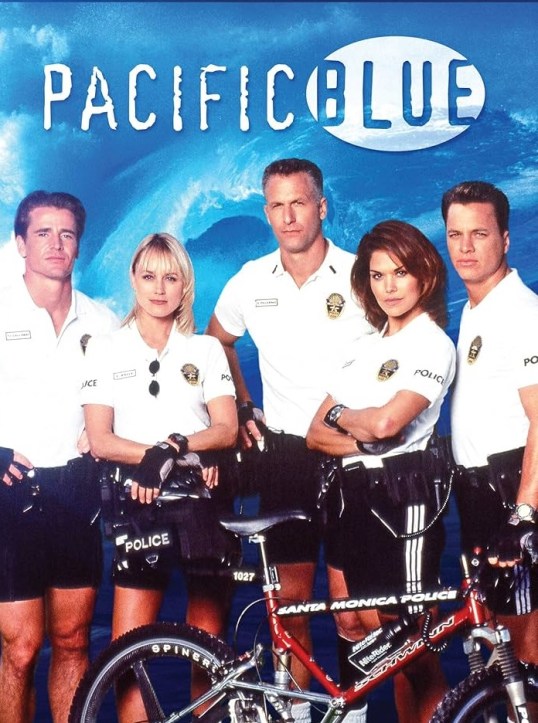
Welcome to Late Night Retro Television Reviews, a feature where we review some of our favorite and least favorite shows of the past! On Tuesdays, I will be reviewing Pacific Blue, a cop show that aired from 1996 to 2000 on the USA Network! It’s currently streaming everywhere, though I’m watching it on Tubi.
It’s a Chris epiosde. *Yawn*
Episode 3.7 “Repeat Offenders”
(Dir by Charles Siebert, originally aired on September 28th, 1997)
When this show first started, Chris Kelly was introduced as being a hotshot Navy pilot who was forced into reserve status due to her eyesight. In this episode, it’s revealed that she actually left active duty because she was involved in an accident that was the fault of her commanding officer. Rather than testify against him and run the risk of being crucified on the stand and then run out of the Navy, she instead took the blame.
Five years later, she discovers that another Navy pilot, Rebecca Santori (Liza Snyder), is facing the same dilemma. Her commanding officer — who was also Chris’s commanding officer — screwed up and Santori is being pressured to take the blame. Chris encourages Santori to fight for her right to fly. Cory suggests that Chris is pressuring Snantori because Chris feels guilty about giving up when she was in the same position. Cory suggests that Chris is putting Santori’s career at risk just to deal with her own anger and resentment. Chris says that’s not true and the show seems to expect us to take her word for it. Fortunately, things do work for Santori. She is cleared in the accident and Chris is vindicated when its determined that their commanding officer has a long history of incompetence.
This storyline had potential but Chris is just such a one-note character that it’s hard to get excited about anything involving her. Every week, it seems like Chris finds something new to get upset about and every week, anyone who suggests that Chris isn’t being totally honest about her motivations has to deal with the Chris Kelly glare of death. In order to remain sympathetic while glaring at people and telling them that they’re idiots, you have to have some shred of charisma. Chris does not and whenever she’s at the center of an episode, even when she’s in the right as with this one, I just find myself thinking about how much I would dread to have to work with her on a daily basis.
As for the other storyline, thieves are targeting foreign tourists on the boardwalk. Palermo and TC put on Hawaiian shirts and pretend to be foreign tourists. The thieves get arrested. Yay. How exciting. Bike patrol does it again.
Welcome to Retro Television Reviews, a feature where we review some of our favorite and least favorite shows of the past! On Tuesdays, I will be reviewing the original Fantasy Island, which ran on ABC from 1977 to 1984. The show is once again on Tubi!
This week, I really missed Tattoo.
Episode 7.19 “”Lost and Found/Dick Turpin’s Last Ride”
(Dir by Bob Sweeney, originally aired on April 7th,1984)
Stung by the discovery that her husband has cheated on her, Sheila McKenna (Carol Lynley) comes to Fantasy Island, looking for revenge. Her husband, Frank (Adam West), follows her and tries to save his marriage. Sheila is tempted to cheat with Frank’s business partner. Fortunately, Mr. Roarke is there to show Frank the error of his ways and, for some reason, Sheila ends up forgiving him and they leave the Island with their marriage stronger than ever.
This storyline is one that I perhaps would have been more invested in if Sheila McKenna had not been played by Carol Lynley. Lynley was the most frequent guest star on Fantasy Island. She was never particularly memorable but, in this episode, she gives a performance that can only be described as bad. Delivering her lines without a hint of emotion (and forget about having any chemistry with West), Lynley comes across as if she under the influence of serious narcotics. I was genuinely worried about her health. I didn’t really care much about her marriage.
As for the other storyline, singer Tom Jones stars as mild-mannered accountant Jack Palmer. Palmer idolizes the legendary Welsh highwayman, Dick Turpin. Roarke sends him into the past so that he can actually be Dick Turpin. Tom Jones as Turpin sings almost all of his dialogue. Jack’s wife (Dianne Kay) is also sent into the past and is kidnapped by Sid Haig.
The Dick Turpin storyline was the sort of thing that Fantasy Island did well in the past. However, despite some surprisingly strong production values, it just kind of fell flat in this episode. A big problem is that this was the type of story that would have been perfect for Tattoo but, unfortunately, the show replaced Herve Villechaize with Christopher Hewett. I have nothing against Christopher Hewett. From what I’ve read, he was apparently a very devout Catholic who was loved by all. But the switch-over from Villechaize to Hewett was definitely the moment that Fantasy Island stopped being a fantasy to watch.
It’s hard to believe that I’m nearly done with this series. I’ve been reviewing it since 2022! It’s brought me a lot of joy but, as I make my way through the final episodes of season 7, I’m ready to finally move on.
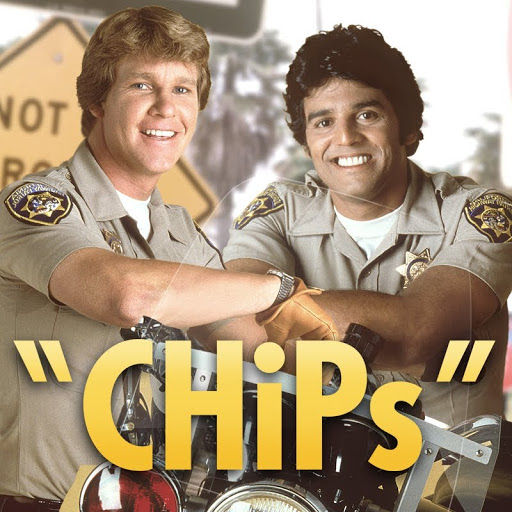
Welcome to Late Night Retro Television Reviews, a feature where we review some of our favorite and least favorite shows of the past! On Mondays, I will be reviewing CHiPs, which ran on NBC from 1977 to 1983. The entire show is currently streaming on Prime!
This week, the fifth season begins.
Episode 5.1 “Suicide Stunt”
(Dir by Michael Caffey, originally aired on October 4th, 1981)
The fifth season opens with the Highway Patrol pursuing a gang of thieves and also keeping an eye on Janos Szabo (Les Lannom), a motorcycle daredevil from Hungary who has come to Los Angeles to take part in charity show for “Highway Patrol Widows and Orphans.”
Since Hungary was controlled by the evil communists (hisssss!) when this episode originally aired, I assumed the episode would be about Janos trying to defect so that he could start a new life in the greatest country on Earth, the USA (yay!). Instead, it turned out that Janos was more concerned with spending time with an ex-girlfriend named Maria (Anita Jodelsohn) who had defected (Good for you, Maria!) and was now working for the Highway Patrol. The entire episode was pretty much scene after scene of Janos sneaking away from his handlers, stealing a vehicle, and then trying to kidnap Maria. Maria found it to be amusing. The members of the Highway Patrol were amused. Even Janos’s handlers seemed to be secretly amused. Still, when Janos set a fire outside of the CHP headquarters to distract everyone so that he could steal another car (this one with Maria in it), Ponch had no choice other than to arrest him.
“I am glad it is you who arrest me,” Janos says to Ponch, smiling like an idiot.
With Janos arrested, it falls on Jon Baker to perfect the stunts while riding Janos’s motorcycle. And Baker is able to do it easily, even the one that involves bursting through a ring of fire. So, I guess they didn’t need Janos to begin with. They should have just had Baker do it and they could have saved a lot of money. Way to waste the taxpayer’s cash, Jerry Brown!
(He was governor at the time. Then, like 30 years later, he was governor again.)
Odd episode, this one. Most season premieres try to go big but this was pretty much just another episode of CHiPs. The California scenery was nice. I always appreciate that this show was largely shot on location and, as a result, even the worst episodes have some value as a time capsule. That said, Janos was an incredibly annoying character. The fact that the show meant for us to laugh at his antics made him even more annoying. There’s only so many times you can watch one jackass try to abduct one woman before you say, “Enough already!”
Welcome to Retro Television Reviews, a feature where we review some of our favorite and least favorite shows of the past! On Mondays, I will be reviewing Miami Vice, which ran on NBC from 1984 to 1989. The entire show can be purchased on Prime!
There’s another serial killer haunting the streets of Miami. We all know what that means. It’s time to put either Trudy or Gina in harm’s way again.
Episode 5.7 “Asian Cut”
(Dir by James Contner, originally aired on January 13th, 1989)
Someone is murdering prostitutes and carving symbols into their skin. The seemingly friendly Prof. Halliwell (David Schramm) confirms that the symbols are Asian in origin. Crockett and Castillo suspect that the murderer might be a knife-obsessed Japanese gangster named Tegoro (Cary-Hiroyui Tagawa) but it turns out that they’re wrong. Gina and Trudy work undercover as escort and Trudy meets Carlos (Alfredo Alvarez Calderon), a man with a kink for being beaten. Carlos wants to introduce Trudy to a friend of his, someone who is something of an expert on torture and who learned the majority of his techniques while he was serving in the CIA during the Vietnam War….
Yep, the murderer is Prof. Halliwell!
This episode was thoroughly unpleasant. That’s not necessarily a bad thing when it comes to episodes about serial killers and David Schramm did a good job of switching from being goofy to deadly. However, in this case, it was hard not to think about the fact that, in five seasons, Gina and Trudy haven’t really gotten to do much other than pretend to be escorts and get threatened by serial killers. For once, Gina was the one providing support while Trudy was the one put in jeopardy but it still otherwise felt very, very familiar. Even the twist that the killer was a former CIA agent who specialized in torturing enemy combatants felt just a bit too predictable. (On Miami Vice, anyone who is former CIA and not named Castillo always turns out to be a murderer.) The torture scenes were so drawn out that they ultimately felt a bit gratuitous.
Today’s song of the day is The Harder They Come, taken from the soundtrack of the 1972 Jamaican film of the same name. This film and Jimmy Cliff’s performance and the soundtrack are all often credited with introducing reggae to the rest of the world.
Well they tell me im a pie up in the sky Waiting for me when i die But between the day your been and when you die They never seem to hear or even cry
So as sure as the sun will shine im going to get my share now of whats mine And then the harder they come the harder they’ll fall One and all Ooh the harder they come the harder they’ll fall One and all
Well the oppressors are trying to keep me down Trying to drive my underground And they think that they have got the battle won I say forgive them lord, they know not what they done
Cause as sure as the sun will shine Im gonna get my share now of whats mine And the harder they come the harder they fall One and all Ooh the harder they come the harder they fall One and all
And i keep on fighting for the things i want Though i know when your dead you cant But id rather be a free man in my grave Than living as a puppet or a slave
So as sure as the sun will shine Im going to get my share now whats mine And then the harder they come the harder they fall One and all Ooh the harder they come the harder they fall One and all
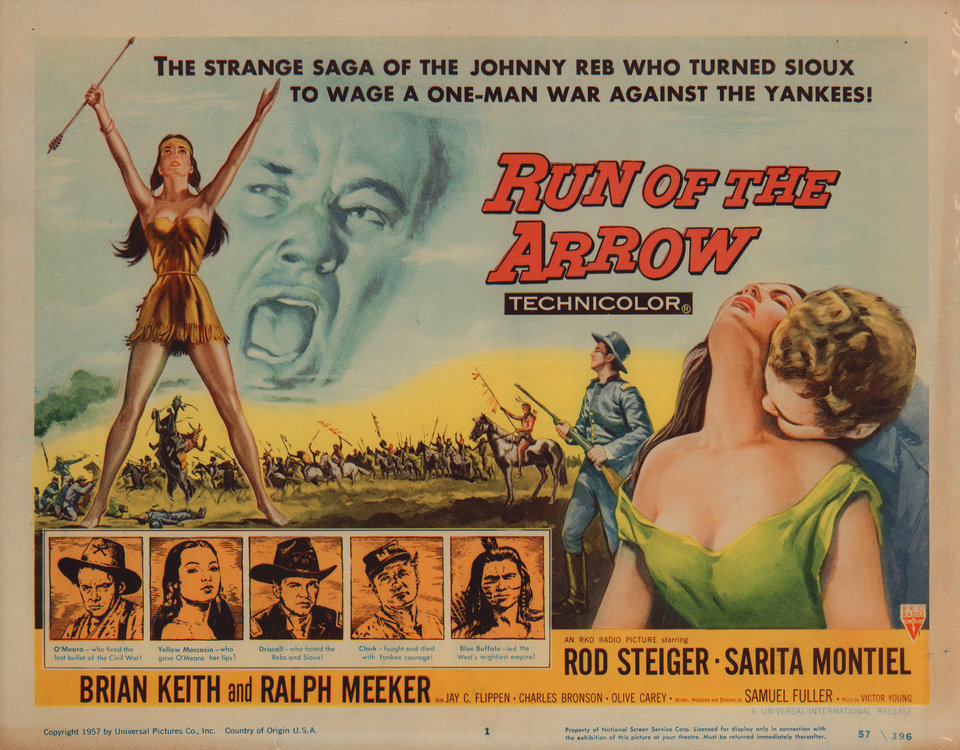
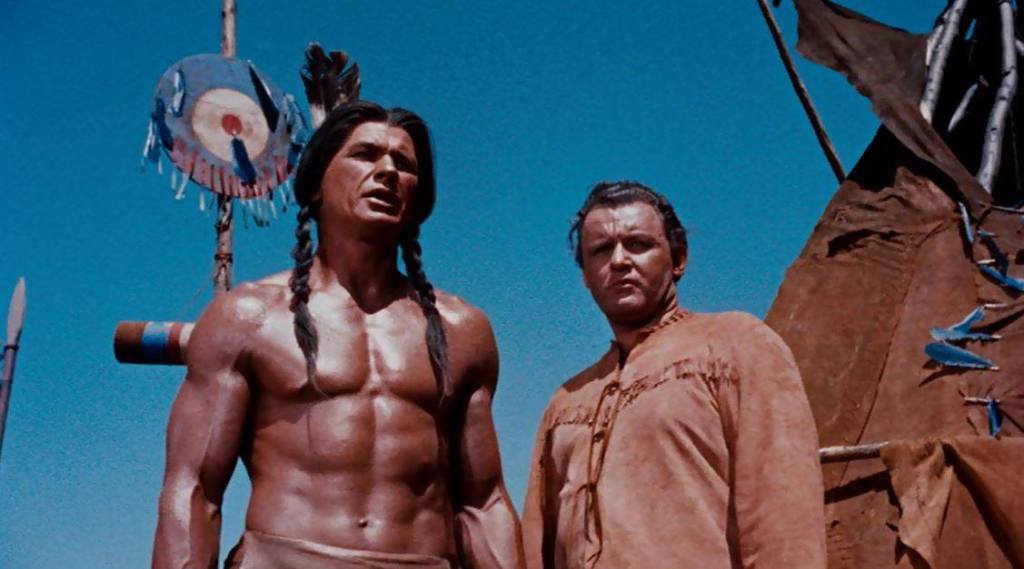
RUN OF THE ARROW opens up on April 9th, 1963, with confederate sharpshooter O’Meara (Rod Steiger) shooting a Union lieutenant named Driscoll (Ralph Meeker). This turns out to be the final shot fired in the Civil War as General Lee is in the process of surrendering to General Grant. It also turns out to be Driscoll’s lucky day, as a slight warping of the bullet causes O’Meara’s aim to be off just enough for him to survive. With no more war to fight and with a heart full of hate for the Yankees, O’Meara declares himself to be a man without a country and decides to head out west towards the land of the Indians. As part of his travels he happens across Walking Coyote (Jay C. Flippen), an aging, renegade Sioux scout who’s headed back home to die. Walking Coyote takes O’Meara under his wing and teaches him the Sioux language, as well as many of their customs. When they’re captured by a band of Sioux warriors led by Crazy Wolf (H.M. Wynant), and are being prepared to be killed, Walking Coyote invokes the “run of the arrow”, a ritualistic game that could save their lives. Unfortunately, no one has ever survived the run of the arrow. But today, it seems there’s a first time for everything, as O’Meara survives just long enough to be found, hidden, and saved by the beautiful Indian squaw Yellow Moccasin (Sarita Montiel). Yellow Moccasin nurses him back to health and presents him to her tribal chief, Blue Buffalo (Charles Bronson), who spares his life since he survived the run. Blue Buffalo also welcomes O’Meara into their tribe and allows O’Meara and Yellow Moccasin, who have fallen in love, to get married and adopt the mute orphan boy, Silent Tongue, as their own son. Things seem to be going well until Sioux Leader Red Cloud (Frank DeKova) and Army General Allen (Tim McCoy) reach an agreement that allows for an Army Fort to be built in a narrowly defined area. While the construction of the fort is entrusted to an honest man of integrity named Captain Clark (Brian Keith), the agreement is ultimately sabotaged by the murderous Crazy Wolf, and then further by the Indian hating Captain Driscoll… yes, that same Union soldier that O’Meara shot on the last day of the war! When the fighting starts again, will O’Meara prove himself to truly be a Sioux warrior willing to kill American army soldiers, or is a part of his heart still with his country?
Director Samuel Fuller’s RUN OF THE ARROW is a movie about the damage that occurs when human beings allow their hearts to be so filled with bitterness and hate that they quit caring about other people. It’s also about what happens when those same people run into rational people of good will, and we find out if they’re still capable of even considering the possibility that their own hate has blinded them from the truth. In other words, it’s a film that’s possibly more relevant today than it was when it was made in 1957. Bitterness and hate is represented by the characters of O’Meara (Steiger), Crazy Wolf (Wynant), and Lieutenant Driscoll (Meeker). O’Meara hates Yankees, Crazy Wolf hates the white man, and Driscoll hates the Indians. The rational people of good will are the characters of Yellow Moccasin (Montiel), Blue Buffalo (Bronson), and Captain Clark (Keith). Yellow Moccasin saves O’Meara, when everyone else would have just let him die. Blue Buffalo engages in honest conversation with O’Meara and even welcomes him into their tribe. Captain Clark shows O’Meara an empathetic ear and kindness when so many others have told him to just get over himself. The actions and fates of the characters play out against this dynamic of hatred versus humanity, with the results underscoring just how tragic it is when people focus on the things that separate us rather than the things that unite us. It’s all so unnecessary, but it’s also a realistic vision of the world we live in. The film also struck me as particularly violent for a 50’s western, which also underscores that reality.
Some of the performances are very effective in the film. Rod Steiger’s Irish, confederate Sioux is an interesting character and the actor gives it his all as you’d expect. I’m a big fan of Steiger and his performance here only solidifies my respect for him. Brian Keith’s Captain Clark arrives fairly late in the proceedings and comes across as a tough, but honest man of integrity at a point when the movie really needs him. He has an excellent scene with Steiger where he debates the old confederate’s reasons for renouncing his citizenship with both sound logic, empathy, kindness and a hint of likable sarcasm all at the same time. It’s one of the best scenes in the film. And likewise, Charles Bronson, the most buff Hollywood Indian to ever strip down to a loincloth, comes across as a reasonable and kind tribal chief in his dealings. Bronson had played Indians before, but he was usually more of the renegade, warpath variety, so it was nice seeing him as a good guy here. H.M. Wynant took the renegade Indian role here which you might have expected for Bronson at the time. He’s suitably fierce but one-dimensional. The same can be said for Ralph Meeker as Lieutenant Driscoll. He’s pretty much just a stereotypical jerk. He’s good at being a jerk though! And Sarita Montiel, voiced by Angie Dickinson, is quite the beauty as Yellow Moccasin. We discussed H.M. Wynant and RUN OF THE ARROW with author Steven Peros on the “This Week in Charles Bronson Podcast.” Check out that interview below:
I’ve recently heard RUN OF THE ARROW compared to Kevin Costner’s DANCES WITH WOLVES, and there are definitely many similarities. I won’t go into all of those here, but one of the things I appreciated the most about RUN OF THE ARROW is the fact that the movie makes its feelings known about politics. In a movie filled with characters who have had their lives upended by the various decisions of political leaders, director Samuel Fuller has crafted a story that focuses most sharply on defining the quality of men based on what’s in their “hearts.” When it’s all said and done, oftentimes the only control we have is the way we respond to the events in our lives, and that’s not politics, it’s personal. To drive this home, in one of their conversations, Walking Coyote tells O’Meara that he could have been a chief if he had wanted to be. When O’Meara pushes the old scout on why he didn’t want the position, Walking Coyote responds with, “Because I hate politics!” On that point, I couldn’t agree more.
It’s a hard knock life for Michelle (Shari Shattuck). One moment she’s a hardworking teller at the local bank who loves her horse, Misty. The next moment she’s sentenced to three years in the women’s penitentiary for a crime she didn’t commit. And life is damn tough in prison. There’s the prison warden Diane (Angel Tompkins) who, when she’s not participating in lesbian dalliances with inmates, is offering Michelle protection, but only if she agrees to act as a spy for her. When Michelle says no, Diane sets her up to be brutalized by the sadistic Rita (Christina Whitaker), the bitch who’s responsible for her being in the pen in the first place! Now having to dodge the threat of rape from prison guard Smiley (Nick Benedict), as well as the constant threat of shiv-induced death at the hands of Rita, it seems Michelle may have finally received a lifeline with the arrival of a new prison guard named Rhonda (Lucinda Crosby). Rhonda seems to show some extra interest and empathy in Michelle’s plight, and she just may be in a position to help her with the wrongful conviction. That is, if Michelle can survive one more night in THE NAKED CAGE!!
Recently, I’ve been trying to watch movies I’ve never seen before that star actors or actresses who worked with Charles Bronson. Tonight, I decided to look for a film starring Angel Tompkins, a Facebook friend, who worked with Bronson in the 1986 cop film from Cannon Films called MURPHY’S LAW. In that film she plays Jack Murphy’s ill-fated ex-wife, where she gives an uninhibited and committed performance in what would have been a throwaway role for many actresses. Not Angel… she took the role very seriously and is actually quite memorable in her couple of scenes. Paul Talbot’s book BRONSON’S LOOSE AGAIN has a chapter on the film, and he was able to interview Tompkins who told of just how much effort went into to her preparation. I recommend the book to anyone interested in Bronson or those numerous actors and actresses who worked with him in the 70’s, 80’s, and 90’s. Filmed the same year as MURPHY’S LAW, I thought it might be fun to see how committed she is in the role of the corrupt warden in Cannon’s THE NAKED CAGE.
I’ll admit that I am not an expert on the “women in prison” genre of film. I did go through my Pam Grier phase that started with movies like COFFY (1972) and FOXY BROWN (1974), but did extend as deep as the Jack Hill “women in cages” films THE BIG DOLL HOUSE (1971) and THE BIG BIRD CAGE (1972). But those movies had Pam Grier in the cast which provided a couple of ample reasons for me to watch. THE NAKED CAGE does have some interesting things going for it. Like most of Charles Bronson’s 1980’s output, the movie was produced by Cannon Films, the international symbol of quality moviemaking from the 1980’s. And then there’s Angel Tompkins herself. She’s quite the sexy lady, having appeared in films like PRIME CUT (1972) and THE TEACHER (1974). Cannon Films and Angel Tompkins drew me in, but what about the film itself? Is it worth a watch?
I’ll go ahead and say that for me, THE NAKED CAGE was worth the watch. This kind of movie only works for me if I like the cast. Shari Shattuck is appealing in the lead role of Michelle, a good woman, who’s wrongly convicted, but who soon finds levels of toughness she never knew she had in order to survive. I remember Shattuck starring in films like POINT OF SEDUCTION: BODY CHEMISTRY 3 (1994) with Andrew Stevens. My wife and I also watched the entire DALLAS TV series a few years ago where Shari had an extended role in season 13. She starts out here as a sweet and innocent lady, and by the end she’s wielding guns and knives like a lifelong delinquent, and I liked it! Angel Tompkins does not disappoint as the corrupt warden who seduces the inmates in order to meet her own sexual needs, as well as manipulating them into playing her larger games of control over the rest of the prison. Overall, she plays the role pretty straight, but is once again quite uninhibited when it comes to the more mature content. To me though, the most enjoyable performance comes from Christina Whitaker as the psychotic Rita. Not content with just ruining Michelle’s life, she’s determined to murder her behind the prison walls as well. From the beginning of the film where the fugitive Rita had Michelle’s estranged husband snorting cocaine off her boobs, all the way to the final frames, Whitaker chews every piece of scenery that comes into view. She’s the character I’ll remember whenever I think of THE NAKED CAGE.
There are some things I didn’t like very much about the film. Prison guard Smiley’s sadistic rapist isn’t fun at all to watch, but his character’s fate is well deserved and somewhat satisfying when it finally occurs. Also, I didn’t care for the manipulation of the character of the drug addict Amy, played by Stacey Shaffer. She had worked very hard to beat her addiction, and in a world where many of us know people who have been lost to addiction, it’s not easy to watch her tragic fall.
Overall, if you enjoy “women in prison” films, I think you’ll probably like this one. It’s certainly not perfect, but being a fan of Cannon Films and Angel Tompkins, I thought it was an enjoyable way to spend a Friday night while I was waiting for my wife to get home from work!


 Through the Shattered Lens