Late Night Retro Television Reviews: Baywatch Nights 1.5 “Just A Gigolo”


Welcome to Late Night Retro Television Reviews, a feature where we review some of our favorite and least favorite shows of the past!  On Tuesdays, I will be reviewing Baywatch Nights, an detective show that ran in Syndication from 1995 to 1997.  The entire show is currently streaming on Youtube!
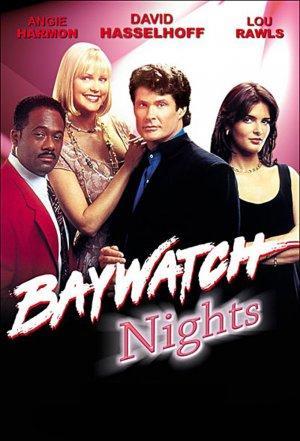
This week, Mitch and Ryan go undercover!

Episode 1.5 “Just A Gigolo”

(Dir by Martin Pasetta, originally aired on October 28th, 1995)

David Hasselhoff is a gigolo!
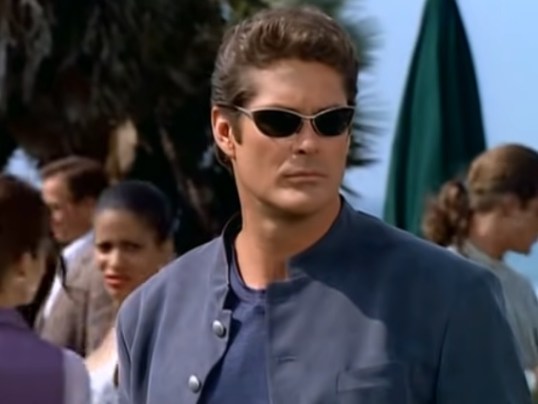
No, not really.  Mitch may be wearing sunglasses and speaking broken French but that’s just because he has gone undercover as a con artist.  He’s trying to expose the actual gigolo, a younger man named Grant Styles (Joel Beeson).  Grant swindled a good deal of money from Mitch’s friend, Julie (Candy Clark), but, because Julie voluntarily handed over the money and told Grant that he didn’t have to pay her back, no crime was committed.

“To catch a gigolo,” Mitch tells us, “I decided to become a gigolo.”  This is followed by a lengthy exercise montage.  Finally, after a week of lifting weights and jogging on the beach, Mitch is ready to make his debut at the local country club.  Accompanying him is Ryan (Angie Harmon), who is pretending to be a wealthy divorcee.  (Mitch’s aunt agrees to allow Ryan to use her mansion.)  Grant immediately starts hitting on Ryan and Mitch can only watch as Ryan flirts back.  Mitch actually starts to feel jealous and Ryan, for her part, starts to feel jealous whenever she sees Mitch flirting with the older women at the club.  Could Mitch and Ryan be falling in love?
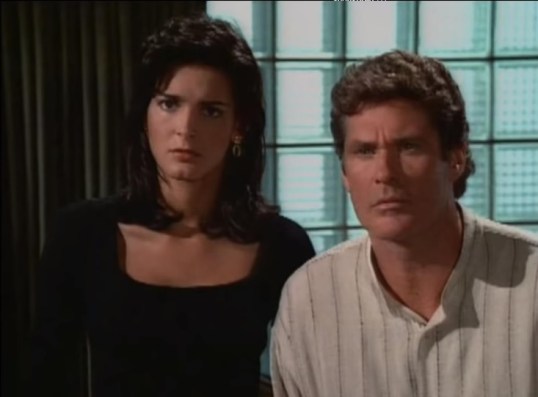
Actually, Mitch and Ryan do kind of make a cute couple.  I mean, seriously, they just look like they belong together.  From the first episode of this series, David Hasselhoff and Angie Harmon have had a playful chemistry and their personalities definitely compliment each other.  These two definitely need to get together.

For now, though, the important thing is exposing Grant and his “manager,” Margo Curtis (future reality star Lisa Vanderpump).  Though Mitch can’t stand the idea of Grant spending time with Ryan, he still has to do things like stand perfectly still while Grant beats him up because fighting back would apparently blow his cover.  (To be honest, I think the only reason the fight scene was included was so Hasselhoff could look directly at the camera and do a “Why me?” shrug.)  After Grant beats up Julie, Mitch and Ryan realize that Grant is far more dangerous than the average gigolo.  After Grant, while flying a paraglider, tries to shoot Mitch on the beach, Mitch and Ryan trick him into breaking into Ryan’s mansion so that he can be captured and sent away.

While all of this is going on, Garner (Gregory Alan Williams) and Destiny (Lisa Stahl) worked together to  catch a notorious bail jumped named Bobby Bahama (Jeff Dashnaw).  Most bail jumpers would probably try to leave the state but Bobby jumps bail and then decides to just keep hanging out at the beach and his favorite club.  Destiny meets Bobby at the club, invites him to her hotel room, and then handcuffs him to the bed.

“Kinky,” Bobby says.

No, Bobby, the term is “captured.”

I enjoyed this episode, not so much for the basic plot but for the chemistry between Angie Harmon and David Hasselhoff.  Like I said earlier, they’re an appealing couple and they have a fun chemistry whenever they’re acting opposite each other.  Any show that features David Hasselhoff pretending to be a gigolo is going to have a bizarre appeal to it but Mitch’s relationship with Ryan was strong enough that not even a rather silly storyline could sabotage it.

Retro Television Reviews: Fantasy Island 4.4 “Don Quixote/The Sex Goddess”


Welcome to Retro Television Reviews, a feature where we review some of our favorite and least favorite shows of the past!  On Tuesdays, I will be reviewing the original Fantasy Island, which ran on ABC from 1977 to 1986.  Almost the entire show is currently streaming is on Youtube, Daily Motion, and a few other sites.

This week’s journey to Fantasy Island is oddly unpleasant.

Episode 4.4 “Don Quixote/The Sex Goddess”

(Dir by Michael Vejar, originally aired on November 15th, 1980)

As always, this episode opens with “the plane, the plane” landing at Fantasy Island and Mr. Roarke and Tattoo heading out to meet their guests.  Unfortunately, as has been the case since the since the third season, Mr. Roarke and Tattoo no longer share any sort of playful banter before meeting the guests.  In fact, Roarke often seems to refuse to even look at Tattoo while speaking to him.  It’s awkward to watch because the dislike between Ricardo Montalban and Heve Villechaize is obvious whenever they share a scene.  It’s something that is easy to joke about while talking about the show but it’s far more unpleasant to actually witness.

Of course, this entire episode is rather unpleasant, which is a shame because Fantasy Island‘s greatest strength as a show was that watching it was usually a pleasant and undemanding way to spend an hour.

Take, for instance, the fantasy of Helen Hendrix (Phyllis Davis).  Helen’s fantasy is to become a “sex goddess.”  Tattoo expresses disbelief that the pretty but far from glamorous Helen could ever be a sex goddess but Roarke reminds Tattoo that, on Fantasy Island, all things are possible.  Roarke then says that Helen doesn’t realize that her fantasy could be a “a very dangerous fantasy.”

Well, Mr. Roarke, if it’s so dangerous, why did you agree to allow her to come to the Island?  In the past, Mr. Roarke has mentioned turning down many requests for fantasies.  He is apparently the final judge on whether or not someone will get their fantasy.  (Even when Tattoo granted a fantasy to someone who Roarke previously turned down, it was suggested that it was all a part of Roarke’s master plan.)  If the fantasy is so dangerous, why give it to Helen?  What is Mr. Roarke’s legal liability if someone gets killed while experiencing their fantasy?

Anyway, Mr. Roarke gives Helen a blue potion and when she drinks it, she becomes a blonde, starts wearing makeup, and gets a dress that’s far more flattering and low-cut than the borderline Amish outfit she was wearing when she first arrived at the Island.  She is now an internationally famous sex goddess, which unfortunately leads to her being kidnapped by three men (Michael Callan, Edd Byrnes, and Don Stroud) and held hostage on a neighboring island.  Eventually, Helen realizes that she’s going to have flirt her way out of captivity, which leads to a smitten Don Stroud helping her to escape.  Or, at least, he does until the potion wears off and Helen goes back being a brunette.  Stroud is shocked but, before he can strangle her, Roarke shows up and whisks Helen back to the Island.

Seriously, what a thoroughly unpleasant fantasy.  Helen comes to the island because she wants to know what it’s like to be famous and sexy and Roarke essentially allows her to be kidnapped by three men who apparently are planning on trafficking her.  Indeed, Roarke seems to suggest that this is Helen’s fault for wanting to be attractive in the first place.  Personally, I think Helen should sue Fantasy Island for all its worth.

As for the other fantasy, Paul Williams plays an eccentric Texas banker named Donald Quick.  His fantasy is to be Don Quixote.  (That’s a weird fantasy but whatever.)  Soon, Donald and his lawyer (David Doyle) are riding their donkeys across Fantasy Island while dressed up like conquistadors.  Donald saves a woman from a motorcycle gang and you have to wonder just what exactly a motorcycle gang is doing on Fantasy Island.  He saves another woman (Mary Louis Weller) from her louse of a boyfriend (Robert F. Lyons) and then he jousts with a Cadillac.  It’s silly but at least Donald finds love and David Doyle gets a few funny lines over how much he wants to sue Fantasy Island.

Honestly, this episode could have been saved if the two fantasies had intersected.  If Donald and his lawyer had turned up to battle the kidnappers and save Helen, this actually would have been an okay episode and the lawyer could have helped Helen file a lawsuit against Roarke.  But instead, the fantasies stay separate and the whole thing just feels icky.  Seriously, Mr. Roarke was not on top of his game of this week.  It might be time to give Tattoo more responsibility.

Film Review: Rustin (dir by George C. Wolfe)


In Netflix’s Rustin, Colman Domingo plays Bayard Rustin.

A Quaker, a pacifist, a leader of the civil rights movement, and a former communist, Bayard Rustin was an early advisor to Martin Luther King, Jr.  Rustin commitment to non-violent protest was a huge influence on King’s own activism and Rustin helped King to organize the Southern Christian Leadership Council.  Rustin was one of King’s closest advisors but he was distrusted by other leaders of the movement because of both his independent nature and the fact that he was a gay man at a time when homophobia was the law of the land.  In fact, Rustin opens with Rustin’s rivals, the NAACP’s Roy Wilkins (Chris Rock) and U.S. Rep. Adam Clayton Powell, Jr. (Jeffrey Wright), letting King know that it would be in his best interest not to be associated with someone like Bayard Rustin.  Rustin, thinking that King will stand with him, offers to resign from the SCLC and is stunned when King (Aml Ameen) accepts his resignation.

After spending three years in relative obscurity and watching as younger civil rights activists start to reject the non-violence that is at the core of his philosophy, Rustin comes up with the idea that will become the 1963 March on Washington.  Putting aside his hurt feelings, Rustin works with King and several other civil rights leaders to organize the March and, at the same time, he once again finds himself being attacked for being both gay and a former member of the Communist Party.  Even while organizing the march, Rustin pursues a doomed relationship with a deeply closeted clergyman (Johnny Ramey).

It’s an important story but the film itself is sabotaged by both its script and its direction.  The script, which was co-written by Dustin Lance Black, is heavy on exposition and monologues but there’s few moments in which the characters really get to come alive.  Meanwhile, George C. Wolfe’s direction is stagey and stodgy.  Visually, the film has the aesthetic of a well-produced made-for-TV movie.  For all the time that is spent on the planning of the March of Washington, the event itself is recreated in a rushed and rather flat matter.  One could argue that the filmmakers felt that the real event is so iconic that there would no way to really do it justice and perhaps the filmmakers were correct in that.  Still, one can’t help but feel that Wolfe should have at least tried to capture some of the event’s electricity.  The film, to its credit, captures the hard work that went on behind-the-scenes of the civil rights movement but there are very few moments that feel spontaneous or as if they have a spark of life actually being lived in front of the camera.

Fortunately, the film is blessed to feature Colman Domingo in the title role.  Playing a larger-than-life figure, Domingo gives a performance that is big, charismatic, flamboyant, and sensitive.  As played by Domingo, Rustin is a collection of seemingly conflicting traits.  At times, he’s confident to the point of being arrogant but, when he finds himself shunned by the other leaders of the civil rights movement, he reveals the insecurity hiding underneath the surface.  Rustin is hyperactive yet focused, angry yet forgiving, and self-absorbed yet compassionate.  One of the film’s best moments comes when Rustin responds to an innuendo-filled attack on him by throwing himself into planning every detail of the March.  Rustin is surrounded by people telling him that, as a black man and a gay man, he will always be a second-class citizen and an outsider.  Rustin refuses to accept that and Domingo captures the intelligence, wit, and determination that allowed Rustin to continue to fight, against amazing odds, for equality.

The film doesn’t tell us much about Rustin’s life after the March on Washington.  In later years, Rustin, while remaining a socialist, became a strong anti-Communist and was also an outspoken supporter of Israel.  Today’s Left would probably not have much use for the moderate Bayard Rustin and, with his commitment to non-violence, it’s doubtful that Rustin would have much use for many of them.  Despite his prominence in the Civil Rights movement and the importance of his work, Rustin is still not as well-known as he should be.  Perhaps this movie, despite its flaws, will change that.

Music Video of the Day: Eras of Us by Fletcher (2023, dir by Alexandre Moors)


Wandering around a city at night while singing is probably not the safest thing you can do but I applaud Fletcher for taking the rest and being smart enough to bring a film crew with her.

Enjoy!

Late Night Retro Television Review: CHiPs 1.5 “Career Day”


Welcome to Late Night Retro Television Reviews, a feature where we review some of our favorite and least favorite shows of the past!  On Mondays, I will be reviewing CHiPs, which ran on NBC from 1977 to 1983.  The entire show is currently streaming on Freevee!

This week, Jon and, to a lesser extent, Ponch continue to keep the highways safe.

Episode 1.5 “Career Day”

(Dir by Ric Rondell, originally aired on October 20th, 1977)

It’s another crazy week on the California highways.  A husband-and-wife team of burglars are driving around in their van and breaking into mansions.  Frat boys are stealing hearses and hiding in coffins.  A photographer and his models hold up traffic by doing a swimsuit shoot under an overpass.  A little child gets lost while walking along the Los Angeles river.

It’s a lot to deal with and somehow, it all falls on Jon and Ponch.  This is one of those episodes that leaves you to wonder where all the other members of the highway patrol are.  At one point, Sgt. Getraer comments that the highway patrol has 100 motorcycles and that 90 of them are being used.  Despite that, it seems like every crime and accident seems to happen just a mile or two away from wherever Jon and Ponch happen to be.  Occasionally, Bear (played by Brodie Greer) shows up in his police car but he always seems to wait until Ponch and Jon have already caught the bad guys.

This episode, Ponch once again damages his motorcycle by not parking it correctly.  (The motorcycle falls over and a bunch of a teenagers point and laugh.  Take that, Ponch!)  Getraer puts Ponch on desk duty but then a helicopter cop says that he needs someone to fly with him.  Ponch gets to go up in a police helicopter and help search for the missing child.  Baker, who is perfect and therefore, still has his motorcycle, is the one who actually retrieves the child and takes him home but Ponch gets to ride in a helicopter.  Seriously, I’ve been in a helicopter a few times and, once you get used to all the shaking and get over your fear of heights, it’s pretty fun.  I guess it’s a good thing, for Ponch, that he is such an incompetent highway patrolman that he can’t even park his own bike.

This episode could best be described as a “week-in-the-life” episode as it follows Ponch and Jon as they deal with all the weird things that happen on the Los Angeles highway.  The burglars bookmarked the episode, showing up at the start and then again at the end, so that they could be chased down by Ponch and Jon.  That said, the closest thing that this episode had to a real storyline was the result of Ponch pulling over his old high school principal (played by the very familiar character actor, Richard Deacon) and being asked to speak at his school’s career day.  The principal seems to believe that if Ponch can actually stay out of jail and become an authority figure, there’s a chance for everyone!  Of course, when it’s time to give his speech, Ponch freezes up and Jon has to act like his hype man.  Eventually, Ponch finds the courage to speak and turns out to be such a blowhard that the entire student body gets bored.  Indeed, as Ponch brags on himself, the line between character and actor becomes rather blurred.  Erik Estrada is not the world’s most subtle actor but he’s entertaining in the right role.

As with all of the previous episodes, the real star here was the California scenery.  The mountains and the blue skies were inviting, no matter how dangerous the highways might have been.

Retro Television Reviews: Miami Vice 1.14 “Golden Triangle: Part One”


Welcome to Retro Television Reviews, a feature where we review some of our favorite and least favorite shows of the past!  On Mondays, I will be reviewing Miami Vice, which ran on NBC from 1984 to 1989.  The entire show is currently streaming on Tubi!

This week, Castillo opens up!

Episode 1.14 “Golden Triangle: Part One”

(Dir by George Stanford Brown, originally aired on January 11th, 1985)

Okay, things are going to get a little complicated here.  This is one convoluted episode.

Crockett and Tubbs’s latest assignment has them pretending to be the head of security for a Miami hotel.  Castillo wants them to catch two crooked cops who are shaking down the prostitutes who use the hotel as their office.  Tubbs and Crockett aren’t happy about it because it makes them feel like they’re working for Internal Affairs but Castillo makes it clear that he has no patience for any dirty cops.

Unfortunately, they’re not having much success with the security gig.  The episode opens with Crockett and Tubbs subduing a guest who is freaking out on Angel Dust.  “Attack the whack!” as the Disco Godfather once put it.

Crockett decides to put on a pair of thick glasses and a pocket protector and sit by the pool.  He’s approached by Candy James (Robin Johnson), a high-class escort who asks Crockett if he wants to party.  Crockett promptly arrests her.

After Candy agrees to help Crockett and Tubbs (in return for her criminal record being wiped out of the system), Crockett and Tubbs decide to go undercover as pimps while still pretending to be hotel security guards.  When a guest named Albert Szarbo (John Snyder) and his unnamed Thai associate see Tubbs setting Gina up with her date (who is actually Zito), they decide that Crockett and Tubbs must be using the hotel as a front for their own prostitution operation.  Szarbo approaches Crockett and explains that he wants to rob all of the hotel’s safe deposit boxes.

With Candy’s help, Crockett and Tubbs discover that the crooked detectives are Herb Ross (Paul Austin) and Dan Garcia (Gary Jellum).  Ross and Garcia are arrested but are released just a few hours later.  Because they were not actually arrested by Crockett and Tubbs, they assume that Crockett and Tubbs are still just the hotel security guys but they also assume that Crockett must have snitched on them to the police and….

Wait?  What?  Seriously, how does everyone in Miami not know, at this point, that Crockett and Tubbs are cops?  They make no effort to hide the fact that they’re cops.  Even when they’re undercover, they refer to each other by their real names and spend half of their time talking about what’s going on back at the station.  Even if the criminals don’t know that Crockett and Tubbs are working undercover, you would at least expect their fellow police officers to know.

Anyway, where was I?  Oh yeah, Candy.  Candy said she would leave Miami after Ross and Garcia were busted but, instead, she shows up back at the hotel.  Crockett is not happy about this but then he finds himself being confronted by Szarbo and Ross, who claims that Crockett is a snitch.  Candy steps up and announces that she’s the snitch, saving Crockett and Tubbs’s case.

However, it turns out that Szarbo was lying to Crockett about wanting Crockett and Tubbs to be present when he robbed the safety deposit boxes.  Instead, he was just using Crockett so that he could get a look at the vault before breaking in.  Szarbo and his associate pull off the robbery and are then murdered by whoever hired them.

Castillo takes one look at the body of Szarbo’s Thai associate and realizes that he was tortured to death by associates of Chinese General Lao Li, a drug lord who Castillo tangled with before he joined the Miami PD.  The normally stoic and unemotional Castillo opens up a little and reveals that he spend three years working undercover in Thailand for the DEA.  Castillo says that they need to discover why Lao Li wanted whatever was in the safety deposit boxes.

Leaving his office and helping Tubbs and Crockett with their investigation, Castillo stuns everyone by revealing that he’s actually a total badass who speaks Thai, knows martial arts, and can handle himself in a fight.  A search of all of Miami’s Thai restaurants eventually leads Castillo to Lao Li’s assassin.  After an exciting fight with Castillo, the assassin purposefully commits suicide by swallowing his own tongue.

Back at police headquarters, Castillo, Crockett, Tubbs, Zito, and Switek takes a look at some of the items that were recovered from Szarbo’s hotel room.  Castillo has deduced that Lao Li has come to the United States and his immigration visa was probably in one of the safety deposit boxes.  He then looks at a picture of an attractive Chinese woman.  (Some viewers will recognize her as being actress Joan Chen.)  When asked who the woman is, Castillo replies, “My wife.”

This was a great episode, with a wonderfully twisty plot and a great fight scene between Edward James Olmos and Paul Tenn.  After spending the past few episodes as a glowering figure who spent most of his time standing in his office and glaring at Crockett, Castillo revealed a bit about himself and it was fun to discover that this stoic figure was actually a total badass.

Next week: Part two of Golden Triangle!

Music Video of the Day: Earthling by Lili Refrain (2023, dir by Paolo Sanna)


This atmospheric video can either be interpreted to mean that the world is going through a rebirth or it’s on the verge of ending.  It all depends on what type of mood you’re in.

I’m in a pretty good right now.

Enjoy!

Late Night Retro Television Reviews: Degrassi Junior High 1.13 “Revolution!”


Welcome to Late Night Retro Television Reviews, a feature where we review some of our favorite and least favorite shows of the past!  On Sunday, I will be reviewing the Canadian series, Degrassi Junior High, which aired on CBC and PBS from 1987 to 1989!  The series can be streamed on YouTube!

This week, the first season of Degrassi Junior High ends …. WITH A REVOLUTION!

Episode 1.13 “Revolution!”

(Dir by Kit Hood, originally aired on April 12th, 1987)

Degrassi Junior High’s first episode featured Stephanie Kaye running for and winning the office of student body president.  Stephanie flirted her way to victory, exchanging kisses for votes and asking the students to go “All the Way with Stephanie Kaye.”  Stephanie’s best friend, Voula, was scandalized but every guy at Degrassi voted Stephanie into office.  Having been elected, Stephanie swore to herself that she would be the best president the school had ever had.

As the first season progressed, it become obvious that Stephanie did not keep that promise to herself.  She got drunk at the first school dance.  She continued to snub anyone who wasn’t in Grade 8.  Stephanie developed a crush on Wheels and she spent more time trying to flirt with him than actually doing whatever it is that a student body president does.  With everyone getting tired of Stephanie’s attitude, it was obvious that it was only a matter of time before open revolution broke out.

This episode opens with Stephanie asking out Wheels, just for him to tell her that he can’t go out with her because he needed to spend his time studying for the end-of-term exams.  Miffed, Stephanie decides to make Wheels dangerous by pretending to like Joey, who has had a huge crush on Stephanie since the show began.

Stephanie is so obsessed with Wheels that she barely notices that, due to a student transferring to another school, the position of “sports rep” is now open.  The sports rep is a member of the student council who represents the athletic teams.  (I’ve never heard of a student council sports rep before.  Maybe it’s a Canadian thing.)  Traditionally, the sports rep is a member of Grade 7 and star basketball player Yick Yu wants to run for the position.  However, Stephanie decides to cancel the election and to just give the position to Joey, despite the fact that Joey is not even on a team!

Grade 7 erupts into open rebellion.  Soon, signs that announce “IMPEACH STEPHANIE KAYE” start appearing on the school walls.  Caitlin and Rick circulate a petition demanding that Stephanie step down.  After they finish their exams, the Grade 7 students storm the halls while chanting, “Out of our way, Stephanie Kaye!”

Meanwhile, Joey has been taunting Wheels about how he stole Wheels’s girlfriend from him.  However, Wheels overhears Erica and Heather Farrell talking about how Stephanie is only dating Joey to make Wheels jealous.  Wheels tells Joey and Joey asks the Farrell twins himself.  When Joey runs into the Grade 7 protestors, he announces that he doesn’t want to be sports rep because “It’s a Grade 7 position.”

Thoroughly humiliated, Stephanie has several minutes of flashbacks to the first episode of Degrassi Junior High.  Realizing that she hasn’t been very nice over the past few months, she walks home with her brother, Arthur.  (During the first episode, Stephanie ordered Arthur to not tell anyone that they were related.)  Arthur says that he enjoyed his first term of junior high.  Stephanie says that the second term is going to be totally different and much better.

While it’s good that Stephanie and Arthur’s storyline came full circle (and it also proves that the show’s writers were making some sort of effort to tell a realistic story, as opposed to just making it up as they went along in the style of Saved By The Bell), this episode is also important because this is the first episode in which Joey, Wheels, and Snake’s band is officially called “The Zit Remedy.”  This episode also featured them performing, for the first time, Everybody Wants Something, the only song that the band would ever write.

This episode also featured Mr. Raditch having a panic attack when he discovers that he’s left his end-of-term exams at home, which gave Dan Woods a chance to show off his comedic timing.  Given just how much of a jerk Mr. Raditch would eventually become in Degrassi: The Next Generation, it’s kind of nice to see him having a human moment in this episode.

And so, season one of Degrassi Junior High comes to an end.  It was a good season, without the unevenness that one often comes across in the first season of a long-running series.  This episode was absolutely everything that a season finale should be, bringing storylines to a close while hinting at future developments to come.

Next week, we start season two!

Retro Television Reviews: The Last Angry Man (dir by Jerrold Freedman)


Welcome to Retro Television Reviews, a feature where we review some of our favorite and least favorite shows of the past!  On Sundays, I will be reviewing the made-for-television movies that used to be a primetime mainstay.  Today’s film is 1974’s The Last Angry Man!  It  can be viewed on YouTube.

During the Great Depression, Dr. Sam Abelman (Pat Hingle) is a doctor who works in the slums of Brooklyn.  Dr. Abelman can be gruff.  Dr. Abelman can be crotchety.  Dr. Abelman can be, as the title suggests, a little bit angry.  He can’t help but get annoyed at how difficult it is to get his patients to pay him.  He gets easily annoyed with red tape and bureaucracy.  Dr. Abelman is an angry man.  In his eyes, he’s the last angry man.

But that doesn’t mean that Dr. Abelman doesn’t care about his patients or the community in which he lives.  Underneath his gruff exterior, Dr. Abelman is truly a man who wants to make the world a better place.  Sam Abelman is especially angry at the doctors who have abandoned the neighborhood that once supported them and who now work at hospitals that have little room for the poor.

The film focuses on Dr. Abelman’s attempts to help Frankie Parelli (Michael Margotta), a troubled teenager who has a reputation for being a bully and a petty criminal.  When Frankie starts to suffer from frequent seizures, Dr. Abelman comes to be convinced that Frankie is suffering from a brain tumor.  Dr. Abelman wants to get Frankie seen by a specialist and a surgeon but it’s difficult because of Frankie’s own bad reputation and also the fact that Frankie’s family doesn’t have much money.  Dr. Abelman uses a combination of shaming and outrage to finally get Frankie examined.  But, when it become apparent that Frankie is going to need an operation, is Dr. Abelman going to be able to get him under the knife?

The Last Angry Man was loosely based on a novel by Gerald Green.  The novel was previously adapted into a 1959 film, which starred the great actor Paul Muni in his final role.  (Muni received an Oscar nomination for his performance.)  If the novel and the 1959 film emphasized the grittiness of the neighborhood in which Dr. Abelman worked, the 1974 made-for-TV version takes place in a remarkably clean version of Brooklyn.  It’s a very pleasant slum.  There’s no trash to be seen.  The apartment buildings and the streets have the crisp look that only comes from shooting on a studio backlot.  Everyone in the neighborhood is remarkably friendly.  Even Frankie is a rather mild-mannered delinquent.  Dr. Abelman may be angry but everyone’s so nice that it sometimes seems like he’s going a little bit overboard.

The Last Angry Man was clearly meant to be a pilot for a television series and, as such, the movie’s action doesn’t really seem to build up to any sort of grand climax.  Instead, the film is more about introducing Dr. Abelman and all the quirky people in the neighborhood.  Pat Hingle was a good actor but, as Dr. Abelman, he’s all bluster with little depth.  It’s hard not to feel that both the film and the potential show would have been well-served by having Pat Hingle and Sorrell Brooke (who plays Abelman’s best friend, Dr. Vogel) switch roles.  When Sorrell Brooke gets annoyed and angry in this film, you have no doubt that the feeling is genuine.

Unfortunately, The Last Angry Man just isn’t angry enough.

Music Video of the Day: Tunnel Lights by Chelsea Wolfe (2023, dir by George Gallardo Kattah)


Today’s music video of the day is this enjoyably surreal video from Chelsea Wolfe.  The dream-like nature of this video brings to mind Jess Franco’s classic Female Vampire.

Enjoy!