Retro Television Review: Fantasy Island 4.20 “Delphine/The Unkillable”


Welcome to Retro Television Reviews, a feature where we review some of our favorite and least favorite shows of the past!  On Tuesdays, I will be reviewing the original Fantasy Island, which ran on ABC from 1977 to 1984.  Almost the entire show is currently streaming on Daily Motion.

Smiles, everyone, smiles!

Episode 4.20 “Delphine/The Unkillable”

(Dir by Cliff Bole, Originally aired on April 11th, 1981)

For our first fantasy, Dr. Paul Todd (Randolph Mantooth) is a paleontologist who feels that the first life on Earth was silicon-based and that the missing link lives underneath a volcano on Fantasy Island.  He comes to the Island with his girlfriend, Liz (Annette Funicello) and his assistant, Kyle (Alex Cord).  With Roarke’s weary approval, they head off to the volcano to search for proof of Todd’s theory.

And they do find proof!  After Kyle attempts to sexually assault Liz, she falls through a crevice and finds herself in the lair of …. well, it appears to be someone who is waring a rubber suit but Paul and Kyle are convinced that they’ve found their silicon man!  (Kyle attempting to force himself on Liz is seemingly forgotten.)  The Silicon Man appears to be immortal, which proves to be a bit of problem when it decides to carry of Liz.  But then the Silicon Man falls in a pool of lava and dies so I guess he wasn’t immortal.  At the end of the show, Tattoo suggests that the The Silicon Man was made of lava and that’s why he was vulnerable to it but …. what?

Mr. Roarke doesn’t seem to be that worried about the Silicon Man or the fact that one of the island’s volcanoes is spewing lava.  He’s more concerned with his goddaughter, Delphine (Ann Jillian).

According to Roarke, Delphine is the daughter of one of the Island’s oldest families.  She has spent the last few years off the Island, working as an assistant for a magician named The Great Zachariah (Carl Ballantine).  Delphine’s secret is that she actually does have magical powers!  She’s the one who does all of Zachariah’s tricks for him.  However, Delphine now wants to marry Greg (Don Galloway) and she doesn’t want him to know that she can move stuff with her mind and make people materialize out of thin air.  Her fantasy is to lose her powers.

Zachariah, not happy about the prospect of losing his assistant, comes to the Island and teams up with fortune-telling Madame Cluny (Doris Roberts) to trick Delphine into revealing her powers and driving Greg away.  Myself, I’m not really sure I understand why her magic powers would be a deal-breaker.  I mean, Delphine can literally do anything!  And, as we see in this episode, she only uses her powers for good.  Why would Greg have a problem with that?

On the plus side, Ann Jillian (who starred in another show that I reviewed on this site, Jennifer Slept Here) gives a good performance as Delphine and it’s easy to imagine an alternate version of the show where she played Roarke’s sidekick.  On the negative side, the rest of the show and both of the fantasies are just silly and never make any sense.

This was not a memorable trip to the Island.  Seriously …. silicon?

Scenes That I Love: Jean-Paul Belmondo in Breathless


Today would have been the 91st birthday of international screen icon, Jean-Paul Belmondo.

Belmondo spent the majority of his career in France, where he was one of the early faces of the New Wave and also a prominent action star, famed for doing his own very dangerous stunts.  In America, he was best-known for his starring turn in Jean-Luc Godard’s Breathless.  In Breathless, Belmondo was the perfect existential outlaw, living life day-by-day and obviously doomed but still so incredibly magnetic and stylish.

In tribute to Belmondo, here is a scene that I love, the final moments of Breathless, with Belmondo and Jean Seberg.

Late Night Retro Television Review: CHiPs 1.21 “Crack-Up”


Welcome to Late Night Retro Television Reviews, a feature where we review some of our favorite and least favorite shows of the past!  On Mondays, I will be reviewing CHiPs, which ran on NBC from 1977 to 1983.  The entire show is currently streaming on Freevee!

This week, Ponch rides with Getraer!

Episode 1.21 “Crack-Up”

(Dir by Phil Bondelli, originally aired on March 9th, 1978)

After causing an accident that lands Officer Baker in the hospital, street racer and tow truck drive Niles (Joey Aresco) has a psychotic break and decides that he wants to put as many police officers in the hospital as possible.  He starts driving recklessly in his tow truck, all the better to get the attention of highway patrol officers.  Soon, Officer Grossman has joined Baker in the hospital.

Meanwhile, with his partner laid up, Ponch faces his greatest nightmare.  His temporary partner is none other than Sgt. Getraer!  Getraer tells Ponch that he expects Ponch to do everything by the book.  He expects Ponch to follow orders and observe official procedure.  Ponch, however, is more concerned with saving lives and getting results than following the book.  Ponch is a rebel!

And that’s fine, except for the fact that there’s never been anything about Erik Estrada’s performance that has ever made Ponch seem like he’s actually the rebel who everyone claims he is.  Estrada plays Ponch as someone who is quick to smile and quick to brag on himself and quick to get annoyed if a motorist doesn’t pull over for him.  In short, Estrada has always been convincing when he plays Ponch as being a jackass but far less convincing when it comes to convincing us that Ponch is a cop who deliberately breaks the rules for the greater good.

While Getraer and Ponch get on each other’s nerves, Baker lies in bed and insists that he’s ready to get back on his bike.  Wanda (Phyllis Diller), who is visiting her husband in the hospital, frequently stops by to tell jokes.  When I saw this episode was going to be co-starring Phyllis Diller, I cringed because CHiPs seems like the type of show that would screw something like that up.  But actually, Diller gives a really good performance as Wanda and her scenes were the best in the episode.  She told a lot of jokes but, as she admitted to Baker, she was only joking to distract herself from worrying about her husband.

In the end, things work out.  Baker gets back on his bike.  Getraer and Ponch come to respect each other.  And, eventually, Niles the mad mechanic is captured.  To be honest, it’s kind of weird that it took so long to capture Niles.  After Baker was injured, Niles called the police to say that someone has stolen his car an hour or so before.  He also got another mechanic, Ray (Gary Sandy), to lie and provide him with an alibi.  But then, Niles went driving around in his tow truck and that’s what he was driving when he injured Grossman.  So, really, a smart cop would have said, “Hey, that stolen car belonged to a tow truck driver and now, another office has been injured by someone driving a tow truck!  Maybe we should go talk to that guy again….”

This episode was better than I was expecting, largely due to Phyllis Diller and the comedic interplay between Officers Grossman and Baker.  As always, the California scenery was the real star of the show and the state looked lovely.

Retro Television Review: Miami Vice 2.9 “Bushido”


Welcome to Retro Television Reviews, a feature where we review some of our favorite and least favorite shows of the past!  On Mondays, I will be reviewing Miami Vice, which ran on NBC from 1984 to 1989.  The entire show can be purchased on Prime!

This week, a man from the past returns to haunt Castillo.

Episode 2.9 “Bushido”

(Dir by Edward James Olmos, originally aired on November 22nd, 1985)

This week’s episode opens with yet another intricately plotted drug bust going awry.  This time, a dealer ends up dead, a DEA Agent ends up knocked out and tied up in a bathroom, and $50,000 goes missing.  Watching the tapes of the bust, Castillo is shocked to spot a familiar face on the scene.  Castillo says that Jack Gretsky (Dean Stockwell) was his partner when he was working for the CIA in Vietnam.  Gretsky has long been thought dead but there he is, on tape and ruining Castillo’s bust.

Realizing that Gretsky was sending him a message, Castillo decides to deal with the situation personally.  After visiting two CIA agents (Jerry Hardin and Tom Bower) who work out of an adult novelty shop, Castillo tracks Gretsky down to a Buddhist temple.  The two of them talk.  Gretsky reveals that he’s married to a Russian woman and that he has a son.  He asks Castillo to watch over them if anything happens to him.  The stoic Castillo agrees and then gives Gretsky a hug.  Castillo says that he has to arrest Gretsky.  Gretsky says he knows and then pulls a machine gun, forcing Castillo to kill him.  The CIA agents are happy to no longer have to deal with Gretsky.

A day later, the coroner’s office calls Vice and says that Gretsky was terminally ill with cancer and probably only had a few days left to live.  When Crockett and Tubbs go to tell Castillo, they find his badge and a note sitting in the office.  Castillo is fulfilling Gretsky’s final wish and protecting his wife (Natasha Schneider) and his son, Marty (Robin Kaputsin).  Castillo sees it as being a part of the samurai code by which he lives his life.  Meanwhile, a rogue CIA agent named Surf (David Rasche, giving a wonderfully unhinged performance) is working with the KGB to track down Gretsky’s family.

Directed by Edward James Olmos, Bushido is a wonderfully odd episode.  With a combination of skewed camera angles and deliberately eccentric performances from Dean Stockwell and David Rasche, this episode plays out with the relentless intensity of a fever dream.  (The opening drug bust even features Zito burying himself in the sand and using a straw to breathe until its time to emerge and knock out one of the bad guys.  It’s weird but it’s great.)  Olmos contrasts Castillo’s trademark stoicism with the more verbose characters played by Stockwell and Rasche and, as a result, Castillo emerges as an honorable man who hides his emotions because he knows that’s the only way to survive in his world.  To fall in love like Jack or to get cocky like Surf can only lead to one’s downfall.

After a few uneven episodes, Bushido is a nice reminder of what Miami Vice was capable of at its best.

Song of the Day: Brain Damage/Eclipse by Pink Floyd


I was torn about whether or not to listen to Pink Floyd’s Dark Side of the Moon during the eclipse because — bleh! — Roger Waters. But then I remembered that the other members of the band hate Roger Waters as well and I was able to use that to justify things. I mean, seriously, some things are just made for eclipses and that’s certainly true of the somewhat silly and portentous but still effective Dark Side of the Moon.

(Silly, portentous, and effective is also a good description of Pink Floyd as a whole.)

So, with that in mind, here is today’s special Eclipse Day song of the day. Actually, I guess I should say that these are today’s songs of the day because technically, they are two separate songs. But they might as well be two.

Music Video of the Day: Eclipse by Robert Koch, featuring Julian Marchal (2016, dir by Mickael Le Goff)


Happy Eclipse Day to all who celebrate!

The prediction down here is that it’s going to be cloudy and rainy today so we probably won’t have the best view of the eclipse.  That’s okay, though.  I’m always tempted to look straight at the sun during an eclipse and, apparently, that’s one reason why my eyesight gets worse with each passing year.  My friend Tammy says that it doesn’t matter because it will still get dark so we’ll know the eclipse is happening, even if we can’t see it.

Where as I?

Oh yeah …. enjoy!

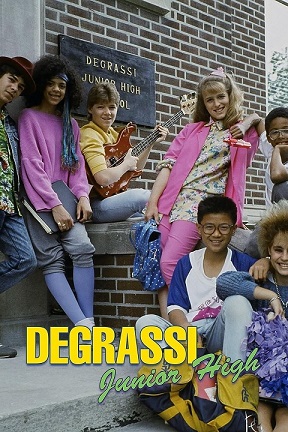
Late Night Retro Television Review: Degrassi Junior High 2.12 “He’s Back”


Welcome to Late Night Retro Television Reviews, a feature where we review some of our favorite and least favorite shows of the past!  On Sunday, I will be reviewing the Canadian series, Degrassi Junior High, which aired on CBC and PBS from 1987 to 1989!  The series can be streamed on YouTube!

Mr. Colby returns!

Episode 2.12 “He’s Back”

(Dir by Clarke Mackey, originally aired on March 21st, 1988)

Mr. Colby (Marcus Bruce) is back, substituting for Ms. Avery.

The last time that Mr. Colby substituted at Degrassi, he ended up sexually harassing Lucy.  Despite the attempts of L.D. and Wheels to convince her otherwise, Lucy decided not to report Mr. Colby.  She just wanted to put the experience in the past and move on.  However, this episode opens with Lucy being woken up by nightmares, in which Colby is the central figure.  When Lucy sees Colby in the office, asking for Ms. Avery’s lesson plans, she freaks out.

Still, she refuses to go to the principal about what happened.  She still just wants to move on.  After her trouble with shoplifting during the first season, Lucy has finished up her community service and is now volunteering at a daycare out of the kindness of her heart.  She’s trying to build a new life for herself but, when it becomes obvious that Colby is now grooming Susie (played by Sarah Charlesworth), Lucy realizes that she can no longer be silent.

“You want to see Mr. Lawrence?” the school secretary says when she sees Lucy, Susie, and every other girl in Colby’s class standing in front of her.  “This better be important.”

It is, Lucy replies.

This is a pivotal episode as far as Lucy’s development is concerned.  In this episode, Lucy shows that she’s gone from being spoiled and self-centered to someone who actually does care about other people and who wants to make the world a better place.  If you know the history of this show and the characters, there’s something a little sad about the scenes in which she goes to Wheels for support.  Those of us who have seen School’s Out (and this is a spoiler for those of you who haven’t so consider yourself warned) know that Wheels is destined to go to prison for killing a kid while driving drunk.  We also know that Lucy is destined to be temporarily blinded and crippled in that same accident.  In this episode, though, both Wheels and Lucy still have their entire future ahead of them.

This episode was a good example of what Degrassi Junior High did so well.  So many teen shows would have wrapped up this storyline in one episode and certainly, they would have never address Lucy’s lingering trauma.  Instead, Lucy would have done gone to the principal on her own, Colby would have been fired, and the entire thing would have never been mentioned again.  Degrassi Junior High, on the other hand, understands that it’s not always easy to do the right thing, especially when you just want to put it all behind you and get on with your life.  With its portrayal of Lucy’s lingering trauma and her reaction to seeing Mr. Colby back in the school, Degrassi Junior High proves itself to be one of the most honest shows about growing up.

Film Review: Underground (dir by Vincent Sherman)


1941’s Underground tells the story of two brothers on opposite sides in Nazi Germany.

Kurt Franken (Jeffrey Lynn) is a patriotic German who believes that the country got a raw deal at the end of World War I and who is a strong supporter of the Nazis.  He served in the army, fighting on the front.  When he returns home to Berlin, he’s missing an arm.  Whenever his friends and his family say that they’re sorry that he lost his arm, he replies that he was happy to make the sacrifice for his country.  When someone starts to mourn for his son who was killed in the fighting, Kurt accuses the man of being a traitor for doubting the wisdom of the government.  Kurt is a true believer, just the type to be recruited by the SS and tasked with helping to investigate who is behind a series of anti-Nazi radio broadcasts.  Kurt believes that, if the government says it, it must be right.  Laws must be obeyed and orders followed without question.  Kurt, in other words, is a very familiar type.

What Kurt doesn’t realize is that the man behind the broadcasts is his own brother, Eric (Phillip Dorn).  As Kurt investigates, he falls in love with Sylvia (Kaaren Verne) without realizing that she is also a part of the resistance.  While Kurt tries to discover who is behind the underground radio station, Eric and his fellow resistance members attempt to stay one step ahead of the Gestapo.

For a film made in 1941, the film’s doesn’t flinch from showing the brutality of the Gestapo.  Like all authoritarian dictatorships, The Third Reich is determined to quash any and all signs of dissent and they investigate the underground radio station with a ruthlessness that even takes Kurt by surprise.  Witnessing first hand the brutality and sadism of the government for which he gave his arm, Kurt starts to doubt his previous beliefs.  But will Kurt’s doubts come in time to save the lives of Eric and his fellow resistance members?

Made at a time when the United States was still officially neutral in the violent conflict that was sweeping the rest of the world and released just a few months before the U.S. officially declared war on the Axis Powers, Underground is a powerful look at life under a dictatorship.  Shot in a noir style, the film’s black-and-white imagery perfectly captures the harshness of life in Germany while the shadows in the background perfectly capture the paranoia of knowing that saying the wrong word could lead to arrest, torture, and death.  The film’s final minutes involve a guillotine sitting ominously in the background, a reminder that Nazi Germany was not the first authoritarian regime and that it would not be the last.

The film is well-acted, with Jeffrey Lynn epitomizing the otherwise intelligent people who allow themselves to get caught up in the madness of the majority.  His discovery of the truth about Germany was obviously meant to mirror the awakening of the Americans who previously supported a policy of neutrality.  By the end of the film, both Karl Franken and the audience understand that the time for neutrality has passed.

Retro Television Review: The Hunted Lady (dir by Richard Lang)


Welcome to Retro Television Reviews, a feature where we review some of our favorite and least favorite shows of the past!  On Sundays, I will be reviewing the made-for-television movies that used to be a primetime mainstay.  Today’s film is 1977’s The Hunted Lady!  It  can be viewed on YouTube.

Detective Susan Reilly (Donna Mills) reluctantly teams up with a chauvinistic cop named Sgt. Arizzio (Alan Feinstein) to investigate a United States senator who has presidential ambitions.  Arizzio believes that the senator is being back by the Mafia and that it would be disastrous for the country if a mob-connected politician ended up in the White House.  (Being mob-connected didn’t seem to hurt John F. Kennedy but still….)

Now, Detective Reilly and Sgt. Arizzio working together to take down a corrupt senator sounds like an intriguing premise for a movie, right?  Well, oddly enough, that’s not what this movie is actually about.  Instead, it’s about Susan going on the run after she’s framed for Arizzio’s murder.  She escapes from police custody with the help of her father.  Though she’s still recovering from being shot earlier in the film, Susan makes her way to Reno and attempts to hide out from both the cops and the Mafia assassin that has been sent to kill her.

Susan hiding out in Reno.  Hmmm …. sound like an intriguing premise for a movie, right?  Well, don’t get to attached to Susan pretending to be a professional gambler because it turns out that bullet wound was more serious than she realized and she ends up passing out from blood loss.  When she awakens, she’s in a free clinic that is run by Dr. Arthur Sills (Robert Reed).  Dr. Sills doesn’t ask Susan too many questions about her past and even hires Susan on as a nurse.  Susan and Dr. Sills fall in love and try to clear the name of a Native American who has been accused of blowing stuff up.

Doing some research, I was not surprised to discover that The Hunted Lady was originally developed as a possible television show.  The show would have played out like a combination of Charlie’s Angels and The Fugitive, with Susan moving from town to town and getting involved with a new set of guest stars each week.  With both the police and the mob trying to track her down, Susan would try to clear her name while also helping out strangers.  Unfortunately, The Hunted Lady wasn’t exactly a hit in the ratings and Susan’s further adventures went untold.

The main problem with The Hunted Lady is an obvious one.  The idea of the Mafia trying to install one of their guys in the White House is considerably more intriguing that Susan falling in love with Dr. Sills while working at a free clinic.  The whole time that Susan was helping the doctor’s patients, I was thinking, “But what about the senator?”  Donna Mills was surprisingly convincing as a tough cop but she had next to no chemistry with Robert Reed.  If anything, Reed looked annoyed at just having to be there.

Anyway, here’s hoping that Susan cleared her name eventually.  You can only run for so long.

Scenes That I Love: Harry’s Nightmare from The Conversation


1974 was a very good year for Francis Ford Coppola.  Not only did he direct the Oscar-winning Godfather Part II but he also directed another film that was nominated for Best Picture, an intense study of paranoia called The Conversation

Today’s scene that I love comes from The Conversation.  Surveillance expert Harry Caul (Gene Hackman, giving one of his best performances) fears that his work may lead to murder.  In this scene, he has a nightmare in which he tries, in vain, to talk to one of the people who he has been surveilling.  This scene perfectly captures the horrific logic and helpless feeling of a nightmare.  Harry, who is not the most open or emotional of men, can only be his true self in his dreams.