Late Night Retro Television Review: Degrassi Junior High 3.11 “Taking Off: Part One”


Welcome to Late Night Retro Television Reviews, a feature where we review some of our favorite and least favorite shows of the past!  On Sunday, I will be reviewing the Canadian series, Degrassi Junior High, which aired on CBC and PBS from 1987 to 1989!  The series can be streamed on YouTube!

This week, Degrassi goes there!

Episode 3.11 “Taking Off: Part One”

(Dir by Kit Hood, originally aired on February 13th, 1989)

Gourmet Scum has come to Toronto and everyone is excited to hear the Scum sound.  At the concert, Shane and Luke (Andy Chambers) purchase LSD from the local Scum dug dealer.  Shane drops acid before the concert begins.  Surely, this won’t lead to any trouble, right?

Meanwhile, Wheels is still skipping school.  While his teachers send notes to his grandmother to let her know that Wheels is falling behind, Wheels is spending all of his time playing a boxing video game at the local arcade.  When Joey asks Wheels how can afford to spend all day playing one game over and over again, Wheels says that he sold his bass.

“What about the Zit Remedy?!” Joey says.

Sorry, Joey, Wheels doesn’t care about school or your stupid band anymore.  In fact, Wheels is planning on running away from home.  When he gets a birthday postcard from his biological father, Wheels discovers his father’s band has a two-week gig at Port Hope.  Wheels decides to join his father, despite not being sure where New Hope is.  In fact, it’s not even Wheels’s birthday.  His birth father missed the date by about a month but Wheels doesn’t care.  Wheels just wants to get away from everything.

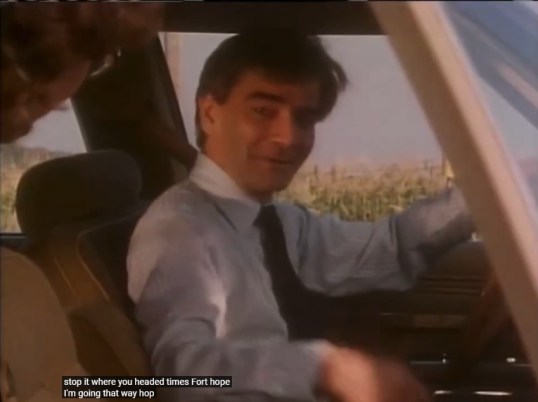
How is Wheels going to get to New Hope?  He decides to hitchhike!  Uhmm …. not a good idea, Wheels.  Actually, everyone who picks up Wheels seems to be pretty nice.  That is until this guy pulls up….

“Don’t do it!” I shouted as Wheels got in the car.  Unfortunately, as this all happened 35 years ago and I was just watching it play out on YouTube, Wheels couldn’t hear me.

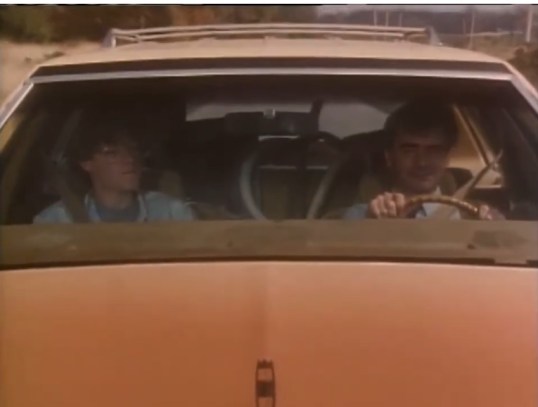
As they drive towards what Wheels assumes is Port Hope, the driver (chillingly played by James Knapp) asks Wheels if he has a lot of girlfriends.  He asks Wheels if he works out.  He asks a lot of questions that immediately raise red flags.  Not that Wheels notices….

Suddenly, the driver pulls off the road, turns to Wheels, and grabs Wheels’s thigh.  AGCK!  Wheels manages to get the door open and scrambles out of the car.  The driver throws Wheels’s backpack out of the car and then drives off, leaving Wheels in the middle of nowhere.

Meanwhile, back in Toronto, Joey’s mother tells Joey that Shane’s mother has been calling because Shane didn’t come home after the concert.  Soon, the police are talking to all of Shane’s friends and trying to figure out where he could be.  Luke is asked whether Shane did any drugs.  Luke lies and says, “No.”

This was a classic Degrassi episode and probably one of the most effective anti-hitchhiking PSAs ever filmed.  When the driver attacked Wheels, it was a truly frightening moment and it was impossible not to remember all of the times, over the course of this season, that Wheels has bragged about his ability to take care of himself.  Now, Wheels is stuck in the middle of nowhere and Shane, who didn’t pay child support specifically so he could go to the concert, is missing.

Never has “To be continued….” felt more ominous.

Film Review: Brothers (dir by Arthur Barron)


First released in 1977 and based on the real-life story of prison activist George Jackson, Brothers opens with David Thomas (Bernie Casey) being charged with robbing a gas station.

Thomas explains that, while he was in the car with the people who robbed the station, he personally had nothing to do with the robbery and did not know that it was going to happen.  Thomas’s attorney tells Thomas that the smart thing to do would just be to plead guilty.  That way, Thomas will probably just spend a few months in jail as an accessory and then he’ll be a free man.  Instead, the judge sentences Thomas to a sentence of one year to life in prison.  Essentially, Thomas will be in prison until the State decides to let him out.

Thomas serves his sentence at Mendocino Prison, where he has to deal with threats from both the white prisoners and the guards.  Thomas’s cellmate is Walter Nance (Ron O’Neal), a political activist who tells David that he’s “letting your time do you.”  Nance educates David, teaching him about both chess and radical politics.  Soon, David is publishing an underground newsletter that is discreetly passed around amongst the black prisoners.

Meanwhile, on the outside, David’s younger brother, Josh (Owen Pace), is trying to free David from prison.  Josh approaches a radical professor named Paula Jones (Vonetta McGee) and asks for her help in publicizing David’s case.  Paula is at first skeptical but, after she reads David’s writings, she starts to correspond with him.  Soon, David and Paula have fallen in love.  However, when Walter is murdered by the racist guards and David starts to organize within the prison, both David and Paula find themselves being targeted by the government.

As I said at the start of this review, Brothers is based on a true story.  David Thomas is based on George Jackson, who was sentenced to a year to life for robbery and who, while serving time in Soledad Penitentiary, wrote two books that made him a cause celebre amongst political radicals in the early 70s.  Paula Jones is based on Angela Davis, who was placed on the FBI’s Most Wanted list after a gun registered in her name was used by Jackson’s younger brother during a shoot-out at a courthouse.  (The shoot-out, which is depicted in the film, led to the murder of Judge Harold Haley and the deaths of Jonathan Jackson and two prisoners.)  George Jackson was later shot and killed while attempting to escape San Quentin.  In the film, the fate of David Thomas is just as violent but slightly more poetic.

There’s still a considerable amount of controversy as to whether or not George Jackson was a hardened criminal or an innocent man who was targeted for his activism.  Brothers is firmly on the side of George Jackson and Angela Davis, portraying them both as activists who are fighting back against an unjust system that is determined to hold them down and destroy them if necessary.  Bernie Casey and Vonetta McGree both give good performances as David Thomas and Paula Jones.  Casey, in particular, smolders with an intensity that makes him instantly believable as someone who could organize a rebellion.  Unfortunately, the film itself moves a bit too slowly for its own good and it ends on a false note, suggesting that David’s sacrifice has managed to unify both the white and the black prisoners against the guards.  Considering that, up until that point, the film had been honest about racism in prison, the ending feels like an attempt to provide some hope to an otherwise downbeat story.  Unfortunately, the hope doesn’t feel earned.  Still, Brothers is an interesting historical document, one that deals with issues that are still being fought over to this day.

Retro Television Review: Homicide: Life on the Street 1.1 “Gone For Goode”


Welcome to Retro Television Reviews, a feature where we review some of our favorite and least favorite shows of the past!  On Sundays, I will be reviewing Homicide: Life On The Street, which aired from 1993 to 1999, on NBC!  It  can be viewed on Peacock.
Today, I take a look at the pilot for a show that has been called one of the best of all time.

Episode 1.1 “Gone For Goode”

(Directed by Barry Levinson, originally aired on January 31st, 1993)

The opening credits for the first episode of Homicide: Life on the Street immediately announce that the show is not going to be a typical network cop show.  The music starts out as moody and low-key before eventually being dominated by a pulsating beat.  The images of dirty streets and crumbling rowhouses and of a dog running around behind a fence are all in black-and-white.  The faces of the cast appear, the majority of them in harsh close-up.  When viewed today, most of the faces are familiar.  Daniel Baldwin, Ned Beatty, Andre Braugher, Clark Johnson, Yaphet Kotto, Melissa Leo, Jon Polito, and Kyle Secor all flash by and the thing that the viewer will immediately notice is that it’s almost as if they’ve been filmed to remove any hint of glamour or attractiveness.  (Out of that impressive cast, only Baldwin, Johnson, Leo, and Secor are still with us.)

Gone for Goode tells several stories, introducing the detectives as they investigate various murders in Baltimore.  Meldrick Lewis (Clark Johnson) and Steve Crosetti (Jon Polito) are first seen searching for a bullet in a dark alleyway and arguing in only the way that two people who have worked with each other for a long time can argue.  Lewis continually refers to Crosetti as a “salami-head,” and Crosetti, who claims that he’s being kept up at night by his doubts about whether or not John Wilkes Booth was actually Lincoln’s assassin, repeatedly says that Lewis will regret that.  Later, Crosetti writes a complaint about the ethnic insults that he’s been forced to listen to but apparently, he never actually sends it.

When not arguing with each other, Crosetti and Lewis investigate “Aunt Calpurnia,” who has buried five husbands and whose niece has nearly been murdered three times.  Aunt Calpurnia has life insurance policies out on everyone.  While digging up Calpurnia’s former husband, Lewis comments that the body in the grave doesn’t look as large as the man in the picture that he’s been given.  The cemetery’s caretaker replies, “Nobody stays fat down there.”  Technically, that’s true but it also turns out that the wrong man was buried in the grave and the caretaker has no idea where anyone is actually buried.

Detective Felton (Daniel Baldwin) and Detective Howard (Melissa Leo) investigate the murder of a man who was found decaying in a basement.  Howard is the primary detective on the case because Felton, being a screw-up, has too many unsolved cases under his name on the dry-erase board that dominates the squad room.  Howard currently has a streak of solved homicides and that continues for her when the murderer just happens to call the crime scene and then agrees to come in for a talk.

Detective Stanley Bolander (Ned Beatty) guilts Detective John Munch (Richard Belzer, who would play the same character years later on Law & Order: SVU) into investigating a hit-and-run that happened months ago.  Munch, who earlier tells a suspect that he is not Montel Williams (“So don’t like to me like I’m Montel Williams”) and leaves both Bolander and the suspect confused as to who Montel Williams is, eventually discovers that the murder was committed by a brain-dread idiot who can only repeat, “I was drinking,” when he’s confronted with his guilt.

Finally, Lt. Al Giardello (Yaphet Kotto) assigns Felton to work with Frank Pembleton (Andre Braugher), a brilliant but arrogant detective who insists on working alone.  Pembleton and Felton’s partnership begins with Pembleton spending an hour in the station’s garage, searching for his squad car because Pembleton forgot to write down the parking space on the back of his keys.  (Of course the garage is full of identical white cars.)  When Felton says suggests just going upstairs and getting a new set of keys, Pembleton shouts that the next car he tries to unlock could be the right car.

Needless to say, the Pembleton/Felton partnership does not last and Pembleton instead ends up working with an eager newcomer to the squad, Tim Bayliss (Kyle Secor).  They two of them work surprisingly well together until Bayliss objects to Pembleton “fooling” a suspect into waving his right to an attorney.

As the episode comes to a close, Bayliss answers his first call in the squad room.  At the crime scene, in the middle of a torrential storm, he discovers the body of a small girl.

I have to say that the idea of trying to review Homicide: Life on The Street is a bit intimidating, just because the show has got an almost legendary reputation.  It’s often described as being the best cop show of the 90s, as well as being held up as a perfect example of a show that was too good to last.  It was never a hit in the ratings and came close to being canceled several times.  Because it was filmed in Baltimore, it was viewed as being an outsider amongst the New York and Hollywood-produced shows that dominated the airwaves.  Executive produced by Barry Levinson (who also directed Gone for Goode) and based on a non-fiction book by David Simon, Homicide is the show that is often cited as the precursor for The Wire, another show that was loved by the critics but not by its network or the Emmy voters.

The pilot is intriguing, largely because it seems determined to scare off its audience.  Unlike other television  detectives, who are inevitably portrayed as being crusaders who are obsessed with justice, the detectives in Homicide are a blue collar bunch who, for the most part, are just doing their job.  Sure, someone like Frank Pembleton might be brilliant.  And Stanley Bolander might truly mean it when he tells Munch that “we speak for the dead.”  And Bayliss does seem to be very enthusiastic about being a “thinking” policeman.  But the show suggests that most detectives are like Felton, Lewis, and Much.  They’re not particularly brilliant and their approach to the job can sometimes seem callous.  But occasionally, they get lucky and a murder is solved.  Indeed, if there is any real message to the pilot, it’s that criminals are stupid.  They get caught not because of brilliant police work but because they do stupid things, like calling the crime scene or failing to ditch the car that they sole.

That said, the pilot also does what a pilot is supposed to do.  It introduces the characters and gives them just enough space to make an impression, along with also leaving enough room for them to grow.  The characters may not all be instantly likeable but, fortunately, the strong cast holds your interest.  The pilot is very much a product of the 90s, with Munch ranting about Montel Williams and Crosetti mentioning Madonna at one point.  But, at the same time, it still feels relevant today.  Pop culture might change but murder remains the same.
Horror Film Review: Premature Burial (by Roger Corman)


Poor Guy Carrell (Ray Milland!)

The character at the center of the 1962 Edgar Allan Poe adaptation, The Premature Burial, Guy spends his days terrified of being buried alive.  Like his father before him, Guy suffers from a disease that can make him appear to be dead despite actually being alive.  Guy is convinced that his father was buried alive and swears that he could even hear his father crying for help inside of his tomb.  Though his fiancée, Emily (Hazel Court), insists that Guy is driving himself mad with his fears, Guy continue to spend his time trying to invent a coffin from which one can easily escape.  Even after Emily and Guy are married, Guy continues to obsess.

Finally, faced with the prospect of opening his father’s tomb to discover whether or not his father truly was buried alive, Guy appears to drop dead of a heart attack.  But is he really dead or is he about to be buried alive!?  And who is responsible for the series of mysterious events that apparently drove Guy to collapse of fright?  Watch the film to find out!  Or read the Edgar Allan Poe short story.

This was the third of Roger Corman’s Edgar Allan Poe adaptations and it’s the first one to not feature Vincent Price as the lead character.  For the most part, the members of the small cast all do a good job with their roles.  Ray Milland is both sympathetic and a little frightening as the obsessed Guy.  Heather Angel is properly enigmatic as Guy’s overprotective sister and Hazel Court will keep you guessing as far as her character’s motivations are concerned.  Dick Miller has a small but key role as a grave digger who seems to take just a little bit too much enjoyment from his work.  The film’s atmosphere is properly gothic and, if the film isn’t as visually audacious as the first two Poe films, Corman still finds time to include a creepy and psychedelic dream sequence.

That said, Vincent Price is still very much missed.  Corman reportedly wanted to use Price but, because Corman produced and financed the film  himself, Corman’s former business partners at American International Pictures would not allow Price to appear in the film.  (Price was under exclusive contract to AIP.)  By the time Corman and AIP worked out their disagreements and again joined forces, Ray Milland had already been cast in the lead role.

While the actors all do a good job, it’s hard to deny that Guy Correll would have been an ideal role for Vincent Price, even if it would have meant essentially re-doing his performance from The Pit and the Pendulum.  It’s not just that the film misses Price’s theatrical acting style.  The film also misses the energy that Price brought to the previous two Poe films.  The Premature Burial moves at a stately pace and, in the end, it’s a bit too slow and respectable for its own good.  Price would have jazzed things up and made a decent film into a truly memorable one.  Fortunately, Price would return for the later Poe adaptations.

Horror on the Lens: The Cabinet of Dr. Caligari (dir by Robert Wiene)


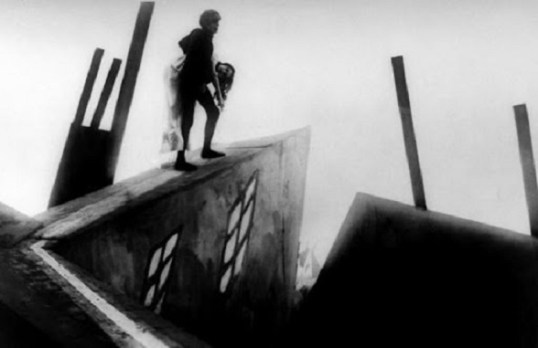
The Cabinet of Dr. Caligari (1920, dir by Robert Wiene, DP: Willy Hameister)

The Cabinet of Dr. Caligari is a film that I’ve shared many times previously on the Shattered Lens.  The first time was in 2011 and then I shared it again in 2014, 2015, 2016, 2017, 2018, 2019, 2020, 2021, and 2022!  Well, you know what?  I’m sharing it again because it’s a classic, it’s Halloween, and everyone should see it!  (And let’s face it — it’s entirely possible that some of the people reading this post right now didn’t even know this site existed in any of those previous years.  Why should they be deprived of Caligari just because they only now arrived?)

Released in 1920, the German film The Cabinet of Dr. Caligari is one of those films that we’ve all heard about but far too few of us have actually seen.  Like most silent films, it requires some patience and a willingess to adapt to the narrative convictions of an earlier time.  However, for those of us who love horror cinema, The Cabinet of Dr. Caligari remains required viewing.  Not only did it introduce the concept of the twist ending (M. Night Shyamalan owes his career to this film) but it also helped to introduce German expressionism to the cinematic world.

My initial reaction to The Cabinet of Dr. Caligari was that it simply wasn’t that scary.  It was certainly interesting to watch and I was happy that I was finally experiencing this film that I had previously only read about.  However, the film itself was obviously primitive and it was difficult for my mind (which takes CGI for granted) to adjust to watching a silent film.  I didn’t regret watching the film but I’d be lying (much like a first-year film student) if I said that I truly appreciated it after my first viewing.

But you know what?  Despite my dismissive initial reaction, the film stayed with me.  Whereas most modern films fade from the memory about 30 minutes after the end credits,The Cabinet of Dr. Caligari has stuck with me and the night after I watched it, I even had a nightmare in which Dr. Caligari was trying to break into my apartment.  Yes, Dr. Caligari looked a little bit silly staring through my bedroom window but it still caused me to wake up with my heart about to explode out of my chest.

In short, The Cabinet of Dr. Caligari passes the most important test that a horror film can pass.  It sticks with you even after it’s over.

For the curious with an open mind to watch with, here is Robert Wiene’s The Cabinet of Dr. Caligari!

Enjoy!

October Positivity: Last Flight Out (dir by Jerry Jameson)


The 2004 film, Last Flight Out, tells the story of Dan (Richard Tyson) and Anne (Bobbie Phillips).

Once upon a time, Dan and Anne were in love.  Perhaps they were attracted by the fact that their names rhymed.  “Dan and Anne” is just one of those phrases that just rolls off the tongue.  Unfortunately, it takes more than rhyming names to make a relationship work.  Dan was a cynic and Anne wanted to make the world a better place and, in the end, she decided she could do that better without him than with him.

Now, Anne is  missionary, working with Dr. Matteo Barrero (Adriano Gonzalez) at a village in a South American country that is, more or less, ruled by a drug cartel.  And Dan is a pilot, flying missions throughout the world and trying not to get emotionally connected with anyone.  Anne’s mentor, Tony Williams (Cliff de Young), approaches Dan with a job.  The village where Anne is working is currently under siege from a drug lord who demands that all the villagers come to work for him.  The payment that drug lord offers for their work is simple.  If they work for him, he will reward them by not killing them.  If they don’t work for him …. well, you get the idea.

Dan flies to the village, mostly to try to get Anne to safety.  But Anne explains that she won’t abandon the villagers to the drug lord.  Eventually, Anne is able to convince the village’s chief that the entire villages needs to be moved to safety.  That’ll mean putting all twenty of them on Dan’s plan and flying them away from the drug lord’s army.  Dan explains that, even if they take all the seats out of the plane, they’ll still be overweight and unable to take off.  Both Anne and Matteo tells Dan to have a little faith.

And, while the drug lord’s army fires at them from the ground, the plane does manage to take off!  But Matteo is left behind.  Back in civilization, everyone is convinced that Matteo is dead.  Dan, however, is determined to go back and, if possible rescue Matteo.  That, of course, will mean flying straight back into the gunfire and once again, risking his life for another person.  And, in this case, his name doesn’t even rhyme with Matteo’s!

Last Flight Out isn’t a bad little film.  Of course, those tempted to watch the film on Tubi should be aware that it is a faith-based production, so Matteo is very outspoken in his belief in God and the film does feature prayers while in flight.  Naturally, Dan is the atheist who changes his position after witnessing the bravery of the missionaries.  That said, the film is smart to emphasize action over preaching and Richard Tyson gives a likable performance as Dan.  In the end, one need not be filled with faith to know that slave labor is wrong.  Director Jerry Jameson, who directed a host of disaster films in the 70s and the 80s, keeps the action moving at a steady pace and, the end result, is a watchable action film.

Late Night Retro Television Review: Check It Out! 2.14 “Let’s Get Metaphysical”


Welcome to Late Night Retro Television Reviews, a feature where we review some of our favorite and least favorite shows of the past!  On Saturdays, I will be reviewing the Canadian sitcom, Check it Out, which ran in syndication from 1985 to 1988.  The entire show is currently streaming on Tubi!

This week, Howard goes on a mission to save Marlene.

Episode 2.14 “Let’s Get Metaphysical”

(Dir by Alan Erlich, originally aired on January 25th, 1987)

Marlene’s been showing up late for work!

Christian thinks that it’s a big deal that Marlene isn’t showing up for work.  I’ve never had a retail job or a job where I had a boss who required me to do things but I do have to say that I think Christian has a point.  Since it appears that Cobb’s only has seven employees and it appears to be a rather large store with several different departments, I imagine it is a bit difficult when one of them doesn’t show up.

(Actually, two of them.  For some reason, Edna is not in this episode.)

Howard, however, says it’s no big deal because Marlene is only late because she’s in love with a new guy and this guy apparently likes to stay up all night and discuss philosophy.  (Bleh!  Sounds like she’s dating a real bore.)  But when Marlene starts lecturing at her register about how unfair it is to charge people for food, Christian feels that he has no choice but to fire her.  Marlene thanks Christian for setting her free and then leaves the store for her new home at the local commune.

Uh-oh …. MARLENE HAS JOINED A CULT!

Wanting to free her from the Order of Eternal Light, Howard decides to go down to the commune.  Accompanying him is Viker and I was happy about that because, as played by Gordon Clapp, Viker was a character who made any scene funnier by his very presence.  The head of the cult is a bearded man who calls himself Solar (Sam Moses).  Solar preaches a life of simplicity while living in a mansion and driving a Ferrari.

Howard decides that the best way to free Marlene is to go undercover and pretend to join the cult.  Over the next few days, Howard doesn’t show up at work but Marlene does.  Marlene explain that she left the cult after talking to a strange man with a beard.  She also says that she never saw Howard at the cult.

Suddenly, Howard shows up, wearing love beads and speaking in an Indian accent.  Marlene throws water on his face, which magically sets Howard free from Solar’s brainwashing.  Marlene tells Howard that she left on her own after talking to the bearded man.  Howard reveals that he was that bearded man….

Wow, it sounds like a lot of interesting stuff happened off-camera!  In fact, that’s the main problem with this episode.  Almost all of the interesting stuff — Marlene getting brainwashed, Howard going undercover, the police raiding the commune and arresting Solar — happens off-screen.  What we’re left with is okay but never quite as funny as it potentially could be.

Still, at least Marlene’s back!  Someone has to keep the sharp insults flying in that store and no one’s better at it than Marlene.

Lisa Marie’s Week In Television: 9/29/24 — 10/5/24


As you can probably guess, I spent most of this week watching horror movies.  I didn’t watch many television shows but here’s a few thoughts on what I did watch.  (For those keeping track, I still need to watch the first episodes of the new season of Survivor and I guess the first few episodes of Doctor Odyssey.  Maybe I’ll find the time next week.)

American Sports Story: Aaron Hernandez (Wednesday Night, FX)

This week, Aaron finally made it to the NFL.  This episode was well-done and made a point about how sports is big business and how players are expected to have the right image but it was really hard not to feel that, as with so many Ryan Murphy productions, this episode basically spent 50 minutes telling a 15 minute story.  Did we have to see every details of Aaron at the combine?  Probably not.  Did we have to once again hit on all the stuff about Aaron’s family?  I mean, most of what was revealed in this episode was already revealed in the previous three episodes.  The danger with these shows is that they always drag out the story to such an extent that it’s easy to get bored.

Hell’s Kitchen (Thursday Night, FOX)

Despite all of the talent assembled for the season, the first dinner service was a disaster!  Isn’t that always the way?  “GET OUT!” Ramsay shouted.  If I went to Hell’s Kitchen and my food wasn’t screwed up and if Chef Ramsay wasn’t yelling at people the entire time, I would feel extremely disappointed.

Law & Order (Thursday Night, NBC)

Law & Order is back.  The season premiere was bland, disappointing, and heavy-handed but that always seems to be the case when it comes to the premiere of each season of Law & Order.  For whatever reason, the season premiere is almost always the weakest episode of this series and the show usually steadily improves afterwards.  That said, this is an election year and the partisan atmosphere is exactly the type of thing that tends to inflame this show’s worst tendencies.  McCoy is still missed.  Why is Maroun even on the show?

One Step Beyond (YouTube)

I watched a few episodes this week and I shared them here on the site as a part of Horrorthon!  Be sure to check them out when you get a chance because they’re all pretty entertaining.  I like the fact that the show pretended to be based on fact.  It was like the Beyond Belief of its day.

Rescue: Hi-Surf (Fox, Monday)

On Sunday morning, I watched the first three episodes of this new Fox show about lifeguards in Hawaii.  There was nothing particularly original about this show.  It was basically just a remake of Baywatch but without that show’s self-awareness.  But the scenery was lovely and some of the rescues were exciting to watch.  This is a show that could definitely become a 9-1-1-style guilty pleasure, assuming it survives its debut season.

Square Pegs (YouTube)

With my friend Pat, I watched a Halloween episode of this old 80s sitcom on Friday night.  It was amusing enough.  A very young Sarah Jessica Parker was apart of the cast and far more likable than she’s ever been on Sex and the City.

Horror On TV: One Step Beyond 1.6 “Epilogue” (dir by John Newland)


Carl Archer (Charles Aidman) is a recovering alcoholic who returns home after an extended stay in a rehab.  His wife (Julie Adams, of Creature of the Black Lagoon and The Last Movie fame) is skeptical about whether or not Carl has really sobered up and is prepared to be a responsible father to their son, Steve (Charles Herbert).  When Steve gets trapped in a cave, will Carl be able to use their psychic connection to find and rescue him?

Can you prove this didn’t happen!?

This episode originally aired on February 24th, 1959.

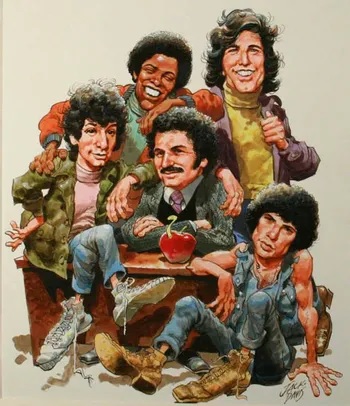
Retro Television Review: Welcome Back, Kotter 4.2 “The Drop-Ins Part 2”


Welcome to Retro Television Reviews, a feature where we review some of our favorite and least favorite shows of the past!  On Saturdays, I will be reviewing Welcome Back Kotter, which ran on ABC  from 1975 to 1979.  The entire show is currently streaming on Tubi!

This week, the fourth season premiere concludes.

Episode 4.2 “The Drop-Ins Part 2”

(Dir by Norman Abbott, originally aired on September 11th, 1978)

When last we saw the Sweathogs, they were planning on dropping out of school and getting real jobs, just like Barbarino.

At the start of the second part of the fourth season premiere, we discover the details of Barbarino’s new job.  He does indeed work at the hospital but, unlike what his classmates assumed, he’s not a doctor.  He’s not a nurse.  He’s not an X-ray technician.  He’s an orderly.  He mops the floor and he changes the sheets and he fluffs the pillows.  As he puts it, “I make 68 dollars a week and ten of that goes to Uncle Sam.”

(Little does Barbarino know that only having to give ten dollars to Uncle Sam would sound pretty good to future viewers.  I imagine by this point next year, we’ll be giving every cent to Uncle Sam and maybe we’ll be lucky to get some stale bread and Flint water in return.  And, of course, everyone will pretend to love it.)

Gabe comes down to see Barbarino.  He tells Barbarino that the Sweathogs look up to him and he asks Barbarino to talk to them about staying in school.  Barbarino, who is mopping the floor, points out that he dropped out and he’s already got a job.

“If this is all you want to do with your life,” Gabe says, looking at Barbarino’s mop and bucket, “you didn’t need to go to school.”

“Now you to tell me,” Barbarino replies.

As for the Sweathogs, they’ve already talked to Barbarino and applied for jobs at the hospital.  But, looking over their applications, they realize that they have no job experience, no educational accomplishments, and no chance of getting a job.

When a patient nearly dies because Barbarino didn’t know how to push the emergency button or where to find the crash cart, he realizes that he needs to get more education.  Soon, he and the Sweathogs are standing in the doorway of Mr. Kotter’s classroom, ready for a new schoolyear.  Barbarino says he’s going to be a doctor but he knows he has to graduate high school first.  As for the other Sweathogs — well, they’re 40 year-old high school students.  What other choice do they have but to go to class?

Part Two of The Drop-Ins is a significant improvement on Part One, largely because the majority of the episode follows John Travolta’s Barbarino.  None of the Sweathogs were bad actors but, when watching an episode like this one, it’s easy to see why Travolta’s the one who went on to become a movie star.  As Barbarino, Travolta just has a natural charisma that can’t be faked.  Of the main Sweathogs, Barbarino is the one who you really find yourself hoping will eventually graduate.  He’s just such a nice guy, even if he is a little …. slow.

And so ends the fourth season premiere.  The Sweathogs are back in class ….  but for how long?