Ever since the birth of film, Robert Louis Stevenson’s Dr. Jekyll and Mr. Hyde has been a popular subject for adaptation. Not only does the classic story of a good doctor who unleashes his evil instinct via potion serve as a potent metaphor for everything from sexual repression to drug addiction, but the dual role of Dr. Jekyll and Mr. Hyde has provides an excellent opportunity for an actor to show off.
The first film adaptation of Dr. Jekyll and Mr. Hyde is believed to have been made in 1908. Two more version followed in 1912 and 1913 and then, suddenly, 1920 saw three different film versions.
The best known of the 1920 version is our film for today. This version is best remembered for John Barrymore’s powerful performance in the title role but it also holds up remarkably well as a work of cinematic horror.
Tonight’s horror song of the day is perhaps not as well-known as some of the other songs that I’ve shared. It appeared in Lucio Fulci’s controversial (to put it mildly) giallo, The New York Ripper. That film is so infamous for its violence, nihilism, and killer who quacks like a duck that it is something overlooked that it features a great score from Francesco De Masi.
This is the main theme from The New York Ripper and it captures the movie’s mix of horror and police procedural. It’s the 70s cop show theme from Hell.
Welcome to Late Night Retro Television Reviews, a new feature where we review some of our favorite and least favorite shows of the past! On Fridays, I will be reviewing Friday the 13th: The Series, a show which ran in syndication from 1987 to 1990. The show can be found on YouTube!
It’s sequel time!
Episode 2.14 “Face of Evil”
(Dir by William Fruet, originally aired on February 6th, 1989)
In this sequel to the first season episode Vanity’s Mirror, Joanne Mackey (Gwendoline Pacey) returns to Curious Goods for the first time since the death of her younger sister, Helen. Joanne reveals that she’s the one who stole the cursed gold compact at the end of Vanity’s Mirror, explaining that she simply had to have something that belonged to her sister. Jack is not amused, telling her that she should have turned it over so that it could be stored in the vault.
Calm down, Jack. Joanne knows she did something wrong and she’s trying to make amends. She is especially concerned because the compact is now in the hands of an aging supermodel named Tabitha Robbins (Laura Robinson). Tabitha is upset that her career is struggling and she’s been told that not even plastic surgery can reverse the fact that she’s just not as young as her competition. Tabitha has figured out that anyone whose face is caught in the reflection of the mirror will either die or, at the very least, suffer a terrible disfigurement. Apparently, in this case, the antique’s curse changes depending on who owns it.
I have mixed feelings about this episode. On the one hand, I could relate to Tabitha’s feelings about aging. No one wants to age and that’s doubly true when you’re working in an industry where youth is the most valuable commodity. I also enjoyed the very 80s fashion shoots that were featured in this episode. On the other hand, there were a lot of rather silly scenes of Tabitha trying to catch Ryan and Micki’s reflection in the mirror while Mick and Ryan ducked around with their hands over their faces. There’s no other way to put it other than to say it all looked really goofy.
The biggest problem with this episode is that the majority of it was taken up with clips from Vanity’sMirror. Every few minutes, Joanne would think about Helen and we would get a flashback. Unfortunately, a lot of the flashbacks didn’t even feature Joanne so you have to wonder how exactly she was able to remember them. The constant flashbacks made this episode feel like a clip show and you know how much I hate those.
In the end, Tabitha accidentally catches her own face in the mirror’s reflection and she immediately starts aging. I guess that’s the risk you take when you try to use a mirror as a weapon. Micki and Ryan finally retrieve the compact and Jack mentions that Joanne could have saved a lot of lives by not stealing the compact in the first place. Look, Jack — she feels bad enough already! I’m sorry everyone isn’t beating down the doors of the antique shop to give you their cursed items. Get off Joanne’s back!
Oh well. At least the evil compact will hurt no one else….
1979’s Delirium takes place on the mean streets of St. Louis and the surrounding countryside. Crime is out of control and something has to be done about it! Thanks to Earl Warren and the Carter administration, the police are powerless to stop the criminals. (“Miranda rights my ass!” you can almost hear the film’s screenwriter shouting.) So, the wealthier citizens of St. Louis get together and hire a bald Vietnam vet named Eric Stern (Barron Winchester) to lead a paramilitary group of vigilantes. One of Stern’s men is another vet, Charlie (Nick Panouzis). Charlie suffers from PTSD and it turn out that being a part of a militia is not the best way to deal with war trauma. Who would have guessed?
Charlie snaps. He starts killing people, in both St. Louis and the surrounding farms. One victim is a hitchhiker who is dumb enough to hitch a ride from him and then to taunt him when he refuses to go skinny dipping with her. It turns out that Charlie’s been impotent ever since he came home from the war. He doesn’t respond well to jokes about it.
As Charlie claims more and more victims, both the police and vigilantes search for him. The police want to stop his rampage, The vigilantes don’t want Charlie to accidentally reveal their existence. The whole thing ends in violence, gun fights, and flashbacks in which Vietnam looks a lot like rural Missouri.
Delirium is a film that I first noticed on my list of Tubi recommendations a few months ago. I finally watched it last night and I have to admit that my first reaction was, “What the Hell was that?” Delirium is bizarre mix of slasher horror and vigilante thrills, the type of mishmash that one can only really find in a grindhouse film. That the budget was low is obvious in every shot. The wealthy conspiracy meets in what appears to be a hut. As I previously mentioned, the Vietnam scenes were clearly filmed in Missouri. The acting is largely amateurish, with the exceptions of the intense Nick Panouzis and the absolutely insane performance of Barron Winchester. The film was gory enough to have earned a spot on the infamous Videos Nastys list but, as is so often case, what was shocking in 1979 seems rather tame in 2024. I did like the conspiracy aspects of the film. The idea of a group of wealthy people putting together a vigilante squad without actually bothering to do any background checks on the people they recruited actually has a good deal of potential. The film is a mess but it’s a mess in the oddly fascinating way that many low-budget 70s films were. The mix of ambition and a low budget often led to watchable oddities like Delirium.
The main thing that really stuck with me about Delirium is just how annoyed and angry almost every single character in the film seemed to be. Even the cop trying to stop Charlie seems like he was pissed off about having to actually do his job. I guess St. Louis does that to people.
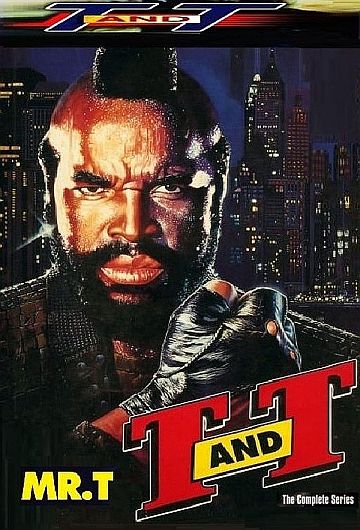
Welcome to Retro Television Reviews, a new feature where we review some of our favorite and least favorite shows of the past! On Fridays, I will be reviewing T. and T., a Canadian show which ran in syndication from 1987 to 1990. The show can be found on Tubi!
This week, things get trippy as Mr. T tells a story about a magical forest.
Episode 3.19 “Turner’s Tale”
(Dir by Patrick Loubert, originally aired on May 12th, 1990)
T.S. and Decker discover a little kid named Daniel (Amos Crawley), who is hiding out underneath the boxing ring at Decker’s gym. Figuring that Daniel ran away from home after getting in trouble for something, T.S. tells Daniel a story while Decker tries to track down Daniel’s parents.
As you can guess from the episode of this title, the majority of the episode is a dramatization of the story that Turner tells. (The story is also told in rhyme, just so you know what you’re getting yourself into.) In Turner’s story, Daniel (Sean Roberge) and his sister Terri (Kistina Nicoll) move into a happy forest that is populated by people dressed up as mice, rabbits, and owls. When Daniel enters a forbidden part of the forest and picks a flower, the police show up and Terri is taken away. So, Daniel has to go to the police captain’s castle and admit what he did so that Terri can be set free and the forest can be happy again….
What? No, I’m not kidding. That’s the plot of this episode.
Okay, this is a weird one. For 24 minutes, T and T goes from being a show about Mr. T solving crimes to a show about a teenager walking through a magic forest and trying to return a forbidden flower to the cops. I can’t imagine that anyone really watched T and T for the action but if they did, this episode probably really pissed them off.
But I don’t know. Maybe I’m getting sentimental as I mature but this episode was actually really sweet and kind of cute. Mr. T really got into telling the story and there was a funny moment where Turner suddenly realized that he had no idea how the story was supposed to end. One thing that has always remained consistent about T and T is that Mr. T was always at his most likable when acting opposite kids and trying to teach life lessons. He and David Nerman made for a good team in this episode and watching them play off each other, it was easy to understand why Decker was the only one of the show’s supporting characters to appear in all three seasons of T and T. There’s not really much else to say about this episode. It was clearly made for kids and the lesson is that you should never be scared to tell your parents the truth, even if it means getting punished. It’s pretty simple but the episode had a few funny moments and everyone seemed to be having fun.
Today’s bonus horror song of the day comes from the 1971 film, Vampyros Lesbos. The Vampires’ Sound Incorporation was a band specifically formed to do the soundtrack for Jess Franco’s classic portrait of Eurotrash decadence. This song found renewed popularity in the 90s when Quentin Tarantino included it on the Jackie Brown soundtrack.
I like this song. It’s great driving music and it sounds like something that a vampire would actually listen to.
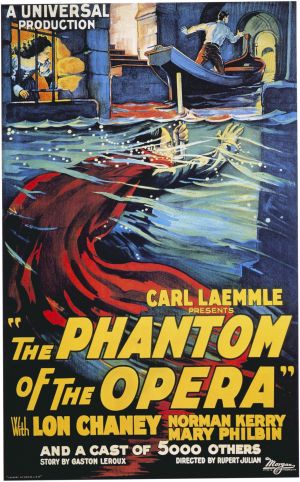
Today’s horror movie on the Shattered Lens is both a classic of silent era and one of the most influential horror films ever made. It’s one that I previously shared in 2013, 2015, 2016, 2108, 2019, 2020, 2021, and 2022 but it’s such a classic that I feel that it is worth sharing a second (or fifth or even a sixth or perhaps an ninth) time.
First released in 1925, The Phantom of the Opera is today best known for both Lon Chaney’s theatrical but empathetic performance as the Phantom and the iconic scene where Mary Philbin unmasks him. However, the film is also a perfect example of early screen spectacle. The Phantom of the Opera was released during that period of time, between Birth of the Nation and the introduction of sound, when audiences expected films to provide a visual feast and Phantom of the Opera certainly accomplishes that. Indeed, after watching this film and reading Gaston Leroux’s original novel, it’s obvious that the musical was inspired more by the opulence of this film than by the book.
This film is also historically significant in that it was one of the first films to be massively reworked as the result of a poor test screening. The film’s ending was originally faithful to the end of the novel. However, audiences demanded something a little more dramatic and that’s what they got.
Today’s horror song of the day comes to us from John Carpenter. Best-known as a director, Carpenter is also an accomplished musician and composer who is responsible for some of the most iconic horror themes of all time. Today, we offer you the main theme from his 1980 film, The Fog.
As I’m sure you have guessed, there will be more Carpenter songs in the days ahead.


 Through the Shattered Lens