Retro Television Review: Welcome Back, Kotter 4.18 “The Sweat Smell of Success”


Welcome to Retro Television Reviews, a feature where we review some of our favorite and least favorite shows of the past!  On Saturdays, I will be reviewing Welcome Back Kotter, which ran on ABC  from 1975 to 1979.  The entire show can be purchased on Prime.
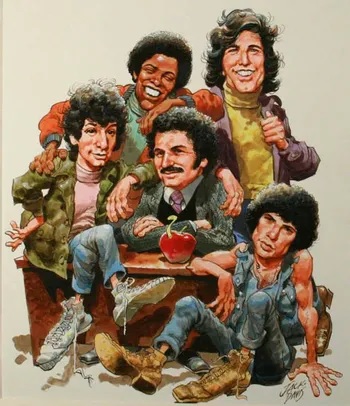
Buchanan High is in chaos!  Only one man can save the day but he’s not around anymore.

Episode 4.18 “The Sweat Smell of Success”

(Dir by Norman Abbott, originally aired on March 3rd, 1979)

Where is Mr. Kotter!?

I mean, don’t get me wrong.  I know why Gabe Kaplan was hardly ever on the show during the fourth season.  He was annoyed that the network refused to allow the Sweathogs to graduate from Buchanan High, despite the fact that the actors playing the Sweathogs were all in their late 20s and early 30s.  He was not happy about working with Marcia Strassman.  And he was shooting a movie for a good deal of the fourth season.  Kaplan felt that he moved on from the series and as such, he allowed his character to become vice principal and kept his appearances on  the show to a minimum,

But, in the narrative of the show, where is Mr. Kotter?  Usually, someone will mention that he’s out of town or busy with school business.  In this episode, he isn’t even mentioned.  It’s kind of disturbing how he’s vanished and no one seems to care.  The Sweathogs need his guidance and this episode, as dumb as it was, features a plot that feels like it would have been perfect for Mr. Kotter’s corny jokes and gentle mentoring.  Even more importantly …. who is the song welcoming back?  Kotter’s gone!  He’s not around to be welcomed back!

As for this week’s episodes, it appears that the show’s writers finally remembered that, at the start of the season, each of the Sweathogs was assigned a job around the school.  Freddie and Horshack run the school store.  Meanwhile, Epstein is in charge of the audio visual department.  But he sucks at his job so Woodman reassigns him to the school paper.  Horshack’s girlfriend, Mary Johnson, edits and writes the paper and is very earnest in her efforts to make the paper something worth reading.  That’s quite a chance from the Mary who tried to kill herself just a few episodes ago.

Anyway, Epstein turns the paper into a tabloid.  He suggests that Julie is having an affair with Woodman.  (“She’s not my type!”  Woodman declares, “Too tall!”)  He writes about Freddie Washington wore diapers until he was six months old.  Epstein describes Horshack as being a diva.  Epstein says that Beau is a member of the Ku Klux Klan. He says….

WAIT!  WHAT!?

Okay, one of these stories is far worse than the others.  Washington did wear diapers when he was a baby and Horshack is a diva and Julie probably is cheating on Gabe.  But Beau is a member of the Klan?  Where did this come from?  “I’m going to need a police escort to go home tonight,” Beau says while the audience laughs.

Seriously, don’t just toss around Klan accusations, folks.  It’s just common sense.

Anyway, Epstein’s friends get mad at him so Epstein quits the paper after publishing an expose of himself on the front page.  He returns to the audio visual department.  He still sucks at his job and I guess Mary is back to having to write, edit, and publish the entire newspaper by herself.  Is this a happy ending?

Well, at least Beau didn’t get killed.

Next week, it’s time for the school talent show!  Wow, Mr. Kotter would have loved that.  RIP.
Retro Television Review: St. Elsewhere 1.13 “Family History”


Welcome to Retro Television Reviews, a feature where we review some of our favorite and least favorite shows of the past! On Fridays, I will be reviewing St. Elsewhere, a medical show which ran on NBC from 1982 to 1988.  The show can be found on Hulu and, for purchase, on Prime!

Usually, I review this show on Friday but, yesterday, my week of visiting Lake Texoma in freezing weather finally caught up with me and I spent most of the day congested and curled up in bed.  As a result, St. Elsewhere got preempted until today.  Now, let’s see what’s happening at St. Eligius….

Episode 1.13 “Family History”

(Dir by Kevin Hooks, originally aired on February 8th, 1983)

After being a background character for the past few episodes, Dr. Wendy Armstrong (Kim Miyori) finally gets her time in the spotlight with this episode.  When Charlie Heller (Keenan Wynn) comes into the ER with a chronic nosebleed, Dr. Armstrong is too quick to assume that it’s nothing serious.  Dr. Westphall, who is in an especially crappy mood this episode, reprimands her for not getting a family history before making her diagnosis.  A chastened Armstrong gets Charlie’s family history and comes to suspect that he has a rare blood condition that only seems to effect Jewish men.  A very expensive test confirms Armstrong’s diagnosis.  Armstrong is excited.  “I was right!” she says.  Westphall again reprimands her, telling her that she now needs to tell Charlie that he has a chronic condition and will have to take medicine for the rest of his life.

Seriously, Westphall was not in a good mood during this episode!  But I don’t blame him.  From her first appearance on the show, Dr. Armstrong has been complaining nonstop.  No matter what happens in the hospital, she seems to take it as a personal affront.  Now, after several episodes of complaining about the other doctors, Armstrong fails to do a simple thing like get a family history.  No wonder Westphall was all like, What are you bragging about?

That said, even if his mood was understandable, I would not want to get on Westphall’s bad side.  Even after Armstrong makes the correct diagnosis, Westphall takes the time to say, “Next time, do what I told you to do.”  Agck!

While Westphall was dealing with whatever was eating away at him, Dr. Chandler was getting annoyed by John Doe’s refusal to try to remember anything about his past.  Even when John Doe’s real father showed up and explained that Doe was his son, Dave Stewart, he refused to try to remember anything.  Eventually, Chandler snapped at Dave for refusing to even try.  Chandler, of course, is played by a young Denzel Washington so, when he gets mad, it’s like having the voice of God call you out.  After Chandler’s reprimand, Dave finally makes an effort to remember his past.  He realizes that, when he was shot, he had a vision of his deceased mother welcoming him to heaven.  Awwww!

Dr. Craig’s friend has his gender affirmation surgery.  Crag met his friend’s lover, a trans man.  Needless to say, this episode featured a lot of scenes of Craig rolling his eyes as he struggled to come to terms with everything he was learning about his old friend.  It was all pretty predictable but William Daniels did a great job playing up Craig’s confusion and single-mindedness.

And finally, Peter was happy because his wife wanted to get back together.  I get the feeling any happiness Peter feels is destined to always be temporary.

This episode was a bit uneven.  Armstrong’s story would have been compelling if Armstrong herself was a more interesting character.  The highlight of the episode were the scenes between Denzel Washington’s doctor and Tom Hulce’s amnesiac.  It’s always enjoyable to watch two good actors perform opposite of each other.

Next week, the great Norman Lloyd takes center stage as Auschlander’s cancer returns.


GANG WAR (1958) – a young Charles Bronson testifies against the mob!


Charles Bronson starred in four movies and one TV show in 1958. Two of those movies were produced by Harold Knox, written by Louis Vittes, and directed by Gene Fowler, Jr. The first of the two films was SHOWDOWN AT BOOT HILL, an excellent low budget western that featured Bronson as a bounty hunter with a chip on his shoulder and love in his heart. The second film was GANG WAR. 

In GANG WAR, Charles Bronson plays Alan Avery, a high school teacher in Los Angeles who’s walking home one night and happens to witness a gangland killing. He calls the police to report the murder, but he doesn’t want to get any further involved so he doesn’t give them his name. Avery was on his way home from a trip to the pharmacy where he had picked up a prescription for his pregnant wife (Gloria Henry) who is suffering from migraines. In the stress of the moment, he left the pharmacy sack in the phone booth and the police are able to track him down to his home. After being pressed by the police, Avery reluctantly agrees to testify. He’s a great witness as he’s able to give the police a description of the car and its license plate number. His information leads to the arrest of Joe Reno, the second in command to mobster Maxie Meadows (John Doucette). Maxie sends his attorney Bryce Barker (Kent Taylor) over to the police station to see Captain Finch. Finch happens to be on Maxie’s payroll, and he immediately tells Barker about the witness. He even leaks it to the press so they can run a story revealing Avery’s name and address. Maxie would prefer to buy Avery’s silence, but he also wants a little insurance, so he sends his punch drunk henchman Chester over to slap around Avery’s wife. This order is akin to asking Lennie Small from OF MICE AND MEN to go play with some puppies. Simple-minded Chester proceeds to kill Mrs. Avery. When Avery comes home and finds his wife dead, he heads directly to Maxie’s house to kill him. The cab driver who took Avery to Maxie’s place just happened to see his gun, so he called the cops. Just before Avery can squeeze off a kill shot, the police show up and arrest him. Pissed that Avery was able to get so close to killing him, Meadows puts an actual hit out on him this time. Will the high school teacher be able to survive his battle against the mob?!!

(Note: The analysis below ventures into spoiler territory for both GANG WAR and SHOWDOWN AT BOOT HILL. You may want to watch these films prior to reading the rest of the review.)

As a lifelong fan of Charles Bronson, I really appreciate his work with director Gene Fowler, Jr. in 1958. Fowler recognized Bronson’s charismatic screen presence, but he also recognized something deeper in the legendary icon… his heart. SHOWDOWN AT BOOT HILL seemed to be giving us Bronson as a typical western hero, only to reverse course and turn Bronson into a romantic lead who would choose to throw down his guns so he could establish roots in a community and spend his life with the woman he loves. In a similar way, GANG WAR seems to be setting Bronson up to be a vigilante, not much different than the type of character he would be portraying throughout the 70’s and 80’s. But when 70’s and 80’s Bronson would be pulling his trigger, Fowler presents a more thoughtful Bronson who recognizes that the best revenge can sometimes be in letting someone live with the consequences of their own decisions. This allows him to lower his gun, walk away and continue his life free of the guilt and the legal consequences that would undoubtedly come with taking another person’s life. This decision honors his wife’s legacy much more than murder and a lifetime in jail ever would. 

There are many good performances in this little gem. Bronson may not have been a “star” when this film was made, but there is no doubt that he was ready. He simply commands every frame that he appears in from the beginning to the end. John Doucette and Kent Taylor are also memorable as the gangster and his paid off lawyer, respectively. Doucette’s Maxie Meadows is certainly a stereotype of the gangsters in TV’s and movies at the time, but he plays the part well, saving his very best for his last moments of the film. Kent Taylor has the movie’s best story arc. When we meet him, he’s an alcoholic who can’t stand what he’s allowed himself to become, yet he continues to run every time Maxie calls. It’s a strong moment when he decides he won’t do it anymore. And Jennifer Holden is simply gorgeous as Marie, Maxie’s woman. Speaking of nice scenery, it was also fun seeing a Los Angeles that included landmarks like the Capitol Records Building and the old Nickodell Restaurant. So much of the action in GANG WAR takes place against these iconic backdrops, and for a guy who’s never been to LA, seeing these places again almost makes me feel like a resident.

Overall, while GANG WAR does feel like an old fashioned 50’s movie, it has plenty of things to recommend it, not the least of which is an excellent performance from a young Charles Bronson. At a 75 minute run time, it’s definitely worth a viewing.

The trailer for GANG WAR is presented below:

Late Night Retro Television Review: Highway to Heaven 3.14 “All That Glitters”


Welcome to Late Night Retro Television Reviews, a feature where we review some of our favorite and least favorite shows of the past!  On Thursdays, I will be reviewing Highway to Heaven, which aired on NBC from 1984 to 1989.  The entire show is currently streaming on Tubi and several other services!

This week, a conman seeks refuge in a church.

Episode 3.14 “All that Glitters”

(Dir by Michael Landon, originally aired on January 7th, 1987)

There’s a fire raging in the city and elderly homeowners are being forced to evacuate.  “Father” Jonathan and “Father” Mark open up an abandoned church so that the people have some place to stay while the fires are burning.  Good for them and also good for this show for finally acknowledging Catholicism.

Also hiding out in the church and disguised as a priest is Charley Trapola (John Pleshette), a con artist who, despite his criminal profession, actually has a good heart.  Charley has a briefcase with him, one that is full of money.  A group of criminals want the briefcase back but, at least initially, they know better than to try anything in the church.  Instead, they decide to wait for Charley to come out.  Inside the church, Charley gets to know Wanda (Didi Conn), a shy but kind-hearted woman who goes to Confession every day.

This episode was okay.  Usually, when Jonathan and Mark go undercover as clergyman, they’re portrayed as being wishy-washy Episcopalians or vaguely liberal Methodists so I was happy that they were Catholic for this episode.  John Pleshette and Didi Conn were both well-cast as this episode’s guest stars.  They eventually made for a very sweet and likable couple.  My main issue with this episode is that it tried to do a bit too much.  Not only did we have Charley being chased by the gangsters but we also had Wanda dealing with her shyness and Mark and Jonathan dealing with the people were seeking shelter and looking for their loved ones.  This episode — and not that weird marriage counseling episode — would have benefitted from an extra hour.  As it was, it just felt a bit overstuffed.  As well, this is another episode in which Jonathan reveals early on that he’s angel and, oddly enough, Charley has no hesitation about believing him.  I always prefer the episodes where Jonathan doesn’t reveal who he really is.  When Jonathan reveals that he’s an angel, it almost seems like cheating.  The show is always more effective when people decide to open up their hearts on their own as opposed to doing so because they feel they’ve been ordered to.

There’s an odd scene where the three thugs break into the church and pull a gun on Jonathan.  After Jonathan gives them fair warning about “the boss,” the main thug attempts to shoot Jonathan.  Needless to say, the bullets don’t have any effect on an angel.  However, a sudden blue lights fills the church and suddenly, the three men are apparently zapped out of existence.  Jonathan later jokes that he’s not sure where the three men are but that they probably aren’t happy.  So, did the three men go straight to Hell?  Are they dead?  I understand the logic behind the scene but it’s not really something you expect from a show where the main theme is usually that everyone has a chance for redemption.

Next week, Dick Van Dyke plays a homeless puppeteer …. uh oh.  This sounds like it could a little bit cringey …. well, we’ll see.


14 Days of Paranoia #6: The Player (dir by Robert Altman)


1992’s The Player tells the story of Griffin Mill (Tim Robbins).

It’s not easy being Griffin Mill.  From the outside, of course, it looks like he has the perfect life.  He’s a studio executive with a nice house in Hollywood.  He’s young.  He’s up-and-coming.  Some people, especially Griffin, suspect that he’ll be the president of the studio some day.  By day, he sits in his office and listens to pitches from respected screenwriters like Buck Henry.  (Henry has a great idea for The Graduate II!)  During the afternoon, he might attends dailies and watch endless takes of actors like Scott Glenn and Lily Tomlin arguing with each other.  Or he might go to lunch and take a minute to say hello to Burt Reynolds.  (“Asshole,” Burt says as Griffin walks away.)  At night, he might go to a nice party in a big mansion and mingle with actors who are both young and old.  He might even run into and share some sharp words with Malcolm McDowell.

But Griffin’s life isn’t as easy as it seems.  He’s constantly worried about his position in the studio, knowing that one box office failure could end his career.  He fears that a new executive named Larry Levy (Peter Gallagher) is after his job.  Two new screenwriters (Richard E. Grant and Dean Stockwell) keep bugging him to produce their downbeat, no-stars anti-capitol punishment film.  His girlfriend (Cynthia Stevenson) wants to make good movies that mean something.  Even worse, someone is sending Griffin threatening notes.

It doesn’t take long for Griffin to decide that the notes are coming from a screenwriter named Dave Kahane (Vincent D’Onofrio).  Griffin’s attempt to arrange a meeting with Dave at a bar so that Griffin can offer him a production deal instead leads to Griffin murdering Dave in a parking lot.  While the other writers in Hollywood mourn Dave’s death, Griffin starts a relationship with Dave’s artist girlfriend (Great Scacchi) and tried to hide his guilt from two investigating detectives (Whoopi Goldberg and Lyle Lovett).  Worst of all, the notes keep coming.  The writer, whomever they may be, is now not only threatening Griffin but also seems to know what Griffin did.

After spend more than a decade in the industry wilderness, Robert Altman made a critical and commercial comeback with The Player.  It’s a satire of Hollywood but it’s also a celebration of the film industry, featuring 60 celebrities cameoing as themselves.  Everyone, it seems, wanted to appear in a movie that portrayed studio execs as being sociopathic and screenwriters as being whiny and kind of annoying.  The Player both loves and ridicules Hollywood and the often anonymous men who run the industry.  Largely motivated by greed and self-preservation, Griffin may not love movies but he certainly loves controlling what the public sees.  In the end, only one character in The Player sticks to her values and her ideals and, by the end of the movie, she’s out of a job.  At the same time, Griffin has a social life that those in the audience can’t help but envy.  He can’t step out of his office without running into someone famous.

The Player is one Altman’s most entertaining films, with the camera continually tracking from one location to another and giving as a vision of Hollywood that feels very much alive.  Tim Robbins gives one of his best performances as Griffin Mill and Altman surrounds him with a great supporting cast.  I especially liked Fred Ward as the studio’s head of security.  With The Player, Altman mixes melodrama with a sharp and sometimes bizarre comedy, with dialogue so snappy that the film is as much a joy to listen to as to watch.  That said, the real attraction of the film is spotting all of the celebrity cameos.  (That and cheering when Bruce Willis saves Julia Roberts from certain death.)  Altman was a director who often used his films to explore eccentric communities.  With The Player, he opened up his own home.

Previous entries in 2025’s 14 Days Of Paranoia:

  1. The Fourth Wall (1969)
  2. Extreme Justice (1993)
  3. The Lincoln Conspiracy (1977)
  4. Conspiracy (2007)
  5. Bloodknot (1995)

Film Review: The Caine Mutiny Court-Martial (dir by Robert Altman)


In the 1980s, director Robert Altman found himself even more outside of the Hollywood system than usual.  A series of films that confused critics and repelled audiences had led to Altman becoming something of a pariah.  As no studio was willing to give Altman a chance to make the type of quirky feature films that he made his name with in the 70s, Altman instead directed a series of low-budget theatrical adaptations.  These films may not have gotten the attention of his earlier films but they allowed Altman to show off his talents, especially when it came to working with actors.

1988’s The Caine Mutiny Court-Martial was one of those films.  Made for television and based on the play by Herman Wouk, The Caine Mutiny Court-Martial was a courtroom drama that Altman brought to life with his usual flair.  Anyone who has read either the play or Herman Wouk’s original novel (or who has seen the 1953 film version, The Caine Mutiny) will know the story.  In the final days of World War II, Lt. Steven Maryk (Jeff Daniels) has been court-martialed for mutiny.  During a particularly violent storm, Maryk took command of the USS Caine away from Lt. Commander Queeg (Brad Davis).  Maryk and his fellow officers, including aspiring novelist Lt. Thomas Keefer (Kevin J. O’Connor), claim that, after several incidents that indicated he was mentally unstable, Queeg froze up on the bridge and had to be relieved of command.  Queeg claims that everything he did was to enforce discipline on the ship and that he never froze.  Prosecuting Maryk is Lt. Commander John Challee (Peter Gallagher).  Defending him is Lt. Barney Greenwald (Eric Bogosian), who is determined to win the case even though he doesn’t necessarily agree with Maryk’s actions.

The Caine Mutiny Court-Martial is very much a filmed play.  Almost all of the action takes place in one location, a gymnasium that has been converted into a court of military law.  We don’t actually see what happened on the Caine when Maryk took control.  Instead, we just hear the testimony of those involved.  Queeg defends himself, ably at first but soon he starts to show signs of the pressure of being in command.  Maryk explains his actions and we want to believe him because he’s played by fresh-faced Jeff Daniels but, at the same time, there’s something a little bit too smug about his declaration that Queeg was not fit for command.  The other officers on the Caine testify.  Under Greenwald’s skillful cross-examination, Queeg is continually portrayed as being a flawed officer.  But only Greenwald understand that Queeg was isolated not only by the loneliness of being in charge but also by members so his own crew, like Keefer, who hated the Navy and didn’t want to take their part in the war effort seriously.  As a Jew who is very much aware of what’s at stake in the war, Greenwald has mixed feelings about the way that Queeg was treated.  It ends with a party, where a drunk Greenwald calls out the true architect of The Caine Mutiny.  As opposed to the way the scene was portrayed in the 1953 film or in Willam Friedkin’s recent adaptation), Altman focuses not so much on Greenwald but on the party occurring around him.  If the other versions of this story ended on a note of triumph for Greenwald, this one ends on a note of sadness with Greenwald’s words being almost unheard by the officers of the Caine.

Altman gets excellent performances from the entire cast and, even more importantly, he avoids the downfall of so many other theatrical adaptations.  The Caine Mutiny Court-Martial may be a talky film and it may largely take place in only one location but it’s never boring.  Altman’s camera is continually prowling around the makeshift courtroom, reflecting the tension of the case in every movement.  The end result is one of Altman’s best theatrical adaptations.

Retro Television Review: Malibu CA 2.3 “Aloha”


Welcome to Retro Television Reviews, a feature where we review some of our favorite and least favorite shows of the past!  On Thursdays, I will be reviewing Malibu CA, which aired in Syndication in 1998 and 1999.  The entire show is currently streaming on YouTube!

Yes, this is from the first season. I don’t care. I refuse to waste my time looking for a second season advertisement.

Even by Malibu CA standards, this week’s episode is incredibly stupid.

Episode 2.3 “Aloha”

(Dir by Gary Shimokawa, originally aired on October 23rd, 1999)

Peter can’t figure out why no one is coming to his restaurant.

Gee, Peter, maybe it’s because your idiot sons work there and are constantly screwing everything up.  Maybe it’s because your only waitress is constantly complaining about everything in the most overdramatic way possible.  (Seriously, after only three episodes, Lisa — the Malibu CA character, not me! — is perhaps the most annoying human being ever.)  Maybe that all has something to do with it….

No, actually, it’s because there’s a new restaurant called Aloha, which features the Cocoanuts, a group of girls who wear bikinis and dance while the patrons are eating.  I can’t imagine anyone going to this restaurant on a date but apparently, all of the single men on the beach love it.  Murray has eaten at the restaurant 21 times in a row!  Jason and Scott go down to Aloha with their father and Jason immediately starts dancing with the girls.  Peter accuses both Jason and Murray of betraying him.

It’s easy to laugh at Peter’s misfortune, especially since it’s his own damn fault for being a terrible business owner.  But when he announces that he might lose the restaurant because he stupidly took out a loan, Jason and Scott bully Murray into using his trust fund to invest in The Lighthouse.  Co-owner Murray wants to have a pirate night.  “Arggh!” Peter says.

Anyway, Jason and Scott eventually bully Murray into applying to be one of the Cocoanuts and after Murray is hired, everyone stops going to Aloha and they return to the Lighthouse because there are only two restaurants in Malibu.  Myself, I’m wondering how exactly Murray got hired.  On the show, it’s suggested that Murray was hired because, otherwise, he would have sued the owner of Aloha for sex discrimination.  That’s not exactly how that law works, though.  Even if the owner did hire Murray to work at Aloha, he wouldn’t be required to make Murray one of the dancers.  He could have just used Murray as a waiter or dishwasher or …. WAIT ON MINUTE!  Murray already has a job!  Just two episodes ago, he was working at The Lighthouse!  What the Hell!?

There’s an equally stupid B-plot.  Traycee wants to date the guy who changes out the coke machine on the beach.  He’s not into flashy celebrities who Traycee works a dark wig and glasses and pretends to be a librarian.  It all seems to be working until he sees Traycee in a bikini and realizes that she’s not actually a librarian …. WHAT!?  Why would Traycee, whose entire life is about being famous, like this guy in the first place?  And why are Lisa (the character, not me!) and Stads still on the show when its obvious that the show really doesn’t have anything for either of them to do?  It would perhaps help if Lisa and Stads didn’t both have exactly the same killjoy personality.  Anyway, Traycee ends up single again but she lands on the cover of Soap Opera Digest.

God, this show was stupid.

Film Review: Buffalo Bill and the Indians, or Sitting Bull’s History Lesson (dir by Robert Altman)


1976’s Buffalo Bill and the Indians, or Sitting Bull’s History Lesson takes place in the waning years of the Old West.  Civilization is coming to America and the “wild” west’s days are numbered.  And yet, even as the days of outlaws and gunslingers come to an end, America is already in the process of building up its own mythology.

Buffalo Bill (Paul Newman) owns a popular wild west show, one where his stars put on a show that claims to recreate the great moments of western history.  The show is made up of a motely collection of performers, some of whom are more talented than others.  This is a Robert Altman film and, as usual, the emphasis is more on watching how his large ensemble of actors interact as opposed to highlighting any one actor.  Indeed, it can be hard to keep everyone in the film straight and one gets the feeling that this was intentional on Altman’s part.  Buffalo Bill and the Indians may be a revisionist western and a satire of American history but it’s also a showbiz film.  The emphasis is on people continually coming and going, sticking around long enough to either prove their worth as a performer or moving on to a hopefully more receptive audience.

Geraldine Chaplin plays Annie Oakley, the sharp shooter who takes joy in firing her gun and who barely seems to notice that her husband (John Considine) is terrified of getting shot.  Joel Grey serves as the unflappable manager of the show while Harvey Keitel is miscast as Buffalo Bill’s somewhat nerdy assistant.  (Keitel, with his natural intensity, seems like he’s desperately waiting for a chance to explode, a chance that never really comes.)  Burt Lancaster plays Ned Buntline, the writer who made Buffalo Bill into a celebrity and who provides a somewhat sardonic commentary as Bill’s current activities.  Shelley Duvall shows up as the wife of President Grover Cleveland (played by Pat McCormick), who comes to the show and is amused until an Indian points a gun towards the president.

Throughout it all, Buffalo Bill enjoys his fame and pushes his vision of the Old West on those who come to see his show.  Newman plays Bill as being a blowhard, an eccentric who is obsessed with opera and whose entire persona is a fake.  He can’t shoot straight.  He can barely ride a horse.  His trademark long hair is actually a wig.  The only people who take Bill seriously as those who come to see his show.  Those who know him view him as being a buffoon but they also understand that he’s a very successful and very famous buffoon and that ultimately matters more than any sort of historical truth.

What conflict there is in the film occurs when Sitting Bull (Frank Kaquitts) and his translator (Will Sampson) arrive on the scene.  Sitting Bull has agreed to appear in the show but only under his own terms.  Buffalo Bill grows frustrated with Sitting Bull and his refusal to pretend to be a savage but he also knows that this audience wants to see the last remaining great Indian chief.

It’s a big and sprawling film and it’s really not entirely successful.  Altman was an intelligent director who was willing to take risks and no one deserves more credit for popularizing the idea of the ensemble film.  That said, he could also be a bit heavy-handed and that’s certainly the case here.  It takes a certain amount of courage to cast a star like Paul Newman as a thoroughly unlikable character and it also took a bit of courage on Newman’s part to give the performance that he did.  At the same time, neither the shallow Buffalo Bill nor the dignified Sitting Bull are really compelling enough characters to carry a film that runs for more than two hours.  The film’s message is an obvious one and it’s also one that Altman handled in a much more memorable way with Nashville.

That said, the film is a memorable misfire.  It’s at its best when it abandons the politics and just concentrates on the community of performers that popular Buffalo Bill’s show.  The film’s best moments are not the ones with Paul Newman growling but instead the ones with John Considine hoping that Geraldine Chaplin won’t accidentally shoot him.  As with many of Altman’s film, Buffalo Bill and the Indians works best when it focuses on the misfit community at the center of its story.