Since today is Raymond Chandler’s birthday, it seems appropriate that our song of the day should come from the best of the Philip Marlowe films.
Since today is Raymond Chandler’s birthday, it seems appropriate that our song of the day should come from the best of the Philip Marlowe films.
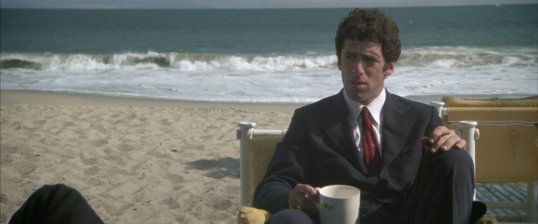
The Long Goodbye (1973, dir by Robert Altman, DP: Vilmos Zsigmond)
4 Shots From 4 Films is just what it says it is, 4 shots from 4 of our favorite films. As opposed to the reviews and recaps that we usually post, 4 Shots From 4 Films is all about letting the visuals do the talking.
Today is the anniversary of the birth of Raymond Chandler. That means that it’s time for….
4 Shots From 4 Philip Marlowe Films
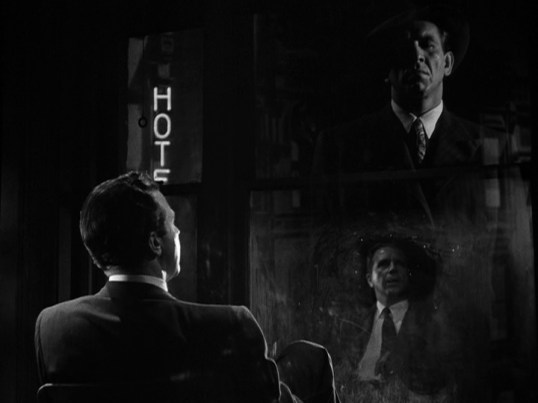
Murder, My Sweet (1944, dir by Edward Dmytryk, DP: Harry J. Wild)
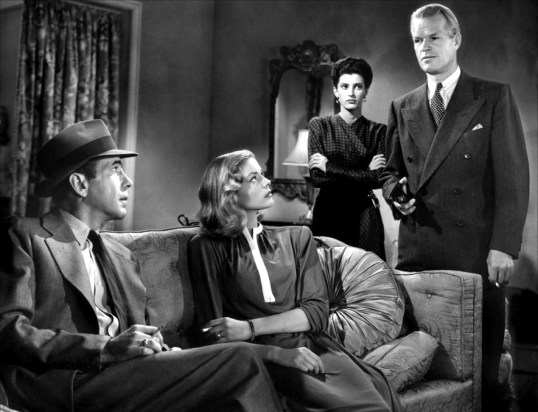
The Big Sleep (1946, dir by Howard Hawks, DP: Sidney Hickox)
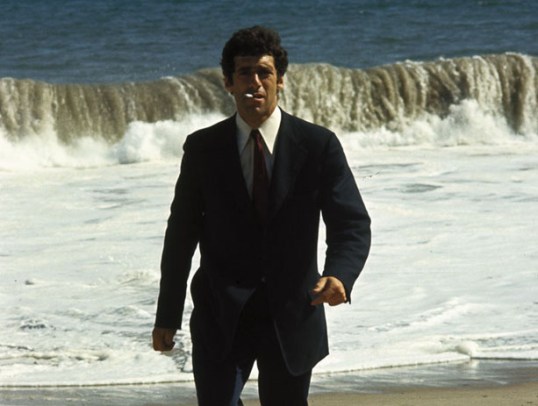
The Long Goodbye (1973, dir by Robert Altman, DP: Vilmos Zsgimond)
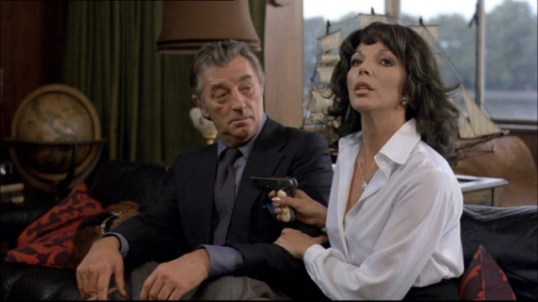
The Big Sleep (1978, dir by Michael Winner, DP: Robert Payner)
Raymond Chandler’s detective classic, The Big Sleep, has twice been adapted for film.
The first version came out in 1946, just seven years after the book’s publication. That version starred Humphrey Bogart as detective Philip Marlowe and Lauren Bacall as Vivian, the daughter of a man who has hired Marlowe to discover who is trying to blackmail him. Directed by Howard Hawks and co-written by William Faulkner, this version of The Big Sleep is considered to be a classic noir, one that was cited as being a major influence on director Akira Kurosawa.
The 1978 version was directed by Michael Winner, takes place in London in the 1970s, and features Robert Mitchum as Marlowe. Despite a strong ensemble cast and an excellent lead performance from Mitchum, this version of The Big Sleep still features one of the worst performances ever put on film.
Sarah Miles plays the role of Charlotte Sternwood Regan, the eldest daughter of General Sternwood (James Stewart). Miles is playing the role that Lauren Bacall played in the first film and, despite the fact that they both earlier co-starred to a certain amount of acclaim in Ryan’s Daughter, Miles and Mitchum do not have a hint of chemistry in this film. Actually, Miles doesn’t have chemistry with anyone in this film. She seems detached from the action and her frequent half-smiles come across as being not mysterious but instead somewhat flakey, as if she doesn’t quite understand that she’s in a noir. Sarah Miles is not a bad actress (as anyone who has seen Hope and Glory can tell you) but her performance here is incredibly dull. That said, she is not the one who gives the worst performance in the film.
Instead, that honor goes to Candy Clark, playing General Sternwood’s youngest daughter, Camilla. Camilla is meant to be mentally unstable and potentially dangerous. Clark plays the role like a giggly teenager, constantly fidgeting and literally hissing in more than a few scenes, as if she’s been possessed by a cat. Clark overacts to such an extent that you’ll be more likely to laugh at than be disturbed by her antics. It doesn’t help that she shares nearly all of her scenes with Robert Mitchum, a man who was a master when it came to underacting. If you’re going to give a bad performance, you don’t want to do it opposite someone who will make you look even worse by comparison.
The mystery of who is blackmailing General Sternwood is twisty and full of disreputable people. At times, the film feels like a a parade of character actors. Edward Fox, Joan Collins, Richard Boone, Oliver Reed, Harry Andrews, Richard Todd, and John Mills all show up throughout the film and, as a viewer, I was happy to see most of them. They all brought their own sense of style to the film, especially the menacing Oliver Reed. That said, director Michael Winner was never known for being a particularly subtle director and the film gets so mired in its own sordidness that it becomes be a bit of a slog to sit through. As a filmmaker, Winner was a shameless. That sometimes worked to a film’s advantage, as with the original Death Wish. That film needed a director who would dive into its Hellish portrayal of New York City without a moment’s hesitation and that’s what it got with Michael Winner. With Winner’s adaptation of The Big Sleep, however, the film gets so caught up in trying to shock and titillate that it’s hard not to miss the wit that made the first adaptation so special.
That said, The Big Sleep does feature the truly special opportunity to see Robert Mitchum and James Stewart acting opposite each other. Both give good and heartfelt performances, with Mitchum plays Marlowe as a cynic with a heart and Stewart capturing the pain of knowing that your children don’t deserve all that you do for them. Stewart and Mitchum bring a lot of emotion and sincerity to their scenes and, for at least a few minutes, The Big Sleep becomes about something more than just bloody murders and revealing photographs. It becomes about two aging men trying to find their place in a changing world. The Big Sleep was one of Stewart’s final feature films and he shows that, even late into his career, he was always one of the best.
Though the Academy of Motion Picture Arts and Sciences claim that the Oscars honor the best of the year, we all know that there are always worthy films and performances that end up getting overlooked. Sometimes, it’s because the competition too fierce. Sometimes, it’s because the film itself was too controversial. Often, it’s just a case of a film’s quality not being fully recognized until years after its initial released. This series of reviews takes a look at the films and performances that should have been nominated but were, for whatever reason, overlooked. These are the Unnominated.
Elliott Gould is Phillip Marlowe!
If I had to pick one sentence to describe the plot of 1973’s The Long Goodbye, that would be it. Robert Altman’s adaptation of the Raymond Chandler detective novel loosely follows Chandler’s original plot, though Altman did definitely make a few important changes. Altman moved the story from the 50s to the then-modern 70s, replacing Chandler’s hard-boiled Los Angeles with a satirical portrait of a self-obsessed California, populated by gurus and hippies. And Altman did change the ending of the book, taking what one could argue is a firmer stand than Chandler did in the novel. In the end, though, the film really is about the idea of Chandler’s tough detective being reimagined as Elliott Gould.
Rumpled, mumbling, and with a permanent five o’clock shadow, Gould plays Marlowe as being an outsider. He lives in a shabby apartment. His only companion is a cat who randomly abandons him (as cats tend to do). With his wardrobe that seems to consist of only one dark suit, Marlowe seems out-of-place in the California of the 70s. When Marlowe’s friend, Terry Lennox (Jim Bouton), asks Marlowe to drive him to Mexico, one gets the feeling that Lennox isn’t just asking because Marlowe’s a friend. He’s asking because he suspects Marlowe would never be a good enough detective to figure out what he’s actually doing.
After Terry’s wife is murdered, Marlowe is informed that 1) Terry has committed suicide and 2) Marlowe is now a suspect. Convinced that Terry would have never killed himself, Marlowe investigates on his own. He meets Marty Augustine (Mark Rydell), a gangster who demands that Marlowe recover some money that he claims Terry stole. Marty seems like an almost reasonable criminal until he smashes a coke bottle across his girlfriend’s face. (One of Marty’s bodyguards is played by a silent Arnold Schwarzenegger.) Meanwhile, Terry’s neighbors include an alcoholic writer named Roger Wade (Sterling Hayden) and his wife, Eileen (Nina van Pallandt). Like Marlowe, Roger is a man out-of-time, a Hemingwayesque writer who has found himself in a world that he is not capable of understanding. Henry Gibson, who would later memorably play Haven Hamilton in Altman’s Nashville, appears as Wade’s “doctor.”
Marlowe, with his shabby suits and a cigarette perpetually dangling from his mouth, gets next to no respect throughout the film. No one takes him seriously but Marlowe proves himself to be far more clever than anyone realizes. Elliott Gould gives one of his best performances as Marlowe, playing him as a man whose befuddled exterior hides a clear sense of right and wrong. Gould convinces us that Marlowe is a man who can solve the most complex of mysteries, even if he can’t figure out where his cat goes to in the middle of the night. His code makes him a hero but it also makes him an outsider in what was then the modern world. The film asks if there’s still a place for a man like Phillip Marlowe in a changing world and it leaves it to us to determine the answer.
Frequently funny but ultimately very serious, The Long Goodbye is one of the best detective films ever made. Just as Altman did with McCabe & Mrs. Miller, he uses the past to comment on what was then the present. And, just as with McCabe & Mrs. Miller, The Long Goodbye is a film that was initially released to mixed reviews, though it would later be acclaimed by future viewers and critics. Whereas McCabe & Mrs. Miller received an Oscar nomination for Julie Christie’s performance as Mrs. Miller, The Long Goodbye was thoroughly snubbed by the Academy. Altman, Gould, Hayden, and the film itself were all worthy of consideration but none received a nomination. Instead, that year, the Oscar for Best Picture went to The Sting, a far less cynical homage to the crime films of the past.
The Long Goodbye (1973, directed by Robert Altman)
Previous entries in The Unnominated:
(Lisa is once again in the process of cleaning out her DVR! She recorded the 1947 film noir Lady In The Lake off of TCM on June 17th!)
You are Raymond Chandler’s world-famous private detective, Phillip Marlowe!
Well, no. Actually, you aren’t. Lady in the Lake is best-known for being one of the first (if not the first) film to be shot from the viewpoint of the main character but actually, the film goes out of its way to remind you that you’re seeing the story through Marlowe’s eyes but you’re not Marlowe yourself. There are three scenes in which Marlowe (played by Robert Montgomery, who also directed the film) is seen sitting behind a desk and directly addressing the audience. He shows up to fill in a few plot details and to assure the audience that, while the film they’re watching may be experimental, it’s not too experimental. For his part, Montgomery looks and sounds absolutely miserable whenever he has to speak directly to the audience. One gets the feeling that these scenes were forced on him by nervous studio execs, who were probably worried that the film would be too weird for mainstream audiences.
However, the rest of the film is seen totally through Marlowe’s eyes. When Marlowe gets punched, we see the fist flying at him. When Marlowe smokes a cigarette, we see the smoke float away from him. When Marlowe leers at every single woman that he meets, the camera leers as well. When Marlowe looks at himself in a mirror, we see his reflection. When Marlowe passes out after a beating or a car accident, the image grows blurry before fading to black. There’s even a rather clever scene when Marlowe leans in for a kiss, just to suddenly change his mind and pull back.
Today, of course, the film’s technique doesn’t seem quite as revolutionary. We’re used to point of view shots and moving cameras. Last year, Hardcore Henry told its entire stupid story through a point of view shot and the shaky cam effect actually made me physically ill. In Lady in the Lake, there is no shaky, hand-held camera work and I was happy about that. Marlowe may turn his head left and right and he may walk forward but he apparently has nerves of steel because the image stays steady and only shakes when Marlowe’s getting beat up.
As for the film’s plot, it opens with Marlowe explaining that, since he’s not making enough money as a P.I., he’s decided to try his hand at writing for a pulp magazine. While his stories are not accepted, publishing executive Adrienne Fromsett (Audrey Totter) does hire him to track down the missing wife of her boss, Derace Kingbury (Leon Ames). As Marlowe quickly figures out, nobody’s motives are exactly pure. Adrienne wants to marry her boss and get her hands on his money. The wife’s lover (Richard Simmons) claims that he hasn’t seen her in weeks but still lets slip that she may no longer be alive. The police (represented by Lloyd Nolan and Tom Tully) are corrupt, rather rude, and may know more than they are letting on. Even a seemingly innocent landlady (Jayne Meadows) might have a secret or two.
And, of course, there’s the dead woman who is discovered in a nearby lake. Her identity holds the key to many mysteries…
It’s an intriguing puzzle and it actually helps to see everything through Marlowe’s eyes. If nothing else, it cuts down on the red herrings. If Marlowe stops to stare at something, you know exactly what he’s staring at and you can be sure that it will prove to be important at some point in the story.
By the way, did I mention that Lady In The Lake is not just an experimental film noir but a Christmas movie? Seriously, it opens with holiday music playing in the background and the opening credits are printed on cheery Christmas cards. It’s only after the credits are over that we see that there’s a gun underneath the cards. As a director, Montgomery does a great job juxtaposing the cheeriness of Christmas with the sordidness of the people who Marlowe has to associate with on a daily basis. He may be dealing with a bunch of murderers and greedy con artists but almost everyone has a Christmas tree in their apartment.
In fact, it’s so easy to get so wrapped up in the film’s technique that the viewer runs the risk of not noticing just how dark and cynical Lady in The Lake truly is. Everyone that Marlowe meets is sleazy. Marlowe, himself, does not come across as being particularly likable. Every room that Marlowe enters is underlit. Interestingly, with the exception of the opening credits and a driving montage, there’s not much music to be heard in the film, a reminder that we’re only hearing what Marlowe hears. And, in Marlowe’s world, there’s no music playing in the background to provide relief from the tension. There’s just a mix of lies and threats.
Lady in the Lake is an intriguing film and it shows up on TCM fairly frequently. Keep an eye out for it.
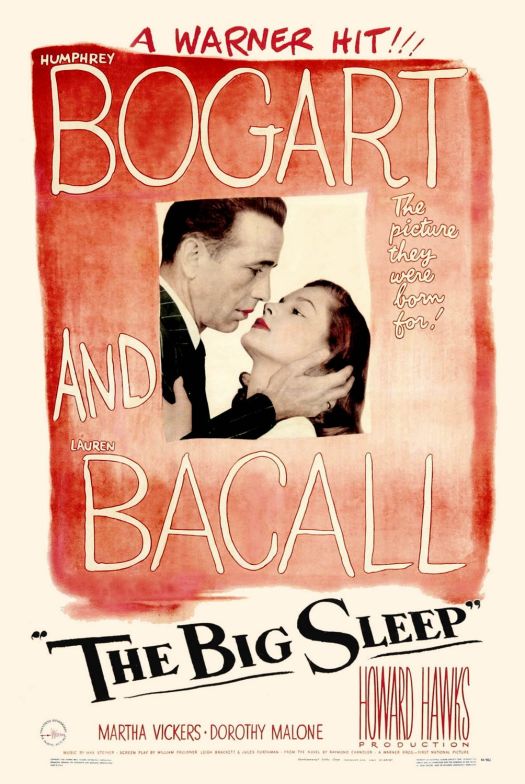
It’s been a long time since we last visited with Raymond Chandler’s fictional “knight-errant”, PI Philip Marlowe. Way too long, so let’s take a look at THE BIG SLEEP, starring Humphrey Bogart as the definitive screen Marlowe. This 1946 Howard Hawks film was a follow-up to 1944’s hit TO HAVE AND HAVE NOT, which introduced audiences (and Bogie) to luscious Lauren Bacall . The pair was dynamite together onscreen, and off as well, marrying a year later. Their May/December romance was one of Hollywood’s greatest love stories, lasting until Bogart’s death from cancer in 1957.
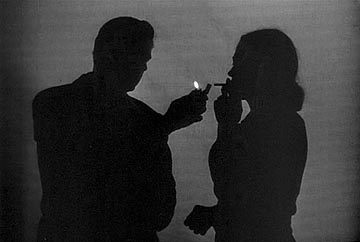
For me to try and explain the plot here would be futile, as it takes more twists and turns than a “Balinese belly dancer”. Marlowe is hired by elderly General Sternwood, whose sexy young daughter Carmen is being blackmailed. The General’s other daughter Vivien, a sexy divorcee, is also in trouble. This takes Our Man Marlowe…
View original post 582 more words
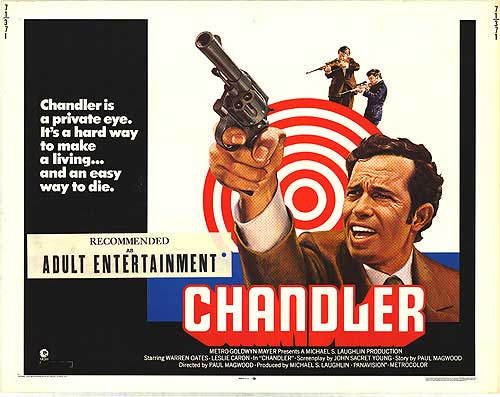
“Some (producers) are able and humane men and some are low-grade individuals with the morals of a goat, the artistic integrity of a slot machine, and the manners of a floorwalker with delusions of grandeur”- Raymond Chandler, “Writers in Hollywood”, first published in Esquire Magazine, Nov. 1945
I had high hopes for CHANDLER, I really did. An homage to the hard-boiled fiction of Raymond Chandler (born July 23, 1888) with Warren Oates as the titular detective sounded like it’d be right up my dark alley. But as much as I wanted to like this movie, I was let down by its slow pace, convoluted script, and butchering by studio execs. Much of the film was cut, scenes were replaced, and the result is an evocative mood piece that ultimately doesn’t satisfy the noir lover in me.
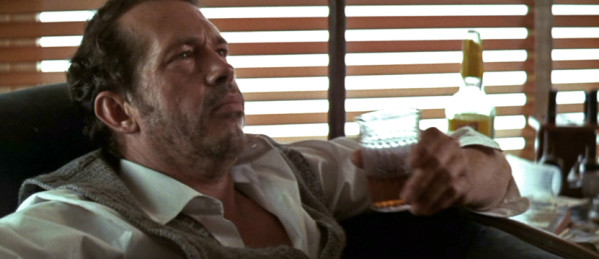
I don’t have a problem with Warren Oates as Chandler, with his Bogie-esque look and low-key performance…
View original post 342 more words
4 Shots From 4 Films is just what it says it is, 4 shots from 4 of our favorite films. As opposed to the reviews and recaps that we usually post, 4 Shots From 4 Films is all about letting the visuals do the talking.
Raymond Chandler was born on this date in 1888. He began publishing his short crime fiction in the pages of the pulp magazine Black Mask, and soon became one of the greatest “Hard-Boiled” writers of the 20th Century. Chandler’s detective Philip Marlowe is the most iconic PI in fiction, and his novels and stories have been adapted to the screen numerous times. Here are 4 Shots from the movie works of Raymond Chandler:
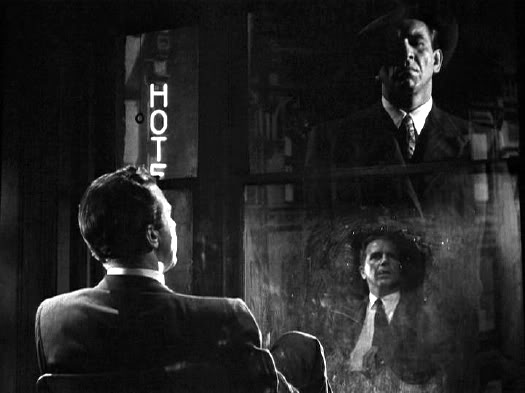
Murder, My Sweet (1944, D: Edward Dmytryk)
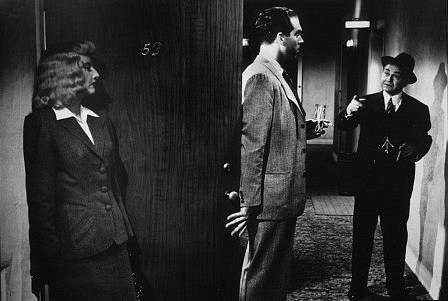
Double Indemnity (1944, D: Billy Wilder)
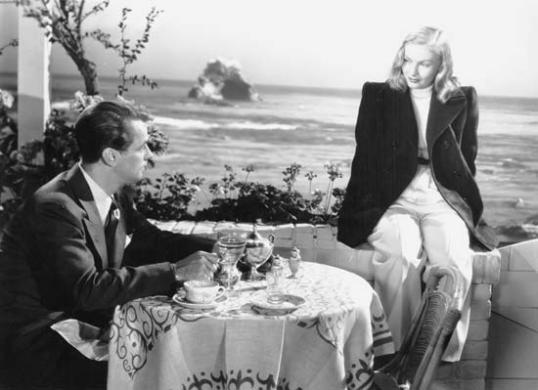
The Blue Dahlia (1946, D: George Marshall)
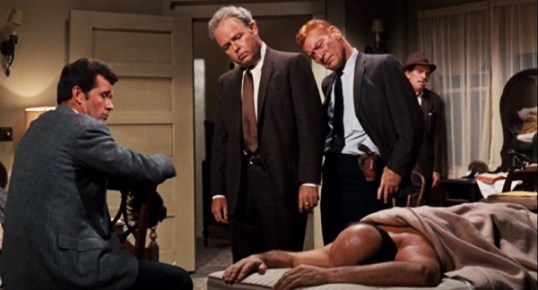
Marlowe (1969, D: Paul Bogart)
Philip Marlowe’s Hollywood history saw the shamus portrayed on the big screen by some very big names. Dick Powell, Humphrey Bogart, Robert Montgomery, George Montgomery, James Garner, Elliott Gould, and Robert Mitchum (twice) all played Raymond Chandler’s hard-boiled private eye at one point in their careers, with varying degrees of success. Los Angeles’ favorite detective also appeared on the small screen, and I decided to do some sleuthing and investigate the TV life of Philip Marlowe.
MARLOWE LIVE!
It was Robert Montgomery who first brought Marlowe into America’s living rooms on his anthology series ROBERT MONTGOMERY PRESENTS. But this time around, Zachary Scott played the gumshoe in a 1950 adaptation of THE BIG SLEEP. Marlowe fans would have a four year wait until he came back in another anthology, CLIMAX! hosted by William Lundigan. This time around, Dick Powell returned to the role in a 1954 telecast of THE LONG GOODBYE. There’s not…
View original post 488 more words
Happy belated birthday, Raymond Chandler. These four shots from four films show four different versions of Chandler’s most famous creation, P.I. Philip Marlowe.
Four Shots From Four Films
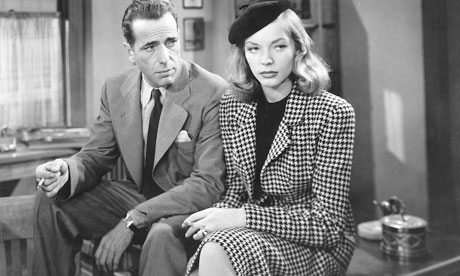
The Big Sleep (1946, directed by Howard Hawks)
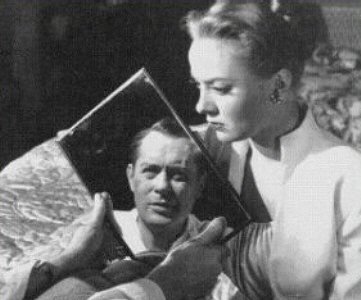
The Lady In The Lake (1947, directed by Robert Montgomery)
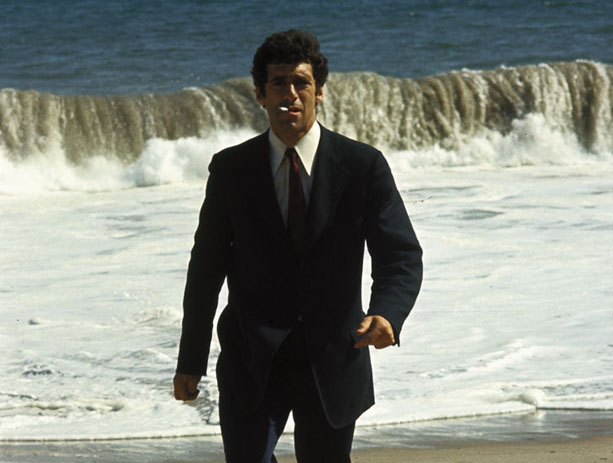
The Long Goodbye (1973, directed by Robert Altman)
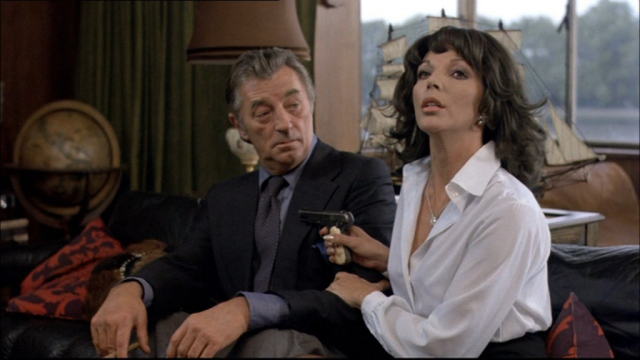
The Big Sleep (1978, directed by Michael Winner)

 Through the Shattered Lens