Trading Places (1983, directed by John Landis)


It all starts with a bet.

As Christmas approaches, Mortimer (Don Ameche) and Randolph Duke (Ralph Bellamy) make a bet to determine whether it’s nature or nurture that shapes someone’s future.  The fabulously wealthy owners of Duke & Duke Commodity Brokers, the brothers casually frame their director, Louis Winthrope III (Dan Aykroyd), for everything from dealing drugs to sealing money to cheating on his girlfriend (Kirstin Holby).  After Louis is kicked out of both his job and his mansion, the Dukes hire a street hustler named Billy Ray Valentine (Eddie Murphy) to take his place.  Earlier Winthrope tried to get Valentine arrested for approaching him in the street.  Now, Valentine is living in Winthrope’s mansion, with Winthrope’s butler and Winthrope’s job.

While Winthrope tries to survive on the streets with the help of a outwardly cynical but secretly kind-hearted prostitute named Ophelia (Jamie Lee Curtis, in her first non-horror starring role), Billy Ray surprises everyone by using his street smarts to become a successful, suit-wearing businessman.  The Dukes, of course, have no intention of keep Billy Ray Valentine on as their director.  Not only are the Dukes snobs but they’re racists as well.  Once their one dollar bet has been settled, they start planning to put Billy Ray back out on the streets with Winthrope.

Trading Places was Eddie Murphy’s follow-up to 48 Hrs and he again showed himself to be a natural star while playing the type of role that could have been played by Dan Ayrkroyd’s partner, John Belushi, if not for Belushi’s early death.  (Jim Belushi has a cameo as a party guest.)  Murphy gets to show off a talent for physical comedy and Trading Places is one of the few films to really take advantage of Dan Aykryod’s talents as both a comedian and actor.  Winthrope goes from being a coddled executive to being as streetwise as Valentine.  This is probably Aykroyd’s best performance and he and Eddie Murphy make for a good team.

But the real stars of the film are four actors who weren’t really thought of as being comedic actors, Denholm Elliott, Don Ameche, Ralph Bellamy, and especially Jamie Lee Curtis.  Ophelia is a much edgier character than the “final girls” that Curtis was playing in horror films and Curtis steals almost every scene that she’s in.  Ameche and Bellamy are great villains and it’s fun to watch them get their comeuppance.  What screwball comedy would be complete without a sarcastic butler?  Denholm Elliot fills the role of Coleman perfectly.

Trading Places was a box office success when it was released and it’s now seen as being one of the new Christmas classics, a film for the adults to enjoy while the kids watch Rudolph and Frosty.  I think the movie ends up going overboard towards the end with the gorilla and Dan Aykroyd wearing blackface but, for the most part part, it’s still a very funny and clever movie.

Retro Television Review: Fantasy Island 5.12 “The Magic Camera/Mata Hari/Valerie”


Welcome to Retro Television Reviews, a feature where we review some of our favorite and least favorite shows of the past!  On Tuesdays, I will be reviewing the original Fantasy Island, which ran on ABC from 1977 to 1984.  Unfortunately, the show has been removed from most streaming sites.  Fortunately, I’ve got nearly every episode on my DVR.

This week’s episode presents your erstwhile reviewer with a bit of an ethical quandary.

Episode 5.12 “The Magic Camera/Mata Hari/Valerie”

(Dir by Don Chaffey and Don Weis, originally aired on January 16th, 1982)

I don’t feel completely comfortable about reviewing this episode of Fantasy Island and I’ll tell you why.

Occasionally, Fantasy Island would broadcast an extra-long episode.  These episodes would typically feature three fantasies as opposed to the usual two.  Unfortunately, when these long episodes were syndicated, one of the fantasies would be edited out so the episode would fit into an hour-long slot.  Usually, the editing was not particularly smooth, either.  The end result would usually be an episode that seemed oddly paced and the performances of Ricardo Montalban and Herve Villechaize would often seem uneven as well.  As such, it’s neither easy nor particularly fair to review those edited episodes.  When it comes to reviewing, I always want to see the complete episode.

And yet, now that the original Fantasy Island is no longer streaming anywhere (seriously, what the Hell, Tubi?), I’m stuck using the episodes that I have on my DVR.  And that means reviewing the edited, syndicated versions of these episodes.

As you can probably guess, this is one of those edited episodes.  The Valerie fantasy was removed for syndication.  That’s a shame because Valerie featured the final televised performance of actor Christopher George, a charismatic B-movie veteran who is pretty popular around the Shattered Lens offices.  It also featured Michelle Phillips, though apparently she did not return as the mermaid who she played earlier on the show.  I’d love to review Valerie but I can’t.  And that sucks,

As for the other two fantasies, one is basically a remake of the Lillian Russell fantasy, except this time Martha Harris (Phyllis Davis) goes into the past and finds herself transformed into her great-grandmother, Mata Hari.  She gets to dance.  She gets to spy.  She gets thrown in prison and sentenced to death but, fortunately, her life is spared when the firing squad’s rifles are filled with blanks and she’s given a drug by one of the men who is in love with that makes her appear to be dead.  This was a enjoyable fantasy, mostly because of the costumes and the melodrama.

The other fantasy features Bob Denver, coming to the Island for the second week in a row.  This time, he’s a photographer who wants to take the type of pictures that the world’s greatest photographers couldn’t.  Because of the awkward way the fantasy was stated, the photographer ends up with a camera that takes pictures of the future.  At first, the photographer is really happy and uses his camera to commit a little insider trading.  But then he takes a picture of a newspaper and sees a headline announcing his death in a fiery auto accident.  Uh-oh!

Again, neither of the two fantasies is bad (though the second one does require a certain tolerance for Bob Denver that some people may not have) but it was hard for me to enjoy them knowing that I was missing out on a third fantasy.  For that reason, I assigning this episode a grade of incomplete.  If I ever get a chance to watch the complete episode, uncut, I’ll revisit this review but until then, I really can’t give an overall grade to this episode.

Finally, for those keeping track, both Julie and Tattoo join Roarke when it’s time to greet the guests.  That’s only second time that’s happened this season.

Retro Television Review: The Love Boat 4.19 “The Return of the Ninny/Touchdown Twins/Split Personality”


Welcome to Retro Television Reviews, a feature where we review some of our favorite and least favorite shows of the past!  On Wednesdays, I will be reviewing the original Love Boat, which aired on ABC from 1977 to 1986!  The series can be streamed on Paramount Plus!

This week, a familiar face sets sail for adventure.

Episode 4.19 “The Return of the Ninny/Touchdown Twins/Split Personality”

(Dir by Roger Duchowny, originally aired on February 14th, 1981)

Oh hey, it’s Charo!

It seems like just yesterday that I was watching her on Fantasy IslandOh wait, it was!

Charo returns to The Love Boat in her regular role as April Lopez.  The former stowaway-turned-singer-turned nanny boards the ship so that she and her two charges — Gayle (Rachel Jacobs) and Jerry (Alex Woodard) — can say goodbye to their father and April’s employer, Ty Younger (Larry Linville).  Ty is taking a vacation with his materialistic girlfriend (Arlene Martel), whom April dislikes.  Ty is looking forward to getting away from the kids for a while but — whoops! — April and the kids don’t get off the boat in time and soon, they’re intruding on Ty’s vacation.  It turns out to be a good thing because, after April learns that Ty’s girlfriend wants to send the kids away to a private school, she’s able to break up Ty’s relationship and keep the entire family together.  Yay!

Frank (Vincent Van Patten) boards the boat with college football teammate, Billy (Phillip Burns).  Billy can’t wait to hit on all the women who are his own age but Frank has decided that he’s in love with Billy’s mom, Meg (Samantha Eggar).  Captain Stubing likes Meg to but Frank shoves him out of the way on the dance floor and says that Meg is officially his MILF.  Billy gets upset and blames Frank …. no, actually, that would make too much sense.  Instead, Billy accuses his mother of leading on his best friend!  (Nobody mentions that Frank himself has spent the entire cruise acting like an unhinged stalker.)  It all works out in the end, of course.  Frank realizes that Meg doesn’t share his feelings and he decides to start dating women his own age.  Billy realizes that his mom is not a tramp.  Meg says she’s proud of the man that Billy has become.  (A man who accuses his own mom of being a tramp?  That kind of man?)  Stubing, once again, fails to get anywhere in his romantic pursuits and Vicki misses out on another potential stepmother.  Yay, I guess?  This story was actually kind of depressing.

Finally, Nick (Michael Lembeck) is an old college friend of Gopher’s.  Nick wants to be executive vice president of a company that it owned by the conservative and stodgy Arnold Hamilton (Ralph Bellamy).  When he’s with Arnold, Nick dresses like Arnold and he claims to agree with everything that Arnold says.  Nick also wants to marry a passenger that he just met, Linda (Laurette Spang).  Linda is almost a parody of a limousine liberal so when Nick is with her, he agrees with everything she says about oppression and the evils of money and he talks about his time as a labor organizer.  Nick is lying to both of them but it’s not like they’ll ever meet …. except, LINDA IS ARNOLD’S DAUGHTER!  Fear not, it all works out in the end.  Nick tells Arnold that he needs to change with the times and he tells Linda that she knows nothing about the working man.  Nick gets his promotion and a girlfriend.  Yay!

This was a pretty forgettable episode, even with Charo running around the ship in a panic over the children.  The storyline that worked best was the one with Michael Lembeck, Ralph Bellamy, and Laurette Sprang, though Bellamy was perhaps a bit too naturally likable to be totally convincing as a ruthless businessman.  (Even in old age, Bellamy had the simple, nice guy aura that always led to him losing the girl to Cary Grant.)  For the most part, this was a serviceable but not particularly memorable cruise.

Retro Television Reviews: Fantasy Island 3.23 “Eagleman/Children of Mentu”


Welcome to Retro Television Reviews, a feature where we review some of our favorite and least favorite shows of the past!  On Tuesdays, I will be reviewing the original Fantasy Island, which ran on ABC from 1977 to 1986.  Almost the entire show is currently streaming is on Youtube!

This week, season 3 comes to an end!

Episode 3.23 “Eagleman/Children of Mentu”

(Dir by Michael Vejar, originally aired on May 17th, 1980)

As I watched the third season finale of Fantasy Island, I found myself growing a bit sad.  Even though I went into this program knowing that Ricardo Montalban and Herve Villechaize eventually came to despise each other, it’s still a bit jarring to see just how obvious that dislike was by the end of season 3.  Gone were the silly moments of banter that used to start each episode.  Instead, by the end of season 3, each episode opened with same stock footage of Tattoo announcing the plane and then Roarke and Tattoo heading down to the docks to meet their guests.  When Tattoo and Roarke do speak to each other, the actors barely look at each other.  As I said, it’s a shame and it’s hard not to feel that the show itself became a bit less interesting once Roarke and Tattoo stopped interacting.

As far as this week’s fantasies, they both feel somewhat familiar.  There’s a comedic fantasy and a vaguely serious fantasy, both featuring actors who had previously appeared on the show in different roles.  The comedic fantasy features Bob Denver as Morris Binstock who comes to the Island for a business retreat.  Accompanying him is his son, Barney (Keith Coogan).  Ever since the death of his wife, Morris has struggled to connect with his son.  His fantasy is to become his son’s favorite comic book hero, Eagleman!

And he gets his wish.  Roarke has set up an entire Eagleman secret headquarters in the closet of Morris’s room.  Morris puts on the Eagleman costume and he does a flew klutzy things and he gets to fly.  His son is happy.  But is Morris devoting so much time to being Eagleman that he’s running the risk of losing a promotion at work?  After all, a promotion would not only mean more money but it would also be something that would continue to exist, even after Morris left the Island.  It looks like obnoxious Hal Ripley (Larry Storch) is going to get the promotion but when the company’s CEO, H.H. Moran (Jim Backus), discovers that Morris has been pretending to be Eagleman to make his son happy, Moran makes Morris vice president.  H.H. Moran is all about family!

The more serious fantasy features Vernee Watson as Rochelle McKenzie, a reporter who is trying to track down Dr. Arthur Gates (Ralph Bellamy), a millionaire who vanished one day.  Roarke explains that Dr. Gates has been spotted on the nearby Island of Mentu.  Roarke warns her that the inhabitants of Mentu are not friendly and Rochelle will be putting her own life at risk if she goes to the island,

Rochelle still goes to the island and guess what?  Roarke was not lying about those angry inhabitants.  One of the men is horribly scarred.  Another has to use a crutch but still growls at every human he sees.  The island and the natives were exploited by a mining company and now, the natives distrust almost everyone they see.  However, Dr. Gates has decided to dedicate his life to taking care of them.  That’s a good thing because it turns out that the scarred native has a sick child and only Dr. Gates can provide the proper medical attention.

Both stories are fairly silly, though at least Rochelle’s story gives Ralph Bellamy a chance to take on the type of role that was usually given to Ray Milland.  If you only know Bellamy as the guy who was constantly getting dumped for Cary Grant in the 30s and 40s, this episode allows Bellamy a chance to show that he could be a likable and authoritative actor.  As for the Eagleman story, it was kind of uncomfortable to watch because Bob Denver looked like he was in his early 60s and it was hard not to worry about him seriously injuring himself whenever he put on the costume.

There’s an interesting moment in Rochelle’s fantasy, in which she tells Mr. Roarke that she feels foolish coming to the Island in pursuit of a “fantasy.”  She feels that she’s being childish but Roarke explains that fantasies are not childish and that one should always pursue their dreams.  Whether it was intentional or not, this scene serves as a mission statement for the entire series.  Yes, Fantasy Island was frequently silly and childish but, in the end, it still resonates because people will always have dreams and they will always have fantasies.  There will always be a place for Fantasy Island.

Cleaning out the DVR: The Boy In The Plastic Bubble (dir by Randal Kleiser)


This made-for-television film from 1976 tells the story of Tod Lubitch (played by a pre-Saturday Night Fever John Travolta).  Tod was born without an immune system and, as a result, he’s had to spend his entire life in a germ-free, plastic bubble.  When Tod was a child, it wasn’t such a big deal not being able to leave his house without getting in a plastic ark beforehand.  But now, he’s in his teens and he wants to do teenager stuff.  His parents (Robert Reed and Diana Hyland) are overprotective.  His doctor (Ralph Bellamy) says that there’s little chance that Tod’s condition will ever improve.  But the girl next door, Gina (Glynnis O’Connor), finds herself falling in love with Tod and she wants to help him live a normal life.  Gina loves to ride horses and Tod wants to ride one with her.  As we all know, horses are totally germ-free.

The Boy In The Plastic Bubble is one of those movies that has a reputation.  It’s usually cited as being the epitome of 70s schmaltz and, indeed, it is very 70s and it is very schmaltzy.  It’s one of those films where the big dramatic moments are so overdone that they instead often become kind of comedic.  When Tod finally convinces his parents to allow him to attend school, he does so while wearing a special protective outfit that makes him look like a cross between an old school astronaut and a demented teddy bear.  When it looks like his suit might be malfunctioning, he runs into the plastic cell that’s been set up in the back of the classroom and strips it off while all of his classmates watch.  Everyone’s truly impressed by both Tod’s positivity and the sight of a 22 year-old John Travolta rolling around in gym shorts.

Indeed, while watching the film, it’s impossible not to ask certain questions.  In what world, for instance, could Robert Reed, best known for playing the patriarch on The Brady Bunch, be John Travolta’s father?  Why is there such a weird tension between Tod and his mother?  (It may have had something to do with the fact that Travolta was dating Diana Hyland at the time.)  How does Tod keep his hair so perfect while living in a plastic bubble?  Did anyone think that the scene where Tod is carried onto the beach inside a plastic box would be so odd to watch?  Reportedly, The Boy In The Plastic Bubble was based on the lives of two young men who has the same condition as Tod.  According to Wikipedia, one of them was very amused by the idea the Todd’s protective outfit would keep him safe at school.  And, then of course, there’s the film’s ending, which tries to offer a ray of hope but instead leaves you convinced that Tod is going to die at any minute.

And yet, for all the obvious flaws, The Boy In The Plastic Bubble is slightly redeemed by the sincerity that Travolta and O’Connor bring to their roles.  In particular, Travolta brings a smoldering anger to his role, which may not have been present in the script but which feels appropriate for the character.  As played by Travolta, Tod may understand why he’s in the bubble but he’s still pissed off about it.  O’Connor has an even more difficult role to play because Gina’s actions often don’t make a lot of sense.  But O’Connor makes you believe that she’s sincere in her desire to give the Bubble Boy the high school experience that he deserves.  It’s a schmaltzy film but Travolta and O’Connor bring a few moments of emotional honesty to it.

Director Randal Kleiser later worked with John Travolta on Grease.  I don’t think Danny Zuko would have been a good influence on the Boy in the Plastic Bubble.

Cleaning Out The DVR: Headline Shooter (dir by Otto Brower)


Bill Allen (William Gargan) is cynical newsreel cameraman.  Everywhere he goes, he’s got a tripod and a camera ready to go.  He films the disasters that other people are too scared to go near.  When there’s an earthquake, he runs outside to film it.  When a building catches on fire, he risks life and limb to record the event.  When a dam breaks, Bill is there to not only record the devastation but also help expose the man responsible for the poorly constructed dam.  When the man later commits suicide, Bill shrugs it off.  The public, he says, had a right to know.

Jane Mallory (Frances Dee) is a reporter.  She tough and she can just as sarcastic as Bill.  When she’s held hostage by  bunch of gangster, she proceeds to not only challenge them to a game of gin rummy but she beats them too!  Jane loves pursuing a good story but she worries that she might end up as cynical and callous as some of her colleagues.  As much as Jane loves it, a part of her is desperate to get out of the news business and, instead, marry the decent but boring Hal Caldwell (Ralph Bellamy, of course).

Together, Bill and Jane …. SOLVE CRIMES!

Actually, they do.  Of course, that doesn’t happen until towards the end of this zippy 61 minute film from 1933.  Before they solve a crime and run afoul some gangsters, Bill and Jane fall in love.  Of course, it’s a cynical journalist type of love, where quips and snarky put-downs replace the traditional endearments.  But it’s love just the same.  Bill and Jane share an understanding of what it feels like to pursue a big story.  It’s something that Hal, as decent a person as Ralph Bellamy ever played in a 1930s movie, just cannot understand.

This is a pre-code film, which means that the characters are allowed to smoke and drink and the dialogue is full of double entendres.  When Bill mentions that a woman he knows has a cold, Jane replies, “Let me guess.  It kept you up all night.”  That’s the type of dialogue that, in just a few short years after the release of Headline Shooter, studio productions would no longer be allowed to get away with.

Headline Shooter is a fast-paced film, one where everyone speaks almost exclusively in the fast rat-a-tat style of 1930s New York.  Considering that it’s only an hour long, it still manages to fit in a lot of plot.  There’s also a lot of real footage of actual disasters, the majority of which is passed off as being footage that was shot by either Bill or his colleagues.  Watching the film today, it’s interesting to consider that the newsreel cameraman were essentially early versions of the paparazzi, searching the city for anything worth shooting and, for the most part, not concerning themselves with the ethical concerns of exploiting disaster.  Many of the issues raised by Headline Shooter are still pertinent today.  One could almost argue that a film like Nightcrawler is a direct descendant of Headline Shooter.

Of course, Headline Shooter in never as dark as something like Nightcrawler.  Instead, all things considered, it’s a rather cheerful melodrama.  Gargan and Dee are wonderful in the lead roles and the cast is full of wonderful 1930s character actors.  This film shows up occasionally on TCM so keep an eye out for it!

(Unless, of course, you’re a Comcast customer….)

Cleaning Out The DVR: Let Us Live! (dir by John Brahm)


In the 1939 film, Let Us Live!, Henry Fonda plays Brick Tennant.  Brick is a poor but honest taxi driver who has always lived a law-abiding life and who is looking forward to marrying waitress named Mary Roberts (Maureen O’Sullivan).  However, when a taxi is used as a getaway car in a violent robbery that leaves a policeman dead, Brick finds that he’s a suspect.

At first, Brick isn’t too worried.  It turns out that every taxi driver in Boston is apparently being considered a suspect.  Brick is just 1 out of 120.  However, when the police bring Brick in to take part in a lineup, one of the witnesses insists that Brick and his friend, Joe Linden (Alan Baxter), were involved in the robbery.  Despite the fact that Brick and Mary were at a church, planning their wedding, during the robbery, Brick and Joe are arrested and put on trial for murder.  Despite Brick’s initial faith in the system, he and Joe are convicted and sentenced to die.

On death row, Brick faces the inhumane reality of American justice.  He watches as other prisoners slowly lose their mind as a result of neglect and abuse.  He watches as another prisoner drops dead in front of him, to the indifference of the guards.  Even when Mary tells him that she’s still looking for evidence that will exonerate him, Brick says that he no longer cares.  The state of Massachusetts is determined to kill him and he doesn’t believe that there’s any way stop them.  As Mary puts it, Brick is now dead inside.

Still, Mary continued to investigate.  Helping her is a police detective named Everett (Ralph Bellamy).  Everett comes to realize that two innocent men are sitting on Death Row but will he and Mary be able to find the real culprits before the state executes Brick and Joe?

While watching Let Us Live, I found it impossible not to compare the film to The Wrong Man, another film in which Henry Fonda played an innocent man being railroaded by the system.  Both The Wrong Man and Let Us Live were based on a true stories, though Let Us Live takes considerably more liberty with its source material than The Wong Man does.  Whereas The Wrong Man is a docudrama that’s full of moody atmosphere courtesy of director Alfred Hitchcock, Let Us Live is much more of a fast-paced, melodramatic B-move.

That said, Let Us Live! is still a definitely effective look at how an innocent man can be railroaded by a system that’s often more concerned with getting a quick conviction than actually searching for the truth.  Sadly, the issues that Let Us Live deals with are just as relevant today as they were in 1939.  The film’s power comes from Henry Fonda’s performance as Brick.  It’s truly heart-breaking to watch Brick go from being a cheerful optimist to a man who has been so broken down by American justice that he can’t even bring himself to celebrate the news that he might be released.  The film ends on a grim note, a reminder that some damage cannot be undone.

Let Us Live! is another good but obscure film that I discovered through TCM.  Keep an eye out for it!

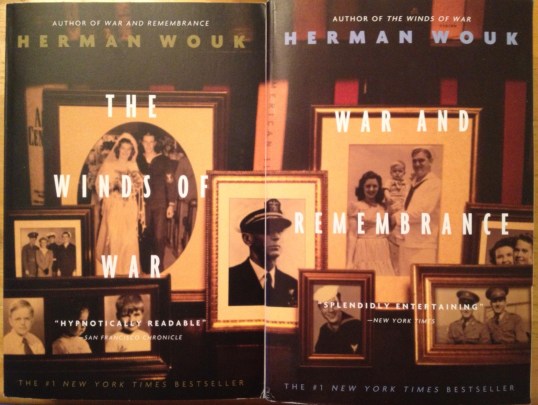
A Herman Wouk Double Feature: The Winds of War (1983, directed by Dan Curtis) and War and Remembrance (1988, directed by Dan Curtis)


When the great American novelist Herman Wouk passed away earlier this month at the age of 103, he left behind a rich and varied literary legacy.  From 1947, the year that his first novel was published to 2016, the year that he published his memoirs, Wouk wrote about religion, history, science, and even the movies.  However, Wouk will probably always be best remembered for the three novels that he wrote about World War II.

Based on his own Naval service during World War II, The Caine Mutiny was published in 1951 and was later adapted into both a successful stage play and an Oscar-nominated film.  It also won Wouk a Pulitzer Prize and established him as a major American writer.  Nearly 20 years later, Wouk would return to the history of the Second World War with two of his greatest literary works, The Winds of War and War and Remembrance.  (Originally, Wouk was only planning on writing one book about the entire war but when it took him nearly a thousand pages to reach Pearl Harbor, he decided to split the story in two.)  Beginning in 1939 and proceeding all the way through to the end of the war, the two books followed two families, the Henrys and the Jastrows, as they watched the world descend into war. Along the way, the book’s fictional characters rub shoulders with historical characters like Hitler, Churchill, FDR, and even Stalin.  Carefully researched and meticulously detailed, the books were both critically acclaimed and popular with readers and, despite some soapy elements, they both hold up well today.

Given their success, it’s not a surprise that both The Winds of War and War and Remembrance were adapted for television.  Today, HBO would probably give the books the Game of Thrones treatment, with 8 seasons of war, tragedy, romance, and Emmys.  However, this was the 1980s.  This was the age of of the big-budget, all-star cast network miniseries.  Wouk’s epic history of World War II was coming to prime time.
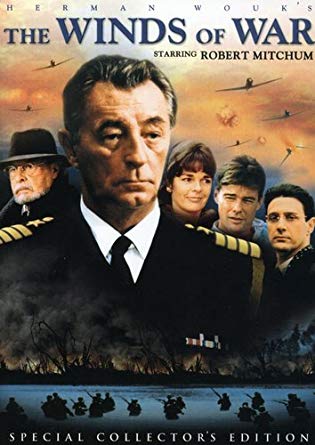
With a total running times of 15 hours, The Winds of War originally aired over seven evenings in 1983.  Produced and directed for ABC by Dan Curtis, The Winds of War had a 962-page script, a 200-day shooting schedule, 285 speaking parts, and a then-record budget of $35,000,000.  It also had Robert Mitchum, starring as Victor “Pug” Henry, an ambitious naval officer who somehow always managed to be in the right place to witness almost all of the events leading up to America’s entry into World War II.  Jan-Michael Vincent played Pug’s son, Byron, while John Houseman took on the pivotal role Aaron Jastrow, a Jewish scholar though whose eyes the home audience would witness the rise of fascism in Europe.  Terribly miscast as Natalie, Aaron’s niece and Byron’s lover, was 44 year-old Ali MacGraw.  Among those playing historical figures were Ralph Bellamy as FDR, Howard Lang as Churchill, and Gunter Meisner as Hitler.

I recently watched The Winds of War on DVD and, despite some glaring flaws that I’ll get to later, it holds up well as both a history of World War II and a tribute to those who battled Hitler’s evil.  Like Wouk’s novels, the miniseries does a good job of breaking down not only how Hitler came to power but also why the rest of the world was often in denial about what was happening.  Watching the entire miniseries in one setting can be overwhelming.  It’s a big production and it is also unmistakably a product of a time when the major networks didn’t have to worry about competition from cable.  It takes its time but, in the end, you’re glad that it did.  All of the little details can get exhausting but they’re important to understanding just how Hitler was able to catch the world off-guard.
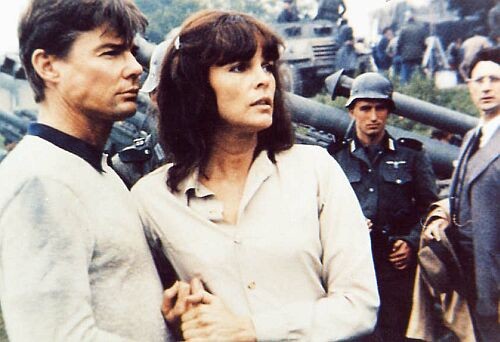
Jan-Michael Vincent and Ali MacGraw in The Winds of War

The miniseries does suffer due to the miscasting of some key roles.  Both Jan-Michael Vincent and Ali MacGraw were far too old for their roles.  Vincent was 38 and MacGraw was 44 when they were cast as naive and idealistic lovers trying to find themselves in Europe.  It’s perhaps less of a problem for Vincent, who had yet to lose his looks to alcoholism and who looked enough like Robert Mitchum that he could pass as Mitchum’s son.  But MacGraw is simply terrible in her role, flatly delivering her lines and looking more like Vincent’s mother than his lover.  It’s particularly jarring when she mockingly calls diplomat Leslie Sloat “Old Sloat,” because Sloat was played by David Dukes, who was six years younger than MacGraw.
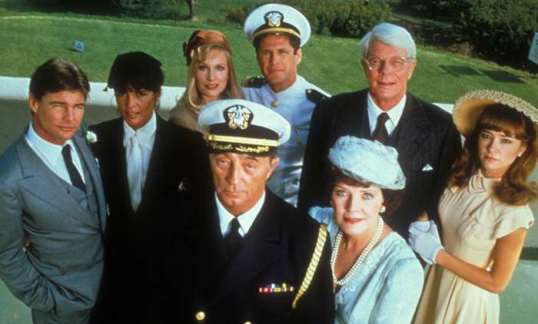
67 year-old Robert Mitchum was also much too old to play an ambitious junior officer, one whose main goal in life is still to ultimately become an admiral.  When he ends up having an affair with a younger British journalist played by 30ish Victoria Tennant, the difference in their ages is even more pronounced than in Wouk’s novel.  (Pug was in his 40s in The Winds of War.)  However, Mitchum overcomes his miscasting by virtue of his natural gravitas.  With his weary presence and authoritative voice, Mitchum simply is Pug.
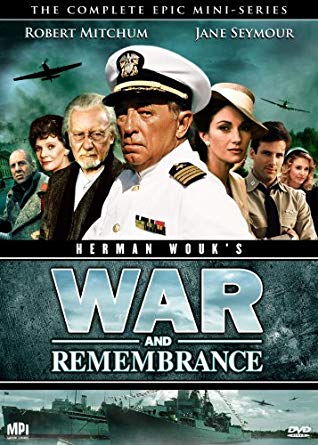
A ratings hit and a multiple Emmy nominee, The Winds of War was followed up five years later by War and Remembrance.  Like its predecessor, War and Remembrance set records.  The script ran 1,492 pages and featured 356 speaking parts.  The production employed 44,000 extras and filming took nearly two years, from January of 1986 to September of 1987.  With a budget of $104 million, it was the most expensive television production to date.  The final miniseries had a 30-hour running time, which was divided over 12 nights.  War and Remembrance not only made history because of its cost and length but also as the first major production to be allowed to film on location at the Auschwitz concentration camp.  For many members of the generation born after the end of World War II, War and Remembrance would serve as their first introduction to the horrors of the Holocaust.

Director Dan Curtis returned and with him came Robert Mitchum, now in his 70s and still playing a junior naval officer.  David Dukes once again played the hapless diplomat, Leslie Sloat.  Ralph Bellamy also returned as FDR as did Victoria Tennant as Mitchum’s lover, Polly Bergen as Mitchum’s wife, and Peter Graves as Bergen’s lover.  However, they were the exception.  The majority of the original cast was replaced for the sequel, in most cases for the better.  With John Houseman too ill to reprise his role, John Gielgud took over the role of Aaron Jastrow while Hart Bochner replaced the famously troubled Jan-Michael Vincent.  Robert Hardy took over the role of Churchill while Hitler was recast with Steven Berkoff.  Best of all, Jane Seymour replaced Ali MacGraw in the role of Natalie and gave the best performance of her career.  Other characters were played by a mix of up-and-comers to tv veterans, with the cast eventually including everyone from Barry Bostwick and Sharon Stone to E.G. Marshall and Ian McShane.
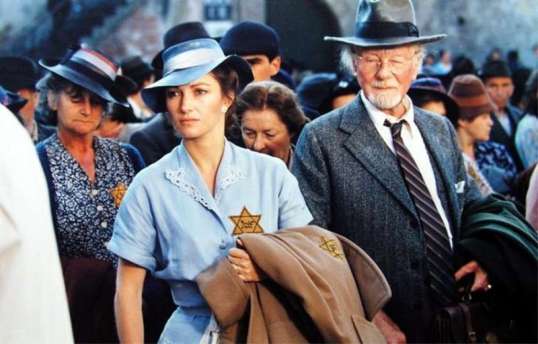
Jane Seymour and John Gielgud

With a stronger cast and (ironically, considering the running length) a more focused storyline, War and Remembrance is superior to The Winds of War in every way.  That doesn’t mean that it’s perfect, of course.  The scenes featuring Barry Bostwick as a submarine commander feel as if they go on forever and Robert Mitchum still seems like he should be preparing for retirement instead of angling for a promotion.  But none of that matters when the miniseries focuses on Aaron and Natalie Jastrow and their struggle to survive life in the Theresienstadt Ghetto and eventually Auschwitz.  At the time that War and Remembrance was initially broadcast, the concentration camp scenes were considered to be highly controversial and many viewers complained that they were so disturbing that they should not have been aired during prime time.  (This was four years before Schindler’s List.)  Seen today, those scenes are the most important part of the film.  Not only do they show why the war had to be fought but they also demand that the world never allow such a thing to happen again.

Though it was considered by a rating disappointment when compared to its predecessor, War and Remembrance was still a multiple-Emmy nominee.  Controversially, it defeated Lonesome Dove for Best Miniseries.  Both Winds of War and War and Remembrance have been released on DVD and, like the books that inspired them, they both hold up well.  They pay tribute to not only those who fought the Nazis but also to the humanistic vision of Herman Wouk.
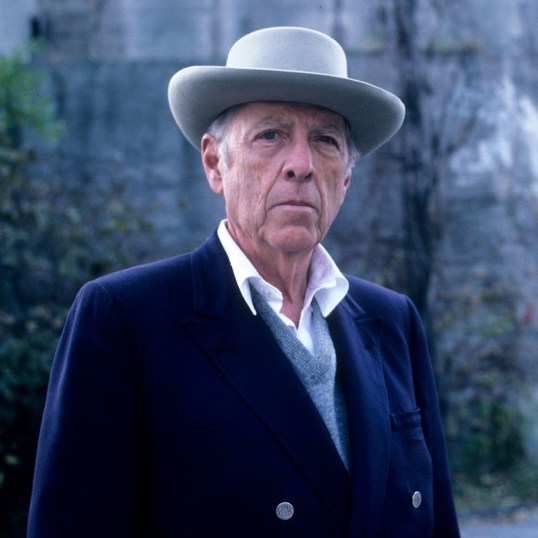
Herman Wouk (1915-2019)

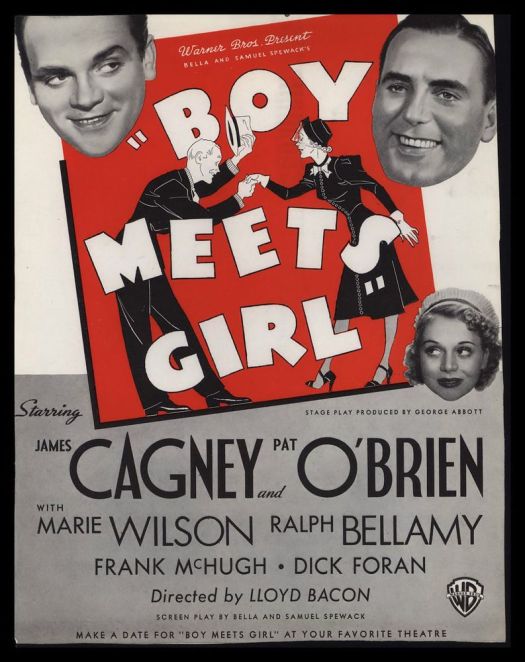
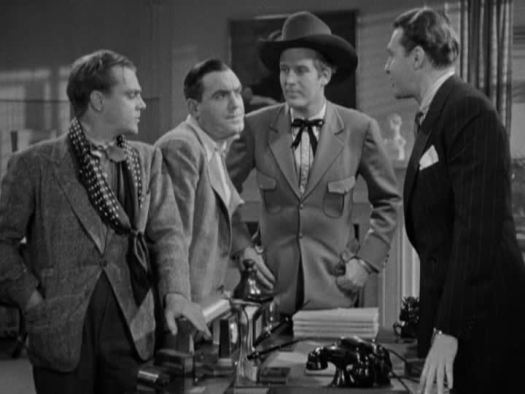
A Wee Bit O’Blarney with Cagney & O’Brien: BOY MEETS GIRL (Warner Brothers 1938)


gary loggins's avatarcracked rear viewer

Tomorrow’s the day when everybody’s Irish, and America celebrates St. Patrick’s Day! The green beer will flow and copious amounts of Jameson will be consumed,  the corned beef and cabbage will be piled high, and “Danny Boy” will be sung by drunks in every pub across the land. Come Monday, offices everywhere will be unproductive, as all you amateur Irishmen will be nursing hangovers of Emerald Isle proportions. They say laughter is the best medicine, so my suggestion is to start your workday watching an underrated screwball comedy called BOY MEETS GIRL, starring James Cagney and Pat O’Brien, both members in good standing of “Hollywood’s Irish Mafia”!

Jimmy and Pat play a pair of wacky screenwriters working for Royal Studios on a vehicle for fading cowboy star Dick Foran. Pretentious producer Ralph Bellamy has enough problems without these two jokers, as rumor has it Royal is about to be sold…

View original post 493 more words

Christmas-tery: Deanna Durbin in LADY ON A TRAIN (Universal 1945)


gary loggins's avatarcracked rear viewer

Deanna Durbin was the best Christmas present Universal Studios ever received. The 15-year-old singing sensation made her feature debut in 1936’s THREE SMART GIRLS, released five days before Christmas. The smash hit helped save cash-strapped Universal from bankruptcy, and Miss Durbin signed a long-term contract, appearing in a string of musical successes: ONE HUNDRED MEN AND A GIRL, THAT CERTAIN AGE, SPRING PARADE, NICE GIRL?, IT STARTED WITH EVE. One of her best is the Christmas themed comedy/murder mystery LADY ON A TRAIN, one of only two films directed by  Charles David, who married the star in 1950, the couple then retiring to his native France.

Our story begins with young Nikki Collins travelling by train from San Francisco to New York City to visit her Aunt Martha, reading a murder mystery to pass the time. Nikki witnesses a real-life murder committed through a window, and after ditching her wealthy…

View original post 579 more words