Film Review: Into the Wild (dir by Sean Penn)


He went looking for America but couldn’t find it.

That’s not actually the tag line that was used to advertise 2007’s Into The Wild but perhaps it should have been.  Based on the true story of Chris McCandless, a college graduate who gave away all of his money and then roamed the country for two years before starving to death in an abandoned bus in Alaska, Into The Wild seems to be Sean Penn’s attempt to make a modern-day Easy Rider.  Just as Dennis Hopper and Peter Fonda crossed the country and met several different people over the course of that seminal road film, Into The Wild follows Emile Hirsch’s Chris McCandless as he takes on the identity of Alexander Supertramp and hikes across the continent.  Along the way, he meets and befriends hippies (Catherine Keener and Brian H. Dierker), blue collar workers (Vince Vaughn), wayward teenagers (Kristen Stewart), and, most poignantly, a retired man (Hal Holbrook) who sincerely tries to help Chris make peace with his wanderlust.

You would think that this would be the type of film that would bring out Sean Penn’s worst directorial instincts but Penn actually directs with a very real sensitivity and a willingness to see the good in just about everyone that Chris meets.  It is true that, especially at the start of the film, Chris can sometimes be a bit difficult to take.  He’s so self-righteous and sure of himself.  He mistakes his college diploma for being a badge of experience and occasionally, he can come across as being incredibly condescending.  But, as the film progresses, Chris starts to realize that he doesn’t know everything and that he can’t do everything by himself.  Sometimes, he does need help, even if he doesn’t want to admit it.  The film’s most moving moments feature Chris and Hal Holbrook’s Ron Franz.  Ron has the years of experience that Chris lacks and Ron also becomes one of the few people to whom Chris is willing to truly listen.  And yet, when Ron offers to adopt Chris and give him a permanent home, Chris’s response is to promise to talk to him about it when Chris returns from Alaska.  As Chris leaves, it’s obvious that Ron knows that he’s never going to see Chris again.  Dying in Alaska, Chris finally makes some sort of inner peace with the parents (William Hurt and Marcia Gay Harden) and the sister (Jena Malone) that he earlier abandoned.  It’s an amazingly touching scene.  Penn, whose other directorial efforts have been a bit didactic, seems to be willing to grant a certain grace to everyone in the film, even those whose politics or cultural attitudes he might not necessarily share.  Penn not only captures the visual beauty of the America wilderness but also the beauty of the people, a beauty that too many other directors chose to downplay.

It’s a strong film and certainly the best of Penn’s directorial efforts.  Emile Hirsch is not always likable as Chris but, then again, the heart of the film is found in the people that Hirsch meets and Penn gets excellent performances from his entire supporting cast.  Hal Holbrook received a much deserved Oscar nomination.  I also liked Vince Vaughn’s performance as guy who teaches Chris about hard work before getting arrested for stealing cable and also Jena Malone as Chris’s sister, the one person who understands him, even if she’s not invited to travel with him.

Into The Wild is a poignant portrayal of  both wanderlust and the often-neglected corners of America.  Did Chris find a little of something that he was looking for before he died in that bus?  One can only hope.
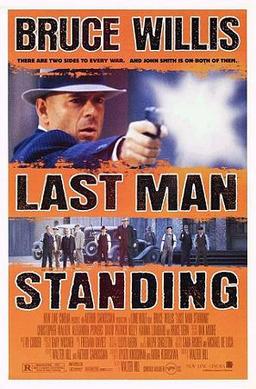
 

Last Man Standing (1996, directed by Walter Hill)


During the 1920s, at the height of prohibition, a mysterious man named John Smith (Bruce Willis) arrives in the dusty town of Jericho.  Jericho sits on the border, between Texas and Mexico, and it is the site of a gang war.  The Italian mob, led by Fred Strozzi (Ned Eisenberg) and Giorgio Carmote (Michael Imperioli), is trying to move in on the Irish mob, led by Doyle (David Patrick Kelly) and his fearsome gunman, Hickey (Christopher Walken).  After the members of the Irish mob destroy his car and leave him stranded in town, Smith offers his services as a gunman to the Italians.  Strozzi hires him but it turns out that Smith has his own agenda and soon, he is manipulating both gangs against each other.

Last Man Standing was Walter Hill’s remake of Yojimbo, with Bruce Willis playing an Americanized version of Toshiro Minfune’s wandering ronin.  (Hill does the right thing and gives Kurosawa credit for the film’s story.)  Now, it should be understood that this is in no way a realistic film.  It makes no sense for two Chicago-style gangs to be fighting over a ghost town in Texas.  Even when it came to smuggling in liquor during the prohibition era, most of it came over the Canadian border rather than the Texas border.  But Walter Hill has always been more about filming the legend than worrying about realism.  He’s the ultimate stylist, creating movies the come together to create an American mythology.  Last Man Standing is a work of pure style, a combination western/gangster movie that pays tribute to the ultimate samurai film.  Gangsters meeting in the desert while tumbleweed rolls past may not make sense but Hill knows a good visual when he sees one and he makes it work.  The plot is taken from Yojimbo.  The western setting is taken from A Fistful of Dollars.  And the gangsters are pure Americana.

Willis, back in his action star heyday, is quick with a gun and a quip and he gets a few scenes that show that, while he may be bad, he’s not as bad as the gangsters in charge of the town.  Hill surrounds Willis with a cast of great character actors, including Bruce Dern as the cowardly sheriff and William Sanderson as the owner of the hotel.  Though he might not be as well-known as some members of the cast, I especially liked Ken Jenkins as the Texas Ranger who informs Willis that he has ten days to finish up his business before the Rangers come to town and kill whoever is still standing.  And then you’ve got Walken, in one of his best villainous roles.  Hickey doesn’t show up until pretty late in the movie but we’ve spent so much time hearing about him that we already know he’s the most dangerous man in Texas and Walken gives a performance that lives up to the hype.

Unappreciated when it was first released, Last Man Standing has stood the test of time as one of Walter Hill’s best.

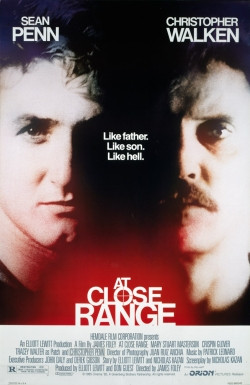
At Close Range (1986, directed by James Foley)


Brad Whitewood, Sr. (Christopher Walken) is known as Big Brad, a rural crime lord who rules the backwoods of Pennsylvania.  When his son, Little Brad (Sean Penn, trying too hard to be James Dean), comes to live with him, Big Brad goes out of his way to try to bring the teenager into his criminal lifestyle.  At first, Little Brad loves being a part of the family business but witnessing a murder and falling in love with Terry (Mary Stuart Masterson) caused Little Brad to start to move away from his father.  With the FBI closing in on the Whitewood family, Brad Sr. starts to eliminate everyone who he considers to be a threat, including the members of his own family.

Based on a true story, this neo-noir features a great cast, including Chris Penn, Millie Perkins, Kiefer Sutherland, Crispin Glover, David Strathairn, Tracey Walter, and Mary Stuart Masterson.  Unfortunately, the movie itself moves at a plodding pace.  There are some good and disturbing scenes, like the montage where Big Brad starts to eliminate the members of his gang.  The film does a good job of showing how seductive Big Brad’s criminal lifestyle can be to a bunch of kids who have basically been written-off by society.  But the story itself is so bleak that most people will end up tuning out long before Little Brad finally turns against his father.

Whatever other flaws it may have, At Close Range does feature one of Christopher Walken’s best performances.  Walken is chillingly evil as Big Brad.  He’s got enough charisma to be believable as someone who could bring a gang together but he’s also frightening as he starts killing anyone who he thinks might talk to the police or the FBI.  Big Brad is a remorseless killer and Walken plays him as being a classic sociopath, someone who cannot understand why the members of his gang and family would get upset when he starts killing some of them.  To Big Brad, that just goes with the territory.  It’s a part of doing business.  With his distinct way of speaking and his trademark tics, Walken is someone who has inspired many impersonators and it can be easy to forget that he’s also a damn good actor.  Films like At Close Range remind us of just how talented Walken actually is.

Film Review: Murder by Numbers (dir by Barbet Schroeder)


First released in 2002, Murder by Numbers is one of those films that seems to be pop up on Cinemax every couple of months.  It’s not really that good, though it has its fans because if features Sandra Bullock being all self-destructive and one of the film’s villains is played by a young Ryan Gosling.

Ryan Gosling is Richard Haywood, child of privilege.  He’s handsome.  He’s funny.  He’s popular.  He’s spoiled.  He’s often high.  And he’s totally psychotic.  Richard wants to commit the perfect crime and, fortunately, so does his classmate, Justin (Michael Pitt).  Justin is a fiercely intelligent introvert who spends most of his time reading and writing and playing with his computer.  He’s got a crush on Richard’s ex, Lisa (Agnes Buckner).  From the minute that Lisa showed up and started talking to Justin, I was concerned.  I was like, “Is this another movie that’s going to feature someone named Lisa being murdered?  CHERISH ALL OF THE LISAS IN YOUR LIFE, PEOPLE!”

Anyway, Richard and Justin do end up killing a woman, though not Lisa.  They go through a lot of effort to frame the school’s pervy janitor, Ray (Chris Penn), for the crime.  And they nearly succeed, though Detective Cassie Mayweather (Sandra Bullock) is way too smart to fall for their tricks.  Unfortunately, no one believes anything that Cassie says because she has a shady past and a drinking problem.  Even her sympathetic new partner, Sam Kennedy (Ben Chaplin), thinks that it was probably Ray.

Literally everyone on the police force tells Sam that Cassie is unstable and not to be trusted, which leads to an interesting question.  If everyone’s convinced that everything Cassie says is wrong, why does she still have a job?  Why do they still assign her to cases?  It’s like, “We’ve got a murder that we have to solve!  Let’s give it to that detective who we think never gets anything right!”

Sandra Bullock does her best to bring the self-destructive Cassie to life but she kind of runs into the huge problem that she’s Sandra Bullock and she has such a firmly entrenched screen presence that it’s difficult to take her seriously as someone who spend her free time sitting on a houseboat, getting drunk, and obsessing on the past.  You really want her to give a good performance because it’s impossible not to root for Sandra Bulllock but she’s just too miscast.  You keep expecting Matthew McConaughey to show up, playing a bongo drum and trying to cheer her up.

Far more convincing is Ryan Gosling, who plays Richard as the type of guy that we all knew in high school.  You know he’s a jerk.  You know you should stay away from him.  But he’s just so much fun and he has so much money!  Unfortunately, Gosling is so charismatic that Richard quickly becomes the only compelling character in the film.  I mean, if you have the choice between watching Michael Pitt, Ben Chaplin, or Ryan Gosling, who are you going to go with?  You’re supposed to hate Richard and hope that justice catches up with him but instead, you find yourself hoping that he’ll sneak out of the country and spend the rest of his hiding out in South America or something.

So, as a result, the film really doesn’t work.  (It also doesn’t help matters that it’s directed in a rather detached fashion by the king of ennui, Barbet Schroeder.)  But it’s interesting to watch, just for a chance to see a future star in the making.  Gosling steps into a rather underwritten role and basically takes over the entire damn movie.

It’s also worth seeing for the scene in which Sandra Bullock gets attacked by a baboon.  It’s a weird moment and Schroeder screws things up by mixing in a flashback to Cassie’s past but still, it’s a baboon attacking Sandra Bullock.  That’s not something you see every day.

A Movie A Day #208: War Party (1988, directed by Franc Roddam)


On the hundredth year anniversary of a battle between the U.S. Calvary and the Blackfeet Indians, the residents of small Montana town decide to reenact the battle and hopefully bring in some tourist dollars.  The white mayor (Bill McKinny) and the sheriff (Jerry Hardin) both think that it is a great idea.  Even the local Indian leader, Ben Cowkiller (Dennis Banks, in real-life a founder and leader of the American Indian Movement), thinks that it will be a worthwhile for the Indians to participate.  The Calvary’s guns will be full of blanks.  The Indians will play dead.  However, as the result of a bar brawl the previous night, one of the local rednecks, Calvin Morrisey (Kevyn Major Howard), shows up with a gun full of bullets.  After he shoots one of the Indians, Calvin ends up with a tomahawk buried in his head.  Three Indian teenagers, Warren (Tim Sampson), Skitty (Kevin Dillon), and Sonny (Billy Wirth), flee into the wilderness.  Thirsty for revenge, a white posse heads off in pursuit.

War Party is an underrated and surprisingly violent movie.   Franc Roddam brings the same sensitivity to his portrayal of alienated Indians that he brought to portraying alienated Mods in Quadrophenia.  Though, at first, Kevin Dillon seems miscast as an Indian, he, Wirth, and Sampson all give good performances, as does Dennis Banks.  The movie is often stolen by M. Emmett Walsh and Rodney A. Grant, playing renowned trackers who are brought in to help the posse chase down the three youths.  That Grant’s character is a member of the Crow adds a whole extra layer of meaning to his role. Even though the setup often feels contrived and heavy-handed and anyone watching should be able to easily guess how the movie is going to end, War Party still packs a punch.