October True Crime: Guilty Until Proven Innocent (dir by Paul Wendkos)


This 1991 made-for-TV movie opens with a murder in a Brooklyn park.  The year is 1979 and a group of teenagers are accosted by two men carrying guns.  The men rob the teenagers of their drugs and guns.  One person is killed.  When the police arrive, almost everyone says that it was too dark to see anything.  However, a 15 year-old named Jimmy O’Neill (Tristan Tait) says that he saw the faces of the men.

At the police station, the detective (Mark Metcalf) shows him a picture of a man named Billy Ferro (Zachary Mott) and Jimmy identifies him as one of the gunmen.  The detective then produces a picture of a 19 year-old named Bobby McLaughlin (Brendan Fraser) and asks if Bobby was the other man.  When Jimmy hesitates, the detective says that McLaughlin has been arrested with Billy in the past.

Of course, the truth of the matter is that, while Bobby has been arrested in the past, he’s never been arrested for anything as serious as murder and he’s never met Billy Ferro.  The man who had been arrested in the past with Ferro was named Harold McLaughlin.  The detective accidentally grabbed the wrong picture.

Bobby, a high school drop-out who lives with his foster parents (played by Martin Sheen and Caroline Kava), is arrested and charged with second degree murder.  It doesn’t matter that Bobby passes a polygraph because the results are not admissible in court.  It doesn’t matter what Bobby has an alibi because the prosecutor portrays all of his friends as being a collection of stoners and losers.  It doesn’t matter what Bobby has never even met Billy Ferro because Ferro isn’t going to help anyone out, even someone who he knows is being falsely convicted.  Bobby is convicted of second degree murder and sent to prison.

For the next seven years, while Bobby tries to survive prison, his foster father attempts to prove his son’s innocence.  With the police refusing to help, Bobby’s father is forced to launch his own investigation but it seems like no matter what he discovers, it’s not enough to get Bobby out of prison.  Still, neither he nor Bobby gives up.  Neither one will accept a system in which you’re guilty until proven innocent….

For most people who choose to watch this film, I imagine it will be because of that “Introducing Brendan Fraser” credit.  Fraser gives a very good performance in this film, playing Bobby as basically well-meaning but directionless teenager who finds himself trapped in a nightmare.  Of course, the majority of this film is Martin Sheen yelling about the injustice of it all.  This is the type of crusader role that Sheen has played often.  As was often the case when he was cast in films like this, there’s nothing subtle about Sheen’s performance but it’s not really a role that needs or demands subtlety.

Though this was made-for-television and, as such, is never quite as critical of the system as perhaps it should be (if anything, the film argues that one should trust the system to eventually do the right thing, even if it does so seven years too late), it still shows how one cop’s mistake can ruin an innocent’s man life.  It’s all the more effective because it’s based on a true story.  Of course, I immediately knew the cop shouldn’t be trusted because he was played by Mark Metcalf.  Niedermeyer as a cop?  That’s definitely not going to end well.

Retro Television Reviews: Miami Vice 1.20 “Nobody Lives Forever”


Welcome to Retro Television Reviews, a feature where we review some of our favorite and least favorite shows of the past!  On Mondays, I will be reviewing Miami Vice, which ran on NBC from 1984 to 1989.  The entire show is currently streaming on Tubi!

Sorry, it’s been a busy day and I’m a little bit medicated and, as a result, this review is posting later than expected.  Fortunately, this week’s episode is also about someone struggling to keep up with their schedule.  Read on!

Episode 1.20 “Nobody Lives Forever”

(Dir by Jim Johnston, originally aired on March 29th, 1985)

Nobody lives forever, the title tells us.  That’s certainly true in 1980s Miami.

Three teenage punks have gone on a crime spree, killing innocent civilians and criminals alike.  The punks (who are played by Frank Military, Michael Carmine, and Lionel Chute) are initially easy to laugh off because of how over the top they are.  When they decide to go to the beach and rob a bookie, they start chanting, “Bookie!  Bookie!”  But, just because they’re ludicrous, that doesn’t make them any less dangerous.  From the very first scene, they’re shooting at people and laughing like maniacs.  As informant Izzy Moreno puts it, these are three guys who know that “they’re already dead.”  They’ve got both the police and the mob (represented by Peter Friedman and a young Giancarlo Esposito) after them.  They might as well go out in a blaze of glory.

What else would you expect from three people who drive this car?

Vice is after the teenagers but, for once, Sonny Crockett has got other things on his mind.  Sonny is dating a wealthy architect named Brenda (Kim Greist) and he’s spending all of his free time at her mansion.  Even when he’s working the streets, Sonny is thinking about Brenda.  He misses a chance to capture the three teens because he is too busy talking to Brenda on the phone.  Later, Tubbs gets severely beaten up because Brenda allowed Sonny to oversleep and Tubbs had to go on a stakeout alone.

Brenda asks Sonny if it’s true that a cop partnership is like a marriage and this episode certainly suggests it is and an obsessive one at that.  All of the members of the Vice Squad get annoyed with Sonny for finding happiness off the grubby streets of Miami.  Castillo doesn’t think Sonny is focused.  Tubbs thinks that Sonny is losing his edge.  Gina is upset that Sonny led her on earlier in the season.  Switek and Zito …. well, they’re too busy reading comic books to really care much about Sonny’s problems.

There are several artfully composed shots of Sonny and Brenda floating in her pool and discussing how Sonny can go from having a gun pulled on him to relaxing at home without missing a beat.  Don Johnson and Kim Greist had a lot of chemistry and it’s impossible not to feel bad when Sonny realizes that he can either be Brenda’s lover or he can be a cop but he can’t be both.

In the end, the punks end up getting gunned down by Vice and Sonny ends the best relationship he’s ever had.  And Tubbs?  He sits on the beach and plays his saxophone.

That’s life in Miami.

Catching Up With The Films of 2022: She Said (dir by Maria Schrader)


To put it lightly, I had mixed feelings about She Said.

On the one hand, the downfall of Harvey Weinstein is an important story and it’s one that should never be forgotten.  It wasn’t that long ago that Weinstein was one of the most powerful people in Hollywood.  Many of the people who now regularly talk about how much they hated him had no problem working for him, taking his money, and thanking him whenever they won an award.  She Said focuses on the work of the two New York Times reporters, Jodi Kantor (Zoe Kazan) and Megan Twohey (Carey Mulligan), who wrote the initial article that detailed the allegations against Weinstein.  (Ronan Farrow’s New Yorker piece was published shortly afterwards.)  The film is not only about the article but it’s also about women working together and supporting each other.  Kazan and Mulligan both do a good job of portraying Jodi and Megan, bringing some nuance to a script that is full of dialogue that is occasionally a bit too on-the-nose.

On the other hand, it’s hard not to feel that She Said lets a lot of people off the hook.  While Jodi does originally pitch her story as dealing with systemic sexism, there’s actually very little examination of how the system enabled a monster like Harvey Weinstein.  Mention is made of Weinstein having powerful friends but few of those friends are called out by name and there’s very little discussion about how Weinstein used his money to become a player in Washington as well as Hollywood.  It leads to some odd narrative choices.  For instance, both Jodi and Megan are shocked to discover that Harvey is being represented by prominent feminist attorney Lisa Bloom, the daughter of Gloria Allred.  Jodi later talks about an off-screen conversation that she had with Bloom, in which Bloom tried to use a number of personal, political, and professional appeals to convince Jodi to drop the story.  It sounds like an interesting conversation but why don’t we get to see it?  Would it have cast Bloom in too negative of a light?  The film’s approach leaves it open to such accusations.  Indeed, it’s hard not to be reminded of the way that Rose McGowan was shunned when she (correctly) pointed out that a lot of the people celebrating Weinstein’s downfall were the same people who spent years ignoring what was an open secret in Hollywood.  The film tells us that Harvey Weinstein is a monster but we already know that.  What the film does not tell us is how he came to power and why he was protected for decades.

Thematically, She Said attempts to be a celebration of journalism, in the style of recent films like The Post, Truth, and Spotlight.  Like those films, it shares the same flat visual style.  There’s nothing particularly cinematic about it which is unfortunate as, with everyone already knowing how the story ends, She Said could have used some stylistic flair.  To a certain extent, I can understand the logic.  The emphasis is supposed to be on the reporters doing the hard work of getting the story and all of the recent films about journalism take a straight-ahead, by-the-numbers approach.  The problem with using this approach for She Said is that it leads to a lot of static, poorly framed shots of people talking on the phone, sitting at their desks, and staring at computer screens.  It may be a realistic depiction of modern journalism but it’s not particularly compelling to watch.  If anything, the film’s depiction of clean offices, supportive co-workers, and fair-minded editors makes the film feel like a testimonial about how The New York Times is the best workplace in America.  As opposed to the reporters in Spotlight, one never feels that Jodi and Megan are in danger of losing their jobs.  Unlike The Post or Shattered Glass, there’s no conversations about how the media establishment is often guilty of initially enabling the same behavior that it later condemns.  The New York Times never feels alive in the way that The New Republic did in Shattered Glass.  There’s not even a moment that’s as ludicrously over-the-top as the scene in Truth where Cate Blanchett argues that she shouldn’t be criticized for producing an obviously false story because it could have, in theory, been true.  Instead, She Said is very respectable and very dignified and a little too safe.  There’s not much going on beneath the surface. 

The film drops a lot of famous names.  Ashley Judd plays herself while Gwyneth Paltrow provides her voice for a scene in which she calls Jodi and says that Harvey has shown up at her house.  (Again, this is a scene that would probably have been more effective if we had seen it happen as opposed to just hearing about it.)  Lena Dunham is given a shout-out as someone who (off-screen) called and offered to help.  Someone casually mentions that Martin Scorsese hates Harvey Weinstein.  And yet, the film’s most powerful moments come when Jodi and Megan talk to the women who weren’t famous but who were still traumatized and victimized by Harvey Weinstein.  Samantha Morton and Jennifer Ehle play two former Miramax employees, both of whom eventually tell their stories to Jodi and Megan.  Morton and Ehle both give heart-felt performances and, during their scenes, She Said finds its reason for existing.  The performances of Samantha Morton and Jennifer Ehle both capture the real-life damage caused by men like Harvey Weinstein and the systems that enable them.

In the end, She Said is a film that I wanted to like more than I did.  It tells a compelling story in the least compelling way possible and, unlike Kitty Green’s The Assistant, it lets far too many people off the hook.


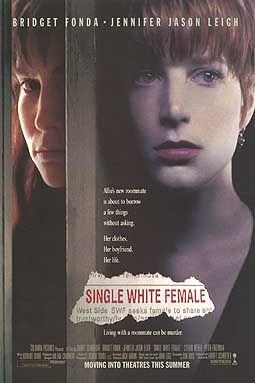
Horror Film Review: Single White Female (dir by Barbet Schroeder)


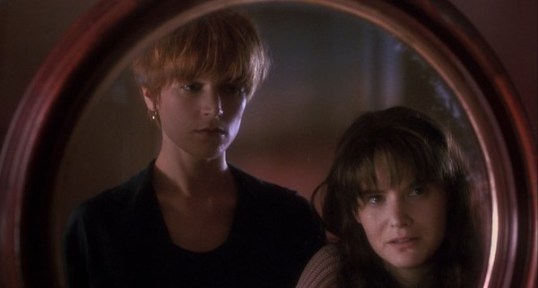
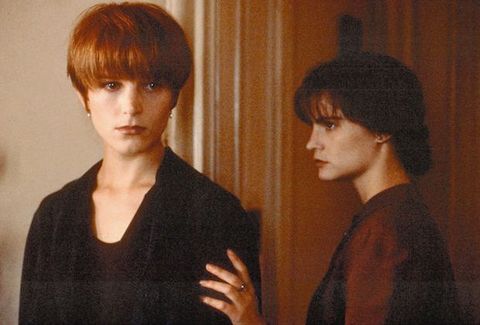
Allie Jones (Bridget Fonda) is an always fashionable software designer who is living in New York City and who has just broken up with her cheating lover, Sam (Steven Weber).  She has pretty hair, a big apartment, a closet full of nice clothes, and a totally devoted gay best friend.

Hedra Carlson (Jennifer Jason Leigh) is shy and socially awkward and in need of someone who will give her a cute nickname like “Hedy.”  She has pretty hair that’s just slightly less pretty than Allie’s, a job at a bookstore, a dead twin sister, a pair of really nice earrings, and a television that only seems to show old black-and-white movies.

Together …. THEY SOLVE CRIMES!

No, actually, they don’t.  Instead, Hedy answers an ad that Allie placed about needing a new roommate.  Even though Allie was thinking of asking another homeless woman to move in with her, Hedy impresses Allie by fixing her sink.  Seriously, how can you turn down a potential roommate who knows how to do simple plumbing?  Allie invited Hedy to live with her and, at first, everything is great.  Hedy even brings home a dog that Allie quickly falls in love with.  However, then Sam shows back up and we quickly discover just how obsessed Hedy has become with her roommate.

Single White Female was originally released way back in 1992 and, even if you’re viewing it for the very first time, you’ll probably feel a sense of deja vu while watching the movie.  This is one of those films that has been so endlessly imitated and has been unofficially remade so many times that you probably already know everything that happens in the film, regardless of whether you’ve actually sat through it or not.  A few years ago, there was a film called The Roommate that basically was Single White Female, just with a college setting and a bit less of a subversive subtext.  As well, I’ve lost count of the number of Lifetime films that have basically ripped off Single White Female‘s plot.  Any time that a new friend proves herself to be excessively clingy, chances are that she’s going to get compared to Jennifer Jason Leigh in this film.


And yet, despite all of the imitations, Single White Female still holds up surprisingly well.  A lot of that is because Single White Female was directed by Barbert Schroeder.  Schroeder started his career as a disciple of the French New Wave and, much like Paul Verhoeven, his American films tend to be genre films with just enough of a subversive subtext to stick in your mind afterwards.

For example, Single White Female is often describes as being a film about “the roommate from Hell” but what always seems to be missed is that, especially during the film’s first half, Allie is often as bad of a roommate as Hedy.  For instance, when Allie comes home late after spending two days with Sam, Hedy is pissed off and waiting for her.  On the surface, the scene is the first indication that Hedy has become obsessed with Allie.  But, at the same time, Hedy actually is making a valid point.  After repeatedly telling Hedy that she wants nothing to do with Sam, Allie runs off and spends two days with him without bothering to call home once.  Though Hedy may have been a bit too quick to yell, she still had every right to be annoyed.

In fact, Allie really is a bit of self-centered character.  She impulsively invited Hedy to live with her and then, just as impulsively, she gets back together with Sam and decides that it’s time for Hedy to move out.  Of course, then Hedy tosses a dog out of a window and you pretty much lose whatever sympathy you may have had for her.

Still, you can’t help but feel that, just as Hedy wants to be Allie, there’s a part of Allie that would like to be Hedy.  Hedy does all the things that Allie’s scared to do.  When Allie is sexually harassed and nearly raped by a client, Hedy’s the one who actually gets revenge.  While Allie tries to get over and suppress her anger at Sam, Hedy’s the one who acts on that anger.  Just Hedy seems to need Allie’s life to be happy, Allie seems to need Hedy’s anger to survive.  In short, there’s a lot more going on underneath the surface of Single White Female than its reputation might lead you to presume.

Not surprisingly, the film is dominated by Jennifer Jason Leigh’s performance.  When Hedy first appears, Leigh plays her as just being slightly off.  She has some obvious confidence issues but, at the same time, she comes across as being so innocent and naive that you can’t help but want to protect her.  You find yourself wondering how she could have possibly survived living in a city like New York.  It’s only as the film progresses that you start to discover that Hedy was never particularly naive and everything that she’s done and said has basically been about manipulating the people around her.  And yet, even after Hedy has started killing dogs and people, you can’t help but feel a strange empathy (though not necessarily sympathy) for her.  There’s an emptiness to Hedy, an emptiness that she attempts to fill by stealing the personalities of the people around her and Leigh does a great job of expressing the pain that would come from not having an identity of your own.  Plus, poor Hedy just seemed so happy with Allie said that she liked her earrings!  I mean, I just can’t imagine being that insecure but I get the feeling it would really suck.

(Fortunately, I’ve also never really had a truly bad roommate situation.  One advantage of having three older sisters is knowing that you’ll always have someone to stay with.)

Despite all of the imitations and rip-offs that have come out over the years, both Single White Female and Jennifer Jason Leigh’s performance hold up remarkably well.  I’d recommend watching it before inviting anyone to come live with you.  If nothing else, you’ll at least learn what stiletto heels are really for.


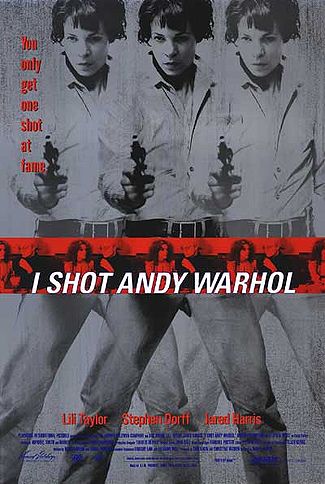
Film Review: I Shot Andy Warhol (dir by Mary Harron)


When did Andy Warhol die?

The official date of death is February 22nd, 1987.  The 58 year-old artist died in his sleep of a cardiac arrhythmia.  He was at Manhattan’s New York Hospital, recovering from gallbladder surgery.  The surgery itself had been a minor procedure and, in the days before his death, Warhol was reported to be making a good recovery.  Warhol himself was scared of doctors and had continually put off having the procedure done.

Others, however, argue that Warhol might as well have died on June 3rd, 1968.  That was the day that the world-famous pop artist was shot, at point blank range, by a woman named Valerie Solanas.  Warhol barely survived the attack, spending five hours in surgery and carrying both the mental and physical scars with him for the rest of his life.  It’s debatable whether Warhol ever physically recovered from being shot.  It’s been theorized that the reoccurring gallbladder problems that led to Warhol entering the hospital were directly the result of being shot.  If that’s the case, then Solanas murdered Andy Warhol.

But even beyond the lingering physical injuries, the shooting left Warhol mentally shaken.  The artist who, in the 60s, was famous for hosting a never-ending party at The Factory became far more reclusive and paranoid.  No longer could anyone from anywhere show up in New York and, if they were interesting enough, become a member of Warhol’s entourage.   No longer would Warhol direct films that challenged the assumption of what film had to be.  Warhol spent most of the 70s doing portrait commissions and finding new ways to make money.  (As he wrote in 1975, “Making money is art, and working is art and good business is the best art.”)

It can be argued that, with the pull of a trigger, Valerie Solanas changed the course of history and yet, she has always remained an obscure figure.  (Many would argue that she deserves to remain an obscure figure.)  After the shooting, when Solanas turned herself in, she said that she had no choice but to shoot Andy because “he had too much control over my life.”  Others theorize that Solanas was upset because Andy hadn’t helped her get her book, The SCUM Manifesto, published.  Solanas was diagnosed with paranoid schizophrenia and, for nearly a killing an artist, she spent three years in prison.  While she was in prison, The SCUM Manifesto was finally published.  Ironically, she died in poverty and obscurity, just a few months after Warhol, as forgotten as Andy as was celebrated.

So, who was Valerie Solanas?  That’s the question that 1996’s I Shot Andy Warhol attempts to answer.  Lili Taylor portrays Valerie, giving a performance that is both frightening in its intensity and empathetic in its portrayal of Valerie’s desperation to be heard as a human being and respected as an artist.  Wherever Valerie goes, she’s an outsider.  As a lesbian, she’s been rejected by conventional society.  When she appears on a local talk show, the audience boos her and the host has her thrown off the set.  As a writer, she is rejected by publishers and readers who view her work as being, as one person puts it, “too sick even for us.”  When, like many aspiring artists and lost souls, she arrives at the Factory, the members of Warhol’s entourage reject her because she’s neither beautiful nor glamorous.  Valerie is stuck in a winless situation.  It’s her intensity that makes her a memorable writer but it’s the same intensity that guarantees that almost no one will be willing to read what she writes.

Valerie has written The SCUM Manifesto.  (SCUM stands for Society of Cutting Up Men.)  Throughout the film, we see black-and-white scenes of Valerie reading from the opening of her book:

“Life” in this “society” being, at best, an utter bore and no aspect of “society” being at all relevant to women, there remains to civic-minded, responsible, thrill-seeking females only to overthrow the government, eliminate the money system, institute complete automation and eliminate the male sex.”

Today, of course, Valerie could just start a tumblr or maybe get a job teaching at Evergreen State.  In the 1960s, though, Valerie believes that the only way she’ll ever be heard is by getting her work to Andy Warhol.  When she first meets Andy (Jared Harris), he seems to be receptive to her but we soon see that this film’s version of Andy is receptive to almost anyone.  I Shot Andy Warhol portrays Andy as being an emotionally detached voyeur, a master of passive aggressive behavior.  Instead of personally rejecting Valerie, he lets the more bitchy members of his entourage do it for him.  In fact, at times it seems as if the reason that Warhol surrounds himself with such angry people is so he’ll never have to get angry himself.  It’s actually a rather interesting interpretation of Warhol and the Factory, though it does rely a bit too much on the clichéd image of Andy Warhol as a passive voyeur.  Whenever Jared Harris is onscreen, you never forget that you’re watching someone imitate Andy Warhol as opposed to feeling like you’re watching Warhol yourself.

(When Andy Warhol died, he was worth 220 million dollars.  That alone should be enough to debunk the image of Andy Warhol being a passive voyeur of his own life.)

I Shot Andy Warhol is a frequently fascinating film, one that is sympathetic to both Solanas’s artistic ambitions and her desperate need to be acknowledged as a writer, while also not shying away from the fact that she was a very sick and dangerous person.  At the same time, the film does leave out one very important detail of Solanas’s later life.  After she was released from prison, she still continued to stalk Andy and other members of the New York art world.  That’s an important detail that should have, at the very least, been acknowledged.

Finally, after Andy Warhol’s death, Lou Reed wrote a song called “I believe.”  The song dealt with his feelings towards Valerie Solanas and it’s reasonable to assume that Reed spoke for many of Warhol’s associates.  Here are just a few of the lyrics: ” “I believe life’s serious enough for retribution… I believe being sick is no excuse. And I believe I would’ve pulled the switch on her myself.”

A Movie A Day #30: Prince of the City (1981, directed by Sidney Lumet)


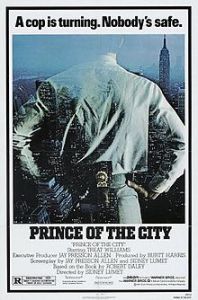
220px-prince_of_the_city_foldedIn 1970s New York City, Danny Ciello (Treat Williams) is a self-described “prince of the city.”  A narcotics detective, Ciello is the youngest member of the Special Investigations Unit.  Because of their constant success, the SIU is given wide latitude by their superiors at the police department.  The SIU puts mobsters and drug dealers behind bars.  They get results.  If they sometimes cut corners or skim a little money for themselves, who cares?
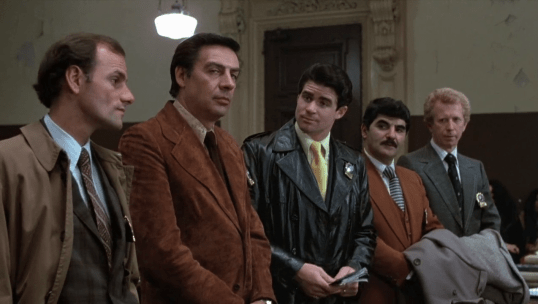
It turns out that a lot of people care.  When a federal prosecutor, Rick Cappalino (Norman Parker), first approaches Ciello and asks him if he knows anything about police corruption, Ciello refuses to speak to him.  As Ciello puts it, “I sleep with my wife but I live with my partners.”  But Ciello already has doubts.  His drug addict brother calls him out on his hypocrisy. Ciello spends one harrowing night with one of his informants, a pathetic addict who Ciello keeps supplied with heroin in return for information.  Ciello finally agrees to help the investigation but with one condition: he will not testify against anyone in the SIU.  Before accepting Ciello’s help, Cappalino asks him one question.  Has Ciello ever done anything illegal while a cop?  Ciello says that he has only broken the law three times and each time, it was a minor infraction.

For the next two years, Ciello wears a wire nearly every day and helps to build cases against other cops, some of which are more corrupt than others.  It turns out that being an informant is not as easy as it looks.  Along with getting burned by malfunctioning wires and having to deal with incompetent backup, Ciello struggles with his own guilt.  When Cappalino is assigned to another case, Ciello finds himself working with two prosecutors (Bob Balaban and James Tolkan) who are less sympathetic to him and his desire to protect the SIU.  When evidence comes to light that Ciello may have lied about the extent of his own corruption, Ciello may become the investigation’s newest target.

prince-of-the-city

Prince of the City is one of the best of Sidney Lumet’s many films but it is not as well-known as 12 Angry Men, Dog Day Afternoon, Network, Serpico, The Verdict, or even The Wiz.  Why is it such an underrated film?  As good as it is, Prince of the City is not always an easy movie to watch.  It’s nearly three hours long and almost every minute is spent with Danny Ciello, who is not always likable and often seems to be on the verge of having a nervous breakdown.  Treat Williams gives an intense and powerful performance but he is such a raw nerve that sometimes it is a relief when Lumet cuts away to Jerry Orbach (as one of Ciello’s partners) telling off a district attorney or to a meeting where a group of prosecutors debate where a group of prosecutors debate whether or not to charge Ciello with perjury.

Prince of the City may be about the police but there’s very little of the typical cop movie clichés.  The most exciting scenes in the movie are the ones, like that scene with all the prosecutors arguing, where the characters debate what “corruption” actually means.  Throughout Prince of the City, Lumet contrasts the moral ambiguity of otherwise effective cops with the self-righteous certitude of the federal prosecutors.  Unlike Lumet’s other films about police corruption (Serpico, Q&A), Prince of the City doesn’t come down firmly on either side.

(Though the names have been changed, Prince of the City was based on a true story.  Ciello’s biggest ally among the investigators, Rick Cappalino, was based on a young federal prosecutor named Rudy Giuliani.)

Prince of the City is dominated by Treat Williams but the entire cast is full of great New York character actors.  It would not surprise me if Jerry Orbach’s performance here was in the back of someone’s mind when he was cast as Law & Order‘s Lenny Briscoe.  Keep an eye out for familiar actors like Lance Henriksen, Lane Smith, Lee Richardson, Carmine Caridi, and Cynthia Nixon, all appearing in small roles.

Prince of the City is a very long movie but it needs to be.  Much as David Simon would later do with The Wire, Lumet uses this police story as a way to present a sprawling portrait of New York City.  In fact, if Prince of the City were made today, it probably would be a David Simon-penned miniseries for HBO.

image-w1280