Film Review: Kelly’s Heroes (dir by Brian G. Hutton)


1970’s Kelly’s Heroes takes place in France during the Second World War.  The American army is moving through the country, liberating it town-by-town.  Private Kelly (Clint Eastwood) is a former lieutenant who was busted down in rank after leading a disastrous raid on the wrong hill.  (It was the fault of the generals but Lt. Kelly was set up as a scapegoat.)  When Kelly learns that the Germans are hiding a huge amount of gold in an occupied town, he gathers together a team of weary soldiers, misfits all, and plans to go AWOL to steal the gold for themselves.

Kelly’s Heroes was one of the big budget studio films that Eastwood made after finding stardom in Europe with Sergio Leone’s Spaghetti westerns.  This is very much an ensemble film, in the vein of The Dirty Dozen.  Indeed, Eastwood’s co-star, Telly Savalas, was in The Dirty Dozen.  Here, Savalas plays Big Joe, the sergeant who isn’t sure that he wants to put his men in danger for gold that may or may not exist.  Don Rickles plays Crapshoot who is …. well, imagine Don Rickles in the middle of World War II and you have a pretty good idea of who Crapshoot is.  Stuart Margolin, Harry Dean Stanton, Perry Lopez, Gavin MacLeod shows up as soldiers.  Carroll O’Connor plays the bombastic general who mistakes Kelly’s attempts to go AWOL for a brilliant tactical maneuver,  Like all of the senior officers in this film, O’Connor’s general is a buffoon.  Kelly’s Heroes was made during the Vietnam War and, much like Patton (released the same year), it attempts to appeal to both the establishment and the counterculture by making the heroes soldiers but their bosses jerks.

And that brings us to Donald Sutherland, who plays a tank commander named Oddball.  You may not have know this but apparently, there were hippies in the 40s!  Actually, I don’t think that’s true but there’s really no other way to describe Oddball than as a Hollywood hippie.  He’s a blissed-out, spacey guy who thinks nothing of accidnetally driving his tank through a building.  The films ask us to believe that the long-haired and bearded Oddball is a World War II tank commander and Sutherland is such a likable presence that it’s temping to just go with it.  Oddball was obviously included to bring in “the kids” but he does generate some needed laughs.  This is a very long movie and the comedic moments are appreciated.

Kelly’s Heroes is two-and-a-half hours long and it definitely could have been shorter.  Director Brian Hutton allows some scenes to drag on for a bit too long and he sometimes struggles to balance the moments of comedy with the moments of violent drama (quite a few character dies) but he does get good performances from his ensemble.  Eastwood’s taciturn acting style is nicely matched with Savalas’s more expressive style and it’s hard not smile at Don Rickles, insulting everyone as if they were guests at Joe Gallo’s birthday party.  The film, at times, doesn’t seem to know if it wants to be a satire or a straight heist film but the cast keep things watchable.  Eastwood even gets to show a few hints of the dry sense of humor that always hid behind the perpetually bad mood that often seemed to hang over him in his early films.  Whatever flaws the film may have, it was a box office success.  One year after this release of Kelly’s Heroes, Eastwood would make history as Dirty Harry.
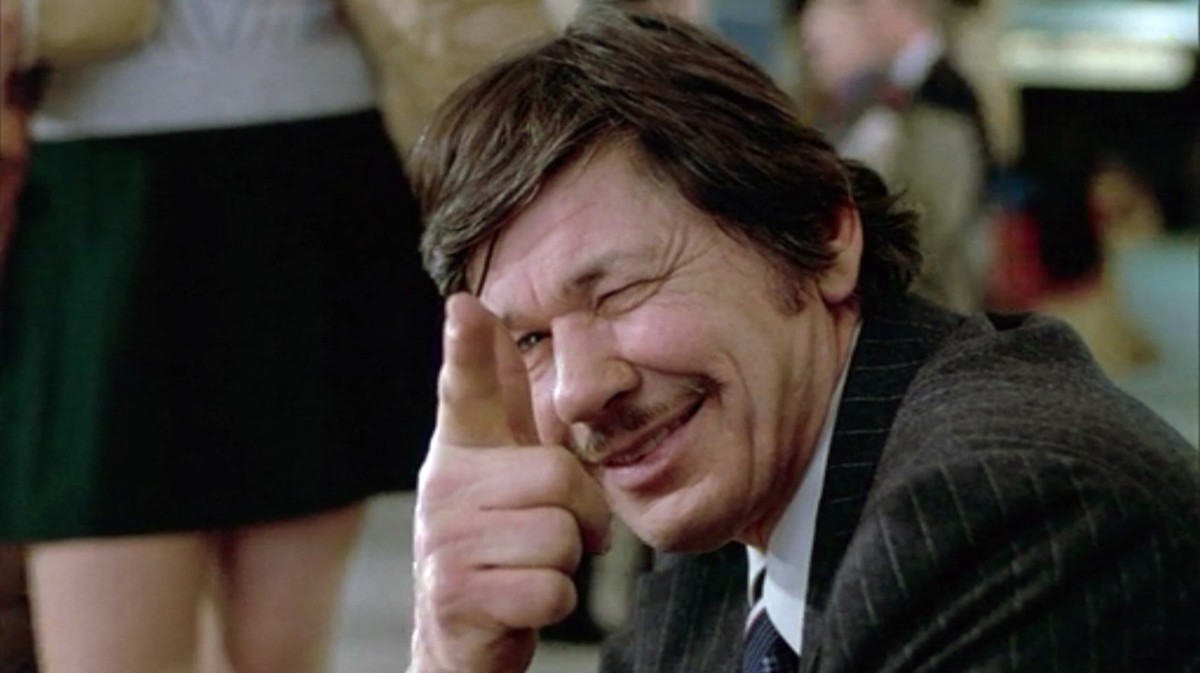
#MondayMuggers presents KINJITE: FORBIDDEN SUBJECTS (1989) starring Charles Bronson!


Every Monday night at 9:00 Central Time, my wife Sierra and I host a “Live Movie Tweet” event on X using the hashtag #MondayMuggers. We rotate movie picks each week, and our tastes are quite different. Tonight, Monday February 10th, we’re watching KINJITE: FORBIDDEN SUBJECTS starring Charles Bronson!

Back when I was a teenager, I would always get the entertainment section out of dad’s Sunday paper so I could check out the movie listings and see if there was a new movie I wanted to see. I would also look for information about my favorite movie star, Charles Bronson. Nowadays, we know about new movies months, even years, in advance, but back then I would first learn about them from the entertainment section of dad’s paper. I remember one Sunday in early 1989, seeing an advertisement for a new Charles Bronson film called KINJITE: FORBIDDEN SUBJECTS. It was the first time I had ever heard of the film. I knew I wasn’t going to get to see it at the movies because it was only playing in Little Rock, and it was rated R, but I was excited anyway because I knew it would be on its way to video pretty soon! 

In KINJITE: FORBIDDEN SUBJECTS, Charles Bronson plays police lieutenant Crowe. He deals with the sleaziest criminals in Los Angeles on a daily basis and it’s starting to take a toll on his personal life. He’s currently personally invested in bringing down an underage prostitution ring led by Duke (Juan Fernandez) and Lavonne (Sy Richardson). When a Japanese businessman’s young daughter is kidnapped by Duke, Crowe decides he must do everything in his power to get her back to her family. 

Here is some interesting trivia about the film:

  1. Beginning with DEATH WISH II (1982) Charles Bronson made 8 films for the infamous Cannon Group. KINJITE: FORBIDDEN SUBJECTS was the last of those films. The others are 10 TO MIDNIGHT (1983), DEATH WISH 3 (1985), MURPHY’S LAW (1986), ASSASSINATION (1987), DEATH WISH 4: THE CRACKDOWN (1987), and MESSENGER OF DEATH (1988). 
  2. Director J. Lee Thompson directed Charles Bronson in 9 different films, with KINJITE: FORBIDDEN SUBJECTS being the final film he ever directed. Charles Bronson loved working with the same directors once he got comfortable with them. Thompson, who directed classics like THE GUNS OF NAVARONE (1961) and CAPE FEAR (1962), always made sure Bronson’s low budget Cannon films were filmed in a competent and professional manner. 
  3. Nicole Eggert plays a teen prostitute in this film and Amy Hathaway plays Charles Bronson’s daughter. Both were appearing in popular sitcoms at the time. Eggert was starring in CHARLES IN CHARGE and Hathaway was in MY TWO DADS. 
  4. The bad guy in the film is played by Juan Fernandez. He’s played some great villains in his day. Actor James Woods told me this about Juan, “The irony is that Juan Fernandez is one of the nicest actors I’ve ever worked with, and yet one of the most truly frightening villains. His work in SALVADOR was superb. A lovely, talented man.” 
  5. Perry Lopez, who plays Bronson’s partner in the film had worked with Bronson twice before. He appeared with Bronson in the excellent 1954 western DRUM BEAT, and also in 1987’s DEATH WISH 4: THE CRACKDOWN. 

So join us tonight to for #MondayMuggers and watch KINJITE: FORBIDDEN SUBJECTS! It’s on Amazon Prime.

I’ve included the trailer below:

Icarus File No. 17: Che! (dir by Richard Fleischer)


Che Guevara!

By most accounts, Che Guevara epitomized the excesses and the hypocrisies of the extreme Left.  He spoke of the class struggle while remaining an elitist himself.  He oversaw thousands of executions and advocated for authoritarian rule.  In his writings, he frequently revealed himself to be a racist and a misogynist.  By arguing that the Russians should be allowed to bring nuclear missiles to Cuba, he brought the world to the brink of destruction.  However, he also died relatively young and he looked good on a t-shirt.  Decades after he was executed by the Bolivian Army in 1967 (or was it the CIA?), he remains an icon for college students and champagne socialists everywhere.

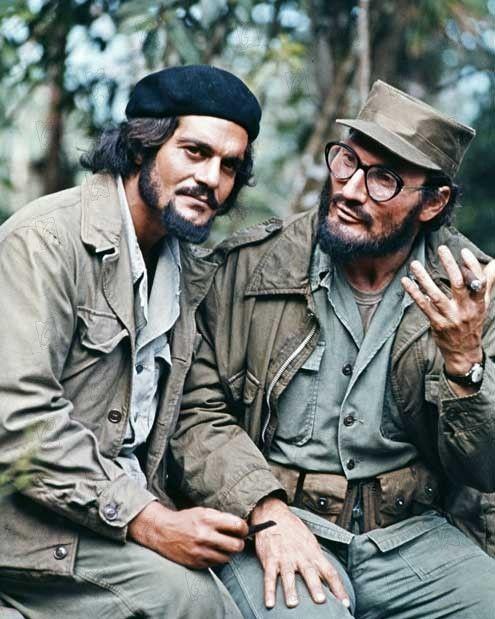
The film about Che! was released in 1969, two years after his death.  Starring the Egyptian actor Omar Sharif as Che Guevara, Che! opens with Guevara already a martyr and then quickly gives way to flashbacks.  Various actors pretending to be Cuban appear and speak directly to the audience, debating Che Guevara’s legacy.  Some describe him as being a violent thug who killed anyone who displeased him.  Others describe him as a visionary doctor who sacrificed his comfortable existence for the people.  It’s a rather conventional opening and one that hints that Che! is going to try to have it both ways as far as Che’s legacy is concerned.  But it’s still effective enough.  A montage of soldiers and rebels creates the proper feeling of a society on the verge of collapse.

And then Jack Palance shows up.

Palance first appears creeping his way through the Cuban jungle with a group of soldiers behind him.  Palance is chomping on a cigar and he wears the intense look of a man on a mission.  My initial reaction was that Palance was playing one of the CIA agents who sent to Cuba to try to assassinate Fidel Castro or to set up the Bay of Pigs invasion.  I kept waiting for him to look at the camera and launch into a monologue about why, for the safety of America, he had been dispatched the topple Cuba’s communist government.  Imagine my shock when Omar Sharif called Palance, “Fidel.”

Yes, that’s right.  Jack Palance plays Fidel Castro!  As miscast as the suave Omar Sharif is as Che Guevara, nothing can prepare one for seeing Jack Palance playing Fidel Castro.  Needless to say, there is nothing remotely Cuban or even Spanish about Jack Palance.  He delivers his lines in his trademark terse Jack Palance voice, without even bothering to try any sort of accent.  (And, needless to say, both he and Sharif speak English through the entire film.)  Anyone who has ever seen a picture of a young Fidel Castro knows that, while he shared a family resemblance with Justin Trudeau, he looked nothing like Jack Palance.  Eventually, Palance puts on a fake beard that makes him look even less like Castro.  When one of our narrators mentions that Castro was a great speaker, the film cuts to a scene of Palance spitting out communist slogans with a noted lack of enthusiasm.  When Castro takes control of Cuba, Palance looks slightly amused with himself.  When Che accused Castro of selling out the revolution, Palance looks bored.  It’s a remarkably bad piece of casting.  Seeing Palance as Castro feels like seeing John Wayne as Genghis Khan.  Thank goodness Hollywood never tried anything that silly, right?  Anyway….

As for the rest of the film, it hits all the expected notes.  The film was made in the very political year of 1969, a time when the New Left was ascendant and many considered Che Guevara to be a hero.  However, since this was a studio production, Che! tries to appeal to both college radicals and their parents by taking a “both sides” approach to Che Guevara.  Here’s Che teaching an illiterate farmer how to read.  Here’s Che overseeing a bunch of dissidents being executed.  Here’s Che getting angry at Castro for not being properly enthusiastic about housing Russian nuclear missiles.  Here’s Che talking about a moral revolution.  Here’s Che trying to start an unwanted war in Bolivia.  Here’s Che talking to Sid Haig — hey, Sid Haig’s in this film!

Like so many mainstream political films of the 60s and today, Che! tries to be political without actually taking any firm positions.  One is tempted to say that is the film’s downfall.  Of course, the film’s real downfall is casting Jack Palance as Fidel Castro.

There’s no way to recover from that.

DEATH WISH 4: THE CRACKDOWN – a missed opportunity in my life!


I’m on Day 4 of my discussion of Charles Bronson’s DEATH WISH series in chronological order. This series has brought me countless hours of entertainment over the last 40 years, so enjoy and let me know your thoughts!

DEATH WISH 4: THE CRACKDOWN was a bit of a missed opportunity in my early years of Bronson fandom. Let me explain. In the mid-80’s I became Charles Bronson’s biggest fan, an honor I possibly share with a few others. As a part of that fandom, a 14-year-old Brad would scour every available source for information about my hero, which at that time was mainly the entertainment section of the Arkansas Democrat, my grandma’s tabloids, and, when I could get a ride, the magazine rack at the Hastings Entertainment Superstore. This in-depth search for information eventually lead to me discovering that DEATH WISH 4: THE CRACKDOWN would be playing at the movie theater in Conway, AR in November of 1987. I was so excited that I might actually get to see Charles Bronson on the big screen for the first time ever. Unfortunately, there were several factors working against me. First, it was rated R, so I was completely dependent on an adult taking me. Second, it was released in November which was in the heart of basketball season, and the only thing that was above Bronson in my life was the basketball court, especially since my dad was my coach. And third, my parents would only consider taking me to the movies on “dollar night,” which was Tuesday and almost always conflicted with my basketball game schedule. I remember driving by the theater and seeing DEATH WISH 4: THE CRACKDOWN listed on the marquee and longing to go see it.  Alas, the stars, and the factors above, all aligned against me, and I would not be able to watch the film during its 2-week run in Conway, Arkansas. At this point in his career, Cannon would give Bronson’s films a short theatrical release and then release them to the home video market where Bronson was still a true moneymaking superstar.  DEATH WISH 4 earned the equivalent in today’s dollars of around $20,000,000 at the box office before going on to sale over 100,000 VHS cassettes to rental stores. It was Bronson’s most successful rental release of the franchise.  

DEATH WISH 4: THE CRACKDOWN opens with Paul Kersey (Charles Bronson) having nightmares about the man he has become after a decade of meting out vigilante justice. He has moved back to Los Angeles where he keeps himself busy with his work as an architect, as well as his relationship with his new lady friend, Karen (Kay Lenz). When Karen’s daughter Erica dies of a drug overdose, Kersey immediately finds the drug dealer who sold her the stuff and shoots him dead. Unfortunately, soon after it seems that someone has pictures of Kersey doing his vigilante deeds, and he finds himself being coerced by millionaire Nathan White (John P. Ryan) into pitting the two primary criminal drug organizations against each other in a turf war in an attempt to get them to take each other out. Nathan White’s own granddaughter had been destroyed by drugs, and this is his way of getting back at the criminals responsible for her death. Kersey begins killing drug dealers, suppliers, day laborers, security detail, you name it; if you’re associated with drugs in any way, whether it be at a video store, fish packing plant, fine restaurant, or skyscraping apartment complex, you are fair game for death. Kersey is able to sufficiently convince the heads of the competing drug organizations that they are at war with each other. This all culminates at the oil fields, where Kersey, armed with a high-powered rifle, is perched above the meeting of the two gangs. With one fateful shot, he is able to ignite the all-out war he and Nathan White have been looking for. Finally, the streets of Los Angeles are free from the drugs that are sucking the life out of its citizens, right. Or are they?

It was on VHS in April of 1988 that I finally got to see DEATH WISH 4: THE CRACKDOWN. It’s the first movie in the series not directed by Michael Winner. J. Lee Thompson took over the reins and created a slick action film that lacked the odd, but interesting touches that Winner provided, but made up for it with stronger craftmanship. DEATH WISH 4 is a balls to the wall action extravaganza that barely rests long enough for the audience to catch their breath. My personal favorite scene of the film is the oil field shootout that produced some really cool, iconic images of Bronson walking with his rifle as he was finishing off the bad guys. I’ve heard DEATH WISH 4 referred to as the “lost Death Wish” film because it is spoken of less than parts 1, 2, or 3, and that may even be true, but it’s actually a very strong entry in the series.  

As Paul Harvey might say, this is the “rest of the story” of me finally getting to see Charles Bronson on the big screen.  After DEATH WISH 4 ended its run, I don’t know of another Bronson film playing at my local theater from that point forward, and I would have to settle to watch MESSENGER OF DEATH, KINJITE, THE INDIAN RUNNER, and DEATH WISH V all on home video. Then, in the summer of 2022, I became aware that the Mahoning Drive-In in Lehighton, PA was programming a Charles Bronson night featuring THE MECHANIC, MR. MAJESTYK and DEATH WISH 3.  My wife and I drove 17 hours from our home in Arkansas to watch those three movies on the big screen.  It was the greatest “movie-night” of my life and something I’ll never forget.  So, all’s well that ends well!

BONUS: Jesse Dabson had a part in DEATH WISH 4: THE CRACKDOWN. Jesse was interviewed on the THIS WEEK IN CHARLES BRONSON PODCAST, where he told my partner Eric Todd, and fellow Buchinsky Boys Chris Manson and Ryan Voss, about his experiences working on DEATH WISH 4, as well as other projects like PLATOON LEADER and ONE FALSE MOVE. Give it a listen if you get a chance!

Bronson’s Rich: Death Wish 4: The Crackdown (1987, directed by J. Lee Thompson)


To quote The Main With No Name, “When a man’s got money in his pocket, he begins to appreciate peace.”

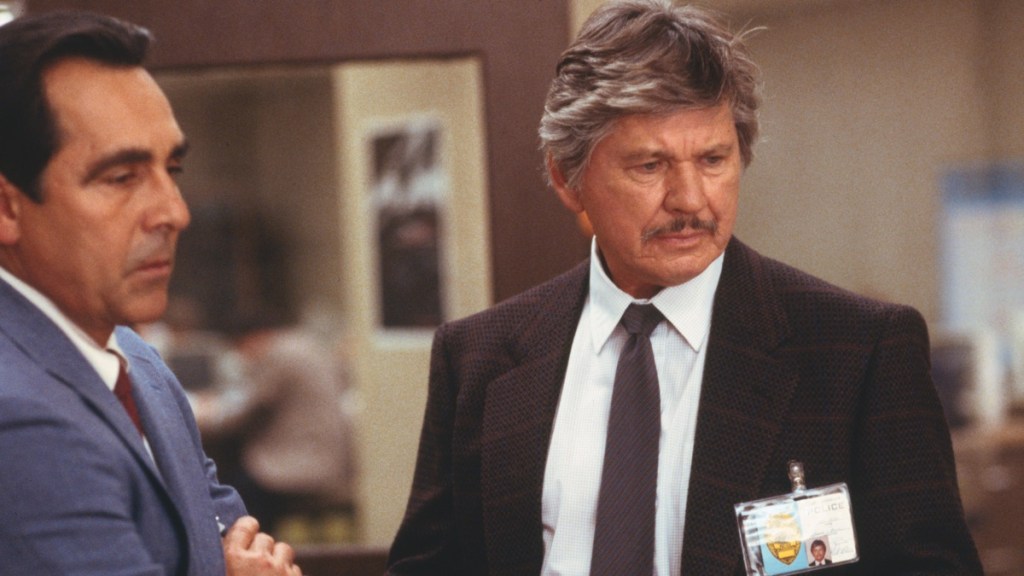
Two years have passed since Paul Kersey (Charles Bronson) last visited and cleaned up New York.  He is back in Los Angeles, the president of his own successful architectural firm.  Now a rich man, he has retired from killing criminals, though he still has dreams where he shoots muggers in parking garages.  Paul has a new girlfriend, journalist Karen Sheldon (Kay Lenz).  When Karen’s teenage daughter, Erica (Dana Barron), dies of a cocaine overdose, it’s time for Paul to get his gun out of storage and blow away a drug dealer.

Shortly after shooting that drug dealer, Paul finds a note on his front porch.  “I know who you are,” it reads.  Paul then gets a call from a mysterious man (John P. Ryan) who identifies himself as being a reclusive millionaire named Nathan White.  Nathan explains that his daughter also died of a cocaine overdose.  He wants to hire Paul to take out not just the drug dealers but also the men behind the dealers, the bosses.  Using his vast resources, Nathan has prepared a file on every major drug operation in Los Angeles.  He offers to share the information with Paul.

“I’ll need a few days to think about it,” Paul says but we all know he’s going to accept Nathan’s offer just as surely as we know that Nathan White has an ulterior motive that won’t be revealed until the movie’s final twenty minutes.

For the first time, Paul is no longer just targeting muggers and other street criminals.  This time, Paul is going after the guys in charge and trying to bring an end to drug trade once and for all.  (The idea that the best way to win the war on drugs was just to kill anyone involved in the drug trade was a very popular one in the late 80s.)  L.A.’s two major drug cartels are led by Ed Zacharias (Perry Lopez) and the Romero Brothers (Mike Moroff and Dan Ferro).  Along with their own activities, Paul and Young work the turn the two cartels against each other.

It’s not just the criminals that have changed in Death Wish 4.  Paul has changed, too.  Paul used to just shoot criminals and run away.  In Death Wish 4, he gets more creative.  He sneaks into Zacharias’s mansion and bugs the phone so that he can keep track of what’s going down.  When it comes time to kill a table full of drug dealers (one of whom is played by Danny Trejo), Paul doesn’t shoot them up.  Instead, he sends them a bottle of champagne that explodes when they open it.  By the end of the movie, Paul is blowing away the bad guys with a grenade launcher!  How many former conscientious objectors can brag about that?

The biggest difference between Death Wish 4 and the films that came before it is the absence of director Michael Winner.  Winner and Bronson had a falling out following Death Wish 3 and, as a result, Winner had little interest in returning to the franchise.  Instead, Winner was replaced by J. Lee Thompson, who had already directed Bronson in several other Cannon films.  As a result, Death Wish 4 is less “heavy” than the previous Death Wish films.  Whereas Winner’s direction often felt mean-spirited and exploitive, Thompson plays up the film’s sense of airy adventure.

Though it barely made a profit at the box office and has been dismissed by critics, Death Wish 4 is an enjoyable chapter in Paul’s story.  If you’re looking for mindless 80s mayhem, Death Wish 4 gets the job done with admirable efficiency.  It would have made a great ending for the franchise but Bronson would return to the role one last time.

Tomorrow: Death Wish V: The Face of Death!

Movie A Day #178: Kinjite: Forbidden Subjects (1989, directed by J. Lee Thompson)


This is the one where Charles Bronson sodomizes a guy with a dildo.

Don’t worry, though.  Bronson does it off-screen and the guy was abusing Nicole Eggert so he had it coming.

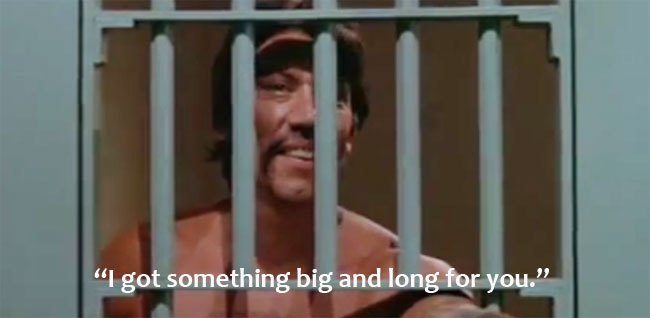
In Kinjite, Bronson plays Lt. Crowe, a tough LAPD vice cop who hates two groups of people: pedophiles (which is cool, who doesn’t hate them?) and the Japanese (which is not cool).  Not only does Crowe sodomize a pervert but he also forces a pimp to eat a gold watch and later, with the help of his partner, he holds another man over the edge of a balcony, just to have that man accidentally slip out of his shoes and plunge to his death.  Finally, Crowe tosses a convict into a prison cell, where another prisoner (played by Danny Trejo, in what may have been his film debut) announces that he’s “got something big and long for you.”  Crowe chuckles, “That’s justice” and then walks away.

Danny Trejo in Kinjite

Of the many strange films that Bronson made for Cannon Films, Kinjite may be the strangest.  The main plot involves Crowe searching for and rescuing the kidnapped daughter of a Japanese businessman (James Pax).  Before his daughter was kidnapped, the businessman groped Crowe’s fifteen year-old daughter on a city bus.  The entire movie seems to be building up to the moment that Crowe, who is portrayed as being overprotective of his daughter, discovers what the businessman did but that moment never comes.  There are numerous scenes of the businessman in Japan but they do not have anything to do with the rest of the plot.  Strangely, neither Crowe’s daughter nor his wife (played by Peggy Lipton) are ever menaced by the bad guys.  What type of Charles Bronson movie is this?

In Bronson’s defense, he was 71 year-old when he made this movie and, off screen, his wife Jill Ireland was battling the cancer that would eventually take her life.  Bronson can be excused for not appearing to be overly invested in Kinjite: Forbidden Subjects.  (Since Kinjite means Forbidden Subjects in Japanese, the actual title of this movie is Forbidden Subjects: Forbidden Subjects.)  No one appears to have made much of an effort on Kinjite, though Bronson’s stunt double gets a good work out.  Kinjite is full of scenes where Bronson throws a punch in close-up but his first in never actually shown connecting with anyone.  Most of the action scenes are clumsily filmed so that Crowe keeps his back to the camera.   All Kinjite needs is a supporting turn from Troy McClure and a cameo from McGarnagle and it would be perfect viewing for The Simpsons.

Kinjite would be the final film that Bronson made for Cannon Films.  It would also be the last Bronson film to be directed by J. Lee Thompson.  After Kinjite, Bronson appeared in two more feature films: Sean Penn’s The Indian Runner (which, if not for Penn’s pretentious direction, could have launched Bronson on a second career as a first-rate character actor) and a final Death Wish film.  Bronson returned to television, appearing in three made-for-TV movies before retiring in 1999.  Bronson died in 2003 but, as long as there are people who enjoy a good action movie, he will never be forgotten.

This scene is not from Kinjite but it’s still pretty fucking cool.

The Daily Drive-In: The Creature From The Black Lagoon (dir. by Jack Arnold)


As anyone who knows me can tell you, Lisa Marie doesn’t do water.

Seriously, I have a very intense fear of drowning and, while I might enjoy laying out by the pool during the summer, you’re never going to catch me actually going anywhere near the deep end.  I’m the epitome of the girl who loves the beach but hates the ocean.  As a result, I have a hard time with movies the feature swimmers thrashing about in the water or ancient monsters coming up to the surface in search of swimsuit-clad victims.

For lack of a better term, these films freak me out.

Sometimes, however, it’s fun to be freaked out.  Perhaps that’s why I so love the 1954 monster classic, The Creature From The Black Lagoon.

Like all good B-movies from the 1950s, The Creature From The Black Lagoon starts off with a lot of stock footage and a stuffy narrator telling us about how the Earth was created and how mankind originally evolved from a creature that crawled out of the sea.  The narrator manages to cover all the bases by including a few Biblical quotes with his explanation of how evolution works.

From the beginning of mankind, we fast forward to the 1950s.  A fossilized claw has been discovered in the Amazon and a group of scientists think that it could be evidence of the missing link in human evolution.  Mark (Richard Denning), who is kind of a jerk, funds an expedition to the Amazon to search for more evidence.  Accompanying Mark is hunky young scientist David (Richard Carlson) and David’s girlfriend, Kay (Julie Adams).  Traveling on a boat captained by the rather gruff Lucas (Nestor Paiva), they go to the camp where the fossil was originally discovered.  However, once they arrive, they discover that everyone in the camp has been killed.  Lucas suggests that the camp was attacked by a jaguar.

Lucas, needless to say, is totally incorrect.  The film isn’t called The Jaguar From The Black Lagoon.  It’s called The Creature From The Black Lagoon and the creature, also known as the Gill-Man (played by Ben Chapman when on land and by Ricou Browning whenever he’s underwater), is none too happy about these strangers invading his home.  Soon, the Gill-Man is stalking the expedition as they move up and down the Amazon River.

The Creature From The Black Lagoon is probably best known for the dream-like sequence in which Kay, wearing a white bathing suit that is simply to die for, swims in the Amazon River without realizing that the Creature is following just a few feet below her.  This scene (which does little to help with my aquaphobia) is one of the most iconic in the history of monster cinema.  Expertly framed by director Jack Arnold, this scene is distinguished by the graceful movement of both Julie Adams and Ricou Browning.  It’s as close as a monster movie has ever gotten to duplicating ballet.

Ultimately, like all good monster films, the Creature from the Black Lagoon is on the side of the monster.  The members of the expedition are, for the most part, interchangeable and, when the Gill-Man attacks, he’s acting more out of self-defense than out of hostility.  The expedition, after all, has invaded his home.  Like many 50s B-movies, the theme for The Creature From The Black Lagoon is not that people should be careful while investigating mysteries but that most mysteries are best left unsolved.

When you combine one of the genre’s most iconic monsters with Jack Arnold’s atmospheric direction, the end result is one of the best B-movies ever made.