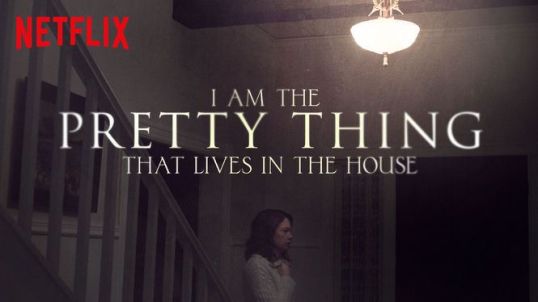
I Am The Pretty Thing That Lives In The House- Review By Case Wright


IAM IAM

Welcome to the second day of October!!! Woohoo! There are a lot of great horror movies to watch and this is not one of them!  HERE WE GO!  I will only refer to this movie as I AM because the above is too much to write unless I create some shortcut key and I am NOT doing that….EVER!

This film is a sloooooow paced artsy haunted house film directed by Oz Perkins the son of Anthony Perkins of Psycho.  The concept is that people die in homes and if they don’t have any outdoorsy interests, they remain in the domicile for eternity and mope about and not do much.  Therefore, if you’re an introvert like a political activist on twitter who always takes offense, your spirit will NEVER leave your home and your wifi service will be cancelled….BWAHAHAHAHA!

The story revolves around Lily who is a scaredy cat hospice nurse who is assigned to take care of the dying formerly famous author Iris Blum.  Iris calls Lily by the name of Polly throughout the film?  Why?  Because she was a terrible author. All she ever did was listen to this weird murder victim ghost name Polly and type out what she told her.  I couldn’t live with myself if everyone thought I was a great writer, when I was actually just a stenographer.

In any case, Polly was murdered and put in the wall of the house back in the 1800s and ever since she kinda hangs out for no particular reason except to give hack-writers storylines.  Why does Polly do this? I’m guessing because she lacked hobbies.  There’s a lesson here…get outside! If you’re going to haunt something, do the Appalachian Trail or a library at least; otherwise, you have a very boring eternity ahead of you!  Lily continues to take care of this dying author and she just doesn’t want to die.  Iris does chit-chat A LOT and Lily is introvert enough to quietly listen.  Honestly, Lily going into the great hereafter will likely not be a huge transition except for no copays for dental.

I would put this film in the elliptical watching category except it’s so quiet that you might need really good headphones.  It does have Bob Balaban in the film who must’ve believed that he was auditioning to play a lamppost, but with less feeling.  Of course, it’s hard to say if boredom wasn’t intentional! Maybe this was a brave choice on the part of Oz Perkins?  For far too long, we, the viewer, have expected to be entertained or even have our attention captured.  I would find some pharmaceutical or extra coffee to focus you while watching this or you’ll be looking up possible deductions for 2018 and miss some critical scene with an actor wandering around aimlessly.

I hope you are having a wonderful October.  Stay Spooky, My Friends!

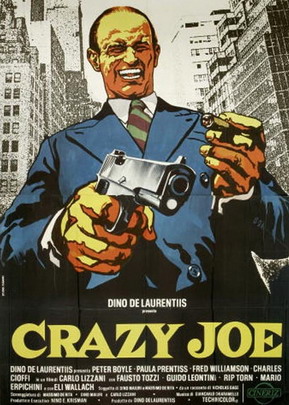
A Movie A Day #147: Crazy Joe (1974, directed by Carlo Lizzani)


Crazy Joe (Peter Boyle) is a gangster with a chip on his shoulder and a self-taught intellectual who can (misquote) Sartre and Camus with the best of them.  Sick of being taken for granted, Joe and his brother, Richie (Rip Torn), attempt to challenge the Mafia establishment.  The mob sets Joe up and gets him sent to prison.  While doing time, Joe befriends a Harlem gangster named Willy (Fred Williamson).  Refusing to associate with the other Italian prisoners, Joe allies himself with the black inmates and even helps to start a riot over the prison’s inhumane conditions.  When he is released, Joe hits the streets of New York with a vengeance, now backed up by Willy and his criminal organization.

Crazy Joe is based on the life of Joey Gallo, who was briefly a New York celebrity, hobnobbing with actors like Jerry Orbach and writers like Norman Mailer before he was gunned down at Umberto’s Clam Shop in Little Italy.  Though the names were changed to protect the guilty, Eli Wallach plays Vito Genovese, Charles Cioffi plays Joe Columbo, and Luther Adler is Joe Profaci.  Fred Williamson’s character is based on the infamous Nicky Barnes.

Crazy Joe is a good and violent mix of the gangster, prison, and blaxploitation genres.  Despite wearing an unfortunate toupee, Peter Boyle is great at putting the crazy in Crazy Joe and Fred Williamson ups the coolness factor of any movie he appears in.  Keep an eye out for Henry Winkler, giving a very un-Fonzie performance as Joe’s right-hand man.

Cleaning Out The DVR Yet Again #39: Where The Boys Are (dir by Henry Levin)


(Lisa recently discovered that she only has about 8 hours of space left on her DVR!  It turns out that she’s been recording movies from July and she just hasn’t gotten around to watching and reviewing them yet.  So, once again, Lisa is cleaning out her DVR!  She is going to try to watch and review 52 movies by the end of 2017!  Will she make it?  Keep checking the site to find out!)

wheretheboysare

Before I talk about the 1960 film Where The Boys Are, I’m going to admit something.  Nearly a month ago, I started this mission to clean out my DVR.  I had 52 films to review and I said that I’d have it all done by Thanksgiving.  Of course, I failed to take into account that Thanksgiving is a holiday and, when you’re celebrating a holiday, that doesn’t always leave time to write 52 reviews.  So, I gave myself until the end of the first week of December.  And that’s when I realized that 52 reviews is not a small amount of work.  Especially if you want to make them decent reviews, as opposed to just posting a few sentences.  So, I’m abandoning all of my arbitrary deadlines.  I’ve got 14 more movies to review and I really hope that I’ll be done by the end of the year.  Maybe I will be, maybe I won’t…

But, seriously, I really hope that I am!

Anyway, now that I’ve cleared that up, let’s go to Where The Boys Are!

Released in 1960, Where The Boys Are was one of the first spring break films and it set the template for many films that would follow.  Because it is a piece of history, it’s one of those films that seems to regularly pop up on TCM.  It last aired on TCM on November 13th.  That’s when I recorded it.

Where The Boys Are tells the story of four girls who go to college in Maryland.  When we first see them, they are trudging across a snowed-in campus and there’s a distinct lack of handsome men around.  We listen as Merritt Andrews (Delores Hart) debates her far older professor about whether or not a girl should be “experienced” before getting married.  The professor thinks that all girls should wait for marriage.  Merritt disagrees.  What makes this scene interesting is that it’s almost totally done in euphemism.  Merritt never says sex.  Instead, she says making out and the professor has to ask her to explain what that means.

I mean …. 1960, amirite?

Anyway, it’s spring break so Merritt and her friends go down to Ft. Lauderdale.  After all … that’s where the boys are!  All of the girls have their own defining characteristic.  Merritt is the leader of the group, an intellectual with an I.Q. of 138.  Tuggle (Paula Prentiss) is smart and no-nonsense.  She’s a self-described “good girl” and her hope is to be a “baby-making machine.”  She intimidates some men because she stands 5’10.  Angie (Connie Francis) is athletic and naive.  And then there’s Melanie (Yvette Mimieux), who overcomes her insecurity and loses her virginity as soon as they arrive in Florida (though, of course, this is all handled via euphemism).

Over the course of spring break, all four of the girls meet a man or two.  Merritt meets Ryder (George Hamilton), who is not only an Ivy League student but has a tan to die for.  Ryder it turns out is very experienced (the film doesn’t seem to have the same issue with men being experienced as it does with women) and Merritt is forced to consider whether she’s really as ready for sex as she claims.  Melanie also hooks up with an Ivy Leaguer but it quickly becomes obvious that, despite going to Yale, Franklin (Rory Harrity) is a total heel.  (Oh, how you will hate Franklin.)  Tuggle finds herself competing for the attention of TV (Jim Hutton).  And Angie falls for a myopic jazz musician, Basil (Frank Gorshin).

Watching Where The Boys Are was an odd experience.  It’s an extremely dated film and it’s hard to believe that its euphemistic sex talk and extremely modest swimsuits were ever considered to be controversial.  There’s a hilarious scene where the girls are getting ready for their dates by changing into dresses that look more appropriate for cotillion than a night in Ft Lauderdale.  Needless to say, nobody is seen smoking weed or skinny dipping or doing any of the other stuff that we’ve come to take for granted as far as spring break films are concerned.  (That said, I get the feeling that both TV and Basil may have been stoned.  But definitely not Ryder.  From the minute Ryder shows up, you know he’s going to end up running a successful business and probably serving as an advisor in the Trump White House.)

There are a lot of jokes about people getting drunk, however.  It’s nice to see that, even in 1960, college students on Spring Break couldn’t hold their liquor.  I also found it interesting that not only did almost everyone in Where The Boys Are smoked but most of them looked really cool doing it.  In fact, I’d say that this film was probably the best advertising for cigarettes that I’ve ever seen.

For the most part, Where The Boys Are is a hit-or-miss comedy that’s distinguished by perfect casting.  Even though the film itself was dated, I felt that I could relate, in one way or another, to all of the girls.  Hart, Prentiss, Mimeux, and even Francis captured universal emotions and feelings in their performances and their friendship felt very true.

About 70 minutes into the film, Where The Boys Are takes a very serious turn and the film actually ends on a rather melancholy note, a reminder that not even a somewhat light weight comedy could escape the harshly judgmental morality of the time.  The sudden shift in tone took me by surprise but the film actually handled it well.  I just wish that it didn’t feel as if the filmmakers were punishing our characters for questioning the dictates of society.

On a final note, it’s interesting to note that Delores Hart, who played the sexually free thinking Merritt, later gave up her film career and became a nun.

So much for where the boys are.
Shattered Politics #34: The Parallax View (dir by Alan J. Pakula)


Parallax_View_movie_poster

Judging from the films that the decade produced, the 1970s were truly a paranoid time.  (Of course, 2015 is a paranoid time as well, which is probably why so many of the classic films of the 70s still feel incredibly relevant.)  Some weekend, you should watch a marathon of 1970s films and I guarantee that, by the time Monday rolls around, you will be looking for lurkers in every shadow and automatically distrusting any and all authority figures.  The 1970s were a good time to be paranoid.

And it’s really not surprising at all.  The previous decade was a time of turmoil and upheavel, a time when some people feared protestors and some people feared the establishment but, ultimately, everyone was afraid of someone.  When you think of the 1960s, you think about all the leaders who were violently assassinated — John F. Kennedy, Malcolm X, Martin Luther King, Robert F. Kennedy, and more.  (And that’s just in America!)  And then the 70s came along, with Watergate and the revelations about the CIA partnering up with the Mafia to try to kill Fidel Castro.

The 70s were a good time to be paranoid and the films of the 70s reflected that fact.

Take for instance, 1974’s The Parallax View.  The Parallax View opens and ends with assassination.  In both cases, the victims are U.S. politicians who are running for President and whose ambitions have caused concern for the shadowy and rarely seen leaders of the established order.  In both cases, the official story is that the assassin was a lone gunman, a nut with a gun and absolutely no political or religious motivations.  Of course, both accused assassins were apparently involved with the shadowy Parallax Corporation and, over the course of the film, anyone who knows anything about Parallax ends up dying.  Reporter Joe Frady (Warren Beatty) goes undercover to investigate the group but, as he does so, he grows increasingly paranoid and unstable, until finally  it’s easy to mistake him for any other paranoid madman, ranting in the street and, in many ways, indistinguishable from the accused assassins that he’s been investigating.  In many ways, Joe becomes like a character in a H.P. Lovecraft short story who, upon laying eyes on Cthulhu, is driven mad as punishment.

It’s a good film, one that’s enhanced by Gordon Willis’s trademark shadowy cinematography and the convincing desperation of Warren Beatty’s performance.  In the film’s best scene, Frady applies for a job with the Parallax Corporation.  As a part of his job interview, he’s taken a dark room and he’s told to watch a short film.  His reactions will help to determine what role he could possibly play at Parallax.

Needless to say, The Parallax View feels just as relevant today as it did when it was first released.  We still live in paranoid times and hints of conspiracy are still everywhere to be seen.  Perhaps the only thing that has changed is that, back in 1974, conspiracies could still take people be surprise.

Now, we just take them for granted.

44 Days of Paranoia #33: The Stepford Wives (dir by Bryan Forbes)


For our latest entry in the 44 Days of Paranoia, let’s take a look at the sci-fi social satire, The Stepford Wives.

Now, don’t panic.  I’m not talking about that terrible Nicole Kidman comedy that came out in 2004.  No, I’m talking about the original Stepford Wives.  This film originally came out in 1975.  I recently saw it on TCM and I was shocked to discover that, despite the fact that the film is undeniably dated in that fascinatingly weird way that most films from the 70s are, The Stepford Wives holds up rather well.

Joanna (Katharine Ross) and her husband, Walter (Peter Masteron) leave dangerous New York City and move to the idyllic suburb of Stepford, Connecticut.  Walter is immediately invited to join the exclusive Stepford Men’s Association but Joanna finds it far more difficult to fit in with the citizens of Stepford.  As Joanna discovers, all of the women of Stepford are oddly submissive and obsessively domestic.  When Joanna and her friend Bobbie (Paula Prentiss) attempt to hold a consciousness raising meeting, they quickly discover that the other women of Stepford would rather talk about cleaning products than women’s lib.

The more that Joanna investigates the social structure of Stepford, the more convinced she becomes that something sinister is being done to keep the Stepford Wives from desiring a life outside of pleasing their husbands.  The more disturbed Joanna is by Stepford, the more Walter loves it…

One of the many reasons why I love my boyfriend is because he knows that I’m not perfect.  He knows that I’m often a neurotic mess.  He knows that I’m just as obsessively insecure about my big nose as I’m obsessively vain about my red hair.  He knows that I tend to take on too much and that I get defensive whenever I’m told that I need to slow down.  He knows that I can be emotional and silly.  He also knows how much I value my independence.  He’s knows that I need to have a life of my own and, instead of being threatened, he has always been there to encourage me, to cheer for me when things go right and to hold me when things go wrong and, most importantly, to never judge me regardless of whether I succeed or fail.  He knows that I’m not perfect and that I’ll never be perfect and he loves me anyway.

That hasn’t always been the case with some of the guys that I’ve gone out with in the past.  For the longest time, I always thought I was the only girl who had a hundred men trying to change her but I’ve discovered that my experiences were hardly unique.  All of my friends have stories about men who have tried to change them.  There seems to be something inherent in the mentality of many men that leads them to assume that they can make any woman into a robot.

Perhaps that’s why The Stepford Wives resonated with me.  Most husbands may not be able to literally turn their wives into robots but it’s certainly not for lack of trying.  The Stepford Wives is a flawed film — the pace often drags and the performances are uneven — but it’s one that rings true for many women.

(And don’t worry, boys!  The men in this film are such pigs that there’s no way you won’t look better by comparison.)

Other Entries In The 44 Days of Paranoia 

  1. Clonus
  2. Executive Action
  3. Winter Kills
  4. Interview With The Assassin
  5. The Trial of Lee Harvey Oswald
  6. JFK
  7. Beyond The Doors
  8. Three Days of the Condor
  9. They Saved Hitler’s Brain
  10. The Intruder
  11. Police, Adjective
  12. Burn After Reading
  13. Quiz Show
  14. Flying Blind
  15. God Told Me To
  16. Wag the Dog
  17. Cheaters
  18. Scream and Scream Again
  19. Capricorn One
  20. Seven Days In May
  21. Broken City
  22. Suddenly
  23. Pickup on South Street
  24. The Informer
  25. Chinatown
  26. Compliance
  27. The Lives of Others
  28. The Departed
  29. A Face In The Crowd
  30. Nixon
  31. The Hunger Games: Catching Fire
  32. The Purge