October True Crime: In Cold Blood (dir by Richard Brooks)


In 1959, the Clutter Family was murdered in Holcomb, Kansas.

Herbert Clutter was a farmer and was considered to be prosperous by the standards of small-town Holcomb.  Neither he nor his wife nor his teenage son and daughter were known to have any enemies.  The brutality of their deaths took not just the town but the entire state by surprise.  People like the Clutters were not supposed to be brutally murdered.  They certainly weren’t supposed to be brutally murdered in a tight-knit community like Holcomb or in a state like Kansas.

The Clutters

The author Truman Capote traveled to Holcomb with his friend Harper Lee, looking to write a story about how the heartland was dealing with such a brutal crime.  Six weeks after the murders, while Capote and Lee were still conducting their interviews, two small-time criminals named Dick Hickock and Perry Smith were arrested for the crime.  Capote’s proposed article about Holcomb instead became the basis for his best-known book, In Cold Blood.  Capote followed the case from the initial investigation to the eventual execution of both Hickok and Smith.  He examined the backgrounds of the two criminals, especially Perry Smith’s.  (Indeed, there were some who felt that Capote saw something of himself in the mentally-fragile Smith.)  In Cold Blood was Capote’s most successful book and it also launched the entire “true crime” genre.  It also may have been Capote’s downfall as Capote reportedly spent the rest of his life haunted by the feeling that he would never top the book and that he had potentially exploited Perry Smith while writing it.  In Cold Blood may be critical of the death penalty but, if Smith and Hickok hadn’t gone to the gallows, Capote would never have had an ending for the book.

(The writing of In Cold Blood and Capote’s subsequent struggles are dramatized in the excellent Capote.)

When it was published in 1965, In Cold Blood shot up the best seller lists.  A film version was an inevitability.  Otto Preminger —  who had already made films out of Anatomy of a Murder, Exodus, Advice and Consent, and The Cardinal — was eager to turn the book into a film and one can imagine him churning out some epic version with his usual all-star cast.  (Sal Mineo as Perry Smith?  Peter Lawford as Dick Hickok?  With Preminger, anything was possible.)  However, Capote sold the rights to Richard Brooks, an independent-minded director who was also an old friend.  Brooks decided to duplicate Capote’s “non-fiction novel” approach by actually shooting his film in Holcomb and having several residents of the town play themselves.  He also rejected Columbia’s suggestion that Smith and Hickok should be played by Paul Newman and Steve McQueen.  Instead, he cast former child actor Robert Blake as Perry Smith and an up-and-coming character actor named Scott Wilson as Dick Hickok.  The only “star” who appeared in the film was television actor John Forsythe, who played the Kansas detective who was placed in charge of the investigation.

The story plays out in deliberately harsh black-and-white.  (Legendary cinematographer Conrad Hall made his debut with this film.)  The opening contrasts scenes of Smith and Hickok, both recently released from prison, meeting up in Kansas with scenes of the Clutter family innocently going about their day.  Perry Smith is neurotic and quick to anger, a wannabe tough guy who wears a leather jacket and whose greasy hair makes him look less like a cunning criminal and more like an understudy in a regional production of West Side Story.  Dick Hickok is friendly and slick, a compulsive shoplifter who claims that his smile can get him out of anything.  In jail, Hickok heard a story that suggested that Mr. Clutter kept a lot of money hidden away in a safe on his farm.  Hickok’s plan is to tie up and rob a family of strangers, with the assumption being that, by the time the Clutters get loose and call the police, he and Smith will already be far out of town.  Neither he nor Smith seem like natural-born murderers.  Smith seems to be too sensitive.  Hickok seems like the epitome of someone who brags but doesn’t follow through.  And yet, the morning after the robbery, four of the Clutters are discovered murdered in their own home.

The film delves quite a bit into Perry Smith’s background.  Throughout the film, he has flashbacks to his abusive father and his promiscuous mother.  When Alvin Dewey (played by John Forsythe) investigates Smith’s family, the recurring theme is that Perry never really had much of a chance to become anything more than a criminal.  We learn less about Dick Hickok’s background, beyond the fact that he was a popular high school jock who turned mean after a car accident.  And yet, despite the fact that the film is clearly more interested in Perry Smith than Dick Hickok, it’s Scott Wilson who dominates the film.  It’s not that Robert Blake gives a bad performance.  It’s just that Perry is such a neurotic mess and Blake gives a performance that is so method-y that occasionally, you’re reminded that you’re just watching a movie.  Scott Wilson, on the other hand, gives a very natural performance as Dick Hickok.  There’s nothing particularly showy about his performance and that makes Hickok all the more disturbing as a criminal and a potential murderer.  If you’ve spent any time in the country, you’ve met someone like Dick Hickok.  He’s the friendly guy who always knows that right thing to say but there’s something just a little bit off about him.  He’s likable without being trustworthy.

A few years ago, when I saw that In Cold Blood was going to be airing on TCM, I told my aunt that I was going to watch the film.  She replied that I shouldn’t.  She saw the film when it was originally released and she described it as being incredibly disturbing.  Despite her warning, I watched the film and I have to admit that she was right.  Even though it’s nearly 60 years old and not particularly explicit when compared to the true crime films of today, In Cold Blood is still a disturbing viewing experience.  Towards the end of the film, we finally see the murders in flashback and the image of Smith and Hickok emerging from the darkness of the farmhouse will haunt you.  There’s not a lot of blood.  The camera often cuts away whenever the actual murders occur (we hear more gunshots than we see) but the Clutters themselves are sympathetic and innocent victims and their deaths definitely hurt.  Indeed, considering that the film falls on the more liberal side of the question of root causes, In Cold Blood deserves a lot of credit for not shying away from the brutality of the crimes.  After spending 90 minutes emphasizing Perry Smith’s terrible childhood, it was important to remind the audiences of what he and Dick Hickok actually did.

The murder scene is so nightmarish that it actually makes it a bit difficult to buy into the film’s anti-death penalty argument.  The film may end with Smith remorseful and a reporter (Paul Stewart) talking about how revenge is never the answer but the film’s liberal talking points feel hollow after witnessing the murder of four innocent people.  (Ironically, it turned out there was no safe so those four people died so Smith and Hickok could steal about forty dollars.)  A few years ago, I probably would have been very moved by the film’s anti-death penalty message.  While I’m still opposed to the death penalty because I think there’s too much of a risk of a wrongly convicted person being executed, I’m long past having much personal sympathy for the Perry Smiths of the world.

Overall, In Cold Blood remains a powerful and disturbing movie. It was a film that was nominated for several Oscars, though it missed out on Best Picture due to 20th Century Fox’s huge campaign for Dr. Dolittle.  Neither Blake nor Wilson were nominated, which is evidence that they were perhaps too convincing as Smith and Hickok for the Academy’s taste.  While Robert Blake would go on to have the more storied career, Scott Wilson was a dependable character actor up until his death in 2018.  A whole new generation of fans knew him not as Dick Hickok but instead as The Walking Dead‘s beloved Herschel Greene.

One final note: Both the book and the film present the murders as being an aberration, something that neither Smith nor Hickok originally planned.  In 2013, new evidence was released that revealed the Smith and Hickok were the number one suspects in the murder of Christine and Cliff Walker and their two children, a crime that occurred in Florida shortly after they fled Kansas.  The two of them were questioned at the time and given a polygraph test, which they both passed.  The bodies of Smith and Hickok were exhumed for DNA testing,  The tests came back inconclusive.

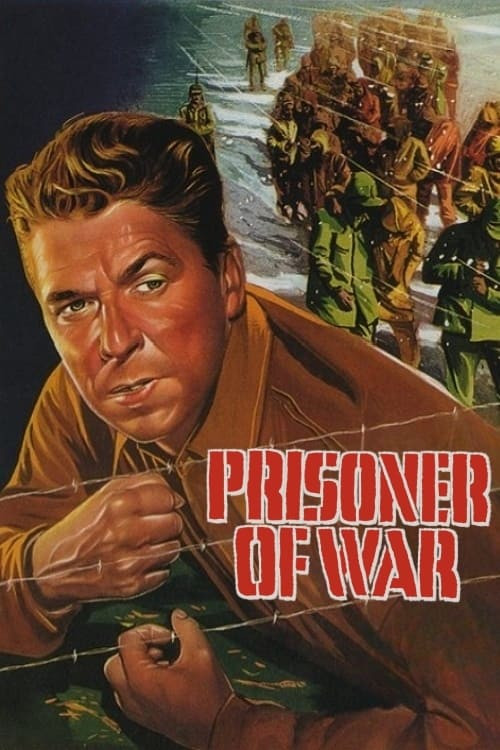
Prisoner of War (1954, directed by Andrew Marton)


The setting is the Korean War.  After getting information that American POWs are being tortured and brainwashed in North Korean prisoner-of-war camps, Major Hale (Harry Morgan) assigns Webb Sloane (Ronald Reagan) to go undercover.  After parachuting behind enemy lines, Webb spots a group of POWs being marched through the snow and joins the group.  From the minute that Webb joins the march, he begins to observe war crimes.  The death march itself, with the POWs being forced to move in freezing weather, is itself a war crime.  At the POW camp, Webb discovers the presence of an arrogant Soviet interrogator (Oscar Homolka) and a routine designed to break the POWs down until their ready to betray their native country.  Some POWS, like Captain Stanton (Steve Forrest), refuse to break.  Others, like cowardly Jesse Treadman (Dewey Martin), break all too quickly.  Webb sends the information back to Hale and eventually tries to make his escape.

It’s not terrible.  That the North Koreans and, later, the North Vietnamese tortured their POWs and forced some of them to denounce America is a matter of the historical record and, for a 1954 film, Prisoner of War doesn’t shy away from the brutality of the torture that POWs were often subjected too.  Of all of Reagan’s film, Prisoner of War had the strongest anti-communist message, though Reagan himself feels miscast as a hard-boiled secret agent.  (Reagan’s affability comes through even in a film set in a POW camp.)  Sending someone undercover into a prisoner of war camp and then hoping that they’ll find a way to escape doesn’t sound like the most efficient way to determine if the Geneva Convention is being violated.

The film features a dog who is found by one of the POWs.  Don’t get attached.

Lisa Marie Reviews An Oscar Winner: Citizen Kane (dir by Orson Welles)


For some reason, certain people seem to feel the need to try to reduce what Orson Welles accomplished with 1941’s Citizen Kane.

In 1971, the famous film critic Pauline Kael published an essay called Raising Kane, in which she argued that screenwriter Herman J. Mankiewicz deserved the majority of the credit for Citizen Kane.  This was Kael’s shot at rival Andrew Sarris and his embrace of the auteur theory.  (1971 was the same year that Kael described Dirty Harry as being  a “fascist work of art” so I guess even the best film critics can have a bad year.)  David Fincher’s father, after reading Kael’s essay, wrote the screenplay for Mank, which not only made the case that Mankiewicz deserved the credit but which portrayed Orson Welles in such a negative fashion that you really did have to wonder if maybe Orson had owed old Jack Fincher money or something.  Herman J.  Mankiewicz himself always claimed that he deserved the majority of the credit for Citizen Kane but then he would, wouldn’t he?

The truth of the matter is that Mankiewicz did write the screenplay for Citizen Kane and he did base the character of Charles Foster Kane on William Randolph Hearst and the character of Kane’s second wife on Hearst’s mistress, Marion Davies.  There’s some debate over how much of the film’s narrative structure belongs to Mankiewicz and how much of it was a result of Welles rewriting the script.  Mankiewicz played his part in the making of Citizen Kane but he played that part largely because Orson Welles allowed him to.  Like all great directors, Welles surrounded himself with people who could help to bring his vision to life.  (That’s something that would think David Fincher, of all people, would understand.  Aaron Sorkin may have written The Social Network but the reason why the film touched so many is because it was a David Fincher film.)

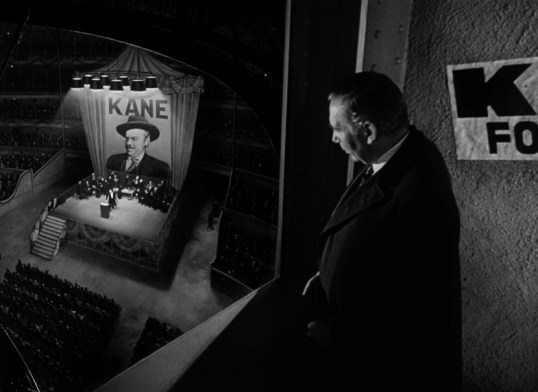
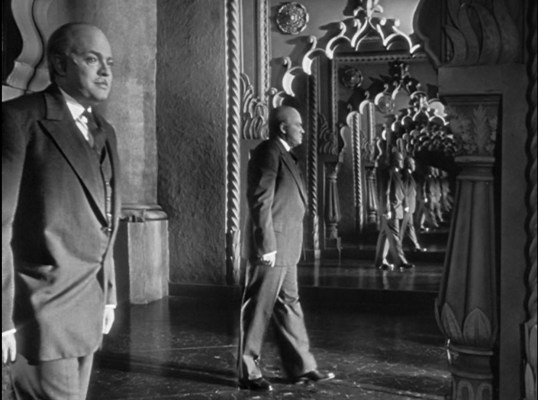
Make no mistake about it.  Citizen Kane is Orson Welles’s vision and Welles is the one who deserves the majority of the credit for the film.  The themes of Citizen Kane are ones to which Welles would frequently return and the cast, all of whom bring their characters to vivid life, is made up of largely of the members of Welles’s Mercury Theatre.  The tracking camera shots, the dark cinematography, and the satiric moments are all pure Welles.  As the Fincher film argues, Mankiewicz may have very well meant to use the film to attack Hearst for his personal hypocrisy and for opposing the political ambitions of Upton Sinclair.  If so, let us be thankful that Orson Welles, as a director, was smart enough to realize that such didacticism is often deadly dull.

And there’s nothing dull about Citizen Kane.  It’s a great film but it’s also an undeniably fun film, full of unforgettable imagery and scenes that play like their coming to us in a dream.  It’s a film that grabs your interest and proves itself to be worthy of every minute that it takes to watch it.  I was lucky enough to first see Citizen Kane at a repertory theater and on the big screen and really, that’s the best way to watch it.  It’s a big film that’s full of bigger-than-life characters who are ultimately revealed to be full of the same human longings and regrets as all of us.  As a young man, the fabulously wealthy Charles Foster Kane thinks that it would be “fun” to run a newspaper.  Later, he thinks that he’s found love by marrying the niece of the President.  He runs for governor of New York and, watching Welles in these scenes, you can see why FDR tried to recruit him to run for the Senate.  Welles has the charisma of a born politician.  When Welles first meets Susan Alexander (Dorothy Comingore) it’s easy to laugh.  The great man has just been splashed by a taxi.  Susan laughs but then winces in pain due to a tooth ache.  Later, Kane insists on trying to turn her into an opera star.  He runs a negative review written by his friend (Joseph Cotten) and then he promptly fires him.  As in all of Welles’s films, it’s all about personal loyalty.  Kane may betray his wife and the voters but he’s ultimately just as betrayed by those around him.  In the end, you get the feeling that Kane was desperately trying to not be alone and yet, that’s how he ended up.

There are so many stand-out moments in Citizen Kane that it’s hard to list them all.  The opening — MIGHTY XANADU! — comes to mind.  The satirically overdramatic newsreel is another.  (Citizen Kane can be a very funny film.)  Joseph Cotten’s performance continues to charm.  Orson Welles’s performance continues to amaze.  Who can forget Agnes Moorehead as Kane’s mother or Everett Sloane as Mr. Bernstein, haunted by that one woman he once saw on a street corner?  Myself, I’ve always liked the performances of Ray Collins (as the sleazy but strangely reasonable Boss Gettys), Paul Stewart (as the subtly menacing butler), and Ruth Warrick (as Kane’s first wife).  Mankiewicz may have put the characters on paper but Welles is the one who selected the amazing cast that brought them to life.

Citizen Kane was nominated for nine Oscars and it won one, for the screenplay written by Welles and Mankiewicz.  Best Picture went to How Green Was My Valley.  When was the last time anyone debated who should be given credit for that movie?

Film Review: The Greatest Story Ever Told (dir by George Stevens)


The 1965 biblical epic, The Greatest Story Ever Told, tells the story of the life of Jesus, from the Nativity to the Ascension.  It’s probably the most complete telling of the story that you’ll ever find.  It’s hard to think of a single details that’s left out and, as a result, the film has a four hour running time.  Whether you’re a believer or not, that’s a really long time to watch a reverent film that doesn’t even feature the campy excesses of something like The Ten Commandments.

(There’s actually several different version of The Greatest Story Ever Told floating around.  There’s a version that’s a little over two hours.  There’s a version that’s close to four hours.  Reportedly, the uncut version of the film ran for four hour and 20 minutes.)

Max von Sydow plays Jesus.  On the one hand, that seems like that should work because Max von Sydow was a great actor who gave off an otherworldly air.  On the other hand, it totally doesn’t work because von Sydow gives an oddly detached performance.  The Greatest Story Ever Told was von Sydow’s first American film and, at no point, does he seem particularly happy about being involved with it.  von Sydow is a very cerebral and rather reserved Jesus, one who makes his points without a hint of passion or charisma.  When he’s being friendly, he offers up a half-smile.  When he has to rebuke his disciples for their doubt, he sounds more annoyed than anything else.  He’s Jesus if Jesus was a community college philosophy professor.

The rest of the huge cast is populated with familiar faces.  The Greatest Story Ever Told takes the all-star approach to heart and, as a result, even the minor roles are played by actors who will be familiar to anyone who has spent more than a few hours watching TCM.  Many of them are on screen for only a few seconds, which makes their presence all the more distracting.  Sidney Poitier shows up as Simon of Cyrene.  Pat Boone is an angel.  Roddy McDowall is Matthew and Sal Mineo is Uriah and John Wayne shows up as a centurion and delivers his one line in his trademark drawl.

A few of the actors do manage to stand out and make a good impression.  Telly Savalas is a credible Pilate, playing him as being neither smug nor overly sympathetic but instead as a bureaucrat who can’t understand why he’s being forced to deal with all of this.  Charlton Heston has just the right intensity for the role of John the Baptist while Jose Ferrer is properly sleazy as Herod.  In the role Judas, David McCallum looks at the world through suspicious eyes and does little to disguise his irritation with the rest of the world.  The Greatest Story Ever Told does not sentimentalize Judas or his role in Jesus’s arrest.  For the most part, he’s just a jerk.  Finally, it’s not exactly surprising when Donald Pleasence shows up as Satan but Pleasence still gives a properly evil performance, giving all of his lines a mocking and often sarcastic bite.

The Greatest Story Ever Told was directed by George Stevens, a legitimately great director who struggles to maintain any sort of narrative momentum in this film.  Watching The Greatest Story Ever Told, it occurred to me that the best biblical films are the ones like Ben-Hur and The Robe, which both largely keep Jesus off-screen and instead focus on how his life and teachings and the reports of his resurrection effected other people.  Stevens approaches the film’s subject with such reverence that the film becomes boring and that’s something that should never happen when you’re making a film set in Judea during the Roman era.

I do have to admit that, despite all of my criticism of the film, I do actually kind of like The Greatest Story Ever Told.  It’s just such a big production that it’s hard not to be a little awed by it all.  That huge cast may be distracting but it’s still a little bit fun to sit there and go, “There’s Shelley Winters!  There’s John Wayne!  There’s Robert Blake and Martin Landau!”  That said, as far as biblical films are concerned, you’re still better off sticking with Jesus Christ Superstar.

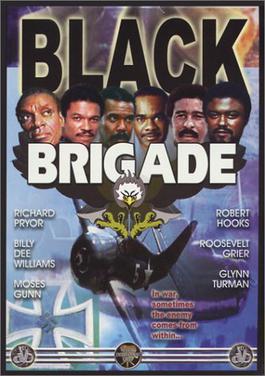
Black Brigade (1970, directed by George McCowan)


During the closing days of World War II, General Clark (Paul Stewart) wants to capture a Nazi-controlled dam and he thinks he’s found just the man for the job.  Captain Beau Carter (Stephen Boyd) is a tough and good with a knife and a gun.  Carter is sent to take command of a ragtag group of soldiers who have spent the last three years waiting for combat.  The only catch is that the soldiers are all black and Captain Carter is a racist redneck.

This was an Aaron Spelling-produced television movie that was originally broadcast under the name Carter’s Army.  When it was released on video, the name was changed to Black Brigade, probably in an effort to fool viewers into thinking that it was a cool blaxploitation film instead of a simplistic TV movie.  The film has gotten some attention because of the cast, which is full of notable names.  Roosevelt Grier plays Big Jim.  Robert Hooks is Lt. Wallace while Glynn Turman is Pvt. Brightman (who keeps a journal full of the details of the imaginary battles in which he’s fought) and Moses Gunn brings his natural gravitas to the role of Pvt. Hayes.  Probably the two biggest names in the cast are Richard Pryor as the cowardly Crunk and Billy Dee Williams as Pvt. Lewis, who says that he’s from “Harlem, baby.”

Don’t let any of those big names fool you.  Most of them are lucky if they get one or two lines to establish their character before getting killed by the Germans.  The movie is mostly about Stephen Boyd blustering and complaining before eventually learning the error of his ways.  The problem is that Carter spends most of the film as such an unrepentant racist that it’s hard not to hope that one of the soldiers will shoot him in the back when he least expects it.  The other problem is that, for an action movie, there’s not much action.  Even the climatic battle at the dam is over in just a few minutes.

There is one daring-for-its-time scene where Lt. Wallace comes close to kissing a (white) member of the German Resistance, Anna Renvic (Susan Oliver).  When Carter sees him, he angrily orders Wallace to never touch a white woman.  Anna slaps Carter hard and tells him to mind his own goddamn business.  It’s the best scene in the movie.  Otherwise, Black Brigade is forgettable despite its high-powered cast.

Film Review: L.A. 2017 (dir by Steven Spielberg)


L.A. 2017 is the Steven Spielberg film about which you’ve probably never heard.

To a certain extent, that’s understandable.  Spielberg was only 24 when, in 1971, he directed L.A. 2017.  It was a film that he directed for television.  In fact, it was only his third directorial assignment.  As opposed to the huge budgets that we tend to associate with a typical Spielberg production, L.A. 2017 was made for about $300,000.  The entire film was shot in about 12 days.  In fact, with a running time of only a scant 69 minutes, L.A. 2017 hardly qualifies as a feature-length film.  L.A. 2017 has never been released on DVD or Blu-ray, making it a true oddity in Spielberg’s filmography.  Despite the fact that Spielberg has credited L.A. 2017 with opening a lot of doors for him, it’s an almost totally forgotten film.

Of course, some of that is because L.A. 2017 really isn’t a film at all.  Instead, it was an episode of a television show called The Name of the Game.  The show was about Glenn Howard (Gene Barry), a magazine publisher, and the reporters who worked for him.  L.A. 2017 was unique in that it was the show’s only excursion into science fiction.  In fact, from everything that I’ve read about the show, it appears that L.A. 2017 was nothing like any of the other episodes of The Name of the Game.  This episode was also unique because Spielberg directed it as if he was making a feature, as opposed to just another installment in a weekly series.  If not for the opening credits (which announce, among other things, that we’re watching a Robert Stack Production), one could easily imagine watching L.A. 2017 in a movie theater, perhaps as a double feature with Beneath The Planet Of The Apes.

L.A. 2017 opens with Glenn driving down a mountain road in California.  He’s heading to a pollution summit and, as he drives along, he awkwardly dictates an editorial into a tape recorder.  Glenn worries that society may have already ruined the environment to such an extent that the Earth cannot be saved.  As if to prove his point, Glenn starts to cough as he’s overcome by all of the smog in the air.  His car swerves into a ditch and Glenn is knocked unconscious.

Welcome to the future

When he wakes up, he finds himself being rescued by men wearing wearing protective suits and masks.  The sky is a sickly orange and an ominous wind howls in the background.  Glenn’s rescuers take him to an underground city where he discovers that, somehow, he has traveled through time.  The year is now 2017, which in this film looks a lot like the 70s except that everyone’s now underground and the landline phones are extra bulky.  (Needless to say, watching 1971’s version of 2017 in 2019 is an interesting experience.)  It turns out that the pollution got so bad that the surface of the planet became uninhabitable.  The U.S. is now run by a corporation that is headquartered in Detroit.  (Presumably, the Corporation is a former car company.)  The U.S. is also at war with England, for some reason.  No mention is made about what’s happened to Canada but, if Detroit’s still around, I assume at least some of Canada managed to survive as well.

The …. uh, Future.

Everyone in the future drinks a lot of milk and, when they’re not listening to cheerful announcements, they’re listening to the soothing music that the Corporation provides for them.  Everyone in the future is also very friendly.  We know this because everyone keeps assuring Glenn that he’s surrounded by friends.  In fact, everyone in the future refers to one another by their first name because “it’s friendlier.”  It’s also the law.  It turns out that there’s a lot of laws in the future.  In fact, the underground cities are pretty fascist in the way that they handle things.  There are constant announcements encouraging people to pursue a career in law enforcement and anyone who disagrees with the Corporation ends up in a straight jacket.  Glenn feels that maybe he’s been brought to the future so he can start a new magazine and challenge the status quo.  The Corporation disagrees….

This is what happens when you don’t go underground in the future.

Okay, so there’s nothing subtle about L.A. 2017.  From the villainous corporation to the heavy-handed environmental message, there’s nothing here that you haven’t seen in dozens of other sci-fi films.  But the lack of subtlety doesn’t matter, largely because Spielberg directs with so much energy and with such an eye to detail that it’s impossible not to get sucked into the story.  As opposed to the somewhat complacent Spielberg who has recently given us rather bland and safe blockbusters like Lincoln, The BFG, and The Post, the Spielberg who directed L.A. 2017 was young and obviously eager to show off what he could do with even a low budget and that enthusiasm is present in every frame, from the wide-angle shots of Glenn driving his car to the scenes of Glenn looking up at the shadowy executives and scientists who are staring down at him when he’s first brought to the underground city.  As opposed to the sterile vision of so many other future-set films, Spielberg’s future feels as if it’s actually been lived in.  When Glenn finds himself in a new world, it comes across as being a real world as opposed to just a narrative contrivance.

Of course, because L.A. 2017 was just one episode in a weekly series, Glenn couldn’t remain in the future and L.A. 2017 returns Glenn to the present in the most contrived and predictable way possible.  Still, L.A. 2017 remains an entertaining example of what a young and talented director can do when he’s determined to be recognized.  Watching the film, it’s easy to draw a straight line from Spielberg doing L.A. 2017 to doing Duel and then subsequently being hired for Jaws.

Incidentally, Joan Crawford is somewhere in this film.  Crawford worked with Spielberg when he directed her in the pilot for Night Gallery and she was one of his first major supporters in Hollywood.  Apparently, in L.A. 2017, she plays one of the people staring down at Glenn when he’s first brought into the underground city.  I haven’t found her yet but she’s apparently there somewhere.

Unfortunately, L.A. 2017 has never been released on DVD or Blu-ray but it is currently available on YouTube.

30 Days of Noir #17: Loan Shark (dir by Seymour Friedman)


The 1952 film, Loan Shark, opens with a familiar film noir situation.

A man walks down a dark city street.  Judging from the way that the man keeps looking over his shoulder, he’s obviously nervous about something.  Suddenly, we hear two sets of footsteps approaching him and it quickly becomes apparent that the man has good reason to be so nervous.  The man is being pursued by two gangsters.  (We know that they’re gangsters because of the suits and the fedoras.)  The gangsters toss the man in an alley and proceed to beat the Hell out of him.

The local tire factory has a problem.  Though its employees are highly valued, they’re not highly paid.  In order to make ends meet, many of them have resorted to gambling.  Plant foreman Charlie Thompson (Russell Johnson) always seems to have the latest tip on a sure thing.  Interestingly enough, the tips never seem to pan out and, as a result, the workers are forced to go to the local loan shark, Lou Donelli (Paul Stewart).  Lou always loans them the money but he charges exorbitant interest and, when the workers can’t pay back the loans, he sends his thugs to beat them up.  The factory’s management knows that they have to do something to take this loan shark out of commission.

Now, what would you do if you were a part of management?  Would you go to the police and maybe see if they could arrange to put a trained undercover cop in your factory?  Or would you hire an ex-con and tell him to just take care of it on his own?

The ex-con in question is Joe Gargen (George Raft).  He’s just been released from prison, though the film is quick to point out that Joe didn’t really do anything that bad.  He just hit a guy who was being obnoxious.  The guy fell back and hit his head and, as a result, Joe was charged with assault with a deadly weapon.  (As Joe explains it, he’s a former boxer and, as a result, his fists are legally considered to be deadly weapons.)  When Joe is first offered the clandestine job at the tire factory, he turns it down.  As he explains it, he’s not looking to get in any more trouble with anyone.  But then when the loan sharks kill his brother-in-law, Joe reconsiders.

Soon, Joe is working at the tire plant.  (If you’ve ever wanted to see, in meticulous detail, how a tire is made, this is the film to watch.)  After Charlie gives him a bad tip on a horse, Joe finds himself in debt to Donelli.  However, when Joe manages to beat up the thugs that Donelli sends to collect, Joe finds himself with another job offer.  Soon, Joe is working for the loan sharks!  Because he can’t reveal that he’s undercover, everyone — from the administrative assistant (Dorothy Hunt) who he once took dancing to his own sister (Helen Westcott) — is disgusted by Joe’s actions.  Joe finds himself a pariah but he’s still determined to discover the identity of Donelli’s boss.

With it’s combination of the mob and exploited blue collar workers (not to mention it’s use of an ex-boxer as its protagonist), Loan Shark lightly treads on the ground that would later be covered, in a far more exacting manner, by On The Waterfront.  Unfortunately, Loan Shark suffers a bit from the miscasting of George Raft in the lead role.  Raft was a charismatic actor but, when he made Loan Shark, he was 51 and looked about 9 years older.  When Raft shares what is meant to be a romantic dance with Dorothy Hart, he looks more like a proud father dancing with his daughter at a wedding reception than anything else.  Loan Shark is one of those films that calls out for a younger actor, a William Holden or maybe a John Garfield.  That said, Raft was a genuine tough guy and, despite his advanced age, he still looked like he could go a few rounds.

That said, Loan Shark is a tough and shadow-filled film, one that features some genuinely exciting fight scenes.  Miscast or not, when George Raft throws a punch, you believe it.

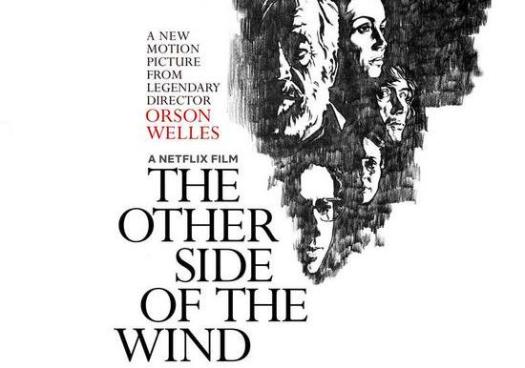
What A Long, Strange Trip It’s Been: Orson Welles’ THE OTHER SIDE OF THE WIND (Netflix 2018)


gary loggins's avatarcracked rear viewer

The day has finally arrived. November 2, 2018. I ordered a free trial of Netflix specifically so I could watch the completed version of Orson Welles’ final film, THE OTHER SIDE OF THE WIND . Welles worked on this project for over a decade, and the footage sat for decades more before finally being restored and re-edited. A film buff’s dream come true – perhaps. There were questions I needed answered. Was there enough salvageable material to make a coherent movie? Does it follow Welles’ vision? Would it live up to the hype? Was it worth the wait?

The answer: OH, HELL YEAH!!

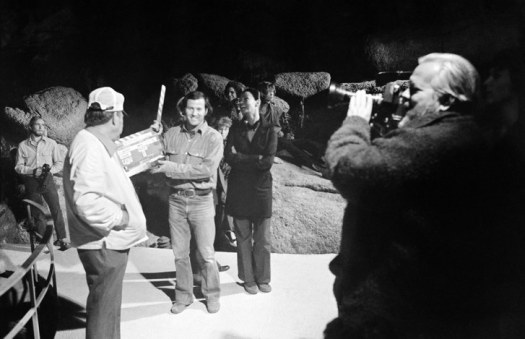
Welles shot over ten hours of film, utilizing different film stocks (Super 8, 16mm, 35mm), switching back and forth from color to classic black and white, to create his movie, which is a documentary about the movie-within-the-movie’s director – a movie-within-a-movie-within-a-movie. It took six years (from 1970-76)…

View original post 719 more words

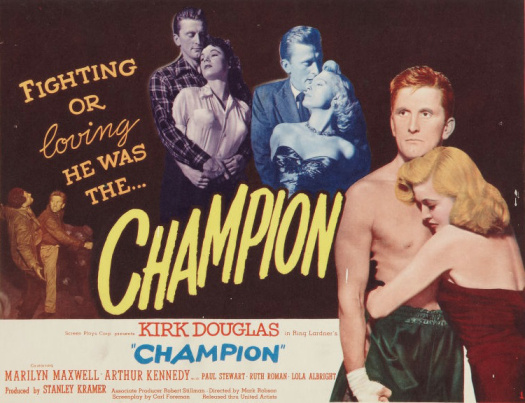
The Main Event: Kirk Douglas in CHAMPION (United Artists 1949)


gary loggins's avatarcracked rear viewer

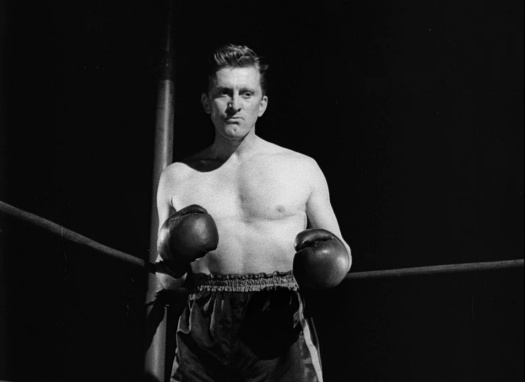
Kirk Douglas  slugged his way to superstardom in director Mark Robson’s CHAMPION, one of two boxing noirs made in 1949. The other was THE SET-UP , helmed by Robson’s former RKO/Val Lewton stablemate Robert Wise. While that film told of an aging boxer (Robert Ryan) on the way down, CHAMPION is the story of a hungry young fighter who lets nothing stand in his way to the top of the food chain. The movie not only put Douglas on the map, it was a breakthrough for its young independent producer Stanley Kramer .

Douglas is all muscle and sinew as middleweight Midge Kelly, and a thoroughly rotten heel. He’s a magnetic character, a classic narcissist with sociopathic tendencies drawing the people around him into his web with his charm. Midge has no empathy for others, not even his loyal, game-legged brother Connie (Arthur Kennedy in a solid performance), after…

View original post 479 more words

A Movie A Day #243: The Joe Louis Story (1953, directed by Robert Gordon)


Joe Louis, also known as the Brown Bomber, is generally agreed to have been one of the greatest heavyweight boxers of all time.  Despite the barriers put up by both poverty and racism, Louis held the world heavyweight championship from 1937 to 1949 and successfully defended his title in 26 fights (ranking him second to only Julio Cesar Chavez, who had 27 title defenses).  In 1938, he defeated German Max Schmelling, disproving Nazi claims that a black man could not defeat an Aryan and making Louis, along with Jesse Owens, one of the first African-American athletes to achieve nationwide hero status in America.

The Joe Louis Story, which was made and released shortly after Louis lost his final fight to Rocky Marciano and announced his retirement from boxing, tells an effective but sanitized version of Louis’s life story.  Made on an obviously low budget, The Joe Louis Story hits all the highlights — Joe’s relationship with trainer Jack Blackburn (James Edwards), Joe’s marriage to Marva Trotter (Hilda Simms), Joe’s two fights against Max Schmelling, and Joe’s time in the army — while ignoring most of the lowlights.  No mention is made of Joe’s financial troubles, Joe’s initial struggle to even get a match against the white heavyweights of the day, or the infidelity that led to Joe and Marva’s divorce.  The Joe Louis Story does briefly touch on racism when Joe is told that, as a black man, he already has a strike against him as far as the boxing establishment is concerned.

The best thing about The Joe Louis Story is that it features footage from Louis’s actual fights. Coley Wallace, the boxer who was hired to play the title role, bore a remarkable resemblance to Joe and the footage of the real Joe Louis boxing is easily mixed in with scene of Wallace as Joe.  Wallace was not much of an actor but, as a real-life boxer, he still brought enough authenticity to the role that his casting works.

One final note: In real life, Joe Louis ended his career after a brutal loss to Rocky Marciano.  Before turning pro, Marciano lost four fights as an amueter.  One of those losses came in 1948 when Marciano was defeated in the final round of the New York Golden Gloves tournament.  The fighter who defeated Rocky Marciano?  Coley Wallace.