Lisa Marie Reviews An Oscar Winner: Platoon (dir by Oliver Stone)


One of my favorite scenes from TV’s King of the Hill occurs in an episode in which Hank and Peggy are celebrating their wedding anniversary.  They’ve sent Bobby and Luanne away for the weekend.  They have the house to themselves but, after their anniversary party, Peggy is feeling depressed.  She tells Hank that, for the first time ever, she feels old and she regrets all the dreams that she had that have yet to come true, like inventing and selling her own barbecue sauce.

Trying to cheer her up, Hank says, “C’mon, Peg.  We got the house to ourselves for weekend …. and I rented an R-rated movie!”

Peggy looks up, briefly hopeful that Hank did something romantic.  “What movie?” she asks.

Hank hesitates, glances down at the floor, and says, “Uhmm …. Platoon.”

It’s funny because it’s true.  Just about every man that I know loves Platoon.  First released in 1986 and reportedly based on Oliver Stone’s own experiences as an infantryman in Vietnam, Platoon is often cited as being one of the greatest war films ever made.  Oddly enough, the film has an anti-war and anti-military message but, in my experience, those who love it talk more about the battle scenes than any message that Stone may have been trying to impart about the futility of war.  Pauline Kael once wrote that Oliver Stone had left-wing politics but a right-wing sensibility and I think you can definitely see that in Platoon.  Despite all of the characters talking about how pointless the war is and how much they resent being forced to risk their lives for no apparent purpose, the film’s energy comes from the scenes of Chris Taylor (Charlie Sheen) stalking through the jungle and, towards the end, losing his mind and giving himself completely over to the adrenaline that comes from being trapped in the middle of a battle.  Throughout the film, we hear Taylor’s rather pedantic thoughts on the military and his fellow soldiers but it’s hard not to notice that his actions and his dialogue are usually far less eloquent.  Taylor may be a rich intellectual (and wow, is Charlie Sheen ever unconvincing when it comes to portraying that part of Taylor’s personality) but when he’s in the jungle, he’s just fighting for survival.

The film’s plot centers around the conflict between two sergeants, the peace-loving Elias (Willem DaFoe) and the war-loving Barnes (Tom Berenger).  Taylor has to decide which one of the two to follow.  The pot-smoking Elias loves his men and goes out of his way to protect them.  The beer-drinking Barnes has a much harsher view of the world but, at the same time, he’s the type of scarred warrior who seems immortal.  One gets the feeling that he’ll never be defeated.  The rest of the platoon is full of familiar faces, with everyone from John C. McGinley to Francesco Quinn to Tony Todd to Forest Whitaker to Johnny Depp to a baby-faced Kevin Dillon showing up.  (Dillon is especially frightening as a psycho who has, for some reason, been nicknamed Bunny.)  The majority of the platoon is dead by the end of the film.  Even with the leadership of Elias and Barnes, the soldiers are stuck in a winless situation.  As Taylor points out, the Americans aren’t just fighting the enemy.  They’re also fighting each other.

Platoon is certainly not my favorite of the film nominated in 1986.  I would have gone with A Room With A View.  (Blue Velvet, which is as influential a film as Platoon, was not even nominated.)  That said, I can’t deny the power of Platoon‘s combat scenes.  Though Stone’s script is didactic and Taylor’s narration is awkwardly deployed throughout the film, Stone’s direction definitely captures the fear and dread of being in a strange place with no idea of whether or not you’re going to survive.  Stone is critical of the military (at one point, an officer calls an air strike on his own men) but seems to love the soldiers, even the ones who have pushed over to the dark side.

Platoon was not the first Best Picture nominee to be made about the Vietnam War.  The Deer Hunter, Coming Home, and Apocalypse Now were all released first.  But both The Deer Hunter and Apocalypse Now are surreal epics that seem to take place in a dream world.  Coming Home, which has a script that somehow manages to be even more didactic than Platoon‘s, focuses on the war back home.  Platoon is far more gritty and personal film.  Watching Platoon, you can smell the gunpowder and the napalm and feel the humidity of the jungle.  I can understand why it won, even if I prefer to watch Helena Bonham Carter and Julian Sands fall in love.

Late Night Retro Television Review: Friday the 13th 2.24 “The Shaman’s Apprentice”


Welcome to Late Night Retro Television Reviews, a feature where we review some of our favorite and least favorite shows of the past! On Fridays, I will be reviewing Friday the 13th: The Series, a show which ran in syndication from 1987 to 1990. The entire series can be found on YouTube!

This week, Micki is faced with a moral dilemma.

Episode 2.24 “The Shaman’s Apprentice”

(Dir by William Fruet, originally aired on May 29th, 1989)

Micki’s friend, Blair (Isabelle Mejias) is in the hospital.  She’s been having serious chest pains and, as Micki puts it, she’s too young to be suffering from them.  Blair finds out that she has a sarcoma and the doctors are not giving her much chance to live.  Dr. Lamar (James B. Douglas), the arrogant head of surgery at the local hospital, doesn’t seem to really care whether Blair lives or dies.  All he cares about is taking care of the wealthy patients who might be moved to donate some of their money to the hospital.

However, Blair has found a reason for hope.  There is a Native American doctor named John Whitecloud (Paul Sanchez).  He has his own clinic, one that is funded by a rich man who Dr. Lamar said couldn’t be saved.  Dr. Lamar hates Whitecloud, largely because Lamar is a racist who views Whitecloud’s “shamanistic” techniques with scorn.  However, Whitecloud appears to be capable of saving anyone.  Of course, the doctors and the nurses who have failed to treat Whitecloud with respect have a habit of mysteriously dying, usually right before Whitecloud manages to save a terminal patient.

Whitecloud does indeed have an objects that Jack and Ryan are interested in retrieving.  It’s not a cursed antique.  Instead, it’s a rattle that Whitecloud stole from his grandfather, Spotted Owl (Gordon Tootoosis).  Whitecloud is using the rattle to cure his patients but, for every cure, he also has to use it to kill someone else.  Whitecloud even uses it to kill Spotted Owl, though Whitecloud seems to feel bad about doing it.  When Jack realizes that Whitecloud’s next target is going to be Dr. Lamar, he and Ryan are determined to stop him….

….except, as Micki points out, stopping Whitecloud will mean that her friend Blair will die.  Why, Micki wonders, should Lamar get to live while Blair dies?  Micki argues that they should at least let Whitecloud cure Blair but Jack gently explains that it doesn’t work that way.  Jack says that their job is not to play God.

Long story short: The spirit of Spotted Owl shows up to drag Whitecloud into the afterlife.  Jack gives the rattle back to the tribe, despite Ryan feeling that it should be in the vault.  (“It’s not ours to take,” Jack explains in that reasonable and reassuring way of his.)  Micki is angry and depressed that Blair is probably going to die.  Blair stands on a street corner and stares at Whitecloud’s now empty clinic.  Roll the end credits!

Wow, that was depressing!  But it was really the only way the episode could end and I respect the fact that the show had the courage and the integrity to stay true to itself and end on such a down note.  Not many shows would have had the courage to resist coming up with some sudden, miracle solution.  This episode had some really cheap looking special effects and some not-so-great acting from some of the guest stars but Chris Wiggins, Robey, and John D. LeMay were as strong as always.  This episode was especially an effective showcase for Chris Wiggins, who played Jack with just the right amount of weary gravitas.  This was a depressing episode but it was a good one.

A Movie A Day #118: Navy SEALs (1990, directed by Lewis Teague)


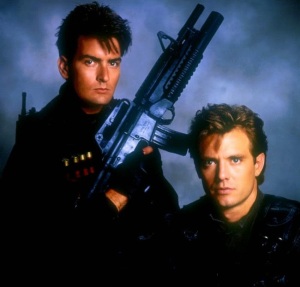
While rescuing hostages in the Middle East, a team of Navy SEALs discover that terrorist leader Ben Shaheed (Nicholas Kadi) has a warehouse full of stinger missiles.  Hawkins (Charlie Sheen) wants to destroy the missiles but his superior, Curran (Michael Biehn), orders him to concentrate on saving the hostages.  As a result, Shaheed has time to move the missiles to another location.  With the help of a Lebanese-American journalist (Joanne Whalley-Kilmer) and the CIA, the SEALs must now track down the new location and destroy the missiles before they are used by Shaheed’s organization.

Navy SEALs is mostly memorable for the amount of James Cameron alumni who appear in its cast.  The cast not only features The Terminator‘s Michael Biehn and Rick Rossovich but Bill Paxton as well.  Of course, the main star is Charlie Sheen, still technically a serious actor at the time, who gives a wide-eyed and histrionic performance that suggests Hawkins may have snorted a little marching powder before reporting for duty.  24‘s Dennis Haysbert plays a SEAL who is engaged to marry Law & Order‘s S. Epatha Merkerson.  Haysbert spends so much time planning his wedding and talking about both the importance of both duty and love that the only shocking thing about his role is that he manages to survive half the movie before getting killed.  Neither Val Kilmer nor Cary Elwes is in the cast, though it seems like they both should be.

Navy SEALs was a box office bust in 1990 but, after the death of Osama Bin Laden, it experienced a sudden upswing in popularity and even appeared on primetime television a few times.  The scene where the SEALs blow off some steam by playing golf is a classic but, otherwise, this is a largely forgettable Top Gun rip off.