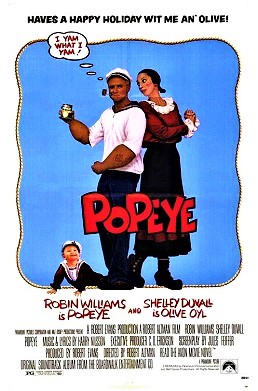
Sometimes, I feel like I’m the only one. Popeye got such bad reviews and was considered to be such a box office disappointment that director Robert Altman didn’t make another major film for a decade. Producer Robert Evans, who was inspired to make Popeye after he lost a bidding war for the film rights to Annie, lost his once-sterling reputation for being able to find hits. This was Robin Williams’s first starring role in a big screen production and his career didn’t really recover until he did Good Morning Vietnam seven years later. Never again would anyone attempt to build a film around songs written by Harry Nilsson. Screenwriter Jules Fieffer distanced himself from the film, saying that his original script had been ruined by both Robert Evans and Robert Altman. Along with Spielberg’s 1941 and Michael Cimino’s Heaven’s Gate, Popeye was one of the box office failures that signaled the end of the era in which directors were given a ton of money and allowed to do whatever they wanted to with it.
I don’t care. I like Popeye. I agree with the critics about Nilsson’s score but otherwise, I think the film does a great job of capturing the feeling of a comic strip come to life. Altman was criticized for spending a lot of money to construct, from scratch, the seaside village that Popeye, Olive Oyl (Shelley Duvall), Bluto (Paul L. Smith), Wimpy (Paul Dooley), and everyone else called home but it does pay off in the movie. Watching Popeye, you really are transported to the world that these eccentric characters inhabit. If the film were made today, the majority of it would be CGI and it wouldn’t be anywhere near as interesting. Featuring one of Altman’s trademark ensemble casts, Popeye create a world that feels real and lived in.
Mumbling the majority of his lines and keeping one eye closed, Robin Williams is a surprisingly believable Popeye, even before he’s force fed spinach at the end of the movie. Paul L. Smith was an actor who was born to play the bullying Bluto and there’s something very satisfying about seeing him (literally) turn yellow. As for Shelley Duvall, she is the perfect Olive Oyl. Not only does she have the right look for Olive Oyl but she’s so energetic and charmingly eccentric in the role that it is easy to see what both Popeye and Bluto would fall in love with her. Though the humor is broad, both Williams and Duvall bring a lot of heart to their roles, especially in the scenes where they take care of their adopted infant, Swee’Pea. Popeye may be a sailor but he’s a father first.
Popeye deserves a better reputation than it has. It may not have been appreciated when it was originally released but Popeye has a robust spirit that continues to distinguish it from the soulless comic book and cartoon adaptations of today.
Welcome to Late Night Retro Television Reviews, a feature where we review some of our favorite and least favorite shows of the past! On Mondays, I will be reviewing CHiPs, which ran on NBC from 1977 to 1983. The entire show is currently streaming on Freevee!
This week, Ponch attacks a reporter …. or does he?
Episode 2.4 “Disaster Squad”
(Dir by Gordon Hessler, originally aired on October 7th, 1978)
In a change-of-pace for this show, it’s Officer Jon Baker who gets a girlfriend in this week’s episode. Ellen Roberts (Liberty Godshall) is a recently divorced woman with an annoying 4 year-old named Chris (Christian Zika). Because Baker doesn’t want any kids around to ruin his action, he gets Ponch to hang out with Chris. Fortunately, it turns out that Chris loves motorcycle and even owns his own mini-bike.
Impressed by how well Chris can handle his bike, Ponch enters Chris in a children’s dirt bike race. When one of the other racers knocks Chris down in the middle of the race, an angry Chris says that he’s going to hit the other racer. Ponch tells Chris to never hit anyone and he says that he’s ashamed to hear Chris speak like that. Chris promises not to ever fight.
But then, the next morning, Chris turns on the TV and sees a report about Ponch punching out an obnoxious news reporter (Harvey Jason) who got in the way while Ponch and Jon were dealing with a suicidal motorist. The anchorman (played by Regis Philbin!) then comes on TV and basically says that Ponch is the epitome of everything bad about the police. Chris starts sobbing. Ponch lied about not fighting! Chris hops on his mini-bike and, still crying, drives away.
What Chris doesn’t know is that Ponch was set up. Lee and the members of “the Disaster Squad” have been following Ponch and Baker around, filming accidents, and getting in the way. (At one point, one of Lee’s men event tosses a road flair under a car that’s leaking oil, causing an explosion.) Lee doctored the tape of an earlier confrontation with Ponch to make it appear the Ponch threatened and hit him.
But that doesn’t matter to Chris. With tears flowing down his cheeks, he drives his little motorcycle into the Los Angeles river. Fortunately, Ponch and Baker find him in time to save his life and teach him an important lesson about fake news.
This episode …. where to begin? It opened with a good chase scene and it featured a truck flipping over so that was good. But then bratty little Chris showed up and the whole episode went downhill. The child playing Chris was, to be charitable, not exactly the world’s best actor and his over-the-top reaction to seeing Ponch hit someone was bit too silly to inspire anything other than a chuckle. “Ponch said never to hit anyone!” Chris wails. Well, kid, Ponch is a damn hypocrite. Sorry.
It was all pretty silly. Baker finally got to do something other than gaze at Ponch in amazement but, in the end, the story was still pretty much Ponch-centered. One thing I noticed about this episode is that Getraer had absolutely no sympathy for Ponch, even though he believed Ponch was being set up. Seriously, I get that Getraer has a lot to deal with but does he have to be a jerk all the time?
Next week …. Ponch and Baker continue to keep California safe!
This 1982 Spanish-produced slasher film was advertised, at least in the United States, with the brilliant tag line: “You don’t have to go to Texas for a chainsaw massacre.” And indeed, Pieces takes place in Boston, Massachusetts. And yet, it’s a Boston that has little relation to the Boston of the real world. (Some of that may be because, while a few scenes were filmed in Boston, the majority of the film was shot in Spain.) Indeed, one can argue that Pieces takes place in an alternate reality, one that was created with bits of giallo suspense, slasher gore, and scenes randomly borrowed from every other exploitation film ever made.
In the 1950s, a little boy wears a bowtie and plays with a pornographic jigsaw puzzle. His mother takes the puzzle away from him, which he doesn’t appreciate at all. It leads, as things usually do, to an axe murder.
In the 1980s, a college student tries to roller skate down a sidewalk, just to suddenly lose control. As she helplessly rolls down the street, two workman carrying a sheet of glass just happen to step out in front of her. Pieces of blood-stained glass fly everywhere. As is typical of Pieces, this actually has nothing to do with the larger plot of the film. We never learn the girl’s name. We never hear learn if she survived nor do we hear much else about the accident. Instead, it’s just a random incident, tossed in to illustrate that the world is going mad.
On campus, a chainsaw killer is killing students and teachers. He’s the boy with the bowtie, all grown up. He takes body parts home with him so that he can stitch them together, recreating the jigsaw puzzle that was stolen from him years before. Oddly enough, he never makes much of an effort to hide his chainsaw. He casually gets on an elevator with one of his victims. She notices that he’s carrying a chainsaw but she doesn’t say anything about it until he actually turns it on.
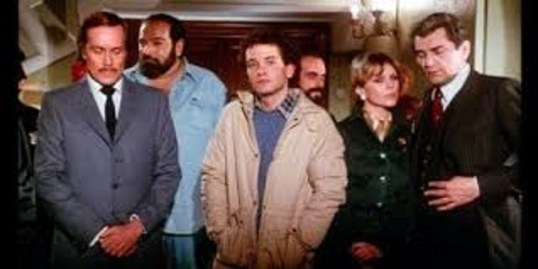
Dean Foley (played by Eurohorror veteran Edmund Purdom) is upset that students keep getting dismembered on campus, as well he should be. Lt. Bracken (Christopher George, barking out his lines with the same annoyed energy that he brought to Graduation Day) is also upset because he’s supposed to arrest criminals and stuff. Unfortunately, all of Bracken’s cops are incredibly incompetent. Bracken is forced to rely on the help of Kendall James (Ian Sera). Despite being kind of scrawny and unappealing, Kendall is the most popular student on campus. Kendall also knows every victim and discovers the majority of them. You would think that Kendall would be the obvious suspect but instead, Kendall somehow ends up directing the entire investigation. Kendall’s not a cop but he’s soon ordering around the veteran detectives and everyone’s okay with that. (One detective even mentions that Kendall might as well be a part of the force.)
Lt. Backen decides that the best way to solve the case is to send in Mary Riggs (Linda Day George), who is not only an undercover cop but also a top-ranked tennis player! There’s a lot of tennis in Pieces, as Mary works on her game in between working with Kendall to solve the murders. Kendall and Mary aren’t very effective though. After discovering that one victim was chopped in half in the showers while Kendall and Mary were trying to find the source of some loud marching band music, Mary lets the killer know exactly what she thinks of him.
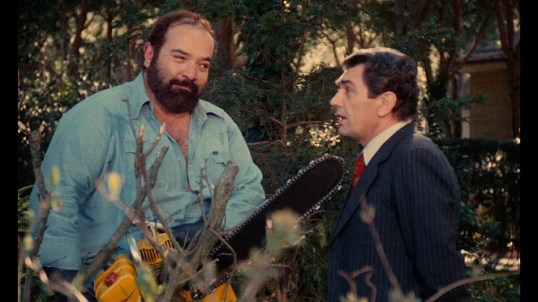
But who is the killer? Because Pieces was as inspired by the giallo genre as the slasher genre, there are several suspects. Kendall seems like the obvious one but, for whatever reason, no one makes that connection. Instead, we’re left to wonder if maybe it could be the Dean. Or how about Prof. Brown (Jack Taylor), the somewhat odd professor who seems to be a bit repressed? Or maybe it’s the handyman, Willard (Paul L. Smith)? Willard is creepy and he works with a chainsaw! There are a lot of suspects and helpfully, after a murder at the pool, every single one of them shows up at the scene of the crime. At one point, they all even gather in the same corner and look straight at the camera. You half expect Kendall to announce, “Well, I can’t possibly solve this one! Can you?”
But that’s not all! When Kendall and Mary aren’t solving murders, they’re having to deal with all of the other weird things that happen on campus. At one point, Mary is randomly attacked by the school’s karate instructor. After Kendall shows up and explains who the man in, they all laugh it off as being the result of “bad chop suey.” Later, Kendall walks Mary back to her place and, after she rejects his attempts at romance, Kendall turns around to be confronted by another student who taunts him by yelling, “Casanova!” Meanwhile, other students are still walking around campus in the middle of the night and making plans to meet up in a room that contain the height of campus luxury, a waterbed!
(Yes, a murder does occur on the waterbed. Yes, water goes everywhere. It’s Chekhov’s waterbed. You can’t introduce it without including a scene where it gets punctured.)
Many things happen, none of which make sense. The entire film is so over-the-top in its combination of gore, overacting, and general absurdity that it becomes strangely fascinating. From today’s perspective, it’s easy to imagine that the film was actually meant to be a parody but director J. Piquer Simon has said that it was meant to be viewed as a serious thriller, regardless of how the film was subsequently advertised in the United States. Even the film’s ending, in which someone who is not the killer is randomly castrated just because, was meant to be taken seriously. Every weird moment was included to give the audience what they wanted. Audiences loved Bruce Lee so, of course, a random karate fight was tossed in. People love chainsaws so, of course …. well, you get the idea.
On the one hand, Pieces is a really heavy-handed and mean-spirited film, one in which the victims are almost exclusively women and where sex and violence are too often connected. Mary may be an absurd character but you’re happy when she shows up because she’s the one woman in the film not presented as being a passive victim. On the other hand, Pieces is just so over-the-top and absurd that it’s hard not to watch the film all the way through. Perhaps the only thing that keeps the film from being incredibly offensive is that, regardless of what the director has claimed, it is so obviously not meant to be taking place in the real world. When that plate glass was shattered, it obviously opened a vortex that sucked the campus into a world where every slasher and giallo trope has been adapted to the point of absurdity. This is one of those films that just gets more and more strange with each passing minute. You watch it and you find yourself continually thinking, “This movie can’t get any weirder” and then it manages to do just that. Watching the movie is like stepping through a portal into some sort of strange alternate reality. Just try to look away.
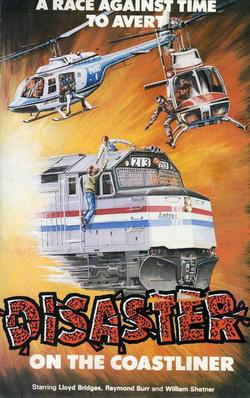
A completely computerized passenger train is traveling across the country, with the Vice President’s wife as one of the passengers. When Jim Waterman (Paul L. Smith), a man who blames the railroad for the death of his family, manages to hijack the train he plans to ram into a locomotive until his demands a met. He wants railroad president Estes Hill (Raymond Burr) to take responsibility for the crash that killed his wife and children. With Waterman determined to crash the two trains, it falls to dispatchers Al Mitchell (Lloyd Bridges) and Roy Snyder (E.G. Marshall) to try to figure out a way to stop the collision. Helping them out on the train is a con artist named Stuart Peters (William Shatner!) who may be wanted by the police but who is still willing to do whatever it takes to save his fellow passengers.
Disaster on the Coastliner is an above-average made-for-TV disaster movie. Even though it was obviously made for a low-budget and that the majority of the money was probably spent on securing the B-list cast, there are enough shots of the train careening on the tracks to bring happiness to the hearts of most disaster movie fans. The cast is full of the type of people who you would typically expect to find in a movie like this, people like Raymond Burr, Lloyd Bridges, and William Shatner. Bridges, interestingly enough, gives the same performance here that he gave in Airplane! and when he starts ranting about how everything’s computerized, he sounds like he could be reciting dialogue from that film. The only difference is that Airplane! was a comedy while Disaster On The Coastliner is meant to be a drama. Raymond Burr also does a good job hamming it up as the president of the railroad. He spends most of the movie sitting behind his desk and looking annoyed, which was pretty typical of Burr in the years after Perry Mason and Ironside.
For a lot of people, the main appeal of this film will be seeing what William Shatner was doing in between Star Trek movies. This is a typical early 80s Shatner performance, when he was still trying too hard to win that first Emmy but also when he had just starting to develop the self-awareness necessary to poke fun at his own image. Shatner really digs into the role of a conman with a heart of gold. He delivers his lines in his trademark overdramatic style but, in scenes like the one where he sheepishly discovers that a door that he’s been pounding on was unlocked all the time, Shatner actually seems to be in on the joke. Shatner also did his own stunts in this film, including one where he had stand on top of a speeding train. In his autobiography, Shatner wrote that he wasn’t even wearing a safety harness in the scene so give it up for Bill Shatner. That took guts!
Fast-paced and agreeably unpretentious, Disaster On The Coastliner is an enjoyable runaway train movie.
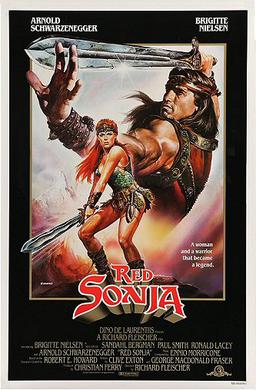
The 1985 film, Red Sonja, invites us to take a journey to a forgotten age, a time of a mythical kingdoms, evil sorcery, epic sword fights, and annoying little child kings who spent a lot of time shouting. It’s a time of wonder, danger, heroism, and, of course, Arnold Schwarzenegger.
Reportedly, the once and future governor of California has frequently named Red Sonja as being the worst film in which he ever appeared. When you consider some of the other films that have featured Gov. Schwarzenegger, that’s indeed a bold statement. In Red Sonja, Schwarzenegger plays Lord Kalidor. Interestingly enough, Lord Kalidor is absent for the majority of the film. He shows up briefly at the beginning of the film and then he vanishes for quite a bit of Red Sonja‘s 89-minute running time. Whenever Schwarzenegger does show up, he wears the smirk of a man who knows that he’s going to get paid a lot of money for doing very little actual work.
The majority of the film focuses on Sonja (Brigitte Nielsen), a warrior who lives in one of those vanished ages, perhaps after the War of the Rings but before the sinking of Atlantis. When we first see her, she’s being spoken to by what appears to be a puff of smoke, which is apparently meant to be some sort of warrior goddess. The puff of smoke fills tells Sonja about everything that happened to her before the start of the movie, though we never do learn why Sonja needs to be told her own backstory. After rejecting the sexual advances of the evil Queen Gedren (Sandahl Begman), Sonja was forced to watch as her parents and brother were murdered and then she was raped and left for the dead by the Gedren’s soldiers. The Goddess promises to make Sonja into a superior warrior, on the condition that Sonja agree to never have sex with a man unless that man can first beat her in fair combat. Sonja agrees and is sent off to get trained by the Grand Master. It’s kinda like Kill Bill, if Bill was a puff of smoke.
Jump forward to …. well, I’m not sure how many years pass. To be honest, it’s next to impossible to really discern any sort of coherent logic to the film’s narrative progression so let’s just give up on that. What’s important is that there’s this temple and, inside the temple, there’s a glowing green talisman. Apparently, the talisman created the world but now it needs to be carefully watched over before being destroyed. Only women are allowed to handle the talisman (Yay!) but they’re not allowed to destroy it unless directed by a man. (Booooo!) The temple priestesses are waiting for Lord Kalidor to arrive so that they can get rid of the talisman. However, Queen Gedren shows up first. Not only does she steal the talisman but she kills the priestesses as well.
One of the priestesses was Varna (Janet Agren, who you might recognize from Lucio Fulci’s City of the Living Dead). Varna just happens to be the sister of Sonja. (Sonja is now known as Red Sonja, because she had red hair. From now on, I want to be known as Red Lisa.) Now, Sonja has yet another reason to want to kill Gedren! Rejecting Kalidor’s help, Sonja heads off for revenge. Along the way, she meets an annoying child king named Tarn (Ernie Reyes, Jr.), who is upset that Gedren previously destroyed his kingdom. Despite hating him, Sonja allows Tarn and his guardian, Falkon (Paul L. Smith), to tag along with her. Despite not being an official member of the revenge party, Kalidor decides to follow after them because he wants to beat Red Sonja in fair combat, if you get what I mean.
Red Sonja is a spectacularly silly film. The dialogue is stilted. Even by the standards of the 1980s ,the special effects are poorly executed. This the type of film where the evil Queen nearly destroys the world not because she has any sort of grand scheme but instead, just because she’s evil and that’s what evil people do. Brigitte Nielsen delivers her lines with a forced solemnity while Schwarzenegger, Bergman, and the great Paul L. Smith seem to be struggling not to start laughing.
And yet, there’s a sneaky charm to be found in all of the silliness. For instance, when Sonja does finally reach the queen’s castle, she has to cross a bridge that appears to basically be the skeleton of giant rhinoceros. No none in the film seems to be surprised to come across a skeleton a giant rhinoceros and, to be honest, there’s no reason for it to be there. It’s just there and it’s so wonderfully out-of-place that it becomes rather fascinating. Add to that, while the portrayal of the evil lesbian queen is problematic in all sorts of ways, this is a film about a strong female warrior who doesn’t need a man to rescue her and that was probably even more rare in 1985 than it is today!
Watching Red Sonja, you get the feeling that nobody involved in the film took it all that seriously and that perhaps the best way to handle the movie is to just sit back and have a laugh. It’s dumb, it’s campy, it often makes no sense but, at the same time, it’s still a lot easier to follow than Game of Thrones. Like many bad films, it’s only bad if you watch it alone. Watch it with a group of your snarkiest friends and you’ll have a totally different experience.
The 1987 film Gor opens with a nerdy college professor (played by Urbano Barberini, of Demons and Opera fame) giving perhaps the worst lecture in the history of underwhelming lectures. The professor explains that there is a counter-earth, a place that he claims is known as Gor. Gor shares the same orbit as Earth but it’s linearly opposed to Earth, which apparently makes it impossible to see. However, the professor says that his father gave him a ring which can transport the user to Gor. The only problem is that the professor has not figured out how to use the ring.
The students all look incredibly bored with the lecture and I don’t blame them. Not only does the professor seem to be rambling but he doesn’t even offer up any visual aides. He could have at least utilized a powerpoint presentation or something. Instead, his only teaching aide is a whiteboard on which he’s written “counter-earth.” I have to wonder what their final exam is going to look like. “True or false. Your professor is a freaking loon.”
(I found myself wondering what university would possibly grant tenure to some guy who thinks he owns a magic ring but then I remembered Evergreen College.)
The professor’s name is Tarl Cabot and I think that’s a good deal of his problem right there. When you give a child a name like Tarl Cabot, you’re pretty much guaranteeing that he’s going to grow up believing that he has a magic ring that’ll transport him to another planet.
Of course, in Tarl’s case, it turns out that the ring does just that. After his teaching assistant dumps him so that she can go on a date with another professor, Tarl crashes his car and when he wakes up, he finds himself on Gor. Apparently, the ring only works if you crash your car or something.
As for Gor itself, it turns out to be kind of a dump. It’s a huge desert. Seriously, check out this counter-earth:
If Tarl wanted to see a desert, he could have just driven around Southern California and saved himself a lot of trouble.
Yes, there is trouble in Gor. No sooner has Tarl arrived then he’s being attacked by a bunch of barbarians on horseback. The barbarians are led by the evil Sarm (played by Oliver Reed). Much as with the case of Tarl Cabot, I think that once you name a child Sarm, you’ve pretty much guaranteed the way that his life is going to turn out. Anyway, Tarl somehow survives being attacked by the barbarians. He even manages to kill Sarm’s son, which leads to Sarm declaring that he wants Tarl dead.
Fortunately, Tarl is eventually rescued by another group of barbarians. This group is led by Talena (Rebecca Ferratti) and she wants Tarl to help her rescue her father from Sarm’s fortress. But how can Tarl help when he’s literally useless? Don’t worry! The good barbarians are willing to train Tarl. One montage later, Tarl is now a master swordsman. Now, all Tarl has to do is dress like a barbarian and then track down a little person who can serve as a guide to Sarm’s fortress!
And what a fortress it is! Sarm may be evil but he likes to make sure that both his guests and his slaves have a good time. Sarm welcomes Tarl to the fortress and even tries to recruit him over to his side. (So apparently, Sarm’s over that whole “you killed my son” thing.) Sarm understands that the best way to recruit Tarl is with a dance number! As Sarm laughs lustfully, the slaves put on a show. It’s somewhat out-of-place but at least it distracts from the rest of the film.
Anyway, there’s a lot of problems with Gor but the main one is that the place itself just doesn’t seem like it’s worth all the trouble. After spending years trying to figure out how to get to the planet, Tarl arrives and discovers that it’s basically the same desert that was used in almost every post-apocalyptic film made in the 80s and 90s. (In fact, judging from John Carter, it’s still being used today.) What I always wonder about this type of movie is 1) why is the other planet always full of humans who speak perfect English and 2) why do all of these planets feature a society that resembles that ancient Roman Empire? Apparently, swords and arrows are literally universal weapons because they’re used on every planet in the universe.
When I first saw that this film starred Urbano Barberini, I assumed that it was going to turn out to be an Italian production. (In the late 80s, there were several Italian films that featured barbarians fighting in post-apocalyptic landscapes.) However, it turns out that Gor was a South African production, co-produced by the legendary Harry Alan Towers and directed by an American named Firtz Kiersch. (Kiersch also directed the first film version of Children of the Corn.) That said, the film itself is so ineptly dubbed and the production values are so low-budget that it would still be easy to mistake Gor for a film directed by Bruno Mattei or Claudio Fragasso.
Because he’s so badly dubbed, it’s difficult to really judge Barberini’s performance as Tarl Cabot. At the very least, he looks good with a sword in his hand and he’s cute — if never quite believable — when he plays Tarl as a neurotic physicist. However, Barberini can’t really compete with Oliver Reed, who devours every inch of scenery that he can find. Reed bellows and laughs and appears to be drunk in almost every scene in which he appears but at least he seems to be having a good time. Reed is also required to wear a silly helmet in most of his scenes and I sincerely hope that he got to take it home with him.
Oliver Reed isn’t the only familiar face to pop up in Gor. There’s also Jack Palance. Palance only shows up for about two minutes and he looks rather confused as he discusses his plan to conquer the world. (Apparently, Palance returned in Gor‘s sequel.) For two minutes of screen time, Palance managed to score himself third billing in the opening credits of Gor, above even Oliver Reed! Way to go, Jack!
Anyway, Gor is a pretty stupid movie. I appreciated the random dance number but otherwise, it’s fairly dull and only occasionally enlivened by Oliver Reed’s refusal to go gently into that dark night. I’m going to guess that films like this were popular with filmgoers who saw themselves as real-life Tarl Cabots and who spent their spare time thinking, “Nobody will laugh at me once they see me with a sword!” I caught the film yesterday on Comet TV, which is quickly becoming one of my favorite channels for watching bad movies.
 I like Popeye.


 Through the Shattered Lens