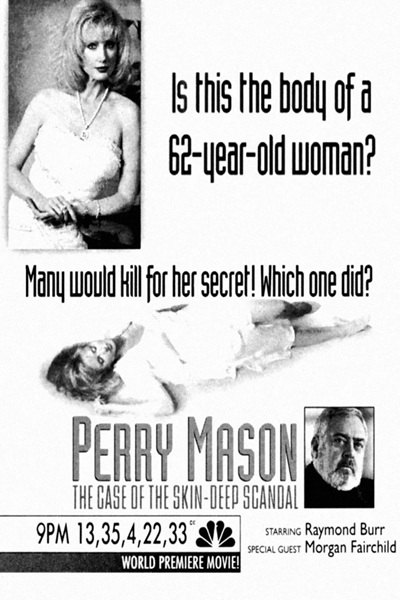
Alana Westbrook (Morgan Fairchild), the ruthless owner of a cosmetics company, is murdered after she announces that she is actually 60 years old and owes her youthful appearance to a miracle skin cream. Her husband (Patrick O’Neal) is charged with the crime but he’s lucky enough to have Perry Mason (Raymond Burr) as his attorney. Perry thinks that the murderer is an eccentric gigolo (David Warner) but, for once, Perry might be wrong. Meanwhile, Ken Malansky (William R. Moses) gets involved with a corporate spy (Lauren Lane) who might know more than she says.
Lisa and I watched this one earlier today. We really enjoyed it! It’s the most soapy of all the Perry Mason films that I’ve watched so far. Morgan Fairchild was great as the murder victim and all of the suspects were enjoyably weird. What I really enjoyed about this movie was that it featured people who appeared, in different roles, in other Perry Mason films. Patrick O’Neal went from being the victim in Perry Mason Returns to being the accused here. David Warner went from being the victim in The Case of the Poisoned Pento being a suspect here. This was also a second Perry Mason film for Jonathan Banks but instead of being a tough guy like he was the first time, he was a skin cream creator this time. This movie understood that people will kill for clear skin.
This was one of the last of Raymond Burr’s Perry Mason films (it aired the same year that he died) and, with the returning actors, it feels like a tribute to Burr and the role that he made his own.
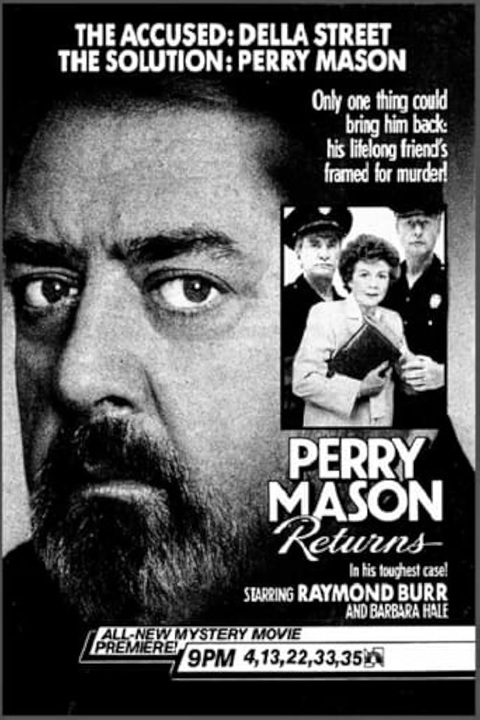
When his former secretary, Della Street (Barbara Hale), is arrested for murdering wealthy businessman Arthur Gordon (Patrick O’Neal), Judge Perry Mason (Raymond Burr) resigns from the bench so that he can defend her in court.
Perry Mason Returns reveals who the killer is when the murder happens. The killer is a lowlife named Robert Lynch (James Kidnie), who is wearing a gray wig and a frumpy dress so that everyone will mistake him for Della. It doesn’t take Perry and private detective Paul Dark, Jr. (William Katt) long to discover that Lynch is the murderer but, after someone shoots Lynch, they have to figure out who hired Lynch to kill Gordon. Gordon had recently disinherited his entire family so Perry and Paul have a lot of suspects to consider. 30 minutes in, I thought I knew who the killer was but it turned out I was wrong.
My Aunt Kate loved her detective stories and, when I was growing up, I would always watch them with her whenever we were visiting for the holidays. Watching Perry Mason Returns really made me feel nostalgic, even if it also made me feel dumb for not being able to guess who the killer was. Perry gives up being a judge so that he can defend Della Street in court. That’s true love. William Katt, who plays Paul Drake’s son, was Barbara Hale’s real-life son so I think that proves my theory that Della loved both Perry and Paul.
Perry Mason Returns was fun to watch. It had more action than I was expecting because Paul Drake, Jr. was always getting into tight situations. The movie really tried to make William Katt into an action star. The murder mystery held my attention and, of course, Perry got the murderer to confess on the stand and on the record. Some things never change! One thing that really amused me was that, as soon as Perry took the case, everyone naturally assumed he would win. Della wasn’t worried for a minute, even though she was facing life in prison. “You didn’t tell me Perry Mason was her lawyer!” Robert Lynch yelled at the person who hired him. He knew the gig was up. Perry Mason always wins!
Watching Perry Mason Returns, I felt like I was a kid again, watching movies with my Aunt Kate and trying to solve the mystery with her. All of the Perry Mason made-for-TV movies are on YouTube so I’ll be reviewing more of them in the future.
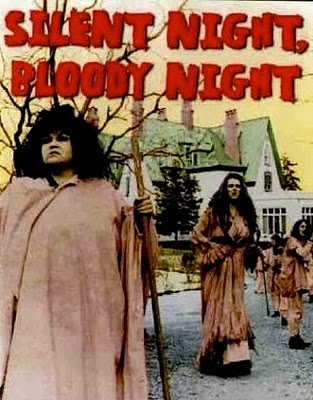
Filmed in 1972 and subsequently released in 1974, Silent Night Bloody Night is a real treat, an atmospheric thriller that has a wonderfully complicated plot that will keep you guessing.
Silent Night Bloody Night opens with attorney John Carter (Patrick O’Neal) arriving in a small town on Christmas Eve. He’s traveling with his assistant and mistress, Ingrid (Astrid Heeren). He’s been hired by Jeff Butler (James Patterson) to oversee the sell of his grandfather’s home. When Carter arrives, he finds that the town is run by a group of elderly eccentrics, including the mute Charlie Towman (John Carradine). Charlie communicates by ringing a bell and he’s the editor of the town newspaper. Carter convinces the town council to buy the Butler mansion. Then, Carter and Ingrid go to the mansion, make love, and are promptly brutally hacked to death by an unseen assailant with an axe. It’s a shocking moment because, up until their death scene, Carter and Ingrid seemed to be our main characters. Much as with Marion Crane’s shower in Psycho, their murder leaves an absence at the heart of the film.
That night, our new hero, Jeff Butler (James Patterson) comes to the isolated town to check on how the sale is going. He finds the mansion locked up and no one willing to talk about John Carter. With the help of local girl Diane (Mary Woronov), Jeff investigates his grandfather’s death and discovers that the town is full of secrets and people who are willing to kill to maintain them. As we discover through some wonderfully dream-like flashbacks, Jeff’s grandfather died nearly 40 years ago when he was set on fire in his own home. Those aren’t the only flashbacks to the film. In an extended sepia-toned flashback, we learn about the previous inhabitants of the house. They are all played by former Warhol superstars, including Candy Darling, Ondine, Tally Brown, Charlotte Fairchild, Lewis Love, Harvey Cohen, George Trakas, Susan Rothenberg, and Jack Smith. (Mary Woronov was, herself, a former member of Warhol’s entourage.)
Silent Night Bloody Night has a terrible reputation. Mary Woronov, who was married to director Theodore Gershuny at the time she made the film, later described it as being “lousy.” Personally, I think the film’s reputation has more to do with all of the grainy, bad copies of the film that have turned up in various Mill Creek box sets over the years than the quality of the film itself. (Silent Night BloodyNight is in public domain.) The film itself is atmospheric, memorably bloody, and — for those who have the patience to deal with the occasional slow spot — effectively creepy. Mary Woronov is a likable lead and the Warhol superstars definitely make an impression. The film plays out at its own deliberate pace and, at its best, it duplicates the feeling of a particularly macabre holiday dream.
Director Theodore Gershuny uses the low budget to his advantage and the sepia-toned flashbacks are truly disturbing and haunting. Ultimately, Silent Night BloodyNight feels like a dream itself and the mystery’s solution is less important than the journey taken to reach it.
The 1974 film Silent Night, Bloody Night is an oddity.
On the one hand, it’s pretty much a standard slasher film, complete with a menacing mansion, a horrible secret, a twist ending, and John Carradine playing a mute newspaper editor.
On the other hand, director Ted Gershuny directs like he’s making an underground art film and several of the supporting roles are played by actors who were best known for their association with Andy Warhol.
Personally, I like Silent Night, Bloody Night. It has a terrible reputation and the film’s star, Mary Woronov, has gone on record calling it a “terrible movie” but I like the surreal touches the Gershuny brought to the material and the sepia-toned flashbacks have a nightmarish intensity to them. The film makes no logical sense, which actually makes it all the more appealing to me. As the saying goes, your mileage may vary.
The 1974 film Silent Night, Bloody Night is an oddity.
On the one hand, it’s pretty much a standard slasher film, complete with a menacing mansion, a horrible secret, a twist ending, and John Carradine playing a mute newspaper editor.
On the other hand, director Ted Gershuny directs like he’s making an underground art film and several of the supporting roles are played by actors who were best known for their association with Andy Warhol.
Personally, I like Silent Night, Bloody Night. It has a terrible reputation and the film’s star, Mary Woronov, has gone on record calling it a “terrible movie” but I like the surreal touches the Gershuny brought to the material and the sepia-toned flashbacks have a nightmarish intensity to them. The film makes no logical sense, which actually makes it all the more appealing to me. As the saying goes, your mileage may vary.
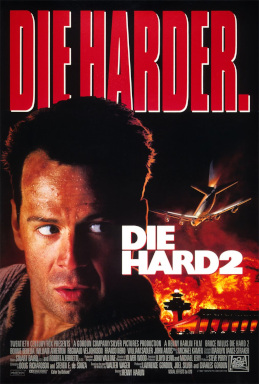
During 1990’s Die Hard 2, John McClane (Bruce Willis) asks himself, “How can the same shit happen to the same person twice?” and he does have a point.
I mean, consider the situation. In 1988, McClane spent his Christmas sneaking around a skyscraper and saving his wife from a group of sadistic mercenaries. Two years later, John McClane spends his Christmas sneaking around an airport and saving his wife from a group of sadistic mercenaries.
There are a few differences of course. In 1988, the mercenaries were only interested in stealing as much money as they could and each mercenary had his own properly ghoulish personality. In 1990, the mercenaries are really more of a cult, led by the fanatical Col. Stuart (William Sadler). And, along with trying to make some money, they are also trying to free General Ramon Esperanza (Franco Nero), a Central American drug lord and former CIA asset. Despite the fact that the mercenaries are played by familiar actors (like Robert Patrick, John Leguizamo, Tony Ganois, and Vondie Curtis-Hall), none of them are quite as memorable as the henchmen that Alan Rickman commanded in the first film. And while Sadler has charisma and makes a big impression during his first scene, his character is nowhere near as interesting or entertaining as Hans Gruber. Franco Nero, it must be said, is as dashing as ever. He really seems to be having fun in this movie.
A lot more people die in Die Hard 2 than died in the first Die Hard and the majority of them are innocent bystanders. This isn’t like the first film, where Harry Ellis died because his coke-addled mind led him to believe that he could outsmart Gruber. The victims in Die Hard 2 include a friendly church caretaker and over 200 passengers of an airplane that Stuart tricks into crashing on an airport runway. The scene where the plane crashes remains disturbing no matter how many times that you see it and it truly makes you hate Colonel Stuart. When the plane crashes, despite McClane’s futile efforts to warn the pilots, McClane sobs and it’s a powerful scene because it’s the first scene in which McClane has not had a quip or a one-liner ready to go. In this scene, McClane fails to save the day and, for a few minutes, he’s helpless. I usually end up crying with McClane. Today, those tears are also a reminder of what a good actor Bruce Willis truly could be whenever he let down his defenses and allowed himself to be vulnerable on screen.
Die Hard 2 is usually dismissed as not being as good as the first movie and …. well, that’s correct. It’s not as good but then again, few actions films are. There’s a reason why Die Hard continues to be held in such high regard. That said, Die Hard 2 is not bad. The stakes are a bit higher and the action scenes a bit more elaborate, as you would expect from a film directed by Renny Harlin. Bruce Willis plays McClane with the blue collar swagger that made his such an awesome hero in the first film. Bonnie Bedelia and William Atherton also return from the first film and Atherton once again gets his comeuppance in a crowd-pleasing moment. The cast is full of character actors, all of whom get a chance to make an impression. Dennis Franz is the profane head of security who eventually turns out to be not such a bad guy. John Amos is the major who eventually turns out to be not such a good guy. Colm Meaney has a few heart-breaking moments as the pilot of the doomed airplane. My favorite supporting performance is given by Fred Thompson, bringing his quiet authority to the role of tough but fair-minded Air Traffic Control director. Watching Die Hard 2, it does feel as if the viewer has been dropped in the middle of these people’s lives. Everyone seems real. No one seems like a mere plot device.
Is Die Hard a Christmas movie? You bet it is! But so is Die Hard 2 and it’s not a bad one.
The 1974 film Silent Night, Bloody Night is an oddity.
On the one hand, it’s pretty much a standard slasher film, complete with a menacing mansion, a horrible secret, a twist ending, and John Carradine playing a mute newspaper editor.
On the other hand, director Ted Gershuny directs like he’s making an underground art film and several of the supporting roles are played by actors who were best known for their association with Andy Warhol.
Personally, I like Silent Night, Bloody Night. It has a terrible reputation and the film’s star, Mary Woronov, has gone on record calling it a “terrible movie” but I like the surreal touches the Gershuny brought to the material and the sepia-toned flashbacks have a nightmarish intensity to them. The film makes no logical sense, which actually makes it all the more appealing to me. As the saying goes, your mileage may vary.
 Through the Shattered Lens