Stripes (1981, directed by Ivan Reitman)


Bill Murray and Harold Ramis join the army.

Wait, that can’t be right, can it?  Bill Murray and Harold Ramis were cinematic anarchists.  Early in his career, Bill Murray was the ultimate smart aleck slacker who did not have any respect for authority.  Harold Ramis was hardly a slacker but he came across as someone more likely to be marching on the Pentagon than guarding it.  Stripes is one of the ultimate examples of a comedy where the laughs come from things  that don’t seem to go together suddenly going together.

John Winger (Murray) at least has a reason to join the army.  He has a dead end job.  He has just broken up with his girlfriend.  The country appears to be at peace so why not spend four years in the Army?  It’s harder to understand why John’s friend, Russell (Ramis), also decides to enlist, other than to hang out with John.  Along with Ox (John Candy), Cruiser (John Diehl), Psycho (Conrad Dunn), and Elm0 (Judge Reinhold), they enlist and go through basic training under the watchful eye of Sgt. Hulka (Warren Oates).  John and Russell go from treating everything like a joke to invading East Germany in a tank that’s disguised as an RV.  They also meet the two sexiest and friendliest MPs in the service, Stella (P.J. Soles) and Louise (Sean Young).  Russell goes from being an proto-hippie who teaches ESL to asking John if he thinks he would make a good officer.  John goes from not taking anything seriously to picking up a machine gun and rescuing his fellow soldiers.

It’s a comedy that shouldn’t work but it does.  It’s actually one of my favorite comedies, full of memorable lines (“Lighten up, Frances.”), and stupidly funny situations.  The cast is full of future comedy legends and P.J. Soles shows that she deserved to be a bigger star.  This was early in Bill Murray’s film career and he was still largely getting by on his SNL persona but, in his confrontations with Hulka, Murray got a chance to show that he could handle drama.  With all the comedic talent in the film, it’s Warren Oates who gets the biggest laughs because he largely plays his role straight.  Sgt. Hulka is a drill sergeant who cares about his men and who knows how to inspire and teach  but that doesn’t mean he’s happy about having to deal with a collection of misfits.  (Watch his face when Cruiser says he enlisted so he wouldn’t get drafted.)

The movie does get strange when the action goes from the U.S. to Germany.  What starts out as Animal-House-In-The-Army instead becomes an almost straight action movie and the movie itself sometimes feels like a recruiting video.  Join the Army and maybe you’ll get to steal an RV with PJ Soles.  That would have been enough to get me to enlist back in the day.  But the combination of Murray, Ramis, and Oates makes Stripes a comedy that can be watched over and over again.

Reblog: Arleigh’s Review Of The Original Halloween (dir. by John Carpenter)


Hi everyone! Lisa here! As Halloween approaches, now is the perfect time for us to take a look back at the infamous and trend-setting career of Michael Myers. In about 90 minutes, Case will be posting his review of Halloween 4. However, before reading that, why not re-read Arleigh’s thoughts on the one that started it all, the original Halloween! From 2010, here’s Arleigh’s review…

Arleigh's avatarThrough the Shattered Lens

What better way to bring back a new daily grindhouse than the film which started the teen slasher genre. I speak of John Carpenter’s Halloween.

The film was truly a child of 1970’s independent filmmaking. With a budget of just $320,000 (even adjusting for inflation it’s still quite low) Carpenter made what’s considered one of horror’s defining films. Carpenter’s film was a smash hit when it was released in 1978. It played mostly in drive-in’s, grindhouse cinema houses before finally appearing in more mainstream venues. By then the film had become one of those must-see titles that many films both independent and mainstream try for but fail to do.

Some have commented that since Halloween was such a success in the box-office then it shouldn’t be considered grindhouse. I look at such thinking as quite narrow. Grindhouse was never synonymous with bad filmmaking. If one said the term meant…

View original post 177 more words

Back to School Part II #12: Breaking Away (dir by Peter Yates)


Has Indiana changed much since 1979?

I ask because I just watched Breaking Away, a 1979 nominee for best picture.  Breaking Away was shot on location in Bloomington, Indiana and on the campus of Indiana University.  And though the film doesn’t go out of its way to idealize either the state, the town, or the university –in fact, the title refers to the desire of several characters to break away from their life in Bloomington — it still manages to make Indiana look like the nicest place on Earth.  Add to that, Indiana University is home to the Eskenazi Museum of Art, which I will someday visit.

Breaking Away is actually a film about a lot of things: it’s a comedy, it’s a quasi-love story, it’s bittersweet coming-of-age story, it’s a sports film, and it’s a sweet, good-natured film that made me cry.  At the heart of the film is Dave Stoller (Dennis Christopher), who has just graduated from high school and whose cheerful and eccentric exterior hides the fact that he appears to have no real future.  Dave is obsessed with bicycle racing and idolizes that the Italian cycling team.  In fact, he idolizes them so much that he decides to be Italian.  He rides around Bloomington, greeting people with a merry “Ciao!”  At home, he listens to opera and renames the family cat “Fellini.”  While his mother (Barbara Barrie) is understanding, his father (Paul Dooley) cannot understand what’s happening to his son.  Of course, Dave doesn’t truly believe that he’s Italian.  He just desperately wants to be something other than who he is.

And who is Dave?  He’s a citizen of Bloomington, a town that is divided between the upper class students at Indiana University and the blue-collar townies.  The students call Dave and his friends “cutters,” because the only real industry in town is working in the quarry, cutting stone.  The students look down on the cutters and the cutters resent the students.

Dave has three close friends, all of whom were big in high school and who are now facing an uncertain future of anonymity.  Cyril (Daniel Stern) is the funny and quirky one, the former basketball player who talks about how he would like to be a cartoon character.  Moocher (Jackie Earle Haley) is usually easy-going but loses his temper whenever anyone mentions that he’s short.  (At one point, Moocher’s boss orders him to, “Punch the time clock, Shortie!”  Moocher literally does just that.)  And finally, there’s Mike (Dennis Quaid).  Mike is their leader, a former high school quarterback who idolizes the Marlboro Man and who knows that he’s destined to spend the rest of his life in Bloomington, going from “20 year-old Mike” to “mean old man Mike.”

When Dave meets a student named Katherine (Robyn Douglass), he pretends to be an Italian exchange student and, soon, he’s serenading her on the lawn of her sorority house.  That doesn’t make Katherine’s boyfriend, Rod (Hart Bochner), happy.  Rod and his friends beat up Cyril, which leads to another fight at a bowling alley.  (Cyril, for his part, gets his finger stuck in a bowling ball.)  Seeking to broker some sort of peace and understanding between the students and the town, the university president (played by John Ryan, who was the real-life President of Indiana University at the time) announces that the cutters will be invited to take part in the annual Little 500 bicycle race at Indiana University.

And you can probably guess how the race turns out.  It’s a feel-good sports film so you already know who is going to win and that he’s going to have to win after initially falling behind and sacrificing a big lead.  You know all that but it doesn’t matter.  Breaking Away is such a sweet and well-acted movie that it still brought tears to my eyes even if the ending didn’t surprise me.

And really, the film does have a few surprises.  For one thing, Rod turns out to be not as bad a guy as you initially think he’s going to be.  Over the course of the film, he gets two small reaction shots, both of which hint that he’s not as much of a jerk as he often appears to be.  It’s a minor detail and it’s easy to miss but what’s important that it’s there and it’s one of the many small details that makes Breaking Away feel alive.  After watching the movie, I feel like I could go to Bloomington and still find all these character hanging out at the quarry.

There’s another scene that I want to mention.  This is the scene that made me cry.  Dave and his father walk around the university and his dad talks about how he and the fathers of all of Dave’s friends helped to cut the stone that was used to build campus.  His dad admits that, even though he helped to build it, he’s never felt comfortable on the campus and then tells his son that he doesn’t have to be a cutter.  And it’s such a heartfelt scene and so beautifully performed by Paul Dooley and Dennis Christopher that I started to cry.  Perfectly acted, perfectly directed, and perfectly written, what a great scene!  Fantastico!, as Dave might say.

I loved Breaking Away and I bet you would to.

Breaking Away

Back to School #22: Rock ‘n’ Roll High School (dir by Allan Arkush)


Originally, when I started this series of Back to School reviews, I was planning on reviewing Grease.  After all, everyone has seen that film.  It’s on TV all the time.  (Looking in your direction, AMC.)  It’s a musical, which is a genre that I love but one which I also rarely seem to review.  The movie features a good performance from Stockard Channing.  It also has a lot of dancing and you know how much I love that.  And speaking of love, a lot of people seem to absolutely love Grease.

But, the more I thought about it, the more I realized that while others may love Grease, I don’t.  Oddly enough, I always seem to fool myself into thinking that it’s a fun movie but then I make the mistake of watching it whenever it pops up on AMC and every time, I am surprised to discover just how boring Grease really is.  The majority of the cast play their roles as if they’re still on a Broadway stage and projecting to the back of the house.  Olivia Newton-John is miscast.  John Travolta appears to be acting on auto pilot.  Both the songs and even Stockard Channing are never as good as I remembered.  Worst of all, the dance numbers are so ineptly staged and filmed that, half-the-time, you can’t even see what anyone’s doing with their feet.

While I certainly don’t have any problem writing a negative review (and check out my thoughts on Avatar if you doubt me), I wanted to end the 70s on a positive note.  So, instead of telling you that Grease isn’t good as many people seem to think, I want to recommend another film that, like Grease, features a lot of singing and dancing but which also happens to be a lot of more fun.

That film, of course, is the 1979 cult classic Rock ‘n’ Roll High School.

screen-shot-2010-04-27-at-1-34-11-am

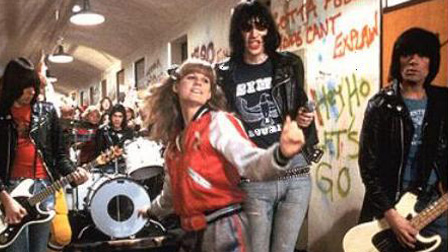
Things are amiss at Vince Lombardi High School.  The students are so obsessed with rock and roll (and the music of the Ramones, in particular) that they have caused several principals to quit.  The hallways are a disorganized mess.  Student Riff Randall (P.J. Soles) spends all of her time having fantasies about the way that Joey Ramone eats pizza.  A strange students named Eaglebauer (Clint Howard) runs a shadowy company known as Eaglebauer Enterprises out of a smoke-filled boy’s restroom.  (He’s even got an administrative assistant to schedule meetings for him.)  Handsome jock Tom Roberts (Vincent Van Patten) can’t get a date, largely because he’s obsessed with Riff who is obsessed with the Ramones.  Little does Tom realize that Riff’s best friend, the sweet and intelligent Kate Rambeau (Dey Young), has a crush on him.

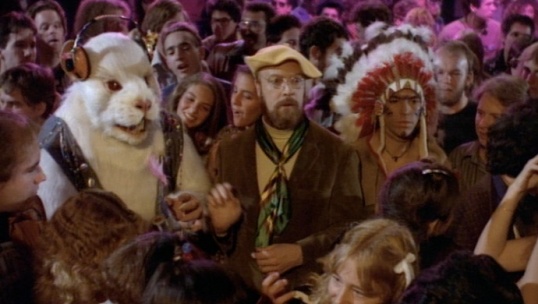
The school board hires a new principal to bring some peace to the high school.  Ms. Togar (Mary Woronov) is a strict and mentally unbalanced disciplinarian who, with the help of two apparently subhuman hall monitors, is determined to suppress any sort of fun, rebellion, or free thought.  Togar hates loud music, mostly because it causes white mice to spontaneously explode.  (When, late in the film, a human-sized white mouse — or he could have just been a very strange man wearing a white mouse costume, the film is ambiguous on this point — attempts to enter a Ramones concert, he’s turned away for his own good.  Until, of course, he reveals that he’s brought along headphones for his own protection…)

rat


In the end, it all comes down to this: Togar and her allies want to burn records.  Riff and the Ramones want to stop her.  And maybe blow up the school.  (David from Massacre at Central High would have been a fan of the Ramones.)

Rock ‘n’ Roll High School is an intentionally over-the-top film that both celebrates youthful rebellion while satirizing traditional high school films.  The jokes (which are a good combination of the silly and the genuinely clever) come non-stop, the actors all bring a lot of energy to their roles, and the entire film is just a lot of fun. As played by P.J. Soles, Riff Randall really is the ideal best friend and I imagine that a lot of boys in 1979 probably walked out of the theater with a huge crush on both P.J. Soles and Dey Young.  And finally, Mary Woronov gives a wonderfully demented performance as Ms. Togar.

rock-n-roll-high-school-1979


Rock ‘n’ Roll High School seems like the perfect film to end the 70s with.  Tomorrow, Back to School continues with the 80s!  So, if you’ve never seen Rock ‘n’ Roll High School before, watch it below!

http://www.youtube.com/watch?v=gKUHFI1dnKo

Halloween Horrors 2013 : “Carrie” (1976)


Carrie-Poster


Over at my “main” site — http://trashfilmguru.wordpress.com , for those who don’t know, don’t care, either, or both — I’ve been doing what every other goddamn movie blog in the universe does in the month of October: namely, review a bunch of random horror flicks. But come on — you didn’t think I was just gonna sit back and let Lisa Marie, Arleigh, Leonard Wilson, and everybody else have all the fun here on TTSL, did you?

Nah. I just had to muscle in and opine on a few macabre movie delights on these digital “pages” before the month was out, as well. And I might as well start with the one everybody’s talking about right now, Carrie, the 1976 classic directed, in his inimitable style, by Brain DePalma, based on the runaway best-seller by Stephen King, and starring Sissy Spacek as quite likely the most hapless horror heroine in history.

This film is significant for a number of reasons, not the least of which being that it was the first King “property” to be adapted for the big screen, thus announcing the arrival of a major new player on the scene who would go on, of course, to have a veritable industry of celluloid “translations” of his work sprout up over the ensuing decades, some of which were clearly — oh, wait, people these days are talking about a different Carrie altogether? One that just came out last week?

Well, I saw that one, too, but fuck it — I feel like reviewing this one first.

carrie_mother


Let’s backtrack to that “horror’s most hapless heroine” claim for a minute, shall we? It might sound like a bold claim, but I swear it’s true — think about it for a minute : poor Carrie White starts the movie by having her first period in the shower at school, she thinks she’s dying because her religious whack-job of a mom is too chickenshit to tell her about menstruation, she gets teased mercilessly by all the girls who witness her uncomfortable (to say the least) entry into womanhood, she has no friends to speak of, she’s stuck with a bunch of telekinetic powers that she doesn’t understand or know how to effectively control, she’s the butt of every cruel joke her classmates play, she has to listen to her idiot mother blather nonsense 24/7,  she gets invited to the prom as by the most popular kid in school strictly as an act of misguided charity, and then, just when she’s granted one moment of respite from the nonstop parade of tragedy that comprises her existence when she’s crowned world’s most unlikely  prom queen, she gets a bucket full of pig blood dumped all over her, freaks out and kills everybody with her “mind powers,” and goes home from the best/worst night of her life to find that mommie dearest has decided to kill her in Jesus’ name.

Talk about a gal who just can’t catch a break.

carrie1976-0372


Sure, it all seems a bit over the top — okay, it all is a bit over the top — but DePalma pulls out all the stops to draw you into this sordid little world of revival tent-reject parents (Piper Laurie), evil high school bitches (Nancy Allen), pussy-whipped wannabe-tough guys (John Travolta), well-meaning but ultimately ineffectual teachers (Betty Buckley), semi-guilt-ridden classmates (Amy Irving), jocks with out of control white-guy ‘fros (William Katt), and grounds the whole heady mixture in a turn-for-the-ages performance by Spacek that really makes you feel for the poor kid even — maybe especially — when she finally snaps. His always-stylish-and-inventive use of sound, split screen, and slow-burn tension keep you pretty well fixated on the proceedings throughout, and all in all you’ve just gotta say this still holds up as a pretty impressive cinematic achievement.

Of course, King hit on a fairly inventive little gimmick from the outset here — plenty of horror stories, fairy tales, fables, and probably even  nursery rhymes are little more than thinly-disguised metaphors for the onset of puberty and the scary transition from childhood into the ‘adult” world, but here he just dispensed with the pretense and doubled-down by ripping the mask off and piling the real, actual, non-metaphorical point on top of the , as we say in modern parlance, “genre trappings,” and as a result ended up penning a scary story for the ages.

Sissy_Spacek_as_Carrie_White,_1976


Classic visuals — you know, like the one reproduced directly above — hammer the point home in memorable fashion, to be sure, and what Carrie lacks in subtlety it definitely makes up for in sheer, shock-ya-senseless power. Audiences went wild for this flick back in ’76, and while that might not be saying much because they also went apeshit for every cheesy “patriotic” bicentennial gimmick, knick-knack, gee-gaw, and useless item of “home decor” that came out that year, in this case they were absolutely right — this is a nifty little barnburner of a movie that has aged as well as any wine you care to mention.

Carrie is aviailable on DVD and Blu-Ray from MGM, and it’s also currently playing on Netflix’s instant streaming queue, where it can be found under no less than three category headers — “horror,” “Halloween favorites,” and “cult movies.” So go check it out already — or check it out again already, as the case may be — and we’ll talk about that other  movie with the same title next time around.

The Daily Grindhouse: Halloween (dir. by John Carpenter)


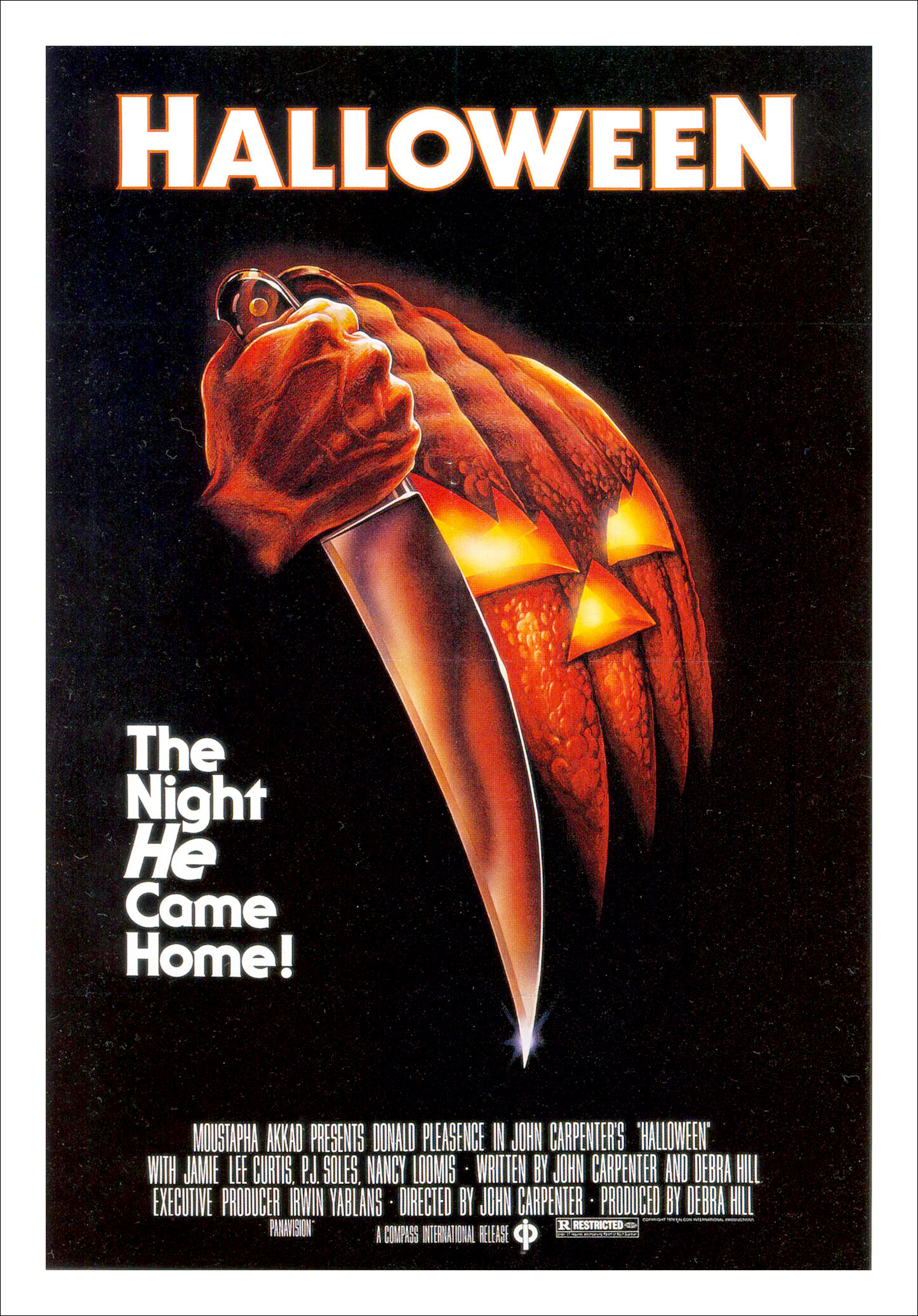
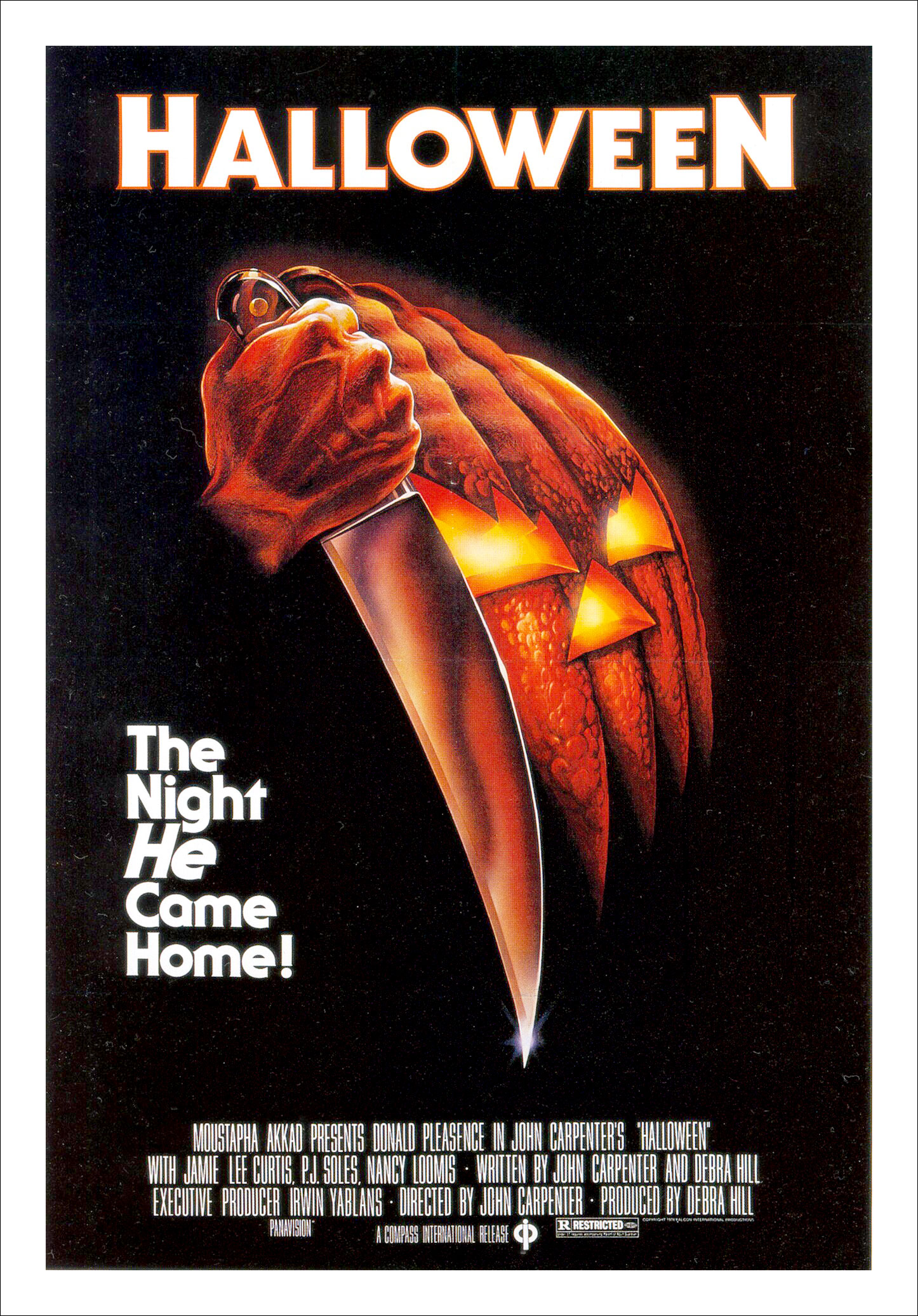
What better way to bring back a new daily grindhouse than the film which started the teen slasher genre. I speak of John Carpenter’s Halloween.

The film was truly a child of 1970’s independent filmmaking. With a budget of just $320,000 (even adjusting for inflation it’s still quite low) Carpenter made what’s considered one of horror’s defining films. Carpenter’s film was a smash hit when it was released in 1978. It played mostly in drive-in’s, grindhouse cinema houses before finally appearing in more mainstream venues. By then the film had become one of those must-see titles that many films both independent and mainstream try for but fail to do.

Some have commented that since Halloween was such a success in the box-office then it shouldn’t be considered grindhouse. I look at such thinking as quite narrow. Grindhouse was never synonymous with bad filmmaking. If one said the term meant cheap filmmaking then I would agree. Carpenter’s film has all the trappings of what makes a great grindhouse. It’s violent (though it really has less blood than what audience really remember) and uses sex as a storytelling tool (again the sex is quite chaste compared to later teen slashers).

While some film historians credit Hitchcock’s Psycho as the granddaddy of the slasher genre it wasn’t primogenitor of the teen slasher subgenre which has become an industry onto itself since Carpenter’s breakthrough hit. A hit that set many of the basic rules of teen slasher horror for decades to come. We get the nigh-unstoppable killer who seems more like a force of nature than human. The notion that teenage girls who have premarital sex will die horribly because of it while the chaste and virginal girl survives and inevitably stops the killer (until the subsequent sequel that is).

Halloween is grindhouse through and through. The fact that Carpenter’s obvious talent and skill as a director, editor, film composer and cinematographer shouldn’t DQ this film from being called grindhouse.