That’s a question that’s asked frequently in the 1975 film, Tommy. An adaptation of the famous rock opera by the Who (though Pete Townshend apparently felt that the film’s vision was more director Ken Russell’s than anything that he had meant to say), Tommy tells the story of a “deaf, dumb, and blind kid” who grows up to play a mean pinball and then become a cult leader. Why pinball? Who knows? Townshend’s the one who wrote Pinball Wizard but Ken Russell is the one who decided to have Elton John sing it while wearing giant platform shoes.
Tommy opens, like so many British films of the 70s, with the blitz. With London in ruins, Captain Walker (the almost beatifically handsome Robert Powell) leaves his wife behind as he fights for his country. When Walker is believed to be dead, Nora (Ann-Margaret) takes Tommy to a holiday camp run by Frank (Oliver Reed). Oliver Reed might not be the first person you would expect to see in a musical and it is true that he wasn’t much of a singer. However, it’s also true that he was Oliver Reed and, as such, he was impossible to look away from. Even his tuneless warbling is somehow charmingly dangerous. Nora falls for Frank but — uh oh! — Captain Walker’s not dead. When the scarred captain surprises Frank in bed with Nora, Frank hits him over the head and kills him. Young Tommy witnesses the crime and is told that he didn’t see anything and he didn’t hear anything and that he’s not going to say anything.
And so, as played by Roger Daltrey, Tommy grows up to be “deaf, dumb, and blind.” Various cures — from drugs to religion to therapy — are pursued to no avail. As the Acid Queen, Tina Turner sings and dances as if she’s stealing Tommy’s soul. As the Therapist, Jack Nicholson is all smarmy charm as he gently croons to Ann-Margaret. Eric Clapton performs in front of a statue of Marilyn Monroe. Ann-Margaret dances in a pool of beans and chocolate and rides a phallic shaped pillow. As for Tommy, he eventually becomes the Pinball Wizard and also a new age messiah. But it turns out that his new followers are just as destructive as the people who exploited him when he was younger. It’s very much a Ken Russell film, full of imagery that is shocking and occasionally campy but always memorable.
I love Tommy. It’s just so over-the-top and absurd that there’s no way you can ignore it. Ann-Margaret sings and dances as if the fate of the world depends upon it while Oliver Reed drinks and glowers with the type of dangerous charisma that makes it clear why he was apparently seriously considered as Sean Connery’s replacement in the roles of James Bond. As every scene is surreal and every line of dialogue is sung, it’s probably easy to read too much into the film. It could very well be Ken Russell’s commentary on the New Age movement and the dangers of false messiahs. It could also just be that Ken Russell enjoyed confusing people and 1975 was a year when directors could still get away with doing that. With each subsequent viewing of Tommy, I become more convinced that some of the film’s most enigmatic moments are just Russell having a bit of fun. The scenes of Tommy running underwater are so crudely put together that you can’t help but feel that Russell was having a laugh at the expense of people looking for some sort of deeper meaning in Tommy’s journey. In the end, Tommy is a true masterpiece of pop art, an explosion of style and mystery.
Tommy may seem like a strange film for me to review in October. It’s not a horror film, though it does contain elements of the genre, from the scarred face of the returned to Captain Walker to the Acid Queen sequence to a memorable side story that features a singer who looks like a junior Frankenstein. To me, though, Tommy is a great Halloween film. Halloween is about costumes and Tommy is ultimately about the costumes that people wear and the personas that they assume as they go through their lives. Oliver Reed goes from wearing the polo shirt of a holiday camp owner to the monocle of a tycoon to the drab jumpsuits of a communist cult leader. Ann-Margaret’s wardrobe is literally a character of its own. Everyone in the film is looking for meaning and identity and the ultimate message (if there is one) appears to be that the search never ends.
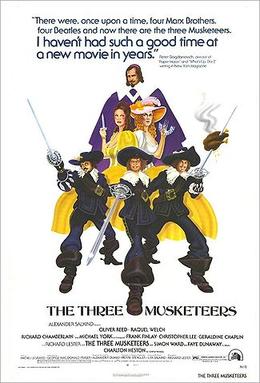
In 1973, director Richard Lester and producer Ilya Salkind decided to try to get two for the price of one.
Working with a script written by novelist George McDonald Fraser, Lester and Salkind had assembled a once-in-a-lifetime cast to star in an epic film adaptation of Alexandre Dumas’s The Three Musketeers. Michael York was cast as d’Artagnan, the youthful swordman who goes from being a country bumpkin to becoming a King’s Musketeer. His fellow musketeers were played by Oliver Reed, Richard Chamberlain, and Frank Finlay. Faye Dunaway and Christopher Lee were cast as the villains, Milady and Rochefort. Charlton Heston played the oily Cardinal Richelieu. Geraldine Chaplin played Queen Anne while Simon Ward played the Duke of Buckingham. Comedic relief was supplied by Roy Kinnear as d’Artagnan’s manservant and Raquel Welch as Constance, d’Artagnan’s klutzy love interest. The film was a expensive, lushly designed epic that mixed Lester’s love of physical comedy with the international intrigue and the adventure of Dumas’s source material.
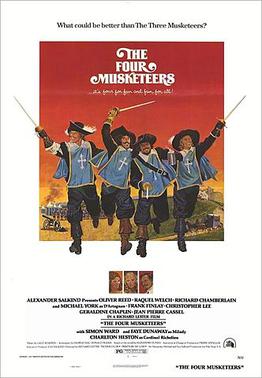
The only problem is that the completed film was too long. At least, that’s what Salkind and Lester claimed when they announced that they would be splitting their epic into two films. The cast and the crew, who had only been paid for one film, were outraged and the subsequent lawsuits led to the SAG ruling that all future actors’ contracts would include what was known as the Salkind clause, which stipulates that a a single production cannot be split into two or more films without prior contractual agreement.
But what about the films themselves? Both The Three Musketeers and The Four Musketeers are currently available on Tubi. I watched them over the weekend and, of the many films that have been made out of Dumas’s Musketeer stories, Richard Lester’s films are the best. Lester captures the swashbuckling spirit of the books while also turning them into two films that are easily identifiable as Lester’s work. There’s a lot physical humor to be found in Lester’s adaptation, especially during the first installment. d’Artagnan runs through the streets of Paris, convinced that he has been insulted by the haughty Rochefort. d’Artagnan manages to get challenged to three separate duels, all to take place on the same day. After his first swordfight as a member of the Musketeers, d’Artagnan tries to tell the men that he wounded about an ointment that will help them with their pain. Raquel Welch also shows a genuine flair for comedy as Constance, which makes her fate in the second film all the more tragic.
For all the controversy that it caused, splitting the story into two films was actually the right decision. If The Three Musketeers is an enjoyable adventure film, The Four Musketeers is far more serious. In The Four Musketeers, Oliver Reed’s melancholic Athos steps into the spotlight and his story of his previous marriage to the villainous Milady casts his character in an entirely new light. In The Four Musketeers, the combat is much more brutal and the humor considerably darker. Likable characters die. The Musketeers themselves commit an act of extrajudicial brutality that, while true to Dumas’s novel, would probably be altered if the film were made today. From being a naive bumpkin in The Three Musketeers, The Four Musketeers finds d’Artgnan transformed into a battle weary soldier.
The cast is fabulous. This is a case of the all-star label living up to the hype. Oliver Reed, Frank Finlay, and Richard Chamberlain all seems as if they’ve been riding and fighting together for decades. Christopher Lee plays Rochefort as being an almost honorable villain while Faye Dunaway is a cunning and sexy Milady. What truly makes the film work, though, is the direction of Richard Lester. Lester stay true to the spirit of Dumas while also using the material to comment on the modern world, with the constant threat of war and civil uprising mirroring the era in which the films were made. Interestingly enough, Richard Lester first became interested in the material when Ilya Salkind reached out to the Beatles to try to convince them to play the Musketeers. While the Beatles were ultimately more interested in a never-produced adaptation of The Lord of the Rings, Richard Lester was happy to bring Dumas’s characters to life.
Both The Three Musketeers and The Four Musketeers are currently on Tubi, for anyone looking for a truly great adventure epic.
Raymond Chandler’s detective classic, The Big Sleep, has twice been adapted for film.
The first version came out in 1946, just seven years after the book’s publication. That version starred Humphrey Bogart as detective Philip Marlowe and Lauren Bacall as Vivian, the daughter of a man who has hired Marlowe to discover who is trying to blackmail him. Directed by Howard Hawks and co-written by William Faulkner, this version of TheBigSleep is considered to be a classic noir, one that was cited as being a major influence on director Akira Kurosawa.
The 1978 version was directed by Michael Winner, takes place in London in the 1970s, and features Robert Mitchum as Marlowe. Despite a strong ensemble cast and an excellent lead performance from Mitchum, this version of TheBig Sleep still features one of the worst performances ever put on film.
Sarah Miles plays the role of Charlotte Sternwood Regan, the eldest daughter of General Sternwood (James Stewart). Miles is playing the role that Lauren Bacall played in the first film and, despite the fact that they both earlier co-starred to a certain amount of acclaim in Ryan’sDaughter, Miles and Mitchum do not have a hint of chemistry in this film. Actually, Miles doesn’t have chemistry with anyone in this film. She seems detached from the action and her frequent half-smiles come across as being not mysterious but instead somewhat flakey, as if she doesn’t quite understand that she’s in a noir. Sarah Miles is not a bad actress (as anyone who has seen Hope and Glory can tell you) but her performance here is incredibly dull. That said, she is not the one who gives the worst performance in the film.
Instead, that honor goes to Candy Clark, playing General Sternwood’s youngest daughter, Camilla. Camilla is meant to be mentally unstable and potentially dangerous. Clark plays the role like a giggly teenager, constantly fidgeting and literally hissing in more than a few scenes, as if she’s been possessed by a cat. Clark overacts to such an extent that you’ll be more likely to laugh at than be disturbed by her antics. It doesn’t help that she shares nearly all of her scenes with Robert Mitchum, a man who was a master when it came to underacting. If you’re going to give a bad performance, you don’t want to do it opposite someone who will make you look even worse by comparison.
The mystery of who is blackmailing General Sternwood is twisty and full of disreputable people. At times, the film feels like a a parade of character actors. Edward Fox, Joan Collins, Richard Boone, Oliver Reed, Harry Andrews, Richard Todd, and John Mills all show up throughout the film and, as a viewer, I was happy to see most of them. They all brought their own sense of style to the film, especially the menacing Oliver Reed. That said, director Michael Winner was never known for being a particularly subtle director and the film gets so mired in its own sordidness that it becomes be a bit of a slog to sit through. As a filmmaker, Winner was a shameless. That sometimes worked to a film’s advantage, as with the original DeathWish. That film needed a director who would dive into its Hellish portrayal of New York City without a moment’s hesitation and that’s what it got with Michael Winner. With Winner’s adaptation of The Big Sleep, however, the film gets so caught up in trying to shock and titillate that it’s hard not to miss the wit that made the first adaptation so special.
That said, TheBigSleep does feature the truly special opportunity to see Robert Mitchum and James Stewart acting opposite each other. Both give good and heartfelt performances, with Mitchum plays Marlowe as a cynic with a heart and Stewart capturing the pain of knowing that your children don’t deserve all that you do for them. Stewart and Mitchum bring a lot of emotion and sincerity to their scenes and, for at least a few minutes, The Big Sleep becomes about something more than just bloody murders and revealing photographs. It becomes about two aging men trying to find their place in a changing world. TheBigSleep was one of Stewart’s final feature films and he shows that, even late into his career, he was always one of the best.
Today’s scene that I love comes from 1975’s Tommy. Based on The Who’s rock opera and directed by Ken Russell, Tommy featured several actors who weren’t necessarily known as singers. Oliver Reed is the most obvious example.
And then there’s Jack Nicholson! Jack’s role is pretty small. He’s the therapist who examines Tommy and who eye flirts with Ann-Margaret. And, of course, he gets his check.
The late, great British actor Oliver Reed was born 87 years ago in London. Reed was one of those actors who was so infamous for his often alcohol-fueled exploits off-screen that it was often overlooked that he was also a very talented man whose ability to create intriguing characters was appreciated by directors Ken Russell and whose powerful screen presence went far beyond his famously scarred face. Oliver Reed was one of the actors considered for the role of James Bond after Sean Connery left the part. With his physicality and his dangerous smile, Reed would have offered an intriguing take on the character.
A British cultural icon, Oliver Reed was someone who tended to show up in the least expected places. In 1992, The Troggs rerecorded and rereleased their best-known song, Wild Thing. Accompanying them in the recording was none other than Oliver Reed. In honor of an actor who could do it all, here is today’s song of the day!
Wild thing, you make my heart sing You make everything groovy, wild thing Wild thing, I think I love you But I wanna know for sure Come on and hold me tight I love you
Wild thing, you make my heart sing You make everything groovy Wild thing
Wild thing, I think you move me But I wanna know for sure Come on and hold me tight You move me
Wild thing, you make my heart sing You make everything groovy, wild thing C’mon, c’mon, wild thing Check it, check it, wild thing
Songwriters: Matt Dike / Marvin Young / Anthony Terrell Smith
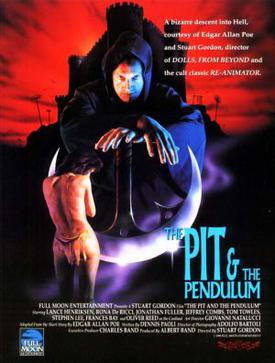
That was my reaction when I watched the 1991 film, The Pit and the Pendulum. Based very narrowly on several Edgar Allan Poe short stories, The Pit and the Pendulum takes place at the height of the Spanish inquisition. Despite the objections of the Pope, Grand Inquisitor Torquemada (Lance Henriksen) is leading a reign of terror though 15th Century Spain. In his torture chambers, Torquemada forces confessions from accused witches and other criminals. The dirty prison cells are full of starving and beaten partners. Witches are burned at the stake and explode while the crazed citizenry calls for blood and Torquemada tests out new torture devices.
Torquemada presents himself as being a grim and emotionless man, someone who is above all sin and who is allowed to sit in judgment of the people who are brought before him. However, Torquemada is hardly the sinless figure that he portrays himself as being. His actions are fueled by his repressed lust and his anger. Maria (Rona De Ricci) has been brought before him, accused of being a witch and Torquemada is determined to get her to confess. Maria’s refusal to be broken by Torquemada only increases Toquemada’s anger but, at the same time, Torquemada has also decided that he’s in love with Maria. While Maria waits in the prison and takes advice from the witch Esmerelda (Frances Bay), Maria’s husband, Antonio (Jonathan Fuller), attempts to break Maria out of prison. When Antonio is captured, Torquemada decides to try out his latest device, a swinging and sharpened pendulum that hangs in a pit….
The Pit and the Pendulum is not always an easy movie to watch. I have to admit that I spent the majority of the movie with my hands over my eyes, not wanting to watch the extremely graphic torture scenes. Like many of director Stuart Gordon’s film, The Pit and the Pendulum is gripped by an atmosphere of pervasive corruption and the movie captures the feeling of not being able to escape from the worst place on Earth. Poor Maria spends a good deal of the movie naked and chained to various devices but Rona De Ricci gives such a strong and such a committed performance as Maria that, instead of being offended by the obvious exploitation element of the scenes, you instead find yourself admiring Maria and her strength.
It’s probably not a coincidence that Oliver Reed shows up in the film as a Cardinal because The Pit and the Pendulum, with its portrayal of blood frenzy and hypocrisy, is definitely influenced by Ken Russell’s The Devils. The imagery is graphic and often disturbing but the most memorable thing about the film is Lance Henriksen’s intense performance as the evil Torquemada. Henriksen plays Torquemada as being a hateful and self-loathing figure, a man who deals with his own demons by bringing his fury down on the innocent. It’s a truly frightening villainous performance, one that carries shades of Vincent Price’s excellent performance in The Witchfinder General.
The Pit and the Pendulum is not an easy film to watch and I doubt I’ll watch it a second time. In the end, it’s a disturbing film but one that definitely leaves an impression.
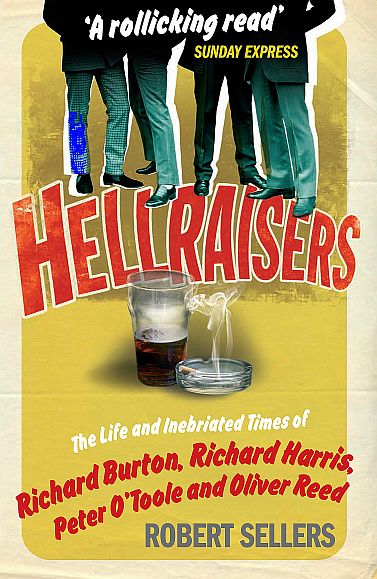
First published in 2009, Hellraisers is a fast-paced look at the life and times of four men, Richard Burton, Richard Harris, Peter O’Toole, and Oliver Reed, and an examination of what they all had in common.
First off, they were all talented actors who were at the height of their careers in the 60s and the 70s.
They all first came to prominence in the UK. Peter O’Toole and Oliver Reed were English. Richard Burton was Welsh. Richard Harris was born in Ireland.
With the exception of Oliver Reed, all of them were multiple Oscar nominees but none of them actually won the award.
All four of them could boast filmographies that included some of the best and some of the worst films of all time.
And, of course, all four of them were infamous for their drinking. They were all, if I may borrow the book’s title, famous for raising Hell.
Hellraisers is a frequently entertaining look at their careers and their legendary off-screen exploits. All four of them come across as being very different drinkers. Richard Burton was a depressing drunk, one who drank because he was aware that he was wasting his talents in mediocre films. O’Toole was a drunk who alternated between being charming and being dangerous, someone who was capable of coming across as being a bon vivant even at his lowest moments. Richard Harris was the angry drunk but he was also the one who seemed to have the both the best understanding of why he drank and why, at a certain age, it was necessary for him to cut back. And, finally, Oliver Reed was the showman, the one who viewed drinking a beer the way that others viewed having a cup of tea and who would rather damage his career than allow anyone else to tell him how to live. He knew that he had a reputation and he was determined to live up to it, even at the risk of his own health.
Perhaps not surprisingly, it’s Oliver Reed who dominates the book. There was very little that Reed wouldn’t do while drunk and he was drunk quite a lot of the time. He was also perhaps the most unpredictable of all of the actors profiled in the book, a raw mountain of energy who kept audiences off-balance. Personally, I would not have wanted to have been along in a room with a drunk Oliver Reed. The book has too many stories of Reed dropping his trousers and asking everyone to look at what he called his “mighty mallet,” for the reader to feel totally safe with Reed. At the same time, anyone who has seen a good Oliver Reed performance knows that he deserved better roles than he was often given. (Then again, the book is also honest about the fact that a lot of filmmakers would not work with Reed because they had justifiable reasons to be terrified of him and his erratic nature.) Over the course of the book, Reed comes across as hyperactive, easily bored, and also far more intelligent than most gave him credit for. In many ways, he was a prisoner of his own reputation. He was outrageous because he knew that was what was expected of him. As shocking as some of his behavior seems today, he felt that he was giving the people what they wanted and Hellraisers suggests that he may have been right.
Personally, I don’t drink and I find most heavy drinkers to be tedious company at best. That said, Hellraisers is an interesting book. Burton, Harris, O’Toole, and Reed are all fascinating talents and the book takes a look at how their hellraising reputations both hurt and, in some cases, helped their careers. However, the book is more than just a biography of four actors who drank a lot. It’s also an examination of a different era, of a time when performers were expected to raise Hell and when one could get away with being a contrarian just for the fun of it. One can only imagine what the moral scolds of social media would have to say if Oliver Reed were around today! As a result, this is a book that can be enjoyed by both film lovers and history nerds, like you and me.
O Canada! Our home and native land! True patriot love in all of us command. With glowing hearts we see thee rise, The True North strong and free! From far and wide, O Canada, we stand on guard for thee. God keep our land glorious and free! O Canada, we stand on guard for thee. O Canada, we stand on guard for thee.
Canada! It always seems like such a nice country until you watch a David Cronenberg film. Hailing from Toronto, Cronenberg started his film career with two satirical, black-and-white science fiction shorts and then went on to become one of Canada’s best-known filmmakers. At a time when most people associated Canada with politeness and maple syrup, Cronenberg made visceral and often-disturbing films, ones that often mixed sexuality with graphic body horror. At a time when the genre was being dominated by Italian filmmakers, Cronenberg brought a uniquely Canadian sensibility to horror.
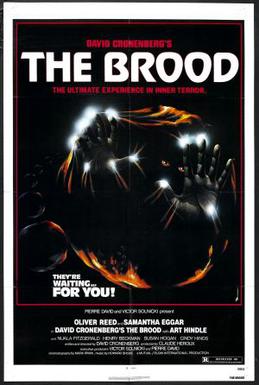
Take 1979’s The Brood, for instance.
The Brood tells the story of one very doomed marriage. Frank (Art Hindle) and Nola (Samantha Eggar) Carveth are fighting for custody of their five year-old daughter, Candice (Cindy Hinds). (Not coincidentally, Cronenberg was going through his own custody battle when he first came up with the idea for The Brood.) Nola, who has been emotionally scarred by both her alcoholic parents and her troubled marriage to Frank, is a patient at Somafree Institute. Her psychotherapist, Dr. Hal Raglan (Oliver Reed), practices a technique called “psychoplasmics.” Though it’s not easy to describe (and, wisely, Cronenberg doesn’t spend too much time trying to justify the science of it), it basically involves channeling anger and suppressed emotions into body modification. What you or I might consider to be a hive or a welt is what Dr. Raglan would call a major breakthrough.
Frank is skeptical about Dr. Raglan’s theories but he still takes Candice to visit her mom. However, when Candice returns from one visit bruised and scratched, Frank is convinced that Nola has been abusing her. Hoping to both win custody of Candice and prove that Dr. Raglan’s methods are dangerous, Frank starts his own investigation into just what exactly has been happening at the Somafree Institute.
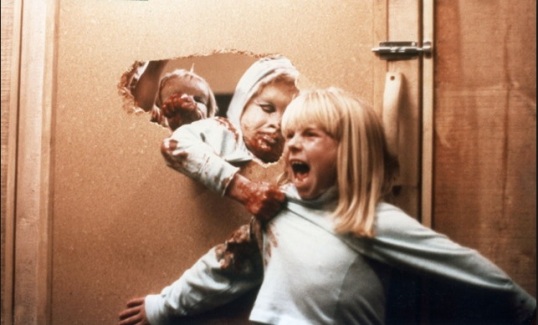
That’s when the children start to show up. The children are small, with pale skin and light hair and oddly featureless faces. They never smile. They never speak. They show up without any warning and violence always seems to follow them. They attack both Nola’s mother and father. When Nola suspects that Frank might be having an affair with Candice’s teacher, two of the children suddenly appear in her classroom. Candice is scared of the children but still seems to have some sort of connection to them…
Even if you didn’t know this was a Cronenberg film, it would take just one look at the snow-covered landscape to identify The Brood as being a Canadian film. As was often the case with Cronenberg’s early horror films, the imagery is frequently cold and chilly. However, The Brood is not a cold film. With its look at dysfunctional families and its emphasis on Frank’s attempts to protect his daughter, The Brood is actually one of Cronenberg’s most emotional films. It’s a film about not only anger but also how people deal with that anger. The killer kids are both literally and metaphorically children of rage.
Even by the standards of Cronenberg, things get grotesque. Fortunately, the film’s talented cast keeps you interested, even when the bloody visuals might make you want to find a nice comedy to watch instead. Art Hindle and Cindy Hinds are sympathetic as the father and daughter. Oliver Reed keeps you guessing as to what exactly Dr. Raglan is actually trying to accomplish. Nicholas Campbell and Robert A. Silverman, two members of the Cronenberg stock company, both make an impression in smallish roles. And Samantha Eggar totally throws herself into her role, turning Nola into an absolutely terrifying monster.
Though it never quite reaches the flamboyant heights of either Scanners or Shivers, The Brood is still an effective horror film. As opposed to some of his other films of the period, Cronenberg actually seems to not only care about the characters in the film but it also comfortable with encouraging us to care about them as well. As a result, The Brood becomes about more than just trying to shock the audience. The Brood is a film that sticks with you.
The Brood (1979, dir by David Cronenberg DP: Mark Irwin)
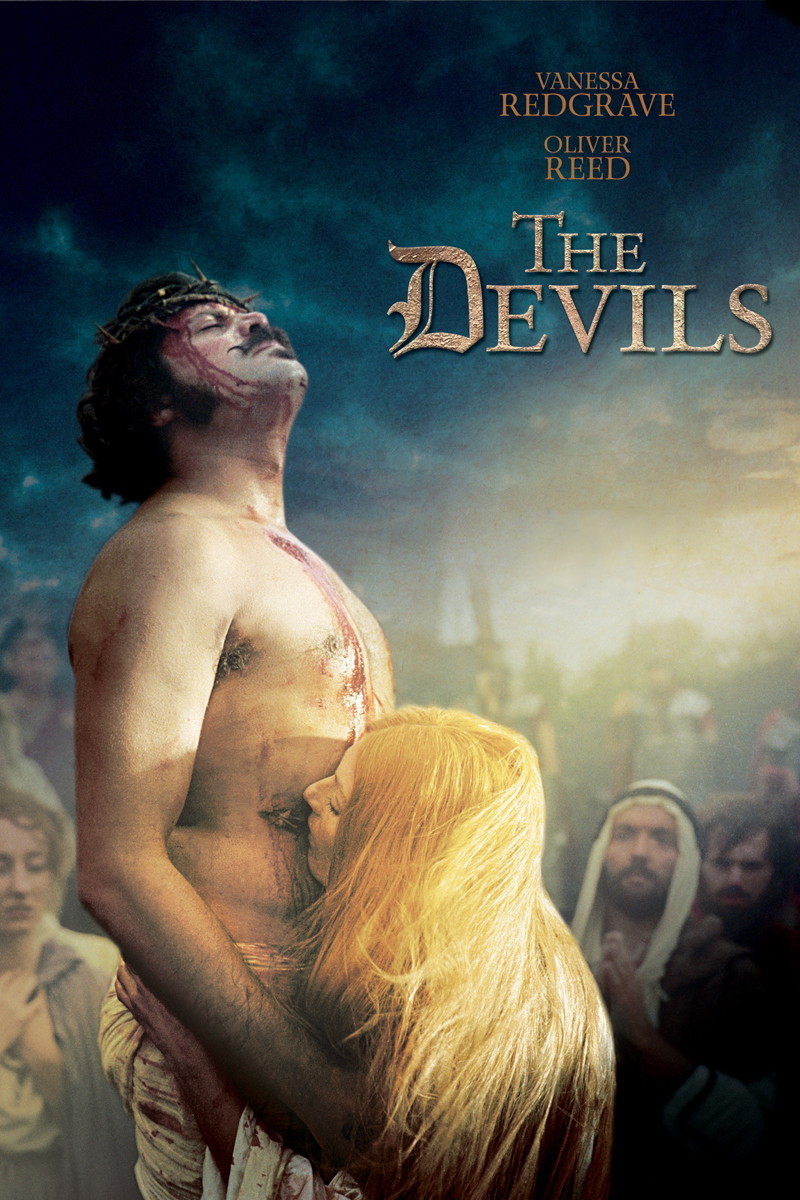
In 17th Century France, Louis XIII (Graham Armitage) may be king but it’s the devious Cardinal Richelieu (Christopher Logue) who holds the power. Richelieu has convinced that king that every walled city in France should have its walls blown up, the better to keep track of what’s actually happening within the city. Unfortunately, for Richelieu, Louis XIII promised the Governor of Louden that he would never harm any structure in the city, leaving its walls untouchable. While Louis XIII concentrates on throwing outdoor parties where murdering protestant is the main source of entertainment, Richelieu searches for an excuse to destroy the walls of Loudon.
Along with being frustrated by the fact that Loudon retains its walls, Richelieu is also upset that the unofficial leader of the city is Ubrain Grandier (Oliver Reed), a decadent priest who has not only criticized the discipline of clerical celibacy but who has also publicly opposed the Cardinal’s efforts to increase his own political power. Grandier has made it clear that, as long as he’s in control, the walls of Loudon will never came down and the people of Loudon, fearful of the plague that is ravaging the world outside of the walls, support him.
Among Grandier’s many admirers is Sister Jeanne des Agnes (Vanessa Redgrave), a hunchback who is also the abbess of the local convent. Having become sexually obsessed with Grandier, Agnes requests that he become the confessor of the convent. When Grandier refuses, it sets off a chain reaction that eventually leads to Grandier being accused of worshipping the Devil and “bewitching” Sister Agnes and several other nuns. With the arrival of Father Barre (Michael Gothard), a fanatical witch hunter, the city of Loudon descends into darkness and decadence.
Directed by the infamous (and, let’s just admit it, brilliant) Ken Russell and first released in 1971, The Devils is not an easy film to see. When the film was originally released in Britain, it was controversial for its uncompromising depiction of 17th century torture and its combination of religion and sexual imagery. (This, of course, was a recurring theme in almost all of Russell’s work.) The British censors demanded a few minor cuts before agreeing to approve the film for release. While the British censors focused on the scenes of violence, Warner Bros. also removed several sexually explicit scenes, the most infamous of which was a sequence in which a group of naked nuns sexually defiled a statue of Christ. Also removed was a scene of a priest masturbating while watching the nuns and finally, a scene in which Sister Jeanne masturbated with a charred femur bone. Russell was not happy with the changes and, needless to say, he was even more upset when Warner Bros. removed an additional three minutes before releasing the film in the United States.
In the U.S., The Devils was even more controversial than it had been in the United Kingdom and, while many critics praised it as being a powerful attack on hypocrisy, others described it as merely being pornographic. Despite the cuts that were made, the American version of The Devils was slapped with an X rating and Warner Bros. attempted to distance itself from the controversy that had developed around the film. As of this writing, The Devils has never been given a proper Region 1 DVD or Blu-ray release. It’s rare that ever shows up on any streaming platforms. Even YouTube has only a handful of scenes. If you want to watch The Devils in America, you’re going to have to track down a VCR player and watch it on VHS. And, even then, you’ll only be seeing the version that was cut for the U.S.
Will Ken Russell’s original, uncut version ever be seen in America? It’s a question that many film students have asked themselves. In 2002, a 117-minute edition of The Devils played in London, featuring some of the footage that was cut from the film’s original release. However, that version is still considered to be incomplete and it’s certainly not available here in the United States. The Devils does occasionally show up on Shudder, which is how I saw it earlier this year. Of course, the Shudder version was the cut American version, which Russell repeatedly disowned.
Watching the film, I could understand Russell’s anger. It wasn’t just that scenes had been cut out of the film. It was that the scenes were often edited out with such a lack of finesse that it made the film seem disjointed. Russell was a director known for his hallucinatory and deliberately over-the-top style. When the film abruptly cuts away from showing us its most shocking images, it feels antethical to everything that Russell was about as a filmmaker. On the one hand, it’s easy to say, “Who cares if a scene of Vanessa Redgrave masturbating with a charred femur bone has been removed from the film? Who wants to see that?” But if you watch The Devils, it becomes apparent that it’s not about what would be pleasant to see. Indeed, in many ways, The Devils is meant as a deliberate attack on the senses, one in which shocking imagery is used to awaken the audience from their complacency. As such, the controversy about how the film was cut is not about what’s acceptable. Instead, it’s about the fact that Russell has created a world where it somehow makes total sense that Sister Jeanne would pick up the femur and make use of it. By editing the scene so that it abruptly ends with Jeanne merely looking at the bone, Warner Bros. forced The Devils to not be true to itself.
And yet, despite all of that, The Devils remains a powerful and disturbing film, a hallucinatory collection of nightmarish images and haunting scenes. The excessive stylization that was Ken Russell’s trademark is perfect for this story of an entire community caught up in a frenzy of paranoia and repression. Though a period film (and based on a true story), Russell’s Loudon resembles an alien landscape, an almost expressionistic city of pristine walls and dirty streets. Vanessa Redgrave’s twisted nun stalks through the film like an ominous spirit, both wanting and hating Grandier at the same time. When the “possessions” begin, the possessed finally have the excuse to do what they truly want and to live just as wantonly as the men who previously controlled their lives. Because they’ve come to believe that they’re no longer responsible for their own actions, they can indulge in every depravity. But with Louis XIII casually murdering protestants for sport at his estate and Richelieu manipulating church policy to his own ends, the film asks why the people’s actions are more worthy of condemnation than the actions of the people who rule them.
The Devils has reputation for being blasphemous. It is, of course, nothing of the sort. After I watched the film, I did a little research and I was not surprised to discover that Ken Russell was a practicing Catholic because only a Catholic could make a film that both celebrated what the Church could be while also condemning it for so often falling short. While Richelieu represents the people who use religion as a vehicle for their own drive for power and Sister Jeanne and the witch-hunter Father Barre represents the fanatics who use church doctrine to justify their own madness, it is the sinner Father Grandier who represents what the Church should be. It is Grandier who is ultimately forced to put his own life at risk to protect the people of Loudon.
Is The Devils are horror film? Some would probably argue with my claim that it is. They would probably claim that it’s a historical drama with a heavy political subtext, However, for me, the imagery itself is disturbing enough to justify calling The Devils a horror film. The possessed of Loudon eventually prove themselves to be as mad as any of the infected people from George Romero’s The Crazies and the torture that Grandier suffers is frightening specifically because it’s all based on fact. There really was a town named Loudon that had walls. There really was a priest named Grandier who was accused of practicing witchcraft and who suffered the most vile torture as a result.. The Devils is a film about people driven made by a combination of repression and fanaticsm. It’s a horror film because it’s true and, needless to say, the madness that possessed Loudon didn’t die out in the 17th Century. It’s continued into the present day.
Oliver Reed may seem like an odd choice to play a priest but he gives one of his best performances as the charismatic but foolishly cocky Grandier. Vanessa Redgrave is frightening as the disturbed Sister Jeanne and British actor Murray Melvin is alternatively sympathetic and pathetic as a priest who comes to believe in Grandier’s innocence. For me, though, the film is stolen by Michael Gothard, who plays the fanatical witch hunter, Father Barre. With his long hair and his glasses, Father Barre bears a definite resemblance to John Lennon and the film portrays him as being the 17th century equivalent of a rock star, an arrogant and sensual man who encourages people to indulge in their most secret desires so that he can then declare them to be possessed and in need of an exorcism. Gothard had a magnetic screen presence, allowing him to steal scenes from even formidable talents like Oliver Reed and Vanessa Redgrave. Gothard would go on to play the silent assassin in the James Bond film, For Your Eyes Only and was, again, memorably threatening. Sadly, Gothard took his own life in 1992.
Someday, perhaps the full unedited version of The Devils will be available. Until then, even the edited version retains its power to shock, disturb, and make you think. Today, more than ever, its portrait of hypocrisy and mass madness feels relevant. The modern age is still ruled by hysteria and paranoia and our leaders are still looking for any excuse to take down any walls that might protect us from having to submit to their will. How different is Sister Jeanne from the people who are currently hurling accusations on social media? How different is Father Barre from the the people who were are currently told have all the answers? We may no longer burn people at the stake but we’ve found new ways to silence voices of dissent. The film may have been set in 17th Century France and first released in 1971 but Ken Russell’s masterpiece is all about the modern age. The Devils in not an easy film to watch or find but it is more than worth the effort to track down.