Lisa Reviews An Oscar Nominee: The Longest Day (dir by Ken Annakin, Andrew Marton, Bernhard Wicki, Gerd Oswald, and Darryl F. Zanuck)


As my sister has already pointed out, today is the 73rd anniversary of D-Day.  With that in mind, and as a part of my ongoing mission to see and review every single film ever nominated for best picture, I decided to watch the 1962 film, The Longest Day!

The Longest Day is a pain-staking and meticulous recreation of invasion of Normandy, much of it filmed on location.  It was reportedly something of a dream project for the head of the 20th Century Fox, Darryl F. Zanuck.  Zanuck set out to make both the ultimate tribute to the Allied forces and the greatest war movie ever.  Based on a best seller, The Longest Day has five credited screenwriters and three credited directors.  (Ken Annakin was credited with “British and French exteriors,” Andrew Marton did “American exteriors,” and the German scenes were credited to Bernhard Wicki.  Oddly, Gerd Oswald was not credited for his work on the parachuting scenes, even though those were some of the strongest scenes in the film.)  Even though he was not credited as either a screenwriter or a director, it is generally agreed that the film ultimately reflected the vision of Darryl F. Zanuck.  Zanuck not only rewrote the script but he also directed a few scenes as well.  The film had a budget of 7.75 million dollars, which was a huge amount in 1962.  (Until Steven Spielberg’s Schindler’s List, The Longest Day was the most expensive black-and-white film ever made.)  Not only did the film tell an epic story, but it also had an epic length.  Clocking in at 3 hours, The Longest Day was also one of the longest movies to ever be nominated for best picture.

The Longest Day also had an epic cast.  Zanuck assembled an all-star cast for his recreation of D-Day.  If you’re like me and you love watching old movies on TCM, you’ll see a lot of familiar faces go rushing by during the course of The Longest Day.  American generals were played by actors like Robert Mitchum, Robert Ryan, Henry Fonda, and John Wayne.  Peter Lawford, then the brother-in-law of the President of the United States, had a memorable role as the Scottish Lord Lovat, who marched through D-Day to the sounds of bagpipes.  When the Allied troops storm the beach, everyone from Roddy McDowall to Sal Mineo to Robert Wagner to singer Paul Anka can be seen dodging bullets.  Sean Connery pops up, speaking in his Scottish accent and providing comic relief.  When a group of paratroopers parachute into an occupied village, comedian Red Buttons ends up hanging from the steeple of a church.  When Richard Beymer (who is currently playing Ben Horne on Twin Peaks) gets separated from his squad, he stumbles across Richard Burton.  Among those representing the French are Arletty and Christian Marquand.  (Ironically, after World War II, Arletty was convicted of collaborating with the Germans and spent 18 months under house arrest.  Her crime was having a romantic relationship with a German soldier.  It is said that, in response to the charges, Arletty said, “My heart is French but my ass is international.”)  Meanwhile, among the Germans, one can find three future Bond villains: Gert Frobe, Curt Jurgens, and Walter Gotell.

It’s a big film and, to be honest, it’s too big.  It’s hard to keep track of everyone and, even though the battle scenes are probably about an intense as one could get away with in 1962 (though it’s nowhere near as effective as the famous opening of Saving Private Ryan, I still felt bad when Jeffrey Hunter and Eddie Albert were gunned down), their effectiveness is compromised by the film’s all-star approach.  Often times, the action threatens to come to a halt so that everyone can get their close-up.  Unfortunately, most of those famous faces don’t really get much of a chance to make an impression.  Even as the battle rages, you keep getting distracted by questions like, “Was that guy famous or was he just an extra?”

Among the big stars, most of them play to their personas.  John Wayne, for instance, may have been cast as General Benjamin Vandervoort but there’s never any doubt that he’s playing John Wayne.  When he tells his troops to “send them to Hell,” it’s not Vandervoort giving orders.  It’s John Wayne representing America.  Henry Fonda may be identified as being General Theodore Roosevelt II but, ultimately, you react to him because he’s Henry Fonda, a symbol of middle-American decency.  Neither Wayne nor Fonda gives a bad performance but you never forget that you’re watching Fonda and Wayne.

Throughout this huge film, there are bits and pieces that work so well that you wish the film had just concentrated on them as opposed to trying to tell every single story that occurred during D-Day.  I liked Robert Mitchum as a tough but caring general who, in the midst of battle, gives a speech that inspires his troops to keep fighting.  The scenes of Peter Lawford marching with a bagpiper at his side were nicely surreal.  Finally, there’s Richard Beymer, wandering around the French countryside and going through the entire day without firing his gun once.  Beymer gets the best line of the film when he says, “I wonder if we won.”  It’s such a modest line but it’s probably the most powerful line in the film.  I wish The Longest Day had more scenes like that.

The Longest Day was nominated for best picture of 1962 but it lost to an even longer film, Lawrence of Arabia.

A Movie A Day #44: Let Him Have It (1991, directed by Peter Medak)


The year is 1953.  The place is Croydon.  Derek Bentley (Christopher Eccleston) is 19 years old but has the mental capability of an 11 year-old.  Unable to hold down a job and judged unfit for the national service, Derek drifts into a gang led by 16 year-old Christopher Craig (Paul Reynolds).  When Derek and Craig are caught burglarizing a warehouse, it leads to a tense rooftop confrontation between Craig and the police.  Derek has already been captured by the time that the police demand that Craig hand over his gun.  Bentley shouts, “Let him have it, Chris!”  Craig opens fire, killing one officer.

Because he’s a minor, Craig is only facing a prison sentence for killing the police officer.  But, as a legal (if not mental) adult, Derek will be hung if he’s found guilty.  Under the common purpose doctrine, it doesn’t matter that Derek didn’t actually shoot the gun.  The only thing that matters is what Derek meant when he said, “Let him have it, Chris!”  Derek says that he was telling Craig to hand over his gun.  The Crown says that Derek was ordering Craig to open fire.

Let Him Have It is based on a true story.  The case of Derek Bentley was one of the many cases that eventually led to the death penalty being abolished in the UK.  Let Him Have It was released at the height of a long campaign to secure a pardon for Derek.  That pardon was finally issued in 1998, though it was too late to help Derek Bentley.

Let Him Have It is a powerful and angry docudrama, one that reveals in searing detail how Derek was railroaded by the British legal system.  In his film debut, Eccleston gives a powerful performance as Derek and he is ably supported by both Paul Reynolds and, in the role of Derek’s father, Tom Courtenay.  Let Him Have It leaves little doubt as to why the case of Derek Bentley remained a cause célèbre for 45 years after his initial trial.

Horror Film Review: Death Line (dir by Gary Sherman)


“Mind the doors!”

— The Man (Hugh Armstrong) in Death Line (1972)

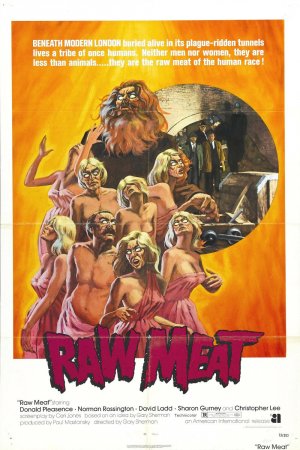
Before I get to far into reviewing the unjustly obscure British horror film, Death Line, I want you to take a look at the film poster below.

Deathlinerawmeat

This is the poster that was used when Death Line was released in the United States.  Now, I have to admit that I like this poster but that’s largely because I’m a lover of old grindhouse and exploitation films.  And this poster is a perfect example of the grindhouse aesthetic.  Of course, it’s not surprising that this poster is largely misleading.

First off, the title has been changed to Raw Meat.  That makes sense when you consider that the film is about a cannibal but it also creates the mistaken impression that this film is primarily about cannibalism.  It’s not.  Actually, Death Line is a film about class differences and government secrecy.  (Though it’s probably best to leave this as a topic for another post, I think it can be argued that almost every film made in the UK is, in some way, about class and secrecy.)

The bearded man is obviously meant to be a stand-in for Death Line‘s cannibal.  Known as the Man and played by Hugh Armstrong, he is the last descendant of a group of Victorian railway workers who were buried alive during the construction of the London underground.  The Man is the product of generations of cross-breeding.  And while the Man is definitely frightening at first, he ultimately emerges as the film’s only truly sympathetic figure.  He’s hardly the intimidating figure pictured above.  Instead, he’s a heart-breakingly pathetic figure who, having grown up in the shadows of the underground, is only capable of uttering three words: “Mind the doors.”  There’s a lengthy scene in which the Man howls in anguish after the death of his wife.  I don’t care if he was a cannibal, it still brought tears to my eyes.

The poster does offer up a glimpse of two men who appear to be searching an underground tunnel.  This image, at the very least, is accurate.  The two men are Inspector Calhoun (Donald Pleasence) and his partner, Detective Sergeant Rogers (Norman Rossington).  When the Man makes the mistake of attacking, murdering, and eating a member of a Parliament, Calhoun and Rogers are the ones who end up investigating the case.  What’s interesting is that neither Calhoun nor Rogers are presented as being sympathetic characters.  In fact, Calhoun is something as a fascist.  When Christopher Lee tells them to stop investigating the case, Calhoun is less upset over the government cover-up and more angered by the fact that he doesn’t like being told what to do.

There are two other people investigating the case, though neither one of them are present on the poster.  Alex Campbell (David Ladd) is an American college student and, though Alex starts out as sympathetic to the Man, that changes when the Man kidnaps his girlfriend (Sharon Gurney) and tries to make her into his new wife.  Alex serves as a stand-in for the self-righteous activists who, in most films, would be responsible for saving the day.  It’s telling of just how cynical a film Death Line is that Alex ultimately turns out to be even more ineffectual than Calhoun and Rogers.

Finally, the poster offers up a group of half-naked people.  I have no idea who these people are supposed to represent but I’m sure they helped to sell tickets!

As for Death Line, it’s an unjustly obscure film.  Whether you track it down under the original title or the Americanized title of Raw Meat, be sure to watch it.

http://www.youtube.com/watch?v=r97IHkxbU8A