4 Shots From 4 Films is just what it says it is, 4 shots from 4 of our favorite films. As opposed to the reviews and recaps that we usually post, 4 Shots From 4 Films lets the visuals do the talking!
Today, I’m using this feature to take a look at the history of the Academy Award for Best Picture. Decade by decade, I’m going to highlight my picks for best of the winning films. To start with, here are 4 shots from 4 Films that won Best Picture during the 1960s! Here are….
4 Shots From 4 Best Picture Winners: The 1960s
The Apartment (1960, dir by Billy Wilder, DP: Ernest Laszlo)
Lawrence of Arabia (1962, dir by David Lean, DP: Freddie A. Young)
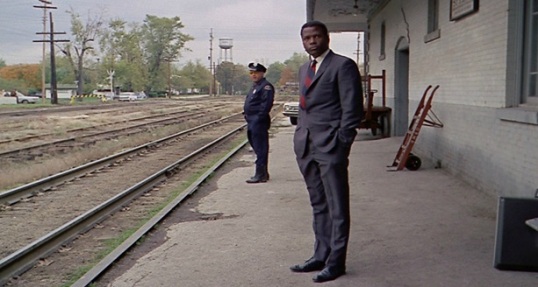
In The Heat of the Night (1967, dir by Norman Jewison, DP: Haskell Wexler)
Midnight Cowboy (1969; Dir by John Schlesinger, DP: Adam Holender)
Today, we observe what would have been Sidney Poitier’s 97th birthday.
Today’s scene that I love comes from the 1967 Best Picture winner, In The Heat of the Night. In this film, Poitier plays Virgil Tibbs, a Northern cop who reluctantly finds himself helping a Southern sheriff (Rod Steiger) investigate a murder. Tibbs’s number one suspect is Eric Endicott (Larry Gates), who owns what was then a modern-day plantation.
In this scene, Tibbs interrogates Endicott, a paternalistic racist who simply cannot believe or accept that he is being questioned by a black man. When Endicott responds to one of Tibbs questions by slapping him, Tibbs slaps him right back.
While Endicott’s slap was in the original script, Tibbs’s response was not. At first, Tibbs was meant to turn the other cheek and leave the plantation without saying a word. Wisely, Poitier approached director Norman Jewison and objected to that, insisting that Tibbs would respond in kind. The scene was rewritten and it became one of Poitier’s best moments in the film.
In memory of the late Norman Jewison, today scene that I love comes from my favorite film to have been directed by him.
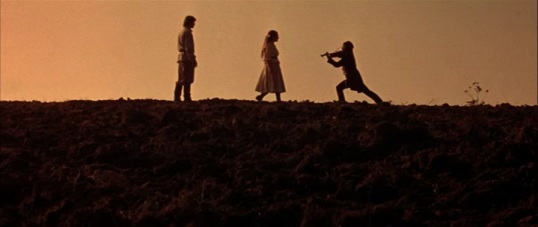
In this scene from 1973’sJesus Christ Superstar, Mary Magdalene (Yvonne Elliman) attempts to comfort Jesus (Ted Neeley) while Judas (Carl Anderson) tries to pull Jesus away from her. This scene showcases both Elliman’s angelic voice and Anderson’s ferocious intensity as Mary and Judas present two very different sides of a spiritual journey.
4 (or more) Shots From 4 (or more) Films is just what it says it is, 4 (or more) shots from 4 (or more) of our favorite films. As opposed to the reviews and recaps that we usually post, 4 (or more) Shots From 4 (or more) Films lets the visuals do the talking.
Rest in Peace, Norman Jewison, a director who believed in the power of cinema to change the world.
4 Shots From 4 Norman Jewison Films
In The Heat of the Night (1967, dir by Norman Jewison, DP: Haskell Wexler)
Fiddler on the Roof (1971, dir by Norman Jewison, DP: Oswald Morris)
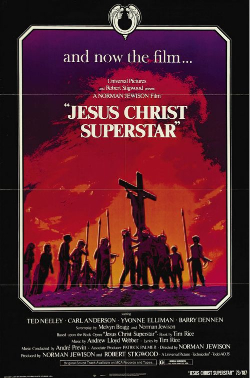
Jesus Christ Superstar (1973, dir by Norman Jewison, DP; Douglas Slocombe)
The Hurricane (1999. dir by Norman Jewison, DP: Roger Deakins)
4 Or More Shots From 4 Or More Films is just what it says it is, 4 shots from 4 of our favorite films. As opposed to the reviews and recaps that we usually post, 4 Shots From 4 Films lets the visuals do the talking!
Earlier, today, it was announced that Sidney Poitier had passed away at the age of 94.
Poitier was, of course, the first black actor to win the Oscar for Best Actor. He won that award for 1962’s Lillies of the Field. He would go on to star in the Oscar-winning In The Heat of the Night, where he delivered the famous line, “They call me Mr. Tibbs!” Poitier was one of the first black actors to be acknowledged as a movie star. In the 70s and the 80s, he chafed at the limited selection of roles that he was being offered in mainstream productions and he started to produce and direct his own films. He also served as a diplomat, serving as the Bahamian ambassador to both Japan and UNESCO.
In honor of Poitier’s life and legacy, here are….
4 Shots From 4 Sidney Poitier Films
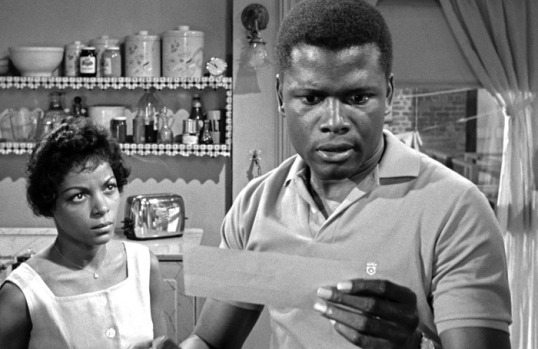
A Raisin in the Sun (1961, dir by Daniel Petrie, DP: Charles Lawton Jr.)
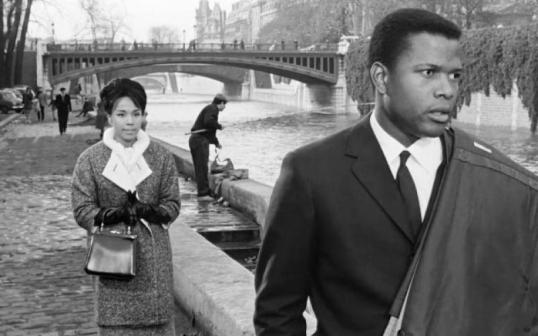
Paris Blues (1961, dir by Martin Ritt, DP: Christian Matras)
In The Heat of the Night (1967, dir by Norman Jewison, DP: Haskell Wexler)
Brother John (1971, dir by James Goldstone, DP: Gerald Perry Finnerman)
The 1967 film, In the Heat of the Night, tells the story of two very different men.
Chief Gillespie (Rod Steiger) is the police chief of the small town of Sparta, Mississippi. In many ways, Gillespie appears to the epitome of the bigoted Southern cop. He’s overweight. He loses his temper easily. He chews a lot of gum. He knows everyone in town and automatically distrusts anyone who he hasn’t seen before, especially if that person happens to be a black man or from the north.
Virgil Tibbs (Sidney Poitier) is a black man from the north. He’s a detective with the Philadelphia Police Department and he’s as cool and controlled as Gillespie is temperamental and uncouth. Tibbs has no patience for the casual racism that is epitomized by lawmen like Chief Gillespie. When Gillespie says that Virgil is a “fancy name” for a black and asks what people call Virgil in Philadelphia, Virgil declares, “They call me Mister Tibbs!,” with an authority that leaves no doubt that he expects Gillespie to do the same.
Together …. THEY SOLVE CRIMES!
For once, that old joke is correct. When a Chicago industrialist named Phillip Colbert is discover murdered in Sparta, Chief Gillespie heads up the investigation and, assuming that the murderer must be an outsider, orders Deputy Wood (Warren Oates) to check out the train station for any suspicious characters. When Wood arrives at the station, he discovers Virgil standing on the platform. Virgil is simply waiting for his train so that he can get back home to Philadelphia. However, Wood promptly arrests him. Gilespie accuses him of murdering Colbert, just to discover that Virgil’s a police detective from Philadelphia.
Though neither wants to work with the other, that’s exactly what Gillespie and Virgil are forced to do as they investigate Colbert’s murder. Colbert was planning on building a factory in Sparta and his wife (Lee Grant) makes it clear that, if Sparta wants the factory and the money that comes with it, Virgil must be kept on the case. Over the course of the investigation, Gillespie and Virgil come to a weary understanding as both of them are forced to confront their own preconceived notions about both the murder and life in Sparta. In the end, if it’s impossible for them to truly become friends, they do develop a weary respect for each other. That is perhaps the best that one could have hoped for in 1967.
I have to admit that it took me a few viewings before I really appreciated In the Heat of the Night. Though this film won the Oscar for Best Picture of 1967, it’s always suffered when compared to some of the films that it beat. One can certainly see that the film was superior to Doctor Dolittle and Guess Who’s Coming to Dinner. But was it a better film than The Graduate or Bonnie and Clyde? Did Rod Steiger really deserve to win Best Actor over Dustin Hoffman and Warren Beatty? (Amazingly, Poitier wasn’t even nominated.)
To be honest, I still feel that In The Heat of the Night was probably the 3rd best of the 5 films nominated that year, superior to the condescending Guess Who’s Coming To Dinner but nowhere near as groundbreaking as Bonnie and Clyde or The Graduate. The first time I watched In the Heat of the Night, I thought Steiger blustered a bit too much and the film’s central mystery didn’t really hold together and, to a large extent, I still feel like that.
But, at the same time, there’s a lot to appreciate about In the Heat of the Night. On subsequent viewings, I came to better appreciate the way that director Norman Jewison, editor Hal Ashby, and cinematographer Haskwell Wexler created and maintained an atmosphere that was so thick that you can literally feel the Mississippi humidity while watching the film. I came to appreciate the supporting cast, especially Warren Oates, Lee Grant, Scott Wilson, Anthony James, and Larry Gates. (Gates especially makes an impression in his one scene, playing an outwardly genteel racist who nearly cries when Tibbs reacts to his slap by slapping him back.) I also came to appreciate the fact that, while the white cop/black cop partnership has subsequently become a bit of a cliche, it was new and even controversial concept in 1967.
And finally, I came to better appreciate Sidney Poitier’s performance as Virgil. Poitier underplays Virgil, giving a performance of tightly controlled rage. While Steiger yells his way through the film, Poitier emphasizes that Virgil is always thinking. As in the same year’s Guess Who’s Coming To Dinner, Poitier plays a dignified character but, here, that dignity is Virgil’s way of defying the demands and expectations of men like Gillespie. When Virgil does strike back, it’s a cathartic moment because we understand how many times he’s had to hold back.
In the Heat of the Night may not have been the best film of 1967 but it’s still one worth watching.
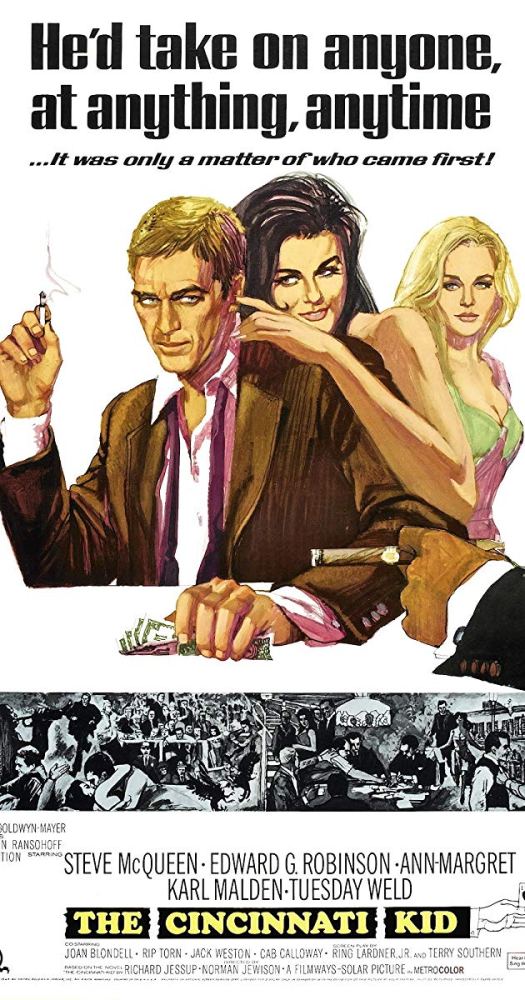
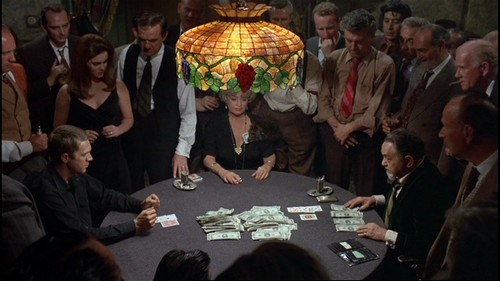
There are movies about the high-stakes world of poker, and then there’s THE CINCINNATI KID. This gripping look at backroom gambling has long been a favorite of mine because of the high-powered all-star cast led by two acting icons from two separate generations – “The Epitome of Cool” Steve McQueen and “Original Gangster” Edward G. Robinson . The film was a breakthrough for director Norman Jewison, who went after this from lightweight fluff like 40 POUNDS OF TROUBLE and SEND ME NO FLOWERS to weightier material like IN THE HEAT OF THE NIGHT and THE THOMAS CROWN AFFAIR.
The film revolves around a poker showdown between up and coming young stud Eric Stoner, known as The Kid, and veteran Lancey Howard, venerated in card playing circles as The Man. This theme of young tyro vs old pro wasn’t exactly groundbreaking, having been hashed and rehashed in countless Westerns over the…
Set during World War II, 1984’s A Soldier’s Story opens with a murder.
On a rural road outside of a segregated army base in Louisiana, someone has gunned down Sergeant Vernon Walters (Adolph Caesar). At the time, Walters was staggering back to the base after a night of heavy drinking. Both the local authorities and Watlers’s fellow soldiers assume that the murder was the work of the Ku Klux Klan. Captain Richard Davenport (Howard Rollins) isn’t so sure.
Captain Davenport is the officer who has been assigned to investigate the murder. From the minute that he arrives at the base, the soldiers stare at him. As Cpl. Ellis (Robert Townsend) explains it, the enlisted men are shocked because they’ve never seen a black officer before. Some of the soldiers admire Davenport while other view him with suspicion, wondering what Davenport must have done or who he must have sold out to earn his commission.
Meanwhile, the other officers (who are all white) view Davenport with a combination of condescension and hostility. Col. Nivens (Trey Wilson) only allows Davenport three days to wrap up his investigation and assigns the polite but skeptical Capt. Taylor (Dennis Lipscomb) to work with him. Taylor suspects that Walters may have been murdered by the openly racist Lt. Byrd (Wings Hauser!). Davenport, however, isn’t so sure. Even though the official story is that Walters was a tough but fair sergeant who was respected by his company, Davenport suspects that one of them may have killed him.
Davenport and Taylor start to interview the soldiers who actually had to deal with Walters on a daily basis. Through the use of flashbacks, Walters is revealed to be a far more complex man than anyone knew. We see that Walters was a man who was bitterly aware of the fact that, even after a lifetime of military service, he was destined to always be treated as a second-class citizen by the nation that he served. Unable to strike out at the men who the army and society had placed over him, Walters instead struck at the men serving underneath him. While the man in Walters’s company wait for word on whether or not they’ll be allowed to serve overseas, Davenport tries to determine if one or more of them is a murderer.
A Soldier’s Story was adapted from a play but director Norman Jewison is careful to prevent the material from becoming stagey. Effortlessly transitioning from the film’s present to flashbacks of the events that led to Walters’s murder, Jewison crafts both an incendiary look at race relations and a compelling murder mystery. He’s helped by a strong cast of predominately African-American actors. In one of his earliest roles, Denzel Washington plays Pfc. Peterson with a smoldering intensity. David Alan Grier and Robert Townsend, two actors known for their comedic skills, impress in dramatic roles. Seen primarily in flashbacks, Adolph Caesar turns Walters into a complex monster.
And yet, with all the talent on display, it is Howard Rollins who ultimately steals the movie. As a character, Captain Davenport has the potential to be a rather thankless role. He spends most of the movie listening to other people talk and, because of his status as both an officer and a black man in the rural south, he’s rarely allowed to show much anger or, for that matter, any other emotion. However, Rollins gives a performance of such quiet intelligence that Davenport becomes the most interesting character in the movie. He’s the ultimate outsider. Because of his higher rank and his role as an investigator, he can’t fraternize with the enlisted men but, as an African-American, he’s still expected to remain separate from and differential to his fellow officers. As the only black officer on a segregated base, Davenport is assigned to stay in an empty barrack. One of the best scenes in the film is Davenport standing alone and surveying the stark layout of his temporary quarters. The expression on his face tells you everything you need to know.
(Towards the end of the film, when Davenport finally gets a chance to drop his rigid facade and, if just for one line, be himself, you want to cheer for him.)
A Soldier’s Story was nominated for best picture but it lost to another theatrical adaptation, Milos Forman’s Amadeus.
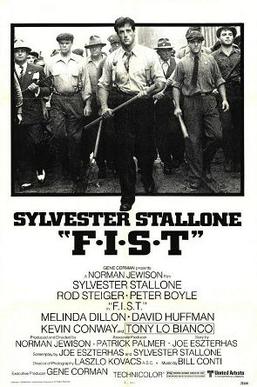
Actually, Stallone plays Johnny Kovak, a laborer who becomes a union organizer in 1939. Working with him is his best friend, Abe Belkin (David Huffman). In the fight for the working man, Abe refuses to compromise to either the bosses or the gangsters who want a piece of union. Johnny is more pragmatic and willing to make deals with ruthless mobsters like Vince Doyle (Kevin Conway) and Babe Milano (Tony Lo Bianco). Over thirty years, both Johnny and Abe marry and start families. Both become powerful in the union. When Johnny discovers that union official Max Graham (Peter Boyle) is embezzling funds, Johnny challenges him for the presidency. When a powerful U.S. senator (Rod Steiger) launches an investigation into F.I.S.T. corruption, both Johnny and Abe end up marked for death.
Obviously based on the life and mysterious disappearance of Jimmy Hoffa, F.I.S.T. was one of two films that Stallone made immediately after the surprise success of Rocky. (The other was Paradise Alley.) F.I.S.T. features Stallone in one of his most serious roles and the results are mixed. In the film’s quieter scenes, especially during the first half, Stallone is surprisingly convincing as the idealistic and morally conflicted Kovak. Stallone is less convincing when Kovak has to give speeches. If F.I.S.T. were made today, Stallone could probably pull off the scenes of the aged, compromised Johnny but in 1978, he was not yet strong enough as an actor. Far better is the rest of the cast, especially Conway, Lo Bianco, and Boyle. If you do see F.I.S.T., keep an eye on the actor playing Johnny’s son. Though he was credited as Cole Dammett, he grew up to be Anthony Keidis of the Red Hot Chili Peppers.
The box office failures of both F.I.S.T. and Paradise Alley led Stallone back to his most famous role with Rocky II. And the rest is history.
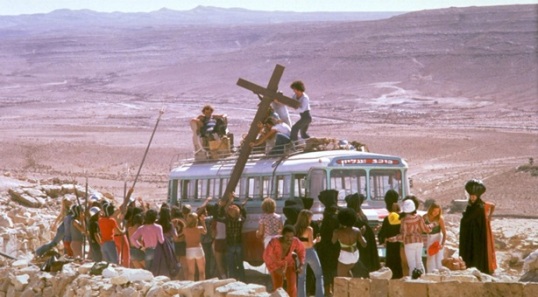
The 1973 film, Jesus Christ Superstar, opens with a desert in Israel. All is still. All is quiet. Suddenly, we see a cloud of dust in the distance. A bus is speeding through the desert and the music on the soundtrack explodes with a sudden urgency.
The bus comes to a stop and we notice that there’s a big cross tied to the top of it. The doors open and suddenly — oh my God, it’s hundreds of hippies! American hippies In Israel! They’re climbing off the bus, one after another. Some of them are being tossed sub machine guns. Another gets a whip. One of them puts on a purple robe and looks like he is slightly disturbed. Others are dressed in black. Makeup is applied. Everyone’s having a great time. One heavy-set fellow, with frizzy hair, climbs to the top of the bus and sits down on a throne. He watches as everyone else pulls down the cross. One long-haired man, who was never seen leaving the bus, is suddenly among the hippies. He’s dressed in white and everyone is suddenly bowing before him.
Well, almost everyone. One of the bus’s passengers, a serious-looking man (Carl Anderson), has walked away from the hippies. From a safe distance, he looks back at them and he seems to be as confused by all of this as we are.
Why is everyone in the desert? That’s relatively easy to explain. They’re performing a Passion Play. Carl Anderson is playing Judas. The man in white is Ted Neeley. Whether he is meant to be an actor playing Jesus or Jesus himself is a question that the movie leaves for you to decide. We never see him get off the bus and, perhaps more importantly, we don’t see him get on the bus at the end.
(Just you watch. I’ll mention that Jesus gets crucified at the end of this movie and someone will pop up in the comments and say, “How about a spoiler alert?”)
Hmmm…religion and hippies. Those are two things that, in the past, I have definitely had issues with. In fact, you would totally be justified in assuming that I would hate Jesus Christ Superstar. And yet, I don’t. I actually rather like it.
True, there are some things that make me cringe. The sound of all the disciples singing, “What’s the buzz, tell me what’s a happening?” always makes me shudder and say, “Oh my God, this is so 1973!” A scene where Judas suddenly finds himself being chased through the desert by a modern tank is just a bit too on-the-nose. Finally, I understand that Ted Neeley’s stage performance as Jesus is highly acclaimed but, to me, his performance in this film will always be known as the Screaming Jesus. Too often, it’s obvious that Neeley is still performing as if he’s on stage and has to project to the back row. It’s interesting to compare him to Carl Anderson, who also played Judas on stage but who, in the movie, gives a performance that is powerful specifically because it’s a cinematic performance, as opposed to a stage performance.
But, even with all that in mind, there’s so much about this movie that works. Based on the rock opera by Tim Rice and Andrew Lloyd Webber, Jesus Christ Superstar is definitely a product of its time, serving as a time machine for amateur historians like me. (Then again, I guess you could say that about any movie the opens with hippies driving a school bus across Israel.) Sometimes, the lyrics are a bit obvious but the songs still stick around in your head. And it’s not just Carl Anderson who gives a good performance. Yvonne Elliman, Josh Mostel, Bob Bingham, Larry Marshall, Barry Dennen — they all contribute strong work, both musically and otherwise.
And then there’s the big Simon Zealotes/Poor Jerusalem production number:
There’s several reasons I love this scene but mostly it just comes down to the fact that it captures the explosive energy that comes from watching a live performance. Larry Marshall (who plays Simon Zealotes) has one of the most fascinating faces that I’ve ever seen in a film and when he performs, he performs as if the fate of the entire world depends on it. As previously stated, I’ve never been sold on Ted Neely’s performance as Jesus but Carl Anderson burns with charisma in the role of Judas.
Mostly, however, I just love the choreography and watching the dancers. I guess that’s not that surprising considering just how important dance was (and still is, even if I’m now just dancing for fun) in my life but, to be honest, I’m probably one of the most hyper critical people out there when it comes to dance in film, regarding both the way that it’s often choreographed and usually filmed. But this scene is probably about as close to perfect in both regards as I’ve ever seen. It goes beyond the fact that the dancers obviously have a lot of energy and enthusiasm and that they all look good while dancing. The great thing about the choreography in this scene is that it all feels so spontaneous. There’s less emphasis on technical perfection and more emphasis on capturing emotion and thought through movement. What I love is that the number is choreographed to make it appear as if not all of the dancers in this scene are on the exact same beat. Some of them appear to come in a second or two late, which is something that would have made a lot of my former teachers and choreographers scream and curse because, far too often, people become so obsessed with technical perfection that they forget that passion is just as important as perfect technique. (I’m biased, of course, because I’ve always been more passionate than perfect.) The dancers in this scene have a lot of passion and it’s thrilling to watch.
Beyond that, there’s the insane burlesque of Josh Mostel’s performance as Herod and Barry Dennen’s neurotic interpretation of Pilate. There’s Yvonne Elliman’s performance of I Don’t Know How To Love Him. There’s that famous closing shot, a happy accident that was achieved when a shepherd just happened to wander past the camera.
And, of course, there’s this:
The performance above pretty much sums up the appeal of Jesus Christ Superstar. It’s both ludicrous and powerful at the same time.
I know there’s some debate as to whether Jesus Christ Superstar is sincere or sacrilegious. In college, there was this girl in my dorm who started the semester as a pagan, spent a month as an evangelical, and then ended the semester as a pagan again. When she was going through her evangelical phase, she would listen to the Jesus Christ Superstar soundtrack constantly. Seriously. 24 hours a day. 7 days a week. After three days, I was sick of hearing it. I found myself wondering if anyone had ever been driven to murder over having to listen to Heaven On Their Minds one too many times. Fortunately, something happened to cause her to once again lose her faith and she went back to listening to Fall Out Boy.
I don’t think that, as conceived by Rice and Lloyd Webber, Jesus Christ Superstar is in any way sacrilegious. At the same time, it does have a potentially subversive streak to it. This is especially true of the film version. At times, director Norman Jewison seems to be almost deliberately parodying the excesses of more conventional religious films. Instead of spending millions to recreate the ancient world, Jesus Christ Superstar uses ruins and desert. Instead of featuring ornate costumes, Jesus Christ Superstar features Roman soldiers who wear pink tank tops. Ultimately, Jesus Christ Superstar reveres Jesus but dismisses the conventions of both organized Christianity and epic filmmaking. Judah Ben-Hur would not have known what to do with himself if he wandered onto the set of Jesus Christ Superstar.
It’s over the top, silly, ludicrous, and ultimately rather powerful. Jesus Christ Superstar is a film that shouldn’t work and yet it does.







 Sylvester Stallone is Jimmy Hoffa!
 Through the Shattered Lens