Mike Kovac (Charles Bronson) is working on a pictorial profile of a banker in a small town outside of New York City, when a man named Terry Killeen (Tom Pittman) robs the bank and kills the banker. Killeen sees Kovac’s camera and forces him to come along with them. Killeen wants to be famous so he has Kovac document his one man crime spree as he robs a bank every day for six straight days. Kovac takes pictures at each robbery and sends them to his friend and small town newspaper man, Jenkins (Russell Collins), to publish the stories. Jenkins figures out that Kovac is using the pictures to provide clues to where they are heading, mainly the Lone Pine Lodge. It seems the college girl that Killeen loves, Sara (Mayo Loiseaux) is at the Lodge and Killeen thinks she will reciprocate his feelings now that he’s a famous outlaw. With Killeen planning to kill Kovac once he’s taken a picture with him and Sara, will Jenkins be able to figure out the clues and make it to Lone Pine and save his friend before it’s too late?!
The most unique aspect of “Profile of a Killer” is the performance of Tom Pittman as the bank robber / murderer, Terry Killeen. He’s certainly over the top, but his cackling laugh as he murders, robs, and terrorizes everyone around him is somewhat unsettling. Sadly, Tom Pittman would die on October 31st, 1958, one week after this episode aired, in a car accident. I also liked the performance of Russell Collins as Kovac’s friend and newspaper man, Jenkins. Jenkins’ day job may be as a newspaper editor, but he makes it clear throughout the episode to the local sheriff’s deputy Gilligan (Wayne Heffley) that he’s planning on getting out of the office and saving Kovac by himself if he has to. That’s pretty much exactly what he does. The episode concludes with a rifle wielding Jenkins and Kovac working together to take on Killeen in a night time gunfight. It’s a fun scene, with Kovac’s flashbulbs and Jenkins’ deadeye shooting skills both coming in handy. And of course, there’s the continued excellence of Charles Bronson in the lead as Mike Kovac. In this episode he uses his brain more than his brawn. He didn’t get any real cool lines, and he didn’t get the opportunity to kick any butt. That’s always a missed opportunity with Bronson, but he still dominates the proceedings with his unique charisma and presence.
“Profile of a Killer” doesn’t give Bronson any true badass moments, but it does create some memorable characters for his Mike Kovac to interact with, and I enjoyed that very much!
Sherriff Jeff Conner (Jack Rockwell) is having trouble ridding his town of outlaws so his son, Larry, (Mickey Kuhn) writes a letter to his hero to ask for help. He addresses the letter to “Durango Kid, Texas.” That’s all it takes for Steve Randall (Charles Starrett) and his sidekick, Smiley Burnette, to show up in town.
Steve and Smiley apply to be deputies but Sheriff Conner explains that someone is circulating a petition to get him fired. Steve dresses up as the Durango Kid and pressures the citizens to give the Sheriff another chance. Realizing that the Durango Kid is making them look bad, the outlaws decide to dress up one of their own as Durango and make the Kid look bad. With the town turning on Durango, will Durango and Smiley be able to save Sheriff Conner from an assassination attempt?
This Durango Kid film is different from the rest of the series in that, for once, Steve is hired to be a deputy instead of a sheriff. This really is Sheriff Conner’s story, as he tries to win the respect of the town and keep its citizens safe, even while his own brother (Ed Cassidy) is working with the outlaws. There are all the usual horse chase and shootouts but this time, Durango and Smiley are mostly around to provide support to a man who is trying to do the right thing. B-western fans will enjoy it.
Smiley sings a few songs, as always. This time, musical accompaniment is provided by Merle Travis and his Bronco Busters.
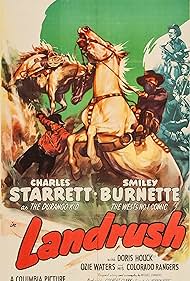
Steve Harmon (Charles Starrett) rides again! This time, he’s investigating the murder of a Pony Express rider. The murderer is outlaw leader Claw Hawkins (Bud Geary), who is working with rancher Kirby Garvey (Steve Barclay) to cheat the local homesteaders out of their land.
When local newspaper editor Jake Parker (Emmett Lynn) is attacked for trying to expose Claw Hawkins, Steve puts on a mask and dark clothing and, as the Durango Kid, he moves Jake to the carpentry shop owned by Durango’s old friend, Smiley Burnette. While Jake continues to spread the word to the homesteaders, Durango works to prevent Claw and Kirby from taking all of the land for themselves.
This is a typical Durango Kid film. This is not the first time that I’ve seen the Durango Kid protect the rights of homesteaders and, as usual, the main villain is not the outlaw that everyone fears but the respectable citizen who is controlling him. Along with the usual gunfights and horse chases, Landrush has an exciting sequence where Durango and the homesteaders have to deal with a series of fires that have been set by Claw to keep the homesteaders from reaching their land. Charles Starrett is as authentic a cowboy as ever. Unfortunately, Bud Geary and Steve Barclay aren’t very interesting as the villains. People who have watched several Durango Kid films will regret that series regulars Frank Fenton and Jock Mahoney weren’t cast in the roles.
As usual, Smiley Burnette provides comedy relief and sings two songs. This time, he’s accompanied by Ozie Waters and His Colorado Rangers.
Steve Landry (Charles Starrett) rides into another town and is once again named the new sheriff. Luckily, Steve’s old friend Smiley Burnette is working as the town’s blacksmith. Steve makes Smiley his deputy and then sets about trying to break up a gang of cattle rustlers. When Steve learns that his jurisdiction does not extend beyond the city limits, he dons the disguise of his alter ego, The Durango Kid, to go after the outlaws.
Has Steve met his match in Belle (Phyllis Adair), the saloon owner who is the secret leader of the outlaws? She notices that The Durango Kid’s boot tracks are the same as Steve’s boot tracks. I’m surprised that no one has ever noticed that before. Steve went through a lot of trouble to disguise himself as Durango but he never bothered to change his boots.
This entry in the Durango Kid series features a lot of Smiley Burnette so your enjoyment on the film will depend on how much tolerance you have for Smiley’s songs and his style of humor. Each film featured Smiley being followed around by a different group of musicians. In this one, Smiley is accompanied by The Trailsman. When Smiley accidentally locks himself in a jail cell, the Trailsman stand on the other side of the bars and sing a song about how Smiley can’t get out of the cell. Smiley does eventually get out but, later on, he’s knocked out cold during an attempted jail break. Smiley’s not much of a help in this one.
This has all of the typical Durango Kid elements, including the stock footage of the stampeding cattle that appeared in nearly all of his films. There’s another saloon fight and a gunfight towards the end. Durango rides out of town alone, leaving Smiley behind, but we know they’ll soon be reunited in another adventure.
Years ago, Bill Donner (George Cheseboro) double-crossed the other members of the Selby Gang and ran off with all of their stolen gold. Now, Donner is blind and half-crazy. When he says that he hid the gold in the ghost town of Shadeville, the Durango Kid (Charles Starrett), Smiley Burnette, and Sheriff Dodge (Stanley Andrews) ride off to find it.
Shadeville is long abandoned and, as the three men spend the night in a deserted saloon, Smiley is worried about ghosts. The Durango Kid tells the story of the first time he met the Selby Gang. The next morning, they discover that they are not the only ones who have come to Shadeville to look for the gold.
Like many of the later Durango Kid movies, Streets of Ghost Town is mostly made up of stock footage to Starrett’s earlier films. This was a cost-cutting technique on the part of Columbia Pictures but it actually works because the flashbacks were always to the horse chases and the gunfights that the audience came to see in the first place. In the days before home video and cable, those scenes were probably still new to many of the people sitting in the theater.
Starrett always made for a good hero and Smiley Burnett’s comic relief never took away from the films’s storylines. This outing features a great scene where Durango shoots a skull in the dark just to let anyone watching him know that he’s a good shot. I also enjoyed George Cheseboro’s manic performance as a man who really loves his gold. Despite all of the stock footage, Streets of Ghost Town is still an above average Durango Kid film, predictable but entertaining if you’re a fan of the genre.
The frontier community of Bonanza Town has been taken over by the corrupt businessman, Krag Boseman (Myron Healey). No one can stand up to Krag because the local judge (Luther Crockett) is under Boseman’s control. The judge’s son (Ted Jordan) writes to the Durango Kid and asks him to come to Bonanza Town and lead a group of vigilantes to overthrow Boseman.
The Durango Kid, whose real name is Steve Ramsay (Charles Starrett) somehow receives the letter and heads into town. As Steve, he gets a job working for Boseman and looks for evidence that Boseman is actually being bankrolled by a notorious outlaw named Henry Hardison (played by the film’s director, Fred Sears). As the masked Durango Kid, he defuses the vigilante’s violent plan and, with the help of Smiley Burnette, he investigates what Boseman has on the judge.
Charles Starrett played the Durango Kid in 131 films. In fact, he appeared in so many movies that the majority of Bonanza Town is made up of flashbacks from 1947’s West of Dodge City. Despite all of the flashbacks, Bonanza Town is one of Starrett’s better films, featuring an interesting story and good performances from both Fred Sears and Luther Crockett. Sears shows some imagination with his staging of the many gunfights and, as always, Starrett is convincing riding a horse and carrying a gun.
Bonanza Town is a fairly serious film and Smiley Burnette’s trademark comedic relief feels out of place but the kids in 1951 probably enjoyed it. While everyone else is shooting guns and committing murder, Smiley is running his barber shop and turning a potato into a musical instrument. While the Durango Kid dispenses frontier justice, Smiley sings a song and leaves his customers bald. They were a good team.
(I am currently in the process of cleaning out my DVR! I recorded the 1952 best picture nominee, High Noon, off of Retroplex on January 28th. This review is scheduled to posted at 12 noon, central time. Clever, no?)
High Noon is a testament to the power of simplicity.
It’s a famous film, one that continues to be influential and which is still studied today. It’s known for being one of the greatest westerns ever made but it’s also a powerful political allegory. Even people who haven’t seen the film know that High Noon is the moment of the day when someone shows their true character. Just as everyone knows the plot of Star Wars, regardless of whether they’ve actually watched the film, everyone knows that High Noon is about a town marshal who, after the entire town deserts him, is forced to face down a gang of gunmen on his own.
And yet, it really is a surprisingly simple movie. It’s the quintessential western, filmed in black-and-white and taking place in the type of frontier town that you would expect to find hiding on the back lot of an old movie studio. Though wonderfully brought to life by a talented cast, the majority of the characters are familiar western archetypes.
There’s the aging town marshal, a simple man of integrity. Gary Cooper won an Oscar for playing the role of Will Kane. When we first see Will, he’s getting married in a frontier courtroom. All of the town leaders have come to his wedding and all of them wish him luck in the future. Will is retiring and everyone agrees that the town would never have survived and prospered if not for Will Kane. After all, Will is the one who captured the notorious outlaw, Frank Miller. When the news comes that Miller has been pardoned and will be arriving back in town on the noon train, everyone tells Will that he should just leave town and go on his honeymoon. However, the new marshal will not be arriving for another day and Will is not willing to abandon the town. However, the town is more than willing to abandon him.
Will’s new wife is Amy Fowler (Grace Kelly). Amy is a Quaker and a pacifist. Amy begs Kane to leave town but Kane says that he’s never run from a fight. Amy tells him that she’ll be leaving on that noon train, with or without him. Helen Ramirez (Katy Jurado) is the former girlfriend of both Kane and Miller. She is one of the few people in town to call out everyone else’s cowardice but she is still planning to leave before Miller arrives. As she explains it to Amy, she would never abandon Kane if he were her man but he’s not her man anymore.
The townspeople, who first appear to be so friendly and honest, soon prove themselves to be cowards. None of them are willing to stand behind Will. The Mayor (Thomas Mitchell) publicly castigates Will for staying in town and putting everyone else in danger. Deputy Harvey Pell (Lloyd Bridges) says that he’ll only help Will if Will recommends him as his replacement. The town minister (Morgan Farley) is more concerned with why Will was married by the justice of the peace, instead of in the church. The town judge (Otto Kruger) leaves early, saying he can be a judge in some other town. One of the few people to show Will any sympathy is the former marshal (Lon Chaney, Jr.) but, unfortunately, he is too old and crippled by arthritis to provide any help.
Though it all, Frank’s gang sits at the train station and waits for Frank to arrive. One gang member is played be Lee Van Cleef. He looks really mean!
With a brisk running time of 84 minutes, High Noon unfolds in real time. Throughout the film, as Kane grows increasingly desperate in his attempt to find anyone brave enough to stand with him, we see clocks in the background of nearly every scene. We hear the ticking. We know that both noon and Frank Miller are getting closer and closer. We know that, soon, Will will have no other option but to stand on the street by himself and defend a town that doesn’t deserve him.
It’s simple but it’s undeniably powerful.
It’s been said that High Noon was meant to be a metaphor for the blacklist. Frank Miller and his gang were the fascists that, having been defeated in World War II, were now coming back to power. Will Kane was a stand-in for all the men and women of integrity who found themselves blacklisted. The townspeople represented the studio execs who refused to challenge the blacklist. That’s the theory and it’s probably true. But, honestly, the political metaphor of High Noon works because it can be applied to any situation. Will Kane is anyone who has ever had to face down the forces of totalitarianism. He is anyone who has ever had the courage to take a lonely stand while everyone else cowered in the corner.
It’s a powerful metaphor and it’s also a genuinely entertaining movie. The gunfight is thrilling. The romance between Will and Amy feels real. Even the town feels like an actual place, one that has its own history and culture. It’s a simple film but it’s a great film.
Like a lot of great films, High Noon was nominated for best picture. And, like a lot of great films, it lost. In High Noon‘s case, it lost to a film that is almost its exact opposite, The Greatest Show on Earth. However, Gary Cooper did win an Oscar for his unforgettable performance as Will Kane.
I think we tend to take classic films for granted. Don’t do that with High Noon. See it the next chance you get.




 Through the Shattered Lens