Welcome to Retro Television Reviews, a feature where we review some of our favorite and least favorite shows of the past! On Saturdays, Lisa will be reviewing The American Short Story, which ran semi-regularly on PBS in 1974 to 1981. The entire show can be purchased on Prime and found on YouTube and Tubi.
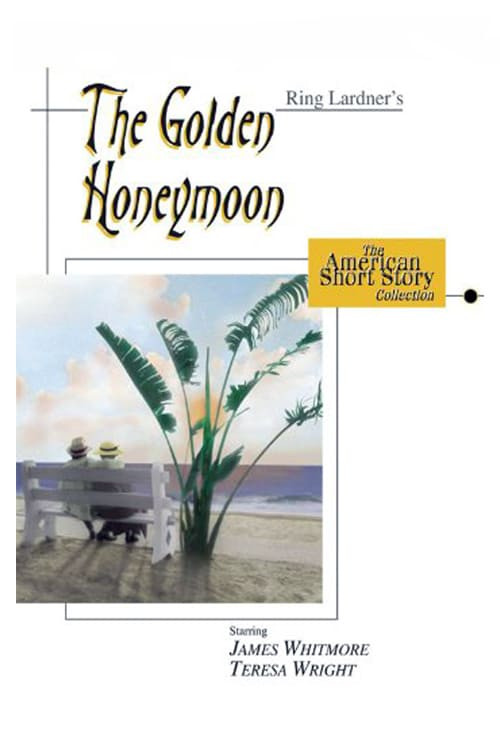
Episode #10: The Golden Honeymoon (1980, directed by Noel Black)
Hey, guest reviewer here! Don’t worry, Lisa will return next week. Next week’s episode has got Eric Roberts in it and she told me there’s no way she’s going to miss that!
This episode is an adaptation of a short story by the author Ring Lardner, who was a member of the Algonquin Round Table and whose son won an Oscar for writing the script for the movie version of M*A*S*H. TheGoldenHoneymoon about an old couple (James Whitmore and Teresa Wright) who celebrate their 50th anniversary by going on a “golden honeymoon” to Florida. While there, they meet the wife’s old flame (Larry Loonin) and Whitmore feels like he has to win his Wright all over again. Whitmore and Loonin play a lot of different games, like shuffleboard and checkers. You know you don’t want to get between a group of elderly people playing checkers! Wright gets frustrated with Whitmore but they make up by the end of the episode. They bicker but they love each other.
I have not read the original short story on which this episode is based. Ring Lardner was famous for his wit and he probably could have found a lot of comedic moments in two old romantic rivals having an intense checkers game. The episode itself reminded me of those films that my high school English teachers would always show in class. “You are going to love this,” the teacher always says and then the members of the class sit there in stony silence as they watched the slowest, most visually static program imaginable. This episode was not just boring. It was PBS boring.
I don’t want to be to negative, though. I like both James Whitmore and Teresa Wright. Whitmore was the elderly prisoner in The Shawshank Redemption. Teresea Wright was in several classic Golden Age films. In The Golden Honeymoon, they were believable as an old married couple, who constantly argue but still clearly love each other.
Welcome to Retro Television Reviews, a feature where we review some of our favorite and least favorite shows of the past! On Saturdays, I will be reviewing The American Short Story, which ran semi-regularly on PBS in 1974 to 1981. The entire show can be purchased on Prime and found on YouTube and Tubi.
This week, after an introduction from Henry Fonda, TheAmericanShortStory presents a short film about a young man discovers that he’s a fool.
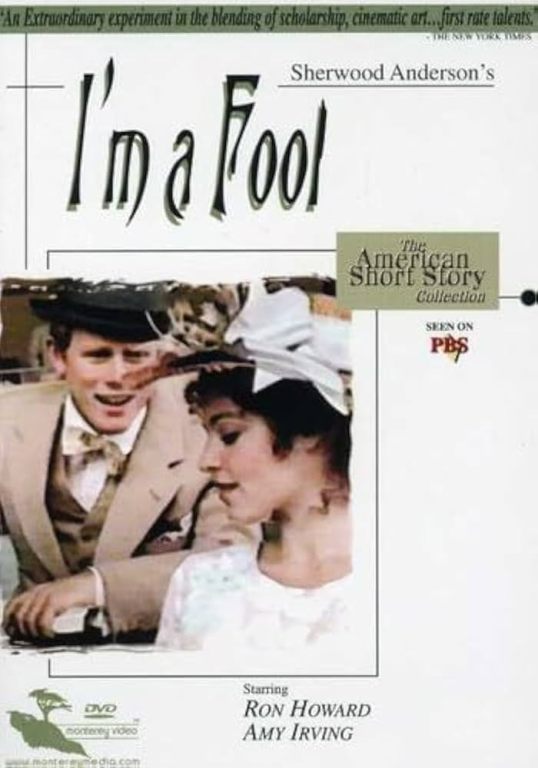
Episode 6 “I’m A Fool”
(Dir by Noel Black, originally aired in 1977)
In this adaptation of a Sherwood Anderson short story, Ron Howard (back in his younger days, before he became better-known as a director) stars as Andy. Andy is a young man who runs away from his safe and comfortable life in search of adventure. He gets a job as a “swipe,” which was apparently what people used to call the folks who took care of the horses at a racetrack. He and an older black man named Burt (Santiago Gonzalez) travel the racing circuit in Ohio and form a tentative friendship. Burt can tell that, for all of his attempts to come across as being tough and worldly, Andy is a virgin who gets drunk easily and who has no idea what the real world is like.
Andy claims to be a proud member of the working class but then he meets a pretty and rich girl named Lucy (Amy Irving). Andy introduces himself as being Walter, the son of a wealthy stable owner. Andy and Lucy spend the day together and Andy comes to realize that he loves her and that she seems to love him as well. But then Andy realizes that she only knows him as Walter and that it’s too late to tell her the truth. “I’m a fool,” Andy says before leaving with Burt.
This 35-minute short film featured good performances from Ron Howard and Amy Irving and some lovely shots of the countryside, showing why a life of wandering through rural Ohio might appeal to a young person searching for meaning. There’s a great scene in a bar where the outclassed Andy tries to prove himself to a bunch of snobs by drinking whiskey and smoking a cigar. Unfortunately, the strength of Sherwood Anderson’s original short story is that it puts us straight into Andy’s head and allows us to see the thought process that led to him coming up with his foolish lie. Despite featuring narration from Ron Howard, this adaptation doesn’t really accomplish that and, as a result, the viewer is always on the outside looking in.
It’s not a bad adaptation but it can’t beat sitting down and reading the original story.
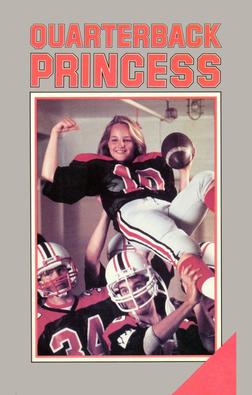
Welcome to Retro Television Reviews, a feature where we review some of our favorite and least favorite shows of the past! On Sundays, I will be reviewing the made-for-television movies that used to be a primetime mainstay. Today’s film is 1983’s Quarterback Princess. It can be viewed on YouTube!
Quarterback Princess begins with Ralph Maida (Don Murray) dropping in on the coach of a high school football team in the small town of Minnvile, Oregon. Ralph explains that he and his family are going to be relocating to the town from Canada. His eldest child wants to play football and Ralph is curious as to when the team will be holding the tryouts. The coach asks what position Ralph’s son plays. Ralph explains that Tami is his daughter and she plays quarterback. After an awkward moment of silence, the coach explains that he’ll have to talk to the school board.
Yes, Quarterback Princess is one of those films. It’s an only girl on the team film, in which an athletic teenager has to convince not only her male teammates but also all of the stodgy old people that she can play just as well as the boys. On the one hand, films (and shows, as Degrassi had an entire storyline about Jane trying to get on the school’s football team) like this are usually entertaining because it’s fun to watch a girl succeed while all of the men sputter with outrage until the team starts winning. On the other hand, they’re always a little bit difficult for me to relate to because I would honestly have no interest in doing what Tami’s doing and it’s hard for me to understand why anyone else would either. I mean, seriously why would anyone want to live in Oregon when Montana’s just a short drive away?
Quarterback Princess is based on a true story. In real life, Tami Maida was 14 year old when she joined her high school football team as their quarterback. That season, the team had a record of 7-1 and they won the state championship. Tami was also elected Homecoming Queen that seem year. The parts of the movie that seem like the type of thing that only a screenwriter could come up actually happened. Helen Hunt, who was 20 years old at the time, plays Tami. When I watched the film, I thought Hunt did a good job in the scenes off field but I thought she was a bit unconvincing when she was actually playing the game and throwing the ball. Fortunately, I did some research before I actually wrote this review and I discovered that Tami served as Helen Hunt’s stand-in during the film and, in most of the game scenes, that actually is Tami throwing the ball and running around the field. That shows you how much I know about football.
Quarterback Princes is definitely a made-for-television production. These are the only high school football players in existence who neither drink nor curse. For that matter, the coaches are surprisingly nice as well. That said, it isn’t bad. The best scenes are the ones that feature Tami and her family adjusting to Tami’s sudden fame. Daphne Zuniga gives a sympathetic performance as Tami’s sister, who is not particularly happy about how Tami’s sudden fame has changed everyone’s lives. The always likable John Stockwell plays Tami’s boyfriend and the two of them are a believable couple. Noel Black, who also directed Pretty Poison, does a good job of keeping the action moving at a steady pace. Probably the worse thing you can say about this film is that it was a bit predictable but, in this case, all of the predictable stuff actually happened so what can you do?
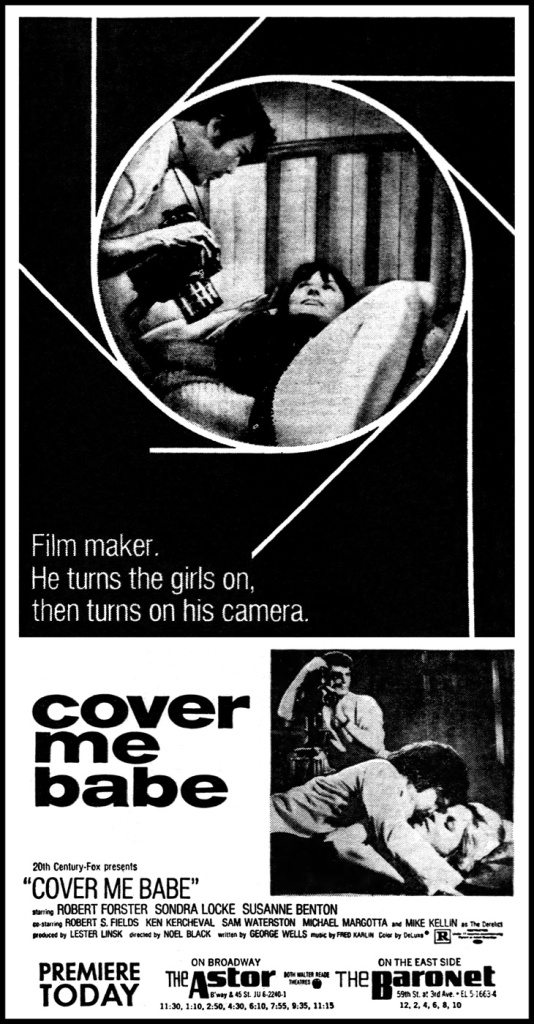
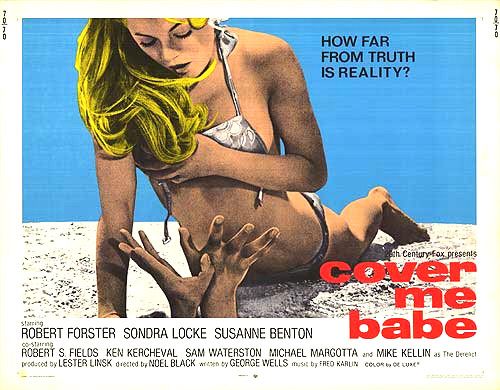
I don’t know if I’ve ever come across a non-horror film that featured a more off-putting lead character than Tony, the protagonist of 1970’s Cover Me, Babe.
A film student, Tony (Robert Forster, even in 1970, who was too old for the role) aspires to make avant-garde films. Everyone in the film continually raves about how talented Tony is. The footage that we see, however, tends to suggest that Tony is a pretentious phony. The film opens with footage of a student film that Tony shot, one that involves his girlfriend, Melisse (Sondra Locke) sunbathing in the desert and getting groped by a hand that apparently lives under the sand. It was so self-consciously arty that I assumed that it meant to be satirical and that we were supposed to laugh along as Tony assured everyone that it was a masterpiece. And, to be honest, I’m still not sure that Cover Me, Babe wasn’t meant to be a satire on film school pretension. I mean, that explanation makes about as much sense any other. (Hilariously enough, Tony’s film had the same visual style as the film-within-a-film around which the storyline of Orson Welles’s The Other Side of the Wind revolved. At least in the case of Welles, we know that his intent was satirical.)
Tony is not only pretentious but he’s also a bit of a prick. He treats Melisse terribly and he manipulates everyone around him. He wanders around the city with his camera, filming random people and then editing the footage together into films that feel like third-rate Godard. He answers every criticism with a slight smirk, the type of expression that will leave you dreaming of the moment that someone finally takes a swing at him. Tony’s arrogant and he treats everyone like crap but, for whatever reason, everyone puts up with him because …. well, because otherwise there wouldn’t be a movie. Of course, eventually, everyone does get sick of Tony because otherwise, the movie would never end.
A Hollywood agent (Jeff Corey) calls up Tony and offers to get him work in Hollywood. Tony is rude to the guy on the phone. Tony meets a big time producer who could get Tony work. Tony’s rude to him. Guess who doesn’t get a job? Tony has to get money to develop his latest film from one of his professors so he’s rude to the professor. Guess who doesn’t get any money? Tony cheats on his loyal girlfriend. Tony’s cameraman (played by a youngish Sam Waterston) walks out when Tony tries to film two people having sex. By the end of the movie, no one wants anything to do with Tony. Tony goes for a run on the beach. He appears to be alienated and disgruntled. We’re supposed to care, I guess.
The problem with making a movie about an arrogant artist who alienates everyone around him is that you have to make the audience believe that the artist is talented enough to justify his arrogant behavior. For instance, if you’re going to make a movie about a painter who is prone to paranoid delusions and obsessive behavior, that painter has to be Vincent Van Gogh. He can’t just be the the guy who paints a picture of two lion cubs and then tries to sell it at the local art festival. You have to believe that the artist is a once-in-a-lifetime talent because otherwise, you’re just like, “Who cares?” The problem with Cover Me, Babe is that you never really believe that Tony is worth all of the trouble. The film certainly seems to believe that he’s worth it but ultimately, he just comes across as being a jerk who manipulates and mistreats everyone around him.
That said, from my own personal experience, a lot of film students are jerks who treat everyone them like crap. So, in this case, I think you can make the argument that Cover Me, Babe works well as a documentary. The fact of the matter is that not every film student is going to grow up to be the next Scorsese or Tarantino or Linklater. Some of them are going to turn out to be like Tony, running along the beach and wondering why no one agrees with him about George Stevens being a less interesting director in the 50s than he was in the 30s. As a docudrama about the worst people that you’re likely to meet while hanging out on campus, Cover Me, Babe is certainly effective. Otherwise, the film is a pretentious mess that’s done in by its unlikable protagonist. Everyone in the film says that Tony has what it takes to be an important director but, if I had to guess, I imagine he probably ended up shooting second unit footage for Henry Jaglom before eventually retiring from the industry and opening up his own vegan restaurant in Vermont. That’s just my guess.
The 1971 film Jennifer On My Mind opens with a lengthy montage of black-and-white photographs of immigrants arriving at Ellis Island. These, the film tells us, are the men and women who came to America with nothing and who fought and struggled to have something. The film itself deals with the grandchildren of those immigrants, who, as opposed to their ancestors, now have everything and who seem to be determined to reduce it all down to nothing.
24 year-old Marcus Rottner (Michael Brandon) would appear to have everything. Following the death of his father, Marcus has inherited the fortune that his immigrant grandfather earned. (The ghost of his grandfather shows up at one point and smokes a joint.) Marcus will never have to work a day in his life, owns a nice apartment, and can go to Europe whenever he feels like it. However, Marcus does have one problem: his girlfriend Jennifer (Tally Walker) just died of a heroin overdose in his living room. Now, Marcus has to try to dispose of the body without anyone discovering what has happened.
The film alternates between showing Marcus’s attempts to get ride of Jennifer’s body and flashbacks to his romance with her. We see how he first met Jennifer in Venice and how he fell in love with her. Like Marcus, Jennifer comes from a rich family. Her parents are alive but we never see them. (Reportedly, scenes were filmed that featured Kim Hunter as Jennifer’s mother but they were cut after a disastrous preview.) As she leaves Venice, Jennifer tells Marcus to visit her back in the states.
Which is just what Marcus does. Marcus and Jennifer’s relationship plays out like a romantic comedy, except for the fact that Jennifer doesn’t really seem to care that much for Marcus. After Jennifer jumps off a roof, Marcus takes her back to Venice and tries to recreate their earlier romance. However, Jennifer just wants to go back to New York…
About ten minutes into the film, I nearly stopped watching Jennifer On My Mind. Both Marcus and Jennifer seemed like such unlikable characters that I couldn’t imagine spending a full 90 minutes with them. The fact that they were both rich and spoiled didn’t help.
But I kept watching because the first part of the film was set in Venice and I love Venice! Watching those scenes reminded me of visiting Italy the summer after I graduated from high school. It was a great time and, despite how I felt about Marcus and Jennifer, the film still brought back some nice memories.
However, then Marcus and Jennifer returned to New York and, since I don’t really care about New York the way that I care about Venice, I again found myself tempted to stop watching. However, it was around this time that I started to realize that Michael Brandon was actually giving a pretty good performance in the role of Marcus. So, I decided to keep giving the film a chance.
And then the ghost of Marcus’s grandfather showed up. And then, the film gave us a scene of Jennifer hanging out with the two traveling “minstrels.” And I thought to myself, “This is getting unbearably cutesy…”
But then, Robert De Niro showed up! That’s right — Jennifer On My Mind is an early De Niro movie. When Marcus hails a cab and asks for a ride to Long Island, the taxi driver is played by none other than Robert De Niro. And while De Niro is only in the film for a few minutes, he totally steals those few minutes. He plays a “gypsy” cab driver in this film and, as he drives Marcus to Long Island, he rambles about his sister, his drugs, and his fear of driving Marcus to see a bunch of “squares.” De Niro is such an eccentric and energetic presence that he brings the whole film to life.
After De Niro’s scene, there was only 30 minutes left in the film and I thought to myself, “Okay, I can give this another 30 minutes…”
Written by Love Story‘s Erich Segal and directed by Pretty Poison‘s Noel Black, Jennifer On My Mind is an uneven but oddly watchable film. If you’re looking for quirky love story … well, I really can’t recommend Jennifer On My Mind because it never really convinces you that Marcus and Jennifer are in love. For the most part, their relationship seems to be one of convenience. Jennifer wants drugs and Marcus can afford them. Marcus wants a girlfriend and Jennifer is willing to pretend. Instead, Jennifer On My Mind is more like a parody of true romance. Marcus spends the entire film wanting Jennifer’s body and now that he has it, he has to find a way to get rid of it.
It’s undeniably uneven; for every scene that works, there’s another one that doesn’t. But, at the same time, it’s undeniably watchable. Plus, you get an early performance from Robert De Niro!
Jennifer On My Mind is currently available to viewed on Netflix.
“I don’t care if critics like it; I hated it. I can’t like or be objective about films I had a terrible time doing.”
— Tuesday Weld on Pretty Poison (1968)
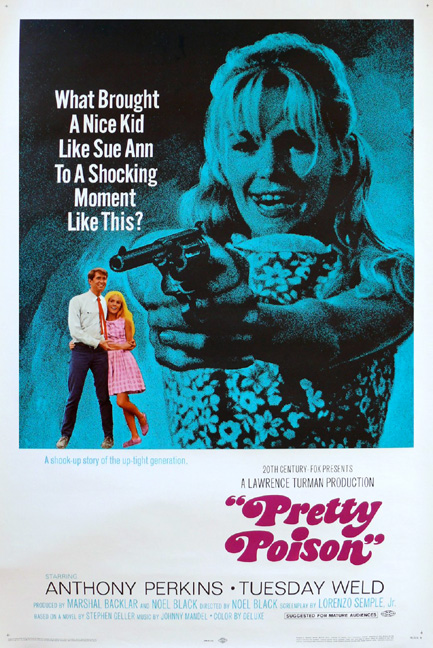
It’s actually rather depressing to read that Tuesday Weld hates Pretty Poison because it really is an underrated gem, a nifty little thriller that acts as sly satire on youth, conformity, and small town life. The main reason that the film works is because of the performances delivered by both Weld and her co-star, Anthony Perkins.
But then again, when we the viewers think back on a movie, we remember what we saw as a member of the audience and sometimes, we forget that just because a film is fun to watch, that doesn’t necessarily mean that it was enjoyable to make. When actors and other technicians think back on a film they were involved with, they remember the experience of actually making it. Reportedly, Weld did not get along with the director of Pretty Poison and couldn’t wait to get away from him.
Interestingly enough, in Pretty Poison, Tuesday Weld plays a teenage girl who doesn’t get along with her mother and who can’t wait to get away from her. Perhaps being miserable while making Pretty Poison helped Weld to bring a miserable character to life.
Pretty Poison opens with a nervous-looking man named Dennis Pitt (Anthony Perkins) watching a group of high school cheerleaders practicing on a field. His attention is focused on one cheerleader in particular, the blonde Sue Ann Stepanek (Tuesday Weld). Even before the opening credits have ended, the film has established a familiar dynamic. Sue Ann is the fresh-faced example of small town American innocence. Dennis is the type of creepy older guy that every girl has had to deal with at some point in her life. (When I was in high school, there were always guys like Dennis hanging out around the mall. When I was in college, the Dennis Pitts of the world were the guy who still hung out around the dorms even though they hadn’t been a student in a decade.)
Having established this dynamic early on, Pretty Poison spends the rest of its running time turning that dynamic upside down.
Dennis has recently been released from a mental hospital. Under the watchful eye of his parole officer (John Randolph), Dennis gets a mind-numbingly dull job at a local mill and tries to live a normal life. When Dennis finally does get a chance to talk to Sue Anne, he lies to her and tells her that he’s a secret agent and that he’s in town on a mission. Sue Anne responds to Dennis’s awkward flirting and soon, she’s accompanying him on his “missions.” During one such mission near the mill, they’re spotted by a security guard. Sue Anne responds by enthusiastically murdering him.
Yes, the cheerleader’s a sociopath.
Sue Anne’s tyrannical mother (Beverly Garland) does not approve of her relationship with Dennis. Sue Anne wants her mother out of the way and she expects her secret agent boyfriend to help her out…
Pretty Poison is a sharp mix of dark comedy and heightened drama, one that gets progressively darker as it progresses. From the minute the film first shows Sue Anne intensely practicing on that field while Dennis watches her, it’s pretty obvious that the film was meant to be an allegory for American society in 1968. Sue Anne is the perfect, all-American cheerleader who kills people because she can. Dennis is the neurotic outsider who knows that he’ll never be able to get anyone to believe the truth.
And it all works, largely because both Anthony Perkins and Tuesday Weld are so well-cast. It is, of course, impossible to watch Perkins without first thinking about Psycho but he actually manages to make Dennis into a very different character from Norman Bates. If Norman was a psycho who, at first sight, looked like an innocent, Dennis is an innocent who, at first sight, looks like a psycho. Tuesday Weld, meanwhile, turns Sue Anne into a disturbingly plausible killer, the type who, within minutes, can alternate between moodiness and giddiness, all the while squealing with orgasmic joy while bashing in someone’s head.
Tuesday Weld may hate Pretty Poison but it’s still a pretty good movie.
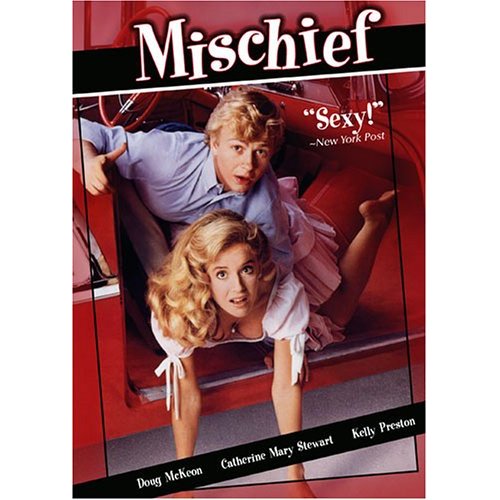
Have you ever noticed how, occasionally, a totally obscure film that was made several decades ago will suddenly show up on either Starz or Encore and, the next thing you know, it’s only like every other day? That was the case a few months ago when, at times, it seemed as if the only thing playing on cable was a teen comedy from 1985 called Mischief.
After I saw it listed in the guide a few dozen times, I thought to myself, “Somebody at that station must really like that movie.” So, one night, I actually took the time to watch it and discovered why that mysterious person loved this movie. Mischief may not be as well-known as some of the other films in this series of Back to School reviews but it’s still a pretty good movie.
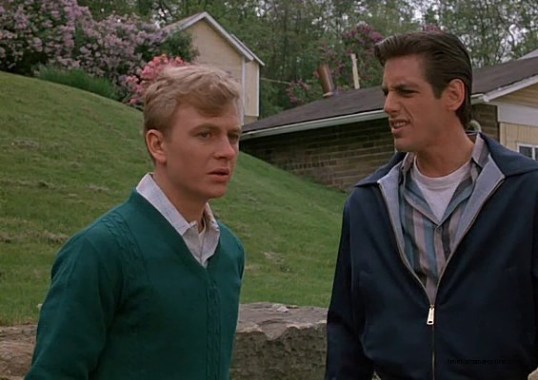
Like so many of the teen films that were released in the 70s and 80s, Mischief takes place in the 1950s. (I assume that’s because most films about teenagers are made by adults who want to both relive and perhaps change the past. I suppose that’s one reason why so many films released today are set in the 1990s. In another ten years or so, all of the new high school films will be set in 2003.) The very shy and clumsy Jonathan (Doug McKeon) has a crush on the beautiful but unattainable Marilyn (Kelly Preston). Fortunately, Jonathan is befriended by Gene (Chris Nash) who is the prototypical rebel without a cause. Gene wears a leather jacket. Gene rides a motorcycle. Gene doesn’t get along with his alcoholic, violin-playing father (Terry O’Quinn, in full asshole mode here). Gene even stands up to the school bully (D.W. Brown) and starts dating the bully’s ex-girlfriend, Bunny (Catherine Mary Stewart). Most importantly, Gene helps Jonathan finally develop the confidence necessary to ask Marilyn out.
And, for a while, Gene & Bunny and Jonathan & Marilyn make for the perfect foursome. But, as we all know, perfection can never last in a coming-of-age story. Jonathan starts to discover that he and Marilyn are not quite as compatible as he originally assumed that they were. As for Gene, he has to deal with his increasingly violent and drunken father…
That last paragraph probably makes Mischief sound a lot more dramatic than it actually is. Make no mistake about it — while Mischief does deal with some serious issues — it is primarily a comedy and a pretty good one at that. McKeon is endearingly clumsy in his initial attempts to get Marilyn to notice him and Nash — even though he’s playing a very familiar character — is likable as well. Perhaps the smartest thing that Mischief did is that it made Gene cool but it didn’t make him too cool. The film’s best scenes are the ones where Gene momentarily surrenders his rebel facade and reveals that he’s just as confused as everyone else. Catherine Mary Stewart and Kelly Preston are well-cast as well, with Preston especially doing a good job at making a potentially unsympathetic character likable.
In many ways, Mischief is a pretty predictable film. I think it features probably every single cinematic cliché that one would expect to see in a film about the 50s. But the film itself is so likable and good-natured that it doesn’t matter if it’s predictable. It’s just a good, enjoyable movie and what’s wrong with that?
(Incidentally, the screenplay for Mischief was written by Noel Black, who also directed the previously reviewed Private School.)
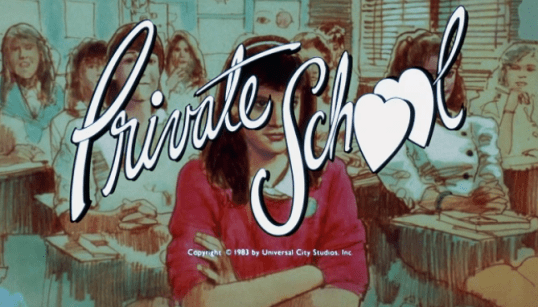
In my previous two Back To School reviews, I took a look at two classic teen comedies. Fast Times At Ridgemont High and Risky Business both used and manipulated the standard teen comedy trappings to tell unusually nuanced stories about growing up. These are films that used the audience’s familiarity with the genre to tell stories that ultimately challenged the viewer’s preconceived notions and expectations. Having considered those two films, let us now consider Private School, a film that used all of the standard teen comedy clichés to make a very standard teen comedy.
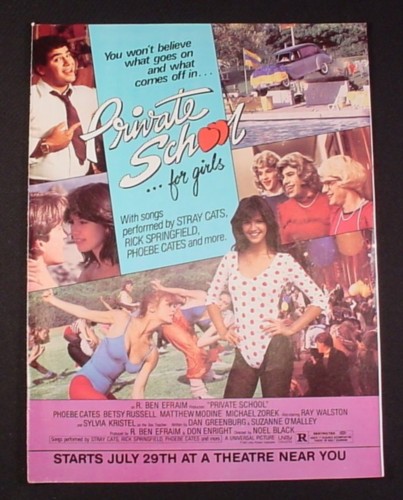
For instance, the film tells the story of two groups of three. There’s the three girls who attend Cherryvale Academy: good girl Christine (Phoebe Cates), bad (and rich) girl Jordan (Betsy Russell), and vaguely asexual tomboy Betsy (Kathleen Wilhoite). And then there’s three guys who attend Freemount Academy. There’s a fat guy named Bubba (Michael Zorek), a short guy named Roy (Jonathan Prince) and a nice guy named Jim (Matthew Modine). Bubba is dating Betsy. Christine is dating Jim. Jordan is dating no one because she’s too busy trying to steal Christine’s boyfriend. Roy is also single, largely because adding a fourth girl would throw off the film’s group-of-three dichotomy.
There’s also a lot of boobs, largely because Private School was made to appeal to teenage boys and you really have to wonder how many of them left the theater thinking that all they had to do to get a girl to disrobe was spill some fruit juice on her dress and then suggest that she take it off. There’s even a scene where Jordan rides a horse naked because — well, why not?
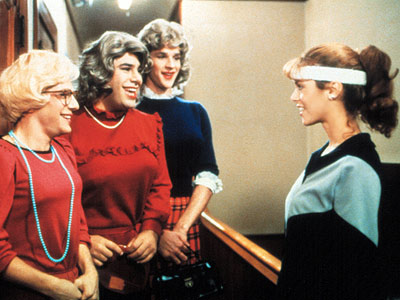
And then there’s an extended sequence where each of the three boys puts on a wig, a red dress, way too much lipstick and then sneak into the girl’s dormitory because cross-dressing is always good for a few easy laughs. Despite their best attempts to speak in falsetto voices, Jim, Bubba, and Roy make for three of the least convincing women that I’ve ever seen but, to the film’s credit, that’s kind of the point. It’s a stupid plan that leads to stupid results.
Of course, the film is also full of terrible adult authority figures. And why not? It’s not like anyone over the age of 18 was ever going to watch the film. So, of course, Jordan’s father is going to be lecherous old perv with a trophy wife. And, of course, all of Cherryvale’s teachers are going to be a collection of spinsters and alcoholics. In the end, the only adult who isn’t a raging hypocrite is the friendly town pharmacist (played by Martin Mull) who, of course, is mostly present so he can make Jim feel nervous about buying condoms.
And, ultimately, Private School is one of those films that wants to be racy and dirty (in order to appeal to teenage boys) while also being sweet and romantic (in order to appeal to teenage girls). The main plot revolves around Jim and Christine’s plans to go away for a weekend so that they can have sex for the first time and the film actually handles this pretty well. Matthew Modine and Phoebe Cates both have a really sweet chemistry. They’re a really cute couple and you hope the best for them. But there’s just so many complications, the majority of which could have been avoided by Jim not being an idiot. It never seems to occur to Jim that maybe he’d finally be getting laid if he wasn’t always doing things like dressing up in drag and trying to sneak into the girl’s dormitory.
That doesn’t necessarily mean that Private School is a terrible film. As far as boob-obsessed teen sex comedies go, Private School is actually pretty well-done and watchable. The cast is likable and director Noel Black keeps the action moving. Even the film’s nominal villain is likable, with Betsy Russell playing Jordan as being more mischievous than spiteful. But, ultimately, what makes Private School memorable is the fact that it is so predictable, that it does literally contain every single cliché that one would expect to find in a teen comedy. This is a film so determined to not bring anything new to the genre that it becomes an oddly fascinated study in how to maintain a status quo.
In fact, perhaps the most innovative thing about Private School is the song that plays over the opening credits. The song — which is called You’re Breakin’ My Heart and is performed by Harry Nilsson — starts with: “You’re breaking my heart/you’re tearing it apart/so fuck you…”
That’s about as close to being subversive as Private School ever gets.
After spending two weeks researching the career of Jason Voorhees, I am in the mood for some movies that feature absolutely no one getting brutally murdered. That’s why this edition of Lisa Marie’s Favorite Grindhouse and Exploitation Trailers is dedicated to some of the most light-weight comedies ever made.
(Yes, I realize that these films aren’t exactly grindhouse films but they’re close enough.)
1) Making the Grade (1984)
This trailer almost feels like a parody, doesn’t it? In fact, it very well could be. Has anyone ever actually seen this Making the Grade movie?
2) White Water Summer (1987)
This is a weird movie that, for some reason, tends to pop up on TV every few months or so. Kevin Bacon is a nature guide who appears to be sociopath and Sean Astin is the kid that he bullies nonstop. Eventually, Bacon breaks his leg and Astin saves his life or something like that. The whole movie just has a really weird feel to it.
3) Private Lessons (1981)
These next three trailers form a trilogy of sorts. We start off with Private Lessons, which — let’s be honest — is a pretty creepy trailer.
4) Private School (1983)
The 2nd part of the private trilogy was directed by Noel Black who also directed one of the best films of the 60s, Pretty Poison.
5) Private Resort (1985)
And then we come to this…Private Resort. Much like White Water Summer, Private Resort used to always show up on Sunday afternoon TV and I’ve never really understood why. That said, I watched it a few times because I’ll watch Johnny Depp in anything.
6) Fraternity Vacation (1985)
And finally, let’s wrap things up with Fraternity Vacation, starring future Oscar winner Tim Robbins.

 Through the Shattered Lens