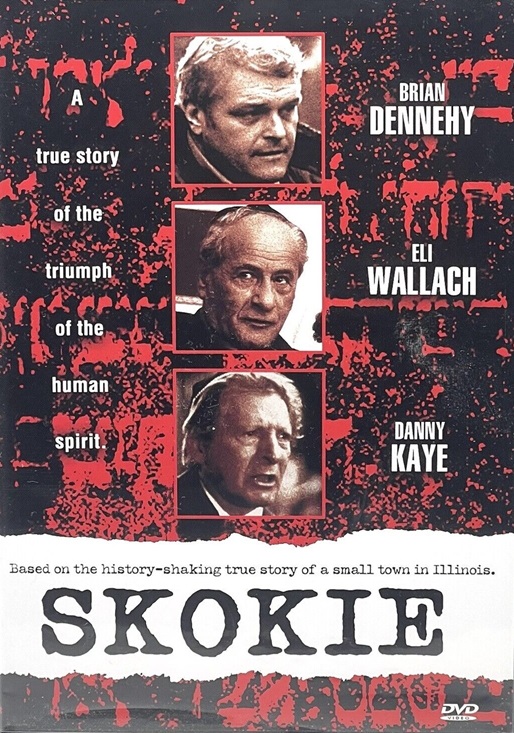
Made-For-Television Movie Review: Skokie (dir by Herbert Wise)


Skokie, a 1981 made-for-television movies, opens in a shabby Chicago office.

A group of men, all wearing brownshirts and swastika armbands, listen to their leader, Frank Collin (George Dzundza).  Collin says that they will be holding their next rally in the town of Skokie.  Collin explains that Skokie has a large Jewish population, many of whom came to the United States after World War II.  Collin wants to march through their town on Hitler’s birthday.

If not for the swastika and the brownshirt, the overweight Collin could easily pass for a middle-aged insurance salesman, someone with a nice house in the suburbs and an office job in the city.  However, Frank Collin is the head of the American National Socialist Party. a small but very loud group of Nazis who specialize in marching through towns with large Jewish populations and getting fee media attention as a result of people confronting them.  Making Frank Collin all the more disturbing is that he isn’t just a character in a made-for-television movie.  Frank Collin is a real person and Skokie is based on a true story.

The Mayor (Ed Flanders) and the police chief (Brian Dennehy) of Skokie are, needless to say, not happy about the idea of modern-day Nazis marching through their city.  Though they inform Collin that he will have to pay for insurance before he and his people will be allowed to hold their rally, they know that the courts have been striking down the insurance requirement as being a violation of the First Amendment.  While the mayor and the police chief worry about the political fallout of the rally, the Jewish citizens of Skokie debate amongst themselves how to deal with the Nazis.  Bert Silverman (Eli Wallach) and Abbot Rosen (Carl Reiner) argue that the best way to deal with Collin and his Nazis is to refuse to acknowledge them, to “quarantine” them.  As Rosen explains it, Collin is only marching to get the free publicity that comes with being confronted.  If he’s not confronted, he won’t make the evening news and his rally will have been for nothing.  However, many citizens of Skokie — including Holocaust survivor Max Feldman (Danny Kaye) — are tired to turning their back on and ignoring the Nazis.  They demand that the Nazis be kept out and that, if they do enter the city, they be confronted.

With the support of the ACLU, Collin sues for his right to march through Skokie.  The ACLU is represented by Herb Lewishon (John Rubinstein), a Jewish attorney who hates Collin and everything that he stands for but who also feels that the First Amendment must be respected no matter what.  When Lewishon is asked how he, as a Jew, can accept a Nazi as a client, Lewishon relies that his client is the U.S. Constitution.

Skokie is a thought-provoking film, all the more so today when there’s so much debate about who should and should not be allowed a platform online.  (Indeed, Collin and his Nazis would have loved social media.)  Lewishon argues that taking away any group’s First Amendment rights, regardless of how terrible that group may be, will lead to slippery slope and soon everyone’s First Amendment rights will be at risk.  Max Feldman, and others argue that the issue isn’t free speech.  Instead, the issue is standing up to and defeating evil.  The film gives both sides their say while, at the same time, making it clear that Frank Collin and his Nazis are a bunch of fascist losers.  It’s a well-acted and intelligently written movie, one that rejects easy answers.  Needless to say, at a time when so many people feel free to be openly anti-Semitic, it’s a film that’s still very relevant.

As for the real Frank Collin, he would eventually be charged with and convicted of child molestation.  After three years in prison, he changed his name to Frank Joseph and became a writer a New Age literature.  He’s looking for Atlantis but I doubt they’d want him either.
Horror Film Review: Godzilla (dir by Roland Emmerich)


There’s a giant lizard rampaging through New York, the result of a mutation that happened as a result of being exposed to radiation.  The military tries to stop the lizard but it turns out that stopping a giant lizard is not that easy.  Scientists try to understand the lizard and how it came to be a destructive giant.  The media breathlessly reports from the scene as two wisecracking cameramen do their best to record every second of the mayhem.  The reporters call this lizard …. GODZILLA!

But is it Godzilla?

No, it’s not.  Oh, it may be called Godzilla.  And the movie itself may be called Godzilla.  But the creature at the center of the 1998 American film Godzilla is definitely not Godzilla.

Godzilla was released with a great deal of fanfare in 1998, with commercials and toys and a lot of hype.  Diddy, back when he was still calling himself Puff Daddy, recorded a song for the soundtrack and upset thousands of Led Zeppelin fans like my Dad who found themselves having to deal with kids who thought Kashmir was called Follow Me.  (Diddy singing, “Follow me?”  AGCK!  How cringey is that!?)  But, like many of the film of Roland Emmerich, it’s been almost totally forgotten in the years since.

And why not?  It’s a forgettable film.  It’s the epitome of an assembly-line action blockbuster, the type of thing that Roland Emmerich is known for.  There’s comic relief, in the form of Hank Azaria.  There’s a nerdy scientist hero in the form of Matthew Broderick.  Broderick’s scientist has an ex-wife and yes, Godzilla’s invasion of New York gives them a chance to get back together.  There’s a mysterious Frenchman who is played, somewhat inevitably, by Jean Reno.  The Mayor of New York is a fat guy named Ebert (Michael Lerner) and he has an assistant named Gene (Lorry Goldman) and they get a lot of screentime because Emmerich wanted to make fun of two films critics who didn’t care much for his work.  In fact, the Mayor and his assistant get so much screentime that it distracts from the rest of the film.  Emmerich was directing a multi-million dollar reboot of a beloved franchise and he was more concerned with a petty feud.

He certainly wasn’t concerned with Godzilla.  Personally, I like the giant lizard and one of the only effective moments in the film is when the lizard discovers that its children have been killed by the military.  But that lizard is not Godzilla and the fact that Emmerich made a Godzilla film without Godzilla indicates that he didn’t really care about the monster or its fans.  This film has no love for its source material and that’s a shame.  The Godzilla films are fun!  And the fact that the majority of the ones made up until the release of this film looked kind of cheap and featured a Godzilla who was obviously a man in a rubber suit only added to the fun.  There’s not much fun to be found in this version of Godzilla.  The movie looks great without ever making much of an impression.

And you know what?  Having gotten this review out of the way, I’m ready to get back to reviewing the true Godzilla films.  They may not have cost as much as Emmerich’s film but they’ve got heart.

Previous Godzilla Reviews:

  1. Godzilla, King of the Monsters (1958)
  2. Godzilla Raids Again (1958)
  3. King Kong vs Godzilla (1962)
  4. Mothra vs. Godzilla (1964)
  5. Ghidorah: The Three-Headed Monster (1964)
  6. Invasion of the Astro-Monster (1965)
  7. Godzilla vs. The Sea Monster (1966)
  8. Son of Godzilla (1967)
  9. Destroy All Monsters (1968)
  10. All Monsters Attack (1969)
  11. Godzilla vs Hedorah (1971)
  12. Godzilla vs Gigan (1972)
  13. Godzilla vs Megalon (1973)
  14. Godzilla vs Mechagodzilla (1974)
  15. The Terror of Mechagodzilla (1975)
  16. Cozilla (1977)
  17. Godzilla 1985 (1985)
  18. Godzilla vs. Biollante (1989)
  19. Godzilla vs King Ghidorah (1992)
  20. Godzilla vs. Mothra (1992)
  21. Godzilla vs Mechagodzilla 2 (1994)
  22. Godzilla vs SpaceGodzilla (1994)
  23. Godzilla vs. Destoroyah (1995)
  24. Godzilla, Mothra, and King Ghidorah: Giant Monsters All-Out Attack (2001)
  25. Godzilla (2014)
  26. Godzilla: Planet of the Monsters (2017)
  27. Godzilla, King of the Monsters (2019)
  28. Godzilla vs Kong (2021)
  29. Godzilla Minus One (2023)

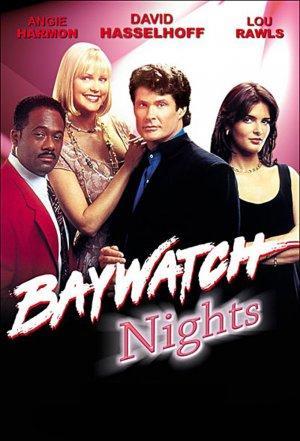
Late Night Retro Television Reviews: Baywatch Nights 1.6 “976 Ways To Say I Love You”


Welcome to Late Night Retro Television Reviews, a feature where we review some of our favorite and least favorite shows of the past!  On Tuesdays, I will be reviewing Baywatch Nights, an detective show that ran in Syndication from 1995 to 1997.  The entire show is currently streaming on Youtube!

This week, Ryan goes undercover!

Episode 1.6 “976 Ways To Say I Love You”

(Dir by Charles Bail, originally aired on November 4th, 1995)

The sixth episode of Baywatch Nights opens with Mitch and Garner doing a surveillance job on someone.  They are sitting out in their car and watching their target and talking about how much they hate having to work surveillance.

One thing that I’ve noticed about the first few episodes of Baywatch Nights is that Mitch and Garner both seem to spend a lot of time complaining about their job.  It’s a bit odd because it’s not like there’s any reason why they have to work as private detectives.  Garner could rejoin the police department if he wanted to.  Mitch actually has another full-time job as one of the top lifeguards in California.  There’s nothing that says they have to spend their nights doing surveillance.  (In fact, I’m not even sure how Mitch is balancing being a lifeguard with being a private eye.)  I mean, if it’s such a bother being a private eye, just don’t do it anymore!

The surveillance subplot doesn’t really have anything to do with the rest of the episode.  (It’s mostly just there so the episode can feature a joke about Garner and Mitch getting dusted by a crop duster that happens to fly over their convertible.)  Instead, the majority of this episode deals with Mitch, Garner, and Ryan helping Addy (Heather Campbell), a former phone sex operator who was scammed by her boss and who is now apparently being stalked by someone who is trying to murder everyone who was involved with Addy’s former career.  This is one of those cases that doesn’t really add up to much but it does provide Garner with a chance to do some real detective work and abandon his idea to abandon crime fighting and open a chicken franchise.

(Seriously, that’s what Garner was planning on doing.)

The investigation also leads to Ryan putting on a blonde wig and going undercover as a phone sex operator.  Watching this episode, I got the feeling that the entire pitch was, “Angie Harmon says sexy things on the phone,” and the plot was basically developed around that one idea.  It should be said that Angie Harmon actually does a pretty good job playing up Ryan’s irritation with having to go undercover.  The way she rolled her eyes whenever some mouth-breather started to talk to her told us everything we needed to know about the experience.  Unlike her whiny partner, Ryan did what she had to do to solve the case and good for her!  Really, this entire series should have just been Ryan kicking ass and solving crimes.  Garner and Mitch are just taking up space.

Along with Angie Harmon’s work as Ryan, this episode was also distinguished by the performance of Robert Ginty as the owner of the phone sex company.  Ginty was wonderfully sleazy as a businessman who made no apologies for how he made his money.  As well, Police Academy fans will probably be happy to see Michael Winslow, as a surveillance technician who imitates static.

The episode was not bad, even if it wasn’t particularly memorable.  Ryan did a good job and again proved herself to be the best private eye in California.  Seriously, though, Mitch and Garner need to stop crying so much.  If you don’t want to do detective stuff, don’t become a detective!

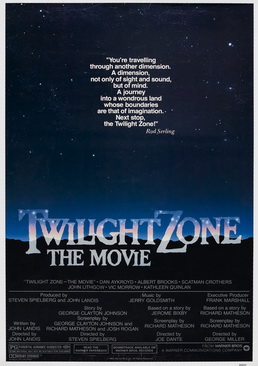
Horror Film Review: Twilight Zone: The Movie (dir by John Landis, Steven Spielberg, Joe Dante, and George Miller)


1983’s Twilight Zone: The Movie is meant to be a tribute to the classic original anthology series.  It features four “episodes” and two wrap-around segments, with Burgess Meredith providing opening and closing narration.  Each segment is directed by a different director, which probably seemed like a good idea at the time.

Unfortunately, Twilight Zone: The Movie is a bit of a mess.  One of the episodes is brilliant.  Another one is good up until the final few minutes.  Another one is forgettable.  And then finally, one of them is next too impossible to objectively watch because of a real-life tragedy.

With a film that varies as wildly in tone and quality as Twilight Zone: The Movie, the only way to really review it is to take a segment at a time:

Something Scary (dir by John Landis)

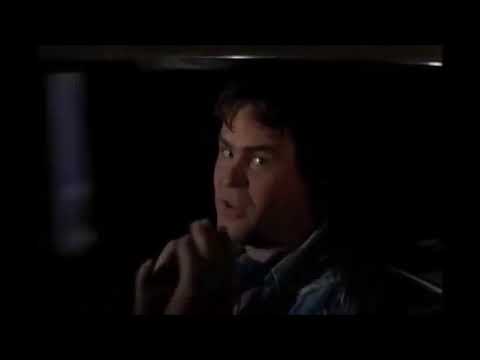
Albert Brooks and Dan Aykroyd drive through the desert and discuss the old Twilight Zone TV series.  Brooks claims that the show was scary.  Aykoyd asks if Brooks wants to see something really scary.  This is short but fun.  It’s tone doesn’t really go along with the rest of the movie but …. oh well.  It made me jump.

Time Out (dir by John Landis)

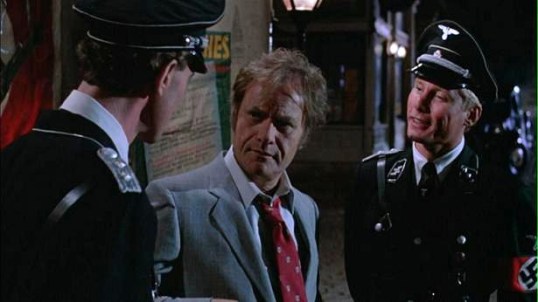
Vic Morrow plays a racist named Bill Connor who, upon leaving his local bar, finds himself transported to Nazi-occupied France, the deep South, and eventually Vietnam.

How you react to this story will probably depend on how much you know about its backstory.  If you don’t know anything about the filming of this sequence, you’ll probably just think it’s a bit heavy-handed and, at times, unintentionally offensive.  Twilight Zone often explored themes of prejudice but Time Out just seems to be using racism as a gimmick.

If you do know the story of what happened while this segment was being filmed, it’s difficult to watch.  Actor Vic Morrow was killed during filming.  His death was the result of a preventable accident that occurred during a scene that was to involve Morrow saving two Vietnamese children from a helicopter attack.  The helicopter crashed, killing not only Morrow but the children as well.  It was later determined that not only were safety protocols ignored but that Landis had hired the children illegally and was paying them under the table so that he could get around the regulations governing how many hours child actors could work.  It’s a tragic story and one that will not leave you as a fan of John Landis’s, regardless of how much you like An American Werewolf in London and Animal House.

Nothing about the segment feels as if it was worth anyone dying for and, to be honest, I’m kind of amazed that it was even included in the finished film.

Kick The Can (dir by Steven Spielberg)

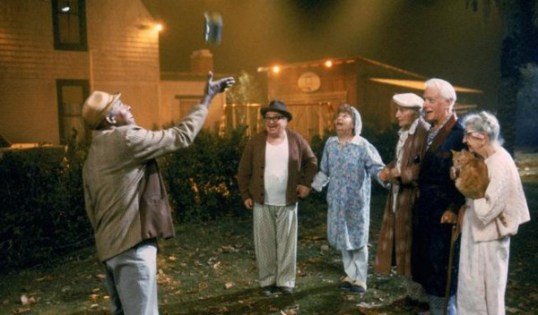
An old man named Mr. Bloom (Scatman Crothers) shows up at Sunnyvale Retirement Home and encourages the residents to play a game of kick the can.  Everyone except for Mr. Conroy (Bill Quinn) eventually agrees to take part and, just as in the episode of the Twilight Zone that this segment is based on, everyone becomes young.

However, while the television show ended with the newly young residents all running off and leaving behind the one person who refused to play the game, the movie ends with everyone, with the exception of one man who apparently became a teenager istead of a kid, deciding that they would rather be old and just think young.  That really doesn’t make any damn sense but okay.

This segment is unabashedly sentimental and clearly calculated to brings tears to the eyes to the viewers.  The problem is that it’s so calculated that you end up resenting both Mr. Bloom and all the old people.  One gets the feeling that this segment is more about how we wish old people than how they actually are.  It’s very earnest and very Spielbergian but it doesn’t feel much like an episode of The Twilight Zone.

It’s A Good Life (dir by Joe Dante)

A teacher (Kathleen Quinlan) meets a young boy (Jeremy Licht) who has tremendous and frightening powers.

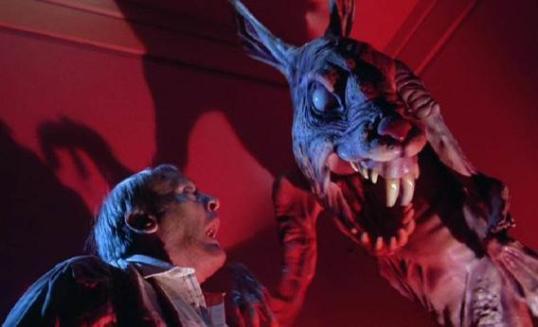
This is a remake of the classic Twilight Zone episode, It’s A Good Life, with the difference being that young Anthony is not holding an entire town hostage but instead just his family.  This segment was directed by Joe Dante, who turns the segment into a cartoon, both figuratively and, at one point, literally.  That’s not necessarily a complaint.  It’s certainly improvement over Spielberg’s sentimental approach to the material.  Dante also finds roles for genre vets like Kevin McCarthy, William Schallert, and Dick Miller and he provides some memorably over-the-top visuals.

The main problem with this segment is the ending, in which Anthony suddenly reveals that he’s not really that bad and just wants to be treated normally, which doesn’t make much sense.  I mean, if you want to be treated normally, maybe don’t zap your sister in a cartoon.  The teacher agrees to teach Anthony how to be a normal boy and again, what the Hell?  The original It’s A Good Life worked because, like any child, Anthony had no conception of how adults felt about him.  In the movie version, he’s suddenly wracked with guilt and it’s far less effective.  It feels like a cop out.

Still, up until that ending, It’s A Good Life worked well as a satire of the perfect American family.

Nightmare at 20,000 Feet (dir by George Miller)

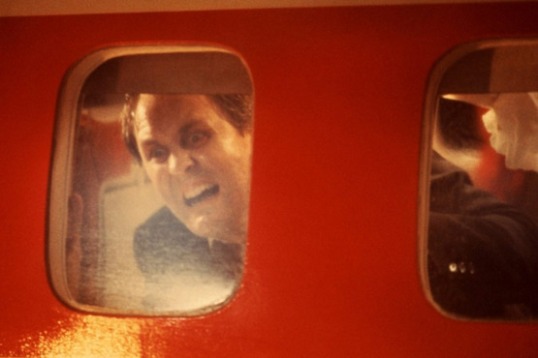
In this remake of Nightmare at 20,000 Feet, John Lithgow steps into the role that was originally played by William Shatner.  He plays a man who, while attempting to conquer his fear of flying, sees a gremlin on the wing of his airplane.  Unfortunately, he can’t get anyone else on the plane to believe him.

Nightmare at 20,000 Feet is the best of the four main segments.  It’s also the one that sticks closest to its source material.  Director George Miller (yes, of Mad Max fame) doesn’t try to improve on the material because he seems to understand that it works perfectly the way it is.  John Lithgow is also perfectly cast in the lead role, perfectly capturing his increasing desperation.  The one change that Miller does make is that, as opposed in the TV show, the gremlin actually seems to be taunting John Lithgow at time and it works wonderfully.  Not only is Lithgow trying to save the plane, he’s also trying to defeat a bully.

Something Scarier (dir by John Landis)

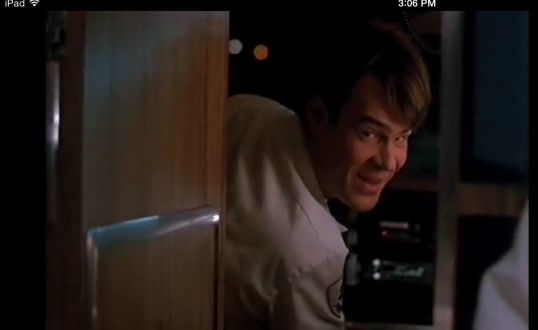
Dan Aykroyd’s back as an ambulance driver, still asking his passenger if he wants to see something really scary.  It’s an okay ending but it does kind of lessen the impact of Nightmare at 20,000 Feet.


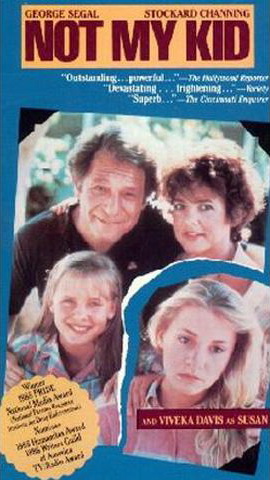
Back to School Part II #18: Not My Kid (dir by Michael Tuchner)


Not_my_kid

Not My Kid, a made-for-television from 1985, opens with 15 year-old Susan Bower (Viveka Davis) in a car with her friends.  They’re drunk.  They’re stoned.  They’re laughing.  And soon, they’re screaming as the driver loses control and the car ends up getting overturned!  (I’ve had that happen before.  It wasn’t fun but I survived with only a few cuts and bruises.)  Susan isn’t seriously hurt but, at the hospital, it’s discovered that she has alcohol and drugs in her bloodstream.

“NOT MY KID!” her father, surgeon Frank Bower (George Segal), declares.

“NOT MY KID!” her mother, Helen Bower (Stockard Channing, totally wasted in a thinly written role), agrees.

“Totally your kid!” her younger sister, Kelly (Christa Denton), says before then revealing where Susan hides her drugs.  This leads to Kelly getting beaten up by Susan and her drug addict boyfriend, Ricky (Tate Fuckin’ Donavon, decades before playing a hostage in Argo.).

Anyway, neither Frank nor Helen want to admit that Susan has a drug problem so instead, they go to see a smug family counselor who tells them that they are both being too hard on their daughter and that they need to just let Susan be Susan.  That sounds like a good (and easy) plan but then Susan runs away and disappears for two days.  After she’s finally found, stoned and hiding out in the family’s boat, her parents finally decide to send her to rehab.

The rehab is run by Dr. Royce.  Dr. Royce is played by Andrew Robinson and it took me a while to recognize him as being the same actor who played the Scorpio Killer in Dirty Harry.  Perhaps that explains why Dr. Royce came across as being such a creepy character.  As I watched this movie, I kept waiting for the big reveal where Dr. Royce would turn out to be a murderer or something.  That never happened, of course.  In the world of Not My Kid, the harsh and confrontational Dr. Royce is the only thing keeping the entire teenage population for shooting up heroin.

The majority of the film takes place at the rehab and it gets annoying pretty quickly.  This is one of those places where everything is done as a group activity.  Whenever someone says something, everyone in the group replies with, “We love you, so-and-so.”  When Susan doesn’t act properly ashamed of herself, the group gangs up on her.  “You’re a phony!” someone says.  “You’re full of crap!” another person adds.  “We love you, Susan,” the group chants.

AGCK!  Seriously, the rehab scenes totally freaked me out because it came across less like therapy and more like brainwashing.  I spent the entire movie waiting for Susan to escape and when she did, I was happy for her.  She may have been a self-destructive drug addict but at least wasn’t a mindless zombie like everyone else in the movie!  But then she ended up getting caught by her father and taken back to the rehab.

Meanwhile, her parents are going through therapy as well.  Again, it’s all group therapy.  When Frank tries to talk about how Susan’s behavior makes him feel, someone says, “You’re a phony!’  Another person adds, “You’re full of crap!”  And the group chants, “We love you, Frank.”  Okay, to be honest, I’m taking some dramatic license with the dialogue here but hopefully, you get the general idea.

I mean, seriously — I understand that I was supposed to be like, “Yay rehab!” while watching the movie but the rehab came across more like some sort of creepy cult.  It reminded me of both a Canadian film called, Ticket To Heaven and a Texas film called Split Image.  As I watched Not My Kid, I kept waiting for James Woods to show up as a cult deprogrammer.

Anyway, don’t worry.  Everything turns out well in the end.  This was a made-for-TV movie, after all.  Not My Kid is way too heavy-handed for its own good and it lacks a certain self-awareness.  On a more positive note, George Segal does a good job in the role of Frank.

You can watch Not My Kid below!