Film Review: The Purge: Election Year (dir by James DeMonaco)


The_Purge_Election_Year

I had really high hopes for The Purge: Election Year.

While the first Purge film was definitely flawed, it still had an interesting and thought-provoking premise behind it.  What would we do, the film forced us to ask, if we could do anything we wanted to for one night out of the year?  Would you hide in your house or would you go out and randomly kill people?  Yes, The Purge had its flaws but it was an interesting film.

And then, in 2014, The Purge: Anarchy was released.  Anarchy was one of the best films of 2014 (a film that saw no shortage of great films).  It was a big, loud, and over-the-top masterpiece of the pulp imagination, one that managed to be as thought-provoking as the first film while also keeping audiences entertained.  It was a political movie, perhaps one of the most overtly political to be released over the past ten years.  And yet, it was also amazingly entertaining.  By further exploring the type of society that would come up with something like an annual Purge, Anarchy forced audiences to think even as it gave them reasons to cheer and hiss.  For many viewers, it also served as an introduction to a tough and grizzled actor named Frank Grillo.  In the role of the enigmatic but ultimately good-hearted Leo Barnes, Frank Grillo gave an outstanding performance.

Well, The Purge: Election Year continues its exploration of the culture behind the Purge.  And Frank Grillo is back as Leo.  It should be said that, just as he did in Anarchy, Grillo supplies Election Year with some of its best moments.  Much like Clint Eastwood, Grillo can communicate an entire backstory just be squinting his eyes.

But overall, Election Year is a disappointment.  As I watched it, I found myself wondering if maybe director James DeMonaco should have quit when he was ahead and ended the series with Anarchy.  Anarchy pushed the idea behind The Purge about as far as it could go and it is perhaps not surprising that Election Year often feels like a rehash that was constructed out of leftovers.

Election Year finds Leo working as head of security for U.S. Sen. Charlie Roan (Elizabeth Mitchell).  Charlie, who saw her family massacred during an earlier purge, is running for President on an anti-Purge platform and it appears that she’s about to overtake the candidate of the New Founding Fathers, the Rev. Edwidge Owens (Kyle Secor).  The New Founding Fathers decide that the best way to take care of Charlie would be to assassinate her on Purge Night.  They announce that, for the first time since the Purge began, government leaders will no longer be granted immunity.

In short, anyone can be killed!

Leo’s idea is for Charlie to stay inside during Purge Night but, if that happened, there wouldn’t be a movie.  Naturally, Leo and Charlie eventually end up on the streets and they get to witness a few surreal and violent moments, none of which have quite the impact of anything we previously saw in Anarchy.  They are given some assistance by a deli owner (Mykleti Williamson) and, naturally, they meet up with rebel leader Dante Bishop (Edwin Hodge).  Just like in the previous film, Leo is eventually forced to decide between purging and showing mercy.

And it’s really never that interesting.  The whole film just falls flat.  The first two Purge film worked because they convinced you that something like The Purge could actually happen.  When, at the end of Anarchy, Leo chose not to murder someone, it felt like a great moment because you truly believed that Leo could have gotten away with murder if he wanted to.  But Election Day is never convinces you that you’re watching anything more than a standard issue sequel.  With the exception of Frank Grillo and Kyle Secor (more about him in a moment), none of the actors are particularly memorable or believable.  In fact, Mykelti Williamson gives a performance that is almost amazingly bad.

I think a huge part of the problem is that the character of Charlie is never credible.  Elizabeth Mitchell is a good actress and has appeared in some of my favorite TV shows (she was Juliet on Lost, for instance) but you never believe that she’s a dynamic senator who is destined to save America from itself.  Every character in the film has at least one moment in which he or she is required to talk about how much they love Charlie.  The film spends so much time worshipping her that it apparently forgot to make her believable.

(It’s hard not to compare Election Year to Anarchy.  Anarchy advocated revolution.  Election Year argues that the system will eventually correct itself, going so far as to present the revolutionaries as almost being villains because they’re not properly deferential to a wealthy white liberal.)

However, I do have to say that Election Year is occasionally elevated by the thoroughly over-the-top performance of an actor named Kyle Secor.  It’s almost as if Secor alone understood that Election Year needed a jolt of pure adrenaline and, at the end of the film, he goes out of his way to provide it.  He bulges his eyes.  He shrieks out his lines.  His entire body shakes and it’s damn near brilliant.  He’s a lot of fun and his performance is probably the most entertaining thing about Election Year.

Undoubtedly, there will eventually be a sequel to Election Year.  Hopefully, it’ll be an improvement.

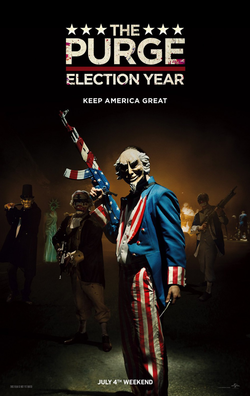
the-purge-ey-pstr01

Embracing the Melodrama Part II #66: Desperate Lives (dir by Robert Michael Lewis)


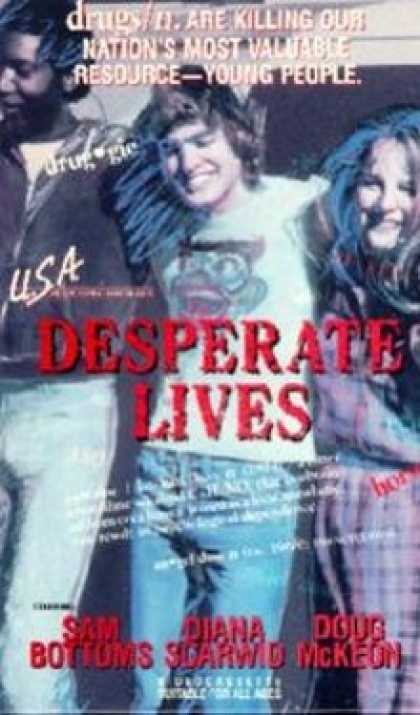
DL-cov2YouTube, my old friend, you have failed me.

For the longest time, the 1982 anti-drug melodrama Desperate Lives has been available for viewing on YouTube.  I first watched it two years ago, after I read an online article about a scene in which a teenage Helen Hunt takes PCP and jumps through a window.  And, when I watched it, I was stunned.  I knew that the film was going to be over-the-top and silly, largely because it’s hard to imagine how a film featuring a teenage Helen Hunt taking PCP could be anything other than that.  But, even with my experience of watching over the top message movies, nothing could have quite prepared me for Desperate Lives.

So, I figured, for this review, that I’d say a few snarky words about Desperate Lives and then I’d just add something like, “And you can watch it below!”  And then I would embed the entire movie and all of y’all could just click on play and watch a movie on the Lens.

Unfortunately, Desperate Lives has been taken off of YouTube.  I assume the upload violated some sort of copyright thing.  And really, it’s kinda stupid because seriously, Desperate Lives is one of those films that really deserves to be seen for free on YouTube.

Oh well.  You can still watch a video of Helen Hunt jumping through that window.  The video below also features some additional elements from Desperate Lives.

For instance, you get to see Diana Scarwid playing the angriest high school guidance counselor in the world.  Scarwid knows that students like Helen Hunt are using drugs and that her fellow faculty members are turning a blind eye to everything’s that’s happening.  From the minute she first appears on screen, Scarwid is shouting at someone and she doesn’t stop screaming until the film ends.

And you also get to see Doug McKeon, playing Helen Hunt’s brother.  McKeon goes for a drive with his girlfriend, who has just taken PCP herself.  As their car goes flying off a mountain, she says, “Wheeee!”

In the video below, you also get to see that the only reason Helen Hunt used drugs was because her boyfriend begged her to.  That’s a scenario that seems to show up in a lot of high school drug films and it’s strange because it’s something that I’ve never actually seen happen or heard about happening in real life.  In fact, in real life, most users of hard drugs are actually very happy to not share their supply.

Unfortunately, the video below does not feature any scenes of Sam Bottoms as the world’s most charming drug dealer and that’s a shame because he gives the only good performance in the entire film (sorry, Helen!).

Even worse, the video doesn’t include any scenes from the film’s memorably insane conclusion, in which Scarwid searches every single locker in the school and then interrupts a pep rally so she can set everyone’s stash on fire in the middle of the gym.  Making it even better is that all the students are so moved by Scarwid’s final speech that they start tossing all of the drugs that they have on them into the fire.

Which means that the film essentially ends with the entire school getting high off of a huge marijuana bonfire.

No, that scene cannot be found in the video below.  But you can find Helen Hunt jumping through a window so enjoy.

http://www.youtube.com/watch?v=rEpyLzHeozY

Shattered Politics #63: Primary Colors (dir by Mike Nichols)


Primaryposter

Jack Stanton (John Travolta) is the charismatic governor of an unnamed Southern state.  After spending his entire life in politics, Jack is finally ready to run for President.  Even more ready is his equally ambitious wife, Susan (Emma Thompson).  Jack proves himself to be a strong candidate, a good speaker who understands the voters and who has the ability to project empathy for almost anyone’s situation. He’s managed to recruit a talented and dedicated campaign staff, including the flamboyant Richard Jemmons (Billy Bob Thornton), Daisy Green (Maura Tierney), and journalist Henry Burton (Adrian Lester).  Henry is the son of a civil rights leader and, as soon as they meet, Jack talks about the first time that he ever heard Henry’s father speak.  Within minutes of first meeting him, Henry believes in Jack.

The problem, however, is that there are constant hints that Jack may not be worthy of his admiration.  There’s the fact that he’s a compulsive womanizer who is given to displays of temper and immaturity.  When one of Jack’s old friends reveals that Jack may have impregnated his daughter, Jack and Susan respond with a pragmatic ruthlessness that takes Henry by surprise.

When one of Jack’s mistresses threatens to go public, Henry is partnered up with Libby (Kathy Bates) and sent to dig up dirt on her and her sponsors.  When the former governor of Florida, Freddie Picker (Larry Hagman), emerges as a threat to derail Jack’s quest for the nomination, Henry and Libby are again assigned to research Picker’s background.  Libby is perhaps the film’s most interesting character.  Recovering from a mental breakdown, Libby has no trouble threatening to shoot one political opponent but she’s still vulnerable and idealistic enough that it truly hurts her when Jack and Susan repeatedly fail to live up to her ideals.  As an out lesbian, Libby is perhaps the only character who has no trouble revealing her true self and, because of her honesty, she is the one who suffers the most.

First released in 1998 and based on a novel by Joe Klein, Primary Colors is an entertaining and ultimately rather bittersweet dramedy about the American way of politics.  John Travolta and Emma Thompson may be playing Jack and Susan Stanton but it’s obvious from the start that they’re meant to be Bill and Hillary Clinton.  And while it takes a few minutes to get used to Travolta’s attempt to sound Southern, this is ultimately one of his best performances.  As played by Travolta, Jack Stanton is charming, compassionate, self-centered, and ultimately, incredibly frustrating.  One reason why Primary Colors works is because we, as an audience, come to believe in Jack just as much as Henry does and then we come to be just as disillusioned as Libby.  Emma Thompson’s performance is a little less obviously based on Hillary.  Unlike Travolta, she doesn’t attempt to imitate Hillary’s voice or mannerisms.  But she perfectly captures the steely determination.

Primary Colors captures both the thrill of believing and the inevitability of disillusionment.  It’s definitely a film that I will rewatch in the days leading up to 2016.