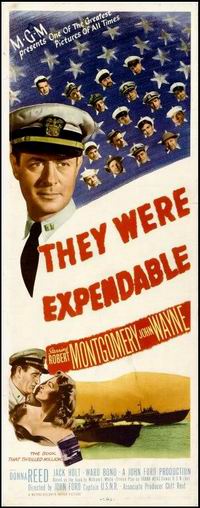
They Were Expendable (1945, directed by John Ford)


In December of 1941, Lt. John Brickley (Robert Montgomery) commands a squadron of Navy PT boats, based in the Philippines.  Brickley is convinced that the small and agile PT Boats could be used in combat but his superior officers disagree, even after viewing a demonstration of what they can do.  Brickley’s second-in-command, Rusty (John Wayne), is frustrated and feels that he will never see combat.  That changes when the Japanese attack Pearl Harbor and then turn their attention to the Philippines.  Brickley gets his chance to show what the PT boats can do but both he and his men must also deal with the terrible risks that come with combat.  Brickley and his men have been set up to fight a losing battle, only hoping to slow down the inevitable Japanese onslaught, because both they and their boats are considered to be expendable.  The hot-headed Rusty learns humility when he’s sidelined by blood poisoning and he also falls in love with a nurse, Sandy (Donna Reed).  However, the war doesn’t care about love or any other plans that its participants may have.  With the invasion of the Philippines inevitable, it just becomes a question of who will be sent with MacArthur to Australia and who will remain behind.

One of John Ford’s best films, They Were Expendable is a tribute to the U.S. Navy and also a realistic look at the realities of combat.  The movie features Ford’s trademark sentimentality and moments of humors but it also doesn’t deny that most of the characters who are left behind at the end of the movie will not survive the Japanese invasion.  Even “Dad’ Knowland (Russell Simpson), the fatherly owner of a local shipyard who does repair work on the PT boats, knows that he’s expendable.  He resolves to meet his fate with a rifle in hand and a jug of whiskey at his feet.  Rusty, who starts out thirty for combat, comes to learn the truth about war.  Ford was one of the many Hollywood directors who was recruited to film documentaries during World War II and he brings a documentarian’s touch to the scenes of combat.

Robert Montgomery had previously volunteered in France and the United Kingdom, fighting the Axis Powers before America officially entered the war.  After the war began, he entered the Navy and he was a lieutenant commander when he appeared in They Were Expendable.  Montgomery brought a hardened authenticity to the role of Brickley.  (Montgomery also reportedly directed a few scenes when Ford was sidelined with a broken leg.)  John Wayne is equally good in the role of the hot-headed Rusty, who learns the truth about combat and what it means to be expendable.  The cast is full of familiar faces, many of whom were members of the John Ford stock company.  Keep an eye out for Ward Bond, Cameron Mitchell, Leon Ames, Jack Holt, and Donald Curtis.

They Were Expendable is one of the best of the World War II movies.  It’s a worthy film for Memorial Day and any other day.

Horror Film Review: Black Friday (dir by Arthur Lubin)


The 1940 film, Black Friday, opens with Dr. Ernest Sovac (Boris Karloff), a once-respected scientist, being led out of his cell on Death Row and being taken to the electric chair.  As he enters the death chamber, he hands one of the gathered reporters his journal.  Dr. Sovac says that he wants the reporter to know the true story of how he came to be on Death Row.  While the police strap Dr. Sovac into the electric chair, the reporter reads the journal.

It’s flashback time!

Months earlier, Dr. Sovac’s best friend, an befuddled English professor named George Kingsley (Stanley Ridges), is nearly fatally injured when he has the misfortune to get caught in the middle of an attempt to assassinate a gangster.  In order to save George’s life, Sovac performs a brain transplant, giving George part of the gangster’s brain.  George does recover but now he’s got the gangster inside of his head, trying to take control.  Much like Dr. Jekyll, George continually switches identities and becomes a viscous hoodlum who is looking for revenge against those who betrayed him, including gang boss Eric Marnay (Bela Lugosi).

Dr. Sovac, however, is more concerned with the fact that, before he died, the gangster apparently hid a good deal of money somewhere.  Sovac wants that money for himself so that he can build his own laboratory and hopefully help other people with otherwise incurable brain conditions.  Sovac tells himself that, once he gets his hands on the money, he can find a way to rid George of his evil alternative personality.  But until George finds the money, Sovac is content to allow George to continue turning into a murderous gangster.  Things, however, come to a head when George starts to threaten Sovac’s daughter (Anne Gwynne).

Black Friday is yet another Universal Horror Film featuring Boris Karloff was a mad scientist.  What makes Dr. Sovac a compelling character is that he starts out with the best of intentions.  He just wants to save the life of his best friend and Sovac’s desperation is increased by the fact that George himself was just an innocent bystander when he was injured.  Later, when Sovac starts searching for the gangster’s money, his intentions are again not necessarily bad.  He sincerely wants to do some good with that money and he uses those good intentions to justify allowing George to do some very bad things.  In the end, Sovac becomes so obsessed with being able to fund his laboratory that he loses sight of the price that both he and George are having to pay.  Karloff does a great job of playing Sovac, showing how a kind man manages to lose track of his morals until it is too late.  Stanley Ridges is also well-cast as George and does an excellent job of switching back and forth from being a befuddled professor to a ruthless gangster.  There’s an excellent scene in which George, attempting to teach his class, suddenly hallucinates that all of his students have become gangsters.  Ridges does a great job playing it.

Reportedly, the film was originally conceived with Karloff playing George and Bela Lugosi playing the role of Dr. Savoc.  However, Karloff said that he would rather play Savoc and, as such, Lugosi lost a role for which he probably would have been very well-cast.  Since Lugosi was a bit too naturally sinister for the role of George, he instead had to settle for a small role as a gang leader.  Lugosi, it should be said, is a convincing gangster but it’s still hard not to be disappointed that, in this film, he and Karloff don’t share any scenes together.

Previous Universal Horror Reviews:

  1. Dracula (1931)
  2. Dracula (Spanish Language Version) (1931)
  3. Frankenstein (1931)
  4. Island of Lost Souls (1932)
  5. The Mummy (1932)
  6. The Invisible Man (1933)
  7. The Bride of Frankenstein (1935)
  8. Dracula’s Daughter (1936)
  9. Son of Frankenstein (1939)
  10. The Invisible Man Returns (1940)
  11. The Wolf Man (1941)
  12. Ghost of Frankenstein (1942)
  13. Invisible Agent (1942)
  14. Frankenstein Meets The Wolf Man (1943)
  15. Son of Dracula (1943)
  16. House of Frankenstein (1944)
  17. The Invisible Man’s Revenge (1944)
  18. House of Dracula (1945) 
  19. Creature From The Black Lagoon (1954)

A Movie A Day #126: Baby Face Nelson (1957, directed by Don Siegel)


The place is Chicago.  The time is the era of Prohibition.  The head of the Chicago Outfit, Rocca (Ted de Corsia), has arranged for a career criminal named Lester Gillis (Mickey Rooney) to be released from prison.  A crack shot and all-around tough customer, Gillis has only two insecurities: his diminutive height and his youthful appearance.  Rocca wants to use Gillis as a hit man but Gillis prefers to rob banks.  When Rocca attempts to frame Gillis for a murder, Gillis first guns down his former benefactor and then goes on the run with his girlfriend, Sue Nelson (Carolyn Jones).  Because they are both patients of the same underworld doctor (played by Sir Cedric Hardwicke), Gillis eventually meets public enemy number one, John Dillinger (Leo Gordon).  Joining Dillinger’s gang, Gillis becomes a famous bank robber and is saddled with a nickname that he hates: Baby Face Nelson.
While it is true that Lester “Baby Face Nelson” Gillis was an associate of John Dillinger’s and supposedly hated his nickname, the rest of this biopic is highly fictionalized.  The real Baby Face Nelson was a family man who, when he went on the run, took his wife and two children with him.  While he did get his start running with a Chicago street gang, there is also no evidence that Nelson was ever affiliated with the Chicago Outfit.  (The film’s Rocca is an obvious stand-in for Al Capone.)  In real life, it was Dillinger, having just recently escaped from jail, who hooked up with Nelson’s gang.  The film Nelson is jealous of Dillinger and wants to take over the gang but, in reality, the gang had no leader.  Because Nelson killed three FBI agents (more than any other criminal), he has developed a reputation for being one of the most dangerous of the Depression-era outlaws but, actually, he was no more violent than the typical 1930s bank robber.  Among the era’s outlaws, Dillinger was more unique for only having committed one murder over the course of his career.  In this film (and practically every other film that has featured Baby Face Nelson as a character), Nelson is a full on psychopath, one who even aims his gun at children.

Baby Face Nelson may be terrible history but it is still an excellent B-movie.  Don Siegel directs in his usual no-nonsense style and Mickey Rooney does a great job, playing Baby Face Nelson as a ruthless but insecure criminal with a perpetual chip on his shoulder.  As his fictional girlfriend, Carolyn Jones is both tough and sexy, a moll that any gangster would be lucky to have waiting for him back at the safe house.  B-movie veterans like Thayer David, Jack Elam, Elisha Cook Jr., and John Hoyt all have colorful supporting roles but the most unexpected name in the cast is that of Cedric Hardwicke, playing an alcoholic surgeon with broken down dignity.

Don’t watch Baby Face Nelson for a history lesson.  Watch it for an entertaining B-masterpiece.


Cleaning Out The DVR #25: The Maltese Falcon (dir by John Huston)


(For those following at home, Lisa is attempting to clean out her DVR by watching and reviewing 38 films by this Friday.  Will she make it?  Keep following the site to find out!)

220px-Falconm

I would love to see a remake of The Maltese Falcon with Bill Murray in the role of Sam Spade.  Well, maybe not the Bill Murray of today because he’s getting a little bit too old to play a hard-boiled private detective who is as good with his fists as his brain.  Instead, I’m thinking more of Lost In Translation era Bill Murray, when he was no longer young but could still probably beat up any sniveling punk who came at him with a gun.

Now, that may sound crazy to some but think about it.  Bill Murray is one of the great deadpan snarkers and so is Sam Spade.  Last night, when I watched the famous 1941 version of The Maltese Falcon (the story was filmed twice before, once with Bette Davis as the femme fatale), I was struck by how much of the film really was a comedy.  It may have been a murder mystery that featured death and betrayal and a lot of people getting beaten up but, ultimately, The Maltese Falcon is really about Sam Spade reacting to all of the crazy and strange people around him.  No matter how weird things get, Spade always responds with a smirk and a quip.  It’s a role that, at times, seems to be tailor-made for an actor like Bill Murray.

Bill Murray wasn’t around in 1941 but fortunately, Humphrey Bogart was.  Humphrey Bogart may have grown up wealthy and attended private schools but, on screen, nobody was tougher than Humphrey Bogart and nobody was better at delivering sarcastic, snark-filled dialogue.  After spending years as a villainous supporting actor, Humphrey Bogart got his first starring role when he played Sam Spade in The Maltese Falcon.  His performance, of course, would set the standard by which all future cinematic private eyes would be judged.

And, of course, Spade was tough and he was cynical and he has that wonderful moment at the end of the film where he explains that nobody’s going to make a “sap” out of him.  But for me, Bogart’s best moments come when Spade is alone and thinking.  It’s at those times that Spade suddenly becomes a human being.  A slight smirk comes to his lips, almost as if he’s sharing a private joke with the audience.  You can tell that he’s thinking to himself, “Can you believe how weird my life is?”

And it is indeed a weird life.  The film opens with Spade’s partner, Miles Archer (Jerome Cowan), being murdered.  The police believe that Archer was murdered by a man named Thursby and that Thursby was subsequently murdered by Spade.  Spade, however, suspects that both Archer and Thursby were killed by his latest client, a woman who introduced herself as Ruth Wonderly (Mary Astor).  Except, of course, that’s not her real name.  Her real name is Brigid O’Shaughnessy and, as she admits to Spade, Thursby was her partner.  She claims that Thursby must have murdered Archer but that she doesn’t know who could have possibly killed Thursby.

What’s particularly interesting about all this is that no one really seems to be that upset about Archer’s death.  Spade’s main motivation for investigating the murder is to clear his name and there are several lines of dialogue that reveal how little regard he had for Miles.  In fact, when Archer’s widow (Gladys George) suggests that Spade might be Archer’s killer, you can understand why she might think that.  But then again, that’s the world of The Maltese Falcon.  Only the tough survive.  Getting sentimental or allowing yourself to care is the biggest mistake you can make.

The murders are connected to the hunt for a valuable statue of a bird.  (This is the famous Maltese Falcon of the title.)  As Spade tries to clear his name in the two murders, he also finds himself getting caught up with a strange group of treasure hunters.  There’s the obsequious Joel Cairo (Peter Lorre).  There’s the ruthless “fat man,” Kasper Gutman (Sidney Greenstreet).  And then there’s Wilmer (Elisha Cook, Jr.), Gutman’s young henchman who spends the entire film trying to convince everyone that he’s tougher than he appears.  Wilmer is a born patsy.  Whenever Spade gets annoyed, he beats up Wilmer.  And he usually smiles afterward.

Along with being the directorial debut of John Huston, The Maltese Falcon was also one of the first great film noirs.  It’s one of the most influential films ever made and, even seen today, it’s a lot of fun.  You really can’t go wrong with Bogart, Astor, Greenstreet, Lorre, and Cook all in the same movie.  Bill Murray may never get a chance to play Sam Spade but that’s okay.  Humphrey Bogart’s the only Sam Spade we really need.

The Maltese Falcon was nominated for best picture.  However, it lost to How Green Was My Valley, a film that literally seems to take place in an entirely different universe from The Maltese Falcon.

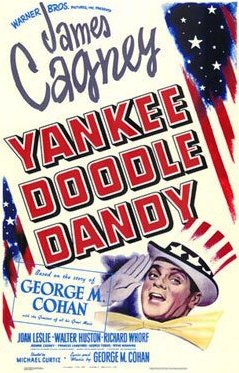
Cleaning Out The DVR: Yankee Doodle Dandy (dir by Michael Curtiz)


Yankee_Doodle_Dandy_poster

So, today, I got off work so that I could vote in Texas’s Super Tuesday primary.  After I cast my vote (and don’t ask me who I voted for because it’s a secret ballot for a reason!), I came home and I turned on the TV and I discovered that, as a result of spending February recording countless films off of Lifetime and TCM, I only had 9 hours of space left on my DVR.  As a result, the DVR was threatening to erase my recordings of Bend It Like Beckham, Jesus Christ Superstar, American Anthem, an episode of The Bachelor from 2011, and the entire series of Saved By The Bell: The College Years.

“Acgk!” I exclaimed in terror.

So, I immediately sat down and started the process of cleaning out the DVR.  I started things out by watching Yankee Doodle Dandy, a film from 1942.

Yankee Doodle Dandy is a biopic of a songwriter, signer, and dancer named George M. Cohan.  I have to admit, that when the film started, I had absolutely no idea who George M. Cohan was.  Imagine my surprise as I watched the film and I discovered that Cohan had written all of the old-fashioned patriotic songs that are played by the Richardson Symphony Orchestra whenever I go to see the 4th of July fireworks show at Breckenridge Park.  He wrote You’re A Grand Old Flag, The Yankee Doodle Boy, and Over There.  Though I may not have heard of him, Cohan was an American institution during the first half of the 20th Century.  Even if I hadn’t read that on Wikipedia, I would have been able to guess from watching Yankee Doodle Dandy, which, at times, seems to be making a case for sainthood.

And that’s not meant to be a complaint!  74 years after it was originally released, Yankee Doodle Dandy is still a terrifically entertaining film.  It opens with George (played by James Cagney) accepting a Congressional Gold Medal from President Franklin D. Roosevelt.  (We only see Roosevelt from behind and needless to say, the President did not play himself.  Instead, Captain Jack Young sat in a chair while FDR’s voice was provided by impressionist Art Gilmore.)  Cohan proceeds to tell Roosevelt his life story, starting with his birth on the 4th of July.  Cohan tells how he was born into a showbiz family and a major theme of the film is how Cohan took care of his family even after becoming famous.

The other major theme is patriotism.  As portrayed in this biopic, Cohan is perhaps the most patriotic man who ever lived.  That may sound corny but Cagney pulls it off.  When we see him sitting at the piano and coming up with the lyrics for another song extolling the greatness of America, we never doubt his sincerity.  In fact, he’s so sincere that he makes us believe as well.  Watching Yankee Doodle Dandy, I found myself regretting that I have to live in such an overwhelmingly cynical time.  If George M. Cohan was alive today, he’d punch out anyone who called this country “Murica.”

Yankee Doodle Dandy is an amazingly positive film.  There are a few scenes where Cohan has to deal with a few Broadway types who are jealous of his talent and his confidence but, otherwise, it’s pretty much one triumph after another for Cohan.  Normally, of course, there’s nothing more annoying than listening to someone talk about how great his life is but fortunately, Cohan is played by James Cagney and Cagney gives one of the best performance of all time in the role.

Cagney, of course, is best remembered for playing gangsters but he got his start as a dancer.  In Yankee Doodle Dandy, Cagney is so energetic and so happy and such a complete and totally showman that you can’t help but get caught up in his story.  When he says that, as a result of his success, things have never been better, you don’t resent him for it.  Instead, you’re happy for him because he’s amazingly talented and deserve the best!

Seriously, watch him below:

James Cagney won the Oscar for Best Actor for his performance here.  Yankee Doodle Dandy was also nominated for best picture but lost to Mrs. Miniver.

I’m really glad that I watched Yankee Doodle Dandy today.  In this time of overwhelming negativity, it was just what I needed!