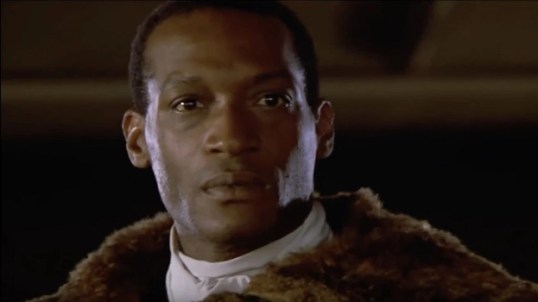
For our final Horror Scene that I Love for our 2023’s horrorthon, we honor the great actor Tony Todd with this scene from 1992’s Candyman.
For our final Horror Scene that I Love for our 2023’s horrorthon, we honor the great actor Tony Todd with this scene from 1992’s Candyman.
Who was the Zodiac Killer?
That is a question that has haunted journalists, cops, and true crime fans since the late 60s. It is known that the Zodiac Killer murdered at least five people in Northern California in 1968 and 1969. He targeted young couples, though he is also thought to have murdered on taxi driver as well. What set Zodiac apart from other killers is that he was a prolific letter writer, who sent cards and ciphers to the police and the journalists who were reporting on his crimes. In one of his ciphers, Zodiac claimed that he had killed 37 people. Cartoonist Robert Graysmith later wrote two books about his personal obsession with the case. He estimated that the Zodiac may have been responsible for hundred of murders, up through the 80s. Of course, reading Graysmith’s first Zodiac book, it’s also easy to suspect that Graysmith reached a point where he saw the Zodiac’s hand in every unsolved murder in the San Francisco area. Of all the unidentified serial killers in American history, Zodiac is one that most haunts us. Zodiac was a serial killer who operated in an era when such things were still considered to be uncommon. Much as Jack the Ripper did during the Victorian Age, Zodiac announced the arrival of a new age of evil.
Zodiac wrote about being a film fan and he was probably happy about the fact that he inspired quite a few films. 1971’s The Zodiac Killer came out while Zodiac was still sending letters to the police and cops actually staked out the theaters showing the film just to see if he would show up. Dirty Harry‘s Scorpio Killer was also based on Zodiac, right down to the taunting letters that he sent the mayor and again, one has to wonder if Zodiac ever showed up to watch Clint Eastwood take him down.
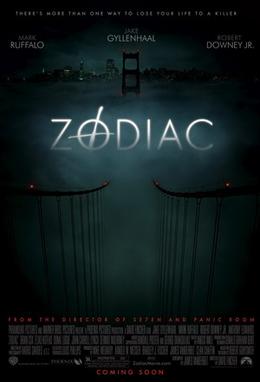
And, if Zodiac survived into the 21st Century, one has to wonder if he showed up in the theaters for 2007’s Zodiac.
One of the best true crime films ever made, Zodiac not only recreates the crimes of the Zodiac but it also examines the mental price of obsessing over the one unknown force of evil. Mark Ruffalo plays Dave Toschi, the celebrity cop who nearly sacrificed his professional reputation in his search for the identity of the killer. Jake Gyllenhaal plays cartoonist Robert Graysmith, who spends over a decade searching for the Zodiac’s identity and who loses his wife (Chloe Sevigny) in the process. And Robert Downey, Jr. plays Paul Avery, the crime reporter to whom the Zodiac wrote and who sunk into paranoia and addiction as a result. This is a film that is less about the Zodiac’s crime and more about how this unknown killer seemed to unleash a darkness that would come to envelope first a city and eventually an entire nation.
As one might expect from a film directed by David Fincher, Zodiac plays out like a filmed nightmare with the starkly portrayed murders being all the more disturbing because they often take place outside, where people would think they would be safe. (The second murder is especially terrifying, as it plays out without even the sound of background music to allow us the escape of remembering that it’s only a movie.) Fincher heightens our paranoia but having a different actor play the killer in each scene, reminding us that the Zodiac could literally be anyone. Indeed, one of the scarier things about Zodiac is that, in the course of his investigation, Graysmith meets so many different people who seem like they could be the killer. Even if they aren’t the Zodiac, the viewer is left with the feeling that the world is full of people who are capable of committing the same crimes. The film becomes a journey into the heart of darkness, with the Zodiac becoming both a malevolent force and potentially your next door neighbor. And with the film’s detailed recreation of the 60s and the 70s, the film becomes a portrait of a country on the verge of changing forever with the Zodaic and his crimes representing all the fear waiting in the future.
Again, as one might expect from a Fincher film, it’s a well-acted film, especially by Robert Downey, Jr. Zodiac came out a year before Iron Man, when Downey was still better known for his personal troubles than for his talent. Downey perfect captures his character’s descent into self-destruction, as he goes from being cocky and self-assured to being so paranoid that he’s carrying a gun. (Paul Avery’s actual colleagues have disputed the film’s portrayal of Avery being mentally destroyed by the Zodiac.) Ruffalo and Gyllenhaal also do a good job of portraying Toschi and Graysmith’s growing obsession with the case while Charles Fleischer and John Carroll Lynch both make strong (and creepy) impressions as two men who might (or might not) be the killer.
Though the film was not a success at the box office and it was totally ignored by the Academy, Zodiac has built up a strong reputation in the years since its released. It’s inspired a whole new generation of web sleuths to search for the killer’s identity. Personally, my favored suspect is Robert Ivan Nichols, an enigmatic engineer who abandoned his former life and changed his name to Joseph Newton Chandler III in the 70s and who committed suicide in 2002. I think much like Jack the Ripper, the Zodiac’s identity will never be definitely known. There have been many compelling suspects but most of the evidence seems to be circumstantial. (That’s certainly the case when it comes to Nichols.) The Zodiac was thought to be in his 30s or even his early 40s in 1969 so it’s doubtful that he’s still alive today. In all probability, his identity and his motive will forever remain an unsolvable mystery.
(Thank you shout-out to my friend Mark for recommending this film!)
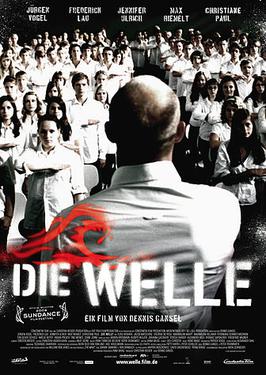
The 2008 German film, The Wave, opens with history teacher and water polo coach Rainer Wenger (Jurgen Vogel), driving to class while listening to the Ramones’s Rock and Roll High School.
Rainer may be a middle-aged authority figure who expects his water polo players to train hard and to always put winning above everything but he still considers himself to be a punk rock rebel, an anarchist who brags about all of the protests that he was involved with. Rainer is upset when he learns that he has been assigned to teach a week-long course on “autocracy.” He very much wanted to teach a class on “anarchy” but that class has been assigned to the most uptight and autocratic teacher in the school. Already feeling resentful, Rainer becomes even more annoyed when it becomes clear that the majority of his students are convinced that there will never be another dictatorship in Germany.
Rainer decides to show them how easily fascism can take root by becoming a dictator in his classroom. Rainer orders the students to call him “Mr. Wegner.” He tells them to all wear the same uniform of jeans and a white shirt to class and when his most intelligent student shows up for class wearing a red blouse because she “doesn’t look good in white,” Rainer refuses to call on her when she raises her hand in class. Mr. Wegner institutes assigned seating, controlling who can sit with who. Everyone is required to stand up if they want to speak. When one student says that he doesn’t want to do any of this, Rainer kicks him and his friends out of class. All three of them eventually return.
Rainer’s experiment works a bit too well. The students come to love being a part of the movement that they come to call The Wave. The Wave ostracizes outsiders, both in school and outside. The Wave covers the town in graffiti, announcing their presence. The Wave doesn’t really have a set goal but the students in Rainer’s class are now obsessed and fanatically loyal to it. One former outcast, Tim (Frederick Lau), becomes so devoted to the cause that he even starts carrying a gun to school so he can defend the other members of The Wave….
If this all sounds familiar, it’s because The Wave is based on the novelization of the American television special of the same name. The German version of The Wave, however, is far more cynical than the American version. Whereas the American version features Bruce Davison as a mild-mannered but always well-intentioned liberal who realizes that his classroom experiment had gone too far, the German version features a teacher who, despite his self-proclaimed radicalism, comes to enjoy the ego boost of being a dictator in the classroom. (Rainer, of course, puts his fascism in superficial left-wing terms, railing against the corporations that make expensive clothing and the individualism that he claims was keeping his class from coming together.) Rainer becomes willfully blind to what he has created. And if the American version of The Wave featured students who eventually learned a lesson and voluntarily walked away from the group they had previous celebrate, the German version presents students who are not willing to abandon their cause, even when their leader tells them that it is time to move on. If the American version featured students who were just play-acting as fascists, the German version features students who go from being blithely unconcerned with the prospect of dictatorship to being the enthusiastic foot soldiers in a cause that has no reason to exist outside of controlling the lives and thoughts of others. If The American version ended with hope for the future, the German version ends with tragedy.
It’s a dark film. Some might claim that The Wave is not a horror film but, by the end of the movie, Rainer’s students have become as relentless and destructive as the zombies from a Romero film or the fanatics who often showed up in Wes Craven’s pre-Scream movies. It takes just one week to transform them from being ordinary teenagers to being the shock troops in a directionless but destructive revolution. They are asked to surrender their individuality and their power to think for themselves and all of them do so without much hesitation, with the desire to belong suddenly superseding everything else about which they claimed to care. Consider this well-acted and disturbing film to be an example of the horror of everyday life.
4 Shots From 4 Films is just what it says it is, 4 shots from 4 of our favorite films. As opposed to the reviews and recaps that we usually post, 4 Shots From 4 Films is all about letting the visuals do the talking.
This October, I am going to be using our 4 Shots From 4 Films feature to pay tribute to some of my favorite horror directors, in alphabetical order! That’s right, we’re going from Argento to Zombie in one month!
Our final director: Rob Zombie.
4 Shots From 4 Rob Zombie Films
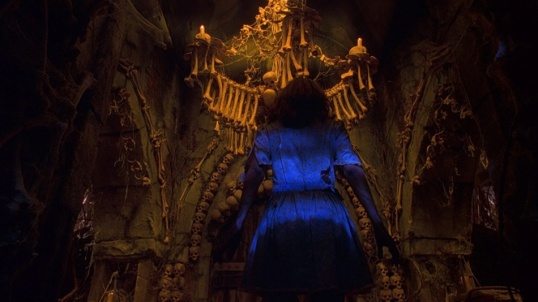
House of 1000 Corpses (2003, dir by Rob Zombie, DP: Alex Poppas and Tom Richmond)

Halloween II (2009, dir by Rob Zombie, DP: Brandon Trost)
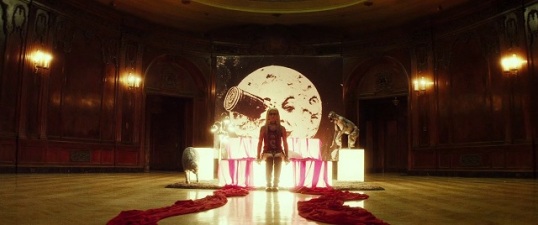
The Lords of Salem (2012, dir by Rob Zombie, DP: Brandon Trost)
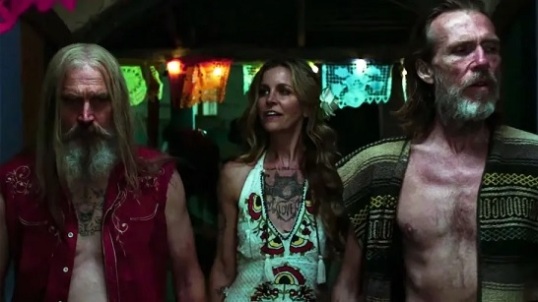
3 From Hell (2019, dir by Rob Zombie, DP: David N . Daniel)
Filmed in 1957 for a television program called Westinghouse Studio One, The Night America Trembled is a dramatization of the night in 1938 when Orson Welles’s adaptation of H.G. Wells’s The War of the Worlds reportedly caused a panic amongst listeners.
For legal reasons, Orson Welles is not portrayed nor is his name mentioned. Instead, the focus is mostly on the people listening to the broadcast and getting the wrong idea. That may sound like a comedy but The Night America Trembled takes itself fairly seriously, complete with Edward R. Murrow narrating and taking drags off of a cigarette.
Clocking in at a brisk 60 minutes, The Night America Trembled is an interesting recreation of that October 30th. Among the people panicking are a large collection of future stars and character actors. Ed Asner, James Coburn, John Astin, Warren Oates, and Warren Beatty all make early appearances.
It’s an interesting historical document and you can watch it below!

Happy Halloween everyone!
Well, as another horrorthon draws to a close, it’s time for another Shattered Lens tradition! Every Halloween, we share one of the greatest and most iconic horror films ever made. For your Halloween enjoyment, here is George Romero’s Night of the Living Dead!
(Be sure to read Arleigh’s equally famous review!)

Happy Halloween! For today’s special edition of Lisa Marie’s Favorite Grindhouse and Exploitation Film Trailers, we are paying tribute to the great George Romero! Here are six trailers, all for films directed by the master of American horror! How many of them have you watched this October?
2. The Crazies (1973)
3. Martin (1977)
4. Creepshow (1982)
5. Monkey Shines (1988)
6. The Dark Half (1993)
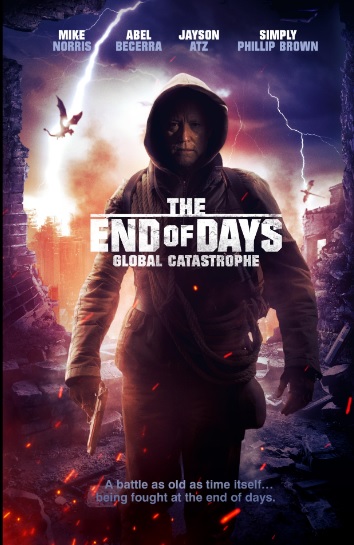
2019’s The End of Days: Global Catastrophe (a.k.a. The Crossroads of Hunter Wilde) opens with a voice-over from Hunter Wilde (played by Chuck’s son, Mike Norris). Hunter explains that the world is in pretty bad shape and it’s for all the usual reasons. Hunter explains that Hollywood destroyed America’s moral fabric. The fake news media promoted a liberal agenda and set Americans against each other. Eventually, disease, war, and pestilence spread across the world.
Hunter and his daughter, Jo (Kat Rowland) are now living in a Christian survivalist compound. Hunter is one of the leaders of the compound but he suffers from frequent wanderlust. Whenever he starts to suffer from doubts or life in the compound starts to become too stressful, Hunter jumps in his jeep and drives off for a few days. Sometimes, he returns with supplies and refugees. As Jo points out, Hunter puts his life in danger every time that he leaves. The world outside the compound is full of terrorists and infected, zombie-like scavengers. Fortunately, Hunter is a good shot with a gun and he also knows some fairly effective karate moves. I mean, would you expect anything less from Chuck Norris’s son?
What Hunter does not fully understand is that there is currently a war raging inside of him. His doubts and his frustrations have left him vulnerable to a demon named Dagon (Jordan DragonKing). Dagon lives in another dimension, one that exists alongside our world but which is still separate. When Dagon drags Hunter into his world, it leads to an otherworldly battle.
Actually, calling it an otherworldly battle is perhaps overselling it. Actually, Hunter and Dagon exchange a few kicks in front of a white fence and eventually, Dagon comes at Hunter with a sword. As far as fight scenes go, it’s not bad but it’s not spectacular either. Mike Norris is a trained martial artist who has starred in various straight-to-video action films. He looks convincing with when he throws a punch or kicks someone in the face. At the same time, Mike Norris was also in his late 50s when this film was made and, as such, it can be forgiven that he doesn’t move quite as quickly as he probably did in the past.
Though the film opens with verses from the Bible and it features a battle between Mike Norris and a literal demon, the film itself feels more like a prepper film than a typical faith-based apocalypse film. Yes, the film seems to be saying, the world is ending and our heroes failed to be raptured so they’re now going to have to deal with the tribulation but thank God they stocked up on canned vegetables and hoarded weapons beforehand. Otherwise, they would really be in trouble! The opening montage feels like it could have been lifted from one of those, “Invest in Gold” infomercials. When the film discusses the end of the world, less emphasis is put on the Book of Revelation and more is instead devoted to the type of news stories that one would expect to see on Breitbart. As such, the film offers a chance to view the world through the eyes of someone who is convinced that society is about to collapse, with the main subtext being, “I was smart enough to prepare but the rest of you all are screwed.”
As you may have guessed, The End of Days has the potential to be an enjoyably bonkers film but, unfortunately, there’s a bit too many slow spots for the film to really hold one’s interest. There’s also a few subplots that don’t really lead anywhere, which occasionally makes the film feel like it’s an episode in a Walking Dead-style television series as opposed to a stand-alone story. That said, Mike Norris may not be as intimidating as his father but he still has a definite screen presence and Jordan DragonKing is enjoyably over-the-top in his performance as Dagon. If the world’s going to end, it might as well go out with jump kicks and swordplay.
The 2022 film, Bleach, tells the story of Jonah Paxton (Mark Justice).
Born in Nevada, Jonah never knew his mother. He was raised in a trailer by his abusive father (Lorenzo Lamas), a degenerate gambler who molested Jonah and forced him to wear dresses in an attempt to shame him into “being a man.” When the mob threatened to come after Jonah because of his debts, he sold Jonah to his uncle, a drug dealer named Matthew (Eric Roberts).
In the mid-80s, grown-up Jonah has some issues. That’s not surprising. He’s haunted by his past and has hallucinations in which the devil is raping him from behind. (Yikes!) He also has visions of selling his soul to a mysterious woman (Mindy Robinson) who throws money at him. In what might be the real world, Jonah is hired by El Jefe (Robert LaSardo), who explains that he loves horror films but that the whole trope of the final girl upsets him. He gives Jonah a million dollars to film an actual snuff film. He tells Jonah that he wants high production values. He wants to watch Jonah become a monster. Jonah takes the money and films himself murdering two women who picked up at a bar and one woman who unfortunately entered the room at the wrong time.
While El Jefe waits for Jonah to bring him the tape, Jonah finds himself having even more violent hallucinations. He sees demons. He sees the devil. After he crashes his car in the desert, he has a vision of a woman (Tara Reid) who claims to be his mother and who encourages Jonah to commit suicide. While the police investigate Jonah’s crimes, Jonah is haunted by the ghosts of his victims and his already tenuous grip on reality continues to loosen. Soon, Jonah is drinking bleach and trying to purify himself with fire….
Bleach is a mess of a film, one that is occasionally surreal but which is more often just boring. The film’s tone is all over the place and certain scenes are so drawn out that they go from being disturbing to being dull. The moments of dark comedy fail to land but the glimpses inside Jonah’s mind are appropriately twisted and bizarre. By the end of the movie, Jonah’s scarred and blistered body is an undeniably shocking sight. Physically, he’s come to reflect the monster that he truly is. But, in the end, the film is too unevenly paced to be really effective and it ends with a shoot-out that is so clumsily choreographed that it’ll probably lead to more laughs than pathos.
Eric Roberts is memorably sleazy as the faux friendly Matthew. One gets the feeling that both and Lorenzo Lamas were only on set for a day or two but both of them make the most of their screen time. Both of them offer a glimpse into how to make a monster.
Previous Eric Roberts Films That We Have Reviewed:

Wow! I’ve been so busy coordinating this year’s Horrorthon that I totally missed the fact that the Gotham nominations were announced on October 24th! In the past, the Gothams only honored films that were made for a certain low budget. This year is the first time that they’ll be honoring films of any budget. To me, that would seem to defeat the purpose of the awards but whatever. Everyone wants to be an Oscar precursor nowadays.
Anyway, this is really late on my part but here are this year’s Gotham nominations! Whether or not these nominations will give a boost to any of these film’s Oscar chances remains to be seen. The winners will be announced on November 27th!
Best Feature
Passages
Ira Sachs, director; Saïd Ben Saïd, Michel Merkt, producers (MUBI)
Past Lives
Celine Song, director; David Hinojosa, Pamela Koffler, Christine Vachon, producers (A24)
Reality
Tina Satter, director; Brad Becker-Parton, Riva Marker, Greg Nobile, Noah Stahl, producers (HBO Films)
Showing Up
Kelly Reichardt, director; Neil Kopp, Vincent Savino, Anish Savjani, producers (A24)
A Thousand and One
A.V. Rockwell, director; Julia Lebedev, Rishi Rajani, Eddie Vaisman, Lena Waithe, Bred Weston, producers (Focus Features)
Best International Feature
All of Us Strangers
Andrew Haigh, director; Graham Broadbent, Peter Czernin, Sarah Harvey, producers (Searchlight Pictures)
Anatomy of a Fall
Justine Triet, director; Marie-Ange Luciani, David Thion, producers (NEON)
Poor Things
Yorgos Lanthimos, director; Ed Guiney, Yorgos Lanthimos, Andrew Lowe, Emma Stone, producers (Searchlight Pictures)
Tótem
Lila Avilés, director; Lila Avilés, Tatiana Graullera, Louise Riousse, producers (Sideshow/Janus Films)
The Zone of Interest
Jonathan Glazer, director; Ewa Puszczynska, James Wilson, producers (A24)
Best Documentary Feature
20 Days in Mariupol
Mstyslav Chernov, director; Raney Aronson-Rath, Mstyslav Chernov, Derl McCrudden, Michelle Mizner, producers (PBS Distribution)
Against the Tide
Sarvnik Kaur, director; Koval Bhatia, Sarvnik Kaur, producers (Snooker Club Films, A Little Anarky Films)
Apolonia, Apolonia
Lea Glob, director; Sidsel Lønvig Siersted, producer (Danish Documentary Production)
Four Daughters
Kaouther Ben Hania, director; Nadim Cheikhrouha, producer (Kino Lorber)
Our Body
Claire Simon, director; Kristina Larsen, producer (Cinema Guild)
Breakthrough Director Award, Presented by Cadillac
Raven Jackson, All Dirt Roads Taste of Salt (A24)
Georgia Oakley, Blue Jean (Magnolia Pictures)
Michelle Garza Cervera, Huesera (XYZ Films)
Celine Song, Past Lives (A24)
A.V. Rockwell, A Thousand and One (Focus Features)
Best Screenplay
All of Us Strangers, Andrew Haigh (Searchlight Pictures)
Anatomy of a Fall, Justine Triet, Arthur Harari (NEON)
May December, Samy Burch (Netflix)
R.M.N., Cristian Mungiu (IFC Films)
The Zone of Interest, Jonathan Glazer (A24)
Outstanding Lead Performance
Aunjanue Ellis-Taylor, Origin (NEON)
Lily Gladstone, The Unknown Country (Music Box Films)
Greta Lee, Past Lives (A24)
Franz Rogowski, Passages (MUBI)
Babetida Sadjo, Our Father, The Devil (Cineverse)
Andrew Scott, All of Us Strangers (Searchlight Pictures)
Cailee Spaeny, Priscilla (A24)
Teyana Taylor, A Thousand and One (Focus Features)
Michelle Williams, Showing Up (A24)
Jeffrey Wright, American Fiction (Orion Pictures / Amazon MGM Studios)
Outstanding Supporting Performance
Juliette Binoche, The Taste of Things (IFC Films)
Penélope Cruz, Ferrari (NEON)
Jamie Foxx, They Cloned Tyrone (Netflix)
Claire Foy, All of Us Strangers (Searchlight Films)
Ryan Gosling, Barbie (Warner Bros. Pictures)
Glenn Howerton, BlackBerry (IFC Films)
Sandra Hüller, The Zone of Interest (A24)
Rachel McAdams, Are You There God? It’s Me, Margaret (Lionsgate)
Charles Melton, May December (Netflix)
Da’Vine Joy Randolph, The Holdovers (Focus Features)
Breakthrough Series – Under 40 minutes
Beef, Lee Sung Jin, creator; Ravi Nandan, Alli Reich, Jake Schreier, Ali Wong, Steven Yeun, executive producers (Netflix)
High School, Clea DuVall, Sara Quin, Tegan Quin, creators; Clea Duvall, Dede Gardner, Laura Kittrell, Jeremy Kleiner, Sara Quin, Tegan Quin, Carina Sposato, executive producers (Amazon Freevee)
I’m A Virgo, Boots Riley, creator; Tze Chun, Michael Ellenberg, Marcus Gardley, Carver Karaszewski, Jharrel Jerome, Boots Riley, Rebecca Rivo, Lindsey Springer, executive producers (Prime Video)
Rain Dogs, Cash Carraway, creator; Cash Carraway, Sally Woodward Gentle, Lee Morris, executive producers (HBO | Max)
Swarm, Donald Glover, Janine Nabers, creators; Ibra Ake, Donald Glover, Stephen Glover, Janine Nabers Jamal Olor, Steven Prinz, Michael Schaefer, Fam Udeorji, executive producers (Amazon Studios)
Breakthrough Series – Over 40 minutes
Anne Rice’s Interview with the Vampire
Rolin Jones, creator; Mark Johnson, Rolin Jones, Anne Rice, Christopher Rice, Alan Taylor, executive producers (AMC)
Dead Ringers
Alice Birch, creator; Alice Birch, Anne Carey, Sean Durkin, Megan Ellison, Erica Kay, Ali Krug, Sue Naegle, Stacy O’Neil, David Robinson, James G. Robinson, Polly Stokes, Barbara Wall, Rachel Weisz, executive directors (Prime Video)
The English
Hugo Blick, creator; Hugo Blick, Emily Blunt, Greg Brenman, executive producers (Prime Video)
The Last of Us
Craig Mazin, Neil Druckmann, creators; Neil Druckmann, Craig Mazin, Rose Lam, Asad Qizilbash, Carolyn Strauss, Carter Swan, Evan Wells, executive producers; (HBO | Max)
A Small Light
Tony Phelan, Joan Rater, creator; Susanna Fogel, William Harper, Avi Nir, Tony Phelan, Joan Rater, Lisa Roos, Alon Shtruzman, Peter Traugott, executive producers (National Geographic)
Telemarketers
Adam Bhala Lough, Sam Lipman-Stern, directors; Nancy Abraham, Dani Bernfeld, David Gordon Green, Lisa Heller, Jody Hill, Brandon James, Sam Lipman-Stern, Adam Bhala Lough, Danny McBride, Tina Nguyen, Benny Safdie, Josh Safdie, Greg Stewart, executive producers (HBO | Max)
Outstanding Performance in a New Series
Jacob Anderson, Anne Rice’s Interview with The Vampire (AMC)
Dominique Fishback, Swarm (Amazon Studios)
Jharrel Jerome, I’m A Virgo (Prime Video)
Natasha Lyonne, Poker Face (Peacock)
Bel Powley, A Small Light (National Geographic)
Bella Ramsey, The Last of Us (HBO | Max)
Chaske Spencer, The English (Prime Video)
Rachel Weisz, Dead Ringers ((Prime Video)
Ali Wong, Beef (Netflix)
Steven Yeun, Beef (Netflix)

