A Movie A Day #245: The Missouri Breaks (1976, directed by Arthur Penn)


After Tom Logan (Jack Nicholson) and his gang of rustlers (played by Randy Quaid, Frederic Forrest, and Harry Dean Stanton) rob a train, Logan uses the money to buy a small ranch.  Their new neighbor is Braxton (John McLiam), a haughty land baron who considers himself to be an ambassador of culture to the west but who is not above hanging rustlers and hiring gunmen.  One such gunman is the eccentric Robert E. Lee Clayton (Marlon Brando), a “regulator” who speaks in a possibly fake Irish brogue, is a master of disguise, and uses a variety of hand-made weapons.  Braxton hires Clayton to kill Logan and his men, despite the fact that his daughter (Kathleen Lloyd) has fallen in love with Logan.

A flop that was so notorious that it would be five years before Arthur Penn got a chance to direct another film, The Missouri Breaks is best remembered for Marlon Brando’s bizarre performance.  Brando reportedly showed up on the set late and insisted on largely improvising his part, which meant speaking in a comical Irish accent, singing an impromptu love song to his horse, and disguising himself as an old woman for one key scene.  (According to Patrick McGilligan’s Jack’s Life: A Biography of Jack Nicholson, co-star Harry Dean Stanton grew so incensed at Brando’s behavior that he actually tried to rip the dress off of Brando, saying that he simply would not be “killed’ by a man wearing a dress.)  Brando’s later reputation for being a disastrously weird performer largely started with the stories of his behavior on the set of The Missouri Breaks.

I had heard so many bad things about Brando and The Missouri Breaks that I was surprised when I finally watched it and discovered that it is actually a pretty good movie.  For all of his notoriety, Brando does not enter this leisurely paced and elegiac western until after half a hour.  The majority of the movie is just about Jack Nicholson and his gang, with Nicholson giving a low-key and surprisingly humorous performance that contrasts well with Brando’s more flamboyant work.  While Arthur Penn may not have been able to control Brando, he still deftly combines moments of comedy with moments of drama and he gets good performances from most of the supporting cast.  Quaid, Stanton, Forrest, and Nicholson are all just fun to watch and the rambling storyline provides plenty of time to get to know them.  Whenever Brando pushes the movie too close to self-parody, Nicholson pulls it back.   The Missouri Breaks may have been a flop when it was released but it has aged well.
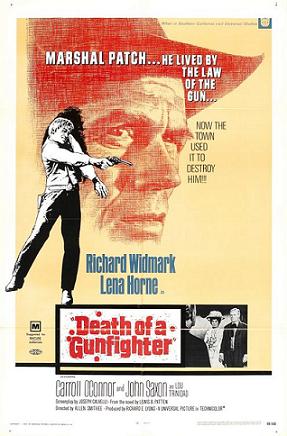
A Movie A Day #244: Death of a Gunfighter (1969, directed by Allen Smithee)


At the turn of the 20th century, the mayor and the business community of Cottonwood Springs, Texas are determined to bring their small town into the modern era.  The Mayor (Larry Gates) has even purchased one of those newfangled automobiles that have been taking the country by storm.  However, the marshal of Cottonwood Spings, Frank Patch (Richard Widmark), is considered to be an embarrassing relic of the past.  Patch has served as marshal for 20 years but now, his old west style of justice is seen as being detrimental to the town’s development.  When Patch shoots a drunk in self-defense, the town leaders use it as an excuse to demand Patch’s resignation.  When Patch refuses to quit and points out that he knows all of the secrets of what everyone did before they became respectable, the business community responds by bringing in their own gunfighters to kill the old marshal.

Death of a Gunfighter is historically significant because it was the very first film to ever be credited to Allen Smithee.  The movie was actually started by TV director Robert Totten and, after Widmark demanded that Totten be fired, completed by the legendary Don Siegel.  Since Totten worked for 25 days on the film while Siegel was only on set for 9, Siegel refused to take credit for the film.  When Widmark protested against Totten receiving credit, the Director’s Guild of America compromised by allowing the film to be credited to the fictitious Allen Smithee.

In the years after the release of Death of a Gunfighter, the Allen (or, more often, Alan) Smithee name would be used for films on which the director felt that he had not been allowed to exercise creative control over the final product.  The Smithee credit became associated with bad films like The O.J. Simpson Story and Let’s Get Harry which makes it ironic that Death of a Gunfighter is not bad at all.  It’s an elegiac and intelligent film about the death of the old west and the coming of the modern era.  It also features not only one of Richard Widmark’s best performances but an interracial love story between the marshal and a brothel madame played by Lena Horne.  The supporting cast is full of familiar western actors, with Royal Dano, Harry Carey, Jr., Larry Gates, Dub Taylor, and Kent Smith all making an impression.  Even the great John Saxon has a small role.  Though it may be best known for its “director,” Death of a Gunfighter is a film that will be enjoyed by any good western fan.

A Movie A Day #243: The Joe Louis Story (1953, directed by Robert Gordon)


Joe Louis, also known as the Brown Bomber, is generally agreed to have been one of the greatest heavyweight boxers of all time.  Despite the barriers put up by both poverty and racism, Louis held the world heavyweight championship from 1937 to 1949 and successfully defended his title in 26 fights (ranking him second to only Julio Cesar Chavez, who had 27 title defenses).  In 1938, he defeated German Max Schmelling, disproving Nazi claims that a black man could not defeat an Aryan and making Louis, along with Jesse Owens, one of the first African-American athletes to achieve nationwide hero status in America.
The Joe Louis Story, which was made and released shortly after Louis lost his final fight to Rocky Marciano and announced his retirement from boxing, tells an effective but sanitized version of Louis’s life story.  Made on an obviously low budget, The Joe Louis Story hits all the highlights — Joe’s relationship with trainer Jack Blackburn (James Edwards), Joe’s marriage to Marva Trotter (Hilda Simms), Joe’s two fights against Max Schmelling, and Joe’s time in the army — while ignoring most of the lowlights.  No mention is made of Joe’s financial troubles, Joe’s initial struggle to even get a match against the white heavyweights of the day, or the infidelity that led to Joe and Marva’s divorce.  The Joe Louis Story does briefly touch on racism when Joe is told that, as a black man, he already has a strike against him as far as the boxing establishment is concerned.

The best thing about The Joe Louis Story is that it features footage from Louis’s actual fights. Coley Wallace, the boxer who was hired to play the title role, bore a remarkable resemblance to Joe and the footage of the real Joe Louis boxing is easily mixed in with scene of Wallace as Joe.  Wallace was not much of an actor but, as a real-life boxer, he still brought enough authenticity to the role that his casting works.

One final note: In real life, Joe Louis ended his career after a brutal loss to Rocky Marciano.  Before turning pro, Marciano lost four fights as an amueter.  One of those losses came in 1948 when Marciano was defeated in the final round of the New York Golden Gloves tournament.  The fighter who defeated Rocky Marciano?  Coley Wallace.

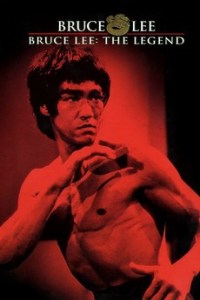
A Movie A Day #242: Bruce Lee, the Legend (1984, directed by Leonard Ho)


From Golden Harvest comes this tribute to their biggest star, Bruce Lee.
Starting with Lee’s birth and early film career and ending with Lee’s mysterious death and posthumous fame, Bruce Lee, The Legend is a breezy documentary about the world’s greatest martial arts star.  Since it was made by Golden Harvest and designed to serve as a tribute to both Bruce’s life and his continuing fame, do not expect to hear a negative word about Bruce in Bruce Lee, The Legend.  Then again, I don’t think I have ever come across anything negative about Bruce Lee.  While Bruce Lee probably was not as saintly as he’s portrayed in this documentary, every thing that I’ve read about Lee indicates that there was little difference between who Lee was in real life and who Lee was in the movies.

For fans of Bruce Lee, the most interesting part of this documentary will be the clips of Bruce as a young actor, often playing juvenile delinquents in films that were never widely released in the United States or Europe.  Judging from the clips shown, Lee’s movie star charisma was present even when he was a teenager.  The documentary also provides details about Bruce’s father, a stage actor who was well-known for his work in what the documentary describes as being Hong Kong’s “version of vaudeville.”  Of course, this documentary also contains clips from Lee’s better-known films, like Enter the Dragon, Way of the Dragon, and The Big Boss.  Even in brief and out-of-context clips, Lee is always exciting to watch.

A Movie A Day #241: Distant Justice (1992, directed by Tôru Murakawa)


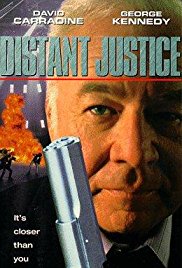
Inspector Rio (Bunta Sugawara) is visiting Boston for the first time.  When his wife accidentally photographs a drug deal in process, his family his attacked.  Rio’s wife is killed.  His daughter is kidnapped. When Rio goes to the local police, he gets no help.  It does not matter that Chief Bradfield (George Kenendy!) is an old friend of his.  Bradfield is on the verge of retirement and he knows that almost every cop in his precinct is corrupt.  The drug syndicate is so powerful that even the local politicians (represented by David Carradine in the role of Joe Foley) are in their back pocket.  Rio is told to go back to Japan but instead, Rio wages war on the Boston syndicate himself.  With the help of one of Boston’s only honest cops (Eric Lutes) and Bradfield, Rio sets out to rescue his daughter and get justice!  Distant justice!

Distant Justice is a typical low-budget 90s action film.  Bystanders get shot, bad guys get blown up, and there’s a shot of someone screaming as he plunges to his death.  The problem with Distant Justice is that it totally wastes David Carradine in a nothing role as a crooked politician.  If Carradine is in a movie about a cop seeking vengeance on a drug lord, Carradine either has to play the cop or he has to be play the drug lord.  If he is cast in any role other than that, the movie has to be considered a failure.  George Kennedy is his usual likable self (Kennedy built one of the longest careers in the movie on pure likability) but even that cannot make up for not taking advantage of having David Carradine as a member of the cast.  Distant Justice is a missed opportunity.

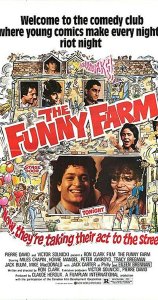
A Movie A Day #240: The Funny Farm (1983, directed by Ron Clark)


Mark Champlin (Miles Chapin) is a fresh-faced, aspiring comedian from Cleveland who drives across the country, listening to tapes of Steve Martin.  He arrives in Los Angeles, hoping to become a star.  Despite being too naive and trusting, Mark starts to find success in the cut-throat entertainment industry.  Soon, he is performing at the Funny Farm, a comedy club owned by Gail Corbin (Eileen Brennan, giving the exact same performance that Melissa Leo gave in Showtime’s I’m Dying Up Here).  Mark befriends the other comedians, finds love, and hopes for his big break.
There have been several movies and television shows about the drama that goes on behind the scenes in the world of comedy.  It’s rare that they ever turn out well.  For every successful movie about the struggle to make a living by telling jokes, there are a hundred movies like Punchline or this one.  Whereas Punchline tried to pass Sally Field off as an up-and-coming stand-up comic, The Funny Farm was full of actual comedians.  Almost everyone in the film is playing a thinly disguised versions of themselves and snippets of their acts are used throughout the movie.  (Probably the best known member of the cast is Howie Mandel.)  Unfortunately, none of their acts seem to be very funny.  Miles Chapin comes across like every forgettable comic who ever bombed on The Tonight Show.

Eileen Brennan does a good job as the club owner, even if she is underused.  There is also a good scene where the younger comedians meet a legendary, older comic who turns out to be a racist asshole.  During this scene, The Funny Farm actually has something to say about the way comedy progressed and changed over time.  Otherwise, The Funny Farm is forgettable.

A Movie A Day #239: Act of Vengeance (1986, directed by John Mackenzie)


Act of Vengeance is an uncompromising look at union corruption and how it hurts the workers while benefitting the bosses.
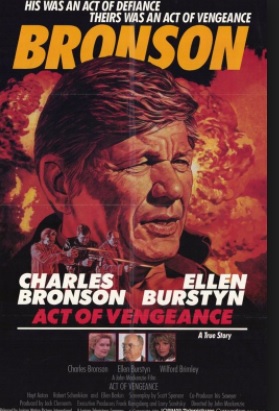
The year is 1969 and the United Mine Workers of America is one of the biggest and most powerful labor unions in the country.  The UMWA was founded to protect the rights of miners but the current union president, Tony Boyle (Wilford Brimley), is more concerned with enriching himself and consolidating his own power.  Despised by the workers that he represents, Boyle has managed to stay in power through fixed elections and his own fearsome reputation.  When 80 West Virginia miners are killed in an accident, Boyle defends the owners.  That is the last straw for Jock Yablonski (Charlies Bronson), a lifelong miner and proud union man.  Yablonski runs against Boyle for the UMWA presidency and, when the election is stolen from him, Yablonski challenges the results.

Boyle’s solution?  Working through one of his supporters (played by Hoyt Axton), Boyle hires three assassins (Robert Schenkkan, Maury Chaykin, and a young Keanu Reeves) and orders them to kill not only Yablonski but his entire family too.

With a name like Act of Vengeance and a star like Charles Bronson, it would be understandable to assume that this is another Cannon action film where Bronson gets vengeance by blowing away the bad guys.  That’s not the case, though.  Made for HBO, Act of Vengeance is based on a true story of union corruption and murder.  There is violence but very little of it comes from Bronson.  Instead, this is a well-made docudrama about what happens when workers are betrayed by the very people who are supposed to be looking out for them.

Bronson grew up working in the mines and he never forgot the poverty of his youth.  He knew men like the men depicted in this movie and Bronson gives one of his most naturalistic performances as Yablonski.  Brimley is at his gruffest as Boyle and the performances of the actors playing the three hapless but deadly assassins also feel authentic.  Ellen Burstyn and Ellen Barkin are also well-cast as, respectively, Yablonski’s wife and the wife of the main assassin.

A Movie A Day #238: Lawman (1971, directed by Michael Winner)


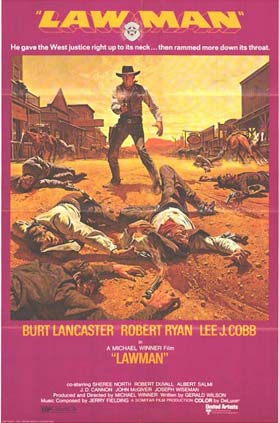
In the 1880s, Jared Maddox (Burt Lancaster) is the marshal of the town of Bannock.  After a night of drinking and carousing leads to the accidental shooting of an old man, warrants are issued for the arrest of six ranch hands.  Maddox is determined to execute the arrest warrants but the problem is that the six men live in Sabbath, another town.  They all work for a wealthy rancher (Lee J. Cobb) and the marshal of Sabbath, Cotton Ryan (Robert Ryan), does not see the point in causing trouble when all of the men are likely to be acquitted anyway.  Maddox doesn’t care.  The law is the law and he does not intend to leave Sabbath until he has the six men.

Lawman starts out like a standard western, with a stranger riding into town, but then it quickly turns the western traditions on their head by portraying Marshal Maddox as being a rigid fanatic and the wealthy rancher as a morally conflicted man who does not want to resort to violence and who continually tries and fails to convince Maddox to leave.  In the tradition of Sergio Leone and Sam Peckinpah, there are no real heroes to be found in Lawman and, even when Maddox starts to reconsider his strict adherence to the law and refusal to compromise, it is too late to prevent the movie from ending in a bloody massacre.  Since Lawman was made in 1971, I initially assumed it was meant to be an allegory about the Vietnam War but then I saw that it was directed by Michael Winner, a director who specialized in tricking audiences into believing that his violent movie were deeper than they actually were.

Even if Lawman never reaches the heights of a revisionist western classic like Pat Garrett and Billy the Kid, it is still pretty good, with old pros Lancaster, Ryan, Cobb, and Albert Salmi all giving excellent performances.  The cast is full of familiar faces, with everyone from Robert Duvall to Richard Jordan to Ralph Waite to Joseph Wiseman to John Beck showing up in small roles.  In America, Winner is best remembered for his frequent collaborations with Charles Bronson.  Chuck is not in Lawman, though it seems like he should have been and Lee J. Cobb’s rancher is named Vincent Bronson.  Winner would not make his first film with Charles Bronson until a year later, when he directed him in Chato’s Land.

A Movie A Day #237: Detention (2003, directed by Sidney J. Furie)


It’s Die Hard in a school!

A group of gun-wielding drug runners have broken into Hamilton High so that they can use it as the base of operations for a huge drug deal.  With the Vice President scheduled to be traveling through town that weekend, they figure that the school will be deserted and no one will be paying attention to what’s going on.  What they failed to consider is that not every student goes home after the final bell rings.  One paraplegic student is still in the library, doing research.  Two more are in the auditorium, getting high.  There’s even a few “bad” kids in detention, including one of whom is pregnant.  Even worse, for the drug dealers, is that Sam Decker (Dolph Lundgren!) is in charge of detention.  He may teach phys ed and history but before he decided to help broaden young minds, Sam was an army ranger.

Of all of the performers who starred in direct-to-video action movies in the 90s and early aughts, Dolph Lundgren was the best actor.  When considering that his competition largely came from Steven Seagal and Jean-Claude Van Damme, that may sound like damning with faint praise but the fact that Lundgren could actually memorize his lines and hit his marks actually did make a difference.  It is easy to imagine Detention with Lundgren and the results are not pretty.  Steven Seagal would have been too busy whispering his lines and waiting for his stunt double to show up.  Jean-Claude Van Damme would have gotten too caught up in doing the splits to waste his time worrying about the kids trapped in the auditorium.  Not Lundgren, though.  Dolph Lundgren’s too busy getting shit done to worry about any of that.

Though the action sequences are top notch, Detention would work better if the villains were Lundgren’s equal but they’re not.  One reason why Die Hard worked was because Alan Rickman and his men always seemed like they were capable of killing Bruce Willis.  In Detention, the main villains are three Hungarian punks and a flamboyant American, Chester Lamb (Alex Karzis), and none of them seem like they could even carry Dolph Lundgren’s shoes, much less defeat him in a combat situation.  Scenes where Chester pretends to be an innocent bystander seem like they were included to remind us of the first meeting between Alan Rickman and Bruce Willis in Die Hard but Chester Lamb is no Hans Gruber.  There is just no way that Dolph Lundgren is going to lose to someone named Chester Lamb.

Even with the underwhelming villains, Detention is a gloriously stupid action movie that is entertaining because Lundgren gives it his all.

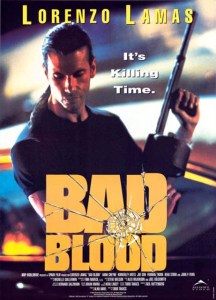
A Movie A Day #236: Bad Blood (1994, directed by Tibor Takacs)


Though it is sometimes hard to remember, there more on late night Cinemax than just Shannon Tweed films like Scorned and Body Chemistry 3.  There were also Lorenzo Lamas action films, movies like the Snake Eater trilogy.  Though Lamas was a terrible actor, his direct-to-video efforts were always a hundred times more violent than everyone else’s and, for male viewers of a certain age, it did not hurt that his then-wife, Kathleen Kinmont, often showed up in various states of undress.

Kathleen Kinmont did not appear in Bad Blood but the movie made up for her absence by being so violent that it was originally given an NC-17 rating.  As a result, there are actually two versions of this movie floating around: the slightly cut R-rated Bad Blood and an unrated version called Viper.  (Interestingly, the violence in both Bad Blood and Viper is really no more graphic than the violence that was featured in a lot of mainstream films released in the mid-90s.)

In this one, Lorenzo Lamas is Travis Blackstone, a former cop who was kicked off the force after he destroyed evidence to protect his smarmy brother, Franklin (Hank Cheyne).  Travis was sent to prison but now that he is out, he is working in a shipping yard and coaching little league baseball.  (I do not know many parents that would be happy with an ex-con as their child’s little league coach but that is the power of Lorenzo Lamas.)  Unfortunately, Franklin has gotten in trouble again, embezzling millions from the mafia.  Not only does Travis have to find the money to repay the mob but he also has to keep Franklin safe.  Unfortunately, since Franklin is now involved with Travis’s ex, Rhonda (Frankie Thorn), Travis’s new girlfriend (Kimberly Kates) assumes that he is cheating on her and tells the mob where they can track down the Blackstone brothers.

The main bad guy, Chang, is played by Joe Son.  (The unrated version begins with Chang giving a little girl a lollipop and then shooting her dead.)  Joe Son was a UFC fighter who was later revealed to be just as bad a guy in real life as he was in the movies.  After being convicted on rape in 2011, Son was sentenced to seven years to life.  As soon as he arrived in prison, he beat his cellmate to death and received an additional sentence of 27 years for voluntary manslaughter.

As for Bad Blood, by the standards of the typical Lorenzo Lamas action movie, it’s not bad.  The action is constant and fierce, with Travis gunning down a seemingly endless number of gangsters in designer suits.  Tibor Takacs was a better filmmaker than most of the directors that Lamas worked with and it appears that he managed to keep Lorenzo Lamas’s ego under control, the result being far less shots of Lamas posing than in any of the other movies that Lamas made during this period.  The production values of Bad Blood are also consistently better than what was on display in the Snake Eater films.  There is even a scene where Lamas not only flips over a speeding car but he shoots the driver while he is doing it.  Let’s see Steven Seagal or even Dolph Lundgren do that!