Musical Film Review: The Apple (dir by Menahem Golan)


1980’s The Apple takes place in the future!

Well, actually, it takes place in 1994.  The film imagines that, by the year 1994, the world would be a decadent, cynical, and soulless place where everyone listened to the mindless corporate music of Mr. Boogalow (Vladek Sheybal).  Really, the film’s version of the future wasn’t that far off.  It was more 2014 than 1994 but still….

Anyway, at the 1994 Worldvision Music Contest, Boogalow cheats to make sure that the latest shallow offering from BIM defeats a painfully earnest love song that is performed by Alphie (George Gilmour) and his girlfriend, Bibi (Catherine Mary Stewart).  Boogalow decides to sign Alphie and Bibi to a recording contract.  Alphie has visions of earthquakes and imagines being taken to Hell by Boogalow.  Alphie refuses to sign the contract.  Bibi, having had no such visions, signs the contract and soon, she is a part of the decadent Boogalow world.  Alphie, meanwhile, ends up living in a park with Mr. Topps (Joss Ackland) and a bunch of overage hippies.  Eventually, the Rapture occurs, largely because something had to happen to finally end this stupid movie.

The Apple was a film that I had heard a lot about before I actually sat down and watched it.  Just from what I had heard, I expected it to be bad-but-enjoyable, a disco campfest in the style of Sgt. Pepper’s Lonely Hearts Club Band In fact, I would have been happy if it had just been as silly as Skatetown USA.  Unfortunately, The Apple can’t compare to either of those two films.  The Apple may be campy but it’s also mind-numbingly dull.  It’s only has an 87 minute running time but it feels considerably longer.  With one big exception, the music is forgettable.  Catherine Mary Stewart probably gives as good a performance as could be expected under the circumstances but George Gilmour is a bland hero.  Even Vladek Sheyball, who was so memorable as the villainous chess master in From Russia With Love, makes for a forgettable bad guy.

Now, I did mention that there is one big exception when it comes to the forgettable music and that’s a song that Bibi sings after she’s signed with Boogalow and given up her soul to be a star.  The song is called Speed.  “America, the land of the free/Is shooting up with her energy/and everyday she has to take more/…. SPEEEEEED!”  Bibi performs the song on a stage while a bunch of backup dancers writhe on motorcycles and, for about three minutes, The Apple actually becomes the spectacle that it so obviously wants to be.  The song may be about drugs but it’s also about American culture.  America is a country that is on the mood.  We don’t need any of that fashionable European ennui.  We’re all about speed, which is one reason why I love this country.  At our most mellow, we still get more done in a day than the average European.  No trains for us!  We’re a motorcycle nation!

Other than that one scene, though, The Apple feels like a middle school production.  We’re told that Boogalow International Music is a decadent company but, in this film, that just means that people speak in an arch tone.  It’s a teenager’s impression of what it means to be decadent.  We’re meant to turn against BIM when its employees laugh at Alphie for being a boring straight guy.  But the fact of the matter is that Alphie is a boring straight guy and his music sucks.  The film takes a stand about corporate music but the 0nly alternative that it come up with is boring folk music.

Don’t listen to those who tell you that The Apple is so bad that it’s good.  It’s just bad.

Electric Dreams (1984, directed by Steve Barron)


Electric Dreams is a film about a love triangle between a man, his neighbor, and his personal computer.

Miles (Lenny Von Dohlen) is an architect who wants to develop a special brick that can withstand earthquakes.  One of his colleagues suggests that he buy something called a — let me check my notes to make sure I got it right — com-put-er.  Apparently, computers can do anything!  Miles is skeptical but he decides to give it a try.

(In all fairness, this movie came out at a time when there were no iPhones or even laptops and personal computers were viewed as being strange and exotic. )

Miles get his computer and it’s basically one of those boxy computers that used to populate computer labs in high schools across the country.  As soon as I saw the computer, I wanted to play Oregon Trail.  After the computer overheats and Miles tries to cool it down by pouring champagne on it (!), the computer comes to life.  Now voiced by Burt Cort, the computer develops a crush on Mile’s neighbor, a cellist named Madeleine (Virginia Madsen).  The computer hears Madeleine playing her cello and composes its own music to play with her.  Madeleine hears the music and assumes that Miles must be a great composer.  Soon, Miles and Madeleine are falling in love and the computer is getting jealous.  The computer composes more more music for Miles but grows angry when Miles doesn’t give the computer any credit.  Even though the computer can’t move from the desk and has to be plugged in to work, it still manages to wreck havoc with Miles’s life.  When this movie came out, the idea of someone’s entire life being electronically monitored and recorded probably seemed like an out-there idea.  Today, that’s just a normal Tuesday for most people.

Electric Dreams is a mix of romance, comedy, and science fiction.  The scenes of Miles and Madeleine falling in love are mixed with scenes of the computer basically having a nervous breakdown and conspiring to ruin Miles’s credit and even trap him in his apartment.  Electric Dreams is probably the most good-natured film ever made about a computer run amuck.  The computer doesn’t mean to hurt anyone, it’s just jealous and feeling neglected.  It’s a weird mix but the movie is so dedicated to its premise and Lenny Von Dohlen and Virginia Madsen are so appealing as the romantic leads that it works.  Electric Dreams proves that true love can conquer all, even in the Computer Age.

Ed and His Dead Mother (1993, directed by Jonathan Wacks)


After the death of his mother (Miriam Margoyles), shy Ed (Steve Buscemi) inherits the family hardware store.  Even though Ed now has his own business and maybe even a chance at having a relationship with Storm Reynolds (Sam Jenkins), Ed simply cannot leave the memory of his mother behind.  One day, he is approached by a salesman named A.J. Peddle (John Glover).  Peddle explains that he can bring Ed’s mother back to life for a thousand dollars.  Ed agrees and soon, Ed’s mother is once again living with Ed and Ed’s Uncle Benny (Ned Beatty).  Benny is upset because he doesn’t think that it’s proper to tamper in matters of morality and he never liked his sister to begin but, at first, Ed is happy to have her back.  However, Ed soon discovers that his mother has changed now that she’s come back to life.  She now has a craving for blood and soon, she’s chasing the neighborhood dogs while holding a knife.  Ed’s mom has returned as a zombie!  Can Ed finally move on and commit to sending his mother back to the grave?

This quirky comedy came out in 1993, a few years too early to take advantage of either the zombie boom or the horror comedy boom.  The movie never really find the right balance between scares and laughs.  The script is full of funny lines and Steve Buscemi and Ned Beatty are a good comedic team but the direction is as flat and as lifeless as Ed’s mom before she was resurrected.  Today, the movie is mostly interesting as a precursor for later trends in horror.  It’s also a chance to see Steve Buscemi is rare starring role.  Buscemi is ideally cast as the gentle Ed, who eventually learns the importance of letting go, accepting death, and moving on.  Buscemi is good, even in a misfire like this one.

Just two years after starring in this movie, Buscemi would appear on Homicide: Life on the Streets, playing a white supremacist murderer named Gordon Pratt.  Among the detectives assigned to arrest Pratt was Stanley Bolander, played by Ned Beatty.  As far as I know, that’s the only other pairing of Buscemi and Beatty and there wasn’t much to laugh about in that episode of Homicide.  It’s too bad because, judging from their interactions in this movie, Ned Beatty and Steve Buscemi could have been one of the great comedy teams.

A Movie A Day #275: The Awakening (1980, directed by Mike Newell)


Charlton Heston is Matthew Cormbeck, a driven archaeologist.  (Could an archaeologist played by Charlton Heston by anything other than driven?)  In 1961, he discovers the long-lost tomb of an Egyptian queen named Kara.  Ignoring both the birth of his daughter and the warning inscribed over the doorway, Matthew enters the tomb and discovers the mummified Kara.  At the same time, his stillborn daughter, Margaret, comes back to life.
18 years later, Cormbeck is a teacher at a British university.  He has since divorced Margaret’s mother and has married his longtime assistant, Jane (Susannah York).  Matthew is still obsessed with whether or not the Egyptians are taking proper care of the mummy and wants to bring it to England.  At the same time, Margaret (Stephanie Zimbalist) defies her mother and comes to England to meet her father.

Like Blood From The Mummy’s Tomb, The Awakening was based on Bram Stoker’s The Jewel of Seven Stars.  Unfortunately, The Awakening is never as good as Blood from Mummy’s Tomb and gets bogged down in the lengthy Egyptian prologue.  (Blood from The Mummy’s Tomb skipped over the first part of Stoker’s novel and started with Margaret already 18 and possessed.)  The Awakening tries to take a more cerebral approach than the Hammer adaptation but both Heston and Zimbalist are fatally miscast.  Especially in the Egyptian scenes, Heston grits his teeth and lets his ascot do most of the work.

When it comes to Heston in Egypt, stick with The Ten Commandments.  When it comes to mummies in England, stick with Hammer.

A Movie A Day #157: Pacific Heights (1990, directed by John Schlesinger)


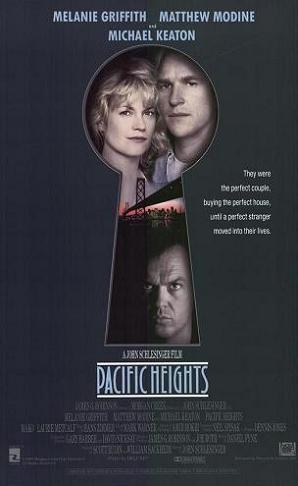
Michael Keaton is the tenant from Hell in Pacific Heights.

In San Francisco, Patty (Melanie Griffith) and Drake (Matthew Modine) have just bought an old and expensive house that they can not really afford.  In order to keep from going broke, they rent out two downstairs apartments.  One apartment is rented by a nice Japanese couple.  The other apartment is rented by Carter Hayes (Michael Keaton).  Carter convinces Patty and Drake not to check his credit by promising to pay the 6 months rent up front.  The money, he tells them, is coming via wire transfer.

The money never arrives but Carter does.  Once he moves into the apartment, Carter changes the locks so that no one but him can get in.  At all hours of the day and night, he can be heard hammering and drilling inside the apartment.  Even worse, he releases cockroaches throughout the building.  When Drake demands that Carter leave, the police back up Carter.  After goading Drake into attacking him, Carter gets a restraining order.  Drake is kicked out of his home, leaving Patty alone with their dangerous tenant.

Pacific Heights is the ultimate upper middle class nightmare: Buy a house that you can not really afford and then end up with a tenant who trashes the place to such an extent that the property value goes down.  As a thriller, Pacific Heights would be better if Drake and Patty weren’t so unlikable.  (When this movie was first made, people like Patty and Drake were known as yuppies.)  Much like Drake’s house, the entire movie is stolen by Michael Keaton’s performance as Carter Hayes.  Carter was not an easy role to play because not only did he have to be so convincingly charming that it was believable that he could rent an apartment just by promising a wire payment but he also had to be so crazy that no one would doubt that he would deliberately infest a house with cockroaches.  Michael Keaton has not played many bad guys in his career but his performance as Carter Hayes knocked it out of the park.

One final note: Keep an eye out for former Hitchcock muse (and Melanie Griffith’s mother) Tippi Hedren, playing another one of Carter’s potential victims.  Her cameo here is better than her cameo in In The Cold of the Night.