Welcome to Retro Television Reviews, a feature where we review some of our favorite and least favorite shows of the past! On Tuesdays, I will be reviewing the original Fantasy Island, which ran on ABC from 1977 to 1986. Almost entire show is currently streaming is on Youtube!
Smiles!
Episode 3.11 “The Mermaid/The Victim”
(Dir by Earl Bellamy, originally aired on December 1st, 1979)
This week, Fantasy Island suddenly becomes the most dangerous place on Earth.
Julie Bett (Joan Prather) comes to the island with a simple fantasy. She wants a date — just one date — with a man that she met briefly four years ago. Mr. Roarke asks Julie if perhaps she has overidealized her memories of Michael Duvall (James Darren). Julie says no and that Michael is the ideal man. Roarke reveals that Duvall lives on a nearby island where Roarke has no legal authority. Julie says that fine, since the date will be on Fantasy Island. Roarke reveals that Duvall is usually not allowed to step foot on Fantasy Island because of his shady reputation. Julie replies that there’s nothing shady about Michael Duvall. Roarke finally allows Duvall to come to Fantasy Island for the date.
Of course, within minutes of arriving, Duvall has drugged Julie’s drink and then whisked her back to his own island. It turns out that Michael Duvall is a Jeffrey Epstein-style human trafficker and his estate doubles as a prison for the women that he had abducted. His evil assistant, Madame Jeannot (Yvonne DeCarlo), announces that there is no way that Julie can escape and, to prove her point, she introduces Julie to Annie (Cathryn O’Neil), who tried to escape and was severely beaten as a result.
Julie tries to rally the other prisoners (including Dorothy Stratten, who would be murdered 8 months after this episode aired) to fight back against Duvall, Jeannot, and their servant. If her rebellion fails, Julie knows that she’ll never be seen again….
Meanwhile, oceanographer Harold DeHaven (John Saxon) has come to Fantasy Island with his wife, Amanda (Mary Ann Mobley). Harold and Amanda have a troubled marriage, largely because Harold is too obsessed with his work and his desire to make a major discovery of some sort. No sooner has Harold started walking along the beach then he comes across a mermaid! Princess Nyah (Michelle Phillips) is apparently a well-known figure on Fantasy Island and, at one point, Roarke even confronts Nyah about her history of trying to lure the guests to their deaths. Can Amanda prevent her husband from drowning in his attempt to be with Princess Nyah?
(This episodes leaves us to wonder just what exactly Fantasy Island’s legal liability would be if someone died as a result of their fantasy. Seriously, it seems like Mr. Roarke has really left himself vulnerable to a lawsuit.)
Anyway, Julie and the other kidnapped women manage to escape from Duvall’s estate, just to find Mr. Roarke and a bunch of policemen waiting for them. Roarke explains that he knew what Duvall was doing but he needed proof before he could contact that authorities. Julie provided the proof. Essentially, Roarke is saying that he put Julie’s life at risk to take down Duvall but Julie and the other women seem to be amused by the whole thing. Everyone smiles as Mr. Roarke says that he’ll take them back to Fantasy Island. I guess PTSD doesn’t exist on the islands.
Meanwhile, Amanda’s efforts to keep Harold from swimming off with Nyah nearly leads to Amanda drowning. Seeing his wife risk her life for him, Harold realizes that he really does love Amanda and both he and Amanda return to dry land. Disappointed, Nyah swims off.
Yay! Everyone lived! As they all left the Island, no one seemed to be the least bit traumatized by nearly dying. At the plane flies away, Roarke suggest that Nyah’s new target might be Tattoo. “Be serious, boss,” Tattoo, “I can’t even swim.” The thought of his assistant dying a terrible death from drowning cause Roarke to laugh out loud as the end credits roll.
There was a weird episode and compulsively watchable as a result. Seriously, how do you not love John Saxon following Michelle Phillips into water? That said, Fantasy Island seems like a very dangerous place.
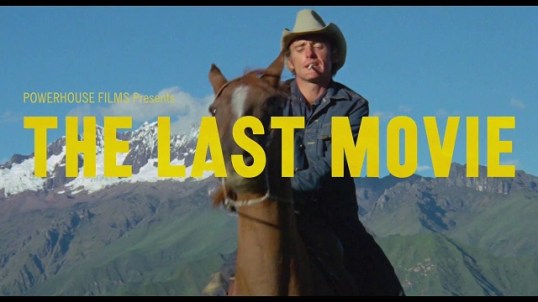
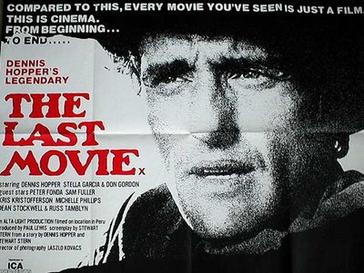
The story behind the making of 1971’s The Last Movie is legendary. It’s also a bit of a cautionary tale.
In 1969, Hollywood was stunned by the box office success of an independent, low-budget counter-culture film called Easy Rider. Easy Rider not only made a star out of Jack Nicholson but it was also the film that finally convinced the studios that the way to be relevant was not to continue to crank out big budget musical extravaganzas like Doctor Doolittle and Hello, Dolly! Instead, it was decided that the smart thing to do would be to hire young (or, at the very least, youngish) directors and basically just let them shoot whatever they wanted. The resulting films might not make much sense to the executives but, presumably, the kids would dig them and as long as the kids were paying money to see them, everyone would continue to get rich. Because Dennis Hopper had directed Easy Rider, he suddenly found himself very much in demand as a director.
Of course, almost everyone in Hollywood knew Dennis Hopper. Long before he became an icon of the counter-culture, Dennis Hopper had been a part of the studio system. John Wayne even referred to Hopper as being his “favorite communist.” Everyone knew that Dennis could be a bit arrogant. Everyone knew that Dennis was very much into drugs and that, as a result, he had a reputation for being a bit unstable. Everyone knew that Dennis Hopper deliberately cultivated an image of being a bit of a wild man and a revolutionary artist. But Dennis Hopper had just directed Easy Rider and Universal was willing to give Hopper some money to go down to Peru and direct his follow-up.
The Last Movie was a film that Hopper had been planning on making for a while. The film’s original script told the story of an aging and broken-down stuntman named Kansas who retires to Mexico and searches for a gold mine with a friend of his. Hopper first tried to get the film going in 1965, with Montgomery Clift in the lead role. After Clift died, Hopper tried to interest John Wayne in the starring role but, though Wayne enjoyed having Hopper in his films so that he could threaten to shoot him whenever Abbie Hoffman said something shocking, he had no interest in being directed by him. When Universal finally agreed to put up the money for the film, Hopper offered the lead role to Jack Nicholson. Nicholson turned it down and told Hopper that it was obvious that Dennis wanted to play the role himself. Dennis decided that he agreed with Nicholson and he cast himself as Kansas. Dennis also made the fateful decision to not only change the story’s setting to Peru but to also film on location.
Dennis and a group of friends flew down to Peru, which, at that time, was the cocaine capitol of the world. Drug use was rampant on the set, with Dennis reportedly being one of the main offenders. The cast and crew filmed during the day and partied at night and no one was particularly sure what the film was supposed to be about. Amazingly, Hopper finished filming on schedule and within budget but, much as he did with Easy Rider, he also overfilmed and ended up with 40 hours of footage. Not wanting to be bothered by the studios, Hopper edited the footage in his compound in Taos, New Mexico. Working slowly and continuing to consume a large amount of drugs and alcohol, Hopper still managed to put together a film that had a straightforward storyline. When Hopper showed his initial cut to filmmaker Alejandro Jodorowsky, the director of El Topo accused Hopper of being too conventional in his approach, which led to Hopper chopping up the film and reassembling it. Finally, after spending over a year working with the footage, Hopper turned in his final edit.
Universal had no idea what to make of the film that Hopper delivered to them. Still, they released it with the hope that the same crowd that loved Easy Rider would embrace The Last Movie. While the film did win an award at the Venice Film Festival, critics hated it and, even worse, audiences stayed away. The film’s reception was so overwhelmingly negative that Hopper found himself largely exiled from Hollywood, with only a few directors (like Francis Ford Coppola) willing to take the chance of working with him. It wasn’t until the 80s, when he finally got clean and sober, that Dennis Hopper was able to reestablish himself as a character actor and, ultimately, a beloved cultural institution.
But what about The Last Movie? Was is it really as bad as the critics claimed? Or was it, as some more recent reviewers have suggested, an unacknowledged masterpiece that was ahead of its time? I recently watched The Last Movie to find out for myself.
Despite its reputation, The Last Movie gets off to a pretty strong start. Samuel Fuller (playing himself) is directing a hilariously over-the-top and violent western in the mountains of Peru. Kansas (Dennis Hopper) is working as a stuntman. He’s fallen in love with a local sex worker named Maria (Stella Garcia). Kansas is meant to be an aging Hollywood veteran, someone who has broken a lot of bones and who carries a lot of aches as a result of his line of work. (One can see why Hopper initially imagined an actor like John Wayne in the role.) He knows that this is going to be his last job and, as we see over the first 25 minutes of the film, he feels alienated from the rest of the cast and crew. Admittedly, Hopper does appear to be a bit too young for the role. The ideal Kansas would have been someone like Ben Johnson, L.Q. Jones, or perhaps Warren Oates. But, still, Hopper does a good job of capturing Kansas’s mixed feelings about the western that’s being filmed around him.
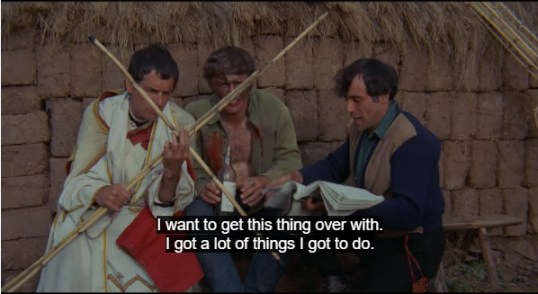
A lot of familiar faces pop up in the film’s fictional western. Dean Stockwell plays an outlaw. Jim Mitchum, Russ Tamblyn and Kris Kristofferson plays his associates. Peter Fonda is the youthful sheriff. Michelle Phillips is the daughter of the town’s banker and apparently, she’s also the girlfriend of one of the outlaws. We watch as the actors pretend to shoot guns and kill each other while the cameras are rolling, just to get up off the ground once “Cut” is yelled. When a local Indian who has been cast as an extra grows upset at the violence, an assistant director explains to him that no one really dies while the cameras are rolling. When shooting wraps, the film company goes home but Kansas stays behind with Maria. One day, the local priest (Tomas Milian) warns Kansas that the local indigenous people have moved into the abandoned film set and are trying to shoot their own movie. Kansas discovers that they have built wooden cameras and wooden boom mics and that their chief is giving orders in the style of Sam Fuller. They’re also firing the guns that the Americans left behind.
The first part of the film works quite well. Hopper’s camera captures the beautiful and isolated Peruvian landscape. The violent western is a pitch perfect and affectionate parody of a generic studio film. Though Hopper is a bit too young for the role, he still does a good job of capturing Kansas’s alienation from his fellow Americans. Even more importantly, the first part of the film seems to have an identifiable theme. The American film crew invaded an isolated part of Peru and changed the culture of the natives without even realizing it. Now, they’ve left but the natives are still dealing with the after effects of the American “invasion.” It’s easy to see, within that part of the story, a critique of both American culture and American foreign policy.
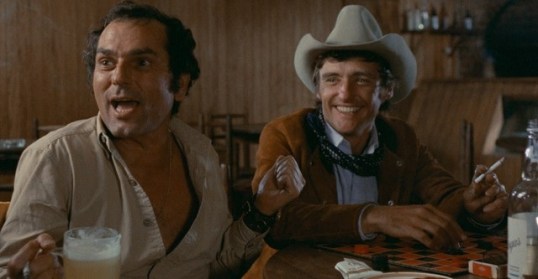
The second part of the film is where things start to fall apart. Kansas meets an old friend named Neville (Don Gordon). Neville has discovered a gold mine in the Peruvian mountains. With Kansas as his partner, he tries to get a businessman named Harry Anderson (Roy Engel) to invest in it. Kansas and Neville try to impress Harry and his wife (Julie Adams, best-known for being stalked by The Creature From The Black Lagoon). Kansas and Neville take the Andersons to a brothel and, in the process, Kansas offends Maria. Kansas then paws Mrs. Anderson’s fur coat and mentions that human beings are covered in hair. For all of their efforts, Harry will not invest, no matter how desperately Neville begs him to reconsider.
The second part of the film drags, with many of the scenes being obviously improvised between Hopper, Gordon, Garcia, Engel, and Adams. Unfortunately, the improved conversations aren’t particularly interesting and they tend to go on forever. Usually a reliable character actor, Don Gordon ferociously chews the scenery as Neville and it doesn’t take long before one grows tired of listening to him yell. (Gordon was far more impressive in Hopper’s Out of the Blue.) With the use of improvisation and overlapping dialogue, the second half of the film tries to feel naturalistic but instead, it’s a migraine-inducing method exercise gone wrong. It’s also during the second part of the film that a “scene missing” title card flashes on the screen, an indication that the discipline that Hopper showed as a director during the beginning of the film is about to be abandoned.
Finally, the third part of the film — well, who knows? The final 25 minutes of the film is collection of random scenes, some of which may be connected and some of which may not. The natives have decided that the only way to properly end their “film” is to kill Kansas. Kansas is shot several times and rides away on his horse. Suddenly, Kansas is back at his home and Maria is taunting him for getting shot. Then, Kansas is riding his horse again. Then suddenly, Dennis Hopper and Tomas Milian are laughing at the camera. A script supervisor tries to get Dennis to look at the shooting schedule while Dennis drinks. This happens:
Milian points out that the blood on Hopper’s shirt is dry. Hopper looks at his shoulder, where Kansas was previously shot, and says that someone needs to add his scar before he can shoot the scene. Ah! So, now we’re acknowledging that it’s all just a movie. Thanks, Dennis! Suddenly, Dennis is Kansas again and he’s collapsing over and over again in the dust. He appears to be dead but no, now he’s Dennis again and he’s standing up and smiling at the camera. And now, he’s singing Hooray for Hollywood. And now, suddenly, Kansas and Neville are talking about The Treasure of the Sierra Madre and then….
Well, let’s just say that it goes on and on before finally ending with a scrawled title card.
It’s a disjointed mess and it’s all the more frustrating because the first 30 minutes of the film is actually pretty good. But then, Dennis apparently remembered that he was supposed to be the voice of the counter-culture and he gave into his most pretentious impulses. Of course, just because a film is a mess, that doesn’t mean that it can’t be entertaining. And again, the first part of the film is entertaining and third part of the film is weird enough that it’ll hold most people’s attention for at least a few minutes. But the middle section of the film is so slow and pointless that it pretty much brings down the entire film.
In the end, what is The Last Movie about? In The American Dreamer(a documentary that was filmed while Hopper was editing The Last Movie in New Mexico), Hopper spends a lot of time talking about revolution and taking over Hollywood but The Last Movie is hardly a revolutionary film. The film is at its most alive when it is focused on the shooting of its fictional western. For all the satirical pokes that The Last Movie takes at the studio system, it’s obvious that Hopper had a lot of affection for Old Hollywood and for directors like Sam Fuller. Kansas may say “Far out,” but he’s hardly a hippie. Even the film’s jumbled finale seems to be saying, “It’s all Hollywood magic!” In the end, the film’s call for a new style of cinema is defeated by its love for the old style of cinema.
Instead, I think The Last Movie works best when viewed as a portrait of paranoia. Hopper himself admitted that he was naturally paranoid and the heavy amount of drugs that he was doing in the 70s didn’t help. One reason why Hopper filmed in Peru and edited in New Mexico was so the studios couldn’t keep track of him and, while directing, he worried about being arrested by the Peruvian secret police. As an actor, Hopper plays Kansas as being someone who views the world with caution and untrusting eyes. He doesn’t trust the other members of the film crew. He loves Maria but he’s still convinced that she’s going to betray him. Even the natives ultimately try to destroy him and the script supervisor tries to get him to stick to the shooting schedule. The film works best as a disjoined portrait of one man’s paranoid and fatalistic world view.
The Last Movie pretty much ended the studio’s attempts to harness the counter-culture by giving money to self-described revolutionaries. The new wave of directors — like Spielberg and Lucas — may have shared Hopper’s then-politics but they weren’t looking to burn down the system. (Hopper himself later became a Republican.) The Last Movie may not have been the literal last movie but it was, for a while at least, the last of its kind.
The plot of the 1991 film, Scissors, is not easy to describe. That’s not because the plot is particularly clever as much as it’s because it doesn’t make much sense.
Basically, Sharon Stone plays a woman named Angela Anderson. She is oddly obsessed with scissors and terrified about getting close to anyone. She’s been getting hypnotherapy from Dr. Carter (Ronny Cox) in an effort to understand why she’s so repressed but she doesn’t seem to be getting anywhere. This could possibly have something to do with the fact that Dr. Carter is continually distracted by the adulterous activities of his wife, Ann (Michelle Phillips).
Angela lives in a lonely but surprisingly big apartment with only her cat for company. Her cat is named Midnight and he’s a black cat so he automatically became my favorite character in the film. Living next door to her are two twin brothers. Alex (Steve Railsback) is a soap opera star. Cole (Railsback, again) is an artist in a wheelchair who continually paints cartoonish pictures of Angela being attacked by a man with a big red beard.
Then, one day, Angela goes out to buy some scissors. When she returns and gets on the elevator to head back up to her apartment, she’s attacked by a man …. A MAN WITH A RED BEARD! Fortunately, Angela is able to stab him with her scissors. After the man with the red beard runs off, Angela is discovered in the elevator by Alex and Cole. Alex and Angela fall in love. Cole’s not too happy about that.
Following so far?
Angela get a call about a job interview, one that requires her to go to a stranger’s apartment. Despite the fact that the film has spent nearly an hour setting up Angela as being intensely agoraphobic, she has no problem going to this apartment. However, once she enters the apartment, she finds herself locked in! She also discovers that the red-bearded man is also in the apartment. Fortunately, he’s dead. Unfortunately, it appears that he was killed by Angela’s scissors. There’s also a raven in the apartment. The raven continually taunts Angela, saying, “You killed him!” Let’s just be happy that Edgar Allan Poe wasn’t around to see this.
Trapped in the apartment, Angela has flashbacks to her past. Is Angela the murderer? Is all of this just happening in her mind? Or is someone trying to drive her over the edge?
Though Scissors is set up as a psychological horror film, it’s really more of an extended acting exercise for Sharon Stone. Stone wanders around the apartment. She talks to herself. She had a nervous breakdown or two. She discusses life with a puppet. Every single scene seems to be designed to make audiences go, “Wow, she really can act!” but, despite all of the histrionics on display, Angela is still a very one note character. By making her obviously unstable from the start, the film doesn’t really leave the character with much room to develop or take us by surprise. The film attempts to end on a bit of an ambiguous note as far as Angela’s character is concerned but that type of ambiguity has to be earned. There’s nothing to Stone’s performance to indicate that there’s anything about Angela that isn’t totally on the surface. To suggest that there was more to her than originally appeared is to insult the audience’s ability to discern hidden depths.
The film does eventually wrap up its mystery and present a solution of sorts. Unfortunately, it’s a totally unsatisfying solution and one that’s dependent on otherwise intelligent people coming up with a ludicrously overcomplicated scheme to deal with one not particularly complicated problem. It’s all pretty forgettable but at least the cat survives.
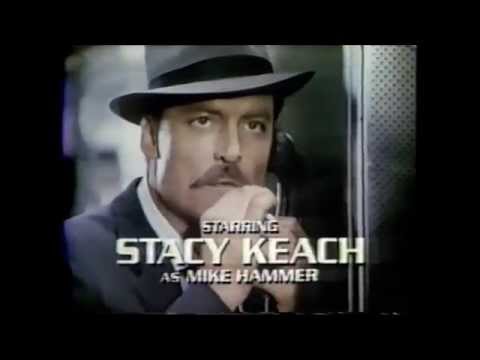
When two employees of an all-female courier service are murdered, Private Investigator Mike Hammer (Stacy Keach) is on the case. The service was owned by his ex-girlfriend, Chris (Michelle Phillips), and she wants him to protect her while she testifies in front of a grand jury. It turns out that her courier service has gotten involved in some shady business, transporting deliveries between a helicopter company and a South American dictator. Chris fears that she’ll be murdered to keep her from testifying. Hammer agrees to protect her and she tells him that he has a 19 year-old daughter who he’s never met.
While Chris is testifying, she suddenly dies on the stand. The doctors say that it was a heart attack but Hammer knows that it was murder. Hammer sets out to not only get revenge for Chris but also to find his daughter, who has disappeared into the world of underground pornography. It’s all connected though, as is traditional with Mike Hammer, it can sometimes be difficult to keep up with how.
Murder Me, Murder You was a pilot film for a brief-lived but fondly-remembered Mike Hammer TV series that aired in the 80s. Murder Me, Murder You takes Mickey Spillane’s famous detective into what was then the modern age but it allows him to remain a man of the hard-boiled noir era. Hammer’s narration is tougher than leather, he’s more interested in listening to swing music than new wave, and he still dresses like an old-fashioned private eye, complete with a fedora on his head. As played by Stacy Keach, he’s also just as dangerous and quick to kill as Hammer was in Spillane’s original novels. In the novels, Hammer was an unapologetic brute who often bragged about how much he enjoyed killing criminals and communist spies and whose closest associate was his gun, which he nicknamed Betsy. When Spillane’s novels were filmed, the violence of Hammer’s character was often downplayed. (A notable exception was Robert Aldrich’s Kiss Me Deadly, which suggested that Hammer was such a fascist that he would eventually be responsible for the end of the world. The Mike Hammer of Spillane’s novels would probably dismiss Kiss Me Deadly as being red propaganda and set out to deliver American justice to the Hollywood communists who wrote it.) In Murder Me, Murder You, Mike Hammer is just as brutal an avenger as Spillane originally imagined him to be. With his hulking frame, grim eyes, and his surly manner, Stacy Keach is the perfect Mike Hammer.
Murder Me, Murder You is a convoluted and often difficult-to-follow murder mystery but with Keach’s bravura lead performance, a strong supporting cast (including notable tough guys Tom Atkins and Jonathan Banks) and good direction from TV movie vet Gary Nelson, this movie comes about as close as any to capturing the feel of Mickey Spillane’s original novels. Murder Me, Murder You was released on DVD fourteen years ago. Though it is now out-of-print, copies are still available on Amazon.
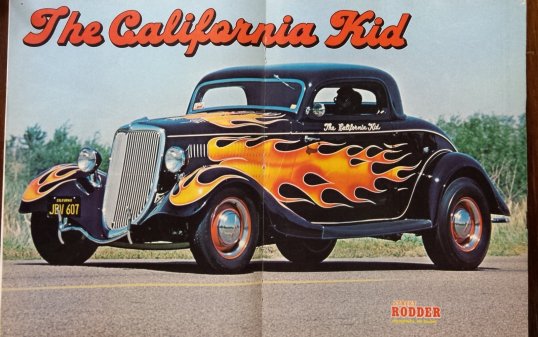
In 1973, a customized 1934 Ford three-window coup appeared on the cover of the November issue of Custom Rod. The car had been created by legendary customizer Pete Chapouris and it was called The California Kid. The cover caught the attention of television producer Howie Horowitz, who thought that maybe the car could become a star.
A year later, the car starred in it’s own made-for-TV movie. Naturally, that movie was called The California Kid.
The California Kid takes place in 1958 in the small town of Clarksberg. Clarksberg is known for being a town that does not tolerate speeders. Sheriff Roy Childress (Vic Morrow) lost his wife and daughter to a speeder and, ever since, he’s become a fanatic about making sure that people respect the speed limits. He’ll give a ticket to anyone who he sees going too fast. He’ll even impound your car. And if you don’t learn your lesson or if you try to outrun him, he’ll get behind your car, give it a push, and send both you and your vehicle plunging over the side of a mountain.
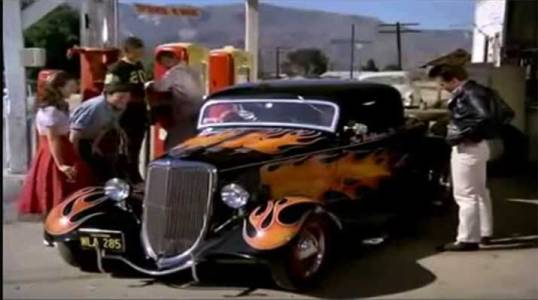
That’s what happens to Don McCord (Joe Estevez), a Marine who was just trying to get back to back to his base on time. After Don and his car go over the side of a cliff, the official ruling is that it was an accident. However, Don’s brother, Michael (Martin Sheen, real-life brother of Joe Estevez), doesn’t buy that. Determined to prove that his brother was murdered, Micheal rolls into town, behind the wheel of the California Kid.
The California Kid is a typical 70s car chase movie. There’s not much going on other than the sheriff chasing the Michael and the California Kid. Martin Sheen coasts through the movie, doing the James Dean impersonation that he perfected in the previous year’s Badlands and Vic Morrow plays his thousandth sadistic authority figure. The supporting cast is full of familiar names who don’t get to do much. Michelle Phillips plays the waitress who falls in love with Martin Sheen. (It’s always a waitress.) Stuart Margolin is Morrow’s deputy and keep an eye out for Nick Nolte, playing a mechanic. Interestingly, The California Kid was written by Richard Compton who, a year later, would direct Notle in his first starring role in the 1975 car chase film, Return to Macon County. Of course, the real star of the movie is the car and the California Kid earns its star billing. The movie might not be anything special but there’s no way you can watch it and not want to drive that car.
This is a made-for-TV movie so you won’t hear any profanity and the characters are all as simple can be. However, there are enough shots of cars going over cliffs to keep chase enthusiasts entertained.
In this one, Stone plays Angela Anderson. Angela is a sexually repressed artist who is obsessed with scissors. When she is attacked in an elevator by a man with a red beard, her neighbor, Alex (Steve Railsback), comes to her rescue. Alex is an actor who lives with his twin brother, the bitter and wheelchair-bound Cole (Steve Railsback, again.) When Angela finds herself locked in an apartment with a dead man (who has been stabbed with a pair of scissors and who has a red beard), who is responsible? According to the dead man’s pet raven, it’s Angela. But could it also have something to do with Angela’s obviously evil psychiatrist (Ronny Cox) and his politician wife (Michelle Phillips)?
This extremely ill-thought attempt at Hitchcockian suspense came out after Total Recall increased Sharon Stone’s profile but before Basic Instinct made her (briefly) a superstar. Scissors, much like the later Intersection, is a film where Sharon Stone attempts to show that she has range by playing a frigid character. Instead, Scissors just reveals how limited Sharon Stone’s range was. For all of the film’s attempts to duplicate Repulsion, Stone is never believable as someone on the verge of losing her mind. To her credit, Stone does try really hard, which is more than can be said for anyone else in the cast. Railsback, normally a good actor, can barely summon up enough interest in the material to play one character, let alone two. To buy what Scissors selling, it is necessary to believe that someone would come up with an elaborate scheme to drive Angela crazy but would still be careless enough to accidentally leave a door open at a key moment.
Do you remember when Chris Brown performed The Man In The Mirror at the 2010 BET Awards? It was during a tribute to Michael Jackson and Brown broke down crying while singing the song. Afterwards, he accepted an award and he said, “I let you all down before, but I won’t do it again. I promise you.”
This, of course, was about a year after Brown had pled guilty to physically abusing Rihanna. I remember being on twitter during Brown’s performance and seeing literally thousands of tweets from people talking about how brave Chris Brown was and how amazing his performance had been. Chris Brown was looking at the man in the mirror and asking him to change his ways. Chris Brown was promising not to let anyone else down by nearly killing any future girlfriends. A lot of people on twitter claimed this was amazing. I thought it was disgusting and I tweeted out my opinion. I really didn’t give a fuck if Chris Brown was asking the man in the mirror to change his ways. The man in the mirror was (and is) an abusive asshole. The man in the mirror beats women. The man in the mirror is not capable of changing his ways. “FUCK THE MAN IN THE MIRROR!” I tweeted.
And, oh my God, the reaction my little twitter rant inspired. What was especially disturbing was that the majority of people who tweeted me in Brown’s defense were other women. Yes, they all agreed, Chris Brown had beat Rihanna but he admitted what he had done, he was asking the man in the mirror to change his ways, and hey, Rihanna probably deserved it.
My favorite excuse — and this was used by quite a few of Brown’s defenders — was this: “Only God can judge Chris Brown.” Well, you know what? I asked God and he says Chris Brown’s an abusive asshole.
I’m tempted to say that it amazes me that Chris Brown still has fans but actually, it doesn’t. Sadly, when it comes to a celebrity, people are willing to make excuses for almost anything. If you ask most people, they’ll say that they’re against domestic abuse and they think abusers should suffer the worst punishment imaginable. But when the abuser is someone who they know (or, in the case of a celebrity like Chris Brown, someone who they feel they know), the excuses start. The equivocations are heard. The blame is assigned to everyone but the abuser. We start hearing bullshit about how people make mistakes and only God can judge.
In short, people are willing to talk but when it matters, they rarely act.
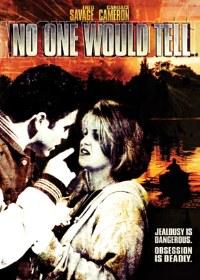
That’s also the theme of a powerful and sad movie called No One Would Tell. No One Would Tell was originally made for television in 1996 and it still shows up fairly regularly on Lifetime. Though the names and certain details have been changed, it’s based on a true story. In fact, the film feels like it’s based on several true stories. The plot of No One Would Tell is one that has occurred and continues to occur on far too regular of a basis.
Stacy Collins (played by Candace Cameron, before she added the Bure to her name) is a 16 year-old high school student. She’s quiet, shy, and insecure. When she first starts to date a popular jock named Bobby Tennison (Fred Savage), it seems like a dream come true. But soon, Bobby starts to show another side. He’s controlling and possessive. He grabs her wrist hard enough to leave bruises. He shoves her into a wall when they have an argument. When she wears a skirt that he thinks is too short, he grabs her in the school hallway and demands that she change immediately. When she isn’t home to answer his calls, he assumes that she most be cheating on him. And, when she finally breaks up with him, he kills her.
What’s infuriating is that, throughout the film, Bobby’s abuse is witnessed by all of his and Stacy’s friends. Everyone sees him push her. Everyone sees the bruises. Everyone knows that Bobby is unstable and that Stacy is afraid of him. And yet, nobody says a word. Nobody does a thing. Instead, they just make excuses for Bobby’s behavior. Some of them even blame Stacy. No one is willing to get involved and it eventually costs Stacy her life.
For a TV movie from the mid-90s, No One Would Tell holds up surprisingly well. Admittedly, Fred Savage overacts in the role of Bobby (and maybe it would have been better if the role had been played by Eric Balfour, who appears as Bobby’s best friend) but Candace Cameron does a perfect job as the tragic Stacy, capturing both her insecurity and her vulnerability. Some of the film’s best moments are the ones shares by Cameron and Michelle Phillips. In those scenes, we see how Stacy learned how to make excuses for Bobby’s behavior from watching the way that her mother made excuses for the men who similarly abused her. No One Would Tell is a powerful film, one that offers an unflinching look at abuse and one that dares to demand that its audience take a stand.
No One Would Tell is a film that should be watched by anyone who thinks that the man in the mirror can change his ways.
“He’s thrown a tripus! Steve Tevere has thrown a tripus! The most outstanding dismount tonight, or any night!”
— Really Excited Announcer In American Anthem (1986)
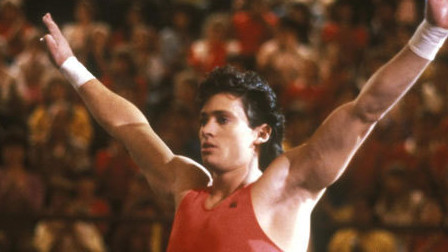
Way back in March, I dvr’d a movie called American Anthem off of Encore. I did this for two reasons. First off, the film was described as having something to do with gymnastics and that’s always been my favorite part of the Summer Olympics. Secondly, any film from the 1980s that has the word “American” in the title is sure to be fun or, at the very least, achingly sincere.
When I finally got around to watching American Anthem, I wasn’t expecting much. The film turned out to be largely what I expected it would be: the story of gymnasts hoping to qualify for the Olympics and find some personal redemption along the way. All of the stock characters were present. We had Steve Tevere (Mitch Gaylord), the brooding rebel who had to decide between pursuing his Olympic dreams or working in a garage for the rest of his life. We had Steve’s girlfriend, Julie (Janet Jones), who had to learn to be humble before she could be great. We had Kirk (Stacy Maloney), Steve’s best friend and fellow gymnast. We had kinda bitchy Becky Cameron (Maria Anz), who was Julie’s friend and rival. And then there was Arthur (Andrew White), Julie’s crippled, musician cousin. And let’s not forget Tracy Prescott (Jenny Ester), the 12 year-old gymnast with the impressive afro. And, of course, there was Coach Sarnoff (Michael Pataki) who was tough, compassionate, and Russian. The majority of the cast was made up of real-life gymnasts and, with the exception of the genuinely charismatic Stacy Maloney, they all gave performances that suggested that they should stick with gymnastics.
And yet, despite all of that, I absolutely loved American Anthem. Now, don’t get me wrong. For the most part, I loved it for all the wrong reasons. My love for the film is not the type of love that would lead to me being quoted on the back of a Blu-ray case. American Anthem is a thoroughly bad film but it’s also compulsively watchable. From the minute that I started watching it, I became obsessed with American Anthem‘s bizarre ineptness. Since that first night in March, I’ve rewatched American Anthem a few dozen times. I’ve lost track of how many times that I have grimaced at the cutesy music that Sarnoff tried to force Julie to use for her floor routine. I can imitate Becky’s squeal of pain when she’s tries to compete with an injured knee. Whenever Julie and the girls start to chant, “Kirk! Kirk! Kirk!,” I chant with them. And don’t even get me started on how much I love hearing, “He’s thrown a tripus!”
American Anthem is pure style. This is one of the few films that I’ve seen that has absolutely no subtext. There is literally nothing going on beneath the surface. It’s almost as if somebody dared director Albert Magnoli to make a film that was just one big montage. This is one of those films where the camera is always moving, the colors are always bright, and the soundtrack is always soaring. Hardly anyone in the film can actually act but oh my God, everyone looks so good (in a 1986 sort of way, of course).
The other “great” thing about American Anthem is that there’s not a single cliché that the film doesn’t include and, as a result, you really don’t have to pay that much attention to the film to understand what’s going on. To its credit, this film doesn’t even pretend to be anything other than a collection of clichés. It’s almost as if the characters themselves realize that they are in a film and understand that they have no choice but to conform to what the audience has been conditioned to expect.
(Hmmm…I guess American Anthem does have a subtext. And kind of a disturbing one at that!)
For instance, within minutes of meeting and despite having no chemistry, Steve and Julie are in love. Why? Because the only reason that they are in the film is to fall in love. It has to be done.
Steve fights with his father (John Aprea) and we’re never quite sure why, beyond the fact that all brooding rebels fight with their fathers. When his father shows up to watch his son compete, the triumphant music soars and it no longer matters that he’s been portrayed as being an abusive rageaholic up until that moment.
All of the characters tell us that Coach Sarnoff is the best, despite the fact that we don’t actually see any evidence of that fact. But Sarnoff has to be the best because nobody ever makes a movie about athletes training under a merely adequate coach.
When Becky suddenly shows up at the final competition with a bandaged knee, it doesn’t matter that we don’t actually see her get injured beforehand or, for that matter, hear anything about it. All that matters is that, in films like this, someone has to compete with an injury. Becky is simply playing her part.
American Anthem. It’s not a particularly good film but it sure is watchable. And, as I’ve come to realize while writing this review, it’s a bit of an existential nightmare as well!
I don’t think I’m ever going to erase it from my DVR.








 Through the Shattered Lens