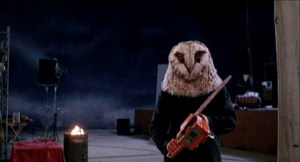
Director Michele Soavi is probably best known for directing the last great Italian horror film, Dellamorte Dellamore. However, his word in that film has been so praised that, to a certain extent, Soavi’s earlier horror films have been overshadowed. This is a shame because Soavi was (and is) a great director and — before he temporarily retired from films in the mid-1990s — he directed four of the greatest Italian horror films ever made. The first of these films (and Soavi’s directorial debut) was the 1987 slasher film Stagefright.
As written by Luigi Montefiore (who, as an actor, was better known as George Eastman), Stagefright’s basic story function almost as a parody of a stereotypical 80s slasher film. On a dark and stormy night, an eg0-crazed, cocaine-addicted theatrical director (played by David Brandon) is running a rehearsal for his latest show, a campy musical about a fictional serial killer. However, even as his cast performs fictional mayhem on stage, a real killer escapes from a nearby mental hospital and makes his way to the theater. After the real killer murders the production’s wardrobe mistress, the director decides it would be a brilliant idea to rewrite his show to make it about the real killer. Not realizing that the real killer has snuck into the building, the director secretly locks his cast inside the theater and forces them to rehearse his new show. As you can probably guess, mayhem ensues and blood (a lot of blood) is spilled.
That the film worked (and continues to work over 20 years later) is a tribute to the talent of Michele Soavi. Obviously understanding that he was working with a genre piece, Soavi embraced the expectations of the slasher film and then pushed those expectations as far as he could. The end result is a film that works as both an old school slasher film and as a commentary, of sorts, on the genre as a whole. Soavi’s camera prowls every corner of the film’s theater, creating an atmosphere of truly claustrophobic dread. To me, the most effective thing about the film is that, for once, our victims actually do the smart thing. They stick together and try to fight off the killer as a group. And they end up failing miserably in a scene of horrific choas that shows Soavi at his best.
Soavi started his career as an actor and appeared in a countless number of Italian horror films in the late 70s and early 80s. (For whatever reason, Soavi always seemed to be getting killed in some awful way…) Perhaps that’s why, of all the great Italian horror directors, Soavi always seemed to have the best instincts when it came to casting. For a slasher film, Stagefright is well-acted by a cast made up of horror regulars. Barbara Cupisti is a properly likable protagonist in the role of “final girl” while the great Giovanni Lombardo Radice does good work in the small role of Brett, a flamboyantly gay actor. However, the film is dominated by David Brandon who snorts cocaine and barks out orders as if the fate of the world depended upon it.
(Soavi, himself, appears in a small role as an ineffectual policeman who, while people are dying all around, is more concerned with whether or not anyone else agrees that he looks like James Dean. And, it should be noted, there was a resemblance.)
As opposed to a lot of other directors involved with the Italian horror genre, Soavi had (and, I hope, still has) a genuine love of film and that love is obvious in his stylish direction here. There’s something truly exhilarating about seeing a movie made by someone who is truly in love with the possibilities of film and, because of that love, has no fear of pushing genre “rules” to their extreme.
Here’s the latest edition of Lisa Marie’s Favorite Grindhouse and Exploitation Trailers. (I know, I know — worst intro paragraph evuh! Following the tradition of the Pieces trailer, which can be found below, I’m keeping things simple. I’ll be back to my usual complicated self next week.)
Believe it or not, this was directed by Abel Ferrara, the same man who directed Ms. 45. Fear City is one of the few Ferrara films that I haven’t seen but the trailer just oozes sleaze doesn’t it? And speaking of sleaze, maybe that’s what all the men in this film were putting in their hair. Seriously, why not call it Gel City? And how about Billy Dee Williams there, sounding like the angel of the final judgment? Shut up, Billy Dee Williams!
This is one of Lucio Fulci’s final films and you’re either going to love it or you’re going to hate it. The film is surprisingly meta for an Italian horror film not directed by Michele Soavi. This is the one where Fulci plays himself and attempts to personally answer his critics. Anyway, the reason I love this trailer is because of the cat puppet that appears at the end. It’s so cute! (Ignore the quote from Clive Barker — he’s almost as much of a whore as Stephen King.)
I imagine this is another film that’s “exactly what you think it is.” I love trailers that show off what was considered to be chic and decadent in the past. This is one is from the 70s. (Surprised?)
While the rich people were partying in London, cannibals were apparently ruling the streets of Atlanta. According to actor John Saxon, starring in Cannibal Apocalypse made him suicidal. Cannibal Apocalypse is actually a pretty good film with an anti-war subtext and it features a great supporting performance from Giovanni Lombardo Radice so seriously — shut up, John Saxon! (Actually, Saxon gives a really great performance here — of course, his character is meant to be suicidal — and he’s the main reason that Cannibal Apocalypse works.)
Much like Cannibal Apocalypse, Cannibal Man is actually an allegory of alienation that’s disguised as a horror movie. Cannibal Man is a seriously strange movie and highly recommended.
1) A Black Veil For Lisa— There’s several things that I love about this trailer. I love the faux-noir narration. I love the teasing tone. I love the old school femme fatale attitude of lead actress Lucianna Paluzzi. But, to be honest, the main reason I love it is because it’s all about a redhead named Lisa. That and the line “Every man wants a Lisa…”
2) The Italian Stallion— This is the trailer for the re-release of Sylvester Stallone’s porn debut, A Party At Kitty and Stud’s. I’ve never seen the movie nor do I have much desire to see it but this trailer just amused me to no end. Whether its the awesomely phony line readings of Gail Palmer or the catchy and empty theme song, this trailer feels like a genuine time capsule.
3) The House On The Edge of the Park— Speaking of catchy but empty theme songs, Ruggero Deodato’s The House on the Edge of the Park features my personal favorite, Riz Ortolani’s infamous Do It To Me (Once More). It can be heard at the end of this trailer and once it gets stuck in your head, it’ll stay there forever. As for the trailer itself, it’s a perfect example of how a well-edited trailer can actually make a somewhat draggy film seem exciting (that said, this movie is one of my all-time guilty pleasures, as misogynistic and wrong-headed as it ultimately is). A few things I love about this trailer — the blue-tinted views of New York City, David Hess’s iconic psycho performance, the sight of my man Giovanni Lombardo Radice dancing, and the fact that the trailer actually manages to 1) get the movie’s name wrong and that 2) nobody ever bothered to fix it.
(Author’s note: Whoops! Before you watch this, I have to admit that I’d forgotten just how explicit, violent, and exploitive this trailer really is. So, consider this to be definitely NSFW — not that you should be watching any of these trailers at work, to begin with — and seriously, no joke, don’t watch this trailer if you are easily upset or offended. Honestly, if I saw this trailer without having any knowledge of how silly the actual movie really is, I would probably find this trailer to be deeply offensive. Well, no, actually, I probably wouldn’t. For the most part, I’m only offended by things that happen offscreen in the real world. — Lisa Marie Bowman)
4)The Texas Chainsaw Massacre— Yes, I know everyone’s probably seen this trailer a hundred times but it’s still probably one of the best and most effective trailers of all time. Plus, I’m from Texas so you know I had to mention this movie at some point. (I may have mentioned this in the past, but seriously — try to imagine this movie being as effective if it was called The Vermont Chainsaw Massacre.)
5) Mindwarp (a.k.a. Galaxy of Terror) — I’ve been eagerly awaiting the chance to buy this film on DVD ever since seeing this trailer on the latest 42nd Street Forevercompilation. Rumor has it that this film was actually directed by James Cameron, back when he was still interesting. Supposedly, this film features a very aggressive tentacle but, to be honest, I mostly just want to see Sid Haig’s arm get cut off. (Seriously, who doesn’t? Take that, Capt. Spaulding!)
6)Stage Fright— This is the wonderfully intense and claustrophobic trailer to the great Michele Soavi’s 1st film, Stage Fright, a movie I’m going to watch as soon as I finish up this post. So, with no further delay…
If you’re lucky, you remember your first time. I know I do. I was 17 years old and I was trying very hard to convince myself that I was an adult. It had been less than a year since I was first diagnosed as being bipolar and I was still struggling to understand what that truly meant about me. My days were spent wondering if I was crazy or if I was just misunderstood. In the end, I just desperately wanted to be loved. As for the event itself, I remember being more than a little anxious and, once things really got going, pleasantly surprised. However, the main thing I remember is thinking to myself, “Wow, that’s a lot of blood.”
Yes, everyone should remember the experience of seeing their first giallo as clearly as I do.
Over the years, I’ve read a lot of different definitions of what a giallo is and none of them have really managed to capture what makes this genre of film so strangely compelling. The simplest and quickest definition is that a giallo is an Italian thriller. Typically (though not always), the film features a protagonist who witnesses and then proceeds to investigate a series of increasingly gory murders. Often times, solving the murders means uncovering some dark and sordid sin of the past and, just as often, the film’s “hero” turns out to be as damaged a soul as the killer. However, the plot is rarely the important in a giallo film. What’s important is how the director chooses to tell the story. When I watch the classic giallo films of the 60s and 70s, I get a sense of a small group of directors who were all competing to say who could come up with the most startling camera angle, who could pull off the bloodiest death scene, and who could pull off the most audacious tracking shot. Giallo is a uniquely Italian genre of film, an unapologetic opera of mayhem and murder. For the most part, the films seems to have a polarizing effect on viewers. You either get them or you don’t. (From my own personal experience, I think it helps if you come from a Catholic background but, again, that’s just my opinion.)
The protagonist of A Blade in the Dark is Bruno, a popular young composer who has been hired to score a horror movie. The film’s director has arranged for Bruno to stay in an isolated villa while he works. Every night, Bruno sits in front of his piano and searches for the perfect note. Occasionally, his actress girlfriend calls him from the other side of Italy and demands to know if he’s cheating on her. He’s not despite the fact that he has two attractive neighbors who tend to come by at the most inconvenient of times and who make cryptic comments about the woman who lived at the villa before him. Bruno would probably be even more frustrated if he knew that, on most night, he’s being watched by someone outside hiding outside the villa. One night, Bruno listens to the movie’s soundtrack and hears a menacing voice whispering on the recording. Meanwhile, the mysterious watcher begins to brutally murder anyone who has any contact with Bruno.
(Despite all these distractions, Bruno continues to vainly try to create the perfect score. Much like Kubrick’s Shining,A Blade in the Dark is as much about the horrors of the artistic process as it is about anything else.)
As it typical of most giallo films, the plot of A Blade in the Dark makes less and less sense the more that you think about it. However, this is a part of the genre’s charm. One doesn’t watch a giallo for the story. One watches to see how the story is told and that is where A Blade in the Dark triumphs. Wisely, director Lamberto Bava keeps things simple. Working with a small cast and one main set, Bava fills every scene with a palpable sense of dread and uneasiness. As Bruno finds himself growing more and more paranoid, so does the audience. Watching the movie, you feel that anyone on the screen could die at any moment and, for the most part, that turns out to be the case.
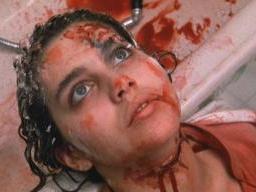
A Blade in the Dark is probably best known for the brutality of its violence. Even after repeat viewings, the murders are still, at times, difficult to watch. In the most infamous of them, one of Bruno’s neighbors is killed while washing her hair over a sink. The violence here is so sudden and so much blood is spilled (and spurted) that its easy to miss just how well-directed and effectively shocking this scene really is. In this current age of generic cinematic mayhem, the violence of A Blade In The Dark still packs a powerful punch.
(The scene is so effective that, for quite some time after seeing it, I actually got uneasy whenever I found myself standing in front of a sink. A Blade in the Dark does for the bathroom sink what Psycho did for showers.)
Bruno is played by Andrea Occhipinti, an actor whose non-threatening, Jonas Brotheresque handsome earnestness was used to great effect by Lucio Fulci in the earlier New York Ripper. Since I’ve only seen the dubbed version, it’s difficult to judge his performance here. He’s never quite believable as a great composer though you could easily imagine him writing whatever syrupy ballad that James Cameron chooses to play at the end of his next blockbuster. However, Occhipinti does have a likable enough presence that you don’t want to see him killed and that’s all that the film really requires anyway.
A far more interesting presence in the cast is that of Michele Soavi. Soavi plays Bruno’s landlord and, even with limited screen time and even with his dialogue dubbed into English, Soavi is such a charismatic presence that he dominates every scene that he’s in. Before being cast, Soavi was already serving as Bava’s assistant director on Blade in the Dark and, of course, he later went on to have a significant directorial career of his own. Soavi is perhaps best known for directing one of the greatest films of the 1990s, Dellamorte Dellamore.
While Soavi would go on to great acclaim, the same cannot be said of this movie’s director. Among fans of Italian horror, it’s become somewhat fashionable to be dismissive of Lamberto Bava. It’s often pointed out that the majority of his filmography is actually made up of cheap knock-offs that he made for Italian television (and, admittedly, A Blade in the Dark started life as a proposed miniseries). Most of the credit for Bava’s most succesful film — Demons — is usually given to producer Dario Argento. Perhaps the most common complaint made about Lamberto Bava is that he isn’t his father, Mario Bava. With films like Blood and Black Lace, Lisa and the Devil, Black Sabbath, and Bay of Blood, Mario Bava developed a deserved reputation for being the father of Italian horror and Lamberto is often accused of simply trading in on his father’s reputation.
It’s true that Lamberto Bava is no Mario Bava but then again, who is? Blade in the Dark was Lamberto’s second film (as a director) and its a tightly constructed, quickly paced thriller. Bava makes good use of the vila and creates a truly claustrophobic atmosphere that keeps the viewer on edge throughout the entire film. Even when viewed nearly three decades after they were filmed, the film’s murders are still shocking in both their violence and their intensity. There’s a passion and attention-to-detail in Bava’s direction here that, sadly, is definitely lacking in his later films. If most of Bava’s film seem to be the work of a disinterested craftsman, A Blade in the Dark is the work of an artist.
I love movies and I love books so I guess it would stand to reason that I love books about movies the most of all. (I also love movies about books but there are far fewer of those, unfortunately.) Below are my personal favorites. I’m not necessarily saying that these are the ten greatest film books ever written. I’m just saying that they’re the ones that I’m always happy to know are waiting for me at home.
10) Soon To Be A Major Motion Pictureby Theodore Gershuny — This is one of the great finds of mine my life. I found this in a used bookstore and I bought it mostly because it only cost a dollar. Only later did I discover that I had found one of the greatest nonfiction books about the shooting of a movie ever written! Gershuny was present during the filming of a movie called Rosebud in the early 70s. I’ve never seen Rosebud but, as Gershuny admits, it was a critical disaster that managed to lose a ton of money. The book provides a fascinating wealth of backstage gossip as well as memorable portraits of director Otto Preminger and actors Robert Mitchum (who was originally cast in the lead role), Peter O’Toole (who took over after Mitchum walked off the set), and Isabelle Huppert. If nothing else, this book should be read for the scene where O’Toole beats up critic Kenneth Tynan.
9) Suspectsby David Thomson — A study of American cinema noir disguised as a novel, Suspects imagines what would happen if George Bailey from It’s a Wonderful Life fell in love with Laura from the movie of the same name. Well, apparently it would lead to Sunset Boulevard’s Norma Desmond having an affair with Chinatown’s Noah Cross and to one of George’s sons, sensitive little Travis, getting a job in New York City as a Taxi Driver. And that’s just a small sampling of what happens in this glorious mindfuck of a novel.
8 ) Profondo Argentoby Alan Jones — Long-time fan Alan Jones examines each of Dario Argento’s films (even Argento’s obscure historical comedy The Five Days of Milan) and proceeds to celebrate and (in many cases) defend Argento’s career. Jones also interviews and profiles several of Argento’s most frequent collaborators — Daria Nicolodi, Asia and Fiore Argento, Simon Boswell, Claudio Simonetti, Keith Emerson, George Romero, Lamberto Bava, Michele Soavi, and many others. Jones’ sympathetic yet humorous profile of Luigi Cozzi is priceless.
7) Spaghetti Nightmaresby Luca Palmerini — Spaghetti Nightmares is a collection of interviews conducted with such Italian filmmakers as Dario Argento, Ruggero Deodato, Umberto Lenzi, Lucio Fulci, and others. Among the non-Italians interviewed are Tom Savini (who, as always, comes across as appealingly unhinged) and David Warbeck. (Sadly, both Warbeck and Fulci would die shortly after being interviewed.) What makes this interesting is that, for once, Argento, Fulci, et al. are actually being interviewed by a fellow countryman as opposed to an American accompanied by a translator. As such, the subsequent interviews turn out to be some of the most revealing on record.
6) Sleazoid Expressby Bill Landis and Michelle Clifford — Landis and Clifford’s book is both a history and a defense of the old grindhouse theaters of New York City. Along with describing, in loving and memorable detail, some of New York’s most infamous grindhouses, they also write about some of the more popular movies to play at each theater. Along the way, they also offer up revealing profiles of such legendary figures as David Hess and Mike and Roberta Findley. Reading this book truly made me mourn the fact that if I ever did find myself in New York City, I won’t be able to hit the old grindhouse circuit.
5) Beyond Terror: The Films of Lucio Fulciby Stephen Thrower — Fulci has always been a terribly underrated director and, indeed, it’s easy to understand because, in many ways, he made movies with the specific aim of alienating and outraging his audience. It requires a brave soul to take Fulci on his own terms and fortunately, Stephen Thrower appears to be one. Along with the expected chapters on Fulci’s Beyond Trilogy and on Zombi 2, Thrower also devotes a lot of space to Fulci’s lesser known works. Did you know, for instance, that before he became the godfather of gore, Fulci specialized in making comedies? Or that he also directed two very popular adaptations of White Fang? Thrower also examines Fulci’s often forgotten westerns as well as his postapocalyptic sci-fi films. And, best of all, Thrower offers up a defense of the infamous New York Ripper that, when I read it, actually forced me to consider that oft-maligned film in a new light. That said, Thrower does admit to being as confused by Manhattan Baby as everyone else.
4) Immoral Talesby Cathal Tohill and Pete Toombs — Tohill and Toombs offer an overview of European “shock” cinema and some of the genre’s better known masters. The book contains perhaps the best critical examination of the work of Jean Rollin ever written. The authors also examine the work of Jesus Franco and several others. This is a great book that reminds us that the Italians aren’t the only ones who can make a great exploitation film.
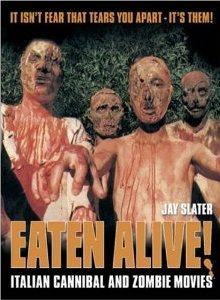
3) Eaten Aliveby Jay Slater — This book offers an overview of the Italian film industry’s legendary cannibal and zombie boom. Along with reviewing every Italian movie to feature even the slightest hint of cannibalism or the living dead (this is one of the few books on Italian cinema that discusses both Pasolini and Lucio Fulci as equals), Eaten Alive also features some very revealing interviews with such iconic figures as Catriona MacColl, Ian McCullough, and especially Giovanni Lombardo Radice. Radice, in fact, also contributes a memorable “guest” review of one of the movies featured in the book. (“What a piece of shit!” the review begins.) Memorable reviews are also contributed by Troma film founder Lloyd Kaufman who brilliantly (and correctly) argues that Cannibal Holocaust is one of the greatest films ever made and Ramsey Campbell who hilariously destroys Umberto Lenzi’s infamous Nightmare City.
2) The Book of the Deadby Jamie Russell — If, like all good people, you love zombies then you simply must do whatever it takes to own a copy of this book. Starting with such early masterpieces as White Zombie and I Walked With A Zombie, Russell proceeds to cover every subsequent zombie film up through George Romero’s Land of the Dead. Russell offers up some of the best commentaries ever written on Romero’s Dead films, Fuci’s Beyond Trilogy, Rollin’s Living Dead Girl, and Spain’s Blind Dead films. The pièce de résistance, however, is an appendix where Russell describes and reviews literally ever zombie film ever made.
1) All The Colors Of the Darkby Tim Lucas — This is it. This is the Holy Grail of All Film Books. If you’ve ever asked yourself if any book is worth paying close to 300 dollars, now you have your answer. This one is. Tim Lucas offers up the most complete biography of director Mario Bava ever written. In fact, this may be the most complete biography of any director ever written! Lucas examines not only Bava’s life but also every single movie that Bava was ever in any way connected to, whether as a director or as a cameraman or as the guy in charge of the special effects. This is 1,128 pages all devoted to nothing but the movies. This is the type of book that makes me thankful to be alive and I owe a huge debt of gratitude to Tim Lucas for writing it.





 Through the Shattered Lens