Review: Knives Out (dir. by Rian Johnson)


“The family is truly desperate. And when people get desperate, the knives come out.” — Benoit Blanc

After shaking up galaxies far, far away with Star Wars: The Last Jedi, Rian Johnson returned to solid ground in 2019 with Knives Out, a film so self-assured and inventive it practically felt like a director catching his breath while reminding the world what made him exciting in the first place. It was his first movie after that polarizing Star Wars entry, and he used the opportunity not to go bigger, but smarter—to take something intimate, character-driven, and refreshingly old-school and make it gleam again. Knives Out landed as a kind of palate cleanser for both him and the audience: a modern mystery that leaned into genre nostalgia while reinventing it with sharp humor and social bite. The result wasn’t just a change of pace—it was a confident display of craft from a filmmaker unbothered by his critics, operating with absolute control over every frame, every line, and every perfectly timed smirk.

The setup couldn’t be more classic: a wealthy family patriarch, Harlan Thrombey, turns up dead after his 85th birthday, leaving behind a tangled household of suspects, secrets, and strained smiles. His death looks like suicide, but something isn’t right. Enter Benoit Blanc, a Southern gentleman detective hired anonymously to snoop through the wreckage of lies and grievances. The scenario drips with vintage whodunit flavor, but Johnson’s genius lies in retooling that familiarity into something electrifyingly modern. The Thrombeys aren’t just eccentric millionaires—they’re avatars of American entitlement, each convinced of their own superiority while quietly dependent on the man they pretend to revere. By building his mystery around a clan that mirrors contemporary divisions of money, politics, and self-deception, Johnson injects wit and purpose into the genre without ever losing the fun of the game.

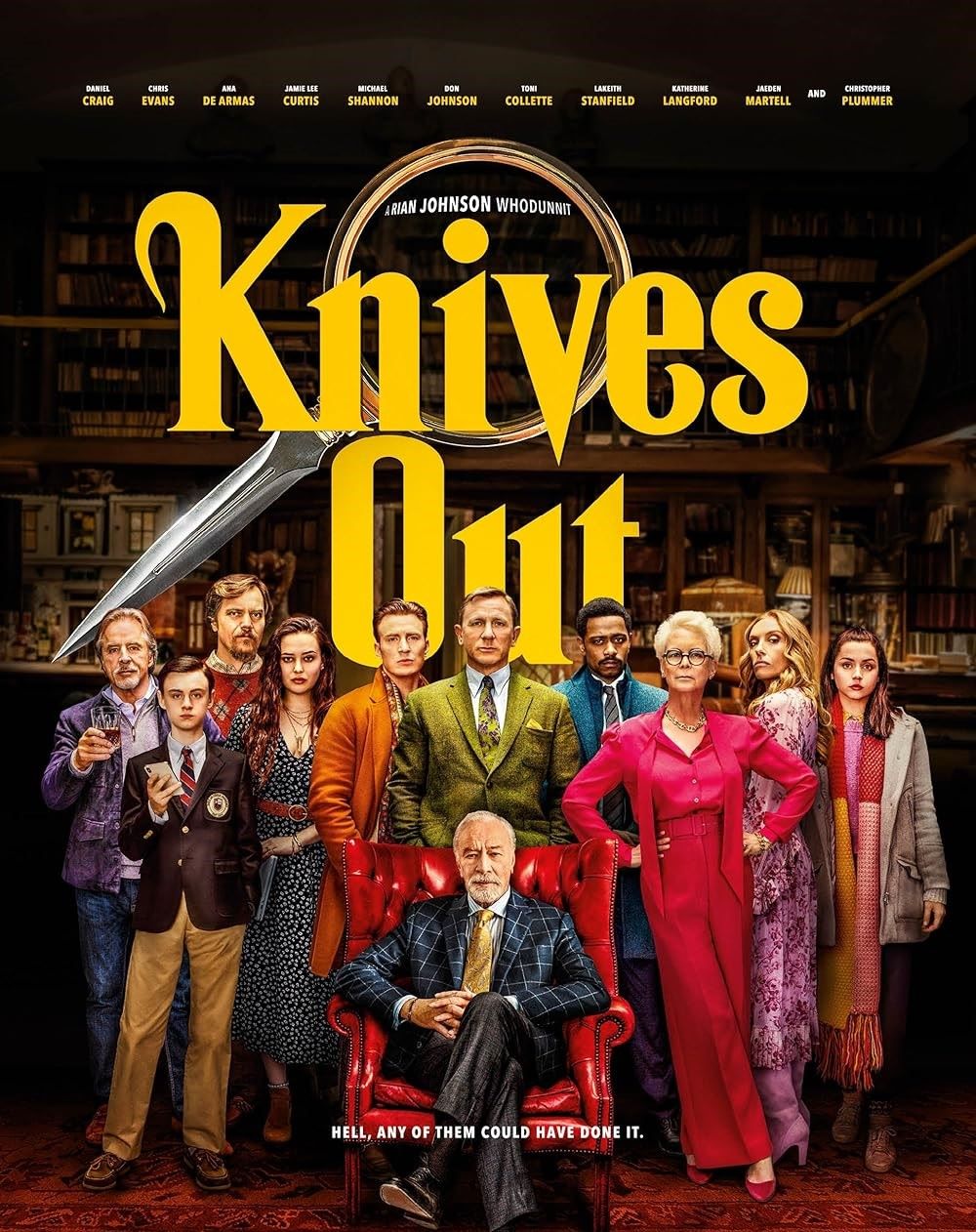
Jamie Lee Curtis plays the confident matriarch Linda, Michael Shannon the resentful son Walt, Toni Collette the spiritual grifter Joni, and Don Johnson the smirking son-in-law Richard—all of them playing heightened but recognizable shades of selfishness. Their sniping exchanges during the first act are among the film’s best sequences, packed with fast banter, political jabs, and casual hypocrisy. Johnson directs these moments like a verbal tennis match, letting personalities bounce and clash until the family’s shiny façade cracks enough for true frustrations to spill out. It’s sharp, funny, and chaotic, showing early on that no one in the Thrombey family is as self-made or self-aware as they claim to be.

Amid that colorful ensemble, the performance that most stunned audiences came from Chris Evans as Ransom Drysdale, Harlan’s playboy grandson and the family’s unapologetic black sheep. Coming off years of playing Marvel’s resolutely noble Steve Rogers, Evans dives into Ransom with visible glee, turning him into a figure of charm and mystery whose motives are never quite clear. He’s magnetic from the moment he appears—witty, cynical, a little dangerous—and Johnson clearly relishes using Evans’s clean-cut image to toy with expectations. Ransom strides into the story radiating confidence, but there’s a guarded, almost predatory intelligence behind his grin. His scenes crackle because the audience can’t quite decide where to place him: is he the rare Thrombey who sees through the family hypocrisy, or is he spinning his own kind of manipulation? That tension between self-awareness and deceit gives his every line an edge. Watching Evans in this role feels like a release for him and a thrill for viewers, a testament to both his range and Johnson’s intuitive casting.

Opposite that moral uncertainty stands Ana de Armas’s Marta Cabrera, Harlan’s kind and soft-spoken nurse who suddenly finds herself at the heart of the story. Marta grounds the entire film emotionally, her decency cutting through the Thrombeys’ arrogance like sunlight in a dusty room. She’s the migrant caretaker who everyone claims to love while casually condescending to, a detail Johnson uses to expose how often politeness masks prejudice. Marta’s inability to lie without vomiting, played initially for laughs, gradually becomes symbolic—a kind of moral honesty that makes her unique in a house ruled by deception. De Armas brings layered vulnerability to the role, balancing fear, guilt, and compassion with natural ease. Through her, Johnson turns the whodunit into something more human and emotionally resonant. She isn’t just a witness or a suspect; she’s the beating heart around which all the greed, paranoia, and privilege revolve.

Then there’s Daniel Craig’s Benoit Blanc, whose arrival shifts the film into another gear entirely. His Southern drawl—equal parts poetic and perplexing—sets the tone for what becomes one of Craig’s most playful performances. After years of portraying the stoic James Bond, he’s clearly having the time of his life as a detective who investigates with both intellect and intuition. Blanc operates less like a hard-nosed cop and more like a philosopher; he believes that solving a crime means understanding human weakness as much as evidence. His famous “donut hole” speech perfectly captures the balance Johnson strikes between earnestness and absurdity. Blanc may revel in his own melodrama, but he also brings heart to chaos, observing people’s contradictions without losing his sense of wonder. The result is a detective who’s less about revelation and more about revelation’s moral cost.

Visually, Knives Out belongs to a rare category of films that are so meticulously crafted they could be paused at any frame and still look compelling. Johnson and cinematographer Steve Yedlin transform Harlan’s mansion into a breathing character—an architectural echo chamber of secrets. The walls are lined with strange trinkets, elaborate paintings, and heavy mahogany furniture that suggest old money’s suffocating weight. There’s something both cozy and claustrophobic about the space, which mirrors the tension between family warmth and poisonous resentment. The camera glides through it with purpose, lingering on small details that gain meaning later, and the autumn-colored palette—deep reds, browns, and golds—wraps everything in an inviting melancholy. It’s as much a visual experience as it is a narrative one, and few modern mysteries feel as tactile.

Johnson’s writing keeps that sense of precision. The plot unfolds like clockwork, but the mechanics never feel mechanical. Instead, he keeps viewers off-balance by blending humor with genuine suspense. Instead of relying entirely on high-stakes twists, Johnson builds tension through empathy, giving us access to characters’ doubts and stakes rather than just their clues. The result is a mystery that keeps the audience guessing in emotional and moral dimensions, not just logical ones. Every revelation says as much about character as it does about the crime.

Underneath the quick humor and ornate mystery structure, Knives Out doubles as a satire of class and entitlement. Johnson sketches the Thrombeys as people who talk endlessly about fairness, morality, and self-reliance yet collapse into panic when their material comfort is threatened. Through them, he captures a peculiar American irony: the people most obsessed with earning their status are often those most insulated from real struggle. When the family gathers to argue over wealth and loyalty, Johnson doesn’t need to exaggerate—they expose themselves with every smug phrase and self-justified rant. It’s social commentary that’s biting but never heavy-handed because it plays out through personality instead of sermon.

Nathan Johnson’s score carries the story forward with playful precision, shifting from tension to whimsy in sync with the characters’ shifting loyalties. There’s something almost dance-like about the film’s rhythm: scenes of laughter can spiral into confession, and interrogations can dissolve into comedy without losing a beat. The editing supports that agility, cutting crisply between overlapping dialogue and close-ups that reveal just enough expression to keep us alert. Johnson’s sense of pacing feels theatrical in the best way—it’s about timing and tone rather than spectacle.

As with many of Rian Johnson’s works, contradiction fuels the story’s appeal. Knives Out is cynical about human greed but oddly hopeful about individual decency. It mocks arrogance but rewards empathy. Even when it toys with genre clichés, it does so out of affection, not scorn. Johnson clearly understands that mystery storytelling is as much about character and morality as deduction, and he uses humor and chaos as tools to explore who people become under pressure. The movie’s sophistication lies in how effortless it feels—its layers unfold smoothly, but the craft behind them is razor sharp.

The film’s ending closes with a visual that redefines power without needing words. After a story filled with deceit, pretension, and the scramble to control a legacy, it concludes on an image that says everything about perspective—who actually holds the moral high ground and how quietly dignity can win. Like the rest of the movie, it’s both playful and pointed, leaving you smiling while still turning the characters’ behavior over in your mind.

Looking back, Knives Out stands as a defining moment in Rian Johnson’s career. After the spectacle and dialogue storms of The Last Jedi, this lean, ensemble-driven mystery reaffirmed his strengths as a writer-director who thrives on structure, rhythm, and human contradictions. It’s a film that takes as much pleasure in observation as revelation, brimming with sly humor and performances that sparkle across the moral spectrum. Anchored by Ana de Armas’s poignant sincerity, Daniel Craig’s eccentric brilliance, and Chris Evans’s unpredictable charisma, it became one of the most purely enjoyable movies of its time. Witty without pretense, political without lecturing, and perfectly balanced between cynicism and heart, Knives Out remains proof that the old whodunit can still cut deep—and that Rian Johnson’s sharpest weapon is still his storytelling.
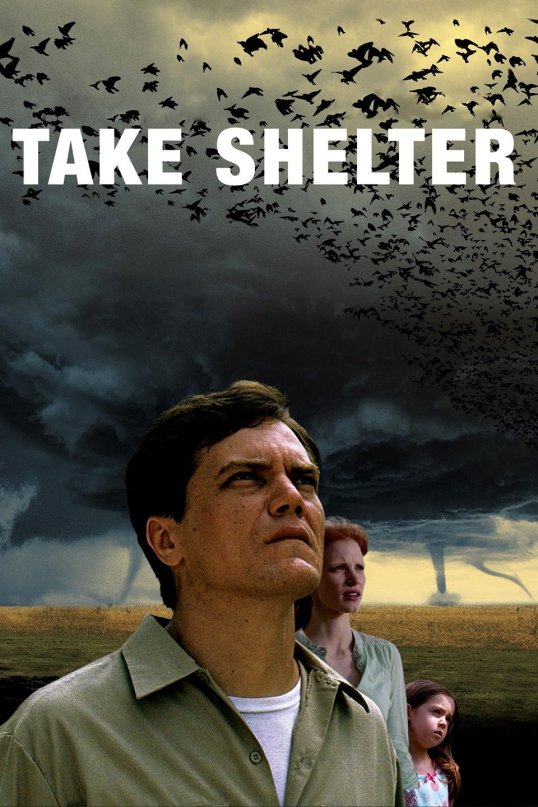
Miniseries Review: Death by Lightning (dir by Matt Ross)


Death by Lightning, a four-episode miniseries that recently dropped on Netflix, tells the story of two “forgotten men,” as the show itself puts it.

Michael Shannon plays James A. Garfield, the Ohio farmer and former Congressman who, despite attending the 1880 Republican convention solely to give the nominating speech for Secretary of Treasury John Sherman (Alistair Petrie), found himself nominated for President after the convention found itself deadlocked between supporters of Former President Grant (Wayne Brett) and Senator James Blaine (Bradley Whitford).  Garfield did not want to run for President and he certainly did not want to run with Chester A. Arthur (Nick Offerman), an associate of New York political boss, Roscoe Conkling (Shea Whigham).  However, in November of 1880, James Garfield was narrowly elected the 20th President of the United States.

Matthew MacFayden plays Charles J. Guiteau, a failed lawyer and self-proclaimed newspaper publisher who felt that a stump speech he had given at a small rally was responsible for Garfield’s victory.  Guiteau expected to be appointed to a position in the Garfield administration, perhaps as Consul to France.  In those days of no Secret Service protection and an open White House, Guiteau was one of the many random office seekers who managed to get a face-to-face meeting with Garfield.  What Guiteau did not get was a job.  While Guiteau may have deluded himself into thinking that he was an inside player, everyone else viewed him as being a pesky and disreputable character.  On July 2nd, 1881, Guiteau shot Garfield in the back.  After Garfield died in September, Guiteau was convinced that he would be pardoned by the newly sworn-in President Arthur.  Instead, Guiteau was hanged on June 30th, 1882.

(It’s now generally agreed that Guiteau was such a bad shot that Garfield would have survived his wounds if not for the incompetence of his doctors, who probed his wounds with their bare hands in an effort to extract the bullet.  Garfield died as a result of multiple infections caused by his medical treatment.)

Again, Death by Lightning describes Garfield and Guiteau as both being forgotten men.  That’s not quite true.  I knew who both of them were before I watched the miniseries but then again, I’m also a history nerd.  As much as I don’t want to admit it, it is true that the majority of today’s Americans don’t know either Garfield or Guiteau.  And yet, in 1881, America revolved around them and their fate.  Everyone checked every day for news on Garfield’s health and Guiteau’s trial was heavily covered by the press.  That’s something to remember whenever you hear people talking about how “history will remember” whatever may be happening in the news today.  History may remember but people are quick to forget.

As for Death by Lightning, it does a good job of telling not only the stories of Garfield and Guiteau but also Chester Arthur as well.  The miniseries takes place at a time when political machines dominated American politics and also at a time when the Spoils system and the widespread corruption that it engendered were both accepted as immutable political realities.  Guiteau, having spent his life seeing other people receive jobs for supporting the right candidate, felt that he was naturally entitled to whatever position he requested.  Guiteau’s actions actually did lead to reformation of the Spoils system, with President Arthur emerging an unlikely reformer.  Never again would a random office seeker by allowed through the front doors of the White House and never again would a President casually walk around Washington D.C. without some sort of guard.  With a smart script, good performances, and even a few moments of unexpected cringe humor, Death by Lighting recreates that moment in American history and it pays tribute to James A. Garfield, who was universally described by his contemporaries as being a decent man who was struck down before he could reach his full potential.

How historically accurate is Death by Lightning?  That’s a fair question.  Death by Lightning sticks to the established facts about Garfield and Guiteau but a scene in which Garfield’s daughter argues with him about immigration is undoubtedly meant to be more of a commentary on 2025 than 1880.  I think it can be argued that no film or series can be 100% historically accurate because those who actually witnessed the events in question are no longer with us.  Inevitably, the past is always viewed and recreated through the filter of the present.  And indeed, it is tempting to compares Garfield and Guiteau to our modern-day politicians and activists.  Guiteau, with his constant excuses for his own dumb decisions and his ranting and raving about how he speaks for the people, was a particularly familiar character.  As for the modest and honest Garfield, it’s sadly difficult to think of any modern-day politicians from the same mold.

As a final note, my favorite part of this miniseries occurred during the first episode.  The recreation of the 1880 Republican Convention is wonderfully entertaining.  It’s amazing to think that, in the days before television coverage required political conventions to become carefully choreographed and tightly controlled, there actually was legitimate suspense about who would end up being nominated.  Sadly, those days seem to be over.

Film Review: Groundhog Day (dir by Harold Ramis)


Happy Groundhog Day!  For the record, Punxsutawney Phil saw his shadow today so get ready for six more weeks of winter!

Oh, how I love Groundhog Day.  I really do.  It’s perhaps the silliest holiday that we have in America and I absolutely adore the whole thing.  I love the fact that people get dressed up for it.  I love that there are people who plan their entire weekend around seeing what the groundhog predicts.  I love that we all know there’s no way a groundhog can reasonably predict the weather but, for one day, we pretend like it can.  And while Groundhog Day itself had its beginning in Germany, the holiday really has become pure Americana.  It’s such an innocent holiday, or at least it is now that Bill de Blasio is no longer in a position to kill the magic groundhog.

(Boo de Blasio!  Boo!)

Of course, no Groundhog Day is complete without watching the 1993 comedy of the same name.  The film has become such a major part of American culture that even people who haven’t watched it know what it’s about.  (It’s a bit like It’s A Wonderful Life in that way.)  Bill Murray plays Phil Connors, a cynical weatherman who is sent to cover Groundhog Day in Punxsutawney and finds himself reliving the same day over and over again.  Every morning, it’s once again February 2nd.  Sonny and Cher’s I Got You Babe plays on the radio.  Phil is approached by Ned Ryerson (Stephen Tobolowsky), an annoying former classmate turned insurance salesman.  Phil steps in the same puddle.  He finds himself covering the same story and, again and again, he’s stranded by the same blizzard.  At first, Phil is angry.  Even multiple suicides can’t stop the cycle.  Kidnapping the groundhog can’t stop the cycle.  Then, he decides to take advantage of living the same day over and over again.  He gets to know the people in the town and realizes that they’re not so bad.  He saves the mayor (Brian Doyle-Murray) from choking at dinner but, in the film’s most poignant moment, realizes that an old homeless man is going to die regardless of how many times he tries to save him.  Phil learns how to learn the piano.  He learns how to speak French.  And, most importantly, he falls in love with Rita (Andie MacDowell).  Of course, when he tells Rita this, she assumes he’s just trying to take advantage of her.  Rita says that they barely know each other but what she doesn’t realize is that Phil has been spending day-after-day with her.

As you might have guessed I relate to Rita.  She loves the silliness of the holiday and so do I.  I also relate to Nancy Taylor (Marita Geraghty), just because of her determination to enjoy the day no matter what.  That said, this is totally Bill Murray’s film and this is one of his best performances, one in which he expertly mixes his trademark comedy with some very poignant drama.  One thing I like about this film is that Phil becomes a better man as a result of living the same day over and over again but it doesn’t totally change his personality.  At the end, he’s still the same sarcastic smartass that he was at the start of the film but he’s no longer a cynic.  He’s learned how to appreciate other people.  He’s fallen in love.  Much like George Bailey, he’s become the richest man in town.  This is a rare film where the main character is as interesting after he’s reformed as before.

It always breaks my heart a little to read that Bill Murray and director Harold Ramis had a difficult time working together while making this film.  It’s truly a perfect film and that’s due to both Murray’s performance and Ramis’s heartfelt direction.  I’m also glad that Ramis and Murray made up before Ramis passed away.  Life’s too short and sadly, unlike in the movies, we don’t always get a chance to go back and correct the past.

Groundhog Day is a holiday classic and may it continue to be watched for decades to come.

The Films of 2024: The Bikeriders (dir by Jeff Nichols)


Taking place in the late 60s and the early 70s, The Bikeriders tells the story of The Vandals Motorcycle Club.

The Vandals were founded by Johnny (Tom Hardy), a truck driver who got the idea for starting his own motorcycle gang after catching a late night broadcast of The Wild One.  Under Johnny’s strong leadership, the Vandals quickly grow and soon, branches are opening up across the country.  Of the many members of the Vandals, the most charismatic is Benny (Austin Butler), a quiet and enigmatic man who loves his motorcycle and who seems to have the worst luck when it comes to crashing and getting caught by the police.  If Johnny epitomizes the leadership needed to successfully start a motorcycle club in the first place, Benny epitomizes the coolness of being a rebel and doing your own thing.  Everyone in the club wants to be like Benny, even if the majority of them have more in common with the simple-minded Cockroach (Emory Cohen) or the eccentric Zipco (Michael Shannon).  The fatalistic Johnny knows that he can’t remain in charge forever and he views Benny as his heir apparent.  However, Benny’s feelings about the whole thing are far more difficult to decipher.  As the Vandals themselves grow increasingly more violent and hostile and as lowbrow criminals like The Kid (Toby Wallace) step up to challenge Johnny’s power, both Benny and Johnny are forced to confront the reality of what The Vandals have become.

Watching The Bikeriders is a frustrating experience, especially for those of us who have enjoy director Jeff Nichols’s other films.  It’s a good movie but it never quite becomes the great movie that it so obviously wants to be.  On the plus side, both Austin Butler and Tom Hardy give excellent performance as Benny and Johnny.  Both characters serve as archetypes for a uniquely American style of masculinity and Hardy and Butler bring them to life as both symbols and as human beings.  Tom Hardy, especially, captures the tragic dignity of a man who knows that his fate has already been set.  Wisely, Butler and Hardy both underplay their characters.  Neither Johnny nor Benny are the types to normally show their emotions, which makes their rare moments of vulnerability all the more powerful. If nothing else, The Bikeriders serves as a reminder that both Butler and Hardy are legitimate movie stars, along with being excellent actors.

Unfortunately, the film suffers due to an awkward framing device, in which Benny’s wife, Kathy (Jodie Comer), is interviewed by photographer and writer Danny Lyon (Mike Faist).  Kathy serves as the audience surrogate.  We learn about the Vandals through her eyes and she’s the one explains to us all of the ins-and-outs of Vandal culture.  Unfortunately, Kathy is a bit of an underwritten character and her relationship with Benny never feels convincing.  Unlike Hardy and Butler, Jodie Comer never lets you forget that she’s a performer giving a performance.  Much like Meryl Streep in The Laundromat and Don’t Look Up, Comer gives the type of bad and mannered performance that could really only come from an otherwise good actress.  Whenever the viewer starts to get emotionally involved with the story, director Jeff Nichols cuts back to Lyon staring reverently at Kathy while Kathy prattles on in dialogue that tries so hard to sound authentic that it ultimately makes the whole thing feel artificial.

Just as he did in Take Shelter and Mud, Nichols attempts to capture the unique mythology of the Midwest in The Bikeriders.  Occasionally, he succeeds.  The scene where Benny outruns the cops, just to discover that his motorcycle has run out of gas, serves as evidence of just how good a director Jeff Nichols can be.  But, in the end, The Bikeriders is never quite as strong, moving, or insightful about outlaw culture as it wants to be.  It’s a good film but it’s hard not to feel that it could have been so much more.

Horror Scenes That I Love: A Nightmare From Take Shelter


Take Shelter was one of my favorite films of 2011.  It was not only the first to introduce me to director Jeff Nichols but it was also the first time that I ever watched Michael Shannon act and thought to myself, “Hmmm….so, yeah, he’s a really good actor.”

The film was usually described as being either a “psychological thriller” or “a character study” but that’s just because critics were trying to justify how good the film was by ignoring the fact that it was totally a horror film.  Shannon plays a man who is haunted by disturbing nightmares of the end of the world.  The film perfectly integrates the nightmares into the narrative, so that you’re never quite sure when one of them is going to pop up.  It’s always raining in the nightmares but sometimes, it’s cloudy while Shannon’s awake as well and you’re just like, “Oh no….”

Anyway, this is one of the nightmares and I remember it totally freaked me out when I saw Take Shelter in the theaters.  I was like, “Uhmmm….did anyone else just notice a shadow walk by the window?”

Take Shelter‘s a really good movie so you need to see it if you haven’t already.

Rian Johnson unsheathes the Knives Out Trailer


A filmmaker is sometimes only as good as their last film. If you mentioned director Rian Johnson’s name around 2012, it was probably met with wild applause. After all, he gave us the time travelling thriller Looper, with Bruce Willis, Emily Blunt and Joseph Gordon-Levitt.

Mentioning Johnson now breeds a bit of contempt after his outing on Star Wars: The Last Jedi. The film was hit with reviews ranging from daring to awful, and most of the Star Wars fanbase don’t think of what he’s done there.

With his newest film, Knives Out, Johnson looks like he’s moving forward. The film appears to be a classic whodunit with a fantastic cast. Christopher Plummer, Chris Evans, Ana de Armas, Jamie Lee Curtis, Toni Collette, Daniel Craig, Don Johnson, Lakeith Stanfield, Michael Shannon, Katherine Langsford, and Jaeden Martell round out the cast list, which is pretty great overall. The story seems to cover the murder of a patriarch, and a family of suspects which reminds me of the classic Infocom game, Deadline.  Hoping for the best with this one.

Enjoy.

Film Review: Fahrenheit 451 (dir by Ramin Bahrani)


(Before reading this review, make sure that you’ve read my review of Ray Bradbury’s novel!)

(And then make you sure that you’ve read my review of the 1966 Truffaut film!)

The latest HBO original film, Fahrenheit 451, is bad.

For all the talent involved, for all the hype, and for all the hope that many of us had for it, it is extremely bad.  It sets up its targets and then fires at them with all the aim and success of a myopic archer.  By almost any standard, it’s a misfire of almost Vinyl proportions.

The film, of course, is based on Ray Bradbury’s novel about a future dystopia where the population is kept in line through pharmaceuticals and mind-numbing television and where firemen burn books.  Michael B. Jordan plays Montag, the fireman who develops doubts.  Michael Shannon plays Beatty, Montag’s boss. Sofia Boutella is Clarisse, who inspires Montag to question why.  And no one plays Montag’s wife because that character was apparently cut from the film.

From the minute this version starts, it’s obvious that this film was inspired less by Bradbury and more by Black Mirror, Blade Runner, and the Purge franchise.  The entire world is defined by neon and dark shadows.  Gone is Bradbury’s suggestion that a world without books would be a bland one.  Instead, a world without books is now one that looks like every single recent sci-fi film.  People may have stopped reading but apparently, they’re still watching old Ridley Scott movies.

Gone too is the idea of Montag as a middle-aged man struggling with an existential crisis.  Now, he’s Michael B. Jordan, who comes across as if he’s never had a moment of doubt in his entire life.  He’s less Montag and more Creed in an authoritarian future.  Also gone is the weary relationship with Captain Beatty.  Now, Beatty is almost a father figure to Montag.  Of course, Montag’s real father died mysteriously years ago.  Nothing indicates a lazy screenwriter quicker than a character with daddy issues.

As I mentioned earlier, in this version, Montag is not married.  Instead, he lives a bachelor lifestyle in a glitzy apartment and he spends most of his time asking questions to the future’s version of Alexa, Yuxie.  (“Yuxie, was Benjamin Franklin the first fireman?”)  Of course, in the novel, Montag’s wife stood in for every citizen who never questioned why books were being burned.  It was Montag’s dissatisfaction with his bland home life that led to him getting to know Clarisse and eventually questioning his job as a fireman.  Now, Montag starts to doubt after a random rebel says that Benjamin Franklin didn’t support burning books.  But why, if Montag has spent a lifetime refusing to question anything, would some rando rebel suddenly make him reconsider?

The Book People are still around but now they’re kind of a pain.  I love books but I wouldn’t want to hang out with any of them.  They’re a humorless group of people who live in a farm and apparently being a book person means you can’t wash your hair or something because seriously, everyone looked a bit grimy.  I mean, it’s important to rebel again authoritarianism but that doesn’t meant you can’t look good while doing it.  Each Book Person has memorized a book and you have to wonder how they decide who gets to memorize which book.  We’re told that one Book Person has memorized Chairman Mao but if you’re battling censorship, would you really want to hang out with a person who has devoted her life to the guy behind the Cultural Revolution?  Another Book Person claims to have memorized all of Proust but I think he’s a damn liar.  I mean, how is anyone going to check that?  I’m guessing he probably only memorized the first 20 pages or so of Swann’s Way.  What I want to know is who got to memorize the Twilight books?

This version of Fahrenheit 451 is a bit of a mess.  I’m not one to demand that literary adaptations stick exactly to their source material.  (For instance, the film version of The Godfather was greatly improved by ignoring 60% of what happened in Mario Puzo’s novel.  For that matter, we can all be thankful that It didn’t end with the Losers Club solidifying their bond by having group sex with Beverly.)  But, in this case, the changes don’t improve on the original.  Instead, they just turn Fahrenheit 451 into yet another shadowy dystopian film.

When it comes to Fahrenheit 451, my advice is just to read the book.

Here’s The Latest Trailer For HBO’s Fahrenheit 451!


Earlier this year, I read Ray Bradbury’s original novel so I hope the upcoming HBO film version of Fahrenheit 451 will do justice to the book’s themes.  The trailer below feels a bit more like Blade Runner than Bradbury but Michael B. Jordan and Michael Shannon both seem to be ideally cast.

So, we’ll see!

New Orleans Film Review: Bad Lieutenant: Port Of Call New Orleans (dir by Werner Herzog)


“Do you think fish dream?”

— Terrence McDonagh (Nicolas Cage) in Bad Lieutenant: Port of Call New Orleans (2009)

Happy Mardi Gras!

Since today is not only Fat Tuesday but also rapidly coming to a close, I think it’s time for me to share one final New Orleans film review.  Admittedly, though this film takes place and was filmed in New Orleans, it doesn’t feature any Mardi Gras scenes.  However, it does feature a lead performance that is perhaps as bizarre as anything that you’re likely to see in the French Quarter tonight.  Of course, I’m talking about Werner Herzog’s 2009 film, Bad Lieutenant: Port Of Call New Orleans.

Whenever I mention this movie to anyone, it only takes a few minutes before they get around to saying, “What was the deal with the iguanas?”  Everyone remembers the two iguanas who would randomly show up throughout the movie.  At one point, they were sitting in a coffee table while Lt. Terrence McDonagh (Nicholas Cage) and Sgt. Stevie Pruit (Val Kilmer) were watching a house across the street.  When McDonagh demanded to know why the iguanas were on his coffee table, Pruit replied, “There ain’t no iguanas.”  McDonagh looked down at them and grinned.  This was followed by several hand-held close-ups of the iguanas, looking around inquisitively while McDonagh kept giving them the side eye.

The iguanas show up a second time, after McDonagh has tricked one gangster into killing another gangster.  “Shoot him again,” McDonagh demands, “his soul’s still dancing!”  Herzog pans over to show us that, indeed, the man’s soul is still dancing next to his corpse.  After the soul gets shot down, an iguana wanders across the floor.

What do the iguanas represent?  Some people think that they actually are meant to be hallucinations.  As the result of a back injury that he received saving a prisoner during Hurricane Katrina, McDonagh has permanent back problems and this has led to him getting hooked on drugs.  The perpetually high McDonagh sees and does a lot of bizarre things over the course of this movie.  Perhaps the iguanas are just a part of his addiction.

Myself, I think the iguanas represent the fact that, no matter what McDonagh and anyone else in New Orleans does over the course of the film, the randomness of nature is going win out in the end.  After all, Bad Lieutenant: Port of Call New Orleans opens with Katrina, which is perhaps the ultimate example of how helpless modern society is in the face of nature’s whims.  The film takes places in neighborhoods that have yet to recover from the flooding.  Every corner of the film is full of physical, emotional, and mental debris.  McDonagh pops pills and snorts cocaine in an attempt to maintain some semblance of control but ultimately, the iguanas are going to show up regardless of how much control he thinks he has.  Just as how Klaus Kinski, at the end of Aguirre, The Wrath Of God, couldn’t keep the monkeys off of his raft, Terrence McDonagh can’t keep the iguanas off of his coffee table.

Bad Lieutenant: Port of Call New Orleans apparently started life as a reboot of Abel Ferrara’s 1992 film, Bad Lieutenant.  The script (which was credited to William M. Finkelstein) is full of moments that mirror scenes from Ferrara’s film.  Once again, the protagonist is a corrupt police lieutenant who spends almost the entire film fucked up on drugs and whose only friend is a prostitute.  Again, there’s a disturbing scene in which the lieutenant harasses a young woman in a parking lot.  Again, the lieutenant has gambling debts and again, the lieutenant has to solve a horrifying crime.

While promoting his film, Herzog always said that 1) he had never seen Bad Lieutenant and 2) he didn’t even know who Abel Ferrara was.  Judging from the way Herzog directs the film, which is the complete opposite of the approach that Ferrara took to similar material, I’m inclined to believe Herzog.  Whereas Ferrara’s film was a grim and humorless plunge into the depths of Hell, Herzog takes an almost satirical approach to the story.  The running joke throughout Herzog’s film is that the bad lieutenant gets results precisely because he is so thoroughly messed up and incompetent.  The final part of Herzog’s film features so many sudden twists and turns that it’s hard not to conclude that Herzog is poking fun at how American crime films always have to wrap everything up within the final fifteen minutes, regardless of how messy or convoluted their plots may be.  Whereas Ferrara’s film featured Harvey Keitel naked and bellowing in soul-searing pain, Herzog gives us Nicolas Cage grinning, laughing, and apparently having a ball.

This has got to be one of Nicolas Cage’s wildest performances.  He yells.  He bulges his eyes.  He grins maniacally at the strangest moments.  He interrogates a suspect while taking hits off a joint.  Because his character has a bad back, Cage moves stiffly, carrying himself almost as if he were a living Golem.  McDonagh may have his demons but, at the same time, he also seems to be having a blast every time we see him.  Wisely, Herzog also allows the character some quieter moments.  When the lieutenant talks about how he used to imagine there was pirate treasure buried in his back yard or when he and an ex-con sit in front of a gigantic fish tank, Cage gets a chance to show that there actually is something going on underneath all of McDonagh’s bluster.  This not only one of Cage’s most over the top performances but also one of his best.

Herzog not only gets the best out of Cage but also the best out of New Orleans.  He may not make New Orleans look beautiful but he still captures the atmosphere that has made New Orleans one of the most legendary cities in the world.  Cage, Herzog, and New Orleans make for a great combination.

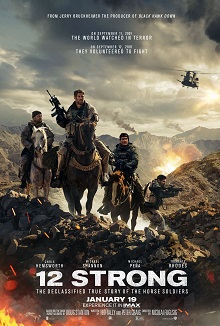
Film Review: 12 Strong (dir by Nicolai Fuglsig)


12 Strong begins with a montage of terror.

The World Trade Center is bombed in 1993.  Planes are bombed.  Ships are attacked.  Bill Clinton gives a speech in which he impotently condemns Al-Qaeda.  Finally, we reach September 11th, 2001.  Captain Mitch Nelson (Chris Hemsworth) is playing with his daughter when she suddenly looks up at the TV behind him.  “Look, Daddy,” she says.  Nelson turns around and sees The World Trade Center on fire.

Even though he’s recently announced his intention to retire, Nelson reports for duty.  Despite the skepticism of his commanding officer (Rob Riggle), Nelson and 11 others are sent into Afghanistan.  Their mission is to meet up with a warlord named Abdul Rashid Dostum (Navid Negahban) and to capture territory from the Taliban.  Nelson is initially given 6 weeks to complete this task.  Nelson replies that he’ll get it done in three, before the harsh Afghan winter makes it impossible to move through the mountains.

Among the actors who make up Nelson’s team: Michael Shannon, Trevante Rhodes, Austin Stowell, and Geoff Stults.  Fortunately, the cast is made up of familiar faces.  Even though you might not learn everyone’s name, you still feel as if you know them because you’ve seen all of them playing similar roles in other movies.  (After his performance in Moonlight, it’s a bit disappointing to see Trevante Rhodes playing such a minor supporting role in his follow-up but still, he’s a charismatic actor and he has enough screen presence that he definitely makes an impression.)  Somewhat inevitably, Michael Pena plays the funny member of the team.  It’s not a 21st century action film without Michael Pena providing comedic relief.

(That’s actually a little unfair to Michael Pena, who is a good actor and who gives a pretty good performance in 12 Strong.  It’s just that he’s played this role so many times that it’s almost become a cliché that every action movie will feature Micheal Pena making jokes.)

When the team first meets up with Dostum, there’s immediate tension between the supposed allies.  As Dostum puts it, the United States only cares about getting rid of the Taliban but they don’t care about what will happen afterward.  When Dostum looks at Nelson, he immediately announces that Nelson does not have killer eyes.  Everyone else on the team has killer eyes but not Nelson.  Dostum and his men are even less impressed when they see the Americans struggling to ride the horses that are required to get through the mountains.  Will Nelson win Dostum’s respect?  Will he develop the eyes of a killer?

You probably already know the answer to that.  There’s really not a single moment in 12 Strong that you won’t see coming.  As soon as Dostum says that Nelson needs to prove himself in battle, you know that he’ll get a chance to do just that.  As soon as another soldier talks about home, you know that he’s going to be seriously wounded.  When you first spot the child soldiers among Dostum’s forces and you see one of them give Nelson a nervous smile, you know that child’s probably going to be one of the first casualties of the attack.

12 Strong is a predictable movie but that doesn’t necessarily mean that it’s a bad one.  It’s a well-made film, with the cast all giving strong performances and director Nicolai Fuglsig doing a good job with the battle scenes.  My heart was racing during the film’s final battle.  New Mexico doubled for Afghanistan and the film features some truly stunning shots of the mountainous landscape.  The film even makes a point about why, after 17 years, there still doesn’t appear to be any end in sight to the War in Afghanistan.

Clocking in at 2 hours and 9 minutes, 12 Strong is probably about thirty minutes too long.  It’s a predictable movie but it’s well-made and the fact that it’s based on a true story does make it a bit more poignant than it would be otherwise.  It’s not a bad war film, particularly for January.