Lisa Marie Gets Super (dir. by James Gunn)


Super, a very dark and very Catholic comedy that pretends to just be your standard issue super hero movie, played for about three weeks down here in Dallas.  Despite a cast that included Kevin Bacon, Liv Tyler, Ellen Page, and Rainn Wilson, it kinda came and went like a ship in the night.  It got a few vaguely confused reviews from the local critics and the audience that I saw the film with seemed to be pretty confused as to what they were watching.  Which is a shame because if you give the film a chance, you’ll discover one of the best films of 2011.

In Super, Rainn Wilson plays a short order cook who, at various points in his life, has had visions in which he believes God has spoken to him.  When his wife, an ex-drug addict played by Liv Tyler, leaves him for a sleazy club owner and low-level drug dealer (Kevin Bacon), Wilson sinks into a deep depression until finally he has a vision in which God sends a bunch of hentai-style tentacles to cut off the top of Wilson’s head and literally place an idea in there.  That idea is for Wilson to become a costumed super hero and fight “evil.”

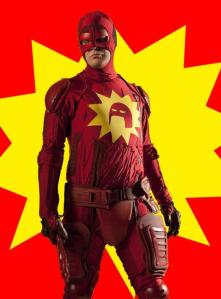
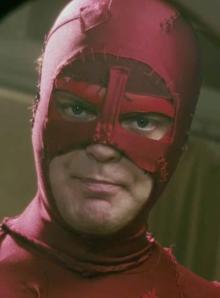
So, that’s what Wilson does, dressing up in what looks like a low-rent Halloween costume, and taking on all those who he considers to be evil and/or doing the wrong thing.  This could be anything from dealing drugs to cutting in line at the movies.  (And this is a big reason why I loved Super because it asked the same question that I always wonder when I see a super hero movie — i.e., who is to say what’s wrong and what’s right?)  Calling himself The Crimson Bolt, Wilson soon becomes a cult figure in the city but he still finds himself incapable of getting Tyler away from Bacon. 

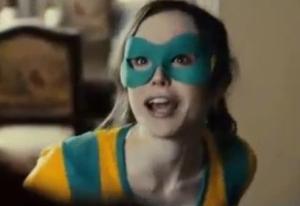
Eventually, he finds himself saddled with a sidekick.  Ellen Page, giving a performance just as award-worthy as her more acclaimed role in Juno, plays Libby, who works in the local comic book store.  She is the only person who figures out that Wilson is actually the Crimson Bolt and she quickly decides that they should work together.  Calling herself Boltie, Page quickly turns out to be just as zealous in the pursuit of “justice” as Wilson.  Unlike Wilson, who sees himself as being on a holy mission, Page appears to just be happy to have an excuse to kill people.
It all leads to the expected final confrontation with the bad guys and a surprisingly poignant ending which forces the viewer to reconsider what they thought they knew about every character in the film.

Super’s low-budget is obvious in almost every frame of the film but it works to the movie’s advantage, creating an almost defiantly gritty atmosphere.  The film is also full of good performances.  I already mentioned Page but, in the lead role, Rainn Wilson is perfectly cast.  For those of us who love him on The Office, it’s sometimes hard to realize that Wilson is not Dwight Shrute, he’s just an actor playing a role.  However, with Super, Wilson proves himself to be a charismatic actor who, if given the right role, can easily carry the film.  Towards the end of the film, one of the bad guys taunts Wilson for concerning himself with seemingly minor things like people cutting in line.  Wilson shouts, “You shouldn’t cut!” with such righteous fury that it becomes clear  that he’s not talking about cutting in line as much as he talks about living in a world where people just no longer seem to care about doing the right thing.  It’s an unexpectedly effective scene and line and Wilson handles it perfectly.

Super is the latest film from a genius named James Gunn.  Now, I should admit that I am like crazy in lust with James Gunn.  Seriously, he’s handsome, he’s funny, he’s talented, he’s hot, he’s vulnerable, he’s dangerous, he’s Irish, and he comes from a Catholic background, which is pretty much a perfect description of my dream man.  Plus, he talked to me once on twitter and as a result, I got all giggly and red-faced and I sent him all of these gushy tweets which he never responded to, probably because I was like totally coming across like some sort of psycho stalker type.  So, some people are probably saying, “Well, gee, Lisa Marie, are you sure you’re not just letting your damp panties review this film as opposed to your unbiased judgment as a film watcher?”  And to those people, I say, “Shame on you and watch your mouth.  And speaking of mouths, guess where my mouth would be if I ever met James Gunn…”

Mon amour James Gunn

But let’s get back SuperSuper has been frequently compared to Kick-Ass (even though Super actually went into production first) and, on the surface, they do appear similar.  It’s only when you dig and look under the surface that you discover that Super and Kick-Ass have about as much in common as I do with that overly friendly girl who always takes our tickets at the Angelika.  (She’s the same girl who needs to stop smiling so much at Jeff every time we try to get popcorn.  Seriously, not kidding.)  While Kick-Ass was undeniably violent, it was also one of those films where the violence was rarely lingered over.  Super is not only incredibly violent but it’s also incredibly bloody.  Gunn doesn’t just show us the violence but he shows us the end results of the violence as well and, as a result, the audience is forced to consider how much we love to see people getting shot in the head just as long as we don’t have to worry about seeing the body afterwards.  Whereas Kick-Ass’s Aaron Johnson was portrayed as being a comic book fan who got to live out his fantasy, Rainn Wilson in Super is specifically portrayed as not being a comic book fan as much as he’s just a genuinely unstable guy who becomes a super hero in order to maintain the delusional black-and-white morality of his worldview.  Whereas Chloe Grace Moretz’s Hit Girl was portrayed as having been raised to kill, Ellen Page’s Boltie kills simply because she now suddenly has the opportunity to do so.  Finally, Kick-Ass actually ended up fighting true evil doers whereas the villains played by Kevin Bacon and Michael Rooker, in Super, are probably the most stable and sensible characters in the entire film.

In short, Super is that perfect rarity — a truly transgressive work of popular entertainment.

Yes, Super is one of those films that delights in challenging and even ticking off the audience.   The common filmgoer watches and asks, “If it’s a drama, then why is it so funny?  If it’s a comedy, then why does Rainn Wilson’s heartbreak seem so real and sincere?  If Rainn Wilson and Ellen Page are the good guys, why does the film suggest that they both might be sociopathic?  If Kevin Bacon’s the bad guy, why is he so likable here?”  As a result, the common filmgoer probably walked out of Super feeling confused and slightly annoyed that things didn’t work out the way they were expecting. 

Well, you know what?  The common filmgoer sucks.  The common filmgoer is responsible for every bad thing that has ever happened in the history of the world.  The common filmgoer is wasting oxygen that you, my deeply enlightened friends, could make much better use of.  This is not the site for the common filmgoer and if you’re still reading, then you’re not a common filmgoer either.

Super was made with you in mind.
James Gunn’s Super: Official Trailer


In what could be 2011’s version of Kick-Ass, the latest film from writer-director James Gunn looks to take the superhero genre into the realm of ultraviolence and some heavy dark comedy. The film is simply titled Super and stars Rainn Wilson, Ellen Page, Liv Tyler and Kevin Bacon and it’s about Wilson’s character deciding he’s had enough of being the meek and the weak. His decision to take control of his life takes him into a very dark place where superheroes are made and lots of vigilante justice served on crime everywhere.

From the look of the trailer it definitely looks like its going to go even farther than what Kick-Ass did in 2010. This film may also share something with that film in that it probably won’t make the sort of money it’s supporters and fans are hoping it’ll make.

So, I suggest people see this film as soon as it comes in their area. People need to support films like this or they should just shut up about how Hollywood has run out of ideas and only cookie-cutter flicks are being pushed on the audience year in and year out.


Review: The Walking Dead (EP04) – “Vatos”


[Some Spoilers Within]

We’re now into the first episode of the second half of this initial season. The Walking Dead has been a definitive hit for cable network AMC who has been hyping up the show every week for months. The pilot episode has been hailed as one of the best premiere shows and it helped that showrunner Frank Darabont wrote and directed it. Then we had the follow-up episode which have been hit-or-miss for some people with the second one being a miss for some who began to question whether Robert Kirkman’s comic book series will have the legs to last several seasons and beyond. The third episode allayed some of those fears, but still some people were still doubting whether the show can truly balance the intense drama and character interaction with the zombie mayhem and gore.

Now we’re on the fourth episode and when people heard that creator Robert Kirkman would be writing the episode more doubts started to creep in. I say this because as critically-acclaimed and popular the comic book series is there’s a vocal segment of the fans who think the book succeeds despite Kirkman’s writing which tend to be heavy on the exposition. They see him not knowing the concept of “less is more”. As a long-time fan I can see what these fans mean, but I also think he’s quite good in creating the scenarios his characters must navigate through.

With this fourth episode titled “Vatos” we get Robert Kirkman writing not as a comic book writer but as someone who knows its a new medium and must write accordingly. In what I consider the best episode since the Darabont written and directed pilot, Robert Kirkman has shown just why millions of fans have flocked to read the comic book and why millions more have fallen in love with it’s tv adaptation.

The episode begins with a beautifully shot prologue of Amy and Andrea sitting in a boat fishing in the quarry lake and reminiscing about their father. It’s a nice tender moment which takes on a sad note as they finally voice every survivor’s fear. Are their parents alive? Maybe where they lived wasn’t hit hard. It’s survivor’s guilt to the nth degree as we and these characters know that the odds of any of the camp’s loved ones in far off places being alive are miniscule to none.

We also see a disturbing portent of what may yet come to pass as Jim, the mechanic from the past episode, seem to be losing his edge. It falls to Dale to notice Jim’s erratic behavior and then down to Shane to take care of things before Jim finally goes over the deep end and hurts not just himself but everyone else. I liked how Jim’s little revelation about what happened to his family arrived quite naturally and the effect it had on Lori and the others. Lori, Carol and Andrea may still have a semblance of a family, but Jim is the prime example of someone who has lost everything and may not have anything left to live for.

Now, we ended the third episode with Rick and his little band of Merle rescuers finding their quarry missing and not just from the roof but the hand he was cuffed with. We see the aftermath of Merle’s improbable, but quite the badass, escape from the roof. While we don’t see Michael Rooker as Merle in this episode his presence looms over everything and everyone. It’s during Rick and the groups attempt to find not just where Merle went but also the bag of guns Rick dropped in the pilot episode that we finally meet the episode’s title characters.

At first, it seemed like another attempt by Kirkman and the writers to drop stereotypical characters into an already crowded plate. Latino gangbangers becoming an immediate threat to Rick and his group. They even had a smooth-talking and intelligent leader that some may see as the show’s attempt on the typical drug lord. The confrontation between the two groups don’t come off so smoothly the first, second and third time, but it takes the intervention of the kindly grandma-type to ease the tensions. Tensions which reveals that people shouldn’t judge a book by it’s covers.

I definitely think this is like Kirkman’s shot across the bow of his detractors who think he cannot write beyond wordy exposition. The dialogue in this episode was some of the strongest and I’d say just slightly above of the pilot’s. There were more characters involved with two paralleling storylines to manage. Kirkman has shown with this episode that he actually knows the concept of “less is more” and that his true calling may not be writing comic books but writing teleplays for tv. I wouldn’t mind if all the episodes of The Walking Dead were written by just Darabont and Kirkman. I truly believe that this episode won’t be last time we see a Kirkman-written episode and that’s a good thing to look forward to.

In the end, “Vatos” more than lives up to the high standard the pilot episode set. It was an episode which was able to combine not just the dramatic interaction between character and groups (and not just conflicts, but the quieter moments) but also the very zombie mayhem and carnage fans of the genre expect the show to have. The episode which begins so calm and serene ends on a horrifying and sad way. This episode has finally illustrated what the comic book was all about. A story and journey of survivors living day by day trying to retain a semblance of their old lives only to have the ever-present threat of the zombie apocalypse shatter such misguided attempts.

Extras

* KNB EFX founder Greg Nicotera makes an appearance as a zombie in the second-half of the episode.

* Merle Dixon never appearing on-screen but still ends up being the badass of the episode.

* Guillermo’s (leader of the Vatos) hounds from hell.

* “Admit it, we only came back to Atlanta for the hat” (Glenn seeming to be the one person in every episode with the witty quip and remark to lighten things a bit)

* Breakin’ Bad veteran-director Johan Renck’s masterful handling of the episode’s climactic scene in the camp.

* The show loses a regular character and one of the cardboard ones.


Review: The Walking Dead (EP03) – “Tell It to the Frogs”


[Some Spoilers Within]

Ok, the second episode of The Walking Dead was seen by some as being too much like every past zombie films and stories that’s ever been told. It was too much about the typical zombie siege of a group of survivors inside a building with little to no way out of the predicament. Now add in the elements of infighting within the group not to mention a dangerous wild card of a character and some viewers were turned off by it. The fact that the episode was one of the goriest episodes of any show ever put on non-premium cable never got much press.

One character introduced in episode 2 which really polarized viewers was the one played by veteran genre actor Michael Rooker. The character was one Merle Dixon and he instantly appeared in the show as an uncouth, loud, abrasive redneck racist that for some the only thing missing was the song “Dixie” playing in the background. I must admit that the character of Merle Dixon was written and introduced rather awkwardly, but to say that the zombie apocalypse wouldn’t include such blatant racists individuals have way too an optimistic view of humanity.

It is how we start the third episode, titled “Tell It to the Frogs”, that has redeemed the character of Merle Dixon to some skeptics. I wouldn’t say redeemed as in they accepted the racist but that he might still have a part to play in this 6-episode first season of the show. In the second episode Merle was left behind by Rick and the group handcuffed on the roof of the very building which was now overrun by “walkers”. Fortunately for Merle, T-Dog (who had happened to drop the cuff keys down the drain in his attempt to free Merle) had chained and padlocked the door to the roof to keep Merle from becoming the next sun-burned meal for the walkers. Unfortunately for Merle the chain and padlock had some slack to it that the door could be opened with enough of a gap for a walker to stick its head through.

Merle opens the third episode talking to himself as he reminisces about punching some Army officer in the past. Right from the get-go we see Merle might have lost his mind somewhat. But as soon as his trip down racist memory lane ends he finally snaps back to reality and realizes he’s cuffed to the roof, no key to the cuffs and the zombies as working their damndest to push the chained roof door wide enough to get through. Before the scene moves to the intro credits me last see Merle trying to use his belt to pull the steel hacksaw to him while praying and condemning Jesus in equal amounts.

That was some fine acting from Michael Rooker and was one of the highlights of the episode. While it still doesn’t answer the question of how such a racist was even with the group in the building, it does confirm that Merle might not be all there mentally. The appearance of his brother Daryl halfway through the episode and showing the younger Dixon to be as racist but not as unhinged reminds me of the two characters from Of Mice and Men except these two are of the racist variety. George being the younger Dixon and the Lennie role taken on by Merle. It’ll be interesting how these two new characters to the series will unfold as the first season rushes towards its conclusion. The scene in the end with Daryl finding the aftermath of Merle’s attempts to escape his cuffs was another fine moment in an episode that was more about character interaction and drama than about violence and gore (thought there’s some of that in the episode).

While the episode begins and ends with the fate of Merle Dixon the bulk of the episode was the reunion of the Grimes family and how Rick’s miraculous arrival has changed the camp’s group dynamics with Shane Walsh (Jon Bernthal in a performance which turned his character of Shane from hated “black hat” of the show to one that was a complex character who may or may not still be a simple “black hat”) and his wife Lori.

The scene where Rick slowly makes himself seen by the camp was very touching and showed hints of the love triangle the show will be exploring between Rick, Lori and Shane. The fact that Shane’s the first to see Rick and his expression turns from curiosity about who this new survivor was to one of shocked disbelief that the man he had spoken of as being dead has come back to his life. A life he seemed to be remaking with Lori as his partner and him a surrogate father to Rick’s son Carl. The reaction by Lori to suddenly seeing her husband back in her life healthy and alive ran the spectrum of surprise, shock and guilt.

Even the complex reactions from Shane and Lori didn’t diminish the heartwarming reunion between father and son as Rick literally fell to his knees in tears to hug his son Carl. That scene definitely was a tearjerker for many and Lincoln’s performance was very believable. One could almost see the burden and tension drain away from Lincoln’s Rick. The goal he had set for himself since episode 1 was now complete and nothing else mattered at that moment.

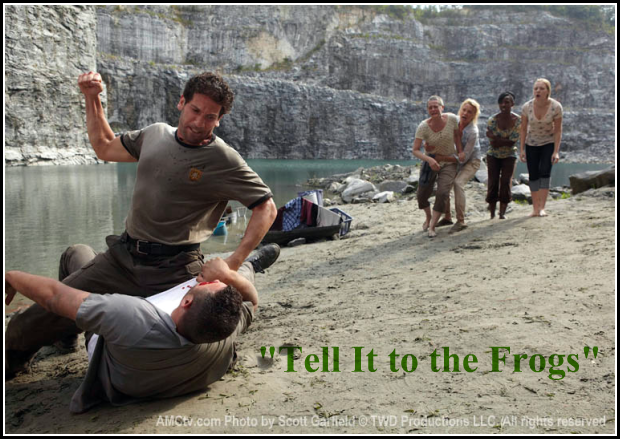
The show did have some moments which showed Darabont and the writers still feeling their way around Kirkman’s source material. One of it being the introduction of an abusive husband for one of the book’s regular faces in Carol. In the book the husband was only  mentioned as not having survived the trip to Atlanta but no mention of him ever being abusive. Like the introduction of Merle in the previous episode, the appearance of Ed as the caveman husband was done too haphazardly. Almost like someone out of stereotype casting call, Ed bullied his way around the women in the camp until Shane had to step in and put on an epic beating that added some depth to the character of Shane but also made one wonder if the addition of Ed was just as a way to give Shane an outlet for the anger and frustration he was feeling from the return of Rick and the subsequent frosty attitude by Lori towards him.

In the end, “Tell It to the Frogs” was a much stronger return for the show after a second episode that some thought was being too stereotypical of a zombie story. I enjoyed the second episode but understand why some reacted to negatively to it after such a powerful initial pilot episode. The crew of Darabont, Kirkman and the other writers definitely have a balance to do between dramatic storytelling and zombie mayhem as the show continues through this first season and into the next. While some of the characters, both new and old, do seem too one-dimensional and more like plot devices for the main characters the show is only in its third episode and to judge the whole thing on such a small sampling is not fair to the show and the people behind it. I think the show has hit a nice balance of drama and mayhem. Time will tell if the show will live or die by balancing the two or finally landing on one side or the other.

PS: Oh yeah, anyone who happens to be fans of Bambi and her mom will have a hard time watching this episode.

The Walking Dead – Behind the Scenes Sizzle Reel (AMC)


It’s now just a little over a month to go before one of the most anticipated new shows on TV hits the airwaves. AMC’s tv series adaptation of Robert Kirkman’s critically-acclaimed and fan favorite comic book series The Walking Dead will premiere on Halloween night 2010 at 10pm. The show will also premiere within days in over 40-plus countries which would be an unprecedented feat for a first time tv series.

Frank Darabont and his band of writers seem to have taken Kirkman’s story and made the necessary changes to make it work on tv. One aspect of Kirkman’s storytelling was how some people thought it to be too expositionary. This left each page with too much talking while at the same time not fleshing out each character to be distinct from each other. While I can see that I don’t buy into that particular flaw in the story too much. This is a story of the end of the world and stress definitely plays a key role in how everyone reacts to their new environment.

From the AMC “sizzle” reel the network has released just in the last few days it looks like the show’s writers have taken Kirkman’s story, ideas and dialogue and made them flow much more naturally. Final judgement on whether this actually happens will have to wait until the show premieres, but Darabont has always been a writers first and filmmaker second so I definitely have much faith that he and his team will come out with a great product that takes the best from the comic book and trims the fat and gristle off by the wayside.

There’s also one thing the “sizzle” reel above shows which should answer the trepidations that some of the comic book’s fans have had since hearing th news of the adaptation. This was whether AMC will keep the gore and violence from the comic books or will it be toned down. From the looks of some of the scenes shown in the reel above the gore and violence is on-hand and from the look of things this may be the most gory thing on tv that’s not premium cable. I see blood, gore, viscera and all the nice gooey things that happens when a body’s insides are exposed to the environment. YUM!

Halloween 2010 needs to come now, but until then revisiting the comic books the series is adapting is a good way to pass the time.

Source: io9

The Walking Dead – Official Series Trailer (AMC)


Well, it’s now official. AMC has finally released the very same trailer that people not fortunate enough to have attended San Diego Comic-Con last month. This trailer is under 5 minutes long and it’s the same one those who attended the Comic-Con panel for the show saw. Only shaky and grainy bootleg copies of the trailer has been seen outside of that panel. While some bootleg versions were quite good in quality they’re still not a substitute for the official release of the same trailer by AMC for everyone to watch.

This official trailer release was also AMC’s way of finally announcing the premiere date of the 90-minute pilot episode (directed by showrunner and producer Frank Darabont). The pilot will premiere worldwide on Halloween Night, October 31, 2010. While some thought the pilot will premiere early on AMC’s “Fearfest” campaign for October I think it’s appropriate that the series premieres on Halloween Night. I can definitely see many fans of the comic book series planning their Halloween parties to include group watch of the pilot episode the very same night.

Still two months away and this trailer definitely doesn’t make the wait any easier.

Source: The Walking Dead (AMC)

The Walking Dead Comic-Con Bootlegged Trailer


It may be weeks before AMC puts up a much more high-quality version of this trailer, but until then this is the only one non-Comic-Con goers can watch. The trailer definitely shows enough of what Darabont and his writers are going for to assuage any fear I have that they’re straying too far away from Kirkman’s laid out plans and that they may be staying too loyal to the original source.

I really like how the trailer shows enough scenes from the comic book’s first couple issues that fans have memorized. This series (6 episodes in total) will definitely be the show to watch this coming tv season. That scene with the zombies swarming in, around and over the tank sent chills up my spine.

I also love how loud and well the panel attendees received the trailer. Now time for the series to impress the non-fans. If the series does that then The Walking Dead will join Mad Men and Breaking Bad in creating a trifecta of the best shows on basic cable and probably tv in general.

Review: Slither (dir. by James Gunn)


James Gunn first got his chance to work in the horror-comedy genre with his time in Troma Films. His first contribution to the genre being a send up of Shakespeare’s Romero and Juliet aptly titled as Tromeo and Juliet. He next moved on to penning scripts for the major studios with his first two being the critically-panned, but profitable two Scooby-Doo live-action films. Gunn next moved on to writing a script reimagining George A. Romero’s classic Dawn of the Dead. Despite howls of protest from the original film’s legion of fans, the film went on to be a modest success and helped bring about the renaissance of the current zombie mania in all facet of entertainment. Gunn follows up the success of his Dawn remake by not just writing the script but finally getting behind the camera and directing it himself. I’m glad to say that James Gunn’s first directorial debut with Slither has turned out to be one fun, gross-out, disgustingly hilarious horror-comedy that brings to mind the splatter-comedy films of the 1980’s.

I say that Slither has alot in common with the horror-comedy during the 80’s just for the fact that we’ve not seen a film of this kind since. Slither brings to mind such 80’s B-movie shlock classics like Critters, Return of the Living Dead, and Night of the Creeps. But Gunn also pays some an homage to cult classics like John Carpenter’s The Thing. One of the character’s in the film and a store are even named after The Thing‘s badass antihero, R.J. MacReady. Then there’s the tip of the hat to Romero’s zombies, though this time around I would say that Gunn had more in mind the quickthinking and funny undead from John Russo’s Return of the Living Dead. There’s even a shout out to Invasion of the Body Snatchers as the alien slug-controlled populace are actually part of a much larger organism who thinks for all.

The story Gunn came up with for Slither was pretty straightforward and simple. Intelligent alien organism bent on world domination hitches a ride on a meteor which travel the depths of space until it falls on an unsuspecting planet. Unfortunately, the planet in question for the film happens to be Earth. Right from the get go the comedic aspect of the film begins even as the alien-laden meteor crash lands its way to one Wheelsy, N.C. A podunk town where the most interesting to happen each year is the annual Deer Cheer which signals the start of Deer Hunting season. We get to see the mundane day-to-day life of the townspeople from the pretty high school teacher Starla Grant (adorably played and with a strong sense of marital fidelity by Elizabeth Banks), the town’s obnoxious and foulmouthed Mayor MacReady (Gregg Henry’s performance was hilarious and he gets pretty much all the best one-liners), to its Chief of Police Bill Pardy (Nathan Fillion in Han Solo mode).

The alien soon finds a host in the town’s richest person who also happens to be Starla’s much older husband, Grant Grant. Michael Rooker (Henry: Portrait of a Serial Killer) plays Grant and his performance was both funny and sad. He pretty much starts morphing into a creature somewhere between Jabba the Hutt and a Lovecraftian squid-person. But through it all, Grant’s love for his wife manifests itself by way of the alien’s collective intelligence. When the townspeople all start getting infected by the large, slug-like offsprings of the main alien, it’s hilarious to find that they all share Grant’s love for Starla. It would seem that the alien collective learned abit or two from Grant about marital love and also a love of Air Supply’s syrupy ballad, “Every Woman in the World.” These zombies chant the word “Starla” instead of “brains.” The rest of the film was pretty much Starla, Bill Pardy and a small band of survivors trying to stop the Grant-alien, the slugs and the zombified townspeople from spreading out of Wheelsy and out onto the rest of the planet.

The film balances well between horror and comedy. The horror aspect of Slither comes from the many gory scenes. Trust me when I say that this film has more than its share of blood, gore and splatter. We’re shown dead and gutted pets and farm animals. Not to mention the requisite flesheating performed by the zombies. the great thing about the scenes of horror in Slither was the absence of CGI except for a scene or two and even then it was difficult to pinpoint which was CGI and which was animatronics and make-up effects. Slither‘s monster effect owes alot to the work of Rob Bottin and his crew who did the disgustingly creative effects on Carpenter’s The Thing. I’m glad to see that Gunn decided to forgo CGI for these scenes and went for more realism. Even if such realism were nauseatingly disgusting and gross. Just what a horror movie was suppose to be. The comedy part came not from the aliens and the scenes of horror, but from the characters reactions to the unfolding events around them.

Just like Shaun of the Dead, Slither’s characters stumble, bumble and trip their way through the crisis. Even Fillion’s character of Bill the Chief goes against the stereotypical hero from these type of film. He’s a smartass about his job and how he sees the people he’s suppose to protect, but when the time comes to do his job as protector he tries to do the best he can even though the best he can doesn’t measure up to what we’re suppose to get from our heroes. The dialogue was fast and wickedly sharp which made for alot of hilarious one-liners and most of them coming from the mouth of Slither’s Mr. Pibb-obssessed Mayor MacReady and his penchant for overreacting to everything and also for calling everyone cocksucker.

Slither doesn’t try to be anything but what it set out to be: a funny horror film with a large helping of slapstick, splatter and slime. In that respect, James Gunn succeeded with his writing and directing of Slither. The movie doesn’t bring any originality to the horror-comedy genre. To be honest, there’s not much originality left to bring to the genre, but Slither takes all the usual conventions from those 80’s horror-comedies and gives it a new millenium vibe. The acting by the cast was well-done and showed that they must’ve have fun doing the film. The special effects were done old-school style with nary a CGI-effect to be seen except for a few brief scenes. In the end, Slither was one fun, rollercoaster of a movie that scared the audience into jumping and recoiling in their seats and at the same time making them scream, shout and laugh when doing so. I’ve never had as much fun these last couple years watching a movie like I did with Slither.

Review: Henry – Portrait of a Serial Killer (dir. by John McNaughton)


John McNaughton’s directorial debut has been hailed as one of the best by any first-time director. I won’t be one to disagree with those who agree. McNaughton took $125,000 dollars, an idea of fictionalizing a week in the life of one real-life serial killer Henry Lee Lucas, and a dedicated crew of filmmakers to create a raw, unflinching, visceral piece of filmmaking. Originally filmed and finished in 1986, Henry: Portrait of a Serial Killer languished in ratings limbo as the filmmakers struggled with the MPAA over its X-rating. In fact, it’s been reported and written in many publications that it is one of the few films screened by the MPAA where they saw no way an edit here or there can ever lower it to an R-rating. I think its fortunate for film fans and academics everywhere that McNaughton and company decided to release the film in 1990 unrated.

Henry: Portrait of a Serial Killer was loosely-based on the life of one Henry Lee Lucas. One of the most prolific (though Lucas has since discounted ever killing over 600 people) serial killers in American history. From the beginning, Henry plunges the audience into a world seen through the eyes of a sociopath and as, Ebert once wrote in his own review: “an unforgettable portrait of the pathology of a man for whom killing is not a crime but simply a way of passing time and relieving boredom.”

The first scene is haunting in its graphic and realistic portrayal of the randomness of a serial killer’s passing through the myriad roads and highways that criss-cross the American landscape. It was this stark and realistic portrayal of the aftermath of violence and death that has made some people label McNaughton’s directorial debut as a snuff-film masquerading as an arthouse production. It’s difficult to disagree with such people since the violence (though it doesn’t go as far as most horror films of the era and barely a blip on the MPAA’s radar in today’s mega-blockbuster-shoot’em-ups) has no look of articiality and not glossed-over with your typical horror/suspense sensibilities. It doesn’t have that exploitation look that the horror films of the 70’s and early 80’s. What it did have was the look and feel of a documentary. The titular character (chillingly portrayed by Michael Rooker) commits his murders as one who sees nothing wrong in what they’re doing. To Henry what he does he does to pass the time and to break-up the boredom of his existence. This behavior shows the banality of Henry’s view of the world around him. It goes to show that as horrific as Henry must seem to the audience there’s a sense of reality in what he does. We read about it on the news, in true-crime documentaries, and in the sensationalist shows dealing with serial and mass murderers.

Henry is not the only one who wades into the dark underbelly of American life and society. There’s Henry’s former cellmate, Otis (played with relish by Tom Towles) who at first seems like a buffoon, but later shows his own pathology for senseless killings as Henry finally brings him into his own world. In fact, Otis’ reaction to Henry’s revelations about what he does in secret looks similar to the reaction of the violence addicted mass audience who revel in the violence in action films and horror retreads. Otis is at first confused and knows that he should be disgusted with the killings he first witness Henry committing, but he later gives in to his own primal impulses. He soon revels in the act of murder and even sees it as his own form of entertainment. It’s during the home-invasion and subsequent murders of the home’s family captured on videotape by Henry and Otis that this change in Otis hits home.

This is the juncture in the film that posits the damning question the filmmakers want to ask the audience. Do we recoil in horror and disgust at this horrifying, voyeuristic sequence or does the audience continue to watch with the dispassionate eyes of one who has become desensitized to onscreen violence. There’s no clear answer to this question and the filmmakers don’t condescend to the audience and try to sugar-coat the violence. It is also this sequence where we see the difference between Henry and Otis. Henry almost feels remote and disconnected from the acts he’s committing. To him breaking the neck of a teenage boy might be the same as stepping on an ant. But to Otis the killings themselves becomes his addiction and only form of joy. He’s willing to go beyond what his mentor has done to sate his appetites. We see Henry’s reaction to this change in Otis and realize that as much as the audience want to hate Henry, he is the lesser of two evils. He doesn’t take joy from his work and we cling to that barely there shred of decency in the hope that salvation and redemption is at the end of the ride.

To the filmmakers’ credit Henry doesn’t trivialize the gruesome events from scene one right up to the end credits by tacking on a Hollywoodize happy ending. As the final reel comes to a conclusion and we see Henry and Otis’ sister, Becky driving off into the night (a sort of reverse-negative of the typical riding-off into the sunset of Hollywood past), the audience is ready to breath a sigh of relief from the relentless visual and emotional pounding the film has put on the audience. But the rug is pulled out from under the audience’s feet. McNaughton and his writers do not believe in the redemption of Henry. In fact, they know that such things are only seen in Hollywood and fairytales. What they give the audience instead is a scene that continue to show that the film is steeped in the real world. People like Henry do not find forgiveness and salvation from their evil deeds. People like Henry continue to ply the roads and highways of America. Their seeming normalcy hiding the calculating, sociopathic murderous instincts just below the surface.

I credit Henry: Portrait of a Serial Killer as one of the truest work of American filmmaking. A great character study of a sociopathic individual whose banality can truly be called the face of evil. McNaughton’s film is admired and reviled and both sides have credible points in taking their sides. It is a great piece of work that shows that filmmaking can go beyond its basic need to entertain. It is also a brutal piece of film that didn’t have to be made the way it was made, but to do it in any other way would’ve diluted the message and impact of the story.