In this scene from Robert Altman’s 1975 masterpiece, Nashville, Julie Christie plays herself as a famous visitor to the city for which the film is named. She is introduced to Haven Hamilton (Henry Gibson), Haven’s lawyer, Delbert Reese (Ned Beatty), political advance man John Triplette (Michael Murphy), and country music star Connie White (Karen Black). Julie Christie may be a star in Hollywood but Connie is the star of Nashville.
Karen Black improvised her dismissive line about Julie Christine not even being able to comb her hair. It was a moment that reportedly shocked the rest of the cast and the crew but it was also a line that perfectly summed up both Connie as a character and Altman’s version of Nashville.
Welcome to Retro Television Reviews, a feature where we review some of our favorite and least favorite shows of the past! On Saturdays, I will be reviewing 3 By Cheever, which ran on PBS in 1979. The entire show can be purchased on Prime and found on YouTube.
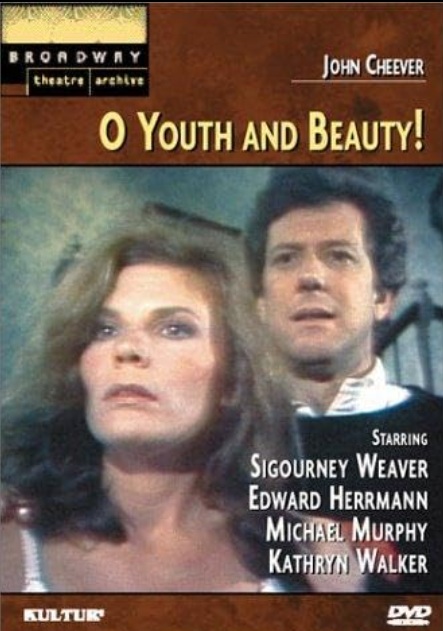
Episode 1.2 “O Youth and Beauty!”
(Dir by Jeff Bleckner, originally aired on October 31st, 1979)
Back in the day, Cash Bentley (Michael Murphy) was an athletic marvel. He was a track star who could jump the hurdles with ease and who everyone in high school looked up to. Now, however, he’s 40 years old and he feels lost. He’s aging and a new generation of young people have come along. They certainly have no idea who Cash Bentley used to be.
At drunken neighborhood parties, Cash insists on recreating his youth by having his hosts set up their furniture like an obstacle course. Giving them a starter’s pistol that he insists be fired to signify the start of the race, Cash will run through the house, jumping over chairs and couches and tables while everyone cheers. Unfortunately, Cash’s luck runs out and he ends up breaking his leg during one of his demonstrations.
Forced to get around on crutches, Cash feels isolated from the rest of the world. He doesn’t get a promotion because his bosses say they need someone who can start traveling immediately. When all of his neighbors get on the train that is heading into the city at the usual morning time, a hobbled Cash arrives late and is forced to wait alone for the next one. His wife, Louise (Kathryn Walker), gets a job working at a boutique to help pay the bills. She says that maybe she’ll make enough that they’ll be able to take a vacation. At the neighborhood parties, no one wants to deal with Cash and his broken leg. His athleticism was all he had left. It was what he was known for. It was the source of all his confidence. Now that he doesn’t have that, he’s lost.
Eventually, his legs comes out of the cast and he insists that Louise set up all the furniture in the house so that he can run another obstacle race. He gives Louise the starter’s pistol and insists that she fire it when it’s time for him to start. The scene cuts to the outside of their suburban home. The sound of one gunshot upsets the calm. Later, Louise and her children are seen moving out of the house. Cash is nowhere to be seen.
The episode ends ambiguously. Those who are familiar with the original John Cheever short story know that Louise shot Cash and that no one was sure whether she meant to do it or not. The movie cuts away before the gun is actually fired. For all we know, Cash did the obstacle course and then just never returned home.
O Youth and Beauty is one of John Cheever’s most acclaimed short stories. The screen adaptation features an excellent performance from Kathryn Walker but the scenes of Cash running the furniture obstacle course are probably something that worked better on the page and in the reader’s imagination than when actually presented on film. Michael Murphy is almost too confident and handsome as Cash. The role calls for a former jock slowly going to seed and desperately trying to hold onto his youth whereas Murphy looks like he’s still in peak athletic form. Murphy does a good job portraying Cash’s depression and his alienation after he breaks his leg but, physically, he still seems miscast in the role.
Edward Herrmann and Sigourney Weaver, who were the center of last week’s episode, make a brief appearance in this one, hovering in the background of the neighborhood’s endless parties.
In the 1980s, director Robert Altman found himself even more outside of the Hollywood system than usual. A series of films that confused critics and repelled audiences had led to Altman becoming something of a pariah. As no studio was willing to give Altman a chance to make the type of quirky feature films that he made his name with in the 70s, Altman instead directed a series of low-budget theatrical adaptations. These films may not have gotten the attention of his earlier films but they allowed Altman to show off his talents, especially when it came to working with actors.
1988’s The Caine Mutiny Court-Martial was one of those films. Made for television and based on the play by Herman Wouk, The Caine Mutiny Court-Martial was a courtroom drama that Altman brought to life with his usual flair. Anyone who has read either the play or Herman Wouk’s original novel (or who has seen the 1953 film version, The Caine Mutiny) will know the story. In the final days of World War II, Lt. Steven Maryk (Jeff Daniels) has been court-martialed for mutiny. During a particularly violent storm, Maryk took command of the USS Caine away from Lt. Commander Queeg (Brad Davis). Maryk and his fellow officers, including aspiring novelist Lt. Thomas Keefer (Kevin J. O’Connor), claim that, after several incidents that indicated he was mentally unstable, Queeg froze up on the bridge and had to be relieved of command. Queeg claims that everything he did was to enforce discipline on the ship and that he never froze. Prosecuting Maryk is Lt. Commander John Challee (Peter Gallagher). Defending him is Lt. Barney Greenwald (Eric Bogosian), who is determined to win the case even though he doesn’t necessarily agree with Maryk’s actions.
The Caine Mutiny Court-Martial is very much a filmed play. Almost all of the action takes place in one location, a gymnasium that has been converted into a court of military law. We don’t actually see what happened on the Caine when Maryk took control. Instead, we just hear the testimony of those involved. Queeg defends himself, ably at first but soon he starts to show signs of the pressure of being in command. Maryk explains his actions and we want to believe him because he’s played by fresh-faced Jeff Daniels but, at the same time, there’s something a little bit too smug about his declaration that Queeg was not fit for command. The other officers on the Caine testify. Under Greenwald’s skillful cross-examination, Queeg is continually portrayed as being a flawed officer. But only Greenwald understand that Queeg was isolated not only by the loneliness of being in charge but also by members so his own crew, like Keefer, who hated the Navy and didn’t want to take their part in the war effort seriously. As a Jew who is very much aware of what’s at stake in the war, Greenwald has mixed feelings about the way that Queeg was treated. It ends with a party, where a drunk Greenwald calls out the true architect of The Caine Mutiny. As opposed to the way the scene was portrayed in the 1953 film or in Willam Friedkin’s recent adaptation), Altman focuses not so much on Greenwald but on the party occurring around him. If the other versions of this story ended on a note of triumph for Greenwald, this one ends on a note of sadness with Greenwald’s words being almost unheard by the officers of the Caine.
Altman gets excellent performances from the entire cast and, even more importantly, he avoids the downfall of so many other theatrical adaptations. The Caine Mutiny Court-Martial may be a talky film and it may largely take place in only one location but it’s never boring. Altman’s camera is continually prowling around the makeshift courtroom, reflecting the tension of the case in every movement. The end result is one of Altman’s best theatrical adaptations.
First released in 1971, McCabe & Mrs. Miller takes place in the town of Presbyterian Church at the turn of the 19th Century.
Presbyterian Church is a mining town in Washington State. When we first see the town, there’s not much to it. The town is actually named after its only substantial building and the residents refer to the various parts of the town as either being on the right side or the left side of the church. The rest of the town is half-constructed and appears to be covered in a permanent layer of grime. This is perhaps the least romantic town to ever appear in a western and it is populated largely by lazy and bored men who pass the time gambling and waiting for something better to come along.
When a gambler who says that he is named McCabe (Warren Beatty) rides into town, it causes a flurry of excitement. The man is well-dressed and well-spoken and it’s assumed that he must be someone important. Soon a rumor spreads that McCabe is an infamous gunfighter named Pudgy McCabe. Pudgy McCabe is famous for having used a derringer to shoot a man named Atwater. No one is really sure who Atwater was or why he was shot but everyone agrees that it was impressive.
McCabe proves himself to be an entrepreneur. He settles down in Presbyterian Church and establishes himself as the town’s pimp. Soon, he is joined by a cockney madam names Mrs. Miller (Julie Christie). The two of them go into business together and soon, Presbyterian Church has its own very popular bordello. Sex sells and Presbyterian Church becomes a boomtown. It attracts enough attention that two agents of a robber baron approach McCabe and offer to buy him out. McCabe refuses, thinking that he’ll get more money if he holds out. Mrs. Miller informs him that the men that he’s dealing with don’t offer to pay more money. Instead, they just kill anyone who refuses their initial offer.
Three gunmen do eventually show up at Presbyterian Church and we do eventually get an answer to the question of whether or not McCabe killed Atwater or if he’s just someone who has borrowed someone else’s legend. The final gunfight occurs as snow falls on the town and the townspeople desperately try to put out a fire at the church. No one really notices the fact that McCabe is fighting for his life at the time and, as befits a revisionist western, there’s nothing romantic or dignified about the film’s violence. McCabe is not above shooting a man in the back. The killers are not above tricking an innocent cowboy (poor Keith Carradine) into reaching for his gun so that they’ll have an excuse so gun him down. McCabe may be responsible for making Presbyterian Church into a boomtown but no one is willing to come to his aid. The lawyer (William Devane) that McCabe approaches is more interested in promoting his political career than actually getting personally involved in the situation. Mrs. Miller, a businesswoman first, smokes in an opium den with an air of detachment while the snow falls outside.
It’s a dark story with moments of sardonic humor. It’s also one of director Robert Altman’s best. The story of McCabe and Mrs. Miller and the three gunmen is far less important than the film’s portrayal of community growing and changing. Featuring an ensemble cast and Altman’s trademark overlapping dialogue, McCabe & Mrs. Miller puts the viewer right in the heart of Presbyterian Church. There are usually several stories playing out at once and it’s often up to the viewer to decide which one that they want to follow. Yes, the film is about Warren Beatty’s slick but somewhat befuddled McCabe and Julie Christie’s cynical Mrs. Miller. But it’s just as much about Keith Carradine’s Cowboy and Rene Auberjonois’s innkeeper. Corey Fischer, Michael Murphy, John Schuck, Shelley Duvall, Bert Remsen, and a host of other Altman mainstays all have roles as the people who briefly come into the orbit of either McCabe or Mrs. Miller. Every character has a life and a story of their own. McCabe & Mrs. Miller is a film that feels as if it is truly alive.
As with many of Altman’s films, McCabe & Mrs. Miller was not fully appreciated when initially released. The intentionally muddy look and the overlapping dialogue left some critics confused and the film’s status as a western that refused to play by the rules of the genre presented a challenge to audience members who may have just wanted to see Warren Beatty fall in love with Julie Christie and save the town. But the film has endured and is now recognized as one of the best of the 70s.
First released in 1970, Brewster McCloud takes place in Houston.
A series of murders have occurred in the city. The victims have all been older authority figures, like decrepit landlord Abraham Wright (Stacy Keach, under a ton of old age makeup) or demanding society matron Daphne Heap (Margaret Hamilton, who decades earlier had played The Wicked Witch in The Wizard Of Oz). The victims all appear to have been killed by strangulation and all of them are covered in bird droppings. Perplexed, the Houston authorities call in Detective Frank Shaft (Michael Murphy) from San Francisco. Shaft only wears turtlenecks and he has piercing blue eyes. He looks like the type of guy you would call to solve a mystery like this one. It’s only later in the film that we discover his blue eyes are due to the contact lenses that he’s wearing. Frank Shaft is someone who very much understands the importance of appearance. As one detective puts it, when it comes to Shaft’s reputation, “The Santa Barbara Strangler turned himself in to him. He must have really trusted him.”
Perhaps the murders are connected to Brewster McCloud (Bud Cort), who lives in a bunker underneath the Astrodome and who seems to be fascinated with birds. Brewster dreams of being able to fly just like a bird and he’s spent quite some time building himself a set of artificial wings. A mysterious woman (Sally Kellerman) who wears only a trenchcoat and who has scars on her shoulder blades that would seem to indicate that she once had wings continually visits Brewster and encourages him to pursue his dream. However, she warns him that he will only be able to fly as long as he remains a virgin. If he ever has sex, he will crash to the ground.
Brewster thinks that he can handle that. Then he meets a tour guide named Suzanne Davis (Shelley Duvall, in her film debut) and things start to change….
Brewster McCloud is a curious film. The story is regularly interrupted by a disheveled lecturer (Rene Auberjonois) who is very much into birds and who, over the course of the film, starts to more and more resemble a bird himself. The film is full of bird-related puns and there are moments when the characters seem to understand that they’re in a movie. Frank Shaft dresses like Steve McQueen in Bullittand his blue contact lenses feel like his attempt to conform to the typical image of a movie hero. (A lengthy car chase also feels like a parody of Bullitt’s famous chase scene.) When the old woman played by Margaret Hamilton dies, the camera reveals that she’s wearing ruby slippers and a snippet of Somewhere Over The Rainbow is heard. As played by Bud Cort, Brewster is the perfect stand-in for the lost youth of middle class America. He knows that he’s rebelling against something but he doesn’t seem to be quite sure what. Brewster, like many idealists, is eventually distracted by his own desires and his once earnest plans come cashing down. Brewster becomes an Icarus figure in perhaps the most literal way possible, even if he doesn’t come anywhere close to reaching the sun. As with many of Altman’s films, Brewster McCloud is occasionally a bit too esoteric for its own good but it’s always watchable and it always engages with the mind of the viewer. One gets the feeling that many of the film’s mysteries are not necessarily meant to be solved. (Altman often said his best films were based on dreams and, as such, used dream logic.) With its mix of plain-spoken establishmentarians and quirky misfits, Brewster McCloud is not only a classic counterculture film but it’s also a portrait of Texas on the crossroads between the cultures of the past and the future.
Though it baffled critics when it was released, Brewster McCloud has gone on to become a cult film. It’s a bit of a like-it-or-hate-it type of film. I like it, even if I find it to be a bit too self-indulgent to truly love. Quentin Tarantino, for his part, hates it. Brewster McCloud was released in 1970, the same year as Altman’s Oscar-nominated M*A*S*H. (Both films have quite a few cast members in common.) Needless to say, the cheerfully and almost defiantly odd Brewster McCloud was pretty much ignored by the Academy.
In this scene from Robert Altman’s 1975 masterpiece, Nashville, Julie Christie plays herself as a famous visitor to the city for which the film is named. She is introduced to Haven Hamilton (Henry Gibson), Haven’s lawyer, Delbert Reese (Ned Beatty), political advance man John Triplette (Michael Murphy), and country music star Connie White (Karen Black). Julie Christie may be a star in Hollywood but Connie is the star of Nashville.
Karen Black, who was born on this date in 1939, improvised her dismissive line about Julie Christine not even being able to comb her hair. It was a moment that reportedly shocked the rest of the cast and the crew but it was also a line that perfectly summed up both Connie as a character and Altman’s version of Nashville.
With the Cannes Film Festival underway, I have been watching some of the past winners of the prestigious Palme d’Or. On Thursday night, Jeff and I watched the winner of the 1970 winner of the Grand Prix (as the Palme was known at the time), Robert Altman’s M*A*S*H.
There are, of course, three versions of M*A*S*H. All three of them deal with the same basic story of Dr. Hawkeye Pierce and his attempts to maintain his sanity while serving as a combat surgeon at the 4077th Mobile Army Surgical Hospital during the Korean war. All three of them mix comedy with the tragedy of war. However, each one of them takes their own unique approach to the material.
The one that everyone immediately thinks of is the old television series, which ran for 11 seasons and which can be found on Hulu and on several of the retro stations. The television series starred Alan Alda as Hawkeye. I’ve watched a handful of episodes and, while the episodes that I’ve seen were undeniably well-acted and well-written and they all had their heart in the right place, the show’s deification of Hawkeye can get to be a bit much. Not only is Hawkeye the best surgeon at the 4077th, he’s apparently the best surgeon in all of Korea. In fact, he may be the best surgeon on the entire planet. Not a single thing happens in the camp unless Hawkeye is somehow involved. When a nurse is killed by a landmine in one episode, the focus is not on the other nurses but instead on how Hawkeye feels about it. When bombs are falling too close to the camp, the focus is again only on Hawkeye and how much he hates the war. If you didn’t already know that he hated the war, Hawkeye will let you know. Wish Hawkeye a good morning and he’ll yell at you about how many people are going to be wounder by the end of the day. Even when one agrees with Hawkeye, the character’s self-righteousness can be a bit much.
Less well-known is the first version of M*A*S*H, a short and episodic novel that was published in 1968. The novel was written by Dr. Richard Hornberger, who actually had served in Korea at a M*A*S*H unit and who reportedly based Hawkeye on himself. The book is a rather breezy affair. Reading it, one can definitely tell that it was inspired by someone telling Hornberger, “Your stories about Korea are so funny and interesting, you should write them down!” The book avoids politics, reserving most of its ire for military red tape. Hornberger was a Republican who so disliked Alan Alda’s interpretation of Hawkeye that, when he wrote a sequel to M*A*S*H, he included a scene in which Hawkeye talked about how much he enjoyed beating up hippies.
And then there’s the version that came in between the book and the television series, the 1970 film from Robert Altman. The film retains the book’s episodic structure while also throwing in the anti-war politics that would define the television series. (Though the film was set in the 50s, Altman purposefully made no attempt to be historically accurate because he wanted it to be clear that this film was more about Vietnam than Korea.) From its opening, the film announces its outlook, with shots of helicopters carrying severely wounded (possibly dead) soldiers to the camp while a song called Suicide is Painless plays on the soundtrack. The song was written by director Robert Altman’s fourteen year-old son, Mike. Reportedly, it took Mike five minutes to come up with the lyrics. When the instrumental version of the song was later used as the theme song for the television series, Mike Altman made over a million dollars in royalties.
The film opens with Hawkeye Pierce (Donald Sutherland) and Duke Forrest (Tom Skerritt) arriving at the 4077th MASH in a stolen jeep and it ends with them getting sent home in the same jeep. Though Duke is set up to be a major character, he soon takes a backseat to another surgeon, the unfortunately nicknamed Trapper John (Elliott Gould). Much as with the television series, the movie centers around Hawkeye and Trapper John’s antics. When they’re not in the operating room, they’re drinking, carousing, and playing pranks that are far more mean-spirited than anything the television versions of the characters would have ever done. (Indeed, the book and movie versions of Hawkeye probably would have hated Alan Alda’s Hawkeye.) Unlike the television version of Hawkeye, the film’s Hawkeye is not the best surgeon in Korea. In fact, he’s not even the best surgeon at the 4077th. (That honor goes to Trapper.) Instead, he’s just one of many doctors on staff. They’re rotated in and then, at the end of their tour, they’re rotated out. Hawkeye loses as many patients as he saves. The film’s doctors are not miracle workers, nor are they crusaders. Instead, they are overworked, neurotic, often exhausted, and frequently bored whenever there aren’t any wounded to deal with. The film emphasizes that the doctors are as professional inside the Operating Room as they’re rambunctious outside of it. Unlike the television series, Hawkeye doesn’t joke while working. He’s usually too busy trying to stop his patients from bleeding to death to tell jokes or to complain about the war that brought them to the OR.
Indeed, the film version of M*A*S*H communicates its anti-war message not through indignant speeches but instead through bloody imagery. The operating room scenes don’t shy away from showing the ugliness of war and they are occasionally so visceral that they almost seem to shame the audience for have laughed just a few minutes earlier. One of the film’s more famous (and controversial) sequences features Hawkeye driving Frank Burns (Robert Duvall) to insanity by crudely taunting him about his affair with head nurse Margaret Houlihan (Sally Kellerman). Burns attacks Hawkeye, a response that actually seems rather justified even if it is played for laughs. A scene of Burns being driven out of the camp in straitjacket is followed by a close-up of a geyser of blood erupting from a wounded soldier’s throat. It’s a jarring transition but one that makes a stronger anti-war statement than any self-righteous monologue would have. While Hawkeye and Trapper are taunting Burns and Margaret, soldiers are still being sent off to die.
The humor in M*A*S*H is often brutally misogynistic. Margaret is described as being “a damn good nurse” but is continually humiliated because she believes in maintaining military discipline. One can disagree with her emphasis on following all of the proper regulations while also realizing the Hawkeye and Trapper’s treatment of her is unreasonably cruel. The scene where Trapper and Hawkeye expose her while she’s taking a shower is especially difficult to watch and there’s no way to justify their actions. It’s frat boy humor, the type of stuff that you would expect from a bunch of former college football players, which is what we’re told Hawkeye and Trapper are. (That, of course, is another huge difference between the film and television versions of the characters.) That said, it’s debatable whether or not were supposed to find either Hawkeye or Trapper to be heroic or even likable. As a director, Robert Altman shied away from making films with unambiguous heroes or villains. Just as Margaret could be a “damn good nurse” and a “regular army clown” at the same time, Hawkeye can be both a dedicated doctor and a bit of a jerk.
After 90 minutes of bloody operating room scenes and Trapper and Hawkeye making crude jokes, M*A*S*H suddenly becomes a sports film as the the 4077th plays a football game against their rivals, the 325th Evac Hospital. The change of tone can be a bit jarring but it’s perhaps the most important sequence in the film. For a few hours, the doctors bring “the American way of life” to Korea and the end result is a game that’s played for money and which is only won through cheating and deception. (Future blaxploitation star Fred Williamson made his film debut as the ringer who the 4077th recruits for the game.) For all of the broad comedy of the game, it’s followed by a shot of the doctors playing poker while a dead soldier is transported out of the camp, wrapped in a white sheet. Football may provided a distraction. The money may have provided an incentive. But the war continued and people still died.
Much of M*A*S*H‘s humor has aged terribly but the performances still hold up and the anti-war message is potent today. Though Sutherland and Gould are undeniably the stars of the film, M*A*S*H is a true ensemble film, full of the overlapping dialogue and the small character performances that Robert Altman’s films were known for. One reason why the film works is because it is an immersive experience, the viewer truly does feel as if they’ve been dropped in the middle of an operating field hospital. Though Hawkeye and Trapper may be at the center of the action, every character, from the camp’s colonel to the lowliest private, seems to have their own story playing out. This a film where paying attention to the little things happening in the background is often more rewarding than paying attention to the main action. I particularly liked the performances of David Arkin as the obsequies Staff Sergeant Vollmer and Bud Cort as Pvt. Warren Boone. Boone, especially, seems to have an interesting story going on in the background. The viewer just has to keep an eye out for him. Also be sure to keep an eye out for Rene Auberjonois, who reportedly improvised one of the film’s best-known lines when, after Margaret demands to know how Hawkeye reached a position of authority in the army medical corps, he deadpanned, “He was drafted.”
One of the first major studio films to be openly critical of the military and the war in Vietnam, M*A*S*H won the Palme d’Or, defeating films like Investigation of a Citizen Above Suspicion and The Strawberry Statement. Unlike many Palme winners, it was also a box office success in the United States. Though controversial, it received an Oscar nomination for Best Picture. However, unlike the Cannes jury, the Academy decided to honor a different film about war, Patton.
That, in a nutshell, is the main theme of the 1984 film, Countdown to Looking Glass. It’s a film that imagines the events leading up to an atomic war between the United States and Russia. It’s designed to look like a newscast. A distinguished anchorman named Dan Tobin (played by a real-life anchorman named Patrick Watson) gravely discusses the conflict between the two countries. Another reporter (played, somewhat jarringly given the film’s attempt to come across as authentic, by Scott Glenn) reports from an aircraft carrier. We see a lot of stock footage of planes taking off and world leaders meeting and people fleeing from cities.
There are a few scenes that take place outside of the newscast. They involve a reporter named Dorian Waldorf (Helen Shaver) and her boyfriend Bob Calhoun (Michael Muprhy). (If your name was Dorian Waldorf, you would kind of have to become a television news reporter, wouldn’t you?) Bob works for the government and has evidence that the world is a lot closer to ending than anyone realizes. Dorian tries to put the evidence on air but Dan tells her that they can’t run a story like that with just one source. It would be irresponsible…. when was this film made? I guess 1984 was a lot different from 2020 because I can guarantee you that CNN, Fox, and MSNBC would have had no problem running Dorian’s story and creating a mass panic.
(If Dan Tobin’s ethics didn’t already make this film seem dated, just watch the scene where Tobin announces that, because of the growing crisis, the networks will now be airing the news for 24 hours a day. From the way its announced, it’s obvious that this must have been a radical and new idea in 1984.)
Still, despite those dramatic asides, Countdown to Looking Glass is largely set up to look like a real newscast. We get stories about people naively singing up to serve in the army because they think war will be fun. We get interviews with a group of experts playing themselves. (The only one who I recognized was Newt Gingrich.) Everyone discusses the dangers of nuclear war and also whether or not humanity could survive an exchange of nuclear weapons. No one sounds particularly hopeful. Dan Tobin says that he always believed that nuclear war was inevitable but that the sight of all of the destruction would cause the combatants to come to their senses. That sounds a bit optimistic to me and the film suggests that Dan has no idea what he’s talking about.
In the end, Countdown to Looking Glass is a victim of its format. The newscast itself is rather dull, as most newscasts tend to be. Even the scenes that take place outside of the newscast tend to feel rather awkward, as if Murphy and Shaver were recruited for their roles at the last minute. In the end, Countdown to Looking Glass works best as a historical artifact. This is what a news report about the end of the world would have looked like in 1984. Watch it and compare it to how the news is covered in 2020.
Speaking of watching it …. well, it’s not easy. It’s never been released on video but you can watch it on YouTube. The upload’s not great but that’s pretty much your only option.
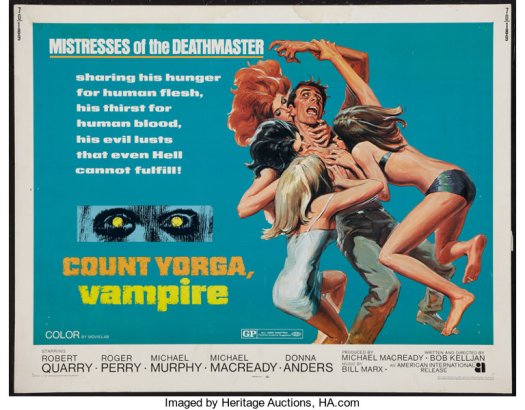
Robert Quarry’s screen career wasn’t really going anywhere by 1970. He had a good part in 1956’s soapy noirA KISS BEFORE DYING , but mostly he was relegated to uncredited bits in movies and guest shots on episodic TV. Quarry kept busy on the stage, until being approached by producer/actor Michael Macready to star in THE LOVES OF COUNT IORGA, originally envisioned as a soft core porn flick with horror elements. The actor said he would accept the job but only if it were turned into a straight modern-day vampire tale, and thus was born COUNT YORGA, VAMPIRE, launching Quarry into a new phase as a 70’s horror movie icon.
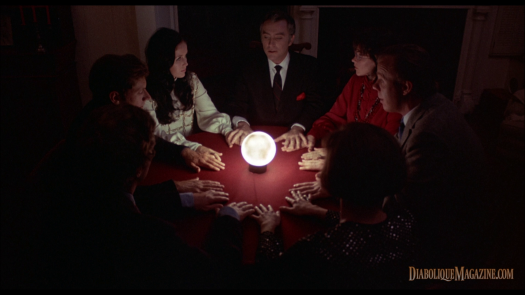
The plot is an updated version of Stoker’s DRACULA, with a few changes. Here, the Bulgarian-born Count Yorga is a recent transplant to California, and we first meet him conducting a séance on behalf of Donna, whose late…
I want to tell you about one of my favorite horror films. It’s a strange one and I think you might like it.
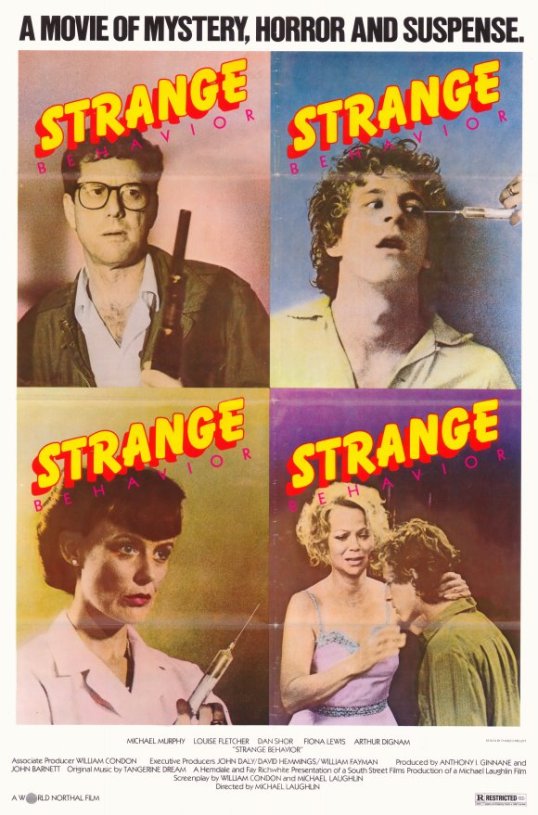
It’s a movie from 1981. It was filmed in New Zealand, even though it takes place in a small town in the American midwest. It was directed by Michael Laughlin and the screenplay was written by Bill Condon, who has since become a director of some note. This was Condon’s first screenplay. In Australia and Europe, this movie is known as Dead Kids. In America, the title was changed to Strange Behavior.
Here, watch the trailer:
It’s a pretty good trailer, actually. That said, as good as the trailer may be, it doesn’t even come close to revealing just what an odd film Strange Behavior actually is. If David Lynch had followed up The Elephant Man by directing a slasher movie, chances are the end result would have looked something like Strange Behavior.
Here’s another scene that I want you watch. It’s kind of a long scene, clocking in at 7 minutes. But I want you to watch it because, in many ways, this scene is the epitome of Strange Behavior:
Strange Behavior is perhaps the only 80s slasher film to feature a totally random and totally choreographed dance number. It comes out of nowhere but, in the world that this film creates, it somehow feels totally appropriate. Of course, the nun is going to announce that she’s not wearing any underwear and then pretend to stab a guy in the back. Of course, the cowboy’s going to throw up and then want to go out to his car with his date. And of course, a bunch of people in costume are going to end up dancing to Lightnin’ Strikes. In Strange Behavior, the strangest behavior is the only behavior that makes sense.
As for the film itself, it’s a mix of small town melodrama, slasher horror, and gentle satire. Teenagers are being murdered by other teenagers and no one is sure why. The chief of police, John Brady (played by character actor Michael Murphy, who gives a quietly authoritative performance that counters some of the weirdness of the rest of the movie), is trying to solve the crimes while trying to cope with the mysterious death of his wife. His son, Pete (Dan Shor), is going to the local college, where classes are taught by a professor (Arthur Dignam) who died years ago but who filmed a few lectures before passing. To make extra money, Pete does what many of the local teenagers do — he volunteers for medical experiments. Researcher Gwen Parkinson (Fiona Lewis) oversees the experiments, handing out pills and occasionally administering a hypodermic needle to the eyes of a test subject. Gwen is always cool, calm, and collected. When one irate father draws a gun on her, Gwen quips, “I can’t stop you. I don’t have a gun.”
But there’s more to this movie than just medical experiments and murder. Strange Behavior is full of wonderfully eccentric supporting characters. Other than John, there’s really nobody normal to be found in either the town or the movie. Pete’s best friend, Oliver (Marc McClure), is cute and dorky. Barbara (Louise Fletcher) just wants to marry John and live in a town where dead bodies don’t turn up in the middle of corn fields, propped up like scarecrows. John’s best friend and fellow cop, Donovan (Charles Lane), has been around forever and has a great, no-nonsense approach to even the strangest of things. When it becomes obvious that John is not going to be able to solve the murders on his own, big city cop Shea (Scott Brady) shows up and wanders ineffectually through the movie, spitting out hard-boiled dialogue like a refugee from a 1930s gangster flick. And finally, receptionist Caroline (Dey Young) sits at her desk in the clinic, gossiping about the patients and smoking cigarette after cigarette. Caroline is probably the smartest person in the movie. As an administrative assistant, I appreciated that.
It’s an odd little movie, which is why I love it. Laughlin, Condon, and the entire cast created a world where everything is just a little off-center. It makes for terrifically entertaining and weird movie, one that works as both satire and straight horror.
Strange Behavior is a film that deserves to much better known than it currently is so my advice is go watch it and then tell you friends to watch it too.




 Through the Shattered Lens