4 Shots From 4 Films is just what it says it is, 4 shots from 4 of our favorite films. As opposed to the reviews and recaps that we usually post, 4 Shots From 4 Films lets the visuals do the talking!
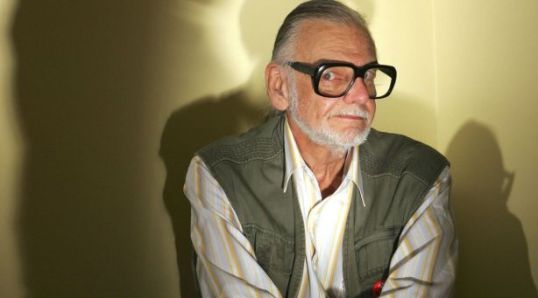
Today would have been George Romero’s 86th birthday.
Now, those of you who have been reading us since the beginning know how important the work of George Romero has been to this site. A mutual appreciation of Night of the Living Dead is one of the things that first brought many of us together. It’s a film that we watch ever Halloween and Arleigh’s review of the original remains one of our most popular posts. If this site had a patron saint, it would probably be George Romero.
And yet, Romero wasn’t just a director of zombie films. He made many films, dealing with everything from hippie lovers (There’s Always Vanilla) to wannabe vampires (Martin) to government conspiracies (The Crazies) and eccentric bikers (Knightriders). George Romero was one of the pioneers of independent films and today, on his birthday, we should all take a minute to consider and appreciate the man’s cinematic legacy. It’s not just horror fans who owe George Romero a debt of gratitude. It’s lovers of cinema everywhere.
With that in mind, here are….
4 Shots From 4 George Romero Films
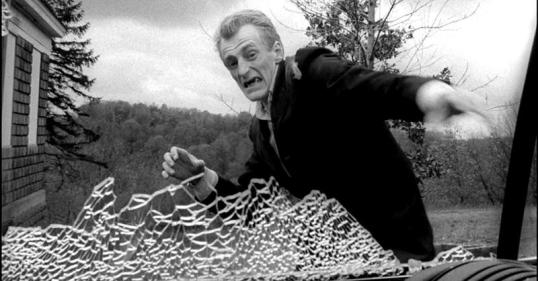
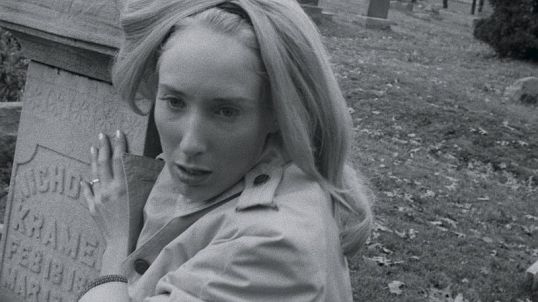
Night of the Living Dead (1968, dir by George Romero, DP: George Romero)
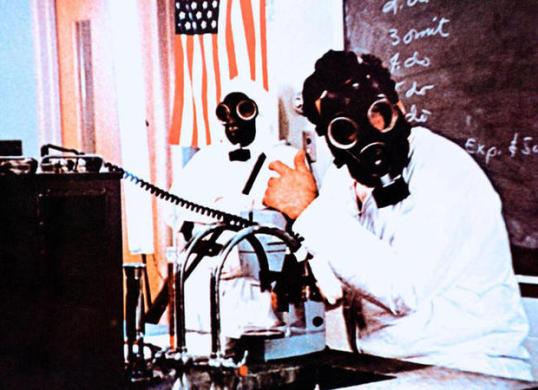
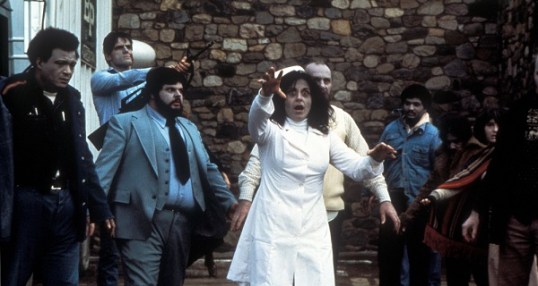
The Crazies (1973, dir by George Romero, DP: S. William Hinzman)
Martin (1978, dir by George Romero, DP: Michael Gornick)
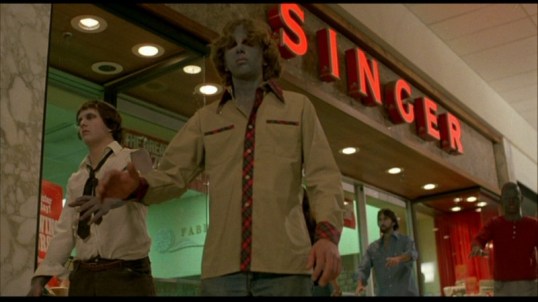
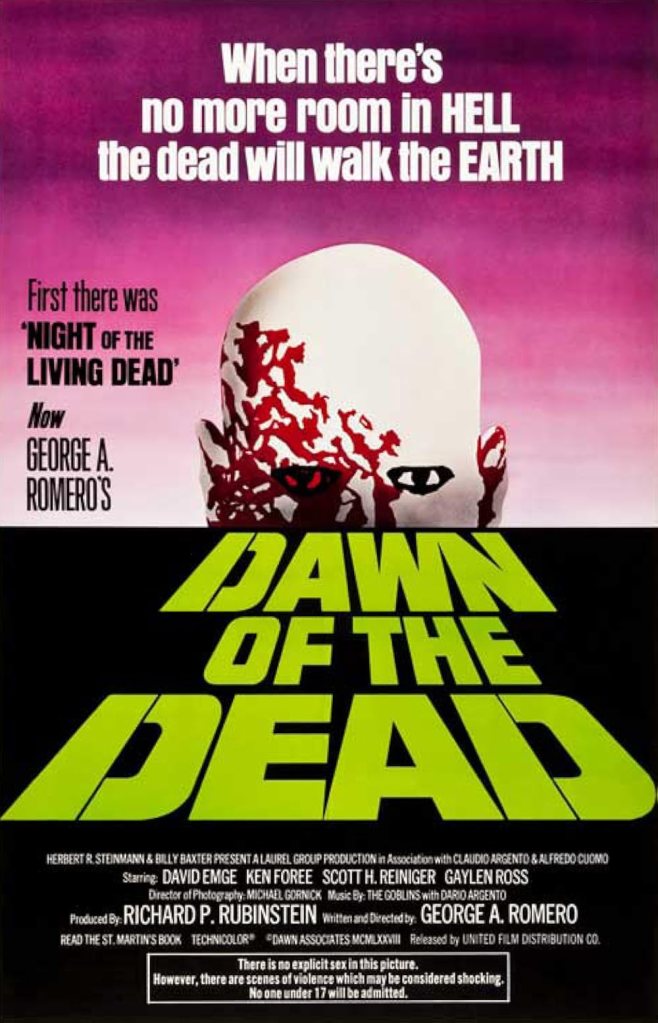
Dawn of the Dead (1978, dir by George Romero, DP: Michael Gornick)
“You want to put some kind of explanation down here before you leave? Here’s one as good as any you’re likely to find. We’re bein’ punished by the Creator…”— John “Flyboy”
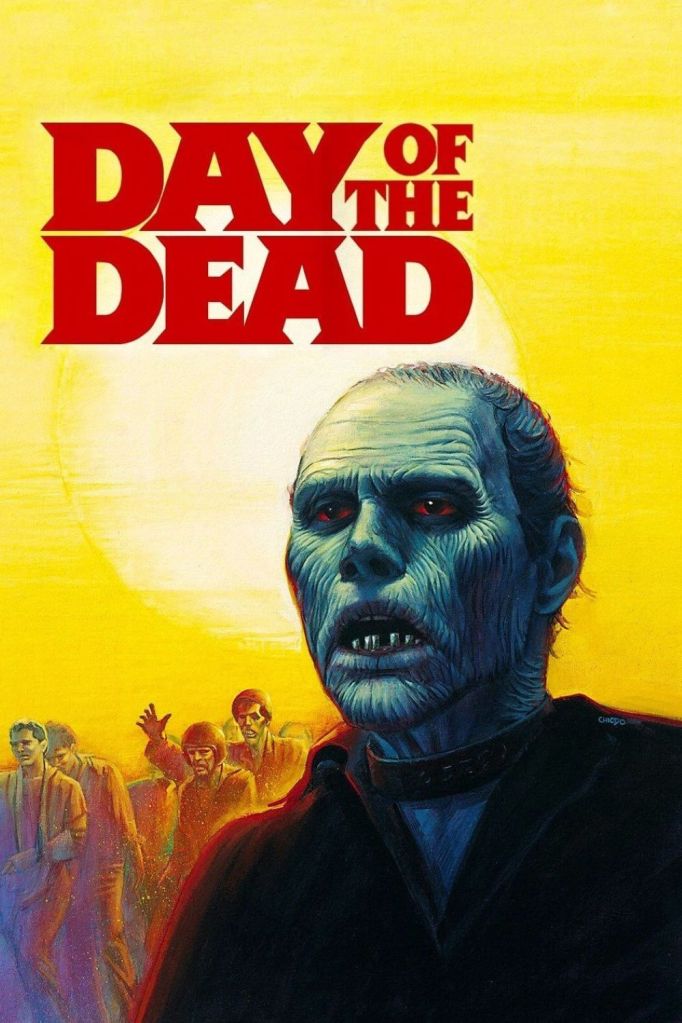
George A. Romero’s 1985 film Day of the Dead stands as an unflinching and deeply cynical meditation on the collapse of society amid a relentless zombie apocalypse, intensifying thematic and narrative complexities first introduced in Night of the Living Dead (1968) and Dawn of the Dead (1978).
Originally, Romero envisioned the film as an epic, describing it as “the Gone with the Wind of zombie films.” His screenplay featured above-ground scenes and a more expansive narrative, but budget cuts halved the original $7 million budget to $3.5 million, forcing a drastic paredown. While much grandiosity was lost, the trimming resulted in a tighter narrative and heightened the nihilistic tone, deepening the film’s focused exploration of humanity’s darkest aspects during apocalypse.
Set after civilization has collapsed, Day of the Dead places viewers in the suffocating confines of a missile silo bunker in Florida, where scientists and soldiers struggle for survival and solutions amid encroaching undead hordes. The claustrophobic atmosphere—born partly from the abandonment of Romero’s broader original sequences—intensifies the tension between the hopeful scientific pursuit of salvation and the harsh pragmatism of military authority. These competing ideologies escalate into authoritarian violence, embodying the fractured microcosm of a dying society.
Within this claustrophobic world, a third group—composed of characters Flyboy and McDermott—emerges as a stand-in for the rest of humanity. They observe the scientists and soldiers—institutions historically symbols of security and innovation—but witness how these deeply entrenched ways of thinking only exacerbate problems instead of solving them. This third faction characterizes humanity caught between rigid orders and doomed pursuits, reflecting Romero’s broader commentary on societal stagnation and fragmentation.
Central to this conflict are Dr. Logan, or “Frankenstein,” a scientist obsessed with controlling the undead through experimentation, and Captain Rhodes, the hardened soldier who believes survival demands ruthless control.
Logan’s controversial research seeks to domesticate and condition zombies, notably through his most celebrated subject, Bub—the undead zombie capable of rudimentary recognition and emotion—challenging assumptions about humanity and monstrosity.
Here the film benefits greatly from the extraordinary practical effects work of Tom Savini, whose contributions on Day of the Dead are widely considered his magnum opus. Savini’s makeup and gore effects remain unsurpassed in zombie cinema, continually influencing horror visuals to this day. Drawing from his experience as a combat photographer in Vietnam, Savini brought visceral realism to every decomposed corpse and violent injury. The close-quarters zombie encounters showcase meticulous practical work—detailed wounds, biting, and dismemberment—rendered with stunning anatomical authenticity that predates CGI dominance.
Bub, also a masterclass in makeup and animatronics, embodies this fusion of horror and humanity with lifelike textures and movements that blur the line between corpse and creature, rendering the undead terrifyingly believable.
The film captures the growing paranoia and cruelty as resources dwindle—food, ammunition, and medical supplies—and the fragile social order begins to shatter. The characters’ mounting desperation illustrates Romero’s thesis that humanity’s real enemy may be its own incapacity for cooperation.
The moral and social decay is vividly portrayed through characters like Miguel, whose mental breakdown sets destructive events in motion, and Rhodes, whose authoritarian survivalism fractures alliances and moral compass alike. Logan’s cold detachment and experiments push ethical boundaries in a world on the brink.
Romero’s direction combines claustrophobic dread with stark psychological terror, further amplified by Savini’s effects. The cinematography’s low lighting and tight framing create an oppressive environment, while graphic violence underscores a world irrevocably broken. The unsettling sound design—moans, silences, sudden outbreaks—immerses viewers in a relentless atmosphere of decay and fear.
Romero described Day of the Dead as a tragedy about how lack of human communication causes chaos and collapse even in this small slice of society. The dysfunction—soldiers and scientists talking past each other, eroding trust, spirals of paranoia—serves as a bleak allegory for 1980s America’s political and cultural fragmentation. Failed teamwork, mental health crises, and fatal miscommunication thrive as the bunker metaphorically becomes a prison of fractured humanity.
Though not as commercially successful as its predecessors, Day of the Dead remains the bleakest and most nihilistic entry in Romero’s Dead series. Its overall grim tone, combined with mostly unlikable characters, establishes it as the most desolate and truly apocalyptic film of the series. The characters often appear fractured, neurotic, and unable to escape their own destructive tendencies, making the story’s world feel even more hopeless and devastating.
Far beyond a simple gore fest, Day of the Dead serves as a profound social critique infused with psychological depth. It explores fear, isolation, authority abuse, and the ethical limits of science, reflecting enduring anxieties about society and survival. The film’s unsettling portrayal of humanity’s failings, embodied in broken relationships and moral decay, presents a harsh reckoning with what it means to be human when humanity itself is the ultimate threat to its own existence. This thematic complexity, combined with Romero’s unyielding vision and Savini’s unparalleled effects, crafts a chilling and unforgettable cinematic experience.
“When the dead walk, señores, we must stop the killing… or lose the war.”
In 1968, horror cinema was irrevocably changed by the emergence of George A. Romero’s vision, signaling the beginning of a transformative era for the genre. Romero, who had spent much of his early career making industrial and educational films, shifted gears dramatically by crafting Night of the Living Dead, an independent film that did more than just scare audiences—it shattered the conventions of horror. This was a film that rejected the glossy, Gothic monsters of studios like Universal and Hammer, replacing them with raw, unvarnished depictions of human decay and social collapse. The fear Romero invoked was no longer supernatural; it was born from human frailty and social upheaval.
Night of the Living Dead introduced audiences to an entirely new kind of monster: the zombie, not as a mystical or alien infection, but as the reanimated corpse of an ordinary person. This change was more than cosmetic. It shifted the source of horror from “the other” to a reflection of ourselves. Death itself had become weaponized, turning friend into foe in the most visceral way imaginable. The infection was no longer a far-off fantasy but an internal threat. Although the word “zombie” was scarcely spoken in Romero’s first three Dead films, the concept solidified into the cultural lexicon, haunting audiences with the idea that anyone—even the people closest to us—could become the enemy.
Despite the landmark impact of Night of the Living Dead, it would take a decade before Romero was able to produce its sequel. The first film’s shocking violence and disturbing social commentary made Hollywood studios wary of financing a continuation. However, a breakthrough came when Italian horror maestro Dario Argento learned of Romero’s plans and offered to co-finance Dawn of the Dead under the condition that he would receive European distribution rights and be allowed to edit a version for his audience. This international collaboration proved pivotal, allowing Romero to create what many consider not just a sequel but a towering masterpiece of horror cinema.
Released in 1978, Dawn of the Dead solidified Romero’s reputation as a visionary filmmaker willing to confront uncomfortable truths. The Motion Picture Association of America refused the film an R-rating due to its graphic content, and Romero opted to release it unrated to avoid association with the X-rating, which was then primarily linked to pornography. While this restricted the number of theaters willing to show the film, it did not hinder its success. The movie drew large audiences hungry for a horror story that dared to depict society’s unraveling with brutal honesty.
From its opening, Dawn of the Dead confronts viewers with the chaos midst societal collapse rather than building toward it. Traditional authority figures—news anchors, government officials, police—are portrayed as overwhelmed, often ineffective, and sometimes themselves sources of danger. The film’s opening sequence, set inside a frenzied television newsroom, captures this chaos vividly; reporters and producers struggle to maintain composure while the world outside falls apart. This scene encapsulates one of Romero’s central themes: the erosion of trust in institutions during extreme crisis. As media credibility falters, survivors are left in an informational vacuum, further imperiling their ability to cooperate or find sanctuary. This mistrust resonates strongly today, echoing recent real-world crises where institutional failure has worsened public panic and political division.
A critical early sequence—the tenement raid—brilliantly illustrates the film’s social complexity. The conflict here stems not only from the undead but from a clash of cultures: the low-income inhabitants hold tightly to their traditions, especially the respect and mourning of their dead, while the government, scientists, and law enforcement—detached “outsiders”—seek to destroy the infected bodies coldly as threats. This refusal to recognize the residents’ humanity and cultural practices sparks a brutal firefight, symbolizing the broader breakdown of social cohesion. Romero uses this conflict to show that the apocalypse is fueled as much by misunderstandings and institutional coldness as by the undead threat itself.
Within this crumbling world, the film centers on four survivors who become our guides through Romero’s apocalyptic landscape: Roger (Scott Reiniger) and Peter (Ken Foree), two disillusioned Philadelphia SWAT officers who desert after that violent raid; Stephen (David Emge), a helicopter pilot; and Fran (Gaylen Ross), a television producer. These characters represent the fractured remnants of a society that once clung to institutions but is now adrift. Their escape from Philadelphia aboard a stolen news helicopter is less a triumphant flight than a retreat into uncertainty.
Their destination is a suburban shopping mall near Monroeville, Pennsylvania. The mall, abandoned but intact, quickly becomes their fortress. Clearing out the zombies inside and barricading the doors seems like a triumph—an oasis amid apocalypse. The survivors revel in a surreal form of luxury that stands in stark contrast to the danger outside. For a time, they indulge in consumer comforts previously unattainable: fine clothes, gourmet food, and even jewelry. This phase is both a coping mechanism and a critique. Romero uses the mall setting as a dark mirror to American consumer culture. The shoppers turned zombies wander these halls as if drawn by habit, herding toward the very symbols of consumption that once defined the pre-apocalyptic world.
Romero’s critique extends beyond consumerism run amok; he exposes consumerism itself as a new religion for America. In the 1970s, as economic and social uncertainties shook the nation, megamalls emerged as the new temples of worship where consumer habits became ritualistic acts of devotion. The film’s setting drives home this analogy—the mall is not simply a marketplace but a sacred space where the rituals of buying and consuming provide meaning and identity. The zombies’ relentless, automatic wandering through the mall’s stores reflects a zombified devotion to these rituals, implying that consumerism has replaced spiritual and community values, offering hollow salvation in its place.
This portrayal is not accidental but deliberately satirical. The mall is a gilded cage, symbolizing consumerism’s dominance over American identity. Even in the apocalypse, the survivors replicate the rituals of capitalism, clinging to items of superficial value and meaning. The zombies’ mindless shuffling through stores like Woolworth’s and the food court underscores this grotesque cycle. Romero’s message is sharp: consumerism is a kind of death, a trance that distracts from and perhaps accelerates societal decay. The film implies that in America, the line between life and death blurs within the walls of the shopping mall because it is there that life’s priorities have long been warped.
While consumerism forms a visible backdrop, Dawn of the Dead probes deeper, exposing a darker undercurrent: humanity’s inherent violent nature as the real engine of destruction. The undead are monstrous and fearful, but they lack the complexity and self-destructiveness of the living. Throughout the film, Romero presents violence not as a rare failing but as a baseline condition of human behavior. The survivors themselves struggle to suppress impulses of aggression, paranoia, and selfishness that grow more toxic over time.
Roger’s reckless bravado during their clearing of the mall leads to a fatal bite from a zombie, making his death a metaphor for the cost of unchecked aggression. The living kill as readily as the dead, but with purpose and calculation that is often more destructive. The raiding biker gang that ultimately invades the mall appears as a harsh symbol of this self-inflicted violence. Unlike the zombies, whose threat is instinctive, the bikers wield cruelty consciously, plundering and destroying the survivors’ fragile sanctuary. Their incursion shatters any illusion of security and exposes the futility of individualistic survival strategies when cooperation is absent.
The unraveling of the survivors’ cohesion over the course of the film underscores one of Romero’s most bleak insights: humanity’s greatest enemy is itself. Even small groups that depend on trust and unity quickly fragment amid fear and scarcity. Despite the severity of their predicament, the four protagonists are often consumed by petty grievances, distrust, and self-preservation. Romero suggests that unless cooperation becomes a collective imperative, survival is impossible. The dead multiply endlessly, but it is the living who ensure society’s demise by turning against each other first.
Romero’s Dawn of the Dead also marks the cinematic arrival of Tom Savini, whose pioneering make-up effects would forever transform horror filmmaking. Savini and members of his team not only crafted many of the film’s grisly effects but also played some of the biker gang antagonists, blending artistry and performance. While the gore in Dawn can appear somewhat garish or cartoony on film, largely due to lighting effects and the practical limits of makeup technology at the time, Savini’s work set the standard for modern horror effects. His techniques and vision became the bedrock of the gore genre, influencing decades of horror cinema thereafter. His legacy continued as he later directed the 1990 remake of Night of the Living Dead, bringing Romero’s seminal vision to a new generation with his signature effects sensibility.
Ken Foree’s portrayal of Peter anchors the film emotionally; his performance balances toughness with vulnerability, capturing a man grappling with the collapse of law and societal norms while striving to retain his humanity. Scott Reiniger’s Roger provides a volatile contrast—impulsive, reckless, and ultimately tragic—as his aggression leads directly to his downfall. David Emge’s Stephen and Gaylen Ross’ Fran round out the core survivors, expressing pragmatism, grief, and the desperate need for connection as their world crumbles. Their dynamic interactions highlight Romero’s warning: human connection in times of extremity is fragile and fraught, undermined by fear and mistrust.
Romero’s expert use of sound and music further elevates the film. The eerie muzak playing through the mall’s PA system contrasts sharply with the groans of the undead and sudden bursts of violence, creating a haunting dissonance between normalcy and chaos. This effective sound design emphasizes the thematic conflict between consumerist detachment and encroaching apocalypse.
Beyond its horror, Dawn of the Dead serves as a time capsule of late-1970s American socio-political anxieties. America was reeling from the disillusionment of Vietnam, shaken by the Watergate scandal, and grappling with urban decay and economic malaise. The film vividly captures this zeitgeist: a society where institutions are distrusted, violence is normalized, and consumerism both numbs and destroys. Romero’s criticism extends to Cold War paranoia, reflected in his depiction of apocalypse not as a sudden cataclysmic event but a slow, grinding decline fueled by human self-destruction.
Romero’s directing style—unpolished at times but unflinching—adds authenticity to the film’s grim message. His use of long takes, handheld camera work, and naturalistic performances grounds the supernatural in the everyday, making the horror tangible. The bleak humor sprinkled throughout, such as the zombies’ fascination with the mall’s siren and muzak, darkens the tragedy with satirical bite.
Dawn of the Dead does not offer easy hope. Its ending—marked by betrayal, destruction, and resignation—echoes Romero’s worldview: humanity’s baser instincts, left unchecked, will always undermine salvation. Yet, in this stark vision lies an ironic beauty: survival is not only about killing or hiding but the recognition of our shared flaws and the possibility, however slim, of striving beyond them.
In conclusion, Dawn of the Dead remains a masterpiece of horror, combining groundbreaking practical effects, compelling performances, and incisive social commentary to create a film that is as relevant today as it was nearly fifty years ago. Romero’s work challenges viewers to confront the monsters within us all and questions whether human nature’s violent and consumerist impulses might prove more lethal than any undead army. Its enduring legacy lies not just in its scares but in its profound understanding of societal collapse and the fragile bonds that sustain civilization.
4 Or More Shots From 4 Or More Films is just what it says it is, 4 shots from 4 of our favorite films. As opposed to the reviews and recaps that we usually post, 4 Shots From 4 Films lets the visuals do the talking!
Tomorrow will be the birthday of Stephen King. Normally, we honor folks on their birthday but tomorrow is also Bill Murray’s birthday so we’re going to honor King now.
In others words, it’s time for….
4 Shots from 4 Stephen King Films
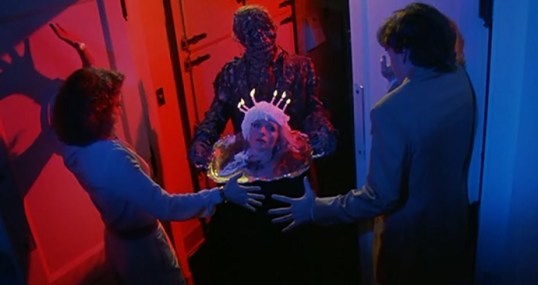
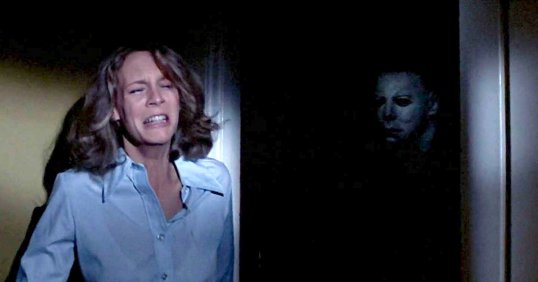
Creepshow (1982, dir by George Romero, written by Stephen King, DP: Michael Gornick)
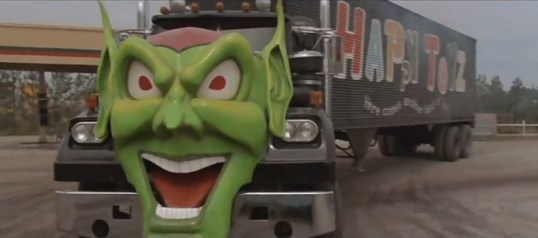
Maximum Overdrive (1986, dir by Stephen King, written by Stephen King, DP: Armando Nannuzzi)
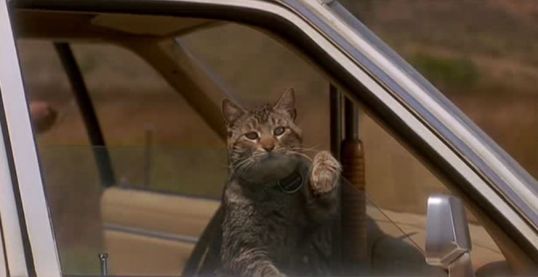
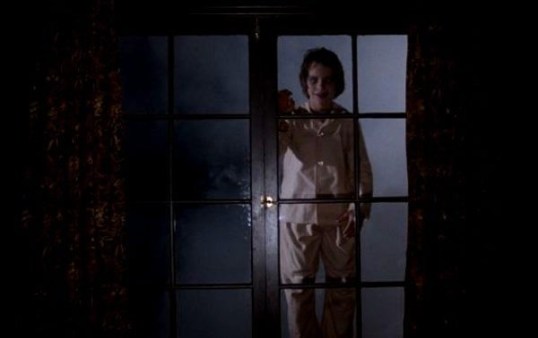
Sleepwalkers (1992, dir by Mick Garris, written by Stephen King, DP: Rodney Charters)
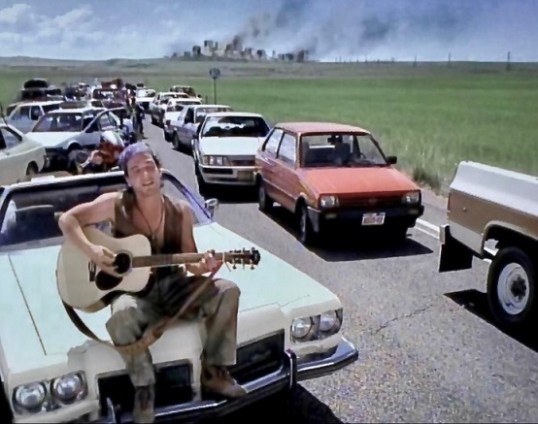
The Stand (1994, dir by Mick Garris, written by Stephen King, DP: Edward J. Pei)
4 Or More Shots From 4 Or More Films is just what it says it is, 4 shots from 4 of our favorite films. As opposed to the reviews and recaps that we usually post, 4 Shots From 4 Films lets the visuals do the talking!
Today, we pay tribute to the year 1978! It’s time for….
4 Shots From 4 1978 Films
Halloween (1978, dir by John Carpenter, DP: Dean Cudney)
Dawn of the Dead (1978, dir by George Romero, DP: Michael Gornick)
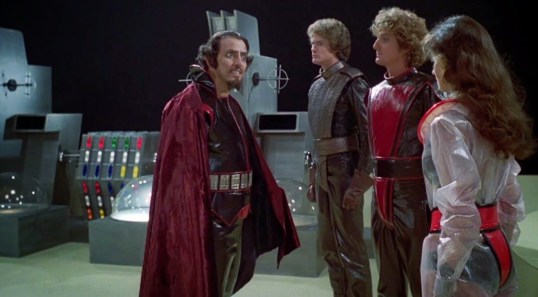
Starcrash (1978, dir by Luigi Cozzi, DP: Paul Beeson and Roberto D’Ettorre Piazzoli)
Salem’s Lot (1978, dir by Tobe Hooper, DP: Jules Bremmer)
4 Shots From 4 Films is just what it says it is, 4 shots from 4 of our favorite films. As opposed to the reviews and recaps that we usually post, 4 Shots From 4 Films is all about letting the visuals do the talking.
Today’s director is one of the most important names in the history of American horror cinema, George Romero!
4 Shots From 4 George Romero Films
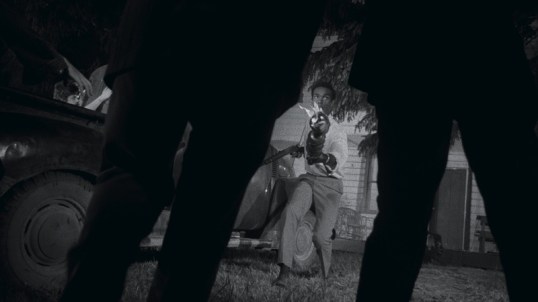
Night of the Living Dead (1968, dir by George Romero, DP: George Romero)
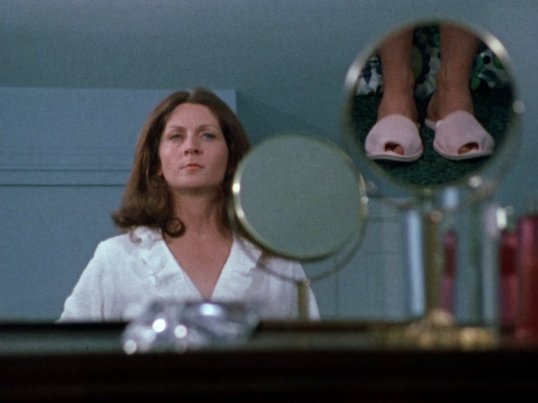
Season of the Witch (1973, dir by George Romero, DP: George Romero)
Dawn of the Dead (1978, dir by George Romero, DP: Michael Gornick)
Creepshow (1982, dir by George Romero, written by Stephen King, DP: Michael Gornick)
4 Shots From 4 Films is just what it says it is, 4 shots from 4 of our favorite films. As opposed to the reviews and recaps that we usually post, 4 Shots From 4 Films is all about letting the visuals do the talking.
This October, I am going to be using our 4 Shots From 4 Films feature to pay tribute to some of my favorite horror directors, in alphabetical order! That’s right, we’re going from Argento to Zombie in one month!
Today’s director is one of the most important names in the history of American horror cinema, George Romero!
4 Shots From 4 George Romero Films
Night of the Living Dead (1968, dir by George Romero)
Dawn of the Dead (1978, dir by George Romero, DP: Michael Gornick)
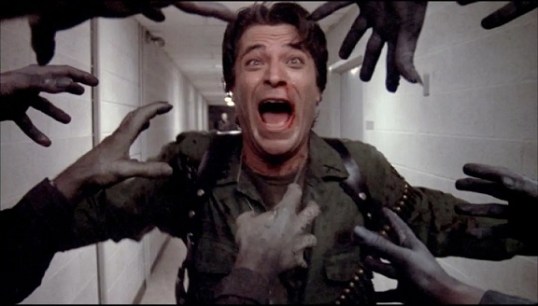
Day of the Dead (1985, dir by George Romero, DP: Michael Gornick)
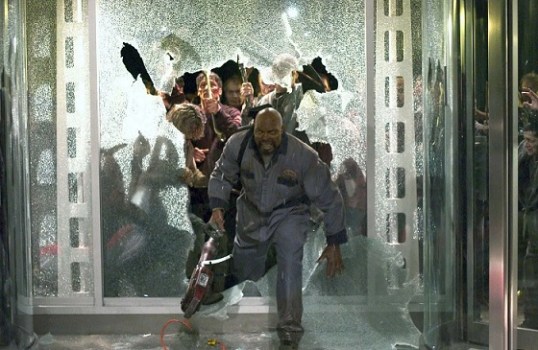
Land of the Dead (2005, dir by George Romero, DP: Miroslaw Baszak)
Welcome to Late Night Retro Television Reviews, a feature where we review some of our favorite and least favorite shows of the past! On Wednesdays, I will be reviewing Monsters, which aired in syndication from 1988 to 1991. The entire show is streaming on Youtube.
This week, Monsters features a vampire! Yay! I usually love a good vampire story.
Episode 1.4 “The Vampire Hunter”
(Dir by Michael Gornick, originally aired on November 12th, 1988)
The fourth episode of Monsters opens in New England, towards the end of the 19th century. Ernest Chariot (Robert Lansing) is a veteran vampire hunter who is planning on hanging up his crucifix and his stake so he can concentrate on flirting with the women who come to him searching for answers about the paranormal. He even tells his young assistant, Jack (Jack Koening), that is planning on heading over to Austria so he can meet with Sigmund Freud and talk about dream interpretation with him. Interestingly enough, it appears that Ernest doesn’t really believe in anything paranormal, outside of vampires. Myself, I think if I ever saw proof that vampires existed, I would probably accept that anything could exist. I mean, it’d be strange for it just be vampires.
Before he can retire, Ernest does have one last job to complete. Ms. Warren (Page Hannah) claims that her brother has been acting strangely, as if he’s been bitten by a vampire. Ernest is skeptical of Ms. Warren’s claims and decides to take a trip to Ms. Warren’s hometown so that he can investigate her background before he agrees to help her. The far more naïve Jack, however, goes with Ms. Warren back to her home.
It turns out that Ernest was right to be suspicious because Ms. Warren is the reluctant servant of Charles Poole (John Bolger), a vampire who wears a blue mask because of a facial injury that was inflicted upon him by Ernest in the past. Jack holds Ernest off with a crucifix but, after he loses that, he soon discovers that it’s not as easy to stake a vampire as he thought.
Ernest returns to his office from investigating Ms. Warren’s background, saying that it required him to work in cotton mill. His housekeeper tells him that Jack left with Ms. Warren. A panicked Ernest goes to Ms. Warren’s home where he finds Jack in a coffin and Charles Poole eager for a final battle….
And that’s pretty much it. This was a really weird episode, largely because there wasn’t even an attempt at a clever twist at the end or anything like that. Instead, it was just a straight-forward story of an old vampire hunter coming face-to-face with a vampire. In the end, Ms. Warren chooses to help Ernest instead of Charles. The good guys win and the final credits role. It’s all very earnest and, again, straight-forward. At the same time, it’s also not that interesting. It feels like a scene from a bigger story and, when viewed outside of the context of that bigger story, it lacks the type of emotional depth necessary to really hold the viewer’s attention.
It’s a shame. I usually love a good vampire story! Unfortunately, this isn’t one. Oh well.
Welcome to Late Night Retro Television Reviews, a feature where we review some of our favorite and least favorite shows of the past! On Wednesdays, I will be reviewing Monsters, which aired in syndication from 1988 to 1991. The entire show is streaming on Youtube.
Monsters was an anthology series that ran, in syndication, from 1988 to 1991. It was produced by Richard Rubinstein and Mitchell Galin, who had previously produced another anthology series called Tales From The Darkside. Monsters, unlike Tales, almost exclusively focused horror stories and, as the title suggests, each story featured at least one monster. As well, each episode opened with a family of monsters sitting around a television and looking for something to watch.
Sounds like fun! I’m looking forward to watching and reviewing this series for Through the Shattered Lens.
Episode 1.1 “The Feverman”
(Dir by Michal Gornick, originally aired on October 22nd, 1988)
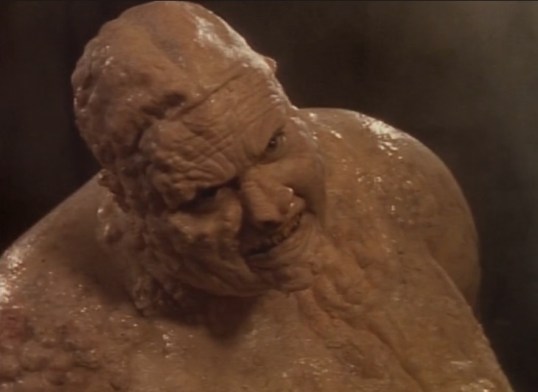
Timothy Mason (John C. Vennema) is in a panic because his daughter (Michele Gornick) has a contracted a fever and is now on the verge of death. When Mason’s friend, Dr. James Burke (Patrick Garner), is unable to lower the girl’s fever, Mason decides to take her to see the Boyle (David McCallum), the feverman. A disreputable fellow who is never seen without a glass of liquor in his hand and a dingy crystal hanging out around his neck, Boyle claims that he can pull fevers out of those suffering. He charges a good deal of money for his services but he also claims that, unlike the doctors of the world, he’s never lost a patient. Indeed, Boyle claims that, if anyone brought to him died, he would die as well.
Burke goes with Mason to Boyle’s house and, when Boyle announces that he must be alone with Mason’s daughter in order to cure her, Burke denounces him as being a charlatan. Still, Mason agrees to leave his daughter alone with Boyle in Boyle’s basement. However, as Burke and Mason wait for Boyle to return from the basement, they grow impatient and Burke pressures Mason to disobey Boyle’s orders. Finally, Burke and Mason head into the basement and that’s where they catch Boyle wrestling with this thing….
It turns out that Boyle wasn’t lying when he said that he could literally bring the fever out of a patient. However, when Burke and Mason interrupt him, that allows the fever monster to once again reenter Mason’s daughter. The crystal necklace falls off Boyle’s neck. Boyle explains to Burke that he is now dying and he can no longer fight the fever. And, because it’s all Burke’s fault, it is now Burke’s obligation to wear the crystal and battle the fever.
Realizing that he’s at fault, Burke puts on the crystal and he wrestles with the fever monster. Burke manages to destroy the monster but, afterwards, he discovers that he cannot take the crystal off. As Boyle explains it, Burke is the new feverman and he will now wear the crystal until the day he dies. Mason, happy that his daughter is now cured, still refuses to stick around to talk to Burke afterwards. Burke is now an outsider. Resigned to his fate, Burke starts drinking and prepares to meet his next patient.
This was an effective episode, featuring a wonderfully dissolute performance from David McCallum as Boyle and plenty of grimy atmosphere. Maybe it’s just because I’m still getting over having the flu last week but the fever monster totally freaked me out. I imagine that creature probably is what a fever really would look like. This episode was the exact right way to start things off for Monsters!
4 Shots From 4 Films is just what it says it is, 4 shots from 4 of our favorite films. As opposed to the reviews and recaps that we usually post, 4 Shots From 4 Films lets the visuals do the talking!
Today would have been George Romero’s 83rd birthday.
Now, those of you who have been reading us since the beginning know how important the work of George Romero has been to this site. A mutual appreciation of Night of the Living Dead is one of the things that first brought many of us together. It’s a film that we watch ever Halloween and Arleigh’s review of the original remains one of our most popular posts. If this site had a patron saint, it would probably be George Romero.
And yet, Romero wasn’t just a director of zombie films. He made many films, dealing with everything from hippie lovers (There’s Always Vanilla) to wannabe vampires (Martin) to government conspiracies (The Crazies) and eccentric bikers (Knightriders). George Romero was one of the pioneers of independent films and today, on his birthday, we should all take a minute to consider and appreciate the man’s cinematic legacy. It’s not just horror fans who owe George Romero a debt of gratitude. It’s lovers of cinema everywhere.
With that in mind, here are….
4 Shots From 4 George Romero Films
Night of the Living Dead (1968, dir by George Romero, DP: George Romero)
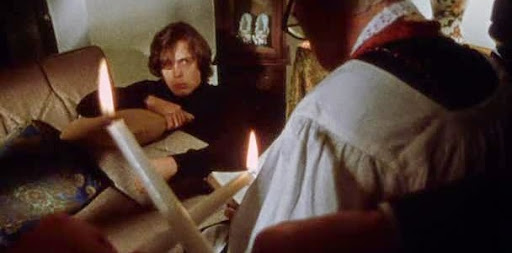
Season of the Witch (1973, dir by George Romero, DP: George Romero)
Creepshow (1982, dir by George Romero, DP: Michael Gornick)
The Dark Half (1993, dir by George Romero, DP: Tony Pierce-Roberts)
 Through the Shattered Lens