The TSL Horror Grindhouse: The Dunwich Horror (dir by Daniel Haller)


Look at me/I’m Sandra Dee….

First released in the groovy and psychedelic year of 1970, The Dunwich Horror stars Sandra Dee as Nancy, an somewhat innocent grad student at Massachusetts’s Miskatonic University.  When the mysterious Wilbur Wheatley (Dean Stockwell) comes to the university and asks to take a look at a very rare book called The Necronomicon, Nancy agrees.  She does so even though there’s only one edition of The Necronomicon in existence and it’s supposed to be protected at all costs.  Maybe it’s Wilbur’s hypnotic eyes that convince Nancy to allow him to see and manhandle the book.  Prof. Henry Armitage (Ed Begley) is not happy to see Wilbur reading the book and he warns Nancy that the Wheatleys are no good.

Nancy still agrees to give Wilbur a ride back to his hometown of Dunwich.  She finds herself enchanted by the mysterious Wilbur and she’s intrigued as to why so many people in the town seem to hate Wilbur and his father (Sam Jaffe).  Soon, she is staying at Wilbur’s mansion and has apparently forgotten about actually returning to Miskatonic.  She has fallen under Wilbur’s spell and it soon becomes clear that Wilbur has sinister plans of his own.  It’s time to start chanting about the Old Ones and the eldritch powers while naked cultists run along the beach and Nancy writhes on an altar.  We are in Lovecraft county!

Actually, it’s tempting to wonder just how exactly H.P. Lovecraft would have felt about this adaptation of his short story.  On the one hand, it captures the chilly New England atmosphere of Lovecraft’s work and it features references to such Lovecraft mainstays as Miskatonic University, the Necronomicon, and the Old Ones.  As was often the case with Lovecraft’s stories, the main characters are students and academics.  At the same time, this is very much a film of the late 60s/early 70s.  That means that there are random naked hippies, odd camera angles, and frequent use of the zoom lens.  The film makes frequent use of solarization and other psychedelic effects that were all the rage in 1970.  Lovecraft may have been an unconventional thinker but I’m still not sure he would have appreciated seeing his fearsome cult transformed into a bunch of body-painting hippies.

Really, the true pleasure of The Dunwich Horror is watching a very earnest Sandra Dee act opposite a very stoned Dean Stockwell.  Stockwell was a charter member of the Hollywood counterculture, a friend of Dennis Hopper’s who had gone from being a top Hollywood child actor to playing hippie gurus in numerous AIP films.  As for Sandra Dee, one gets the feeling that this film was an attempt to change her square image.  When Wilbur tells Nancy that her nightmares sound like they’re sexual in origin and then explores her feelings about sex, Nancy replies, “I like sex,” and it’s obviously meant to be a moment that will make the audience say, “Hey, she’s one of us!”  But Sandra Dee delivers the line so hesitantly that it actually has the opposite effect.  Stockwell rather smoothely slips into the role of the eccentric Wilbur.  Wilbur is meant to be an outsider and one gets the feeling that’s how Stockwell viewed himself in 1970.  Sandra Dee, meanwhile, seems to be trying really hard to convince the viewer that she’s not the same actress who played Gidget and starred in A Summer Place, even though she clearly is.  It creates an oddly fascinating chemistry between the two of them.  Evil Wilbur actually comes across as being more honest than virtuous Nancy.

Executive produced by Roger Corman, The Dunwich Horror is an undeniably campy film but, if you’re a fan of the early 70s grindhouse and drive-in scene, it’s just silly enough to be entertaining.  Even when the film itself descends into nonsense, Stockwell’s bizarre charisma keeps things watchable and there are a few memorable supporting performances.  (Talia Shire has a small but memorable roll as a nurse.)  It’s a film that stays true to the spirit of Lovecraft, despite all of the hippies.

Retro Television Review: If Tomorrow Comes (dir by George McCowan)


Welcome to Retro Television Reviews, a feature where we review some of our favorite and least favorite shows of the past!  On Sundays, I will be reviewing the made-for-television movies that used to be a primetime mainstay.  Today’s film is 1971’s If Tomorrow Comes!  It  can be viewed on YouTube.

If Tomorrow Comes tells the story of a forbidden marriage.

In 1941, Eileen Phillips (Patty Duke) meets David Tayanaka (Frank Liu) and the two of them quickly fall in love.  David asks Eileen to marry him and Eileen says yes, even though they both know that it won’t be easy.  Eileen’s father (James Whitmore) and her brother, Harlan (Michael McGreevey), are both prejudiced against the Japanese and David’s parents (played by Mako and Buelah Quo) would both rather than David marry someone of Japanese descent.  Eileen and David decide to elope first and tell their parents afterwards.

On December 7th, Eileen sneaks out of the house and joins David at his church.  They are married by Father Miller (John McLiam), who agrees to keep their secret.  Eileen and David then drive over to the church attended by Eileen’s family but no sooner have they arrived than the local sheriff (Pat Hingle) pulls up and announces that the Japanese have bombed Pearl Harbor.  The sheriff instructs everyone to return home and to listen to their radios.  David slips his wedding ring off his finger.  Telling the parents will have to wait.

Eileen’s father and brother are convinced that every Japanese person in town, even though the majority of them were born in America and have never even been to Japan, is a subversive.  David and his family are harassed by government agents like the oily Coslow (Bert Remsen).  One morning, they discover that all of their farm animals have been killed and someone has written “REMEMBER PEARL HARBOR” with their blood.  When Franklin D. Roosevelt orders the internment of the Japanese, David’s father is among those taken away.  When Harlan continues to harass David, it eventually leads to not just one but two tragedies.

If Tomorrow Comes is a real tear-jerker, one that features a great performance from Frank Liu and a good one from Patty Duke.  Though it may seem a tad implausible that David and Eileen would get married just an hour before Japan attacked Pearl Harbor (and considering the attack occurred on a Sunday morning, I’m a little curious how they found a priest who was free to secretly marry them), the film does a good job of showing how fear can lead to otherwise good people doing terrible things.  One of the film’s strongest moments comes as David’s father is taken away to an internment camp and the Japanese prisoners try to prove their loyalty by spontaneously singing America, The Beautiful.  It’s a moment that reminds us of the danger of letting our fear destroy our humanity.

It’s a film that still feels relevant today, with its portrayal of heavy-handed government agents searching for subversives and ignoring the Constitution in order to save it.  When David visited his father at the internment camp, I thought about how, at the heigh of the COVID pandemic, it was not unusual to see people demanding that the unmasked and the unvaccinated by interned away from the rest of the world.  If Tomorrow Comes is a love story and a melodrama and tear-jerker but, above all else, it’s a warning about the destructive power of fear and prejudice.

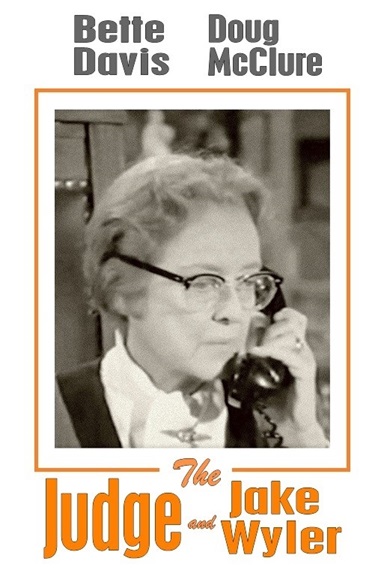
Retro Television Review: The Judge and Jake Wyler (dir by David Lowell Rich)


Welcome to Retro Television Reviews, a feature where we review some of our favorite and least favorite shows of the past!  On Sundays, I will be reviewing the made-for-television movies that used to be a primetime mainstay.  Today’s film is 1972’s The Judge and Jake Wyler!  It  can be viewed on YouTube.

Judge Meredith (Bette Davis) is a retired criminal court judge who has developed a severe case of hypochondria.  She lives in a mansion that she never leaves.  Anyone who comes to see her must be personally vacuumed by her butler before they can be allowed to stand in her presence.  She hates people who take too long to get to the point and she also has little use for people who are rude on the phone.  She especially dislikes cigarettes and refuses to have even an unlit one in her presence.

Jake Wyler (Doug McClure) is an ex-con who is currently on supervised probation.  Despite his criminal past, he’s a likable and amiable guy and, every morning, he wakes up with a new woman in his bed.  Jake enjoys tweaking authority and he always has a pack of cigarettes on him somewhere.

Together, they solve crimes!

They actually do!  The judge is dealing with retirement by running her own detective agency, one that is exclusively staffed by people that she previously sentenced to prison.  Jake does most of the leg work as far as the agency is concerned.  The Judge calls him every morning and demands to know why he’s not working harder.  Jake would rather just sleep-in but working for the judge is a part of his parole.  She could easily send him and everyone else working for her back to prison.  This sounds like a pretty unfair situation to me and the Judge is so demanding that I think it could be argued that she’s an abusive boss.  But, because this is a pilot for a TV show and the Judge is played by Bette Davis, everyone is very loyal to her.

At the start of the film, Jake reveals to Robert Dodd (Kent Smith) that his wife, Caroline (Lisabeth Hush), has been cheating on him with Frank Morrison (Gary Conway).  When Robert is later found dead in a hospital room, the official verdict is that he committed suicide.  However, his daughter, Alicia (Joan Van Ark), claims that her father was murdered.  At first, both Jake and the Judge suspect that Alicia just wants to collect a bigger life insurance settlement but it turns out that Dodd’s beneficiary wasn’t even Alicia.  The money is going to his second wife, the one who was cheating on him.  While the Judge yells at people on the phone, Jake investigates the death of Robert Dodd.

The Judge and Jake Wyler is a mix of comedy and mystery.  Jake has a way with a quip and the majority of the suspects, including John Randolph and Eric Braeden, all have their own eccentricities.  Director David Lowell Rich does a good job of keeping the action moving and the mystery itself is actually pretty interesting.  Surprisingly, the show’s only real flaw is Bette Davis, who seems to be rather bored in the role of Judge Meredith.  Even though the character seems to have been specifically written for her trademark caustic line delivery, Davis delivers her lines with little enthusiasm.  One gets the feeling that she wasn’t particularly happy about the idea of having to do a television pilot.

Davis need not have worried.  The Judge and Jake Wyler did not turn into a series.  That said, the movie is an entertaining and diverting murder mystery.

Horror On TV: Kolchak: The Night Stalker 1.10 “The Energy Eater” (dir by Alexander Grasshoff)


On tonight’s episode of Kolchak….

Kolchak investigates a series of accidents at a hospital and discovers that they’re all connected to a recently reawakened monster known as the Matchemonedo!  This episode features the great character actor William Smith as Jim Elkhorn, who teams up with Kolchak to battle the Matchemonedo.

This episode originally aired on December 13th, 1974.

Enjoy!

http://www.youtube.com/watch?v=pQDhD_x86Eo

A Movie A Day #10: The Longest Yard (1974, directed by Robert Aldrich)


longest-yard-burt-reynolds

Once, Paul “Wrecking” Crewe (Burt Reynolds) was a superstar NFL quarterback.  That was until he was caught up in a point-shaving scandal and kicked out of the league.  When a drunk Crewe steals his girlfriend’s car, gets into a high-speed police chase, and throws a punch at a cop, he ends up sentenced to 18 months at Citrus State Prison.

The warden of the prison, Rudolph Hazen (Eddie Albert), is a football fanatic who, at first, is excited to have Crewe as an inmate.  The prison guards have a semi-pro football game and Hazen wants Crewe to coach the team and help them win a national championship.  Though initially reluctant and just wanting to do his time, Crewe relents after witnessing and experiencing the cruelty of the prison system.  Crewe forms The Mean Machine, a team made up of prisoners, and agrees to play an exhibition game against the guards.

At first, the members of the Mean Machine are just looking for an excuse to hit the guards without being punished but soon, they realize that they have a chance to win both the game and their dignity.  But Hazen is not above blackmailing Crewe to throw the game.

When it comes to understanding the Tao of Burt, The Longest Yard is the place to start.  Starting with a car chase and ending with near martyrdom, The Longest Yard is the ultimate Burt Reynolds film.  Paul Crewe ranks alongside Deliverance’s Lewis Medlock and Boogie Night‘s Jack Horner as Reynolds’s best performance.  Before injuries ended his athletic career, Reynolds was a college football star and, on the prison’s playing field, he holds his own with the large group of former professional football players who were cast to play the guards and the prisoners.  The Longest Yard’s climatic football game takes up over an hour of screen time and reportedly, the action was largely improvised during shooting.  Unlike most movie football games, the one in The Longest Yard looks and feels like a real game.

The Longest Yard was directed by Robert Aldrich, who specialized in making movies about anti-authoritarians fighting the system.  The scenes of Crewe recruiting and training The Mean Machine are very reminiscent of Aldrich’s best-known movie, The Dirty Dozen.  With its combination of dark humor, graphic violence, rebellious spirit, and Southern-friend melodrama, The Longest Yard is a movie that could only have worked in the 1970s.  The Adam Sandler remake may have made a lot of money at the box office but it still comes nowhere close to matching the original.

For tomorrow’s movie a day, it’s the best film of 2016, which also happens to be about a football player in prison.

thelongestyard

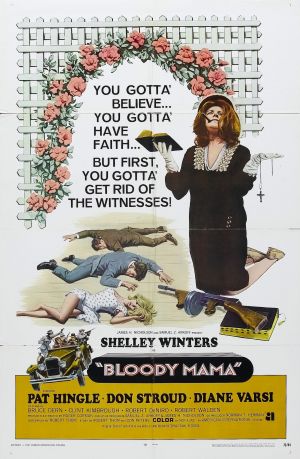
Cleaning Out The DVR, Again #24: Bloody Mama (dir by Roger Corman)


(Lisa is currently in the process of trying to clean out her DVR by watching and reviewing all 40 of the movies that she recorded from the start of March to the end of June.  She’s trying to get it all done by July 11th!  Will she make it!?  Keep visiting the site to find out!)

BloodyMama

The 24th film on my DVR was the 1970 Roger Corman-directed gangster film, Bloody Mama.  I recorded it off of TCM on May 27th.

Bloody Mama opens with a cheerful song that goes, “Maaaaaama…Bloody maaaaama….” and it’s such an unapolegetically over the top song that it perfectly sets the tone for what’s to follow.  Bloody Mama is violent, occasionally perverse, and totally unashamed.  It doesn’t pretend to be anything that it isn’t.  It’s bloody and it’s about a mother and, in the best Corman tradition, it makes no apologies!

The film tells the heavily fictionalized story of the Barkers, a group of brothers who robbed banks and killed people in the 1920s and 30s.  The majority of them were killed in a gunfight with the FBI.  Also killed in the gunfight was their mother, Kate Barker.  Always aware of the danger of bad publicity, the director of the FBI, J. Edgar Hoover, announced that Ma Barker was actually the mastermind of the Barker gang and that she was even more dangerous than her sons.  Ever since, historians have debated whether Ma Barker was the criminal mastermind described by Hoover or if she was just the innocent woman described by … well, by everyone who actually knew her.

Bloody Mama, of course, leaves no doubt.  From the minute that we discover that Shelley Winters will be playing Ma Barker, we know that she’s the most dangerous woman alive.  As played by Winters, Ma Barker is a ruthless bank robber, one who has no fear of gunning down innocent bystanders and who never lets her love for her sons get in the way of ordering them to kill a witness.  As opposed to a lot of gangster films made in the late 60s and early 70s, the film never attempts to portray its title character as being a heroic or particularly sympathetic character.  Instead, what makes the character compelling is just how thoroughly Winters commits to the role.  It doesn’t matter what Ma Barker is doing or saying, Shelley Winters totally sells it.  When the gang is cornered by the police and one associate makes the mistake of yelling that he’s not a Barker, Ma reacts by gunning him down herself and you can’t help but appreciate the lengths that Ma will go to defend her family’s name.

As for her sons, they are an interesting group of perverts and drug addicts and they’re played some of the best character actors of the 1970s.

Herman Barker (Don Stroud) is a sadist but he’s also one of Ma’s favorites.  He travels with a prostitute (played by Diane Varsi), who quickly tires of the Barkers’s violent way of life.

Arthur Barker (Clint Kimbrough) is the most practical of the Barkers and therefore, he’s also the least interesting.

Fred Barker (Robert Walden) is bisexual, which is a fact that the film handles with all the sensitivity that we’ve come to expect from a film made in 1970 (which is to say, not much at all).  Fortunately, Fred’s lover is Kevin and Kevin is played by Bruce Dern and Bruce Dern is always a lot of fun to watch, especially when he’s appearing in a Corman film.

And then there’s Lloyd who sniffs glue and shoots heroin and who is played by an obscure young actor named Robert De Niro and … wait, Robert De Niro!  That’s right!  One of the pleasures of Bloody Mama is getting to see De Niro at the start of his career.  Unfortunately, he doesn’t really get to do much, though he does occasionally flash the same unhinged smile that would later show up in Taxi Driver.

Roger Corman has repeatedly cited Bloody Mama as being one of his favorites of the many movies that he directed over the course of his long career.  I don’t blame him.  It’s a thoroughly shameless and totally entertaining film!

Keep an eye out for Bloody Mama!

Just remember, the real-life Ma Barker was probably innocent.

Embracing the Melodrama Part II #79: Over the Top (dir by Menahem Golan)


OverthetopFor the longest time, whenever I would see a movie at the DFW Alamo Drafthouse, I would always found myself watching a clip that the Alamo management chose to show before the actual movie.  I can’t really remember the specific reason why they were showing the clip.  I imagine it was meant to advertise some special series of testosterone-fueled movies but I really couldn’t tell you for sure.

However, I will never forget the clip itself.

It basically featured Sylvester Stallone arm wrestling a bald giant with a mustache.  As they both struggled to see who would slam down whose wrist first, a crowd of rednecks went wild.  The bald giant growled and groaned.  Meanwhile, Sylvester Stallone was busy … stalloning.  Seriously, you would not believe some of the expressions that passed across Stallone’s face over the course of this one scene.

And finally, after much growling and a lot of constipated facial expressions, Stallone slammed down the guy’s wrist.  The crowed went wild.  Stallone stood up and did the Rocky pose with both of his arms raised in triumph.

Meanwhile, in the audience, I said, “What zee Hell did I just watch?”

(Yes, I did pronounce the with a z.  It was cuter that way.)

Well, it turns out that the scene was taken from a 1987 film called Over The Top.  Now, the scene itself isn’t included in the montage below but I think watching this video will still give you a general sense of what Over The Top is like.

Over The Top turns up on cable fairly regularly and that’s how, after several visits to the Alamo, that I ended up watching the actual film.  Over The Top is an appropriate title because the film’s melodrama truly is over-the-top.  It’s in no way good but it definitely has a “what the Hell am I watching” sort of appeal.

Stallone plays Lincoln Hawk and let’s just take a few minutes to appreciate that name.  When you’ve got a name like Lincoln Hawk, you know that you’re never going to be an accountant or a teacher or … well, really, anything that a person not named Lincoln Hawk would be.  Instead, when you’ve got a name like Lincoln Hawk, you become a truck driver.  And you marry a rich woman (played by Susan Blakely), despite the disapproval of her judgmental father (Robert Loggia).  You have a son and, if you have a sense of humor, you name him Booth Hawk.  Or, in the case of this film, you name him Michael Cutler Hawk (played by David Mendenhall, who was also in Space Raiders) and send him off to military school.

When Lincoln’s wife dies, her father takes custody of Michael.  Even after Lincoln rams his truck into the front of the mansion, Michael still wants to stay with his grandfather.  However, Lincoln can’t spend his time mourning the loss of his family.  He has big plans — like starting his own trucking company.

And how is Lincoln going to do that?

By winning the World Armwrestling Championship, of course!

(Oh come on … that makes total sense in a 1987 Sylvester Stallone movie sort of way!)

Will Lincoln win the championship?  Will Michael bond with his father?  Will Lincoln and his father-in-law develop a grudging respect?  If you don’t know the answer, you’ve never seen the movie before…

Remember how, when I was talking about the Kevin Bacon film Quicksilver, I mentioned how some films were obviously made by people who simply could not understand that not everyone was as fascinated by some silly activity as he or she was?  That’s definitely the case with Over The Top, a film that takes place in an alternative universe where everyone in the entire world is obsessed with arm wrestling.

And it’s all rather silly but it’s also very watchable, in much the same way that American Anthem was very watchable.  Over the Top is not a good film but it’s just so over the top that you owe it to yourself to see it at least once.