Film Review: Cast Away (dir by Robert Zemeckis)


“WILSON!”

Seriously, I’m usually pretty well-behaved when I watch a movie but every time I see the 2000 film Cast Away, I find myself thinking, “Protect Wilson!  You must protect Wilson!”  And then, every time, I feel the sting of tears in my eyes as Wilson, with that red-face and that understanding attitude, goes floating away.

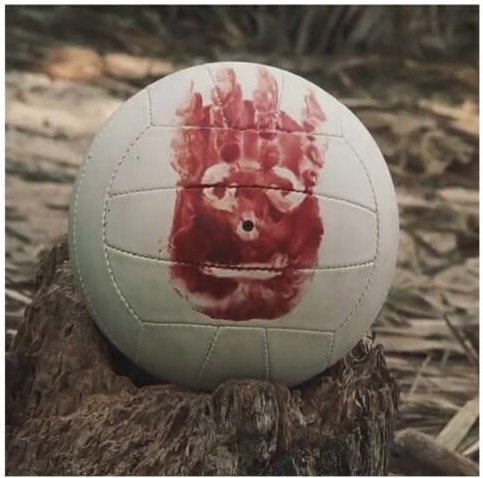
Wilson is a volleyball.  When a FedEx executive named Chuck Noland (played by Tom Hanks) finds himself stranded on a desert island, Wilson becomes his only companion.  A stain from Chuck’s bloody palm creates something that resembles a face on Wilson’s rubber surface and Chuck spends a lot of time talking to Wilson.  It’s how Chuck maintains his sanity, even as he loses weight, sheds most of his clothes, and grows a beard.

Chuck learns how to make fire.  He learns how to catch fish.  He is able to survive due to the supplies that he gathers from the FedEx packages that were being carried on the plane that crashed into the island.  But Chuck never stops dreaming of returning home to his girlfriend (Helen Hunt).  Eventually, Chuck finds the courage to try to make the journey back to civilization.  He brings Wilson with him but ultimately, this is something that Chuck is going to have to do on his own.  Of course, Chuck has failed to consider that he’s been gone for years.  He is presumed dead.  On the Island, time seemed like it was frozen.  For the rest of the world, life has continued.

Cast Away is a film that a lot of people, especially online film commentators, tend to criticize.  The complaint is usually that the film is essentially a commercial for FedEx, that it’s not believable that Tom Hanks could survive on that island for as long as he did, and that the film itself has a weak ending.  I’ll concede that the film does make FedEx look like the nicest corporation on Earth.  (FedEx’s CEO appears as himself, which should tell you something about how the company is presented.)  And I will admit that the film’s time-advancing jump cut, which abruptly takes Hanks from being clean-shaven and husky to being thin and bearded, does leave a lot of unanswered questions.  But I will always defend the film’s ending.  The film ends on a note of ambiguity but how else could it have ended?  Everyone thought Chuck Noland was dead.  His girlfriend had every right to get on with her life and, in fact, it would have been psychologically unhealthy for her if she hadn’t.  As for that final shot, it’s an acknowledgment that Chuck doesn’t know what lies ahead of him in the future.  All he knows is that he life isn’t over yet.  It’s a melancholy ending.  It’s a frustrating ending.  But it’s also the only way the film could have ended and therefore, it’s a perfect ending.

Cast Away is a film that I will always defend and it’s also a film that really only could have worked with Tom Hanks in the lead role.  He plays Chuck as being the ultimate everyman, an affable guy who was just trying to do his job and whose survival of the initial plane crash was largely due to luck.  Hanks is one of those actors who is instantly sympathetic and Cast Away uses his screen persona to good effect.  You want him to survive because he’s Tom Hanks.  He may be playing a character named Chuck Noland but ultimately, he’s Tom Hanks.  He survived being trapped in space.  Surely, he can survive being stranded on an island.  The majority of the film is just Hanks talking to himself.  This would have brought out the worst in so many actors but Tom Hanks makes it work.  And yes, he’ll bring tears to your eyes as he watches Wilson float away.  That’s the power of a good actor.

As for Wilson, I like to think that he washed up in Pensecola.  Recently, I played a little volleyball on a beautiful Florida beach.  Was that you, Wilson?
 

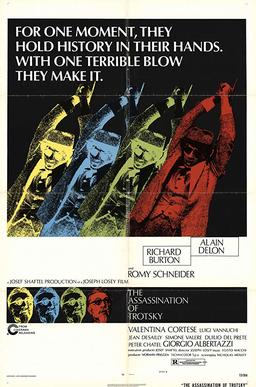
Icarus File No. 16: The Assassination of Trotsky (dir by Joseph Losey)


If you study the history of the International Left in the years immediately following the death of Lenin, it quickly becomes apparent that the era was defined by the rivalry between Joseph Stalin and Leon Trotsky.

Trotsky, the self-styled intellectual who was credited with forming the Red Army and who many felt was Lenin’s favorite, believed that he should succeed Lenin as the leader of Communist Russia.  Stalin, the ruthless nationalist who made up in brutality what he lacked in intelligence, disagreed.  Stalin outmaneuvered Trotsky, succeeding Lenin as the leader of the USSR and eventually kicking Trotsky out of the country. Trotsky would spend the rests of his life in exile, a hero to some and a pariah to others.  While Stalin starved his people and signed non-aggression pacts with Hitler, Trotsky called for worldwide revolution.  To Stalin, Trotsky was a nuisance whose continued existence ran the risk of making Stalin look weak.  When Trotsky was assassinated in Mexico in 1940, there was little doubt who had given the order.  After Totsky’s death, the American Communist Party, which had already been weakened by the signing of the non-aggression pact between Hitler and Stalin, was further divided into Stalinist and Trotskyite factions.

Ideologically, was there a huge difference between Stalin and Trotsky?  Many historians have suggested that Trotsky probably would have taken many of the same actions that Stalin took had Trotsky succeeded Lenin.  Indeed, the idea that Trotsky was somehow a force of benevolence has more to do with the circumstances of his assassination than anything that Trotsky either said or did.  In the end, the main difference between Stalin and Trotsky seemed to be Trotsky was a good deal more charismatic than Stalin.  Unlike Trotsky, Stalin couldn’t tell a joke.  However, Stalin could order his enemies killed whenever he felt like it and some people definitely found that type of power to be appealing.  Trotsky could write essays.  Stalin could kill Trotsky.

First released in 1972, The Assassination of Trotsky is a cinematic recreation of the events leading to the death of Leon Trotsky in Mexico.  French actor Alain Delon plays Frank Jacson, the Spanish communist who was tasked with infiltrating Trotsky’s inner circle and assassinating him with a pickaxe.  Welsh actor Richard Burton plays the Russian Trotsky, giving long-winded monologues about world revolution.  Italian Valentina Cortese also plays a Russian, in this case Trotsky’s wife, Natalia.  And finally, French actress Romy Schneider plays Gita Samuels, who is based on Jacson’s American girlfriend.  This international cast was directed by Joseph Losey, an American director who joined the Communist Party in 1946 and who moved to Europe during the McCarthy era.

Losey was an interesting director.  Though his first American feature film was the anti-war The Boy With Green Hair, the majority of his American films were on the pulpy side.  Not surprisingly, his European films were far more open in their politics.  Losey directed his share of undeniable masterpieces, like The Servant, Accident, and The Go-Between.  At the same time, he also directed his share of misfires, the majority of which were bad in the way that only a bad film directed by a good director can be.  The same director who gave the world The Go-Between was also responsible for Boom!

And then there’s The Assassination of Trotsky.  It’s a bit of an odd and rather uneven film.  Alain Delon’s performance as the neurotic assassin holds up well and some of his scenes of Romy Schneider have a true erotic charge to them.  The scenes of Delon wandering around Mexico with his eyes hidden behind his dark glasses may not add up too much but they do serve as a reminder that Delon was an actor who could make almost any scene feel stylish.

But then we have Richard Burton, looking like Colonel Sanders and not even bothering to disguise his Welsh accent while playing one of the most prominent Russians of the early 20th Century.  The film features many lengthy monologues from Trotsky, all of which Burton delivers in a style that is very theatrical but also devoid of any real meaning.  As played by Burton, Trotsky comes across as being a pompous phony, a man who loudly calls for world revolution while hiding out in his secure Mexican villa.  Now, for all I know, Trotsky could have been a pompous phony.  He certainly would not have been the first or last communist to demand the proletariat fight while he remained secure in a gated community.  The problem is that the film wants us to admire Trotsky and to feel that the world was robbed of a great man when Jacson drove that pickaxe into his head.  That’s not the impression that one gets from watching Burton’s performance.  If anything, Burton’s overacting during the assassination scene will likely inspire more laughs than tears.

The Assassination of Trotsky is one of those films that regularly appears on lists of the worst ever made.  I feel that’s a bit extreme.  The film doesn’t work but Alain Delon was always an intriguing screen presence.  (Interestingly enough, Delon himself was very much not a supporter of communism or the Left in general.)  The film fails as a tribute to Trotsky but it does make one appreciate Alain Delon.

Previous Icarus Files:

  1. Cloud Atlas
  2. Maximum Overdrive
  3. Glass
  4. Captive State
  5. Mother!
  6. The Man Who Killed Don Quixote
  7. Last Days
  8. Plan 9 From Outer Space
  9. The Last Movie
  10. 88
  11. The Bonfire of the Vanities
  12. Birdemic
  13. Birdemic 2: The Resurrection 
  14. Last Exit To Brooklyn
  15. Glen or Glenda

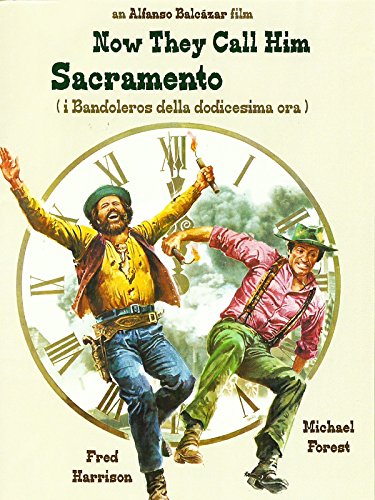
Now They Call Him Sacramento (1972, directed by Alfonso Balcázar)


Sacramento (Michael Forest) is an amiable and laid back Western outlaw who can barely ride his horse and who drifts from town to town.  When he arrives at a local saloon, he meets Big Jim (Fred Harrison) who ridicules Sacramento for only ordering a glass of milk.  What Big Jim doesn’t know is that the milk is Sacramento’s house.  After Sacramento returns, accepts a whiskey-drinking challenge, and proceeds to drink Big Jim under the table, an unlikely partnership is born.

Since it’s the old west and there’s nothing better to do, Sacramento, Big Jim, and Big Jim’s father, Old Tequila (Luigi Bonos), hold up a train and get away with a fortune.  By doing so, they thwart the schemes of an evil banker was planning on robbing the train himself in order to prevent the money from getting to a town of women who the banker wants to evict.  With the banker’s men pursuing them, Sacramento, Big Jim, and Tequila all end up in the town where Sacramento falls in love with the town’s mayor, Jenny McKinley (Malisa Longo).

Now They Call Him Sacramento is an amiable Spanish-made Spaghetti western.  It’s a comedy, one that was obviously based on the very popular series of Italian films that starred Terence Hill and Bud Spencer.  Michael Forest plays the Hill role while Fred Harrison steps into the typical Spencer part.  While Forest and Harrison may not have as strong of a humorous chemistry as Hill and Spencer, they’re still likable in their roles and Forest, in particular, scores just enough laughs to keep the movie entertaining.  (Just watch him trying to get on his horse.)  Now They Call Him Sacramento may be predictable but, like it’s title character, it’s an amiable and likable comedy and the climatic fight scene — in which a fistfight escalates into the entire town has been destroyed — is a minor classic.

Embracing the Melodrama Part II #30: The Sweet Ride (dir by Harvey Hart)


The_Sweet_Ride_FilmPosterThe 1968 film The Sweet Ride takes the audience on a ride through Malibu and reminds us all that, in many ways, the 1960s sucked.

The Sweet Ride opens with actress Vicki Cartwright (Jacqueline Bisset) losing her top while swimming in the ocean.  While Vicki panics and tries to figure out how to get back to the beach without anyone seeing her breasts, she’s spotted by a surfer named Denny McGuire (Michael Sarrazin).  Denny hands her a towel and then leads her back to the beach house that he shares with aging tennis player Collie (Anthony Franciosa) and stoned musician Choo-Choo (Bob Denver).

The rest of the film is a 90 minute tour of California beach life in the late 60s.  Despite Collie’s cynical warning against falling in love, Denny does just that, despite the fact that Vicki refuses to tell him anything about her past or even where she lives.  Meanwhile, Collie spends his time hustling on the tennis court and the married Choo-Choo pretends to be gay in an attempt to get out of being drafted.  (Choo-Choo probably could have gotten out of the draft by pointing out that he appears to be 40 years old but the filmmakers decided to have him walk around with a poodle and speak in falsetto.  Just in case you had any doubt that this film was made in 1968…)  It’s a mix of comedy, romance, and drama and it’s features footage of some real bands performing in actual Malibu nightclubs and that’s a good thing for all of us history nerds.

And, since The Sweet Ride was made in 1968, the whole film gets progressively darker as it reaches its conclusion.  Choo-Choo does get drafted and it’s hard to believe he’ll survive a day in Viet Nam.  Collie’s perfect life is revealed to be an empty facade.  Denny realizes that his friends are all immature losers.  And Vicki ends up getting assaulted by a high-power studio executive (Warren Stevens).  It all leads to more violence, disillusionment, and general ennui.

For some reason, The Sweet Ride shows up on FXM fairly regularly.  It’s a strange film because it doesn’t really work and yet it’s also compulsively watchable.  It tries to be about everything and, as a result, it often feels like it’s about absolutely nothing.  And yet, somehow, it remains compelling…

Why is the film compelling despite itself?  It’s not because of the main characters, that’s for sure.  The boys in the beach house are probably some of the least likable film protagonists in cinematic history.  Anthony Franciosa gave some great performances in his career (check him out in A Face in the Crowd and Tenebrae) but Collie is such a smug jerk that you find yourself hoping that someone will just punch him in the face.  Meanwhile, Denny tends to come across like a weak-willed and obsessive stalker and Choo-Choo — well, Choo-Choo often seems to be a character in a totally different movie.  As for Vicki, her character pretty much exclusively exists to be victimized.

Ultimately, I think The Sweet Ride is watchable because it is such an imperfect time capsule.  If I wanted to know what it was like to be alive in the 60s, The Sweet Ride is one of the films that I would watch.  It’s not the best film ever made but it is a chance to look into the past.

(Incidentally, The Sweet Ride was directed by Harvey Hart, who also directed the underrated Shoot.)