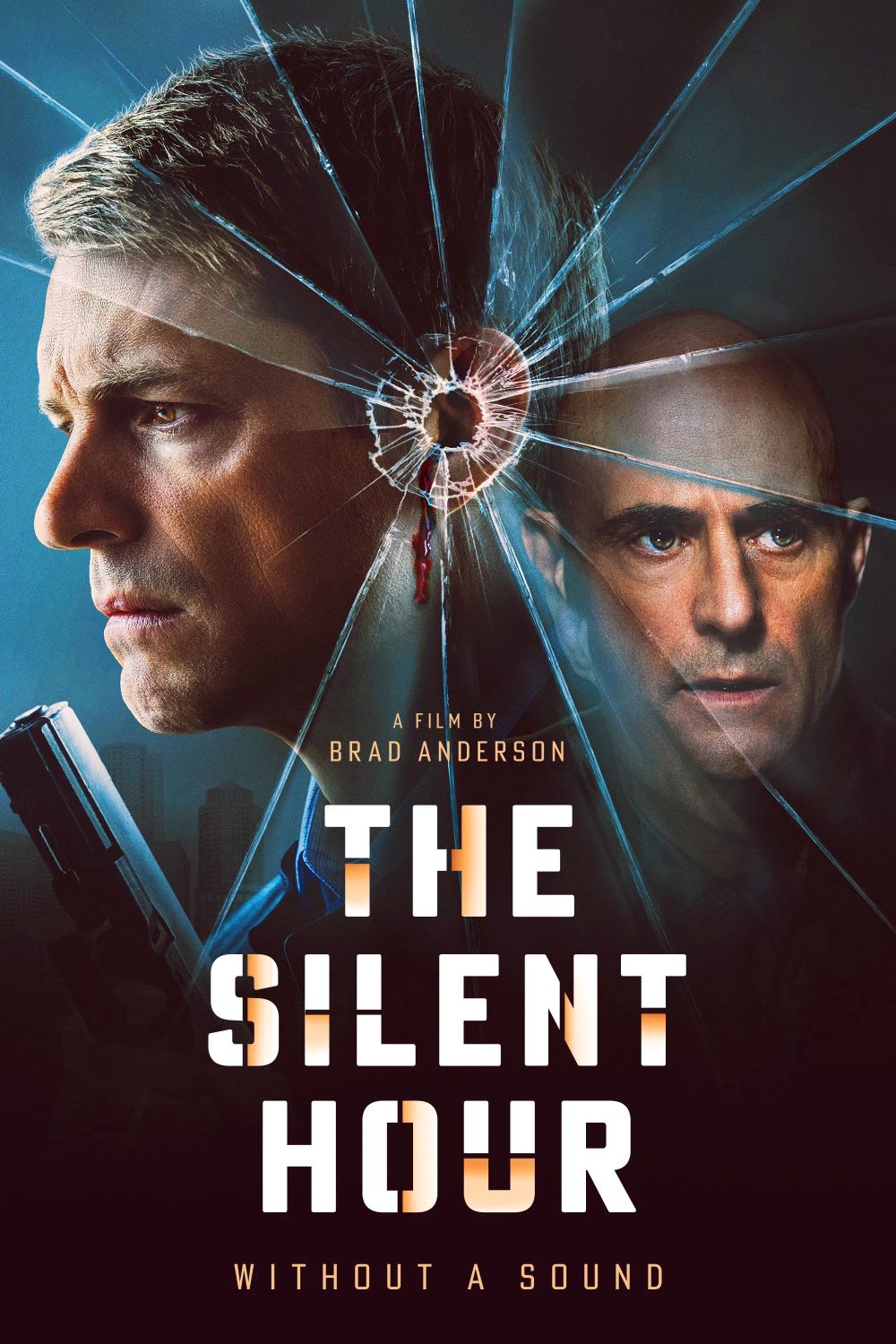
Review: The Silent Hour (dir. by Brad Anderson)


“One missing piece doesn’t make you any less whole.” — Ava Fremont

The Silent Hour is the kind of mid-budget thriller that used to quietly fill up Friday night multiplex lineups, and there’s something refreshing about that. It is not reinventing the genre, but it does just enough with its premise of hearing loss, a deaf witness, and a sealed-off apartment block to feel engaging instead of disposable. When it leans into that sensory angle and the physical geography of the building, it clicks; when it falls back on stock corrupt-cop beats, you can feel the air go out of the room a little.

The setup is straightforward: Boston detective Frank Shaw (Joel Kinnaman) is struggling with permanent hearing loss after an on-the-job accident, trying to find a way back onto the force and into his own life. He is brought in because he knows some sign language and is asked to help take the statement of Ava Fremont (Sandra Mae Frank), a deaf photographer who has video evidence of a brutal gang murder. Once Frank leaves her run-down apartment building, he realizes he forgot his phone, heads back, and walks straight into a hit team sent to silence Ava; the rest of the film traps them inside the almost-condemned complex with a crew of killers who, crucially, they often cannot hear coming.

Director Brad Anderson has always had a knack for tense, contained spaces, and you can feel the same instincts here that powered films like Session 9 and Transsiberian, even if The Silent Hour is more conventional. The apartment block is shot as a grim, half-abandoned maze: flickering lights, long hallways, and just enough remaining tenants to complicate any hope of a clean escape. Anderson stages several sequences as slow, creeping cat-and-mouse instead of wall-to-wall gunfire, which fits the “you can’t hear the danger” concept nicely and gives the movie a more claustrophobic vibe than the plot synopsis might suggest.

Where the film genuinely distinguishes itself is in how it uses sound—or sometimes refuses to use it. Scenes that shift into Frank’s perspective often dampen or distort the audio, letting the score fall away so small vibrations, visual cues, and body language carry the tension, while Ava’s point of view goes further, dropping into near-total silence and forcing the audience to scan frames the way she would. It is not as radical as something like A Quiet Place, but it is effective, and the sound department clearly understands that “absence” can be as expressive as any bombastic action mix.

Kinnaman slides comfortably into this kind of bruised, low-key action role, and here he plays Frank as a guy permanently half a step behind the world around him, frustrated but not wallowing. The script gives him some predictable beats—guilt, self-destructive drinking, a shot at redemption—but Kinnaman sells the physical awkwardness of someone relearning how to move and work while not fully trusting his own body. Sandra Mae Frank is the movie’s secret weapon, though; as Ava, she never reads as a passive victim, and there is a practical, almost sardonic edge to the way she navigates the situation that helps keep the film from turning mawkish about disability.

The dynamic between Frank and Ava is also where the film finds its heart, even if it is pretty lightly sketched. Their communication is messy at first—his sign language is rusty and limited, hers is fast and precise—but that awkwardness becomes part of the tension, because a misread sign or delayed understanding can get people killed in this environment. As they settle into a rough rhythm, the movie quietly nudges Frank toward accepting that his hearing loss is not just a temporary obstacle but a permanent part of who he is now, and Ava is allowed to be more than a symbolic “guide” through that, with her own fears and bad decisions hanging over her.

On the flip side, the actual crime plot is about as standard as they come. The villains are corrupt cops cleaning up a messy murder, and if you have seen more than a couple of thrillers, you will probably guess who is dirty long before the script “reveals” it. There are a few half-hearted attempts at moral compromise and temptation—a hefty bribe, old loyalties—especially around Frank’s former partner Doug Slater (Mark Strong), but the story never digs into systemic rot or moral ambiguity in any meaningful way; it just uses corruption as a convenient engine to keep the bullets and double-crosses coming.

Structurally, the film works best as a series of mini-scenarios inside the building rather than as a twisty conspiracy. You get sequences where Frank and Ava navigate dark stairwells while trying to stay ahead of men they can feel but not hear, tense face-offs in cramped apartments with panicked tenants, and a few well-staged bursts of violence that remind you this is still a pretty nasty situation. The climax leans into fire, chaos, and one last push for survival, and while the resolution lands exactly where you’d expect, the final quieter beats give the characters a bit of closure that feels earned rather than tacked on.

Performance-wise, the supporting cast does its job without stealing the movie. Mekhi Phifer and Mark Strong bring some veteran presence as fellow cops circling around Frank, and even when the writing nudges them toward archetype, they at least feel like people who have known each other for years rather than walking plot devices. The henchmen are more one-note, essentially “the guys with guns” hunting through the building, but the film leans on their physicality and menace instead of trying to give everyone a tragic backstory, which is probably the right call for a lean thriller like this.

If there is a frustration here, it is mostly about missed potential. The core hook—two people with hearing loss trying to survive in a sound-dependent cat-and-mouse game—is strong enough that you can imagine a slightly sharper script pushing much harder on point of view, communication breakdown, and the way the police institution treats disability. Instead, The Silent Hour uses those elements as flavoring around a very familiar skeleton, resulting in a movie that is solid and sometimes gripping but rarely surprising.

Taken on its own terms, though, The Silent Hour is a tight, competently staged thriller that understands how to milk a confined space and an offbeat sensory angle for suspense. The running time is under two hours, the pacing stays brisk, and there are enough well-executed set pieces and committed performances to make it an easy recommendation if you are in the mood for a darker, low-key action night. It will not stick with you the way the very best of Brad Anderson’s work does, but as a late-night watch with the lights down and the volume doing most of the heavy lifting, it gets the job done.
The Eric Roberts Collection: Assault on Wall Street (dir by Uwe Boll)


2013’s Assault on Wall Street tells the story of Jim Braxford (Dominic Purcell), a security guard who loses all of his money due to some bad investments that he had no control over and whose wife, Rosie (Erin Karpluk), kills herself rather than continue her expensive medical treatments.  Jim snaps and, after listening to a bunch of angry people on MSNBC, he decides to take violent vengeance on Wall Street, targeting brokers and CEOs and ultimately launching an all-out assault on a firm owned by the cartoonishly evil Jeremy Stancroft (John Heard).

Full of anti-capitalist rhetoric and heavy-handed plot developments, Assault on Wall Street finds director Uwe Boll in a political mood.  Because the film deals with economic anxiety to which everyone can relate, this film is slightly more effective than Boll’s usual films but that still doesn’t mean that it’s particularly good.  It’s one of those films that takes forever to get where it’s going and the film also suffers due to Boll’s confounding decision to cast Dominic Purcell in the lead role.  The blank-eyed, flat-voice Purcell gives such a spectacularly dull performance that one wonders if he was constructed out of charisma anti-matter.  It doesn’t help that Purcell’s three best friends are played Edward Furlong, Michael Pare, and Keith David, all of whom come across like they would have been a better pick for the lead role.

The film ends with a spate of violence that I remember that I found to be a bit shocking when I first saw the film on cable in 2013.  Of course, today, such violence has been normalized and is often celebrated on social media.  I imagine that members of the creepy Luigi death cult would probably claim that Jim Braxford didn’t go far enough in his murder spree.

Two of my favorites, Eric Roberts and Lochlyn Munro, have supporting roles in this film.  Munro is Jim’s broker, who makes the mistake of complaining about how he had to cancel his planned vacation to Barbados as a result of the economic meltdown.  Roberts plays the lawyer who agrees to help Jim get justice but who ultimately proves to be no help at all.  Both of them are memorable in their small roles, which once again leaves us to wonder why, with all the talent available, Uwe Boll apparently decided to make Dominic Purcell his muse.  That was a bad investment.

Previous Eric Roberts Films That We Have Reviewed:

  1. Star 80 (1983)
  2. Runaway Train (1985)
  3. Blood Red (1989)
  4. The Ambulance (1990)
  5. The Lost Capone (1990)
  6. Love, Cheat, & Steal (1993)
  7. Voyage (1993)
  8. Love Is A Gun (1994)
  9. Sensation (1994)
  10. Dark Angel (1996)
  11. Doctor Who (1996)
  12. Most Wanted (1997)
  13. Mercy Streets (2000)
  14. Raptor (2001)
  15. Rough Air: Danger on Flight 534 (2001)
  16. Wolves of Wall Street (2002)
  17. Mr. Brightside (2004)
  18. Six: The Mark Unleased (2004)
  19. Hey You (2006)
  20. Amazing Racer (2009)
  21. In The Blink of an Eye (2009)
  22. Bed & Breakfast (2010)
  23. Enemies Among Us (2010)
  24. The Expendables (2010) 
  25. Sharktopus (2010)
  26. Beyond The Trophy (2012)
  27. The Dead Want Women (2012)
  28. Deadline (2012)
  29. The Mark (2012)
  30. Miss Atomic Bomb (2012)
  31. Bonnie And Clyde: Justified (2013)
  32. Lovelace (2013)
  33. The Mark: Redemption (2013)
  34. The Perfect Summer (2013)
  35. Self-Storage (2013)
  36. A Talking Cat!?! (2013)
  37. This Is Our Time (2013)
  38. Inherent Vice (2014)
  39. Road to the Open (2014)
  40. Rumors of War (2014)
  41. Amityville Death House (2015)
  42. Deadly Sanctuary (2015)
  43. A Fatal Obsession (2015)
  44. Las Vegas Story (2015)
  45. Stalked By My Doctor (2015)
  46. Enemy Within (2016)
  47. Joker’s Poltergeist (2016)
  48. Prayer Never Fails (2016)
  49. Stalked By My Doctor: The Return (2016)
  50. The Wrong Roommate (2016)
  51. Dark Image (2017)
  52. Black Wake (2018)
  53. Frank and Ava (2018)
  54. Stalked By My Doctor: Patient’s Revenge (2018)
  55. Clinton Island (2019)
  56. Monster Island (2019)
  57. The Reliant (2019)
  58. The Savant (2019)
  59. Seven Deadly Sins (2019)
  60. Stalked By My Doctor: A Sleepwalker’s Nightmare (2019)
  61. The Wrong Mommy (2019)
  62. Exodus of a Prodigal Son (2020)
  63. Free Lunch Express (2020)
  64. Her Deadly Groom (2020)
  65. Top Gunner (2020)
  66. Deadly Nightshade (2021)
  67. The Elevator (2021)
  68. Just What The Doctor Ordered (2021)
  69. Killer Advice (2021)
  70. Night Night (2021)
  71. The Poltergeist Diaries (2021)
  72. The Rebels of PT-218 (2021)
  73. A Town Called Parable (2021)
  74. Bleach (2022)
  75. My Dinner With Eric (2022)
  76. D.C. Down (2023)
  77. Aftermath (2024)
  78. Bad Substitute (2024)
  79. Devil’s Knight (2024)
  80. The Wrong Life Coach (2024)
  81. When It Rains In L.A. (2025

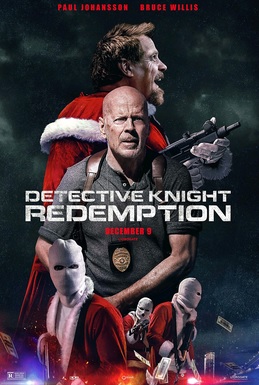
Film Review: Detective Knight: Redemption (dir by Edward Drake)


2022’s Detective Knight: Redemption picks up where Detective Knight: Rogue ended.

After having been arrested in front of his wife and daughter, football player-turned-criminal Casey Rhodes (Beau Mirchoff) has been sent to prison.  In the same prison is Rhodes’s nemesis, former Detective James Knight (Bruce Willis).  Knight has been imprisoned for murdering the two villains from Detective Knight: Rogue, finally answering the age-old question of what happens to an action hero after the end credits roll.  In prison, both men meet Ricky Conlan (Paul Johansson), a former convict who is now a chaplain.  Conlan is big on encouraging everyone in prison to set aside their differences and come together as one big community of sinners seeking redemption.

Meanwhile, as Christmas approaches, New York City finds itself under siege.  Terrorists are dressing up like Santa Claus and robbing banks, chanting “Ho!  Ho!  Ho!” as they do so.  Their leader alternates between handing out candy canes and tossing live grenades at people.  He becomes known as The Christmas Bomber and he announces that he’s only robbing the banks to get back at the 1%.  He’s a revolutionary, you see.

He’s also a prison chaplain.  That’s right, Ricky Conlan is the Christmas Bomber and he’s decided that Casey is going to be newest member of his operation!  He even stages a jailbreak, releasing the entire population of Riker’s onto the streets of New York.  The only prisoner who voluntarily chooses not to escape is Detective Knight.  Impressed by his refusal to escape when he had the chance, NYPD Capt. Anna Shea (Miranda Edwards) arranges for Detective Knight to be released from prison so that he can head up the search for Conlan and the commie Santas.

Meanwhile, Knight’s partner, Eric Fitzgerald (Lochlyn Munro), has traveled to New York to help out with the investigation.  In the previous movie, when we last saw Detective Fitzgerald, he was in the hospital after having been shot by Casey Rhodes.  Fitzgerald may be in a wheelchair now but he’s still good with a gun and he also mentions that the doctors think that he should be able to walk again by Memorial Day.  Fitzgerald doesn’t let being in a wheelchair prevent him from investigating and confronting New York’s power brokers, including the oily mayor (John Cassini).

Detective Knight: Redemption was one of the films that Bruce Willis filmed shortly before the announcement that he would be retiring from acting.  Though he’s definitely the main attraction here and he still looks convincing firing a gun during the film’s finale, Willis’s screen time is limited and it’s also obvious that a stand-in was used for a few of the scenes that involved his character.  There are a handful of fleeting moments where we get to see some hints of the wiseguy charisma that was Willis’s trademark but, for the most part, Detective Knight is written to be a man of few words.  When he made this film, Willis still had his screen presence but it’s still difficult to watch with the knowledge that he was struggling with his health during filming.

With Willis largely sidelined, it falls to Munro, Johansson, and Mirchoff to keep the action moving and all three of them prove themselves to be up to the challenge.  Johansson, in particular, is so wonderfully over-the-top in his villainy that it’s impossible not to be entertained whenever he’s onscreen.  The film’s plot does have a few interesting twists.  Conlan presents himself as being a revolutionary who is dedicated to bringing down the 1% but Casey eventually realizes that, much like Die Hard‘s Hans Gruber, he’s ultimately just a greedy thief.  Conlan’s gang is a mix of hardened escaped prisoners who are looking for revenge on the system and confused kids who quickly discover that the revolution is a lot scarier than they thought it would be.  The story may sometimes be too quick to ask the viewer to suspend their disbelief but the plot moves quickly and, just as he did with Gasoline Alley, director Edward Drake doesn’t allow the film’s low budget to prevent him from choreographing a few impressive action scenes.

Ultimately, of course, the main reason to see Detective Knight: Redemption is that it features a bunch of Santa Clauses chanting “Ho!  Ho!  Ho!” while robbing banks.  Who can resist that?

Film Review: Detective Knight: Rogue (dir by Edward Drake)


Once upon a time, Casey Rhodes (Beau Mirchoff) was a football star.  He was a quarterback.  Everyone expected great things from him.  He was going to be the next Tom Brady.  But then a knee injury took him out of the game and a subsequent drug addiction took him out of mainstream society.  Now, Casey makes his living pulling off robberies.  He may be a criminal but he’s not a bad-hearted one.  He may carry a gun but he tries not to shoot anyone who doesn’t shoot at him first.  Working with him are a former baseball player named Mike (Trevor Getzky) and Nikki (Keeya King), who is the smartest member of the crew.

Despite Casey’s attempts to do his job with as little violence as possible, a gunfight does break out during one robbery in Los Angeles.  When Detectives James Knight (Bruce Willis) and his partner, Eric Fitzgerald (Lochlyn Munro), interrupt the robbery, Fitzgerald ends up getting shot multiple times as Casey and his crew make their escape.  With Fitzgerald in the hospital, Knight decides to follow the crew to New York and take out both them and their boss, a former Internal Affairs officer named Winna (Michael Eklund).  It turns out that there’s a history between Knight and Winna.  Knight wants his revenge on Winna but, at the same time, Winna knows some dark secrets from Knight’s past.

Though it works as a stand-alone film, 2022’s Detective Knight: Rogue is actually the first part of a trilogy that follows the adventures of Detective Knight.  (Detective Knight: Redemption was released at the end of 2022 while Detective Knight: Independence came out last month.)  The Detective Knight films were among the last of the movies in which Bruce Willis appeared before announcing his retirement.  It can be strange to watch Willis’s final films, knowing what we know about what he was going through at the time that he made them.  Though he’s definitely the star of the film, Willis is used sparingly in Detective Knight: Rogue and there’s little of the cocky attitude that we tend to associate with Willis’s best roles.  Instead, he’s a grim avenger, determined to get justice for both his partner and himself.  Willis is convincing in the role, even if the film is edited in such a way that the viewer gets the feeling that a stand-in may have been used for some of the long-shots involving Detective Knight.  That said, Willis still looks convincing carrying a badge and a gun and it’s nice to see a Willis film where he’s again playing a hero instead of a villain.

As the football player-turned-thief, Beau Mirchoff gets more screentime than Willis but, fortunately, Casey is an interesting character and Mirchoff gives a strong performance as a criminal who would rather be a family man and who is desperately looking for a way to make up for the mistakes of his past.  Towards the end of the film, he does a flawless job delivering a surprisingly well-written monologue about how he went from being a football star to being a common thief.  Mirchoff’s strong performance adds a good deal of ambiguity to the film.  The criminals aren’t necessarily that bad at heart and, as we learn, the good guys haven’t always been angels in the past.  Detective Knight: Rogue becomes more than just another low-budget thriller.  It becomes a meditation of regret and redemption.

Detective Knight: Rogue took me by surprise.  As directed by Edward Drake (who was also responsible for another effective late Bruce Willis starrer, Gasoline Alley), it’s an intelligent thriller and it’s one that pays tribute to Bruce Willis as an action icon.  It’s proof that a good story can sometimes be found where you least expect it.

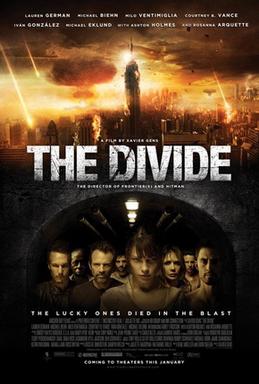
Film Review: The Divide (dir by Xavier Gens)


It seems like whenever there’s any sort of disaster, people are advised to seek shelter.  Often, if the disaster is national news, people are told to take shelter in their basement, as if everyone in the world has a basement.  This is a bit of a pet peeve of mine because I live in North Texas, where the land is completely flat and no one has a basement, a cellar, or any other sort of underground shelter.  (We also don’t have mud rooms and, in fact, I’m not even sure what a mud room is.)

That said, there’s a part of me that’s glad that it would be impossible for me to take shelter because, from what I’ve seen in the movies, it appears that spending months in a shelter can actually be worse than dying in a disaster.

Take the 2011 film, The Divide, for instance.

The Divide opens with several people watching while a mushroom cloud blooms over New York City.  Eight of those people all end up taking shelter in the same basement.  While that means that they don’t get incinerated by the nuclear blast, it also means that they now have to figure out how to live together.  That’s not going to be easy because it doesn’t take long to realize that none of these people should be anywhere near each other.

For instance, there’s Mickey (Michael Biehn).  Mickey’s the one who built the shelter.  He says that he specifically built it so that, in case of a nuclear war or a terrorist attack, he could safely sit underground and laugh at everyone dying above him.  That’s not a nice sentiment but Mickey is played by Michael Biehn so he’s still one of the more likable characters in the film.

There’s Josh (Milo Ventimiglia) and his brother Adrien (Ashton Holmes) and their friend Bobby (Michael Eklund), three idiots who are clearly destined to end up going crazy before the ordeal is over.

There’s Eva (Lauren German) and her boyfriend, Sam (Ivan Gonzalez), who are both obviously destined to be the voices of reason to which no one is going to listen.

And then there’s Marilyn (Rosanna Arquette) and her daughter (Abby Thickson), who are there because it’s not a shelter-movie without a child being put in jeopardy.

Lastly, there’s Devlin (Courtney B. Vance), who is there to be the older authority figure who ultimately fails to exercise much authority.

After an effectively chilling scene where the basement is briefly invaded by some mysterious men in Hazmat suits, The Divide settles down to be a fairly predictable and, to be honest, rather unpleasant examination of a group people going crazy from the stress of being trapped together.  It may seem odd to complain that a film about the aftermath of a nuclear apocalypse was unpleasant and I guess it is.  But The Divide runs a little over two hours and it’s so relentlessly bleak and everyone is ultimately so nasty that it becomes a bit of a chore to sit through.  By the time the torture scenes begin, The Divide has slipped into Hostel territory and it’s hard not to feel that the film is being grotesque simply for the sake of being grotesque.

That said, the film does have its strength.  The shelter is an effectively claustrophobic location and Michael Biehn does what he can with the role of Mickey.  When some of the characters end up getting radiation sickness, it creates some effectively scary visuals.  I mean, if you ever thought it would be cool to poison yourself with radiation, this film will change your mind.  That’s a good thing, I suppose.

The Divide is a very long movie about some very unpleasant people in an even more unpleasant situation.  It’s well-made but not particularly entertaining to watch.  In the end, it’s easy to feel that everyone would have been better off just staying above ground and getting it over with.

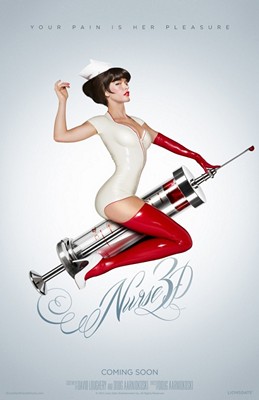
Horror Film Review: Nurse 3D (dir by Doug Aarniokoski)


nurse-3d

So, last night, my boyfriend and I watched Nurse 3D because, based on the trailer that was released way back in January, we thought that it would be a sexy, fun, and enjoyably lurid movie.  Do you remember that trailer?  In case you need a reminder, here it is:

So, we finally got around to watching the movie and oh my God, you guys — sometimes trailers lie!  I know, I know — it’s a shock.  I’m still struggling to deal with it myself!

Actually, technically, the trailer for Nurse 3D doesn’t really lie.  The trailer tells us that the film is about a nurse who is obsessed with another nurse and who spends the majority of the film wearing only a bra.  And that’s true!  But, somehow, the trailer also makes the film look like it’s a lot more fun than it actually is.  The trailer reveals that Nurse 3D is meant to be something of a satirical tribute to the exploitation films of the past.  What it doesn’t reveal is that the film largely does not work.

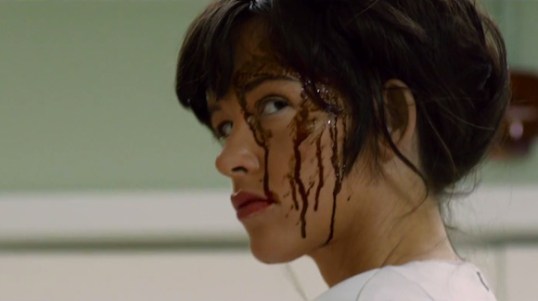
In Nurse 3D, Paz de la Huerta plays Abby Russell, a nurse who also happens to be a serial killer.  When we first meet her, she’s wandering through a club in a black lace, see-through dress.  In a narration that de la Huerta delivers in an emotionless drone, Abby explains that men are a disease that has been created in an “alcoholic petri dish” and that is now “infecting innocent vaginas.”

“There is only one cure for the married cock,” Abby tells us, “Only me.  I’m the nurse.”

Abby, we discover, specializes in murdering married men who are on the verge of committing adultery.  Sounds like a good idea for a movie, right?  Well, don’t get too attached to it because, once we get through the opening credits, that entire storyline pretty much disappears.

Instead, Abby becomes obsessed with a new nurse named Danni Rogers (Katrina Bowden).  One night, after Danni both has a fight with her boyfriend (Corbin Bleu) and gets yelled at by a jerk of a doctor (played by Judd Nelson), Abby invites Danni out to a club.  Abby gets Danni drunk and drugged and soon they’re making out on the dance floor.  The next morning, Danni wakes up in Abby’s bed.  When Danni refuses to spend the day with Abby and quickly leaves, Abby reacts by trying to destroy Danni’s life…

And that plot line goes on for a while until, eventually, the filmmakers remembered that this was supposed to be a 3D film and, with the exception of one man hurtling towards the camera after being tossed off a rooftop, nothing in the film has really lent itself to whole 3D thing.  So, suddenly, Abby goes from being coolly calculating to being batshit insane, essentially so that she’ll have an excuse to toss medical equipment straight at the camera.

(I’m going to guess that this all probably looked really impressive in 3D but since we were watching the film in 2D, who cares?)

And then, eventually, the movie ends.

I like what Nurse 3D was trying to do.  The film is obviously meant to pay homage to the classic exploitation films to the past.  That was obvious in everything from the overwritten narration to the hilariously fetishized nurses uniforms to the unapologetically sordid nature of the entire plot.

However, the film’s execution left a lot to be desired.  For all of it’s attempts to celebrate over-the-top exploitation, the film never quite seems to understand what makes those films so memorable in the first place.  Perhaps if Nurse 3D had stuck with being a film about a nurse who kills cheating husbands, the film would have worked.  But, instead, it just becomes yet another film about an obsessive friend who turns out to be a psycho and who, fortunately for her, is lucky enough to be surrounded by people too stupid to pick up on the most obvious of clues.

And it doesn’t help that, whatever the joke was that Nurse 3D was trying to tell, it’s obvious that Paz de la Huerta was not in on it.  In many ways, her character is meant to be a throwback to the great and deadly femme fatales of yesterday but  it takes more than having a good body to be a femme fatale.  You have to have style and that’s totally what her performance is missing.  Scarlett Johansson could have worked wonders with the role of Abby Russell but Paz de la Huerta just seems to be lost.

That’s actually a pretty good description of Nurse 3D.  It started out on the right track but, obviously, it lost its way.

Nurse3D