Trailer: Big Hero 6 (Official)


Big_Hero_6-V3

Walt Disney Animation has always lagged behind it’s more lauded older sibling Pixar Animation. Yet, in the last couple years it’s more than held it’s own with it’s two most recent releases with Wreck-It-Ralph and Frozen. Will third time be the charm as the studio is set to release the first CG-animated feature that was greenlit after Walt Disney bought Marvel Comics over 6 years ago.

Big Hero 6 is loosely-based on the same comic book title from Marvel Comics. It tells the story of one Hiro Hamada and his sidekick balloon man….robot who must team up with an eclectic group of other would-be heroes to save the fictional city of San Fransokyo from a mysterious villain.

Big Hero 6 is set for a November 7, 2014 release date.

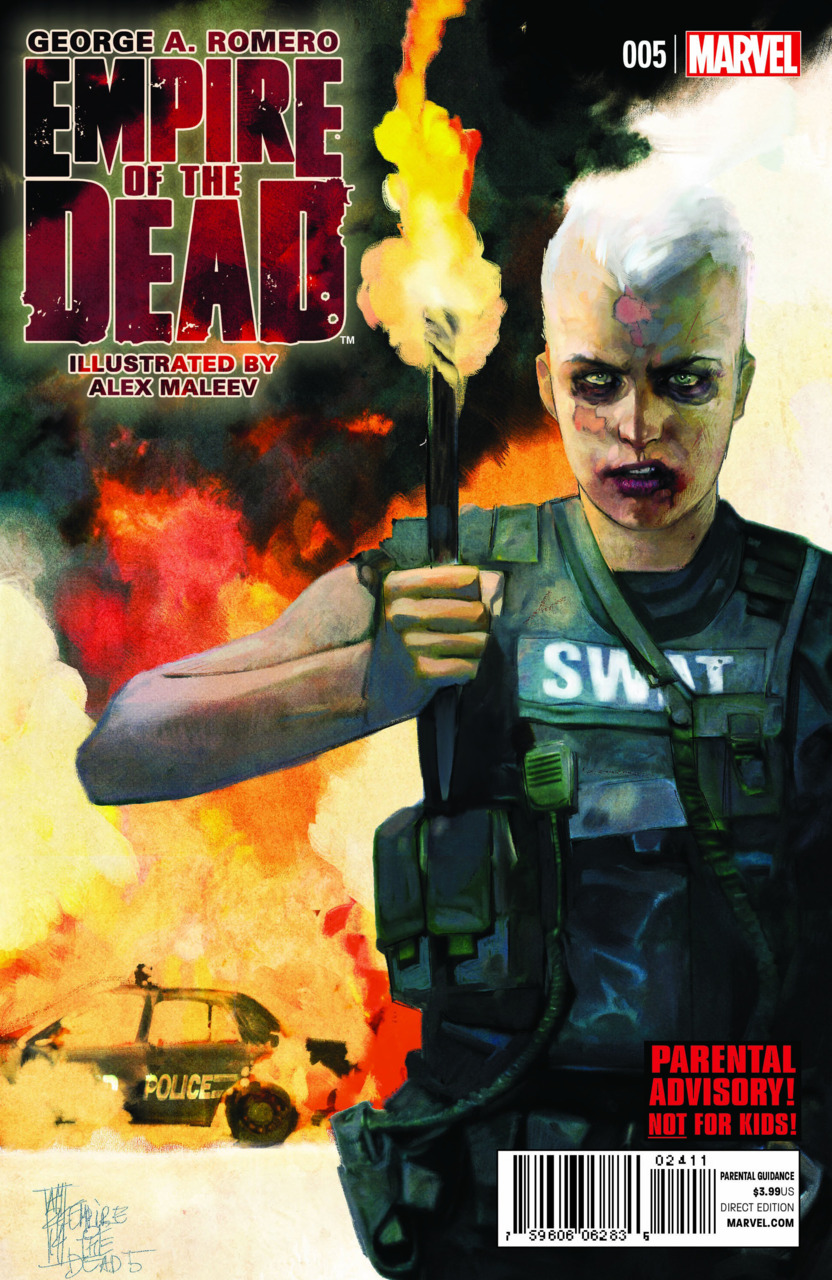
“Empire Of The Dead” #5 : George Romero’s Grand Chessboard Finally Comes Into Focus


3898437-05

If it seems like it’s been awhile since we looked at a new issue of Empire Of The Dead around these parts, that’s because it has — the fifth and final segment of the first arc in George Romero’s printed-page zombie epic (officially titled in the copyright indicia as George Romero’s Empire Of The Dead Act One #5) is a good few weeks late in maintaining its purportedly monthly schedule, but now that it’s finally here, let’s not waste any more time, shall we?

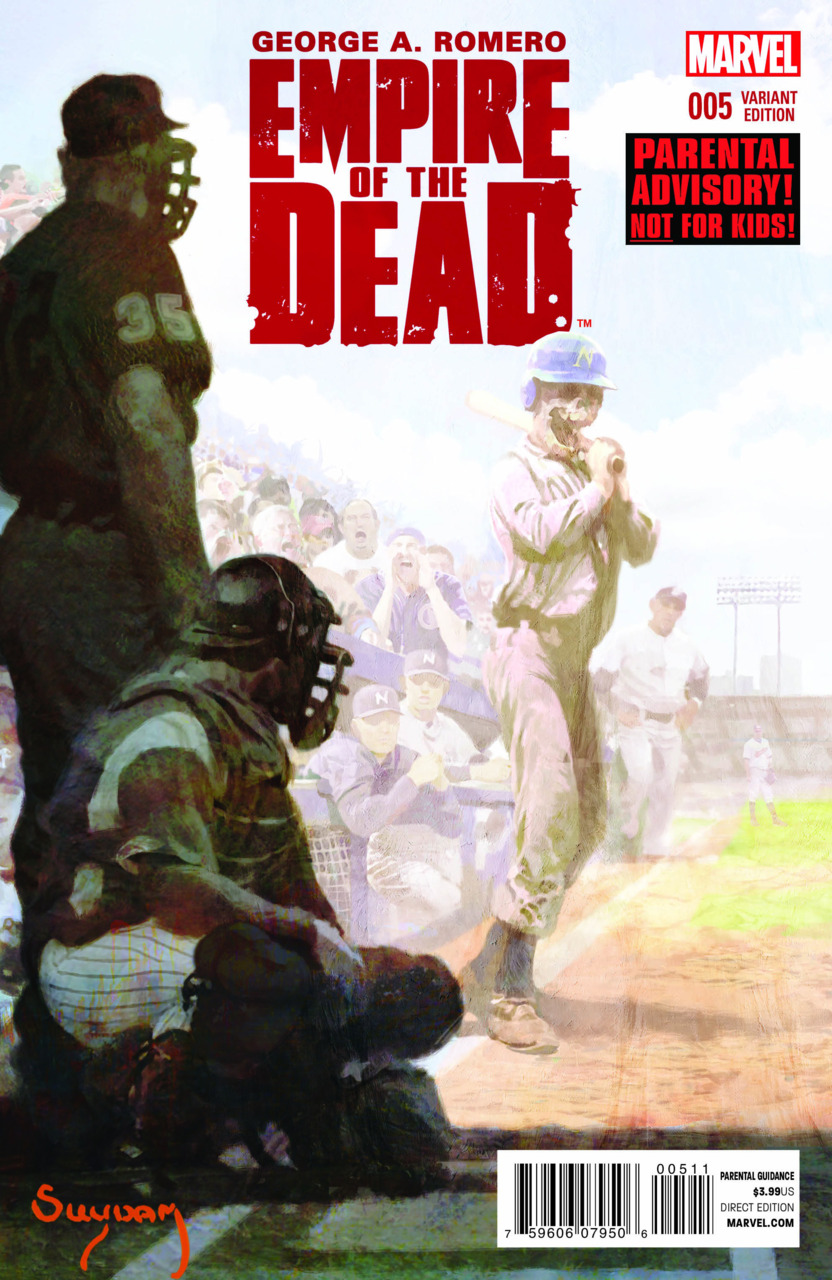
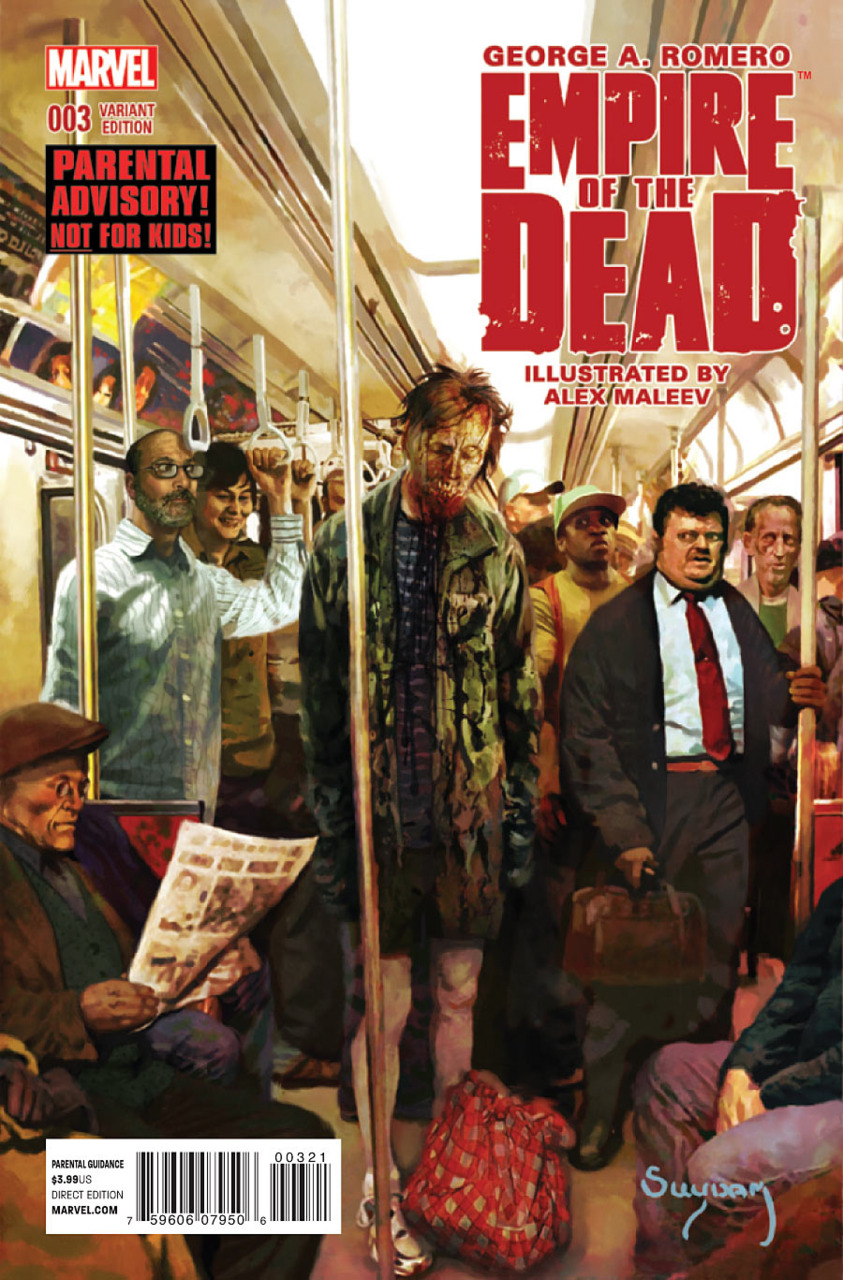
I’ve remarked previously about how this first arc seems more and more like pure set-up the longer it goes on, and I’ve wondered aloud about just how the father of the modern zombie genre was going to bring all the disparate subplots he was working on together in time for at least something resembling a decent climax by the time this issue was over, but I also stated that I still had an innate trust in our guy George’s storytelling ability and reiterated each time I felt like things were headed at least slightly off the rails that I was still reasonably certain that he’d find some sensible way connect all his metaphorical dots before the sand ran out in his equally metaphorical hourglass. As it happens, it seems my faith was not misplaced, because Empire #5 does exactly what you want all good “season-ending” stories to do : brings the overall picture into much clearer view while simultaneously whetting your appetite for the next new episode — and the TV “season” analogy probably isn’t a bad one here given that Romero and artist Alex Maleev (how ’bout that awesome cover he’s cooked up for this one, huh? Arthur Suydam’s “NYC variant,” as they’re known,  is reproduced a couple of paragraphs below) will be returning for their second five-issue “act” in September, right around the same time most television series begin their new episodic runs.

But damn — I don’t really wanna wait that long, ya know? Romero opens the action here in issue number five by delivering Xavier and her makeshift army of “smart” zombies right into the hands of Dr. Penny Jones and “trainer” Paul Barnum, and leaves us with one of his trademark ethical quandaries : will the marginally-more-intelligent undead horde be better off as lab rats, or fodder for coliseum death matches? Either outcome seems grim, and Romero seems to be taking the editorial stance we’ve grown accustomed to from him over the years : the real “monsters” here are the humans, and the zombies can’t win either way unless and until we butt out and leave them the fuck alone.

Palace intrigue is the other major order of the day here, and without giving too much away I’ll just say that the vampiric Mayor Chandrake’s sloppy-ass nephew, Billy, finally screws the pooch here and sees his recklessness get him cut off from the “family business.” Not to worry, though : unbeknownst to all, including Billy himself, this blood-drinking version of Fredo Corelone has friends in high places, who are distinctly unhappy with how his uncle is running the show and think it might be time for some new leadership in New York.

And speaking of friends in high places, it turns out that Southern hell-raiser Dixie Peach and her motley crew of social deviants and hell-raisers might just have some, as well — and they’ve got guns. Lots and lots of guns. And tanks. And bazookas. And grenades. And everything else an ambitious young sociopath might require for a fun night on the town. They’ve also got one thing Dixie herself doesn’t seem to possess — an agenda, and how she fits into that (as well as for how long) remains something of an open question as their siege gets underway on this issue’s climactic final page.

3898756-05-variant

If it seems like I’m pretty stoked at this point for act two, you’re absolutely right. My only real “beefs”  with this issue — and they’re comparatively small ones — are that Maleev’s art does, in fact, look a little bit rushed in some spots, and Romero’s dialogue veers into ever-clunkier territory as things progress. Don’t get me wrong : on the whole the visuals are still quite striking and perfectly suited to the story, but especially for a book that a good 3 or 4 weeks late, I’d expect more consistently-good-looking panels, and Maleev looks like he was cranking it out in order to meet his deadline (not that he made it) in several places here. The dialogue thing is both more excusable and less : obviously Romero had to get a lot done in a short amount of time here, so overly-expository “info-dumps” are to be expected, but if he’d paced himself a bit better earlier on (remember what a complete waste of time, story-wise, the second issue, in particular, was?) he might not find himself as hard up against the wall as he does here.

Overall, though, I can’t claim that these two factors, important as they are, detracted too much from my overall enjoyment of this issue. Nine out of ten of Maleev’s images still look amazing, and events in the story aren’t just moving at this point, they’re flat-out steamrolling. I would expect that Marvel will be issuing a trade paperback collection of this initial run sometime fairly soon in the weeks ahead, and this will probably prove to be an even stronger and more cohesive read in that format, so if you haven’t been following this series in its monthly (-ish) installments, that will give you a good opportunity to get caught up before the next series gets rolling.

Bring on September already!


“Empire Of The Dead” #4 : George Romero Continues Playing The Long Game


3775351-04

There’s no doubt about it at this point — the entirety of the first five-issue arc in George Romero’s Empire Of The Dead is pure set-up. Consider : with one more installment  to go in the opening “act” (the official numbering here being George A. Romero’s Empire Of The Dead Act One #4) we’re finally getting our first sustained glimpse at a character called Dixie Peach, somebody who, from all I’ve read about this series, is slated to play a pivotal role in the proceedings. Who exactly she is and what her motivations are remain a mystery — she and her crew have just come up to New York from Georgia and seem to be intent on causing mayhem as, I guess, a sort of “payback” for the Civil War, and get off to a pretty good start by killing a border crossing guard and shooting out a security camera — but nevertheless, four chapters into his story Romero finally seems to have all his chess pieces in place.

Not that we see all of them this time around, mind you. Mayor Chandrake’s nephew, Billy, is notable for his absence  (in fact the Mayor himself only makes the briefest of appearances here, when he attempts his “vampire seduction” act on Dr. Penny Jones before being cock-blocked — or maybe that should be neck– blocked — by Paul Barnum, who’s finally given something semi-meaningful to do in this issue), as is Zombie super-fighter Zanzibar, but there’s only so much you can cram into 20 pages, I guess.

Former SWAT cop-turned-zombie Xavier has the biggest part to play here in number four, as she befriends a homeless young girl and seems to adapt quickly to her new role as the child’s protector, further continuing Romero’s theme of “humanizing” the undead. That could prove to be an interesting relationship down the road. And the vampire power structure is laid out in more detail as we learn just how thoroughly their “curse” has penetrated every level of the city’s administration and political infrastructure. Plus, we get to learn what happens to vampires when they — get this — die (and yes, they do die under the rules Romero is establishing/expanding upon).

3775531-04-variant

With the second-to-last issue of the opening series being this heavy on the (sometimes clumsily-scripted, it has to be said) exposition, then, it’s fair to say that act one of Empire has laid its cards on the table : don’t expect a self-contained narrative here that can be read on its own apart from its forthcoming sequels. Romero’s following the “long game” strategy so fashionable at Marvel of late, probably best exemplified by Dan Slott’s Superior Spider-Man, which has essentially turned out to be a 31-issue mini-series setting the stage for Peter Parker’s return next week in the (yawn) new Amazing Spider-Man #1.

Not that I expect our guy George to take it quite that far, mind you — by the time we get through all five planned “acts” of Empire Of The Dead, I do believe —or at least hope — that we’ll have a fully-functional, start-to-finish, epic zombie story. But he’s building things very slowly, methodically, and carefully. If this were the work of somebody knew to the genre, I’d probably be a little more cautious about how little narrative progress had been made by this point, but you know how it goes with Romero : sooner or later every one of his plot threads ties together and we end up with a story that says more about “us” (humans) than it does about “them” (zombies).

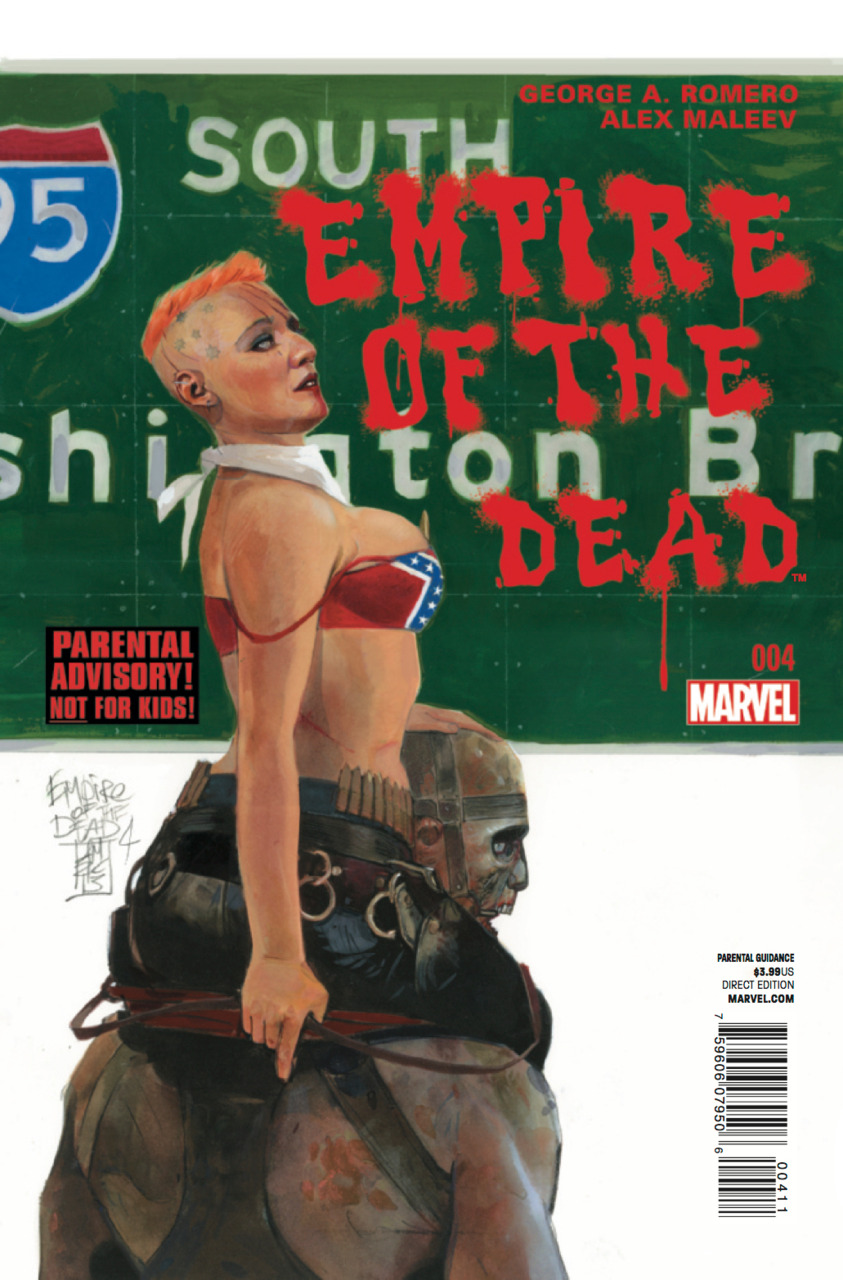
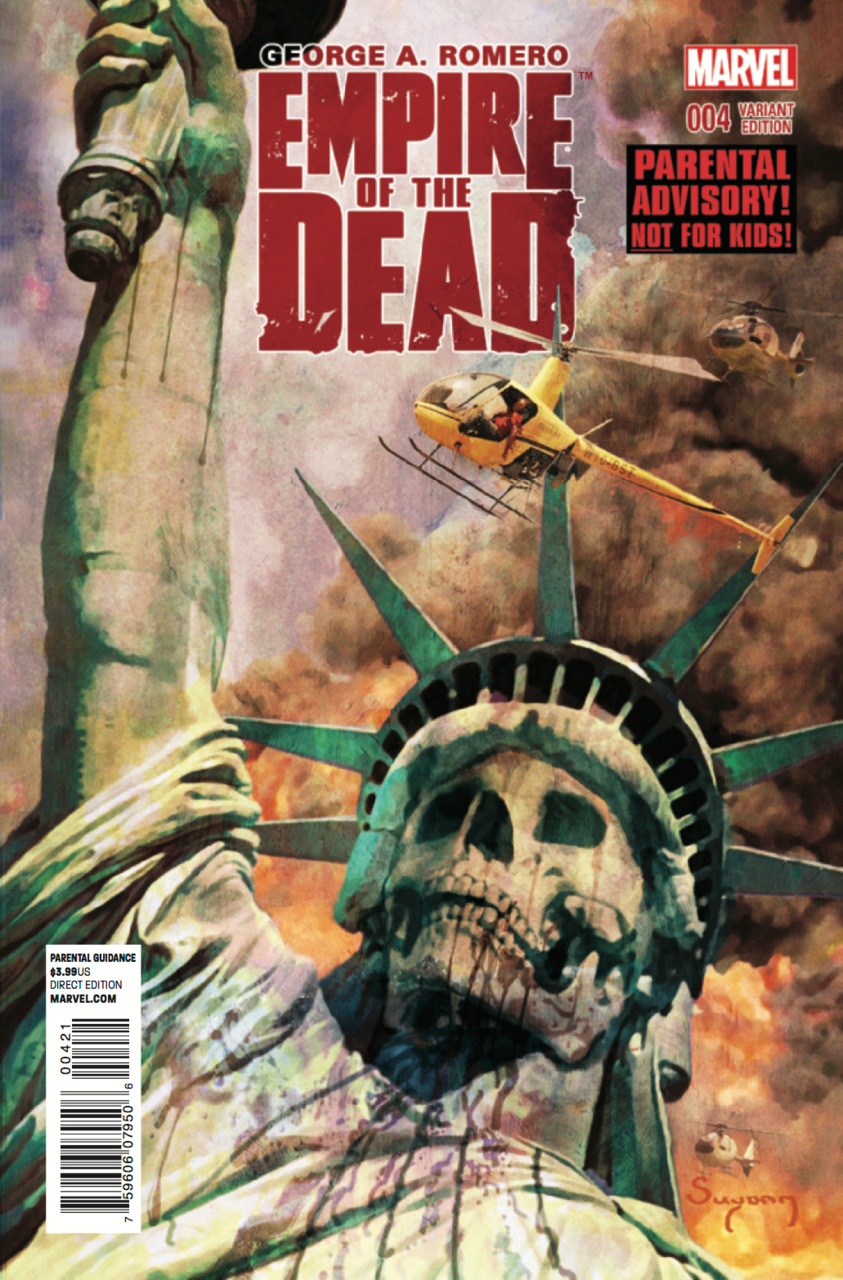
Alex Maleev’s art is enough to keep me coming back for more, as well (his main cover, and Arthur Suydam’s variant, being reproduced above, respectively,  for your edification). He’s just plain hitting it out of the park here, and seems to be gaining more confidence, and a better handle on the grim world he’s depicting, with each issue. I dare say he may even be surpassing the lofty standard he set for himself on  his legendary Daredevil run here. 21 more issues of images as flat-out awesome as those he’s giving us isn’t something I’m going to complain about in the least, and I’m sincerely hoping that the breaks between acts one and two will be a very short one indeed.

“Empire Of The Dead” #3 Shambles Back In The Right Direction


3718046-03

If you’ll recall — and, hell, it remains true even if you don’t — the second issue of Marvel’s “event” mini-series Empire Of The Dead left me feeling decidedly unenthusiastic about this book”s future, given that all it really managed to do was tread water for 20 pages and then stop. But hey — maybe I’ve been a little too quick to judge. It’s been known to happen before.

I’m not here to tell you that Empire Of The Dead #3 (or, to be true to the copyright indicia, George A. Romero’s Empire Of The Dead Act One, #3) regains all the momentum we lost after a really solid first issue, but it does go some way toward explaining a few head-scratching things left over from last time around, like what all those rat slaughterhouses all over town are about (rat blood is provided as nourishment for the vampires who can’t afford the real, human stuff) and why certain factions of the city council are, shall we say, less than taken with Mayor Chandrake’s leadership (turns out they’re all fucking vamps and feel he might be hoarding all the choicest — supplies, shall we say — for himself and his family), and actually does manage, in the midst of all this palace intrigue (some of which, in fairness, is dialogued in incredibly clumsy fashion) to propel the main narrative forward in some interseting new directions, which is a heck of a lot more than the second installment was able to do.

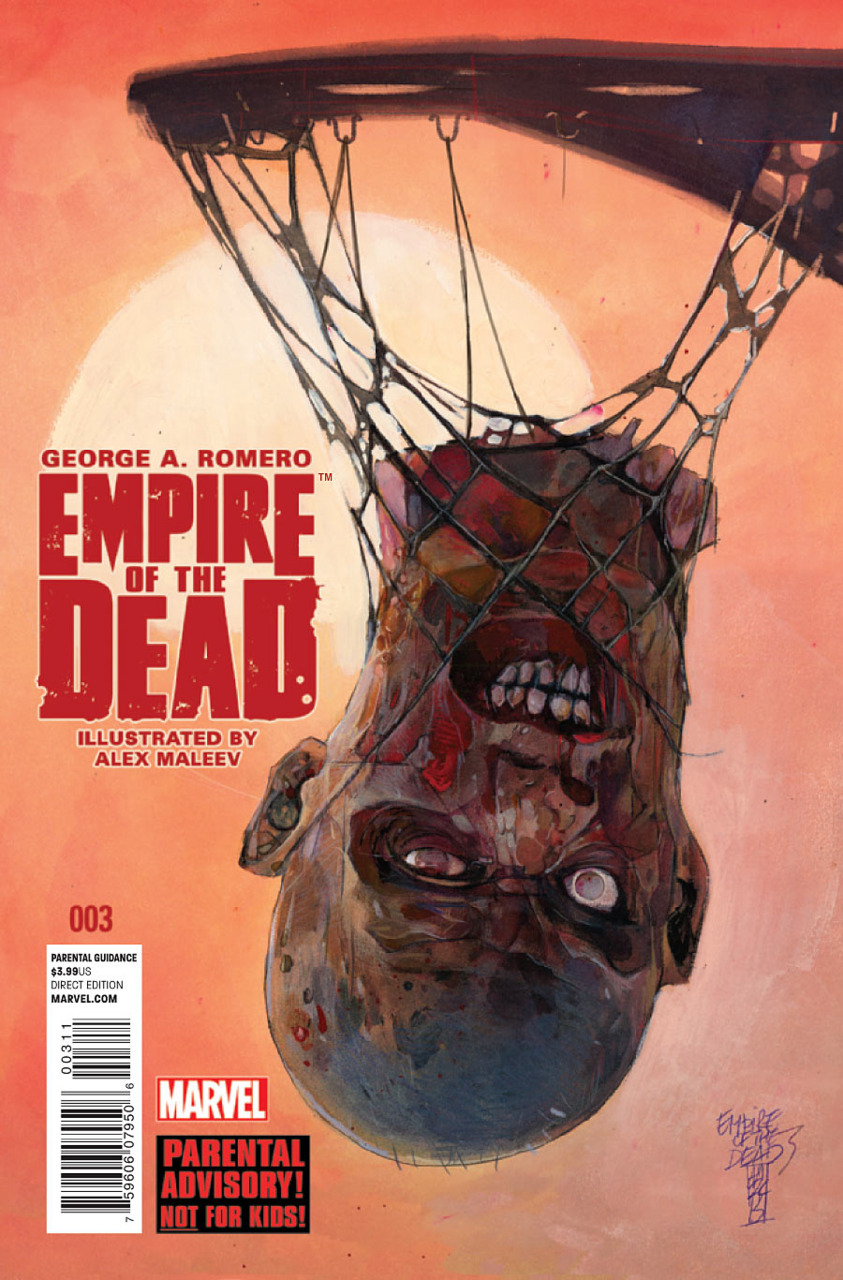
As predicted by anyone and everyone who knows anything about Romero, the relationship between Dr. Penny Jones and former-SWAT-officer-turned-zombie Frances Xavier has quickly become the central focus of this series, since questions of “how different are they from us, anyway?” have been foremost on the father of the modern zombie mythos’ mind at least since he introduced the world to Bub in Day Of The Dead, if not earlier (recall the “this place must have been important to them” line as the undead make their leisurely way through the mall in Dawn for perhaps the first verbalization of this obsession), and it turns out that Xavier is probably even more advanced than we already thought, given that she actually gets bored with some of her less-challenging training exercises/tests and decides she’d rather play some basketball instead (hence that awesome cover art shown at the top of this post).

Things get a little out of hand, though, when — well, that would be telling. Suffice to say this issue ends on a nice cliffhanger that sufficiently whets the appetite for next month’s installment and definitely leaves the reader with a pleasant-enough “hey, maybe things are back on the right track here after all” feeling.

3718333-03-variant

As far as the art goes, I’ve got no cause for complaint whatsoever. Alex Maleev’s “rough sketch” style continues to grow on me, and it’s nice to see a world this un-stylized depicted in such an honest, non-flashy, “warts and all” fashion. Everybody looks as worn down by life (or unlife, as the case may be) as they ought to, and every panel of every page oozes a kind of post-apocalyptic “we’re doing the best we can, but shit, it’s getting tiresome” feel. I dig it a lot — and I dig the heck out of Arthur Suydam’s variant cover (shown directly above) as well — as, I assume, anyone with working eyeballs will.

So yeah — my optimism about this series has returned, and with two issues to go in the opening five-part “act,” it’s safe to say I’ll be on board for both to see how things play out. Some of the major characters — specifically Paul Barnum — still seem under-utilized, but hopefully they’ll get some more to do soon, as well. All in all I have to confess that I should have known better than to doubt The Master — I have renewed  faith  that, wherever he’s taking us, the trip will be worth it.

Treading Water And Sucking Blood : “Empire Of The Dead” #2


3664134-02a


Looking at things in strictly structural terms, second issues are often a tricky wicket in the comic book racket. In today’s marketplace, especially, it’s a pretty safe bet that you’re going to lose nearly half your readership (at the very least) between the first and second installments of any given book simply because cover prices are so fucking high (the going rate for the series under discussion here today, Empire Of The Dead, or as it’s known to Marvel Comics’ legal department, George Romero’s Empire Of The Dead Act One, is $3.99 per 28-page issue, with only 20 of those pages devoted to actual story and art) that a title has to be seriously flawless right out of the gate in order for everybody to shell out their hard-earned cash for a second serving.  So you’d better give the diminished-yet-loyal cadre who have showed up for the second round good reason to keep coming back for more — a nifty plot twist or two never hurts — and you’ve also gotta put in some serious work on fleshing out the world you showed in only the broadest strokes in the series’ debut installment.

With those two admittedly impromptu standards in mind, it’s safe to say that Empire whiffs on the first — badly, in fact — but connects rather nicely on the second, and therefore the end result is a decidedly mixed bag indeed.

3664441-02b


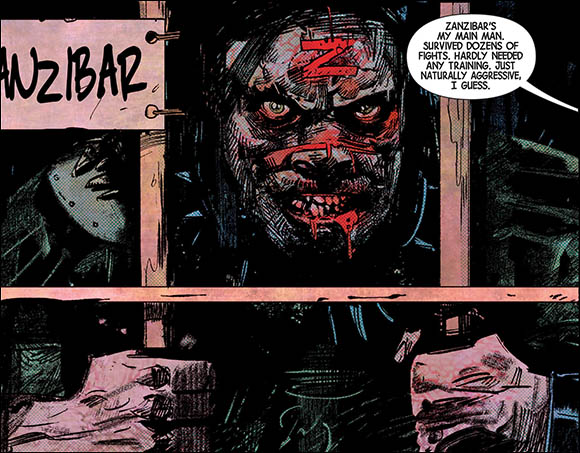
Nothing much happens here in terms of plot progression, with Romero choosing instead to paint a more complete picture of his zombie-and-vampire-infested future New York City. We learn that the devious Mayor Chandrake, his even more devious nephew Bill, and their ghoulish entourage live, appropriately enough, at the infamous Dakota apartment building, and that Bill is a bit reckless in terms of his procurement methods for new flesh (and blood). We learn that SWAT-officer-turned-zombie Francis Xavier is displaying even greater signs of intelligence (or at least more successfully mimicking learned behaviors, as she proves when she arrests a criminal) than previously thought. We learn that uber-zombie Zanzibar is an even bigger bad-ass in the coliseum than we figured by way of a particularly gruesome fight sequence. And we learn that Dr. Penny Jones can be somewhat ruthless in pursuit of her research goals, even going so far as to enlist her feminine wiles to aid her cause.

But that’s about as far as things go here. There is some impressively Bacchanalian excess going on in the Chandrake suites, with carnal blood-letting taking up most of the issue, and there’s some political “court intrigue” introduced in the New York city council, but there’s no real story advancement taking place in the traditional sense, with Romero apparently being content to take this opportunity to merely expound upon his characters and their various situations a bit more fully (except for poor Paul Barnum, who’s scarcely given anything to do). That might work reasonably well for one issue, I suppose,  but we’re going to need more the next time around — a lot more, in fact, especially given that part three will mark the more-than-halfway-point of this initial five-issue arc. I’m not ready to say this second issue was a failure so much as a missed opportunity, but it all hinges on what happens (or doesn’t) next.

3664439-02c

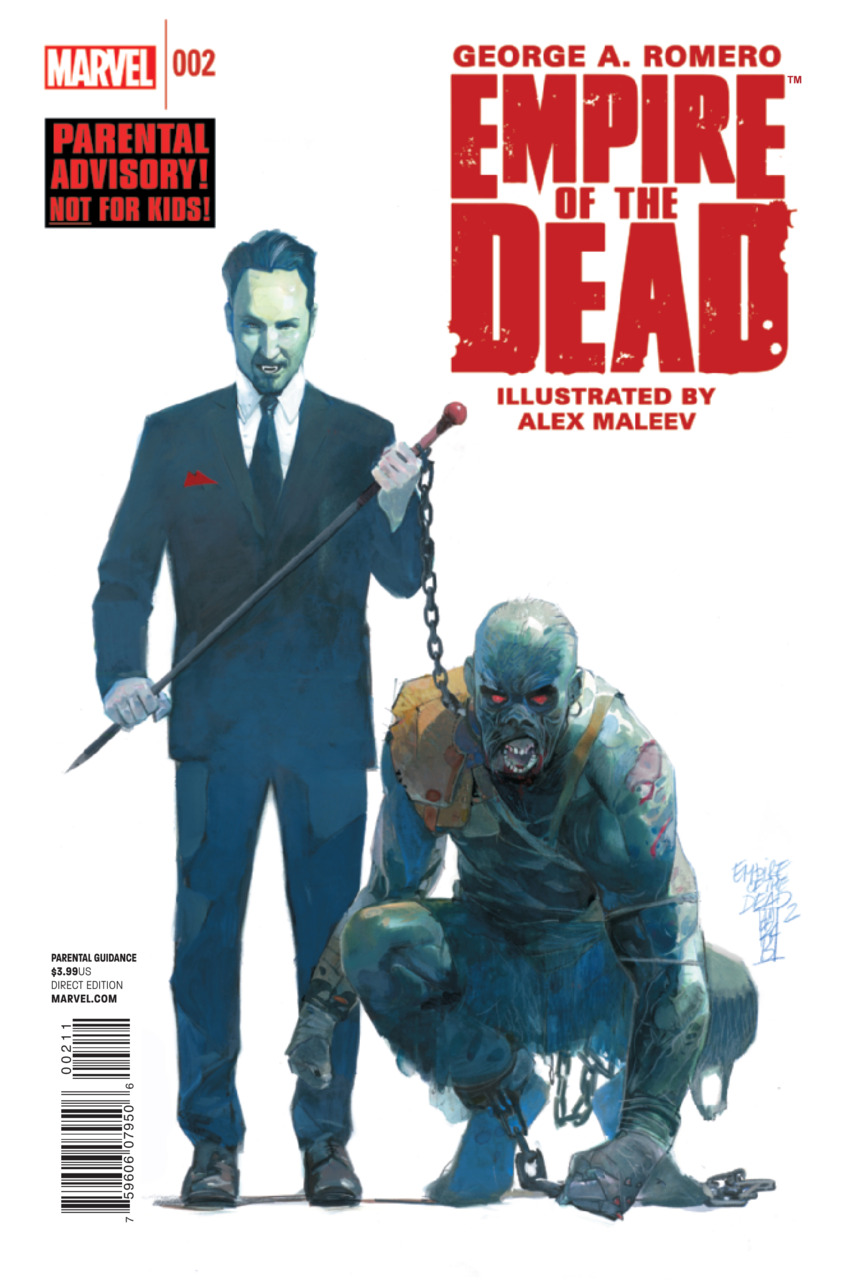
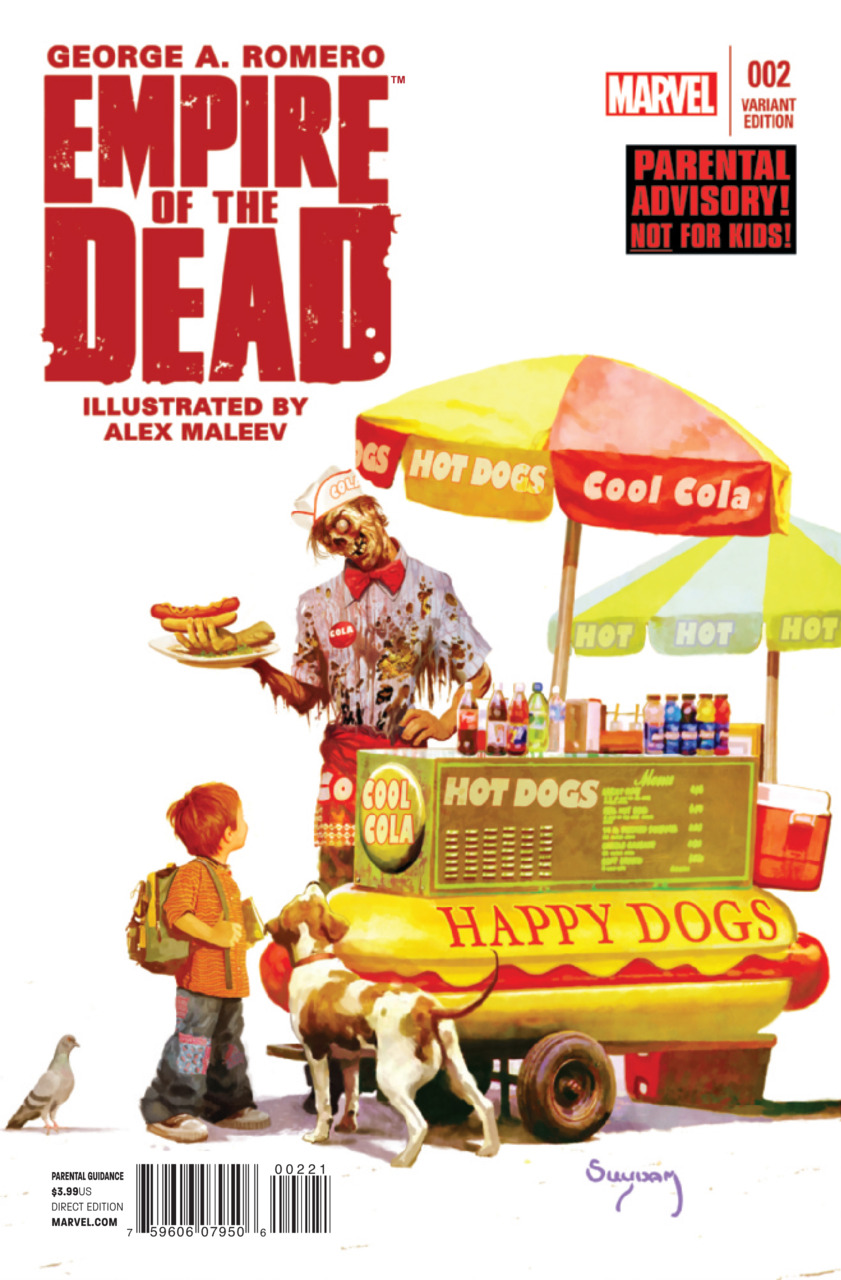
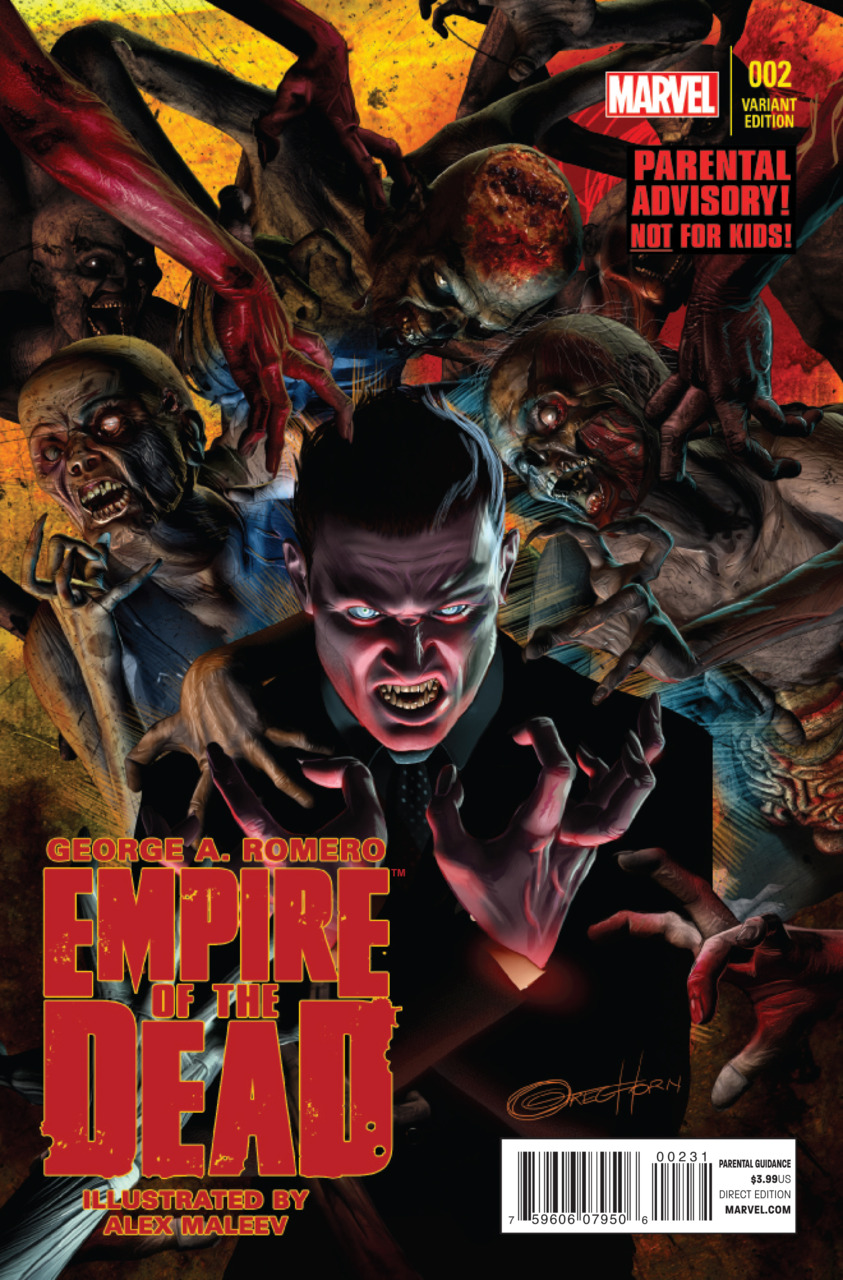
At least the art doesn’t let the side down, though. Alex Maleev’s rough. sketchy illustrations are rich with atmosphere and convey a genuine sense of both brutality and foreboding, while the variant covers (by Maleev, Arthur Suydam, and Greg Horn,  respectively, as shown) are all pretty goddamn cool in their own way. Now it’s just up to “Mr. Zombie” himself, George A. Romero, to give his artist some more interesting things to draw. I’m down for another issue, but the go-nowhere nature of this one has tempered my initial enthusiasm for this series quite a bit.

The ball’s in your court, George. You haven’t let me down yet (as mentioned in my review of issue one I was even a fan of Diary Of The Dead), but this is a  new format for you with new demands — and new possibilities.  I’ve still got exactly $3.99 worth of faith that you won’t disappoint me now, either.


“Empire Of The Dead” : George Romero Brings His Newest Zombie Epic To The Printed Page


3588356-01a

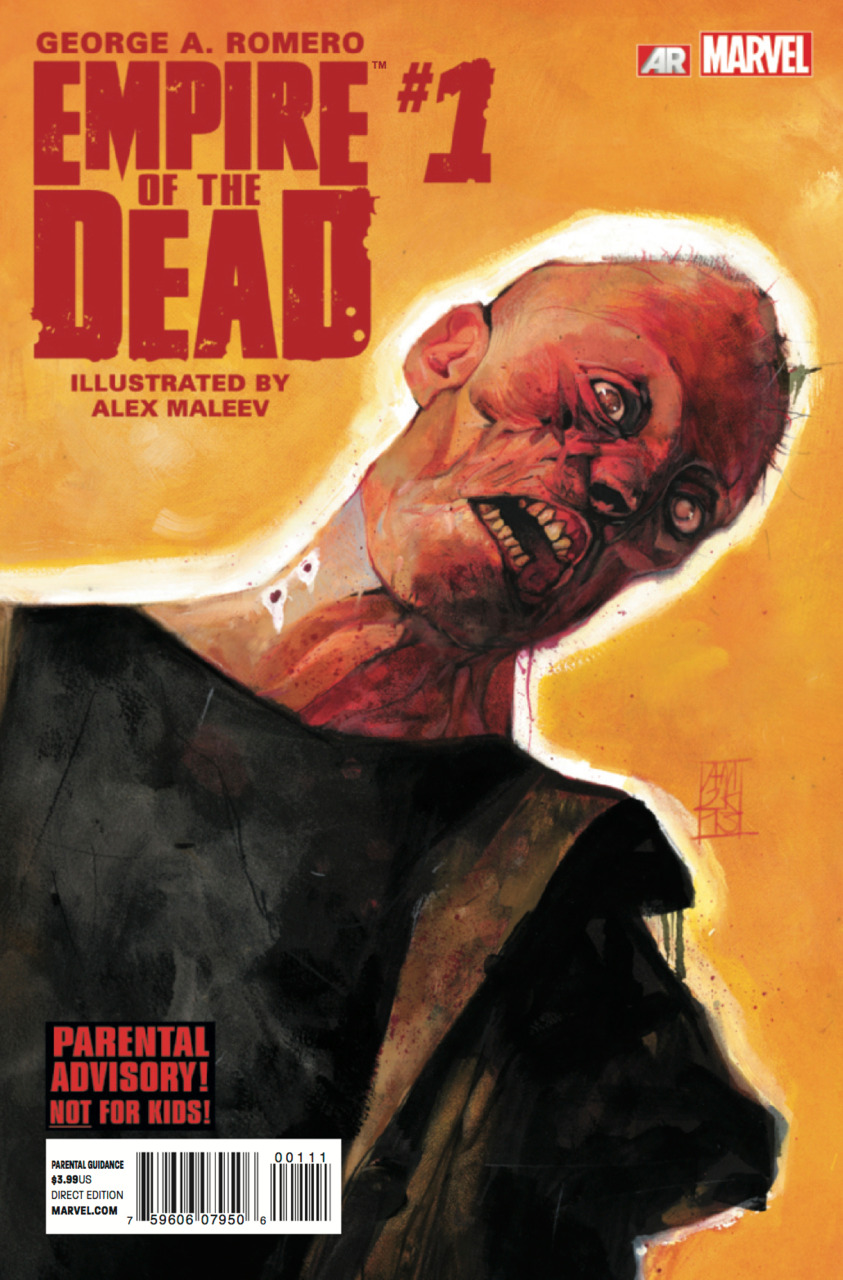
Normally I’m not one for hype, but Marvel’s advertising tagline describing their new series from the father of the modern zombie genre, George A. Romero, as a “comics event” actually strikes me as being a fairly accurate one. I mean, when the guy who gave us Night Of The Living DeadDawn Of The Dead, and Day Of The Dead eschews the silver screen to tell his newest “living dead” story in the comic book format, that’s big news, right?

And from the word “go,” issue #1 of Empire Of The Dead (okay, fair enough, its complete title, according to the copyright indicia,  is George Romero’s Empire Of The Dead Act One, Number 1) has a suitably “big” feel to it, and even though artist Alex Maleev approaches his work in a sketchy, rough, “stripped-down” style — which is flat-out gorgeous, by the way — the overall tone here is much more, if you’ll forgive the term, “epic,” than certainly Romero’s last two (very much under-appreciated) film efforts, Diary Of The Dead and Survival Of The Dead, were.

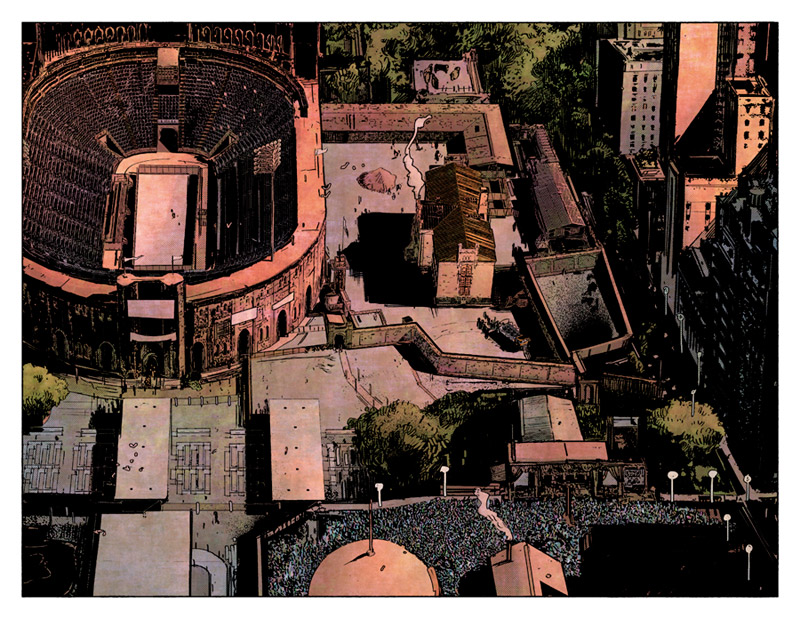
The setting is New York City, five years after the dead began to walk, and things are, as you’d expect, a mess. Corrupt Mayor Chandrake and his creepy nephew hold the city in their thrall by providing Roman Gladiator-style “Zombie Fights” in Yankee stadium that serve to distract a weary populace from the fact that all the resources — well, all the resources that remain, at any rate — are flowing right to the top. A moneyed elite lives in luxury while the populace starves. Sound familiar?

Our two main points of audience identification in the midst of this neo-feudalistic dystopia are Columbia University research scientist Dr. Penny Jones, who’s looking for a zombie with the potential to be, if not educated, at least domesticated, and her guide through the undead part of town, a privateer of sorts who captures zombies for use in the arena named Paul Barnum, whose main claim to fame is having “discovered” current champion fighter Zanzibar.

Empire-of-the-Dead-1-Remembered

Obviously, even at this early stage (Act One is slated to run five issues, with further mini-series to follow) parallels to previous Romero works abound. Penny shares the same research obsessions as Richard Liberty’s Dr. Logan character from Day Of The Dead, while Barnum is essentially a stand-in for Simon Baker’s Riley Denbo from Land Of The Dead. There’s a flashback sequence that intimates strongly that this story takes place in the same fictional “universe” as Night Of The Living Dead, and the economic set-up is, again, essentially the same 1%-vs.-99% scenario that the more-seemingly-prescient-by-the-day Land offered up, with Mayor Chandrake filling the role of Dennis Hopper’s Kaufman. Meanwhile  Zanzibar, for his part, seems to be being groomed for a role not too dissimilar from that of Bub in Day.

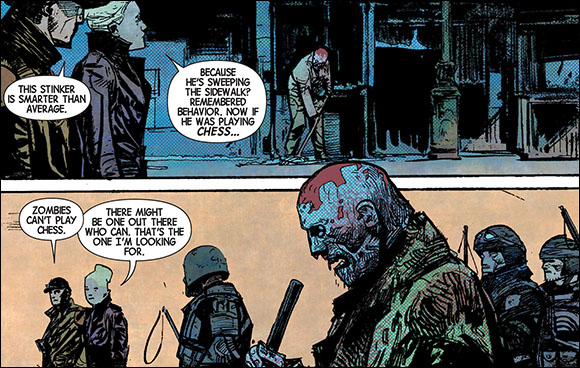
Don’t think it’s all re-hash, though — for one thing, moving things from Pittsburgh and its immediate environs to the Big Apple ups the scale quite a bit, the text blocks Romero employs to flesh out how the zombies “think” provide intriguing new insight into the workings of their rudimentary “consciousness,” the martial-law-type scenario that pervades on the streets adds a new , thematically-relevant wrinkle, and the surprising climax to issue one shows — and I sincerely hope that I’m not giving too much away here — that zombies aren’t the only ghouls in town.

empire_of_the_dead_001_preview_2

So, yeah — there’s enough “newness” here to imbue the proceedings with a reasonably fresh take on things, but for those of us who are old-school Romero die-hards, the story is chock-full of enough familiar themes and tropes to keep us both smiling and anxious for more. The set-up is inherently and immediately topical and politically charged (Occupy The Living Dead, anyone?), and, like all of the maestro’s best work, Empire promises to use its zombies as a stand-in for ourselves, and to utilize its post- apocalyptic sworld to shine some welcome light on uncomfortable, but essential, truths about our own current socio-economic predicament.

Empire-of-the-Dead-1-Zanzibar


For my part, I’m all in on this one, despite having numerous ethical qualms about spending so much as a single dollar (not to mention a hefty $3.99 per issue) on any Marvel product. I think we’re looking at another Romero classic-in-the-making here, and I can’t wait to see where it goes.


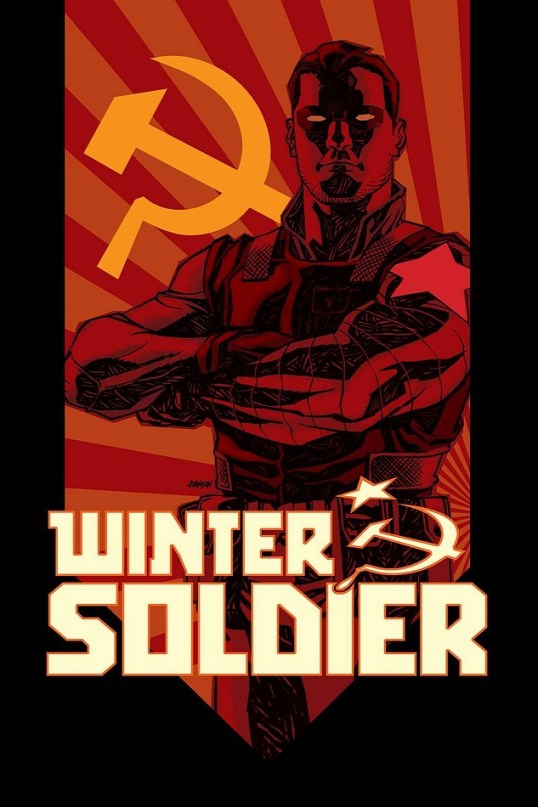
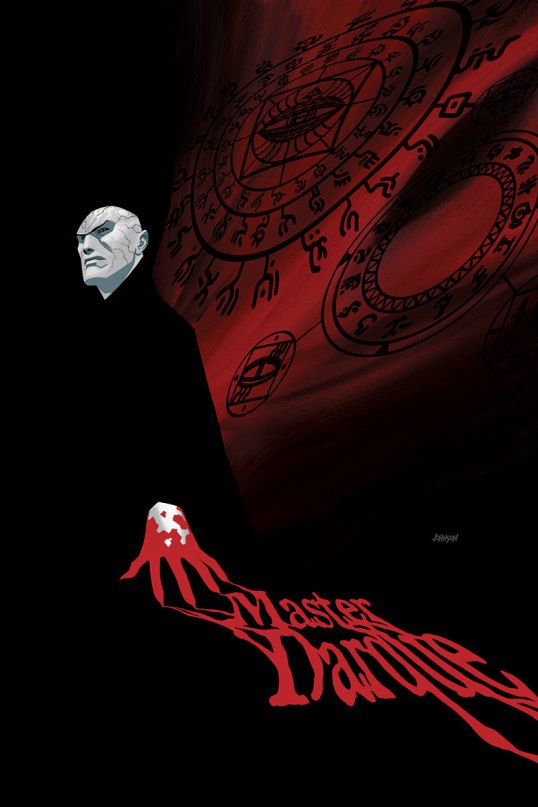
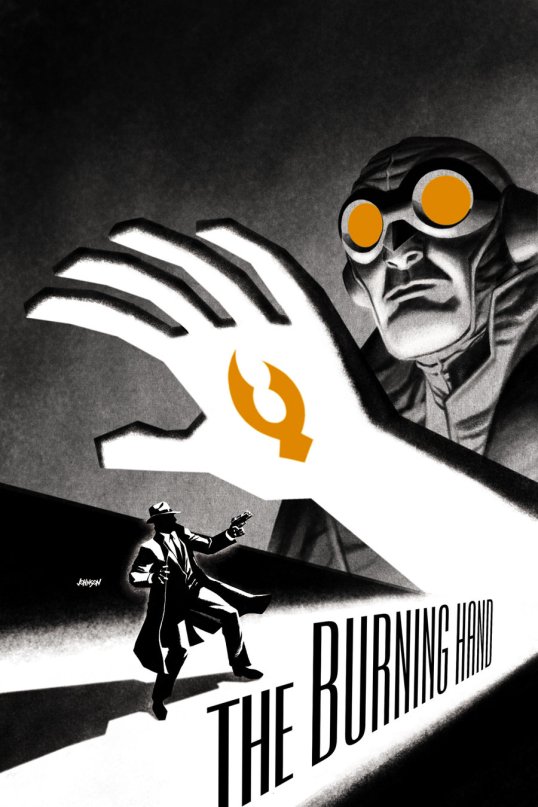
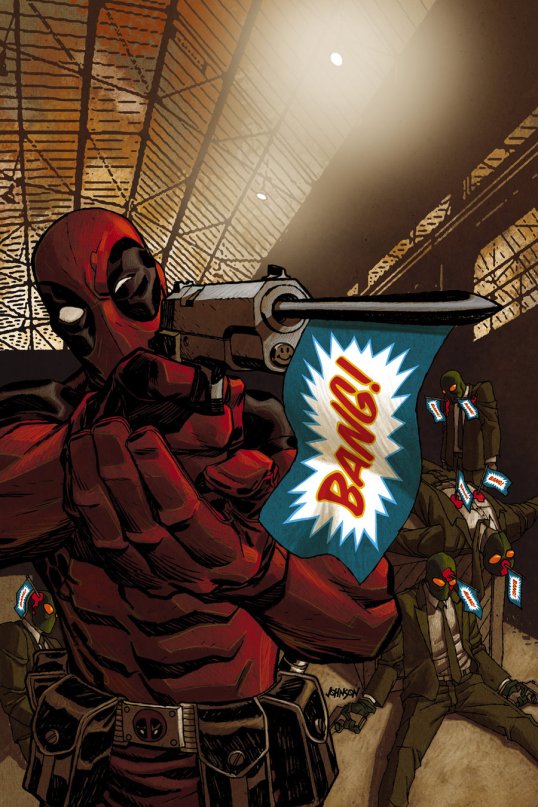
Artist Profile: Dave Johnson


Dave Johnson07

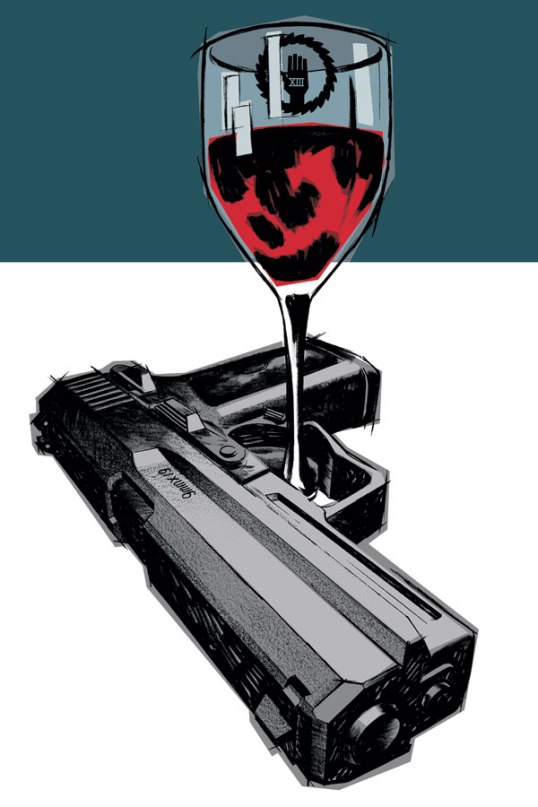
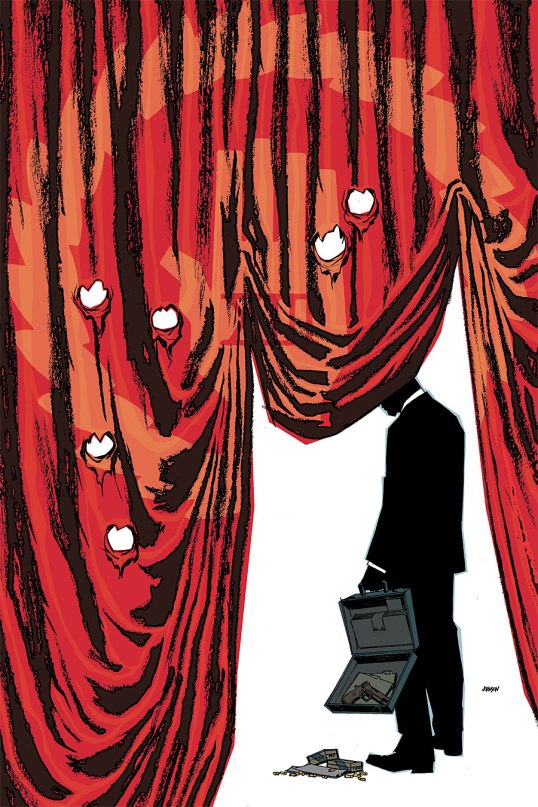
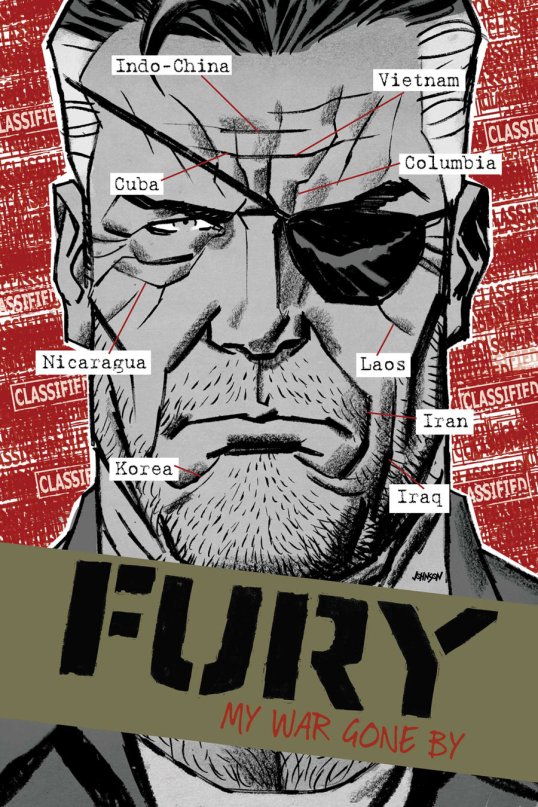
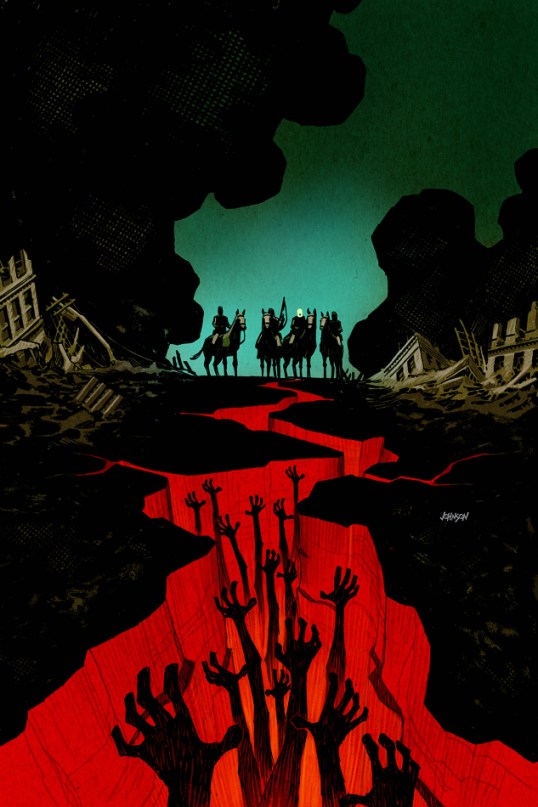
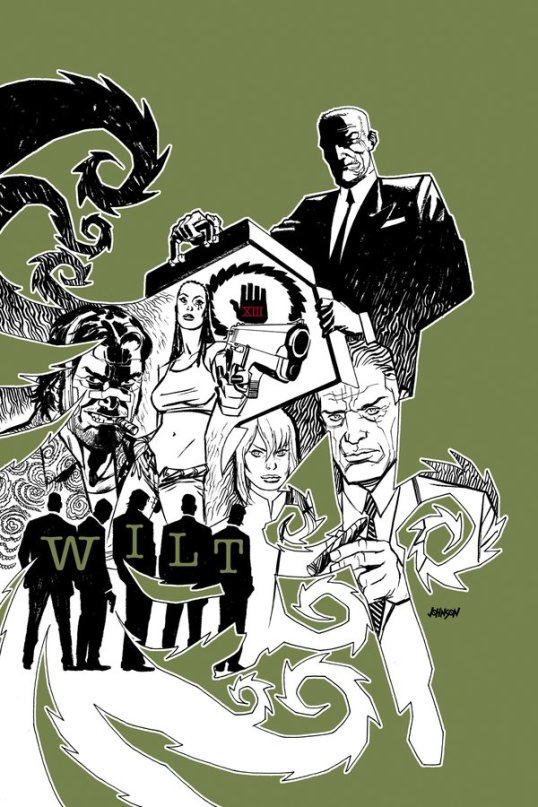
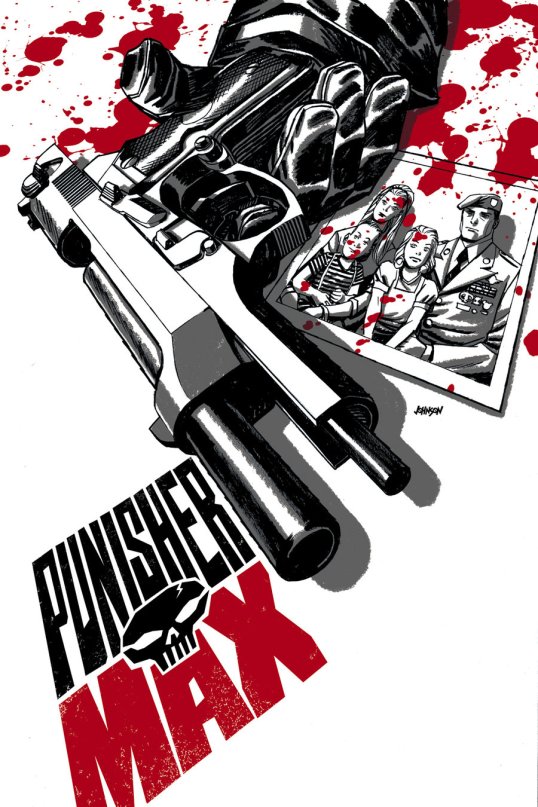
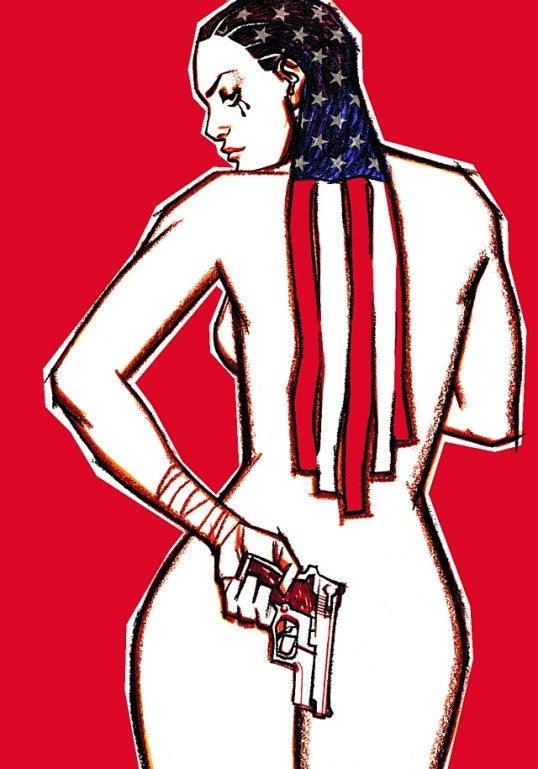
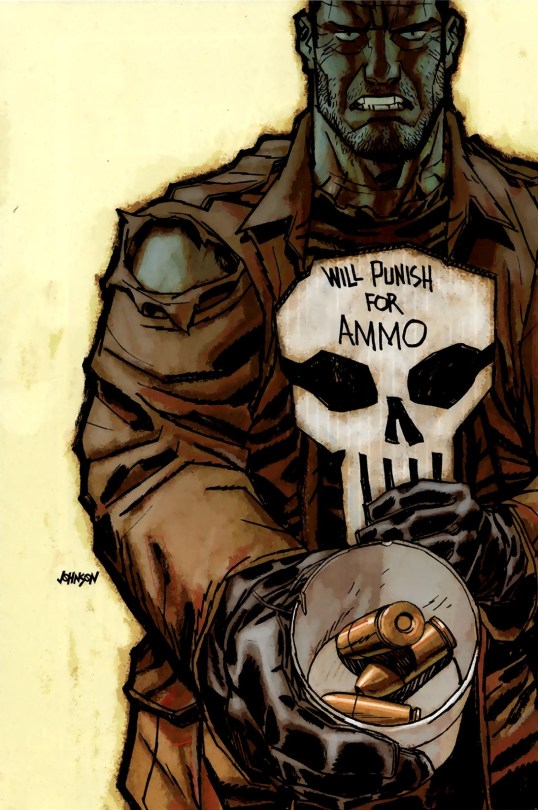
Dave Johnson has earned the reputation of being one of the comic industry’s preeminent cover illustrator. His work has graced the covers of such titles as Vertigo’s 100 Bullets (where he creates the covers to all one hundred issues and the 11 trade paperback collections) and Marvel Comics’ Punisher MAX series. Dave Johnson’s work as a cover illustrator has won him one of the top awards in the comics industry with his 2002 Eisner Award for “Best Cover Artist”.

Born on April 4, 1966, Dave Johnson continues to work as a cover artist for all the different publishers from DC, Marvel, Dark Horse and a slew of independent houses.

Dave Johnson01

Dave Johnson02

Dave Johnson03

Dave Johnson04

Dave Johnson05

Dave johnson06

Dave Johnson08

Dave Johnson09

Dave Johnson11

Dave Johnson12

Dave Johnson15

Dave Johnson16

Trailer: Iron Man 3 (Super Bowl Exclusive)


IronMan3

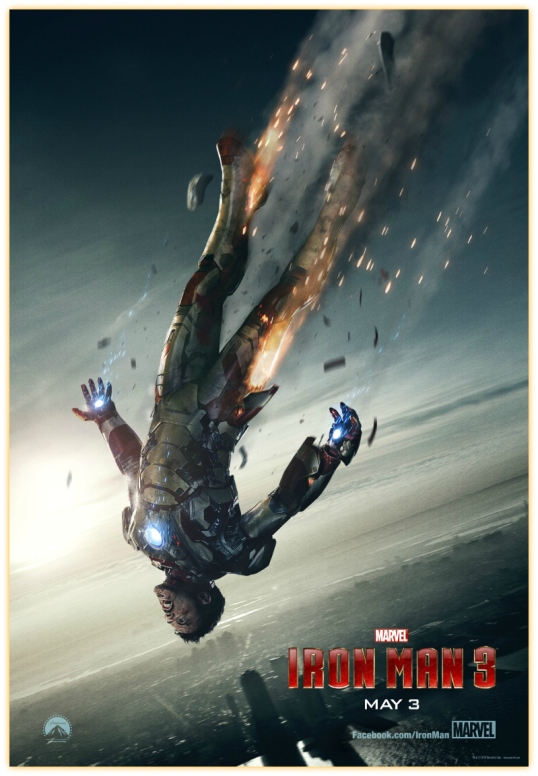
Iron Man 3 will be the film from Walt Disney and Marvel Studios that will kick-off those studios’ Phase Two of their Marvel Cinematic Universe. It was the Galactus-sized success of 2012’s The Avengers which this newest phase will have to live up to and with new director on-board (Shane Black taking over the director’s chair from Jon Favreau) and the original cast back with new faces on-board (Sir Ben Kingsley, Rebecca Hall, Guy Pearce and James Badge Dale to name a few of the new names).

It’s now 2013 and just a few more months before Iron Man 3 makes it’s worldwide premiere and what better place to start the hype and marketing ad machine that will lead up to that premiere by releasing the latest trailer for the film than during one of the biggest one-day event in the world: the Super Bowl.

Iron Man 3 is set for an international release date of April 25, 2013 with a UK premiere in April 26, 2013 after then a North American release in May 3, 2013.

Without further ado the Super Bowl exclusive Iron Man 3.

Source: Joblo Movie Network

Review: The Amazing Spider-Man (dir. by Marc Webb)


It was in the summer of 2002 that the superhero film genre finally entered it’s Golden Age (or Silver Age for some). X-Men had come out two years before to positive acclaim and, most importantly, in the box-office. It wasn’t until Sam Raimi released the first in what would be his trilogy in the Spider-Man film franchise that superhero comic book films became the power in Hollywood it remains to this day. The first film from Raimi easily captured the pulp and campy sensibilities of the source material and for an origin story film it was done quite well in that it introduced the titular character and what made him tick. In 2004, Raimi and company released what many consider the best comic book film with Spider-Man 2. The film brought a level of Greek tragedy to the fun of the first film and it definitely brought one of the best realized comic book villains on film with Alfred Molina as Dr. Octopus. Then the franchise hit a major bump in 2007 with Raimi third entry in the franchise with the bloated Spider-Man 3.

Sony Pictures, who owned the film rights to the Spider-Man franchise, were so quick to churn out a fourth film, but in doing so lost the filmmaker and cast that made the trilogy happen. In the studios’ thinking they needed to get a fourth film up and running in order to keep the rights to the film from reverting back to Marvel and Disney. So, out goes Sam Raimi, Tobey Maguire and Kirsten Dunst and in comes Marc Webb, Andrew Garfield and Emma Stone. Instead of getting Spider-Man 4 we get The Amazing Spider-Man which doesn’t continue what Raimi had established with the first three films, but reboots the franchise all the way to the beginning.

Marc Webb takes the screenplay worked on by a trio of screenwriters (James Vanderbilt, Alvin Sargent, Steve Kloves) and reboots the origin story of Peter Parker’s transformation into Spider-Man. We find Peter Parker back in high school as a student and still getting bullied by Flash Thompson while remaining awkward around girls (especially one Gwen Stacy played by Emma Stone). yet, before we even get to this part of the film we get an introductory coda where we find a preadolescent Peter Parker playing hide and seek with his scientist father. These early scenes show hints that the enhanced spider thatwill bite and give eter his abilities may have had his father’s research and work written all over it.

This intro influences much of the storyline and leaves a huge impact on the character of Peter Parker which the previous three films never explored. The rest of the film has Peter investigating the circumstances of his parent’s disappearance and his adjustment to having been given the superhuman abilities by the spider that his father may or may not have been responsible in breeding.

First off, the film does a good job in re-establishing Peter Parker as a high school student. The original film spent some time in this part of Peter Parker’s life but never truly explored it. We see Peter not just the class genius, but also one who also shows an affinity for photography (something that the original trilogy never really explained other than he needed the job and money). There’s also some added layers to the character as this version of Peter Parker is more than willing to stand up to the bullies picking on the weaker students other than himself. It’s a huge departure from the meek and geeky Peter Parker of the past. We still get a geeky and smart Peter, but one who is also a sort of a well-intentioned slacker. We also get a proper introduction for Gwen Stacy (something the third film criminally mishandled)

The film introduces once again many of the characters the first film in the series had already done. From Uncle Ben (played by Martin Sheen this time around) and Aunt May (Sally Field) right up to the robber who runs into Uncle Ben and changes Peter Parker’s outlook on his role as a hero forever. Again these were character that had already been explored by the first three films and they’re scenes that had an air of familiarity to them though Sheen performance as Uncle Ben added more layers to the character who becomes Peter Parker’s moral center.

Another thing that the film did a good job with was the design of the film. It has been ten years since the first film and the technology in CGI-effects has leapfrogged exponentially since. The look of the OsCorp Tower was a beautiful piece of architectural design. The building loomed over New York City like something dark with a hint of malice. There were changes to the suit Peter wears that really harkens back to the McFarlane years of the Spider-Man comics. Even the return of the web-shooters was a nice surprise that I had some reservations when first hearing about it.

A third good thing about the film was the extended montage when Peter Parker realizes he has gained new abilities and begins to test them out. It’s familiar territory from the first film, but Marc Webb and Andrew Garfield adds a new level of youthful exuberance to the proceedings. Even the use of parkour by Peter Parker to show his growing abilities didn’t come off as silly. Garfield’s performance as Peter Parker in this montage was pretty great. One could believe at how much fun he was having at discovering each new level of abilities. Even some of the growing pains he goes through after getting bit were some of the more hilarious moments in the film that ultimately lacked much of it in the end.

Which brings us to what made this entertaining film end up becoming a failure in the end.

I admit that the film entertained me in the end, but there were things aboutThe Amazing Spider-Manwhich nagged at me throughout and afterwards. While the film was entertaining the story self and most of the characters were inconsistently written. Once one looked past the action and some of the witty dialogue in the beginning the film’s many plot-holes and head-scratching moments become too glaring to ignore.

The character of Peter Parker does get some new layers of characterization in the beginning, but as the film played out the more the Peter Parker of this film began to stray away from not just what Raimi had created and guided through the first three films but also most of the character’s decade’s long growth in the comics. Yes, we see Peter Parker as the science-genius and even moreso than the one portrayed by Tobey Maguire, but we also don’t get the awkward teen who grows into his abilities, but most importantly, one who learns through tragedy that he has a responsibility to the people around him to protect them even if it means sacrificing his wants and dreams to do so. We don’t just see Peter Parker saving people, but also one who seemed to relish beating up and abusing those who used to do the same to him and/or others. Spider-Man in this film acts more like a bully than a reluctant hero by film’s end. Even the events that should’ve taught him the lessons of self-sacrifice and heeding the needs of the many fail to make much of an impact on the teen superhero. All one has to look at as the perfect example of this darker and more selfish turn to the character was Peter’s whisper to Gwen about promises not being kept being the best ones.

Other characters get inconsistencies in how they’re written. The other big one being Dr. Curt Connors who begins the film as a scientist so intent of not just curing his disability but also helping the world. It’s a character similar in tone to Alfred Molina as Dr. Octopus, yet where that villain remained a tragic one throughout the film and we could see the path which led him to become a villain with Dr. Connors in this fourth film there’s such a huge turnabout in the character’s motivations that whatever sympathy we may have had for Connors was squandered.

Not every character fails to impress. Martin Sheen and Denis Leary as Uncle Ben and Capt. Stacy respectively were fully realized characters who become Peter Parker’s moral centers and voice of reason. In fact, both Sheen and Leary helped anchor the scenes they appeared in and thus made their characters’ fate have the sort of emotional impact that a growing hero needs to move from being reluctant to accepting of his lot in life. It’s a shame that the writers failed to capitalize on the performances of these two character actors to help make Peter Parker more a hero and less a teenager more in love with what he can do instead of realizing that he has more to offer those who are weakest.

This is not to say that the performances by the cast was bad. From Garfield and Stone right up to Ifans, Sheen, Leary and Field, the cast did a great job with an uneven and inconsistent script that was too full of themes and ideas but no focus on any one of them. It’s a wasted opportunity to build on what the previous cast of the three films had created. Even the third film which many would agree as being a huge, bloated mess actually had a singular focus. It was a story that tried to explore Peter Parker’s darker side andhow his life as a superhero negatively impacts everyone around him he cares for. With this Marc Webb production we get a Peter Parker who at times was compassionate when it came to others being bullied and then we get one who relished on doing the same to those he now sees deserving of payback. Even Parker’s hunt for his uncle’s killer which the film spent a considerable time following just got dropped without any sort of resolution. One of the most significant events in Peter’s life gets dumped to the wayside to concentrate on finally pitting Spider-Man against the film’s Lizard.

Did The Amazing Spider-Man need to have gotten made? The answer to that would be a yes.

Did Marc Webb, the three writers in Vanderbilt, Sargent and Kloves and the new cast get the reboot correctly? I would say no.

This was a film that spent too much time reintroducing characters both comic book and film fans already knew intimately. The storyline itself shared many similarities to the second film in the series yet none of the cohesiveness which made that first sequel such an instant classic the moment it premiered in 2004. The Amazing Spider-Man spent so much time trying to come off as a grittier and edgier version of the character (I call this the Christopher Nolan-effect) that what should’ve been coming off as a fun-loving, albeit self-sacrificing hero, came off as a dick once he finally got the full costume on. The people in charge of this reboot sacrificed what was fun about the film franchise for realism that the character and his universe were never steeped in to begin with.

Gritty, edgy and realism may work for Nolan’s take on the Batman film franchise, but for Spidey it fails and just turns what could’ve been a fresh new take on the franchise into another entertaining, but ultimately forgettable entry in the series. Maybe it’s time Sony just realize that it’s just pushing this franchise downhill and let the rights revert back to Marvel who seem to have found a balance between pulpy camp and serious realism.

Okay, So I Saw “The Avengers”


Or should that be “Okay, so I saw Marvel’s The Avengers ?”

In any case, I wasn’t going to. I was determined not to participate in the so-called “biggest event of the summer” because I’m flat-out tired of seeing Marvel (and, by extension, Disney) rake in hundreds of millions, if not billions, of dollars off the fruits of Jack Kirby’s imagination while “The King’s” estate gets more or less nothing (although in fairness — or should that be unfairness — they do get some sort of pittance for anything featuring Captain America in it, since he’s officially recognized as Cap’s co-creator along with Joe Simon). Stan Lee’s recent comments about Jack didn’t do much to up my enthusiasm level for this latest blockbuster either, and basically reaffirmed my opinion that he’s a major-league asshole who was lucky enough to glom onto the works a true creative genius that now he doesn’t even have the decency to acknowledge, much less thank, so yeah — it’s fair to say I was pretty cool to this whole thing and found most of the absolute gushing over it that’s been infecting the internet, Twitter in particular, to be annoying in the extreme.

But then the folks who are trying to put together The Jack Kirby Museum came up with a novel idea — donate the price of your ticket to their brick-and-mortar fund, so that future generations can have an actual, physical place to go and experience first-hand the power of the unfettered creative genius that everyone else but his family has gotten rich off. That sounded good to me, so for the price of a $7.50 admission and a matching $7.50 donation, my conscience was suitably assuaged  — hey, I guess I always knew there was some price at which my principles could be sold out, but it’s rather depressing to think that it could be so cheap. Still, best not to spend too much time dwelling on that —

Anyway, before I kick over the hornet’s nest of fan opinion, let me state for the record that I found The Avengers to be a perfectly fun, generally-well-executed, thoroughly entertaining superhero romp. But (and you knew there was a “but” coming, didn’t you?) — that’s all it is.

Sorry, assembled hordes of fandom, but it’s not “groundbreaking,” it’s far from “the best superhero movie ever,” (hello? The Dark Knight? Batman Begins? Spider-Man 2? Superman :  The Movie?) much less “the best comic book adaptation ever,” (hello again? American Splendor? Ghost World? Sin City? A History Of Violence?) and it doesn’t “prove” that co-writer/director Joss Whedon is a “visionary,” or the “new master of the superhero genre.”

And all those quotes I  pulled are, frankly, just a sampling of some of the less effusive praise I’ve seen bandied about online in regard to this flick. I’ve also seen it called “the new benchmark by which all others will be judged,” “the summer blockbuster to end them all,” “a singular work of astonishing breadth and scope,” and “the defining cinematic statement from the undisputed master of the craft.”

In this armchair critic’s opinion, unpopular as saying so is bound to make me, it’s none of those things. Not even close. Whedon has concocted a nice little script and brought it to life in an appealing and pleasant manner, but this isn’t a movie that bears any authorial signature whatsoever — if the credits were blank and someone told you it was directed by, say, Jon Favreau, you’d believe it, because it plays out pretty much exactly the same, in tone and style, as either of the two Iron Man films, and it doesn’t have anything like the individualistic flair of Kenneth Branagh’s Thor or Joe Johnson’s Captain America : The First Avenger. Hell, it even completely overuses the tedious inside-the-helmet perspective shots of Robert Downey Jr.’s head that Favreau is so annoyingly fond of.

In addition, our guy Joss shows no particularly deft touch with his cast. The acting ranges from surprisingly good (Mark Ruffalo positively nails it as Bruce Banner) to completely lethargic (Scarlett Johansson is completely listless as the Black Widow and is the least-convincing Russian superspy in movie history). Downey plays himself, as always, and the talented Jeremy Renner is criminally underutilized as Hawkeye, while both Chris Hemsworth’s Thor and Tom Hiddleston’s Loki, the central villain of the piece, came off much better in Branagh’s flick. Samuel L. Jackson pretty much owns every scene he’s in as Nick Fury, but I don’t think there was ever really any doubt that he would. All told,  the whole thing has the feeling of a director who just told his cast “okay — have at it” and then let the cameras roll.

In his favor, fandom’s newest and biggest crush does do a nice, pacy job with the action sequences, of which there are many (although even he can’t make the bog-standard CGI alien invaders that attack the Earth at the end and, yawn, double-cross Loki seem interesting), and doesn’t overplay his hand in the pathos department — he gives each and every character a nice little individual “story arc” that never taxes the imagination too much and remains dimly interesting without seeming intrusive vis-a-vis the “bigger picture” — which is, of course, to show all these folks coming together and fighting a menace big enough to require their assembled talents and abilities. And while Whedon has an annoying habit of defusing every potentially tense situation with a pithy little quip of some sort, on the whole the interplay between the various characters is reasonably well-handled and plausible (as far as these things so).

So The Avengers has some pluses in its favor, as well as some minuses working against it. It’s good, solid, mindless summer entertainment with a nifty, if thoroughly uninspired, visual sensibility; it plays to what the fans want in a generally competent manner; and it keeps you at least modestly interested in the proceedings throughout. It doesn’t have the mythic scope of Donner’s Superman, nor does it redefine the possibilities inherent in the superhero genre in the way Nolan’s Batman films do. It doesn’t take the time to examine the gap between what these characters symbolize and who they actually are in the way that Marvel’s two far superior summer blockbusters of last year (again, Thor and Captain America : The First Avenger) did — hell, it doesn’t even have much of anything to say about the human condition, much less the superhuman condition. And while it’s all pretty fun to look at by and large, it doesn’t have the inventive, groundbreaking, downright operatic visual flair of Burton’s forays into Gotham City. So it’s fair to say that even the things this movie does well have been done a lot better in other films of this same genre.

But it is fun. Not as fun, or as immediate, or as dramatic, or as dynamic, as the classic Avengers stories brought to life by Jack Kirby that it’s essentially a modernized (and, frankly, watered-down — proof that “The King” could do more with a pencil than Whedon can with a couple hundred million bucks) rehash of, but a good time nonetheless — and in a society as desperate for diversion and spectacle as the one we live in, I can certainly understand why it’s such a big hit. But please. Let’s stop pretending it’s anything more than what it is — modestly-well-realized, lively,  big-budget summer fun that doesn’t demand anything from its audience apart from kicking back and enjoying the ride. And let’s stop venerating Joss Whedon for what’s essentially a director-for-hire project executed in what’s basically become Marvel’s “house style.” Sure, there’s a good possibility that the financial success of The Avengers means he might be able to write his own ticket in Hollywood from here on out — and more power to him if that’s the case since other projects he’s helmed (most notably the excellent sci-fi TV series Firefly) do indeed show that he’s capable of distinctive, highly imaginative drama — but it’s just as likely that Marvel will replace him on this film’s inevitable sequel with some youthful up-and-comer who can deliver essentially the same product and will work for half the price.

Once the novelty of having all these superheroes on screen together wears off, I predict that we’re going to realize we’ve been had a little bit here — but seeing as how we had a pretty good time in the process, there’s no real harm done.