October True Crime: Too Close To Home (dir by Bill Corcoran)


The 1997 film Too Close To Comfort tells the disturbing story of the Donahues.

Nick Donahue (Rick Schroder) is a young attorney, a law school grad who has just joined the bar and who is still making a name for himself as a defense attorney.  He’s good at his job and if you have any doubts, his mother Diane (Judith Light) will be there to tell you why you’re incorrect.  Diane and Nick still live together.  They have the type of relationship where Diane casually walks into the bathroom to talk to Nick while he’s in the shower.

In short, they have a very creepy relationship.

Nick talks about needing to get a place of his own but his mother says that it’s too soon for him to spend all that money.  Nick wants to fall in love and marry a nice girl and start a family.  Diane doesn’t want Nick to have a life separate from her.  When Nick does end up marrying the sweet-natured Abby (Sarah Trigger), Diane snaps.  One night, Abby is abducted and is later found murdered.  Nick sobs and Diane holds her son and she doesn’t mention the fact that she’s the one who arranged for Abby to be killed.

The police figure it out, of course.  Diane wasn’t that clever.  When Diane is arrested and put on trial for murder, Nick is shocked.  With his mother facing the death penalty for murdering his wife, Nick steps forward to defend his mother in court.

Agck!  This movie!  Admittedly, this is a made-for-TV movie but it’s still creepy as Hell.  If anything, the fact that it was made for television make it even creepier than if it was a uncensored feature film.  Held back by the rule of television, the film has to hint at what would probably otherwise be portrayed as explicit.  That makes all of the little moments that indicate Diane’s madness all the more disturbing and frightening because they could be read several different ways.  This is a film where every line is full of a very icky subtext.  Diane is more than just an overprotective mother.  Her feelings for Nick are on a whole other level.

Fortunately, Judith Light is one of those actresses who excels at communicating subtext.  She delivers every line with just enough of an inflection that we know what she’s saying even if she doesn’t actually say it.  From rolling her eyes when Nick asks her to turn around when he gets out of the shower to the scene where she flirts with Nick’s new landlord, Light leaves little doubt as to what really going through Diane’s mind.  Rick Schroder has a far more simpler role as Nick but he still does a good job with the role.  He’s sympathetic, even when he’s refusing to accept the truth about his mother.

This film is all the more disturbing due to being loosely based on a true story.  The real Diana Donahue was named Elizabeth Ann Duncan and she was convicted of killing her son’s wife in the 1950s.  (Too Close To Home is set in the 90s.)  Her son really did defend her, all the way until her execution.  In real life, her son continued to practice law until 2023, when he was disbarred by the state of California.

As for the film, it’s a classic true crime made-for-TV movie that features Judith Light at her disturbing best.
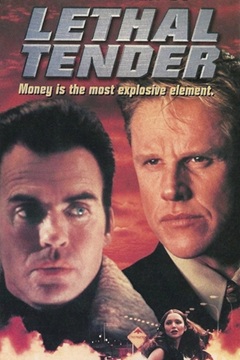
Lethal Tender (1997, directed by John Bradshaw)


Montessi (Kim Coates) and his men have taken over a water filtration plant, are holding hostages, and keep threatening to poison the water supply.  Rogue cop David Chase (Jeff Fahey) and Melissa Wilkins (Carrie-Anne Moss) sneak around the plant and try to stop the terrorists.  David Chase is set up to be a John McClane type but instead, he only kills one terrorists and then lets everyone else do most of the work.  Of course, the whole water filtration hostage situation is just a distraction so Mr. Turner (Gary Busey) can steal a bunch of bonds.  Busey sits behind a computer for most of the movie, lending his name but not much else.

A good cast is wasted in what is definitely one of the worst of the many Die Hard rip-offs to come out in the 90s.  There’s not enough action, with Jeff Fahey as a passive hero and even the great Kim Coates reduced to standing around and doing a lot of yelling for most of his time on screen.  Gary Busey is the big star here but it’s obvious that he was only on the set for a few hours and his plan for stealing the bonds never makes sense.  Whenever anyone questions his plans, he says that it involves computers.  In the 90s, I guess that was enough.

Watching this last night, I realized that I had seen it on Cinemax back in the day.  It didn’t make much sense back then either.

The TSL’s Horror Grindhouse: Diary of the Dead (dir by George Romero)


I have to admit that I was a little bit hesitant about watching the 2007 film, Diary of the Dead.

It wasn’t that I don’t like zombie movies.  In fact, it was the complete opposite.  I love zombie films and Night of the Living Dead is one of my favorites.  George Romero, of course, went on to make several sequels to Night of the Living DeadDawn of the Dead, Day of the Dead, and Land of the Dead are certifiable horror classics.  However, I had heard mixed things about the two zombie films that Romero directed after Land of the Dead.  Seeing as how Diary of the Dead was Romero’s second-to-last film before he passed away in 2017, I was worried that I would watch the film and discover that I hated it.  I didn’t want experience anything that would tarnish Romero’s cinematic legacy.  It didn’t help my expectations that Diary of the Dead is a found footage film and the conventions of the found footage genre tend to get on my last nerve.

(Seriously, nothing makes me throw a shoe at a screen quicker than the sound of someone in a horror movie saying, “Are you filming this?”)

But you know what?

I did watch Diary of the Dead and it’s actually not bad.  It may not reach the heights of Romero’s other zombie films but it’s definitely a worthwhile companion piece.  It opens with news reports about the start of the zombie apocalypse, meaning that Diary of the Dead is meant to take place at roughly the same time as Night of the Living Dead.  (Never mind that Diary of the Dead is full of references to YouTube and blogs and other things that most people probably couldn’t even imagine when Night of the Living Dead first came out.)  A group of film students are in the woods, filming a terrible mummy movie when they first hear reports of the dead coming back to life.  Some say that there’s no way it could be true.  Others say that something must be happening but surely the dead aren’t actually coming back to life.  They soon discover that the dead have indeed returned.

We follow the students as they travel across Pennsylvania, trying to find a place that’s safe from the Dead and discovering that there’s literally no such place left in America.  Along the way, they also discover that the government has no intention of telling the people the truth about what’s happening.  In fact, a group of national guardsmen turn out to be just as dangerous as the zombies.  In their efforts to survive, the students are forced to rely on an underground network of bloggers and video makers.

Diary of the Dead has all of the usual zombie mayhem that you would expect from a film like this but, at the same time, it’s got a lot more on its mind than just the dead returning to life.  Much as he did with Land Of The Dead, Romero uses Diary of the Dead to comment on the state of America under the Patriot Act.  With the government using the zombie apocalypse as an excuse to suspend civil liberties and increase their own power, the film’s characters are forced to depend on new and independent information sources.  It’s not hard to see the parallel that Romero is making between the War on the Living Dead and the War on Terror.  As well, making all of the characters film students allows for some discussion about whether or not horror films should simply concentrate on being scary or whether they should also attempt to deal with real-world issues.  The film leaves little doubt where Romero came down on that issue.

On the negative side, Diary of the Dead struggles a bit to overcome the limitations of its low budget and none of the characters are as compelling as Ben in Night of the Living Dead or Fran in Dawn of the Dead.  At times, you find yourself wishing that Diary of the Dead featured just one actor who was as into their role as Duane C. Jones or Ken Foree were in Night of the Living Dead and Dawn of the Dead, respectively.  But Diary of the Dead still features enough zombies and enough of Romero’s trademark political subtext to be an acceptable addition to Romero’s vision of the apocalypse.