Film Review: Executive Decision (dir by Stuart Baird)


In 1996’s Executive Decision, terrorists hijack an airplane.  Their leader, Nagi Hassan (David Suchet) demands that the U.S. government not only give him and his men safe passage but that they also release Hassan’s commander, Jaffa (Andreas Katsulas).

In Washington D.C., it is decide to use a stealth plane to transport Col. Austin Travis (Steven Seagal) and his men into the passenger plane.  Accompanying them will be Dr. David Grant (Kurt Russell), a consultant for U.S. Intelligence.  Dr. Grant is the world’s leading expert on Hassan, even though neither he nor anyone else is even sure what Hassan looks like.  Travis distrusts Grant because he’s a civilian and also because he holds Grant responsible for a botched raid on a Russian safehouse in Italy.  Dr. Grant is going to have to prove himself to Col. Travis because Travis doesn’t have any time for people who can’t get the job done.  And Travis is determined to get on that plane and save all those passengers.

In other words, Travis is a typical Steven Seagal character and, for the first fourth of this movie, Seagal gives a typical Steven Seagal performance.  He delivers his line in his trademark intimidating whisper, he glares at everyone else in the film, and essentially comes across as being a total douchebag who can still handle himself in a fight..  However, when it’s time to board the airplane through a docking tunnel, something goes wrong.  Everyone — even nervous engineer Dennis Cahill (Oliver Platt) is able to slip through the stealth plane’s docking tunnel and get into the hijacked airplane cargo hold without being detected.  But the two planes are hit by severe turbulence.  Suddenly, it becomes apparent the one man is going to have to sacrifice his life and close the hatch before the docking tunnel decompresses.

David, already in the cargo hold, looks down at Austin in the tunnel.  “We’re not going to make it!”

“You are!” Austin replies before slamming the hatch shut and getting sucked out of the tunnel.  (There’s your Oscar Cheers Moment of 1996!)  After all that build-up, Steven Seagal exits the film early and now, it’s up to Kurt Russell and what’s left of Austin Travis’s men to somehow stop the terrorists.  Not only do they have to stop Hassan but they also have to do it before the Air Force — which has no way of knowing whether or not any of their men were able to get on the plane before the tunnel fell apart — shoots down the airliner.

(If the airplane looks familiar, that’s because Lost used the same stock footage whenever it flashed back to the plane crash that started the show.)

It’s actually a rather brilliant twist.  When this film came out, Seagal was still a film star.  He played characters who always got the job done and who were basically infallible.  He wasn’t a very good actor but he did manage to perfect an intimidating stare and that stare carried him through a lot of movies.  No one would have expected Seagal to die within the first 30 minutes of one of his movies and when Col. Travis, who the film has gone out of its way to portray as being the consummate warrior, is suddenly killed, there really is a moment where you find yourself wondering, “What are they going to do now?”  In just a matter of minutes, Executive Decision goes from being a predictable Steven Seagal action film to a genuinely exciting and clever Kurt Russell thriller.  For once, Russell is not playing a man of action.  He’s an analyst, a thinker.  And, to the film’s credit, he uses his mind more than his brawn to battle Hassan’s terrorists.  With excellent support from Halle Berry (as a flight attendant who discreetly helps out David and the soldiers), Oliver Platt, B.D. Wong, Whip Hubley,  David Suchet, Joe Morton, and even John Leguizamo (as Travis’s second-in-command), Executive Decision reveals itself to be an exciting and ultimately rewarding thrill ride.

And to think, all it took was sacrificing Steven Seagal.
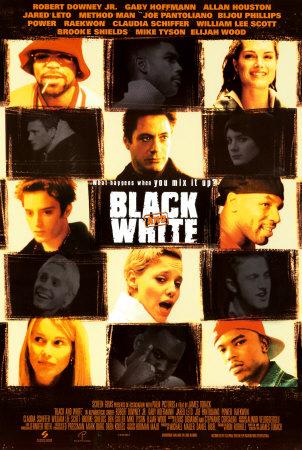
Cleaning Out The DVR Yet Again #31: Black and White (dir by James Toback)


(Lisa recently discovered that she only has about 8 hours of space left on her DVR!  It turns out that she’s been recording movies from July and she just hasn’t gotten around to watching and reviewing them yet.  So, once again, Lisa is cleaning out her DVR!  She is going to try to watch and review 52 movies by the end of Wednesday, December 7th!  Will she make it?  Keep checking the site to find out!)

black_and_white_black_white-681253575-large

On November 15th, I recorded the 1999 melodrama, Black and White, off of Encore.

Black and White is a film that I’ve seen several times and I’ve always meant to review it.  It’s an attempt to explore the state of race, rap, crime, and sex in the late 20th century.  It’s also a James Toback film, which means that it contains all of the stuff that appears in every James Toback film: a threesome in the park, improvised dialogue, cameos from famous people playing themselves, an obsession with college basketball games, casual sexism, and a lot of talk about why you should never send “a little boy to do a man’s job.”  By his own admission, the white Toback is obsessed with the black experience but, when you watch a James Toback film, you get the feeling that his entire knowledge of African-American culture comes from watching other movies.

In short, Black and White is probably one of the silliest and most misjudged films that I’ve ever seen.  In fact, it’s so misjudged that it’s compulsively watchable.  Though I’m always hesitant to casually toss around the term “guilty pleasure,” that’s exactly what Black and White is.

Black and White tells several different stories, some of which are connected and some of which are not.  Sam Donager (Brooke Shields) is an independent filmmaker who is attempting to make a documentary about white people who try to act black.  Her husband, Terry (Robert Downey, Jr.), is gay and hits on every man (and boy) that he sees.  Sam and Terry start following around a group of privileged white kids who are obsessed with rap music.  Sam asks them if they want to be black.  They say that they’re going through a phase.

One of the kids is named Wren and he’s played by Elijah Wood.  He doesn’t really do much but every time he shows up in the film, you go, “It’s Elijah Wood!”  And then there’s Marty King (Eddie Kaye Thomas) who is the son of the Manhattan District Attorney (Joe Pantoliano).  Marty’s older brother is Will (William Lee Scott) ,who is some sort of low-level criminal.  And finally, the unofficial leader of the kids is Charlie (Bijou Phillips) and she gets to give a long monologue explaining the various uses of the n-word.

(Their teacher, incidentally, is played by Jared Leto.  If you’ve ever wanted to listen to Jared Leto lecture about the relationship between Othello and Iago, this is the film to see.  That said, the whole Othello and Iago lecture is just kinda randomly tossed in and doesn’t really pay off.)

Charlie is one of the many girlfriends of Rich Bower (Power), who is not only an up-and-coming rap producer but he’s also the head of a criminal organization.  (There’s a lengthy and kinda pointless scene where he and his associates demand money from a club manager played by Scott Caan.)  Rich is also friends with Mike Tyson.  Tyson plays himself and he gets to deliver an entire monologue about how Rich should never send a boy to do a man’s job.

But we’re not done!  Rich’s cousin is Dean Carter (Allan Houston), a college basketball player.  Dean is dating an anthropology graduate student (Claudia Schiffer, giving a hilariously terrible performance) who is obsessed with fertility symbols.  Dean is also being blackmailed by a corrupt cop named Mark Clear.  Guess who plays Mark Clear?

BEN FREAKING STILLER!

Needless to say, Ben Stiller is massively miscast.  He delivers he lines in his trademark comedic fashion, which makes it next to impossible to take him seriously as any sort of threat.  He also has a backstory that is needlessly complex but at least it allows him to say, “I’m Saul of Fucking Tarsus!”

Anyway, almost the entire film was improvised, which is one of those things that probably seemed like a good idea at the time.  A few of the actors do well with the improvisation.  Stiller may be miscast but at least he can come up with stuff to say.  Robert Downey, Jr.’s character may seem out-of-place but again, Downey knows how to keep things interesting.  But the rest of the cast seems to be a bit stranded so we end up with a lot of lengthy scenes of characters struggling to make some sort of sense of Toback’s storyline.

It’s obvious that James Toback felt that this film had something important to say but, instead of any insight, it can only offer up the occasionally strange-as-Hell scene.

Like this scene, for instance, in which Mike Tyson literally attempts to kill Robert Downey, Jr:

Or this weird little scene between Ben Stiller and Joe Pantoliano, which is dominated by Stiller’s odd delivery of his lines:

Or the closing montage, which is actually rather well-put together and makes great use of Michael Fredo’s Free:

Sadly, the video above ends before it gets to the part where we see Claudia Schiffer on a date with Mike Tyson, telling him about fertility symbols.

Anyway, Black and White is one of those films that wants to say something despite not being sure what.  Again, it may ultimately be rather silly but it’s still compulsively watchable.

(For the record, Marla Maples — who also appeared in Maximum Overdrive and was married to future President Donald Trump when this movie was made — has a cameo as a character named Muffy.  We live in a strange fucking world, don’t we?)