Film Review: Kid Blue (1973, directed by James Frawley)


KidBlueFor the past week and a half, I have been on a major Warren Oates kick.  The latest Oates film that I watched was Kid Blue, a quirky western comedy that features Warren in a small but key supporting role.

Bickford Warner (Dennis Hopper) is a long-haired and spaced-out train robber who, after one failed robbery too many, decides to go straight and live a conventional life.  He settles in the town of Dime Box, Texas.  He starts out sweeping the floor of a barber shop before getting a better job wringing the necks of chickens.  Eventually, he ends up working at the Great American Ceramic Novelty Company, where he helps to make ashtrays for tourists.

He also meets Molly and Reese Ford (Lee Purcell and Warren Oates), a married couple who both end up taking an interest in Bickford.  Reese, who ignores his beautiful wife, constantly praised Greek culture and insists that Bickford take a bath with him.  Meanwhile, Molly and Bickford end up having an affair.

Bickford also meets the local preacher, Bob (Peter Boyle).  Bob is enthusiastic about peyote and has built a primitive flying machine that he keeps in a field.  The town’s fascist sheriff, Mean John (Ben Johnson), comes across Bob performing a river baptism and angrily admonishes him for using “white man’s water” to baptize an Indian.

Bickford attempts to live a straight life but is constantly hassled by Mean John, who suspects that Bickford might actually be Kid Blue.  When Bickford’s former criminal partner (Janice Rule) shows up in town and Molly announces that she’s pregnant, Bickford has to decide whether or not to return to his old ways.

Kid Blue is one of a handful of counterculture westerns that were released in the early 70s.  The film’s biggest problem is that, at the time he was playing “Kid” Blue, Dennis Hopper was 37 and looked several years older.  It’s hard to buy him as a naïve naif when he looks older than everyone else in the cast.  As for Warren Oates, his role was small but he did great work as usual.  Gay characters were rarely presented sympathetically in the early 70s and counter-culture films were often the worst offenders.  As written, Reese is a one-note (and one-joke) character but Warren played him with a lot of empathy and gave him a wounded dignity that was probably not present in the film’s script.

Kid Blue plays out at its own stoned pace, an uneven mix of quirky comedy and dippy philosophy.  Still, the film is worth seeing for the only-in-the-70s cast and the curiosity factor of seeing Dennis Hopper in full counterculture mode, before he detoxed and became Hollywood’s favorite super villain.

o_kid-blue-dvd-dennis-hopper-warren-oates-5cdc

Embracing the Melodrama Part II #122: Calvary (dir by John Michael McDonagh)


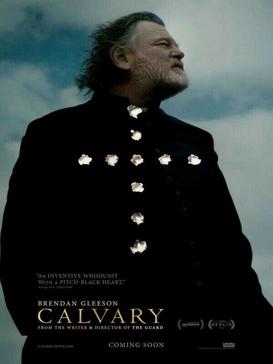
Calvary_movieposterCalvary was probably the best movie of 2014 that you did not see in a theater.  I missed seeing it during its brief theatrical run in the States.  If I had seen it when it was originally released, my list of the best films of 2014 would have been far different.  Calvary is an amazing film that takes a serious and intelligent look at issues of faith, morality, guilt, and absolution.  It is one of the best films about Catholicism that I’ve ever seen.

The film, which was written and directed by John Michael McDonagh (who previously gave us The Guard), tells the story of an Irish priest, Father James (Brendan Gleeson).  During confession, an unseen parishoner tells James about the horrific sexual abuse that he suffered as a child.  The parishoner explains that the priest who abused him has since died so the parishoner plans to get his revenge on the Catholic Church by killing James.  He tells James to meet him on the beach next Sunday.  He also informs James that his death will mean more because James is a “good man.”

The rest of the film follows James over the course of what could be the last week of his life and we watch as James struggles to fulfill his priestly duties in a world that seems to be moving further and further away from the Church.  While everyone seems to come to him with their problems and their questions, few people seem to share James’s faith and James is often left to wonder whether he’s doing any good at all.

For instance, when he confronts the local butcher (Chris O’Dowd) for beating his wife, the butcher refuses to admit that he did anything wrong.  When he goes to prison and talks to a serial killer (Freddie Joyce) who wants forgiveness, James replies that he can’t be forgiven because he feels no guilt.  The local millionaire (Dylan Moran) offers to donate money to the church but also confesses that he made his money through illegal means.  A local doctor, a hedonistic, cocaine-snorting atheist played by Aiden Gillen, takes perverse pleasure in taunting James for caring about death.  When James attempts to talk to a local girl, the girl’s father accuses him of being a pedophile.  When the local church catches on fire, nobody in the village seems to care.  And finally, one night, James returns home to discover that someone has murdered his beloved dog.

And yet, there are good moments as well.  James prays with a woman (Marie-Josee Croze) who has just lost her husband.  James gets chance to bond with his emotionally unstable daughter, Fiona (Kelly Reilly).  James successfully counsels a troubled young man (Killian Scott) and befriends an American writer (M. Emmett Walsh).

And, as Sunday approaches, James is forced to decide whether to leave his parish or to go to the beach.

Calvary is a great film, one that consistently takes you by surprise and forces you to think.  In many ways, James serves as a stand-in for the entire Catholic Church.  He’s made mistakes, he’s been battered, and he struggles with doubt.  And yet, at the same time, he is still capable of doing so much good.  Calvary is one of the best Catholic films ever made.

And it also features Brendan Gleeson’s best performance to date.  That is truly saying something because Brendan Gleeson is one of our greatest actors.  Gleeson is onscreen for every minute of Calvary and his emotional and, at times, warmly humorous performance is an amazing thing to behold.  When we first see James, he’s a weary and burned-out man.  Over the course of the week (and the film), he goes from being frightened to angry to sad to eventually achieving a state of grace.

It’s a great performance in a great film.

You may have missed Calvary in 2014.

Don’t miss it again.

Lisa Reviews An Oscar Nominee: Bound for Glory (dir by Hal Ashby)


Bound_for_glory_Poster

One of my favorite online film reviewers is Mitch Lovell of the Video Vacuum.  The thing I like about Mitch is that he doesn’t worry about how many Oscars a film has been nominated for or whether or not a film’s politics are currently in fashion.  Unlike a lot of online reviewers, he doesn’t worry about whether or not he’s going against the “accepted” views of the critical establishment.  Instead, he’ll watch a film and tell you exactly how he felt about it.

For example, Mitch Lovell’s review of the otherwise critically acclaimed 1976 best picture nominee Bound for Glory can be summed up in three words: “boring as fuck.”  Every other online review that I’ve found for Bound for Glory offers up polite but rarely inspiring praise for this rather lengthy film about the folk singer Woody Guthrie.  Most of those reviews do acknowledge that the film moves at its own pace but we are told that we will be rewarded for being patient.  If the review was written after 2010, you can be sure that the reviewer will be sure to say that Bound for Glory reminds us of why labor unions are still important and need to be protected from the Tea Party.  (The idea apparently being that, if a film has the right politics, it doesn’t have to actually be all that interesting.)  It’s all rather predictable and that’s why we’re lucky to have reviewers like Mitch Lovell around.  Whether you agree with him or not, it’s good to have a reviewer who will go against the conventional wisdom.

I recently watched Bound for Glory as a part of TCM’s 31 Days of Oscars and, to a large extent, I have to agree with Mitch Lovell’s review.  This is a movie that is not only long but which moves slowly as well.  It’s not that the film has a deliberate pace.  It’s just slow!  (If you want to see a film that makes good use of a deliberate pace, check out Barry Lyndon.)  David Carradine plays Woody Guthrie, a sign painter who, during the Great Depression, abandons his family in Texas and, by hopping trains, makes his way to California.  He works with fruit pickers.  He tries to convince his fellow workers to form a union.  He gets beat up a lot.

And he plays his guitar.

If there’s anything that remains consistent about Bound for Glory, it’s that Woody is always playing his guitar and that every time he starts to play, something terrible either has happened or does happen.  There’s a huge dust storm.  Woody plays his guitar.  A fight breaks out at a union meeting.  Woody plays his guitar.  A bunch of hoboes on a train get beat up.  Woody plays his guitar.  Woody shows up at a textile mill and starts to play his guitar.  He gets beaten up by a bunch of thugs.  Woody impresses Pauline (Gail Strickland) by playing his guitar and soon, he’s cheating on his wife.  Woody partners up with another folk singer, Ozark Blue (Ronny Cox), and they get their own radio show where Woody plays guitar.  Woody promptly gets fired.

It quickly became apparent to me that Woody Guthrie’s guitar was cursed.  Whenever he played it, poor people ended up getting oppressed.

In many ways, Bound for Glory is a prototypical example of what it means to be an acclaimed-at-its-time-but-subsequently-forgotten best picture nominee.  It’s a big epic film that tells a fictionalized account of a real person’s life story.  Woody Guthrie is best known for writing This Land Is Your Land, which is a song that I mostly associate with pretentious super bowl commercials.  As Bound for Glory details, Woody was also a union organizer and political activist but what’s odd is that the film keeps the exact details of what he believed rather vague.  We’re given the general idea of what Woody believed but we’re not given any specifics.  As a result, Woody just comes across like another part-time social protestor as opposed to being a true political thinker (much less a revolutionary).

On a positive note, Bound for Glory is impressive to look at.  The film’s cinematographer was the famous Haskell Wexler (who also directed Medium Cool, a film that was as upfront about its politics as Bound for Glory is vague) and Wexler captures some hauntingly beautiful images of the American wilderness.  The scene where a gigantic wall of dust crashes down onto a small Texas town is especially memorable.

Otherwise, though, Bound for Glory is pretty much a snoozefest.  It was nominated for best picture of 1976 and, when you compare it to fellow nominees like All The President’s Men, Network, Taxi Driver, and even RockyBound for Glory does feel a bit out of place.

Then when you consider some of the other films that came out in ’76 — Carrie,  Face to FaceThe Front, God Told Me To, Logan’s Run, The Man Who Fell To Earth, Marathon Man, The Omen, The Outlaw Josey Wales, Lipstick, Robin and Marian, The Sailor Who Fell From Grace With The Sea, and The Town That Dreaded Sundown — the nomination of Bound for Glory feels like even more of a mistake.

Oh well.

Occasionally, the Academy gets it wrong.

Shocking, I know.

Embracing the Melodrama #32: Ordinary People (dir by Robert Redford)


ordinary_people_oc87rd_1

For the past seven days, I’ve been reviewing — in chronological order — fifty of the most memorable melodramas ever filmed.  We started with a silent film from 1916 and now, we have reached the 80s.  What better way to kick off the decade than by taking a look at the 1980 Best Picture winner, Ordinary People?

Directed by Robert Redford, Ordinary People tells the story of the upper middle class Jarrett family.  On the surface, the Jarretts appear to be the perfect family.  Calvin Jarrett (Donald Sutherland) has a successful career.  Beth (Mary Tyler Moore) keeps a perfect home and appears to be the ideal suburban matriarch.  However, one summer, their oldest son drowns in a sailing accident and their youngest son, sensitive Conrad (Timothy Hutton), attempts to commit suicide.  After spending four months in a psychiatric hospital, Conrad come back home and the family struggles to put their lives back together.  Even though he starts to see a therapist (Judd Hirsch) and starts dating his classmate Jeannine (Elizabeth McGovern), Conrad still struggles with his feelings of guilt over having survived.  Beth’s struggle to maintain a facade of normalcy leads to several fights between her and Conrad with Calvin trapped in the middle.

Among my fellow film bloggers, there’s always going to be a very vocal group that is going to hate Ordinary People because it won the Oscar for best picture over challenging black-and-white films directed by Martin Scorsese (Raging Bull) and David Lynch (The Elephant Man).  They always tend to complain that Ordinary People is a conventional film that tells a conventional story and that it was directed by a very conventional director.  More than once, I’ve seen an online film critic refer to Ordinary People as being a “big budget Lifetime movie.”

Well, you know what?

I love Lifetime.  Lifetime is the best network on television and to me, a big budget Lifetime movie would be the best Lifetime movie of all.  And, at the risk of alienating all of my film-loving friends, if I had to choose between watching Raging Bull and Ordinary People, I’m going to pick Ordinary People every time.  Raging Bull is visually stunning and features great performances but it’s also two hours spent watching an incredibly unlikable human being beating the crap out of anyone who is foolish enough to love him.  Ordinary People may essentially look like a TV show but it’s also about characters that you can understand and that, as the film progresses, you grow to truly care about.

Yes, I do wish that the character of Beth had been given more of a chance to talk about her feelings and it’s hard not to feel that Ordinary People places too much blame on the mother.  But, even so, the film still ends with vague — if unlikely — hope that Beth will eventually be able to move past her anger and reconnect with her family.  The film may be hard on Beth but it never gives up on her.  That’s what distinguishes Ordinary People for me.  In many ways, it’s a very sad film.  It’s a film that was specifically designed to make you cry and I certainly shed a few tears while I watched it.  But, even with its somewhat ambiguous ending, Ordinary People is also a very optimistic movie.  It’s a movie that says that, as much pain as we may have in our life,we can recover and life can go on and it’s okay to be sad and its also okay to be happy.

And that’s an important lesson to learn.

(That said, if I had been alive and an Academy voter in 1981, I would have voted for The Elephant Man.)

And, for all you Oscar lovers out there, here are clips of Timothy Hutton and Robert Redford winning Oscars for their work on Ordinary People.