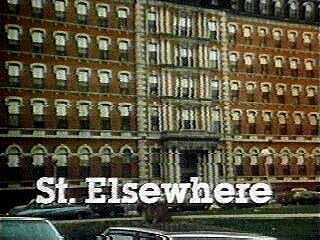
Retro Television Review: St. Elsewhere 2.13 “In Sickness and In Health”


Welcome to Retro Television Reviews, a feature where we review some of our favorite and least favorite shows of the past! On Fridays, I will be reviewing St. Elsewhere, a medical show which ran on NBC from 1982 to 1988.  The show can be found on Hulu and, for purchase, on Prime!

This week, Victor gets married!

Episode 2.13 “In Sickness and In Health”

(Dir by Mark Tinker, originally aired on February 8th, 1984)

This week’s episode features three storylines.

The least interesting one features Joan Halloran’s father, Charlie Halloran (William Windom), being admitted to and eventually dying at St. Eligius.  The entire Halloran family comes out to visit Charlie and this is one of the storylines that would have worked better if I had the slightest bit of interest in Joan or her family.  For the most part, though, Joan is a boring character and her wealthy family is not that interesting.  I got the feeling this storyline was mostly included to remind us that Joan is a character on the show.  We really have seen much of her over the past few episodes.

Dr. Chandler trained for the Boston Marathon by running the route in the rain.  A car ran him off the road.  A dog chased him.  An attractive woman flirted with him.  (He is Denzel Washington, after all!)   And he finally reached the finish line and nearly collapsed while imagining everyone cheering for him.

Finally, Ehrlich married Roberta.  The wedding took place at Dr. Craig’s house.  Dogger (Kevin Scannell) was the best man and turned out to be just as crude as you might expect someone named Dogger to be.  Dr. Craig was disgusted by the whole thing.  Roberta got cold feet after her mother confessed to having never loved her father.  However, Dr. Craig’s abrasive mother-in-law (Lurene Tuttle) was there to order Roberta to take a chance and marry the man who she might eventually come to love.  This marriage is so obviously doomed.  I’m predicting Ehrlich will be divorced before the season ends.

This episode really didn’t work.  Dr. Chandler training for the Boston Marathon finally gave Denzel Washington something to do but the storyline excuse was mostly just an excuse to do some Boston location shooting.  The Halloran storyline didn’t work because the Hallorans themselves aren’t that interesting.  And, after all the build-up, the wedding was a bit anti-climatic.

They can’t all be winners.

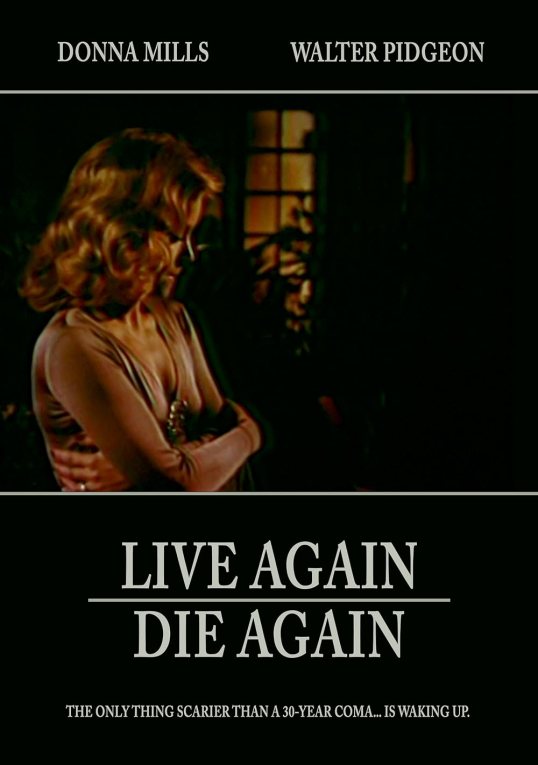
Retro Television Reviews: Live Again, Die Again (dir by Richard A. Colla)


Welcome to Retro Television Reviews, a feature where we review some of our favorite and least favorite shows of the past!  On Sundays, I will be reviewing the made-for-television movies that used to be a primetime mainstay.  Today’s film is 1974’s Live Again, Die Again!  It  can be viewed on YouTube.

30 years ago, Caroline Carmichael (Donna Mills) died.

Except, she really didn’t.  Instead, when on the verge of death, she was put into cryogenic suspension.  She has spent the last three decades in suspended animation and, as a result, she has not aged in all that time.  In fact, her hair still looks perfect.  (I have some doubts about the scientific validity of any of this but let’s just go with it.)  As this movie begins, Caroline Carmichael finally wakes up.

Caroline has an entirely new world to discover.  At a party to celebrate her awakening, Caroline is shocked to discover that, while she still appears to be young, all of her friends are now in their 60s. Her husband, Thomas (Walter Pidgeon), is now old and sickly.  Her beautiful home is now looked after by a strict and suspicious housekeeper (Geraldine Page).    Her two children (played by Mike Farrell and Vera Miles) both appear to be older than her.  In fact, her daughter was so traumatized by Caroline’s “death,” that she is now terrified of being left alone with her mother.

You might expect that this film would be dedicated to Caroline adjusting to the world of the 70s and that it might feature some thoughts on whether it’s ethical to keep someone in suspended animation for 30 years.  And there are elements of that.  Caroline is amazed by all the tall buildings.  Her daughter’s reaction to Caroline’s return is hardly heart-warming and even Caroline’s whiny son doesn’t seem to be quite as happy about it as one might expect.  Her husband has spent the last 30 years of his life waiting for Caroline to wake up and it’s hard not to consider how many opportunities for happiness or success that he missed as a result.

That said, the film itself quickly becomes more of a gothic murder mystery, as Caroline comes to realize that someone is trying to kill her.  That’s kind of a shame because I actually found all of the cryogenic stuff to be much more interesting and the idea that one could basically just stop aging for 30 years was an intriguing one.  It’s an interesting question.  If it could save your life at some undetermined point in the future, would you be frozen?  Myself, I think I would be reluctant to do so because you never know what type of world you might wake up in.  Caroline is lucky enough to wake up wealthy in the 70s but what if you woke up and discovered that your entire family had died while you were in your coma?  What if you woke up and discovered that your country had become some sort of socialist Hellhole?  Imagine if someone went into hibernation in 1994 and then woke up in 2024?  They would probably want to go back to sleep.

The film was written Joseph Stefano, who also did the script for Psycho and was one of the producers behind The Outer Limits.  Not surprisingly, the script is full of snappy dialogue and the cast features two Psycho cast members, Vera Miles and Lurene Tuttle.  Director Richard Colla keeps the action moving and, early on in the film, he does a good job of depicting Caroline’s disorientation with finding herself in an entirely new world.  The film is well-acted by the entire cast, with Donna Mills especially doing a good job as Caroline.  This was an intelligent, well-made, and — most importantly — short made-for-TV movie.  At a time when almost all movies and TV shows seem to be too long for their own good, it’s hard not appreciate Live Again, Die Again‘s 73-minute runtime.

Retro Television Reviews: Fantasy Island 3.13 “The Inventor/On The Other Side”


Welcome to Retro Television Reviews, a feature where we review some of our favorite and least favorite shows of the past!  On Tuesdays, I will be reviewing the original Fantasy Island, which ran on ABC from 1977 to 1986.  Almost entire show is currently streaming is on Youtube!

This week’s trip to Fantasy Island is sadly forgettable.  Let’s find out why.

Episode 3.13 “The Inventor/On The Other Side”

(Dir by Earl Bellamy, originally aired on December 15th, 1979)

This week, there is no banter between Tattoo and Mr. Roarke before they head off to meet their guests.  In fact, Ricardo Montalban and Herve Villechaize barely look at each other.  It’s a shame because this is actually a pretty dire episode.  It could have used some passive-aggressive Tattoo/Roarke interaction.

The first fantasy features Arte Johnson as Professor Dwayne Clebe and Marcia Wallace as his assistant, Martha Meeks.  Professor Clebe is tying to develop a solution that, when sprayed on metal, will make it impervious to damage.  When he first arrives at Fantasy Island, the solution is called 2X76409, with the 9 signifying the 9 labs that have been blow up by Clebe’s experiments.  By the time he and Martha perfect the solution, it has become the 2X76411.  Fear not, no one is injured when the labs blow up.  Even though Clebe and Martha are both standing in the middle of these explosions, they always just end up with soot on their face.

Anyway, once the formula is perfected, leaders of both industry and the world’s trade unions travel to Fantasy Island to try to destroy it.  The industrialists think that it will drive down prices.  The unionists think that it will put people out of work.  Eventually, the Russians show up because they want the formula for themselves.  It all leads to a big chase and Prof. Clebe realizing that he loves Martha.

The whole fantasy was way too cartoonish and overwritten for its own good and it featured some of the worst acting that I’ve ever seen on Fantasy Island.  Let’s move on!

Unfortunately, the other fantasy really isn’t that great either.  Irma Gideon (Jeanette Nolan) was the wife of a medium.  When he died, he promised that he would contact her from the other side.  He hasn’t done so and Irma’s fantasy is to go to the other side, see her husband, and then return.  Mr. Roarke arranges for a séance but, when he suspects that Irma is planning on just going to the other side and staying there, he cancels the fantasy.  After Irma swears that she won’t stay in “the other side,” Mr. Roarke allows her to enter a death-like trance in a Fantasy Island laboratory.  When Irma goes to the Other Side and is tempted to cross a bridge and stay permanently, her grandson (Keith Gordon) enters into a trance of his own so that he can beg her to come back.

It all sounds like it should be interesting but the execution is lacking, with one scene featuring a painting of Irma’s husband speaking to her being so badly done that it makes it impossible to take the rest of the fantasy seriously.  Jeanette Nolan and Keith Gordon both give marginally better performances that Arte Johnson and Marcia Wallace did in the other fantasy but, in the end, the whole thing just falls flat.

Well, not every trip to Fantasy Island can be a winner.

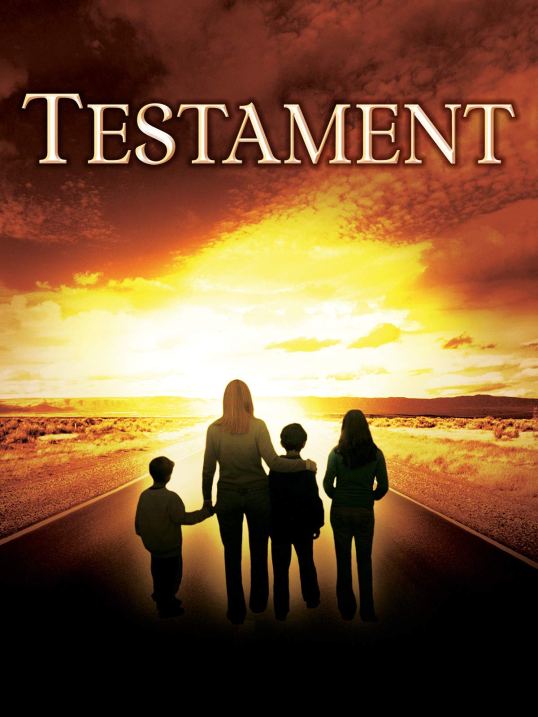
Film Review: Testament (dir by Lynne Littman)


The 1983 film, Testament, is about death.  It’s about the death of a family, the death of a town, the death of a way of life, and the death of hope.

And you may be saying, “Well, gee, Lisa — that sounds like a really happy movie.”

Well, it’s not meant to be a happy movie.  Testament is a painfully grim movie about the end of the world.

The movie takes place in the town of Hamelin, California, which we’re told is 90 minutes away from San Francisco.  It’s a nice town, the type of place where everyone knows each other.  Mike (Mako) runs the local gas station and cares for his disabled son, Hiroshi (Gerry Murillo).  Elderly Henry Abhart (Leon Ames) spends his time on his radio, talking to strangers across the world.  Fania (Lilia Skala) offers up piano lessons.  Father Hollis (Philip Anglim) looks over the spiritual needs of the parish.  It’s a normal town.

The town is home to the Weatherlys.  Carol (Jane Alexander) is a stay-at-home mom who does volunteer work and who is directing the school play.  Tom (William Devane) is a common sight riding his bicycle through town every morning before heading off to work in San Francisco.  They have three children.  Mary Liz (Roxanna Zal) is a teenager who is taking piano lessons.  Brad (Ross Harris) is always trying to impress his father and is looking forward to his 14th birthday.  Scottie (Lukas Haas, in his first film) is the youngest and never goes anywhere without his teddy bear. They’re a normal family living a normal life in a normal town.

And then, one day, everything changes.  Scottie is watching Sesame Street when the program is suddenly interrupted by a clearly terrified anchorman who announces that New York has been bombed.  The president is about to speak but, before he can, there’s a bright flash of light, an distant explosion, and the entire town loses power.

At first, the people of Hamelin try to remain hopeful.  Though Tom works in San Francisco and San Francisco is among the many cities that have apparently been bombed (by who, we never learn), he also left a message on the family’s answer machine, telling them that he was on his way home.  Even with Tom missing, Carol continues to insist the he’ll be coming home at any minute.

Tom doesn’t come home.

The rest of the film follows the slow death of the town.  Even though the town was not damaged by the blast, the fallout soon hits.  Cathy (Rebecca De Mornay) and Phil (Kevin Costner) bury their newborn baby after it falls ill from radiation poisoning.  Mike, Henry, and Fania all start to grow physically ill and, in some cases, dementia sets in.  Father Hollis goes from being hopeful to being tired and withdrawn as he tries to attend to each and every death.  Larry (Mico Olmos), a young boy whose parents have disappeared, briefly moves in with the Wetherly family.  He disappears about halfway through the movie and we never learn if he left or if he died.  All we know is that no one mentions him or seems to notice that he’s gone.

Over the course of the film, Carol buries two of her children.  By the end of the film, her remaining child is starting to show signs of being sick, as is she.  Testament, which opened with bright scenes of a happy town, ends in darkness, with only a handful of people left among the living.  Even those who are alive are clearly dying and can only speak of the importance of remembering all of it, what they had and what they lost.

Sounds like a really happy film, right?  Well, it’s meant to be depressing.  It was made at a time when nuclear war was viewed as being not just probable but also inevitable.  Testament is a film that portrayed what a lot of people at the time were expecting to see in the future and, as a result, it’s not meant to be a particularly hopeful movie.  It’s a film that accomplishes what it set out to do, thanks to a great (and Oscar-nominated) performance from Jane Alexander and Lynne Littman’s low-key direction.  Unlike a lot of atomic war films, Testament does not feature any scenes of burning buildings or excessive gore.  That actually what makes it even more disturbing.  Even after the war, Hamelin still looks like it did beforehand, with the exception that many of the houses are now empty and that all of the residents are slowly dying.

(Would I have reacted as strongly to the film if I hadn’t watched it at a time when many people are afraid to go outside?  Perhaps not.  But this pandemic has brought extra power to a lot of films that may not have had as much of an impact in 2018.)

Testament is a powerful film, though not necessarily one that I ever want to watch again.

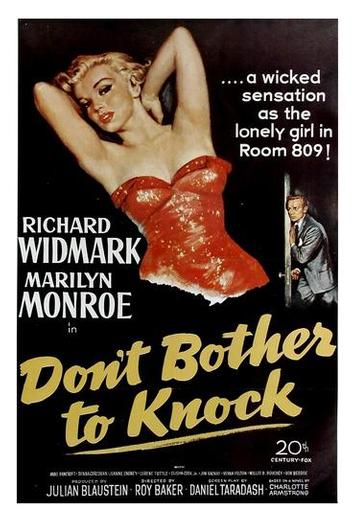
Lisa Cleans Out Her DVR: Don’t Bother To Knock (dir by Roy Ward Baker)


(I am currently attempting to clean out my DVR.  I recorded the 1952 film Don’t Bother To Knock off of FXM on April 3rd.)

Welcome to the McKinley Hotel in New York City!  The McKinley is a nice place, though it’s no Grand Budapest Hotel.  Presumably, the McKinley was named after the late President William McKinley.  While I’m sure that McKinley would have appreciated the gesture, I don’t know how he would feel about all the melodrama that’s occurring behind closed doors.

For instance, there’s Lyn Lesley (Anne Bancroft, making her screen debut).  Lyn sings in the hotel bar and, though she might seem to be cynical and tough, she actually has a big heart.  In fact, she cares so much about humanity that she broke up with her longtime boyfriend, Jed Towers (Richard Widmark), because he doesn’t seem to have a heart at all.  Of course, she broke up with Jed by sending him a letter.  When Jed checks into the hotel and tracks her down in the bar, he has questions about their breakup and he wants answers that won’t require any reading.  She tells him that he’s not capable of caring about anyone so why should she waste her time on him?  Then she sings a love song because that’s her job.

As for Jed, he’s kind of a jerk in the way that most men tend to be in movies from the 1950s.  He’s an airline pilot who served overseas during World War II and spent a year living in England.  He’s tough and he’s cynical and now, he’s single.  He’s also got a room in a hotel for the night.

And then there’s Peter and Ruth Jones (Jim Backus and Lurene Tuttle), who have a function to attend in the hotel ballroom but who don’t have anyone to look after their ten year-old daughter, Bunny (Donna Corcoran).  Fortunately, the hotel’s elevator operator, Eddie (Elisha Cook, Jr.), has a niece named Nell (Marilyn Monroe).  Nell is quiet and shy and needs the money.  She’ll be more than willing to babysit!

Of course, the only problem with Nell is that she’s a little unstable.  This becomes obvious when she’s left alone with Bunny and promptly says that, if Bunny isn’t careful, something bad might happen to one of her toys.  Inside the apartment, Nell is impressed by all the pretty things owned by Ruth.  She tries on her jewelry.  She sprays her perfume in the air.  She puts on Nell’s negligee and looks at herself in the mirror.  Eddie is not amused when he discovers what Nell’s been doing.  If she wants all of this stuff, he tells her, she needs to marry someone rich.  That’s not bad advice but the only problem is that Nell is currently single.  She’s been single ever since her boyfriend died in a plane crash.  In fact, Nell was so upset by his death that she even tried to commit suicide afterward.

From his room, Jed has a direct view of Nell trying on Ruth’s clothes.  When he and Nell spot each other, Nell invites him over.  She tells Jed that she’s a guest at the hotel and that Bunny is her daughter.  Jed can immediately tell that there’s something strange about Nell.  Nell, meanwhile, thinks that Jed is her dead boyfriend.  Meanwhile, Bunny is helpless in her room…

Clocking in at a brisk 72 minutes, Don’t Bother To Knock feels less like a movie and more like a one-act play or maybe even an adaptation of an old television production.  (After watching the movie, I was shocked to discover that it was based on neither.)  Seen today, it’s mostly memorable for featuring Marilyn Monroe’s first true starring role.  After appearing in small roles in several films (including All About Eve), Don’t Bother To Knock was not only Marilyn’s shot at stardom but also her first dramatic performance.  Reportedly basing her performance on her troubled mother, Marilyn is sympathetic and almost painfully vulnerable.  Her scenes with Elisha Cook, Jr. are especially charged, full of a subtext that will probably be easier for modern audiences to spot than it was for audiences in 1952.  Marilyn gave an incredibly poignant performance and she is the main reason to watch Don’t Bother To Knock.

Embracing the Melodrama Part II #56: Walking Tall: Final Chapter (dir by Jack Starrett)


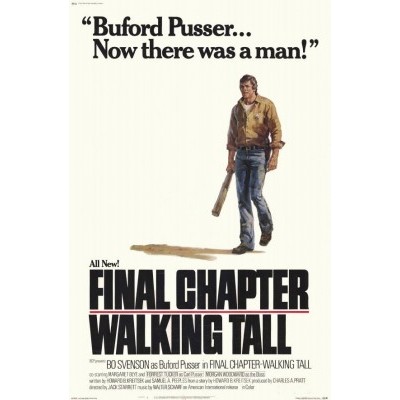
sq_final_chapter_walking_tallFor one last time, Buford Pusser is back!  The 1977 film Walking Tall: Final Chapter ends the story that was begun in Walking Tall and continued in Walking Tall Part II.  And it turns out that the final chapter is pretty much just like the previous two chapters.  In fact, I’m tempted to just tell you go reread my review of Walking Tall Part II because that review works just as well for most of the Final Chapter.

Final Chapter starts with footage from the first Walking Tall, with Bo Svenson awkwardly inserted in place of Joe Don Baker.  Once again, we watch as Elizabeth Hartman is shot in the back of the head and Svenson — in the role of Buford Pusser — is shot in the face.  Oh my God, we think, how many times can the exact same thing happen to the exact same character!?

Oh wait — it turns out that Buford is just remembering the death of his wife.  Buford is still haunted by that day and he’s still out for vengeance.  For the next hour or so, we follow Buford as he and his deputies blow up moonshiners across Tennessee.  After each arrest, an attorney shows up and yells at Buford for violating everyone’s civil rights.  In response, Buford smirks until the attorney gets so mad that he decides to run for sheriff himself.

Buford doesn’t give his opponent much of a chance.  As one of his deputies puts it, this guy is just a “bleeding heart liberal.”  (But if he’s so liberal, what’s he doing in Tennessee?  Off with you, sir — return to Vermont!)  Instead of campaigning, Buford spends his time hunting down more moonshiners.  When he discovers that one moonshiner is also an abusive father, he personally drives the man’s son down to the local orphanage.  Oddly enough, Buford does not offer to adopt the kid himself.

Anyway, to the shock of everyone, Buford is not reelected.  No longer sheriff, he struggles to find a full-time job and makes plans to run in the next election.  One of the moonshiners shows up and taunts Buford until Buford is forced to beat him up in the middle of the street.  The new sheriff show up and demands to know what happened.  None of the townspeople are willing to snitch on Buford.  Good for them!

After about an hour and a half of this, something interesting actually happens.  A film producer drives up to the Pusser Farm and tells Buford that he wants to make a movie out of his life.  “We’re going to tell the story exactly how it happened!” the producer assures him.  In the next scene, Buford is advising the director of Walking Tall on how to properly film a car chase.

And you know what?  These scenes of Buford watching his life story be filmed are actually rather charming.  For the only time in the series, Bo Svenson actually appears to be having fun in these scenes.  And, when Buford runs from a theater while watching the recreation of his wife’s murder, it’s actually a very effective moment.

Anyway, there’s not much running time left after all of that.  We see Buford sign a contract to play himself in the sequel and, by this point, we all know what happened afterward.  Buford was killed in a mysterious car accident.  But fear not!  The film opens with a heavenly choir and Svenson’s voice booming from the heavens so we all know that Buford Pusser is arresting moonshiners in Heaven.

And good for him!

Peace be with you, Buford Pusser.


Embracing the Melodrama Part II #51: Walking Tall Part 2 (dir by Earl Bellamy)


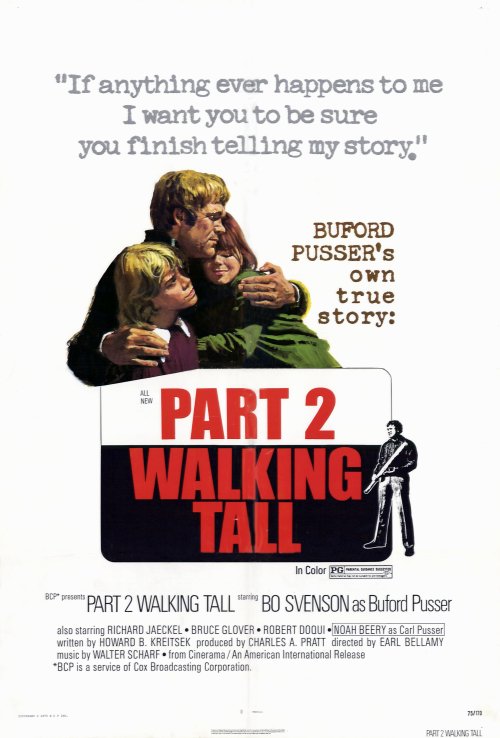
Film_Poster_for_Walking_Tall_Part_2The 1975 southern melodrama Walking Tall Part 2 opens with a voice over telling us that we’re about to see more of the true of story Sheriff Buford Pusser, the Tennessee lawman who carried a big stick, battled the Dixie Mafia, and whose wife was killed in an ambush.  Pusser, we learn, died under suspicious circumstances shortly after the release of the film Walking Tall.

Mere hours before he died, Pusser had signed a contract to play himself in Walking Tall Part 2.  As a result of Pusser’s car “accident,” the film’s producers were forced to cast an actor as the lawman.  Now, it would have made sense to, once again, give the role to Joe Don Baker.  After all, he played the role in Walking Tall and I imagine that to most audiences at that time, he was Buford Pusser.  However, for whatever reason, Baker was not given the role for a second time.  Instead, the role was given to Bo Svenson and, while Svenson does not necessarily do a bad job in the role, he’s still no Joe Don Baker.  The difference between Baker and Svenson is the difference between someone being a redneck and someone just pretending.

The film opens almost immediately where Walking Tall ended.  Terribly wounded in the ambush that took his wife’s life, Buford is in the hospital and his face is covered in bandages.  Townspeople gather outside both his room and his farm and they wonder whether he’ll run for reelection as sheriff.  Someone else mentions that Buford has had massive facial reconstructive surgery.

Finally, the bandages are removed and we discover that Buford has turned into Bo Svenson.  Now, Svenson and Baker do have enough facial similarities that you can force yourself to believe that surgery could lead to Baker having Svenson’s features.  I mean, this isn’t like Mark Ruffalo taking over the role of Bruce Banner from Edward Norton.  At the same time, it’s hard not to wonder how reconstructive surgery could have led to Buford Pusser becoming a blonde or, for that matter, apparently growing by 5 inches between Walking Tall and Walking Tall Part 2.

Anyway, Buford’s out of the hospital and, of course, he’s reelected as sheriff.  One thing that quickly becomes apparent is that everyone in the world totally loves Buford Pusser.  I lost track of how many characters specifically walked up to Buford to tell him that he was a great man and a great sheriff.  Nobody complains about Buford’s habit of ignoring civil liberties while enforcing the law.  Instead, everyone cheers for him.

(And, just in case the viewer is uncomfortable with the sight of the very white Buford taunting the mostly black moonshiners that he spends the film arresting, Buford’s black deputy constantly says stuff like, “Buford, you’re my kind of sheriff!”)

The only people who don’t like Buford are the local crime lords.  They still want Buford dead so they hire a race car driver (Richard Jaeckel) to kill him.  The race car driver’s girlfriend (Angel Tompkins) attempts to hit on Buford but Buford has no interest in her.  Buford’s about enforcing the law and avenging his wife…

Walking Tall Part 2 is a pretty standard film.  Whereas the original Walking Tall had a raw and unpredictable vibe to it, the sequel is predictable and boring.  On the plus side, the film was made on location in rural Tennesee and some of the countryside is nice to look at.

As for Buford Pusser, he died before Part Two was released but the character would return in Walking Tall — The Final Chapter.

Embracing the Melodrama Part II #46: Walking Tall (dir by Phil Karlson)


Walking_Tall_(1973_film)About 50 minutes into the 1973 film Walking Tall (not to be confused with the 2005 version that starred Dwayne Johnson), there’s a scene in which newly elected sheriff Buford Pusser (Joe Don Baker) gives a speech to his deputies.  As the deputies stand at attention and as Pusser announces that he’s not going to tolerate any of his men taking bribes from the Dixie Mafia, the observant viewer will notice something out-of-place about the scene.

Hovering directly above Baker’s head is a big, black, almost phallic boom mic.  It stays up there throughout the entire scene, a sudden and unexpected reminder that — though the film opens with a message that we’re about to see the true story of “an American hero” and though it was filmed on location in rural Tennessee — Walking Tall is ultimately a movie.

And yet, somehow, that phallic boom mic feels oddly appropriate.  First off, Walking Tall is an almost deliberately messy film.  That boom mic tells us that Walking Tall was not a slick studio production.  Instead, much like Phil Karlson’s previous The Phenix City Story, it was a low-budget and violent film that was filmed on location in the south, miles away from the corrupting influence of mainstream, yankee-dominated Hollywood.  Secondly, the phallic implications of the boom mic erases any doubt that Walking Tall is a film about men doing manly things, like shooting each other and beating people up.  Buford does have a wife (Elizabeth Hartman) who begs him to avoid violence and set a good example of his children.  However, she eventually gets shot in the back of the head, which frees Buford up to kill.

As I said earlier, Walking Tall opens with a message telling us that we’re about to watch a true story.  Buford Pusser is a former football player and professional wrestler who, after retiring, returns to his hometown in Tennessee.  He quickly discovers that his town is controlled by criminals and moonshiners.  When he goes to a local bar called The Lucky Spot, he is unlucky enough to discover that the bar’s patrons cheat at cards.  Buford is nearly beaten to death and dumped on the side of the road.  As Buford begs for help, several motorists slow down to stare at him before then driving on.

Obviously, if anyone’s going to change this town, it’s going to have to be Buford Pusser.

Once he recovers from his beating, Buford makes himself a wooden club and then goes back to the Lucky Spot.  After beating everyone up with his club, Buford takes back the money that he lost while playing cards and $50.00 to cover his medical bills.  When Buford is put on trial for armed robbery, he takes the stand, rips off his shirt, and shows the jury his scars.  Buford is acquitted.

Over his wife’s objections, Buford decides to run for sheriff.  The old sheriff, not appreciating the competition, attempts to assassinate Buford but, instead, ends up dying himself.  Buford is charged with murder.  Buford is acquitted.  Buford is elected sheriff.  Buford sets out to clean up his little section of Tennessee.  Violence follows…

On the one hand, it’s easy to be snarky about a film like Walking Tall.  This is one of those films that operates on a strictly black-and-white world view.  Anyone who supports Buford is good.  Anyone who opposes Buford is totally evil.  Buford is a redneck saint.  It’s a film fueled by testosterone and it’s not at all subtle…

But dangit, I liked Walking Tall.  It’s a bit like a right-wing version of Billy Jack, in that it’s so sincere that you can forgive the film’s technical faults and frequent lapses in logic.  Walking Tall was filmed on location in Tennessee and director Phil Karlson makes good use of the rural locations.  And, most importantly, Joe Don Baker was the perfect actor to play Buford Pusser.  As played by Baker, Pusser is something of renaissance redneck.  He’s a smart family man who knows how to kick ass and how to make his own weapons.  What more could you ask for out of a small town sheriff?

In real life, Buford Pusser died in a mysterious car accident shortly after the release of Walking Tall.  Cinematically, the character of Buford Pusser went on to star in two more films.