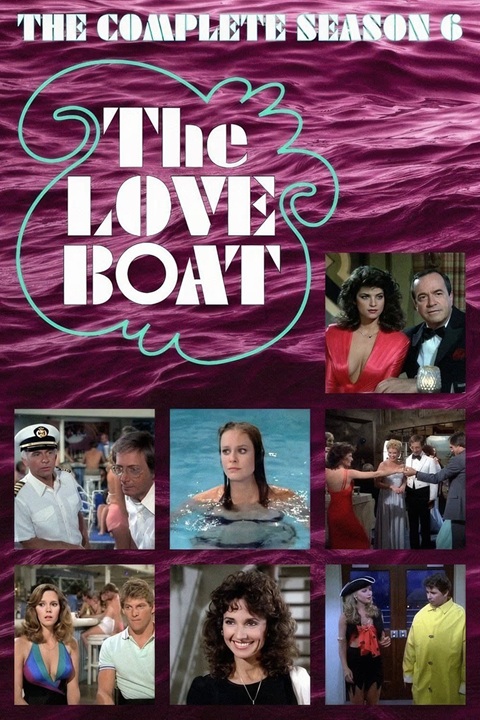
Retro Television Review: The Love Boat 6.9 “The Thanksgiving Cruise/The Best of Friends/Too Many Dads/Love Will Find A Way”


Welcome to Retro Television Reviews, a feature where we review some of our favorite and least favorite shows of the past!  On Wednesdays, I will be reviewing the original Love Boat, which aired on ABC from 1977 to 1986!  The series can be streamed on Paramount Plus!

Come aboard….

It’s a holiday….

THE LOOOOOOOOOOVE BOAT

Episode 6.9 “The Thanksgiving Cruise/The Best of Friends/Too Many Dads/Love Will Find A Way”

(Dir by Richard Kinon, originally aired on November 20th, 1982)

It’s Thanksgiving and the Love Boat crew is not getting along!

It all starts when Gopher makes a joke about Doc being a womanizer.  Doc, who has spent five seasons bragging about being a womanizer, gets offended and stops talking to Gopher.  Isaac tries to give Gopher some advice but Gopher offends him by saying that he’s sick of hearing stories about the wisdom of Isaac’s grandfather.  (I have never heard Isaac mention his grandfather in the past.)  Julie gets mad when Doc says that he didn’t care much for some of her past hairstyles.  (Julie’s hair does look terrible this episode.)  Everyone is fighting …. except for Captain Stubing and Vicki.  They do have an argument but Stubing refuses to take it personally and Vicki says she could never stay angry with her father.  Awwwww!

(I think it’s seriously irresponsible to raise someone on a cruise ship but I still tear up at the Stubing/Vicki scenes.  Can you tell I’m missing my Dad?)

I have to admit that it kind of upset me to see the Love Boat crew fighting.  The passengers come and go but the crew has remained the same for six seasons and their likable chemistry has always been one of the show’s greatest strengths.  Julie getting mad at Doc?  No, it can’t happen!  We all know Julia and Doc are secretly in love!  I was really concerned that the crew was going to have a bad  Thanksgiving but luckily, everyone forgave everyone else in time for Thanksgiving.

I was so worried about the crew that I barely paid attention to the other two stories.  Lorne Greene and Dorothy McGuire played parents who were initially alarmed when their daughter (Wendy Schaal) announced that she was going to marry a paraplegic (Jim Knaub).  Luckily, they saw the error of their ways.  Meanwhile, Michael Lembeck boarded the boat with a court order that stated that he had been given legal custody of B.J. Lewis (Christian Jacobs), who was traveling with his stepfather, Roger (Richard Hatch).  In the end, everyone agreed that Roger was the better father and B.J.’s biological father gave up custody which …. I don’t know.  That doesn’t seem like something that would happen in real life.  I mean, if you go through the trouble of hiring expensive lawyers and then storm a cruise ship, I don’t think you’re just going to shrug and give up.

“Now I have two Dads!” BJ announces.

Kid, one of your Dads just rejected you.

Oh well!  It’s Thanksgiving!  And I’m giving thanks that the Love Boat crew all learned an important lesson about friendship.  That’s what life is all about.

Late Night Retro Television Review: Highway to Heaven 2.8 “The Smile In The Third Row”


Welcome to Late Night Retro Television Reviews, a feature where we review some of our favorite and least favorite shows of the past!  On Thursdays, I will be reviewing Highway to Heaven, which aired on NBC from 1984 to 1989.  The entire show is currently streaming on Freevee and several other services!

This week, Jonathan and Mark head to Broadway!

Episode 2.8 “The Smile In The Third Row”

(Dir by Michael Landon, originally aired on November 20th, 1985)

Fred Fusco (Lorne Greene) is a veteran actor who is appearing in a Broadway play.  In the play, Fred plays a man who learns that he’s about to die.  During the third act, Fred’s character actually does die and Fred ends the play with a monologue about owning the choices he made in his life before he ascends into Heaven (via a harness).

It’s a depressing play and the theater is usually half-empty whenever Fred performs.  But one night, Fred claims that he spotted God sitting in the third row.  Fred also says that God really enjoyed the show.  When the news get out, the play becomes a huge success as audiences turn out to see a play endorsed by God.  Fred becomes a huge celebrity and befriends a terminally ill boy who promises to say hi to God when he goes to Heaven.  However, when Fred starts to talk about leaving his fortune to charity, both his sister (Mary Ann Gibson) and his nephew (David L. Lander) conspire to have him committed.

Fred also happens to be Jonathan and Mark’s later assignment.  Mark gets a job at the theater while Jonathan puts on a collar and becomes Father Jonathan.  While Mark is convinced that Fred is actually seeing God, Jonathan is skeptical because Jonathan doesn’t see God in the theater.  Why, Jonathan asks, would God reveal himself to an actor but not an angel?  There’s an interesting subtext here, as it quickly becomes obvious that Jonathan isn’t so much skeptical as he’s jealous.  He even rather recklessly reveals to Fred that he’s an angel in his quest to convince Fred that he hasn’t actually seen God.  Fred reveals that he’s willing to accept Jonathan’s word that he’s an angel but then asks why Jonathan is not willing to accept his word that he sees God in the theater.

Is God in the theater?  At the end of the episode, Fred’s harness is broken but, at the end of the third act, he still ascends above the theater and then vanishes.  The newspapers call it a hoax but the show suggests that, much like Elijah, he’s been assumed straight to Heaven.  Is Fred meant to be a modern day Elijah?  Would that therefore make his sister a modern-day Jezebel?  Perhaps but, fortunately for her, she is never eaten by wild dogs.

As usual, there wasn’t much subtlety to be found in this episode of Highway to Heaven but it still worked surprisingly well.  When Fred met the dying child, my first instinct was to roll my eyes at the obviousness of it all but those same eyes had tears in them by the time the scene was over.  The episode benefitted greatly from Lorne Greene’s strong performance as Fred Fusco and Michael Landon’s strong portrayal of Jonathan’s mixed feelings about Fred’s claims.  All in all, this was a strong episode.

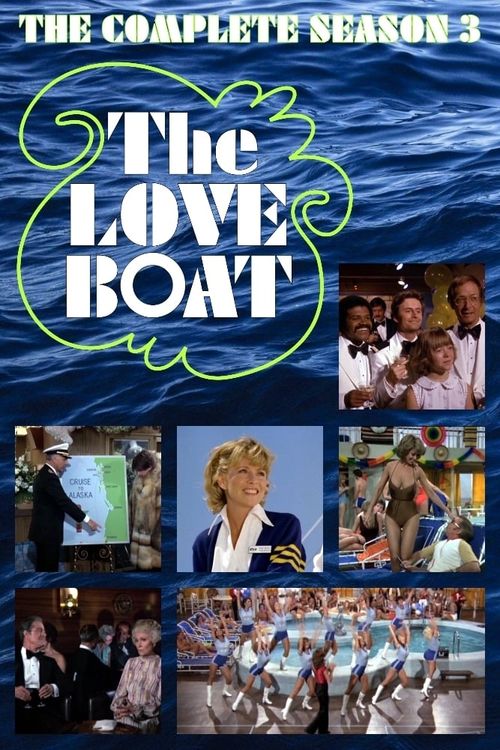
Retro Television Reviews: The Love Boat 3.1 and 3.2 “The Alaskan Wedding Cruise: Carol and Doug’s Story/Peter and Alicia’s Story/Julie’s Story/Buddy and Portia’s Story”


Welcome to Retro Television Reviews, a feature where we review some of our favorite and least favorite shows of the past!  On Wednesdays, I will be reviewing the original Love Boat, which aired on ABC from 1977 to 1986!  The series can be streamed on Paramount Plus!

The Love Boat sets sail for season 3!

Episode 3.1 and 3.2 “The Alaskan Wedding Cruise: Carol and Doug’s Story/Peter and Alicia’s Story/Julie’s Story/Buddy and Portia’s Story”

(Dir by Roger Duchowny, originally aired on September 15th, 1979)

The third season of The Love Boat starts with a special voyage to Alaska and a two-hour running time.  It’s double the guest stars, double the melodrama, double the goofiness, and double the romance!  The opening also features new clips for Doc, Gopher, and Julie.  Whereas the first two seasons introduced Doc listening to his own heartbeat, the third season opening features him laughing while leaning against a railing.  Gopher’s new opening credit features him looking wistfully out at the ocean and it’s a much more mature look for him.  As for Julie, she’s still smiling and perky but she’s let her hair grow out.  If the first two seasons of The Love Boat featured Julie looking like the star of the high school drama department, she looks more like the most popular cheerleader now.  As for the Captain, he continues to salute the camera and Isaac continues to do his signature pointing.

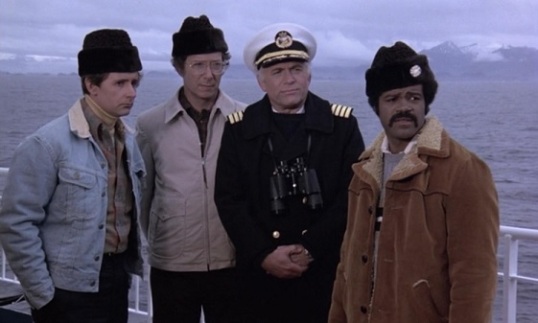
The episode opens in Canada. The boat is docked in Vancouver, where it has been rented out by a huge and wealthy wedding party.  The boat will be sailing to Alaska.  Isaac has been reading everything that he can find about Alaska and he spends most of the episode sharing trivia about the state’s history.  Gopher, preparing for Alaska’s cold weather, buys a gigantic coat.  Meanwhile, Doc Bricker makes jokes about his ex-wives and Capt. Stubing tries to keep everything professional.  (“You’re not going to the North Pole!” he snaps at Gopher when he sees the size of his new fur coat.)

As for Julie, her mind is elsewhere.  Alaska is where Jack (Tony Roberts) lives.  Who is Jack?  During the second season, he was a passenger who fell in love with Julie and who asked Julie to marry him.  She knows that she’s going to see Jack in Alaska and she’s going to give him an answer as far as his proposal is concerned.  (If you don’t remember Jack asking Julie to marry him, don’t feel bad.  I had forgotten about it, too.  Fortunately, the first hour of this episode is full of flashbacks to Jack’s previous episode.)  Is Julie ready to settle down?  While Julie tries to make up her mind, she also has to deal with the romantic intentions of the wedding party’s dorky best man (Donny Most).

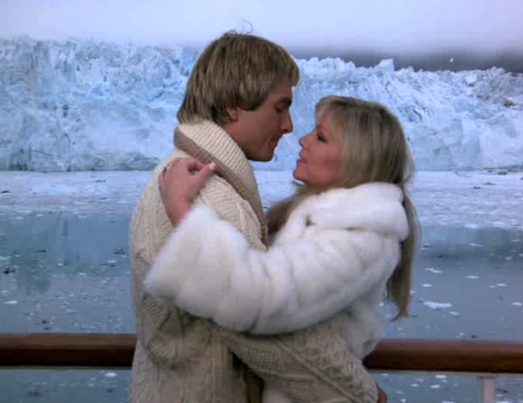
As for the wedding party, Carol (Lisa Hartman) and Doug (Mark Harmon, sporting a truly unfortunate haircut) are looking forward to getting married, even though Doug’s ex-girlfriend (Caren Kaye) is also on the boat and determined to win Doug back.  If that means jumping out a cake while wearing a bikini, she’ll do it.  Doug is more concerned about the fact that his estranged, alcoholic father, Peter (Ray Milland) had turned up on the cruise despite having not been invited to or even informed about the wedding.  Peter has stopped drinking and is trying to make peace with his son and his ex-wife, Alicia (Eleanor Parker).  What Doug and Alicia do not know is that Peter is terminally ill.  And what neither Doug nor Peter knows is that Alicia is on the verge of filing for bankruptcy.

Meanwhile, Carol’s plain-spoken grandfather (Lorne Greene) feels uncomfortable with all of the rich folks but then he meets Doug’s equally plain-spoken aunt (Audra Lindley).  Could we be heading for a double wedding?  It is The Love Boat, after all!

There aren’t really any big surprises on this episode but it’s likable nonetheless.  For this episode, the crew and the cast actually sailed to Alaska and all the action was filmed during an actual cruise.  The scenery is gorgeous, even if it’s obvious that the cast was frequently freezing while filming their scenes.  By this point, the show’s regulars had their chemistry down perfectly and all of the 3rd season premiere’s guest stars are well-selected.  I especially liked the performances of Lorne Greene, Audra Lindley, the great Ray Milland, and Tony Roberts.  Julie and Jack’s reunion was far more touching that I think anyone would expect from a show like The Love Boat, with Tony Roberts playing the role of Jack so well that the viewer really did believe that, under different circumstances, he and Julie truly would have had a wonderful life together.  This was a great way to start the third season.

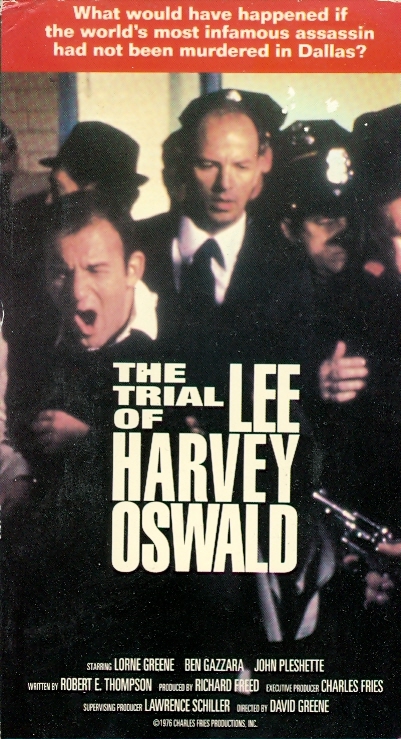
The Trial of Lee Harvey Oswald (1977, directed by David Greene and Gordon Davidson)


What if, instead of being shot by Jack Ruby, Lee Harvey Oswald had survived and been put on trial for the murder of President John F. Kennedy?

That’s the question asked by this television film.  John Pleshette plays Lee Harvey Oswald while Lorne Greene plays his attorney, Matt Weldon and Ben Gazzara plays the prosecutor, Kip Roberts.  The film imagines that the trial would have been moved to a small Texas town because Oswald presumably wouldn’t have been able to get a fair trial in Dallas.  While Roberts is forced to deal with his own doubts as to whether or not Oswald actually killed the President, Weldon is frustrated by Oswald’s paranoid and self-destructive behavior.  Oswald insists that he’s a patsy and that he was framed by “them” but he refuses to tell Weldon who they are.

With a running time of four hours, The Trial of Lee Harvey Oswald is a courtroom drama that tries to be fair to both sides and which ends with a frustrating cop-out.  While Weldon presents all of the evidence that real-life conspiracy theorists frequently cite in their attempts to prove Oswald’s innocence, Roberts makes the case that was presented in the Warren Commission.  Unfortunately, the film ends up trying too hard to avoid coming down on one side or the other and just proves that it’s impossible to be even-handed when it comes to conspiracy theories around the Kennedy assassination.  It’s either buy into the idea that it was all a huge conspiracy involving mobsters and intelligence agents or accept that it was just Oswald doing the shooting as a lone assassin.  Trying to come down in the middle, as this film does, just doesn’t work.

John Pleshette does a good job as Oswald and bears a passing resemblance to him.  Because the movie refuses to take a firm stand on whether or not Oswald’s guilty, the character is written as being a cipher who claims to be innocent but who, at the same time, also refuses to take part in his defense.  Pleshette plays up Oswald’s creepy arrogance, suggesting that Oswald was capable of trying to kill someone even if he didn’t actually assassinate JFK.  Both Greene and Gazzara are convincing as the two opposing attorneys, even if neither one of them really does much more than offer up a surface characterization.

The majority of the movie takes place in the courtroom, with a few flashbacks to Oswald’s past included to keep things from getting too stagnant.  When the film was made, people were still learning about the conspiracy theories surrounding the Kennedy assassination and The Trial of Lee Harvey Oswald might have had something new to tell them.  Seen today, the majority of the film’s evidence seems like old news.  The Trial of Lee Harvey Oswald never escapes the shadow of later films, like Oliver Stone’s JFK.

It’s hard not to regret that The Trial of Lee Harvey Oswald wasn’t willing to come definitively down on one side or the other.  Instead, it ends by telling us that we’re the jury and that the only verdict that matters is that one that we come up with.  They could have just told us that at the start of the movie and saved us all four hours.

Lisa Cleans Out Her DVR: The Silver Chalice (dir by Victor Saville)


If you ever needed proof that everyone has to start somewhere, look no further than the 1954 biblical epic, The Silver Chalice.

The Silver Chalice features the film debut of Paul Newman, who later proved himself to be a legitimately great actor.  It’s true that, unlike a lot of actors, Newman made his debut in a starring role.  He never had to humiliate himself with any one-line roles or walk-on bits.  No, Paul got to humiliate himself with a starring role.

Paul Newman was 29 years old when he played Basil, a former slave turned sculptor.  Not only did Newman bear a disconcerting resemblance to Ben Savage (of Boy Meets World fame) but he gave a performance that was so bad that it’s kind of a shock that he ever worked again.  Basil is a passionate artist, one who survived being betrayed by his adopted family and slavery.  Newman comes across like a nice, young man from Iowa.  Usually, Newman looks miserable but occasionally, he flashes a somewhat weak smile.  When Basil gets mad, Newman speaks in a squeaky voice.  When Basil is feeling reverent, Newman furrows his brow like a hungover Russell Brand staring straight into the sun.

“But me and Topanga are soul mates…”

Then again, I’m not sure that any actor could have given a good performance as Basil.  The Silver Chalice has a terrible script, one that was written by Lesser Samuels.  (I’ll avoid the obvious joke about whether or not The Silver Chalice would have been better if written by Greater Samuels.)  Apparently, before Newman was cast, the producers pursued James Dean for the role.  I’m sure we all would have enjoyed seeing Dean slouch his way through the film but I doubt that even he could have done much with The Silver Chalice.

The Silver Chalice is based on a novel, which perhaps explains why there’s so many characters and so many unnecessary subplots.  Basil follows a path that will be familiar to anyone who has seen a 1950s biblical epic.  He’s a young Greek who is adopted into a noble Roman family.  When his kindly stepfather dies, Basil’s stepsiblings sell him into slavery.  It’s not an easy life but Basil is a talented sculptor so Joseph of Arimathea commissions him to make a silver chalice for the Holy Grail.  Basil goes from poor to rich to poor again to rich again to ultimately saved by grace.  He even gets to do the same walking towards Heaven thing that Richard Burton did at the end of The Robe.

Meanwhile, Simon Magus (Jack Palance) is wowing the citizenry with his magic tricks and claiming to be the risen Messiah.  Simon’s assistant just happens to be Helena, who knew Basil when he was younger.  Young Helena is played by dark-haired Natalie Wood.  Grown-up Helena is played by blonde Virgina Mayo.  They were both good actresses but there’s seriously no way that Natalie Wood would have ever grown up to be Virginia Mayo.

Jack Palance pretty much steals the movie, mostly because he gets to wear the silliest costumes:

Poor Paul Newman has to settle for a tunic and a miniskirt, while Jack Palance gets to wear this:

Personally, I’ve always enjoyed the story of Simon Magus.  He tried to show off by flying over the Roman Forum so St. Peter said a prayer and Simon promptly plunged to his death.  Take that, you Gnostic!

Another interesting thing about The Silver Chalice is that the sets are very deliberately fake.  I don’t mean that they look cheap.  I mean, much as in the style of German Expressionism, the sets are specifically designed to remind you that you’re watching a movie.

For instance, look at the wall behind Palance:

Look at this pleasure palace:

Look at Rome at night:

The sets are extremely dream-like and yet everything else about the film is extremely slow and conventional.  One wonders if director Victor Saville was trying to make an art film, though there’s nothing else in his long filmography that would suggest that Saville was anything other than a workmanlike director.  In fact, most biblical epics of the time took a lot of pride in looking as expensive and “accurate” as possible.  Major studios in the 1950s were not known for artistic experimentation, especially when it came to Biblical epics.  It’s hard to know what to make of The Silver Chalice‘s artistic flourishes, which is why it’s easier to just focus on what a terrible performance Paul Newman gives.

That’s certainly what Paul did!  In 1966, when The Silver Chalice finally premiered on TV, Newman took out a newspaper ad in which he apologized for his performance and then asked people not watch.  Apparently, he also used to show the movie during parties on the condition that his guests mock the film while watching it.

I don’t really blame him.  It’s an amazingly dull film and Newman looks absolutely miserable in nearly every other scene.  However, because it did star Paul Newman, The Silver Chalice will always have a life on TCM.

Speaking of TCM, they last broadcast this film on February 24th as part of their 31 Days of Oscar.  (It was nominated for both its sets and its score.)  That is when I recorded it.  And, after watching it yesterday, I was more than happy to erase it.

Embracing The Melodrama #13: Peyton Place (dir by Mark Robson)


Poster - Peyton Place_04

“Just remember: men can see much better than they can think. Believe me, a low-cut neckline does more for a girl’s future than the entire Britannica encyclopedia.” — Betty (Terry Moore), speaking the truth in Peyton Place (1957)

Sex!  Sin!  Secrets!  Scandal!  It’s just another day in the life of Peyton Place, the most sordid little town this side of Kings Row!  It’s also the setting of the 1957 best picture nominee, Peyton Place.

Peyton Place is a seemingly idyllic little village in New England.  The town is divided by railroad tracks and how your fellow townspeople views you literally depends on which side of the tracks you live on.  As the film itself shows us, the right side of tracks features pretty houses and primly dressed starlets.  The wrong side of the tracks features shacks and a bunch of people who look like the ancestors of the cast of Winter’s Bone.  The difference in appearance is not particularly subtle (but then again, the same thing could be said for the entire film) but, regardless of which side of the tracks live on, chances are that you’re keeping a few secrets from the rest of the town.

On the right side of the tracks, you can find Constance McKenzie (played by Lana Turner, who is just about as convincing as a New England matron as you would expect a glamorous Hollywood star to be), a dress shop owner who is so prim and proper that she literally flies into a rage when she comes across her daughter kissing a boy.  Could it be the Constance’s repression is the result of her once having been a rich man’s mistress?  And will the new high school principal, the progressive and rather dull Mr. Rossi (Lee Phillips), still love her despite her sordid past?

Constance’s daughter is Allison (Diane Varsi) and poor Allison just can not understand why her mother is so overprotective.  Will Allison ever find true love with the painfully shy Norman Page (Russ Tamblyn) or will she be forced to settle for someone like the rich and irresponsible Rodney Harrington (Barry Coe)?

Rodney, for his part, is in love with Betty (Terry Moore), a girl from the wrong sides of the tracks.  Rodney’s father (Leon Ames) is the richest man in town and makes it clear that he will not allow his son to marry someone with a “reputation.”  Will Rodney get a chance to redeem himself by going off to fight in World War II?

And what will happen when Rodney and Betty go skinny dipping and are spotted by a local town gossip who promptly mistakes them for Norman and Allison?  Reputations are at stake here!

Meanwhile, over on the bad side of the tracks, Lucas Cross (Arthur Kennedy) sits in his shack and drinks and thinks about how the world has failed him.  His long-suffering wife (Betty Field) works as housekeeper for the McKenzie family.  Meanwhile, his abused daughter Selena (Hope Lange, giving the film’s best performance) is Allison’s best friend.  When Lucas’s attempt to rape Selena leads to a violent death, the sins and hypocrisy of Peyton Place are revealed to everyone.

Peyton Place is a big, long  movie, full of overdramatic characters, overheated dialogue, and over-the-top plotting and, for that reason, I absolutely love it!  Apparently, the film was quite controversial in its day and the scenes where Arthur Kennedy attacks Hope Lange still have the power to disturb.  However, the main reason why I enjoy Petyon Place is because anything that could happen in Peyton Place does happen in Peyton Place.

Seriously, how can you not love a film this sordid and melodramatic?

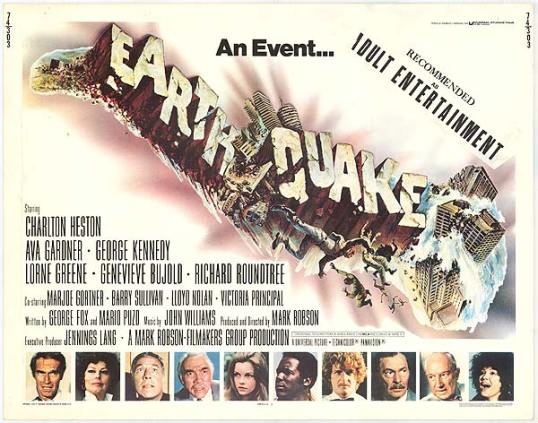
A Quickie With Lisa Marie: Earthquake (dir. by Mark Robson)


Since it’s impossible for me to talk about anything without somehow relating it to a movie, I guess it makes sense that my reaction to San Francisco winning the World Series was to write a review of the award-winning, 1974 disaster film Earthquake.  If the Rangers had won, I would have been obligated to write up a review of No Country For Old Men.

But anyway, Earthquake

So, Earthquake is one of those movies from the 70s in which a large group of different characters had to deal with some sort of cataclysmic disaster that could, in theory, have happened in reality as well as up on the movie screen.  There were apparently about 2,000,000 of these films made between 1970 and 1980 and they all had titles like Hurricane, Tornado, Big Fire, Asbestos, Flash Flood, Lava Flow, Khardashian, Avalanche, and, of course, Earthquake.  These movies always featured an “all-star” cast of people that nobody had ever actually heard of and I guess part of the fun was trying to guess who would survive and who would die.  Apparently, they were the 1970s version of Dancing With The Stars.  Call it Dying With Celebrities.

Earthquake is one of best known of these films.  Apparently, it made a lot of money in 1974 and it won Academy Awards for its earthquake effects.  Bleh.  Whatever.  Have you ever really sat down and looked at a list of the movies that have won at least one Academy Award since they first started handing those things out?  Earthquake is like a 6 hour movie and Los Angeles doesn’t start shaking until halfway through.  The Earthquake itself only lasts for 15 minutes and it’s kind of impressive to watch but it’s 15 minutes out of 360.

Before the earthquake hits, we get to meet the usual cross-section of humanity.  Charlton Heston is an architect who is married to Ava Gardner who is the daughter of Heston’s boss, who is played by an actor named Lorne Greene who appears to be younger than either Heston or Gardner.  Heston has a mistress who is played by Genevieve Bujold who is really pretty, sweet, and boring.  Gardner is none of these things but she is a foul-mouthed alcoholic who fakes suicide attempts so I was pretty much on her side as far as the whole love triangle is concerned.  After the Earthquake, Heston and Greene and a bunch of accident-prone extras are stuck in the ruins of sky scraper.  Heston grimaces a lot in this film but you know what?  Say what you will about Charlton Heston’s politics or his clenched-teeth acting style, the man knew how to wear an ascot.

While Heston is torn between Gardner and Bujold (a plot development that reportedly inspired the famous Sartre play No Exit), Richard Roundtree just wants to jump over stuff on his motorcycle.  That’s right — John Shaft is in this movie and we can dig it.  He’s a professional daredevil.  He’s also a surprisingly dull actor.  Who would have guessed that, without a theme song playing, Shaft would turn out to be so boring?  Still, there’s a really cool scene where Roundtree tries to ride his motorcycle through Los Angeles in the middle of the earthquake and the film is worth watching for his all-flare stunt daredevil costume if nothing else.  Plus, Roundtree’s playing a character named Miles here and I like that name.

There’s another subplot.  It involves George Kennedy as a blue-collar cop who does what he has to do to try to maintain the peace before and after the Earthquake.  Bleh.  I mean, Kennedy actually gives a pretty good performance and he’s probably the most likable character in the film but seriously — Bleh.

And finally, this collection of humanity is rounded out by an aspiring actress (played by actress Victoria Principal who, four years earlier, had made history by being the first woman to successfully seduce actor Anthony Perkins and no, I don’t want to go into how I know that) and the psychopathic grocery store manager who is obsessed with her.  The grocery store manager is played by former child evangelist and 70s exploitation icon Marjoe Gortner.  Much as in the later film Starcrash, Gortner projects a remarkably unlikable vibe that works well for his character.  He also has a really bad perm and a mustache and his performance is so sublimely bad that it’s actually pretty good.  As for Principal, her character here is apparently the owner of 1974’s most ginormous afro and, like most women in the 70s, really should have considered wearing a bra.  It’s hard to really judge Principal’s performance because any time she’s on-screen, you just start thinking, “Oh my God, she had sex with Norman Bates but somehow, she thinks she’s too good for Marjoe Gortner?” 

These are the characters that we follow as Los Angeles is destroyed on-screen.  None of them are really much more than cardboard cut outs but there’s something oddly comforting about how shallow and predictable they all are.  Add to that, most of them end up dead so if you do dislike them, you’ll find a lot to enjoy.  You’ll especially enjoy the film’s final few moments unless, like me, you can’t swim and you’re terrified of drowning.  If you’re like me, that scene might give you nightmares. 

Flawed as it may be, I still have to recommend this movie as 1) a time capsule and 2) as a quintessential piece of American camp.  Every line of dialogue, every performance, every image, and every scene in Earthquake simply screams 1974.   I guess the best way to look at Earthquake is to think about it as if the movie’s a time machine.  You might not like where the machine takes you but you’re still going to get into the damn thing and, once you find yourself stuck in Iowa in the year 1835, you’ll find someway to force yourself to be entertained because otherwise, you’re just hanging out in Iowa in 1835.